Directions

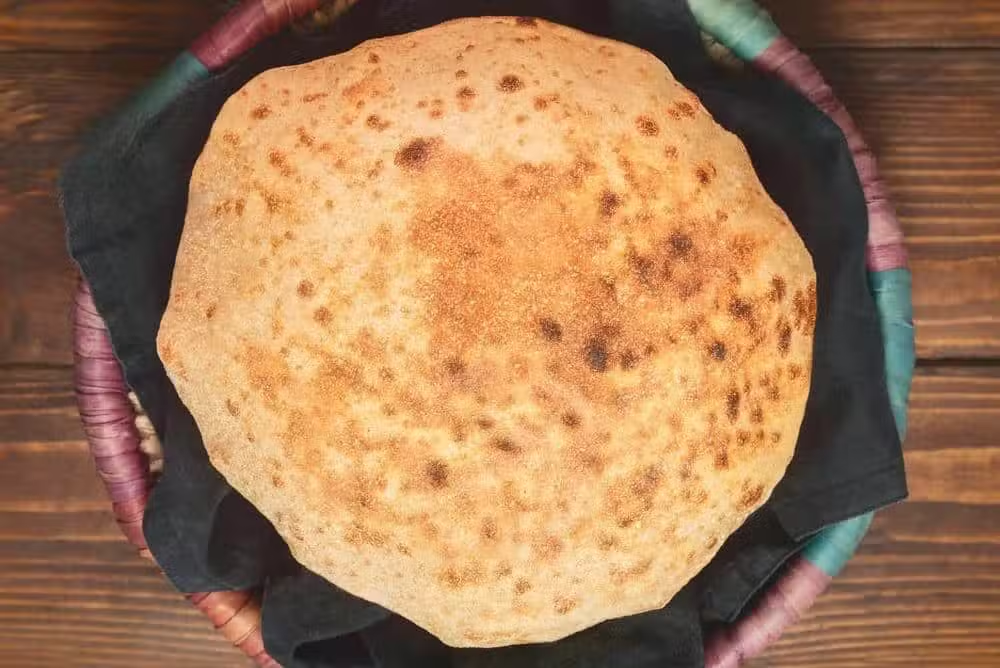
Today, we delve into the heart of Egypt to discover a bread recipe that exudes an ancient and enveloping charm: aish baladi. Imagine a slightly puffy focaccia with a rustic flavor, ideal to be stuffed with succulent meat or stringy cheese and then baked until it reaches perfection.
In Egypt and some other Arab countries, the expression “baladi” or “biladi”, which literally means “of our country”, is used to indicate products, fruits, and vegetables, as well as dishes that reflect the peculiar culinary identity of these lands. The birth of this linguistic practice is lost in the maze of history, but we can hypothesize that it was born between the end of the 19th century and the beginning of the 20th century, in a period marked by the decline of the Ottoman Empire and the emergence of national independence.
This phenomenon has had a particularly significant impact in countries such as Greece, Lebanon, and, of course, Egypt. Returning to our bread of the day, aish baladi, although it may recall other types of regional breads, such as pita, is distinguished by being prepared exclusively with wholemeal flour. A further touch of authenticity is given by the bulgur, sprinkled on top before baking, which gives a unique texture to the bread. Its importance in Egyptian culture is undeniable; the name itself, “aish”, simply means “life” in Arabic, a clear indication of how fundamental this food is in the daily diet of the Egyptian people.
The importance of bread in Egypt dates back to over 7000 years ago, when the first loaves were produced, probably similar to the ones we are presenting to you today. At the time, flour was mainly obtained from barley, an ancient plant that has been cultivated for over 7500 years and is very similar to durum wheat. The latter, in fact, was obtained by man through the hybridization of spelt and other wild grains.
Now that we have explored the history of this incredible bread, the time has come to flour your hands and immerse yourself in its preparation. With aish baladi, we are not just bringing bread to the table but a piece of millenary history; make good use of it.
Preparation time
30 minutes
Cooking time
8 minutes
Leavening-rest
2 hours
Ingredients to make 16 loaves
- 750 g of wholemeal flour
- 1 tablespoon of brewer’s yeast
- 70 cl of warm water
- 13 grams of salt
- 20 grams of oil
- Bulgur, optional
Preparation
- Dissolve the yeast in 25 cl of tepid water and leave to rest for 10 minutes, the time for the yeast to activate.
- Add 350 g of flour, the rest of the water and mix well. Cover and leave to rest for 30 minutes in a warm place.
- Incorporate the salt, the oil then add the flour a little at a time in order to obtain a ball of homogeneous dough.
- Knead for 10 minutes at minimum speed. Form a ball with the dough and place it in a previously oiled bowl.
- Cover and leave to rest in a warm place for 1 hour and 30 minutes.
- Place a tray in the oven and preheat to 260°C.
- Mash the dough, give it a quick knead and divide it into 16 equal sized balls and roll them in the bulgur. Roll out each ball of dough to form a circle 12-15cm in diameter. Place the loaves on a sheet of baking paper, cover and let rise for 30 minutes.
- Bake the loaves for 8 minutes, or until puffed and lightly browned.
How to use the Aish baladi?
Hawawashi: This is a classic Egyptian street dish that involves stuffing aish baladi with a mix of ground meat (usually beef or lamb), onions, peppers, and spices, then grilling it. It is a real culinary masterpiece!
Cured Meat Appetizers: Aish baladi can be used as a base for an assortment of cold cuts. Try filling it with raw ham, mortadella, salami, accompanied by a drizzle of extra virgin olive oil and perhaps a pinch of fresh rocket for a contrast of flavours.
Falafel Sandwich: Another mouthwatering way to use aish baladi is to stuff it with falafel, fresh lettuce, tomatoes, and tahini dressing. A quick and tasty lunch that will take you straight to the bustling street markets of Cairo.
Pizza bread: You could also use aish baladi as a base for a “rustic” pizza. Drizzle on some tomato sauce, add mozzarella, basil and any other toppings you like, then bake until the cheese is melted and golden brown.
Egyptian Bruschetta: Finally, why not try an Egyptian style bruschetta? Lightly toast the bread, rub it with a clove of garlic, then add chopped fresh tomatoes, cucumbers, parsley, lemon juice, olive oil and a sprinkling of salt and pepper.