
Karnak Temple Guide: History, Hypostyle Hall and What to See

Karnak is not a temple in the ordinary sense. It is a sacred city built in stone, enlarged, dismantled, rebuilt and reinterpreted by generations of Egyptian rulers across more than a thousand years. Within its immense enclosure stand pylons, sanctuaries, obelisks, chapels, processional courts, a sacred lake and the most famous forest of columns in ancient Egypt. Beyond the main Temple of Amun-Ra lie separate precincts dedicated to Mut and Montu, smaller temples devoted to Khonsu and Opet, and the remains of monuments belonging to rulers from the Middle Kingdom through the Ptolemaic and Roman periods.
For much of Egyptian history, Karnak was the principal religious centre of Thebes, the city modern visitors know as Luxor. Its rise followed the growing importance of the Theban god Amun, who eventually became Amun-Ra and one of the most powerful deities in Egypt. As Thebes became the centre of a New Kingdom empire stretching from Nubia towards the Near East, Karnak accumulated wealth on an almost unimaginable scale. Kings returning from military campaigns dedicated land, precious metals, statues and monumental architecture to Amun, while the temple institution itself controlled estates, workshops and thousands of people.
Almost every major ruler of the New Kingdom, approximately 1550–1069 BC, left some trace here. Hatshepsut raised enormous obelisks. Thutmose III built his Festival Hall and recorded exotic plants from foreign campaigns. Amenhotep III created monumental gateways. Seti I and Ramesses II covered the Great Hypostyle Hall with reliefs. Horemheb added pylons. Ramesses III inserted his own temple into the forecourt. Later Kushite, Saite, Ptolemaic and Macedonian rulers continued the process.
That history makes Karnak fundamentally different from Luxor Temple. Luxor is comparatively coherent and strongly associated with the Opet Festival and renewal of kingship. Karnak is accumulation itself: centuries of rulers competing with the past by extending a sacred complex that was already ancient when they inherited it.
Allow at least three hours. Four are better if you want to understand the secondary monuments and Open-Air Museum rather than simply cross the Hypostyle Hall and leave.
What to See at Karnak
- The processional approach and ram-headed sphinxes
- The First Pylon
- The Great Court
- The barque shrine of Seti II
- The surviving column of Taharqa’s kiosk
- The Temple of Ramesses III
- The Second Pylon
- The Great Hypostyle Hall
- Reliefs of Seti I and Ramesses II
- The Third and Fourth Pylons
- The obelisk of Thutmose I
- The obelisk of Hatshepsut
- The granite sanctuary of Philip Arrhidaeus
- The remains of the Middle Kingdom sanctuary
- The Festival Hall of Thutmose III, the Akh-menu
- The Botanical Garden of Thutmose III
- The Sacred Lake
- The giant scarab of Amenhotep III
- The north–south processional axis
- The Seventh to Tenth Pylons
- The Karnak Cachette area
- The Open-Air Museum
- The Red Chapel of Hatshepsut
- The White Chapel of Senusret I
- The Temple of Khonsu
- The Temple of Opet
- The Precinct of Mut
- The relationship with Luxor Temple and the Avenue of Sphinxes
Karnak or Luxor Temple?
The two complexes are separate monuments roughly 2.7 kilometres apart, but ancient ritual deliberately connected them.
Karnak was the principal sanctuary of Amun-Ra, the great god of Thebes. Luxor Temple, farther south, was associated with another form of Amun and with the renewal of divine and royal power.
During the Opet Festival, sacred images of Amun, Mut and Khonsu travelled from Karnak towards Luxor Temple in ceremonial barques. At different periods parts of the journey were made along the Nile or through the processional avenue later monumentalised with rows of sphinxes.
The avenue belongs to the connection between them.
Karnak is the northern end.
Luxor Temple is the southern end.
Ancient Thebes and the Rise of Amun
Karnak’s history cannot be separated from the rise of Thebes.
The city became politically important during the Middle Kingdom and reached its greatest influence during the New Kingdom, when Theban rulers expelled the Hyksos and established an empire extending far beyond the Nile Valley.
The local god Amun rose with them.
Originally a regional deity, Amun was increasingly combined with the solar god Ra as Amun-Ra, eventually becoming one of the dominant gods of the Egyptian state.
His priesthood grew correspondingly powerful.
Military victories and imperial expansion produced wealth, and kings repeatedly redirected portions of that wealth towards Karnak.
Religion and empire reinforced one another.
The Earliest Karnak
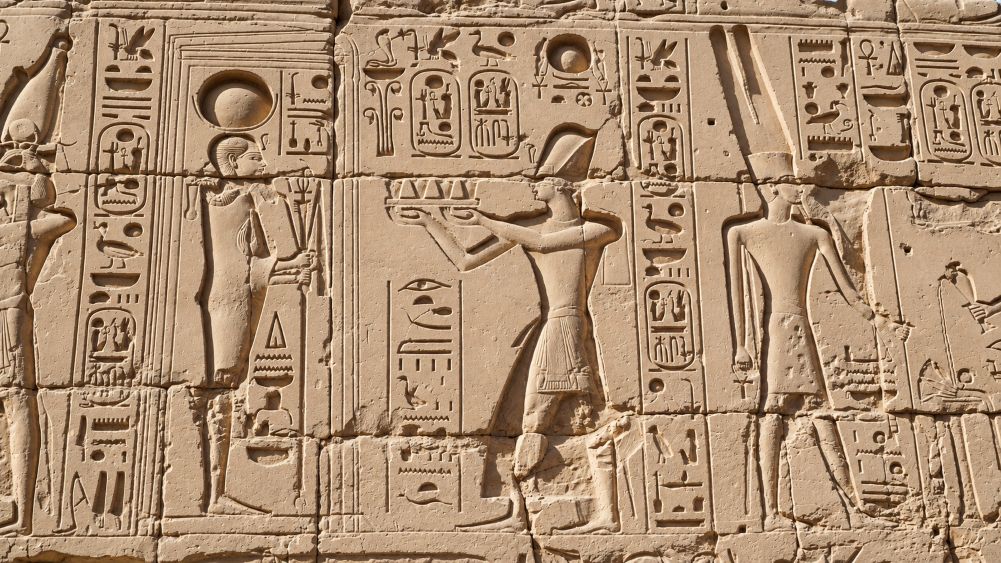
Archaeological evidence at Karnak reaches back to at least the Eleventh Dynasty, around the early second millennium BC.
One of the earliest major royal builders was Senusret I of the Twelfth Dynasty, who created a temple in the sacred core more than five centuries before Ramesses II.
Very little of that first monumental sanctuary survives in its original position because later pharaohs repeatedly rebuilt the centre of Karnak.
Yet reconstructed monuments such as Senusret I’s White Chapel preserve exceptional evidence of Middle Kingdom architecture and relief carving.
The temple visitors see today is therefore not a New Kingdom foundation.
The New Kingdom transformed something already sacred.
A Temple That Never Stopped Growing
Ancient Egyptian temples were not treated as finished historical monuments.
A new king inherited an active sacred institution and could enlarge it as an act of devotion and political legitimacy.
At Karnak, rulers added pylons in front of earlier pylons, dismantled older shrines to reuse their blocks, erected new obelisks beside existing ones and sometimes removed or recarved the names of predecessors.
The result is architectural archaeology in three dimensions.
A wall may contain stone taken from an older monument.
A later gateway can conceal an earlier processional route.
An inscription may preserve one ruler’s image but another ruler’s name.
Karnak constantly rewards visitors who stop thinking of it as one building.
The Precincts of Karnak
The archaeological complex contains several major sacred precincts.
The largest is the Precinct of Amun-Ra, which contains most of the famous monuments encountered on the standard visit.
To the south lies the Precinct of Mut, dedicated to Amun’s consort.
To the north stands the Precinct of Montu, associated with the falcon-headed Theban god of war.
A separate eastern area once contained a major temple built by Akhenaten for the Aten, later deliberately dismantled after the restoration of Amun’s cult.
The standard tourist route concentrates heavily on the Amun precinct, but Karnak historically functioned as a network of temples rather than one sanctuary.
The Theban Triad
The central divine family of Thebes consisted of Amun, Mut and Khonsu.
Amun was the principal male deity and eventually one of Egypt’s supreme state gods.
Mut functioned as his divine consort.
Their son Khonsu had strong lunar associations and eventually acquired a substantial temple of his own inside the Karnak enclosure.
The three deities travelled together during important festivals, particularly Opet.
Understanding this triad explains why the complex contains separate sacred spaces that nevertheless belong to one religious system.
Approaching Karnak
The modern approach leads across a vast open plaza towards the First Pylon.
Before reaching it, visitors encounter rows of ram-headed sphinxes, sometimes called criosphinxes.
The ram was particularly associated with Amun.
Small figures of the pharaoh appear protected beneath the animals’ heads or chests, visually expressing the ruler’s relationship with the god.
These should not be confused with all the sphinxes along the restored route towards Luxor Temple.
Different sections of the ceremonial network used different forms, including human-headed sphinxes.
The Ancient Quay
Karnak originally communicated closely with the Nile through canals and ceremonial landing areas.
Sacred barques arriving by water could approach the temple through a quay before moving towards the sanctuary.
The river was essential not only for transport but for ritual geography.
Ancient Egyptian religious architecture rarely functioned as an isolated stone object.
Temples interacted with canals, harbours, agricultural land, processional roads and other sanctuaries.
The large modern forecourt between Karnak and the Nile obscures some of that ancient relationship, but the orientation survives.
The First Pylon
The enormous First Pylon forms the present monumental entrance to the Amun precinct.
It is surprisingly late in Karnak’s history and was probably begun during the Thirtieth Dynasty, particularly under Nectanebo I, in the fourth century BC.
The structure was never fully completed.
Its rough upper masonry and unfinished state are therefore not simply consequences of later destruction.
Parts were never finished in antiquity.
This creates an important inversion: the first architecture encountered by visitors is among the latest major monumental additions to the main axis.
Karnak becomes older as you walk inward.
Mud-Brick Construction Ramp
Evidence associated with the construction process survives near the First Pylon, including traces interpreted as part of a mud-brick ramp used to move stone during building work.
Such remains are valuable because ancient Egyptian monuments often conceal the practical methods used to construct them.
The finished pylon advertises divine and royal permanence.
The construction ramp reveals labour, logistics and engineering.
Thousands of tonnes of stone had to be quarried, transported, raised and positioned before theology could become architecture.
The Great Court
Beyond the First Pylon lies the Great Court, one of Karnak’s largest open spaces.
Unlike many parts of the complex, the court contains monuments belonging to several different periods and rulers rather than one unified architectural programme.
This makes it an excellent introduction to Karnak’s historical layering.
On one side stands the triple barque shrine of Seti II.
Farther inside rises a single surviving giant column from the kiosk of Taharqa.
The Temple of Ramesses III projects into the southern side.
The court looks spacious today, but in antiquity it was architecturally more crowded and ceremonially far more active.
The Barque Shrine of Seti II
Near the Great Court entrance stands a triple shrine built by Seti II, a Nineteenth Dynasty ruler.
Its three chambers were associated with the sacred barques of Amun, Mut and Khonsu.
Portable divine images travelled inside barque-shaped shrines during festivals.
When processions paused, purpose-built chapels gave the sacred vessels somewhere to rest.
These buildings therefore acted almost like divine stations along ceremonial routes.
The shrine is modest beside the Hypostyle Hall but extremely useful for understanding how the temple actually functioned.
The gods moved.
Architecture accommodated that movement.
Taharqa’s Kiosk
A single enormous column dominates another part of the Great Court.
It is the principal surviving vertical element of a kiosk associated with Taharqa, the Kushite ruler of Egypt during the Twenty-fifth Dynasty in the seventh century BC.
Originally the structure consisted of multiple monumental columns.
Taharqa’s presence at Karnak is important because Egyptian kingship was not confined to rulers originating in the Nile Delta or Upper Egypt.
For a period, kings from Nubia controlled Egypt and presented themselves as legitimate pharaohs, strongly supporting traditional Egyptian religion.
Building at Karnak was one way to demonstrate that legitimacy.
The Temple of Ramesses III
Ramesses III inserted a substantial temple into the Great Court centuries after the main axis had already developed.
The building has its own pylon, courtyard, columns and inner chambers, creating something almost like a smaller temple nested inside a larger one.
Osiride statues of Ramesses III appear in the courtyard, presenting the king in a mummiform divine guise associated with Osiris.
The structure was particularly connected with processional worship.
Its presence demonstrates how later kings could claim space within an already crowded sacred environment.
At Karnak, expansion did not always mean building farther outward.
Sometimes it meant inserting something new into existing ceremonial territory.
The Second Pylon
The Second Pylon leads from the Great Court into the Great Hypostyle Hall.
Its history is complicated, with construction and restoration involving rulers including Horemheb and the early Ramesside kings.
Like many pylons at Karnak, it incorporated blocks reused from earlier monuments.
Such reused stones are known as talatat when referring specifically to the smaller standardized blocks associated especially with Akhenaten’s buildings.
After Akhenaten’s religious revolution collapsed, his monuments were dismantled and their blocks frequently disappeared inside later constructions.
The destruction of one religious programme physically helped construct another.
The Great Hypostyle Hall
Nothing at Karnak prepares you fully for the Great Hypostyle Hall.
Its roof was once supported by 134 enormous sandstone columns arranged across an area of roughly 5,000 square metres.
Most columns rise to around 15 metres.
The twelve columns of the central nave reach approximately 20–21 metres and are considerably thicker.
Today the missing roof allows sunlight to pour between them.
In antiquity, much of the hall would have been darker, with light entering mainly through elevated clerestory windows along the central nave.
The experience would have been less like walking through ruins beneath open sky and more like entering a monumental artificial forest.
Why the Hypostyle Hall Feels Like Vegetation
Egyptian columns frequently imitate plant forms.
At Karnak, column shafts and capitals evoke giant papyrus plants.
The taller central columns have open papyrus capitals, while many lower columns use closed-bud forms.
This was not arbitrary decoration.
Egyptian temples were conceived as models of the ordered cosmos.
The temple floor could evoke the fertile earth or primordial marsh.
Columns became vegetation.
The ceiling represented the sky.
The sanctuary recreated the first emergence of divine order from primordial creation.
The Hypostyle Hall therefore turns landscape mythology into architecture.
Who Built the Great Hypostyle Hall?
The architectural history is more nuanced than the common claim that Ramesses II simply “built” the hall.
Its development may have begun in some form under Amenhotep III, while the principal construction and decorative programme belong to the Nineteenth Dynasty.
Seti I created much of the hall and commissioned particularly refined raised relief on the northern side.
His son Ramesses II completed substantial portions and added extensive decoration, frequently using faster sunk relief techniques better suited to enormous surfaces exposed to sunlight.
The difference between the two carving techniques is visible.
Look closely.
The history is written not only through names but through chisels.
Raised Relief and Sunk Relief
In raised relief, the background is cut away so that figures and hieroglyphs project slightly from the stone surface.
The technique produces subtle modelling but requires considerable labour.
In sunk relief, outlines and details are cut directly into the surface.
Strong Egyptian sunlight creates sharp shadows inside the incisions, making images highly legible outdoors.
Seti I’s more refined raised relief and Ramesses II’s extensive sunk relief coexist within the Hypostyle Hall.
Comparing them provides a rare opportunity to understand ancient Egyptian carving technique at monumental scale.
Colour in the Hypostyle Hall
The columns were originally vividly painted.
Traces of blue, red, yellow and green pigment survive in protected sections, particularly high on capitals and beneath architectural elements less exposed to weather.
These fragments completely change the mental reconstruction of the hall.
Ancient Karnak was not a uniform expanse of honey-coloured sandstone.
Hieroglyphs, gods, royal figures, astronomical imagery and architectural surfaces carried strong colour.
Imagine that colour under a roof in comparatively low light.
The original hall would have felt far more intense than the open archaeological space visible today.
The Clerestory Windows
The elevated central nave rose above the surrounding columns.
Stone clerestory windows filled the vertical difference between roof levels, allowing filtered daylight into the hall.
The principle will feel familiar to anyone who knows later basilicas or Gothic cathedrals, although there is no direct architectural relationship implied.
The engineering solution is simply similar: raise the central space and admit light through openings above the lower roofs.
At Karnak, these windows created a controlled transition from bright courts towards darker sacred interiors.
Reliefs of War and Ritual
The exterior walls surrounding the Hypostyle Hall preserve major historical reliefs.
Seti I and Ramesses II are shown campaigning in Syria-Palest and interacting with foreign enemies, while other scenes depict religious ritual.
As always with Egyptian royal imagery, these are not neutral historical reports.
Military reliefs turn political events into permanent claims of royal victory.
Enemies are defeated.
The king dominates.
Egyptian order triumphs over foreign chaos.
Temple walls therefore served both gods and propaganda.
Seti I’s Battle Reliefs
The northern outer wall contains particularly important campaigns associated with Seti I.
Scenes represent the king confronting groups from the Levant and other regions.
Chariots, fortified settlements and bound enemies provide information about Egyptian military ideology and foreign relations.
Their value lies in details as much as heroic royal imagery.
Clothing, weapons and place names can preserve information about neighbouring societies.
Egyptian temples therefore became archives almost accidentally.
Their ideological images now supply evidence far beyond the message their creators intended.
Ramesses II and Kadesh
Ramesses II’s military identity also appears within Karnak.
His confrontation with the Hittites at the Battle of Kadesh around 1274 BC became one of the most heavily promoted military episodes of his reign.
Egyptian royal texts frame the encounter as a spectacular display of the king’s personal courage.
Historical reconstruction is more cautious.
The battle produced no decisive destruction of Hittite power, and the long rivalry eventually resulted in a diplomatic settlement.
The contrast between political reality and monumental representation is useful.
Ancient propaganda survives because it was carved in stone.
The Third Pylon
Beyond the Hypostyle Hall stands the Third Pylon, associated principally with Amenhotep III.
Its construction had an unexpected archaeological consequence.
Earlier sacred buildings were dismantled and their stones reused inside the massive pylon.
When modern archaeologists investigated the structure, they recovered thousands of blocks belonging to older monuments.
Some have been reconstructed elsewhere within Karnak.
A pylon intended to replace older architecture therefore became the accidental archive that preserved it.
The Open-Air Museum
Many reconstructed monuments created from reused blocks can be seen in Karnak’s Open-Air Museum.
The area is essential for anyone interested in architecture rather than simply monumental scale.
Among its highlights are the White Chapel of Senusret I and the Red Chapel of Hatshepsut, structures representing very different moments in Egyptian history.
Current standard foreign admission to Karnak includes access to the Open-Air Museum.
Do not skip it because the buildings are smaller than the Hypostyle Hall.
Their reliefs and historical importance are exceptional.
The White Chapel of Senusret I
The White Chapel dates to the reign of Senusret I in the Twelfth Dynasty, centuries before most of Karnak’s famous structures.
Built from pale limestone, it is one of the finest surviving examples of Middle Kingdom relief carving.
Its walls preserve lists and geographical information associated with Egyptian administrative regions, making the monument valuable historically as well as artistically.
The chapel was later dismantled, and its blocks were reused within subsequent construction.
Modern reconstruction recovered its original form.
This means visitors can stand inside a Middle Kingdom building that survived partly because later builders buried it inside another monument.
The Red Chapel of Hatshepsut
The Red Chapel, or Chapelle Rouge, belonged to Hatshepsut.
Built largely from red quartzite with contrasting dark stone elements, it functioned as a barque shrine for Amun.
Its reliefs include valuable scenes connected with religious festivals and the movement of sacred processions.
Thutmose III eventually dismantled the chapel, and its blocks were later reused.
Modern reconstruction assembled surviving material into one of the Open-Air Museum’s most important monuments.
The building also reveals Hatshepsut’s sophisticated use of materials.
Colour was built into the architecture before paint was even applied.
Hatshepsut at Karnak
Hatshepsut’s relationship with Karnak was central to her kingship.
As a woman occupying the traditionally male office of pharaoh, she invested heavily in architecture and religious ideology linking herself with Amun.
She built chapels, modified sacred areas and erected enormous obelisks.
Her monuments did not merely express personal devotion.
They argued that Amun supported her right to rule.
After her death, parts of her image and titulary were attacked during the reign of Thutmose III.
Yet Karnak preserves enough of her programme to demonstrate how ambitious it was.
The Obelisk of Thutmose I
Beyond the Third Pylon, the temple becomes increasingly associated with rulers of the Eighteenth Dynasty.
One major surviving obelisk belongs to Thutmose I, Hatshepsut’s father.
Obelisks were carved from single blocks of granite, usually quarried at Aswan and transported hundreds of kilometres down the Nile.
Their pointed summit, the pyramidion, carried solar significance and may originally have been covered in gleaming metal such as electrum.
Even standing still, an obelisk implied sunlight.
Its form transformed stone into a frozen solar ray.
Hatshepsut’s Obelisk
Nearby rises the most spectacular surviving obelisk at Karnak, erected by Hatshepsut.
It stands almost 30 metres high and weighs more than 300 tonnes.
Its granite came from Aswan.
The logistical achievement is astonishing: quarrying a single stone of that scale, shaping it without breaking it, transporting it along the Nile and raising it vertically required extraordinary control of labour and engineering.
Hatshepsut’s inscriptions celebrate the monument and its dedication to Amun.
The obelisk was originally one of a pair.
Fragments of another monumental obelisk associated with her remain elsewhere within the complex.
Why Obelisks Were So Important
The Egyptian obelisk developed from solar symbolism associated with the benben, the primordial mound connected with creation and the sun god.
Its pyramid-shaped summit caught the light and may have been sheathed in reflective metal.
Obelisks usually carried inscriptions naming the king and dedicating the monument to a deity.
They were therefore simultaneously religious symbols and royal signatures.
At Karnak, the competition to raise larger and more impressive obelisks turned the skyline itself into a statement of kingship.
The Unfinished Obelisk at Aswan
The famous Unfinished Obelisk at Aswan is commonly associated with Hatshepsut’s building programme and may have been intended for Karnak.
It was abandoned after serious fissures developed in the granite.
Had it been completed, it would have measured around 42 metres and weighed well over a thousand tonnes.
The unfinished monument is particularly useful after visiting Karnak because it reveals the first stage of a process that the standing obelisks conceal.
At Aswan, you see quarrying.
At Karnak, you see the seemingly impossible finished result.
The Fourth, Fifth and Sixth Pylons
Moving farther east means approaching some of the oldest monumental zones of the surviving New Kingdom temple.
The Fourth and Fifth Pylons are closely associated with Thutmose I and later modifications by Hatshepsut and Thutmose III.
The Sixth Pylon belongs substantially to Thutmose III.
These spaces became progressively more restricted.
The enormous open architecture near the front of Karnak gradually contracts into smaller courts and sanctuaries.
This is not accidental.
Sacred access increased as physical space decreased.
The closer one came to Amun’s divine presence, the fewer people could enter.
The Granite Barque Sanctuary
At the sacred centre stands a granite shrine associated with Philip Arrhidaeus, the half-brother and successor of Alexander the Great.
He ruled nominally during the late fourth century BC after Alexander’s death.
The presence of a Macedonian ruler’s name inside the heart of Karnak demonstrates how successfully Egyptian kingship absorbed foreign dynasties.
A ruler could be Macedonian in origin and still appear on temple walls performing the duties of a pharaoh before Amun.
The sanctuary replaced earlier sacred structures but continued the ancient function of housing the divine barque.
Political dynasties changed.
Temple ritual adapted and survived.
The Middle Kingdom Court
Beyond the later granite sanctuary lie remains associated with Karnak’s earlier sacred core.
The architecture here can appear visually disappointing after the Hypostyle Hall because less monumental material survives.
Historically, however, this is one of the most important areas.
The great New Kingdom temple expanded around a sacred centre whose origins stretched back into the Middle Kingdom.
The relative emptiness is therefore deceptive.
You are approaching the point from which centuries of architectural growth radiated outward.
Thutmose III and the Akh-menu
At the eastern end of the main complex stands the Akh-menu, generally known as the Festival Hall of Thutmose III.
Thutmose III was one of Egypt’s most successful military rulers and oversaw campaigns that extended Egyptian power deep into the Near East.
The Akh-menu was connected with royal cult, divine worship and ceremonial renewal.
Its architecture differs noticeably from some earlier Egyptian halls, with columns in certain spaces taking forms sometimes compared with tent poles.
The unusual design may deliberately evoke temporary ceremonial structures transformed into permanent stone architecture.
The Festival Hall
The word “festival” can make the Akh-menu sound like a public entertainment venue.
It was nothing of the sort.
Egyptian royal festivals, particularly renewal ceremonies such as the Sed Festival, had profound religious and political significance.
They rejuvenated royal power symbolically and reaffirmed cosmic order.
Thutmose III’s hall linked the king’s identity with gods and royal predecessors.
Architecture became a mechanism for maintaining kingship beyond the immediate political present.
The Botanical Garden of Thutmose III
One chamber within the Akh-menu contains extraordinary reliefs traditionally known as the Botanical Garden.
Plants, birds and animals appear with unusual attention to individual forms.
The images are associated with species encountered or symbolically collected during Thutmose III’s campaigns in Syria and surrounding regions.
They should not be interpreted as a scientific botanical catalogue in the modern sense.
Their political message is equally important.
Foreign nature itself has been gathered into the king’s sacred monument.
Empire becomes flora and fauna carved on temple walls.
Thutmose III: Warrior and Builder
Thutmose III ruled Egypt for decades, initially alongside Hatshepsut and later independently.
His military campaigns established Egyptian influence throughout much of the eastern Mediterranean region and Nubia.
At Karnak, victories translated directly into religious patronage.
Temple inscriptions famously record campaigns, tribute and foreign territories.
This relationship was fundamental to New Kingdom imperial ideology.
Amun granted victory.
The pharaoh conquered.
Foreign wealth returned to Amun’s temple.
The cycle strengthened both king and priesthood.
Akhenaten at Karnak
One of Karnak’s most dramatic historical episodes is largely invisible because the relevant architecture was deliberately destroyed.
Before moving his capital to Akhetaten, modern Amarna, Amenhotep IV—later Akhenaten—constructed major monuments dedicated to the Aten at Karnak’s eastern side.
Their architectural language differed sharply from traditional Amun temples.
The buildings used relatively small standardized sandstone blocks now known as talatat, making construction faster.
After Akhenaten’s death and the restoration of Amun’s cult, his temples were systematically dismantled.
Thousands of talatat were reused as filling material inside later monuments.
Karnak therefore preserves Akhenaten partly through the buildings intended to erase him.
The Aten and Amun
Akhenaten’s religious reforms represented a direct challenge to the traditional cult of Amun.
He elevated the Aten, represented through the visible solar disk and its rays, and suppressed or reduced the institutional power of older cults.
The royal court moved away from Thebes.
Amun’s name was attacked in inscriptions.
After Akhenaten’s death, the policy was reversed.
Tutankhamun restored traditional cults, and Horemheb later presented himself as a restorer of order.
Karnak’s rebuilding became part of that political recovery.
Stone could participate in religious conflict.
The Sacred Lake
South of the principal temple axis lies the large Sacred Lake.
The water served ritual rather than recreational purposes.
Priests used it in connection with purification, and the lake formed part of the daily religious infrastructure of the temple.
Its broad rectangular surface also brings an extraordinary visual pause after hours of columns and pylons.
From the bank, Hatshepsut’s obelisk and surrounding temple structures reflect across the water.
This is one of the few places within Karnak where the scale of the sacred precinct becomes easier to appreciate from a distance.
Priestly Purification
Egyptian temple ritual required repeated purification.
Priests shaved body hair, washed, wore clean linen and observed rules intended to maintain ritual purity before entering restricted sacred spaces.
Water from the sacred lake formed part of that system.
This helps correct a common misunderstanding about ancient temples.
They were not simply places where ordinary people walked inside to pray.
Much of the inner temple was operated by highly organised priesthoods performing complex daily rituals largely away from public view.
The Giant Scarab
Near the Sacred Lake stands a monumental stone scarab associated with Amenhotep III.
The scarab represents Khepri, the form of the solar god associated with the rising sun and daily regeneration.
Ancient Egyptians observed scarab beetles rolling balls across the ground and connected the behaviour symbolically with the sun moving across the sky.
Khepri therefore embodied becoming, renewal and rebirth.
The sculpture’s position today makes it one of Karnak’s most photographed secondary monuments.
Walking Around the Scarab Seven Times
Modern tourist folklore claims that walking around the scarab a certain number of times—often seven—will bring love, fertility, marriage or good fortune.
There is no good evidence that ancient Egyptians practised such a ritual at the monument.
It is a modern tradition attached to an ancient object.
The scarab’s authentic symbolism is already interesting enough: it represents solar regeneration and cyclical renewal.
No invented fertility ritual is required.
The North–South Axis
Karnak’s principal Temple of Amun develops mainly along an east–west solar axis, but the complex also possesses an important north–south axis.
This route turned towards Luxor Temple.
It became particularly significant for festivals in which the Theban triad moved between sanctuaries.
A sequence of additional pylons was constructed along this axis.
This is another reason Karnak cannot be understood as a single straight temple.
It is a crossroads of ritual movement.
The Seventh Pylon
The Seventh Pylon is associated principally with Thutmose III.
Nearby stood royal statues and important inscriptions celebrating Egyptian victories and foreign captives.
The imagery connects religious architecture directly with imperial power.
Enemies carved onto temple surfaces were symbolically placed beneath the authority of king and god.
The location later became archaeologically famous for another reason.
A huge deposit of statues and ritual objects was discovered nearby.
The Karnak Cachette
Between 1903 and 1907, excavations led by Georges Legrain uncovered one of the greatest deposits of Egyptian statuary ever found.
The so-called Karnak Cachette contained hundreds of stone statues and thousands of other objects, including bronzes.
Many represented priests, officials, kings and deities spanning long periods of Egyptian history.
The material appears to have been deliberately buried in antiquity when the temple became crowded with accumulated sacred objects.
Rather than destroying consecrated material, temple authorities could deposit it respectfully within sacred ground.
The discovery transformed understanding of Egyptian sculpture and priestly society.
Many objects from the cache are now dispersed through Egyptian museum collections.
The Eighth, Ninth and Tenth Pylons
Farther south, additional pylons record further phases of New Kingdom expansion.
The Eighth Pylon is closely associated with Hatshepsut.
Later kings modified its decoration.
The Ninth and Tenth Pylons are strongly associated with Horemheb, who used large quantities of stone from dismantled Aten temples as construction fill.
This produces one of Karnak’s greatest historical ironies.
Akhenaten’s religious architecture disappeared visually.
Yet the blocks survived physically inside monuments celebrating the restored cult of Amun.
Destruction preserved what it tried to erase.
The Temple of Khonsu
In the southwestern part of the Amun enclosure stands the Temple of Khonsu, one of the best places to understand the standard layout of an Egyptian temple on a manageable scale.
Construction began substantially under Ramesses III on the site of an earlier sanctuary and continued under later rulers.
The building includes a pylon, courtyard, hypostyle hall and inner sacred chambers.
Khonsu was the lunar member of the Theban triad.
His name has associations with movement or travelling, fitting well with the moon’s passage across the night sky.
Because the temple is smaller and more coherent than Karnak’s main axis, its architectural sequence is exceptionally easy to read.
Khonsu as Lunar God
Khonsu is frequently represented as a youthful deity with a side-lock of hair, a feature associated with childhood, or as a mummiform figure.
A crescent moon and full lunar disk appear above his head.
Over time he acquired strong associations with healing and protection.
The moon’s cyclical disappearance and return naturally connected it with ideas of renewal.
Within the Theban family, Khonsu completes the divine household of Amun and Mut.
The Temple of Opet
Close to Khonsu’s temple stands a sanctuary dedicated to Opet, a protective hippopotamus goddess associated particularly with childbirth and regeneration.
Much of the surviving structure belongs to the Ptolemaic period.
Her form may remind visitors of Taweret, another protective hippopotamus goddess, although the deities are distinct.
The temple’s comparatively late date is important.
Karnak remained an active religious centre long after the age of Hatshepsut and Ramesses II.
Ptolemaic rulers continued investing in Egyptian sacred architecture centuries after Alexander conquered the country.
The Precinct of Mut
South of the main Amun enclosure lies the Precinct of Mut.
Mut was Amun’s consort and one of the central deities of the Theban triad.
The precinct developed around its own temples and a distinctive crescent-shaped sacred lake, often called the Isheru.
Numerous statues of the lioness-headed goddess Sekhmet have been found in the area, many associated originally with the enormous sculptural programme of Amenhotep III.
Sekhmet embodied destructive solar power, disease and healing simultaneously.
Her presence in large numbers created one of the most striking sculptural environments in Thebes.
Why Sekhmet Appears So Often
Amenhotep III commissioned an extraordinary number of Sekhmet statues, probably hundreds.
Many were originally associated with his monuments on the west bank and later moved or reused.
The repetition may relate to ritual cycles in which different images received offerings on different days.
Sekhmet’s character makes the programme particularly intriguing.
She could unleash plague.
She could also prevent or cure it.
Worship transformed dangerous divine power into protection.
The Precinct of Montu
North of the Amun precinct lies the Precinct of Montu.
Montu was an ancient Theban deity strongly associated with warfare and commonly represented with a falcon head.
Before Amun achieved overwhelming prominence, Montu held major importance within the region.
The precinct preserves temples and gateways from several periods but is much less central to ordinary visitor itineraries than the Amun complex.
Its existence is nevertheless essential to understanding Karnak.
The site contained several divine centres.
Amun eventually dominated them, but he was never the only god worshipped here.
The Open-Air Museum Is Not Optional for a Serious Visit
Visitors with only two hours often skip the Open-Air Museum to reach the Hypostyle Hall sooner.
That is understandable but unfortunate.
The museum preserves reconstructed architecture that explains what successive rebuilding destroyed.
Senusret I reveals Karnak before the New Kingdom.
Hatshepsut’s Red Chapel explains festival architecture and barque ritual.
Other reconstructed pieces show how rulers continually dismantled, buried and repurposed sacred buildings.
The main temple shows architectural accumulation.
The Open-Air Museum explains the archaeology underneath that accumulation.
Why Karnak Has So Many Pharaohs’ Names
Every ruler wanted to demonstrate a legitimate relationship with the gods.
Building was one of the most effective methods.
A king could erect an obelisk, enlarge a pylon, add a chapel or simply carve his name into an older structure.
Sometimes later rulers usurped earlier inscriptions by replacing cartouches.
This behaviour can feel almost obsessive to modern visitors.
In ancient Egyptian political theology, it made perfect sense.
A name carved into sacred architecture participated in permanence.
Karnak became history’s most prestigious surface on which to announce that you had ruled Egypt.
The Wealth of Amun’s Priesthood
By the later New Kingdom, the Temple of Amun controlled immense resources.
Temple estates included agricultural land, livestock, workshops and personnel.
Priests administered economic assets across Egypt.
This wealth eventually gave the Theban priesthood considerable political influence.
The architecture visitors admire was therefore supported by an institutional economy rather than royal generosity alone.
Karnak was simultaneously temple, employer, landholder, storehouse and political power centre.
Sacred institutions could function almost like states within the state.
Amun and Egyptian Empire
New Kingdom rulers frequently credited Amun with their military successes.
Victories abroad produced tribute and captured wealth.
Some of that wealth was dedicated back to Amun.
Temples expanded.
The priesthood became richer.
Royal propaganda then presented the king as the god’s chosen conqueror.
This feedback loop explains why Karnak grew so dramatically during Egypt’s imperial centuries.
The temple’s immense columns are also monuments to geopolitics.
Festival of Opet
The Opet Festival was one of the most important ceremonies connecting Karnak with Luxor Temple.
Sacred images of Amun, Mut and Khonsu left their sanctuaries and travelled south.
The processional route changed over centuries.
At times the divine barques travelled along the Nile.
At others, overland procession played a major role.
The restored Avenue of Sphinxes represents the monumental land connection most visitors recognise today.
At Luxor Temple, rituals renewed the relationship between Amun and the pharaoh.
The gods eventually returned to Karnak.
The journey itself was sacred.
The Avenue of Sphinxes
The fully monumentalised ceremonial route stretches approximately 2.7 kilometres between Karnak and Luxor Temple.
Different rulers contributed to its development.
The sphinxes are not uniform across the entire distance.
Near Karnak, ram-headed forms strongly express the identity of Amun.
Elsewhere, human-headed lion sphinxes dominate.
The avenue was reopened as a major restored archaeological route in the twenty-first century.
Its importance lies less in the individual statues than in urban scale.
Ancient Thebes transformed an entire city corridor into ritual architecture.
The Beautiful Festival of the Valley
Karnak also participated in another great Theban celebration, the Beautiful Festival of the Valley.
During this festival, Amun’s procession crossed the Nile from the east bank towards the royal mortuary temples on the west.
The journey linked temples of the living gods with landscapes of royal death and regeneration.
Hatshepsut’s temple at Deir el-Bahari held particular importance within this sacred geography.
Understanding these festivals changes how Luxor should be visited.
The Nile, Karnak, Luxor Temple and the west-bank temples were not isolated attractions.
They formed one ritual city.
Karnak and Hatshepsut’s Temple Across the Nile
Hatshepsut’s mortuary temple at Deir el-Bahari lies on the opposite side of the Nile from Karnak’s broader sacred landscape.
Her chief architect and steward Senenmut helped articulate a strong relationship between the ruler and Amun.
Reliefs at Deir el-Bahari even record the transport of enormous obelisks destined for Karnak.
Visiting both monuments creates an unusually complete picture of royal patronage.
At Deir el-Bahari, Hatshepsut prepares for eternity.
At Karnak, she inserts herself into the living cult of Egypt’s most powerful god.
Karnak’s Alignment and the Sun
The principal Amun temple follows an east–west orientation with important astronomical associations.
Studies of Karnak have examined the relationship between the temple axis and winter-solstice sunrise.
The alignment is especially fascinating because Egyptian sacred architecture often connected cosmic order with specific landscapes and celestial events.
The temple was therefore not positioned arbitrarily.
River, horizon and solar cycle participated in its meaning.
Later builders respected much of that inherited orientation even as they extended the complex.
Architecture grew while cosmology remained.
The Temple as a Model of Creation
Ancient Egyptian temples represented the ordered universe.
Massive enclosure walls separated sacred territory from the instability outside.
Floors could rise gradually as visitors approached the sanctuary.
Ceilings lowered.
Light diminished.
Columns evoked primordial vegetation.
Sacred lakes represented cosmic waters.
The sanctuary functioned like the first dry land emerging from creation.
Karnak’s enormous scale can obscure this underlying idea.
Yet the same cosmological structure that organised small Egyptian temples also operates here.
It has simply been multiplied over centuries.
What the Temple Originally Looked Like
Modern Karnak is dominated by broken sandstone, open sky and isolated standing columns.
Ancient Karnak was much denser.
Roofs covered halls.
Tall flagpoles rose before pylons.
Colour filled carved surfaces.
Doors controlled movement.
Sacred statues occupied sanctuaries.
Precious metal covered important architectural details.
Incense filled interiors.
Priests moved through restricted zones.
Most visitors would have remained outside the deepest areas.
The open archaeological landscape is beautiful.
It is also profoundly unlike the functioning temple of antiquity.
Why So Many Roofs Are Missing
Stone roof blocks were extremely heavy but structurally dependent on columns and walls remaining stable.
Earthquakes, foundation movement, deliberate dismantling and centuries of stone reuse gradually destroyed large roofed areas.
Once upper structures failed, interiors became exposed to rain, sunlight and temperature change, accelerating deterioration.
The Hypostyle Hall demonstrates this transformation dramatically.
Today it feels airy.
Originally, its roof created darkness and compression.
Archaeological survival can completely reverse an architectural experience.
Stone Reuse
Karnak was both a building site and, at times, a quarry.
Later pharaohs reused blocks from earlier buildings.
After the ancient cult declined, communities in subsequent periods also reused accessible stone.
This is common throughout Egyptian archaeology.
Quarried sandstone already cut into manageable blocks represented valuable building material.
The modern expectation that ancient monuments should remain untouched would have made little sense to many later inhabitants.
Ruins became resources.
Hieroglyphs at Karnak
Karnak is one of the best places to stop seeing hieroglyphs as decorative pattern.
Cartouches identify rulers.
Vertical inscriptions dedicate monuments.
Reliefs show offerings.
Military texts record campaigns.
Divine names establish the identity of figures.
Repeated formulas proclaim royal legitimacy.
Even without reading Egyptian, visitors can learn a few visual principles.
Kings wear different crowns.
Deities carry identifying attributes.
Cartouches enclose royal names.
Scale establishes hierarchy.
Once these basics become visible, walls stop looking like decoration and start behaving like documents.
The Erasure of Names
Egyptian rulers occasionally ordered the destruction of earlier names or images.
Hatshepsut suffered systematic posthumous attacks on portions of her royal identity.
Akhenaten attacked the name of Amun.
His own monuments were later dismantled.
Royal cartouches could be replaced.
Divine figures could be recarved.
This process has sometimes been described as an attempt to rewrite history.
Within Egyptian religion it could carry an even deeper implication.
Destroying a name or image threatened the continued presence of the person represented.
Carving was not merely information.
It participated in existence.
Best Time to Visit Karnak
Arrive at 06:00, or as close to opening as possible.
Early morning offers cooler temperatures, lower visitor numbers and directional light that reveals relief carving far better than midday sun.
The Hypostyle Hall is particularly impressive when low sunlight enters between the columns and produces alternating zones of gold and shadow.
Winter mornings can be surprisingly cool.
By late morning the large open courts become significantly hotter.
From roughly April to October, early arrival is even more important.
How Long Do You Need?
A rushed visit takes around two hours, but that usually means the main axis only.
Allow three hours for a strong first visit.
Allow four hours if you want to include the Open-Air Museum, Sacred Lake, Akh-menu, Temple of Khonsu and secondary areas without reducing everything to photographs.
Egyptology enthusiasts can spend considerably longer.
Karnak rewards time because its scale initially hides detail.
Only after the first hour do individual historical periods begin separating themselves from the visual mass.
Current Opening Hours and Tickets
Karnak is currently open daily from 06:00 to 17:00.
The standard international ticket currently costs approximately:
- International adult: EGP 600
- International student: EGP 300
The international ticket includes the main Karnak complex and the Open-Air Museum.
The Precinct of Mut has a separate ticket:
- International adult: EGP 200
- International student: EGP 100
For Egyptian visitors, current standard admission is substantially lower.
Student discounts require appropriate identification.
Getting There
Karnak stands on the east bank of the Nile, north of central Luxor.
The distance from Luxor Temple is roughly three kilometres by road, closely corresponding with the ancient processional relationship between them.
Taxi is the simplest option.
Horse carriages operate throughout Luxor, although vehicle and animal-welfare conditions vary.
Visitors staying along the Corniche may also combine transport with walking sections of the Avenue of Sphinxes.
During hot weather, conserve energy for the temple itself.
Karnak involves a considerable amount of exposed walking.
A Strong Three-Hour Route
Begin with the ram-headed sphinxes and First Pylon.
Spend time in the Great Court with Seti II’s shrine, Taharqa’s surviving column and the Temple of Ramesses III.
Enter the Great Hypostyle Hall before crowds become heavy and study both the scale and surviving pigment.
Continue towards the obelisks of Thutmose I and Hatshepsut, then reach the central sanctuary.
Walk east to Thutmose III’s Akh-menu and Botanical Garden.
Return south towards the Sacred Lake and giant scarab.
Finish with the Open-Air Museum, where the smaller reconstructed monuments finally make the earlier history of Karnak easier to understand.
If You Have Four Hours
Add the Temple of Khonsu and explore more of the north–south axis.
Spend longer comparing Hatshepsut, Thutmose III and Horemheb’s interventions.
Study the exterior battle reliefs of the Hypostyle Hall.
Give the White and Red Chapels proper time rather than using the Open-Air Museum as an exit route.
If the Precinct of Mut is open and a serious interest in Egyptology justifies the extra time and separate admission, extend the visit farther south.
At that point, Karnak becomes closer to a half-day archaeological excursion than a sightseeing stop.
Karnak and Luxor Temple in One Day
The strongest sequence is Karnak in the morning and Luxor Temple in late afternoon.
Karnak benefits from early light and cooler temperatures.
Use midday for rest or Luxor Museum.
Visit Luxor Temple before sunset and remain into the illuminated evening.
This sequence also follows the ancient ritual direction of the Opet Festival.
Amun leaves Karnak.
The procession moves south.
Luxor Temple becomes the destination.
The modern visitor can recreate that geography without pretending to recreate the ancient ritual itself.
Karnak and Luxor Museum
Luxor Museum is particularly valuable after Karnak.
Objects excavated from the temple complex include sculpture of exceptional artistic quality that can be examined under controlled lighting.
The museum also helps visitors shift scale.
After hours of pylons and 20-metre columns, a beautifully carved human face or polished statue reminds you that Egyptian art was capable of extraordinary intimacy.
Karnak communicates through architecture.
The museum restores individual objects to the story.
Photography
The Hypostyle Hall is most dramatic in early directional light.
Avoid photographing only from the central axis. Move between outer columns and use alternating shafts of sunlight to create depth.
Hatshepsut’s obelisk works well framed between pylons or column shafts.
At the Sacred Lake, reflections can incorporate palms, obelisks and temple walls in one composition.
The Great Court needs scale, so include people where appropriate rather than waiting endlessly for an empty archaeological site.
Karnak was built for crowds, processions and priests.
Human scale helps explain it.
What Most Visitors Miss
The first mistake is calling Karnak “Karnak Temple” and imagining one building. It is a complex of temples and sacred precincts developed over many centuries.
The second is walking directly from the First Pylon to the Hypostyle Hall without understanding the monuments in the Great Court.
The third is photographing the 134 columns but ignoring the difference between Seti I’s raised relief and Ramesses II’s sunk carving.
The fourth is skipping the Open-Air Museum, where some of the most important earlier architecture has been reconstructed.
The fifth is treating Hatshepsut’s obelisk simply as an engineering record. It was also a political statement about her relationship with Amun.
The sixth is assuming the Sacred Lake was ornamental. It belonged to priestly purification and temple ritual.
The seventh is believing the modern seven-circuits fertility story around the scarab is an ancient Egyptian custom.
The eighth is leaving before reaching the Akh-menu and Botanical Garden.
And the ninth is confusing the ram-headed sphinxes at Karnak with the entire Avenue of Sphinxes extending towards Luxor Temple.
Karnak vs Luxor Temple
Karnak is larger, older in its surviving sacred history and considerably more complex.
Its power lies in accumulation.
Ruler after ruler expanded the sanctuary until it became an architectural record of Egyptian religious and political history.
Luxor Temple is smaller and easier to read as one ceremonial sequence.
Its identity is especially connected with the Opet Festival, royal regeneration and later religious reuse within the heart of the modern city.
At Karnak, you study a sacred institution.
At Luxor Temple, you follow a procession.
Both are essential.
They should never be treated as duplicates.
Karnak vs Abu Simbel
Abu Simbel delivers more immediate visual unity.
Ramesses II created an extraordinary rock-cut monument whose façade, colossal statues and sanctuary belong to one dominant royal programme.
Karnak does almost the opposite.
Its architecture contains competing centuries, different kings and shifting religious priorities.
Abu Simbel is a monumental statement.
Karnak is an architectural archive.
The more history you know, the more impressive Karnak becomes.
Karnak vs Philae
Philae presents a more compact and later sacred environment, with much surviving architecture belonging to the Ptolemaic and Roman periods.
Its island setting creates an exceptional sense of place.
Karnak’s strength is historical depth.
The complex records Egypt from the Middle Kingdom through the New Kingdom and far beyond, preserving the changing fortunes of Amun’s cult across political regimes.
Philae is easier to comprehend visually.
Karnak is far harder to exhaust intellectually.
Why the Great Hypostyle Hall Matters
The Hypostyle Hall inevitably dominates photographs, but its importance is greater than spectacle.
Architecture turns the Egyptian vision of creation into physical experience.
Columns become papyrus.
The floor becomes primordial earth.
The high central space admits divine light.
The decorated surfaces place king and god in perpetual ritual relationship.
Seti I and Ramesses II then cover that cosmic environment with political and religious imagery.
The hall compresses theology, engineering, kingship and art into one space.
That is why the columns remain overwhelming even after thousands of photographs have made them familiar.
Why Karnak Matters
Karnak is one of the clearest surviving demonstrations of how religion operated at the heart of an ancient state.
This was not a quiet neighbourhood sanctuary.
The temple received imperial wealth.
Its priesthood controlled land and labour.
Kings used its walls to legitimise rule.
Foreign conquest became divine tribute.
Festivals connected its gods with the entire city.
Architectural additions became acts of political competition across generations.
Even attempts at religious revolution left physical traces inside its masonry.
Karnak therefore records much more than Egyptian belief.
It records the machinery of Egyptian civilisation.
Is Karnak Worth Visiting?
Karnak is indispensable.
The Great Hypostyle Hall alone would justify the visit, but concentrating on those 134 columns undersells the complex.
The real achievement lies in walking through time.
A Late Period pylon opens into a court containing Ramesside, Kushite and earlier elements. Beyond it, Seti I and Ramesses II create a forest of stone. Amenhotep III’s gateway leads towards obelisks of Thutmose I and Hatshepsut. Thutmose III waits farther inside with an architectural festival hall and images of foreign plants. Macedonian rulers preserve traditional pharaonic ritual in the sanctuary. Ptolemaic builders continue working elsewhere in the precinct. Akhenaten survives invisibly inside monuments built from stones taken from his destroyed temples.
And south of the main axis, the Sacred Lake still reflects the same sky under which priests once purified themselves before serving Amun.
Karnak does not offer one perfect ancient building.
It offers something rarer.
It shows what happens when an entire civilisation keeps returning to the same sacred place and refuses to stop building.
Useful Information
- Name: Karnak Temple Complex / Karnak Temples
- Location: East bank of the Nile, Luxor
- Ancient city: Thebes
- UNESCO property: Ancient Thebes with its Necropolis
- Main precinct: Amun-Ra
- Other major precincts: Mut and Montu
- Theban triad: Amun, Mut and Khonsu
- Earliest archaeological evidence: Middle Kingdom and earlier Middle Kingdom context
- Major early builder: Senusret I
- Greatest building phase: New Kingdom
- Important rulers: Hatshepsut, Thutmose I, Thutmose III, Amenhotep III, Horemheb, Seti I, Ramesses II and Ramesses III
- Later important rulers: Taharqa, Nectanebo rulers, Macedonian and Ptolemaic kings
- Great Hypostyle Hall: 134 columns
- Central Hypostyle columns: approximately 20–21 m high
- Other major Hypostyle columns: approximately 15 m high
- Hypostyle Hall area: roughly 5,000 sq m
- Hatshepsut obelisk: almost 30 m high
- Hatshepsut obelisk weight: over 300 tonnes
- Major processional connection: Luxor Temple
- Avenue of Sphinxes: approximately 2.7 km
- Sacred water feature: Sacred Lake
- Major eastern monument: Akh-menu / Festival Hall of Thutmose III
- Essential secondary monument: Temple of Khonsu
- Open-Air Museum: included in current international Karnak ticket
- Key reconstructed monuments: White Chapel of Senusret I and Red Chapel of Hatshepsut
- Opening: 06:00–17:00 daily
- International adult admission: EGP 600
- International student admission: EGP 300
- Precinct of Mut adult admission: EGP 200
- Precinct of Mut student admission: EGP 100
- Recommended visit: 3–4 hours
- Minimum realistic visit: around 2 hours
- Best time: opening time
- Best season: October–March
- Best architectural highlight: Great Hypostyle Hall
- Best engineering highlight: Hatshepsut’s obelisk
- Best smaller monuments: Open-Air Museum
- Best ritual landscape: Sacred Lake and processional axes
- Best combination: Karnak in the morning + Luxor Temple late afternoon
Alternative Titles
Karnak Temple Complex: Amun, Obelisks and the Greatest Sacred City of Ancient Thebes
Inside Karnak: 134 Columns, Giant Obelisks and a Thousand Years of Pharaohs
Karnak Temple Guide: From Hatshepsut’s Obelisk to the Great Hypostyle Hall
Beyond the Hypostyle Hall: The Complete Story of Karnak’s Temples, Pharaohs and Gods
Karnak Beyond the Columns: How Egypt’s Kings Built a Sacred City Over a Thousand Years
Temple of Karnak: Amun-Ra, Hatshepsut and the Monumental Heart of Ancient Thebes
Inside the Karnak Complex: Pharaohs, Sacred Lakes and the Road to Luxor Temple
Karnak Temple Complex Guide: What to See from the First Pylon to Thutmose III’s Festival Hall
Why Visit Karnak? The Pharaohs, Obelisks and Rituals Behind Egypt’s Greatest Temple Complex
Karnak and the Gods of Thebes: Architecture, Empire and the Rise of Amun-Ra

