
Luxor Temple: Where Ancient Egypt, Rome, Christianity and Islam Share the Same Sacred Ground

Luxor Temple is one of the rare ancient Egyptian monuments that becomes more impressive once the obvious grandeur is stripped away. It has no colossal hypostyle hall comparable with Karnak and no remote desert setting like Abu Simbel. Instead, it stands directly within modern Luxor, its pylons, statues and columns rising beside busy streets and the Nile promenade. What makes it exceptional is continuity: for more than three thousand years the same sacred ground has been rebuilt, appropriated and worshipped by pharaohs, Macedonian rulers, Romans, Christians and Muslims.
The ancient Egyptians called the sanctuary Ipet-resyt, the “Southern Sanctuary”. It formed the southern counterpart to the great temple complex of Karnak, around three kilometres to the north, and was connected to it by the ceremonial Avenue of Sphinxes. During the annual Opet Festival, sacred images of Amun, Mut and Khonsu travelled from Karnak to Luxor Temple in one of the most important religious processions of the New Kingdom.
The architecture visible today is largely the work of Amenhotep III and Ramesses II, but the monument never belonged to one ruler or even one religion. Hatshepsut created an earlier shrine; Tutankhamun and Horemheb completed major reliefs; Alexander the Great rebuilt a sanctuary; Roman emperors transformed part of the temple into an imperial cult chamber; Christian churches occupied sections of the complex; and the Mosque of Abu al-Haggag still rises above the courtyard of Ramesses II.
That layering is Luxor Temple’s real masterpiece.
Allow around two hours for a serious visit. Come in late afternoon if possible and stay as daylight gives way to illumination: few Egyptian temples change character so dramatically after sunset.
What to See at Luxor Temple
- The Avenue of Sphinxes
- The First Pylon of Ramesses II
- The surviving Luxor Obelisk
- The colossal statues of Ramesses II
- The Court of Ramesses II
- The Mosque of Abu al-Haggag
- The Great Colonnade of Amenhotep III
- The Opet Festival reliefs
- The Court of Amenhotep III
- The Hypostyle Hall
- The Roman imperial cult chamber
- The Divine Birth Room
- The Sanctuary of Alexander the Great
- The inner sanctuary of Amun
- The surviving Christian and later religious layers
- The temple after dark
From Thebes to Luxor
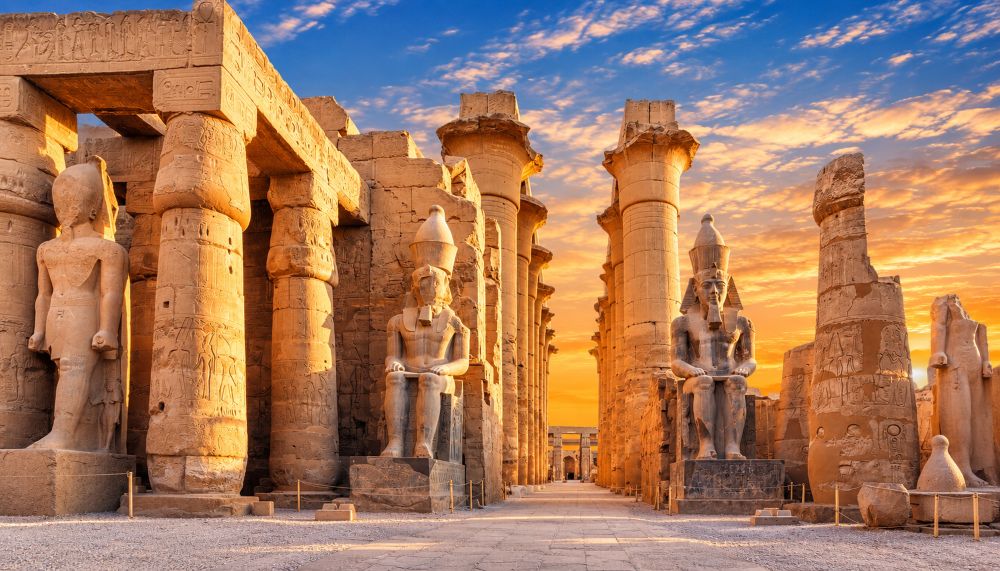
Ancient Luxor was Thebes, known to the Egyptians as Waset, one of the great political and religious cities of the ancient world.
Thebes rose to particular importance during the Middle Kingdom and became extraordinarily powerful during the New Kingdom, approximately 1550–1069 BC, when Egyptian rulers controlled territories extending deep into Nubia and across parts of the eastern Mediterranean world.
The Nile divided the sacred landscape into two broad spheres. On the east bank stood the great temples of the living gods, principally Karnak and Luxor Temple. On the west bank lay royal necropolises and funerary temples associated with death, regeneration and the afterlife.
The division was never absolute, but it created one of the most extraordinary ritual landscapes in antiquity.
Luxor Temple occupied a special place within that geography because it was directly connected with the renewal of both Amun and kingship.
Ipet-resyt: The Southern Sanctuary
The ancient name Ipet-resyt distinguishes Luxor Temple from Karnak.
Unlike many Egyptian temples, it is not simply oriented east to west according to the movement of the sun. Its main axis turns towards Karnak because the relationship between the two sanctuaries was fundamental to its purpose.
Luxor was associated with a local form of Amun often called Amun of Opet or Amenemopet.
During festival ritual, Amun did not remain permanently isolated within Karnak.
He travelled.
That movement between temples transformed architecture into sacred geography.
The Opet Festival
The Opet Festival provides the key to understanding Luxor Temple.
During this great celebration, images of Amun, his consort Mut and their son Khonsu left Karnak in portable sacred barques. Priests carried them in procession towards Luxor Temple, accompanied by musicians, officials and ceremonial participants.
At different periods the route could involve travel along the Nile or movement through the processional avenue connecting the temples.
The festival expanded considerably during the New Kingdom. What may originally have lasted only a relatively short period eventually developed into a celebration extending over many days.
Its purpose went far beyond public spectacle.
The festival was closely connected with renewal, fertility and royal legitimacy. Through ritual interaction with Amun, the pharaoh’s divine authority was symbolically refreshed.
Luxor Temple was therefore one of the places where Egyptian kingship was repeatedly recreated.
The Avenue of Sphinxes
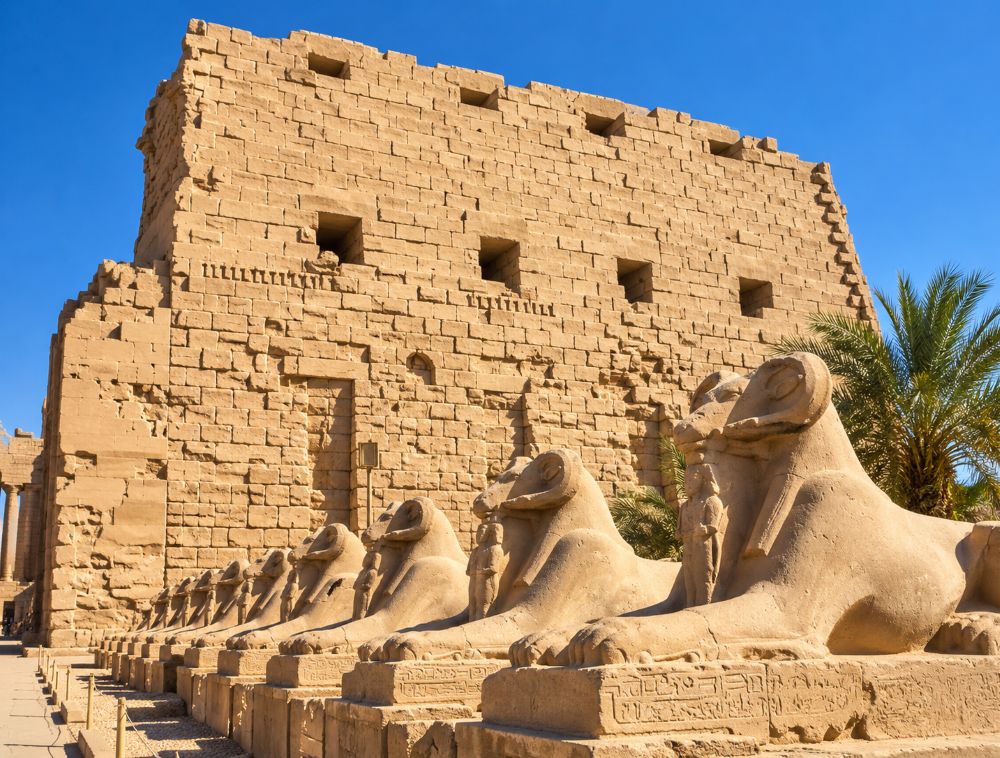
The ceremonial route between Karnak and Luxor stretched for approximately 2.7 kilometres.
Rows of sphinxes lined the avenue, forming a monumental corridor through ancient Thebes.
Different sections use different forms. Near Luxor Temple, many surviving sphinxes combine a human head with a lion’s body, while other portions closer to Karnak include ram-headed figures associated particularly with Amun.
The avenue developed over centuries and reached its monumental form under several rulers, with major work continuing into the Late Period.
Modern excavation and restoration gradually recovered long sections that had disappeared beneath the later city.
Walking even part of the route radically changes the relationship between Karnak and Luxor Temple.
They stop feeling like two separate archaeological attractions.
They become components of one ceremonial landscape.
Hatshepsut and the Earlier Temple
The oldest substantial surviving structure within the present complex dates to the reign of Hatshepsut, one of ancient Egypt’s most remarkable rulers.
Hatshepsut reigned during the Eighteenth Dynasty in the fifteenth century BC and used architecture extensively to articulate her relationship with Amun and strengthen the religious legitimacy of her kingship.
A triple shrine associated with her survives within the later temple.
Much of Luxor Temple as visitors experience it, however, belongs to the reign of a later Eighteenth Dynasty pharaoh: Amenhotep III.
Amenhotep III and the Creation of the Great Temple
Amenhotep III ruled approximately 1390–1352 BC, during one of the wealthiest periods of Egyptian history.
International diplomacy, tribute, trade and control over Nubian resources supported an extraordinary programme of royal construction.
His monuments once transformed Thebes.
On the west bank he created an enormous mortuary temple, now represented most visibly by the Colossi of Memnon. On the east bank he built the principal core of Luxor Temple.
The surviving architecture of his reign includes the great court, hypostyle areas, inner ceremonial chambers and the monumental colonnade leading towards the sanctuary.
Amenhotep III was not simply building a temple to a god.
He was creating an architectural stage for the divine nature of kingship.
The Divine Birth of Amenhotep III
Among Luxor Temple’s most important religious scenes is the cycle known as the Divine Birth.
Its message is political theology presented through images.
Amun approaches Queen Mutemwiya, mother of Amenhotep III, in the form of her husband Thutmose IV. The resulting child is therefore presented not merely as the son of a mortal king but as the offspring of Amun himself.
Subsequent scenes show the conception, birth and recognition of the future ruler.
The point was not biological biography in a modern sense.
The narrative explains why the pharaoh possesses divine authority.
Kingship is legitimate because the god has created the king.
Amenhotep III’s Court
Deep within the temple lies the large peristyle court of Amenhotep III.
Rows of columns surround an open central area, creating a rhythm of light and shadow that changes dramatically across the day.
These columns do more than support stone roofs and porticoes.
Their forms refer to the vegetation of the Nile landscape. Egyptian architecture repeatedly transformed papyrus, lotus and other plants into monumental stone architecture.
The temple became a stylised version of the created world.
Columns represented vegetation.
The floor could symbolically evoke the fertile earth.
Ceilings decorated with stars represented the sky.
Entering the temple therefore meant entering a model of the ordered Egyptian cosmos.
The Luxor Temple Cache
This courtyard produced one of the most important archaeological discoveries in modern Luxor.
During work in 1989, archaeologists found a concealed group of exceptionally well-preserved statues buried beneath the floor.
The deposit included images of kings and deities, many preserved in remarkable condition.
A number of the finest pieces are now displayed in Luxor Museum, where their polished stone surfaces can be seen much more easily than they could within the temple itself.
The discovery demonstrated how much archaeological material can remain concealed beneath monuments that have been excavated and studied for generations.
Luxor Temple is not a finished archaeological story.
The Great Colonnade
North of Amenhotep III’s court rises one of the temple’s architectural masterpieces: the Great Colonnade.
Fourteen enormous columns stand in two parallel rows, creating a monumental ceremonial passage towards the inner sanctuary.
Amenhotep III commissioned the structure, but much of its decoration was added after his death.
The scale is carefully controlled.
Unlike Karnak’s Great Hypostyle Hall, where columns multiply into a stone forest, Luxor’s colonnade is essentially processional.
Its architecture directs movement forward.
This was a corridor designed for gods, kings and festival ritual.
Tutankhamun and the Return to Amun
Amenhotep III was succeeded by his son Amenhotep IV, better known as Akhenaten.
Akhenaten radically transformed Egyptian religion by elevating the solar Aten and moving the royal court away from Thebes to a new city at Amarna.
Traditional cults, particularly that of Amun, suffered.
After Akhenaten’s death, the young Tutankhamun restored traditional religious institutions and returned royal patronage to the old gods.
At Luxor Temple, Tutankhamun’s contribution survives particularly in the magnificent reliefs covering the walls of the Great Colonnade.
They depict the Opet Festival.
Political restoration became architectural decoration.
The Opet Reliefs
The reliefs are among Luxor Temple’s most valuable historical documents.
Rather than presenting an isolated king defeating enemies or making offerings, they show an entire festival world.
Sacred barques move through the city.
Priests participate.
Musicians perform.
Offerings are presented.
Crowds and ceremonial groups take part in the procession.
The images allow the architecture surrounding you to be mentally repopulated.
The same colonnade through which visitors now walk once formed part of a ritual route filled with music, movement and divine images.
Tutankhamun initiated much of the decoration, while Horemheb later appropriated or completed portions during the political restoration that followed the Amarna period.
Ramesses II Arrives at Luxor
More than half a century after Amenhotep III, Ramesses II transformed the northern end of the temple.
Ramesses ruled for around sixty-six years during the Nineteenth Dynasty and left his name across Egypt on an extraordinary scale.
At Luxor he added the enormous first pylon, a large peristyle courtyard, colossal royal statues and a pair of obelisks.
The result altered the experience of the temple completely.
Amenhotep III’s elegant processional axis now began with an emphatic statement of Ramesside royal power.
The First Pylon
The monumental First Pylon forms the great façade most visitors immediately associate with Luxor Temple.
Two massive tapering towers frame the central gateway.
The stone walls were originally much more visually active than their weathered condition suggests. Reliefs, inscriptions, flagstaffs and colossal sculpture created a deliberately overwhelming entrance.
The façade celebrates Ramesses II’s military identity, including scenes relating to his campaign against the Hittites and the famous Battle of Kadesh.
Modern historians interpret Kadesh far more cautiously than Ramesses did.
The battle did not produce the overwhelming Egyptian triumph claimed by royal propaganda.
That distinction is precisely what makes the reliefs valuable: they show how pharaohs wanted military events to be remembered.
The Battle of Kadesh
The Battle of Kadesh took place around 1274 BC near the Orontes River in present-day Syria.
Ramesses II confronted the forces of the Hittite king Muwatalli II.
Egyptian inscriptions describe the pharaoh almost single-handedly rescuing his army after being caught in a dangerous position, presenting the battle as a demonstration of superhuman royal courage.
The actual military outcome was far less decisive.
Neither power achieved permanent domination, and the rivalry eventually gave way to one of the earliest surviving major international peace treaties.
The temple reliefs therefore reveal Egyptian propaganda as much as warfare.
The Luxor Obelisks
In front of the pylon originally stood two granite obelisks, each around 25 metres high.
Only one remains at Luxor.
Its partner now stands in the Place de la Concorde in Paris, where it has been since 1836.
Obelisks were not simply decorative needles.
Their form had strong solar associations, representing the rays of the sun and the primordial act of creation.
Carved inscriptions identify the king responsible for dedicating them and celebrate his relationship with the gods.
At Luxor, the surviving obelisk also reveals how carefully ancient Egyptian architects manipulated perspective.
The original pair was not perfectly identical, and subtle differences in placement and scale helped them appear balanced when viewed from the ceremonial approach.
How the Second Obelisk Reached Paris
The removal of one obelisk belongs to the nineteenth-century history of European involvement in Egypt.
The two Luxor obelisks were presented to France during the reign of Muhammad Ali Pasha, although only one was ultimately transported.
Moving such an enormous monolith from Upper Egypt to Paris required specialised engineering, transport along the Nile and Mediterranean, and considerable logistical planning.
It was finally erected in the Place de la Concorde in 1836.
The empty position beside Luxor’s surviving obelisk is therefore more than a missing architectural element.
It records a period when monumental antiquities could be displaced across continents as diplomatic gifts.
The Colossi of Ramesses II
Gigantic statues of Ramesses II dominate the entrance and courtyard.
Some show the king seated; others present him standing.
Their purpose was not realistic portraiture in the modern sense.
Colossal royal sculpture amplified the pharaoh’s presence until architecture and human form operated on the same scale.
Small subsidiary figures often appear beside the king’s legs, including members of the royal family.
One particularly important figure is Queen Nefertari, Ramesses II’s celebrated chief wife, shown on surviving sculpture within the courtyard.
The difference in scale communicates hierarchy immediately.
The pharaoh is not simply the largest person in the scene.
He belongs to another visual order.
The Court of Ramesses II
Passing through the pylon brings you into the large peristyle courtyard of Ramesses II.
Double rows of columns surround much of the space, while royal statues occupy positions between them.
The courtyard does not align perfectly with the older temple behind it.
This slight change of axis responds partly to the relationship with the ceremonial approach from Karnak.
The result is an architectural transition.
Ramesses respected the older sanctuary but inserted his own enormous ceremonial space in front of it.
Few Egyptian temples demonstrate more clearly how one ruler could appropriate an existing sacred landscape without demolishing it.
The Mosque of Abu al-Haggag
One of Luxor Temple’s most extraordinary features rises directly above the ancient courtyard.
The Mosque of Abu al-Haggag remains an active Muslim place of worship.
Its position initially looks almost impossible. The mosque sits high above the pharaonic floor level because, over the centuries, the abandoned temple became partly buried beneath accumulated settlement and debris. Medieval builders constructed at what was then ground level.
Later archaeological excavation removed the material around the ancient temple.
The mosque remained.
The result is a building apparently suspended above a pharaonic courtyard.
Abu al-Haggag and Medieval Luxor
Yusuf Abu al-Haggag was a Muslim holy man associated with Luxor from around the late twelfth century.
His shrine became an important religious focus, and the mosque bearing his name developed above earlier structures within the temple precinct.
Its survival is not an intrusion into an otherwise untouched archaeological site.
It is part of the history of the place.
Luxor Temple has been sacred under multiple religious systems for thousands of years.
The mosque makes that continuity visible.
Boats, Processions and a Curious Continuity
The annual festival associated with Abu al-Haggag traditionally includes ceremonial elements involving boats.
The resemblance to the ancient Opet Festival—when divine barques moved through Luxor—has long fascinated scholars and travellers.
It would be simplistic to claim an uninterrupted ritual surviving unchanged from the pharaohs into modern Islam.
Religious meaning, participants and historical contexts are entirely different.
Yet the recurrence of processional boats within the same urban landscape is an extraordinary example of how local traditions can develop around a place whose ceremonial importance predates the communities using it.
The Christian Temple
Before the mosque, Christianity also occupied Luxor Temple.
As Christianity spread through Egypt during late antiquity, churches were established within and around ancient sanctuaries.
Parts of Luxor Temple were adapted for Christian worship, and remains connected with churches survive within the complex.
This reuse was common across Egypt.
Ancient temples provided walls, columns, enclosed spaces and prestigious central locations that could be adapted to new religious needs.
The result at Luxor is not a simple sequence in which one religion erased another.
Different layers remain physically entangled.
The Roman Fort
Roman power added another major layer.
In the late third century AD, under the emperor Diocletian, the temple became incorporated into a Roman military installation.
A fortification known as a castrum developed around the complex, while parts of the ancient sanctuary were adapted to the needs of imperial administration and cult.
One of the inner chambers was dramatically transformed.
Ancient Egyptian reliefs were covered with plaster, and new paintings presented the Roman emperor and his colleagues in the government of the empire.
A pharaonic sacred chamber had become a Roman imperial hall.
The Tetrarchic Paintings
Diocletian reorganised imperial rule around a system commonly known as the Tetrarchy, in which authority was shared between senior and junior emperors.
At Luxor, painted decoration represented this new Roman political world directly inside the ancient Egyptian temple.
Although much of the painting has been lost or damaged, surviving traces remain historically exceptional.
They collapse more than a millennium of political change into a single room.
Behind the Roman surface lies the architecture of Amenhotep III.
Around it stands a temple still filled with pharaonic inscriptions.
Few monuments display ancient regime change so physically.
Alexander the Great at Luxor
After Alexander the Great conquered Egypt in 332 BC, he presented himself within the traditions of Egyptian kingship.
The Macedonian conqueror did not dismantle the religious structure that legitimised earlier pharaohs.
He entered it.
At Luxor Temple, a central bark sanctuary was rebuilt in Alexander’s name, and reliefs present him performing the ritual roles expected of an Egyptian ruler before Amun.
The imagery may seem strange to anyone thinking of Alexander exclusively as a Greek or Macedonian king.
In Egypt, political legitimacy required another identity.
Alexander could be conqueror of Persia in one context and pharaoh before Amun in another.
The Bark Sanctuary
Sacred barques played a major role in Egyptian temple ritual.
Cult statues normally remained hidden within inner sanctuaries, but festivals required them to travel.
They were placed inside portable shrines shaped like boats and carried ceremonially by priests.
The bark shrine at Luxor therefore functioned as more than architectural decoration.
It accommodated one of the essential objects involved in divine movement.
Its rebuilding under Alexander demonstrates the remarkable longevity of Egyptian ritual architecture.
More than a thousand years after the early New Kingdom, rulers were still using familiar forms of sacred kingship.
The Inner Sanctuary
The deepest spaces of Luxor Temple once formed the most restricted sacred zone.
Ordinary Egyptians did not wander freely through these chambers.
Access became progressively more controlled as one moved inward, passing from open courtyards to covered halls and finally towards rooms associated directly with the divine cult.
Priests performed offerings, purified sacred spaces, burned incense and maintained the daily ritual cycle.
The temple was not created primarily to accommodate a congregation.
Its architecture served the gods and the institution surrounding them.
Modern visitors therefore move through spaces that most ancient inhabitants of Thebes would never have entered.
Light and Darkness
Luxor Temple becomes increasingly enclosed as you move deeper inside.
The enormous open courts receive direct sunlight.
The colonnade creates alternating bands of brilliance and shade.
Hypostyle spaces become darker.
The inner sanctuary is more compressed.
This progression is fundamental to Egyptian sacred architecture.
Moving inward meant approaching increasing sanctity.
Architecture translated religious hierarchy into light.
The god resided not beneath the brightest open sky but within increasingly restricted darkness.
Stone That Was Once Painted
The warm sandstone colour now associated with Egyptian temples can be misleading.
Luxor Temple was originally far more colourful.
Reliefs, columns, ceilings and hieroglyphs carried pigments—reds, blues, greens, yellows and blacks—which transformed architectural surfaces into vivid narrative environments.
Small areas still preserve traces of colour, especially where stone remained protected from weather and intense sunlight.
Whenever colour survives, mentally extend it across the surrounding walls.
Ancient Luxor was not beige.
Reading Egyptian Reliefs
The temple becomes more rewarding if you stop expecting reliefs to function like modern illustrated history.
Images communicate hierarchy and religious order.
Kings are often larger than other humans.
Gods can appear at comparable scale to the pharaoh.
Enemies may be compressed into groups.
Different moments can coexist within one composition.
Hieroglyphic texts identify participants, record speeches or explain rituals.
The objective is not photographic realism.
The objective is to show how the world should be ordered.
Why Pharaohs Recarved Each Other’s Names
Luxor Temple contains traces of political editing.
Egyptian rulers sometimes appropriated earlier monuments by replacing names, altering reliefs or inserting themselves into existing inscriptions.
Horemheb, for example, became closely associated with restoring religious order after the Amarna period and took over material connected with Tutankhamun.
Ramesses II was particularly prolific in placing his names across older monuments.
This behaviour should not always be interpreted simply as vandalism.
Monumental inscriptions were active statements of legitimacy.
Recarving a name could symbolically bring an old monument under a new king’s authority.
Luxor Temple and Karnak
The two temples should be understood together but not treated as interchangeable.
Karnak is vastly larger and developed into a sprawling sacred complex containing multiple temples, pylons, obelisks and one of the most extraordinary hypostyle halls ever constructed.
Luxor Temple is more compact and architecturally coherent.
Its strongest theme is not scale but procession.
Karnak was the principal home of Amun.
Luxor was a destination of renewal.
The Avenue of Sphinxes physically expressed the relationship between them.
Visit Karnak first if possible.
Luxor Temple then becomes the conclusion of a ritual journey rather than simply another set of columns.
Why Luxor Temple Is Especially Good at Night
Many Egyptian monuments close before darkness transforms them.
Luxor Temple does not.
Its current evening opening allows visitors to see the architecture under carefully placed artificial light.
The experience is dramatically different.
During the day, sunlight flattens large sandstone surfaces and exposes the relationship with the modern city.
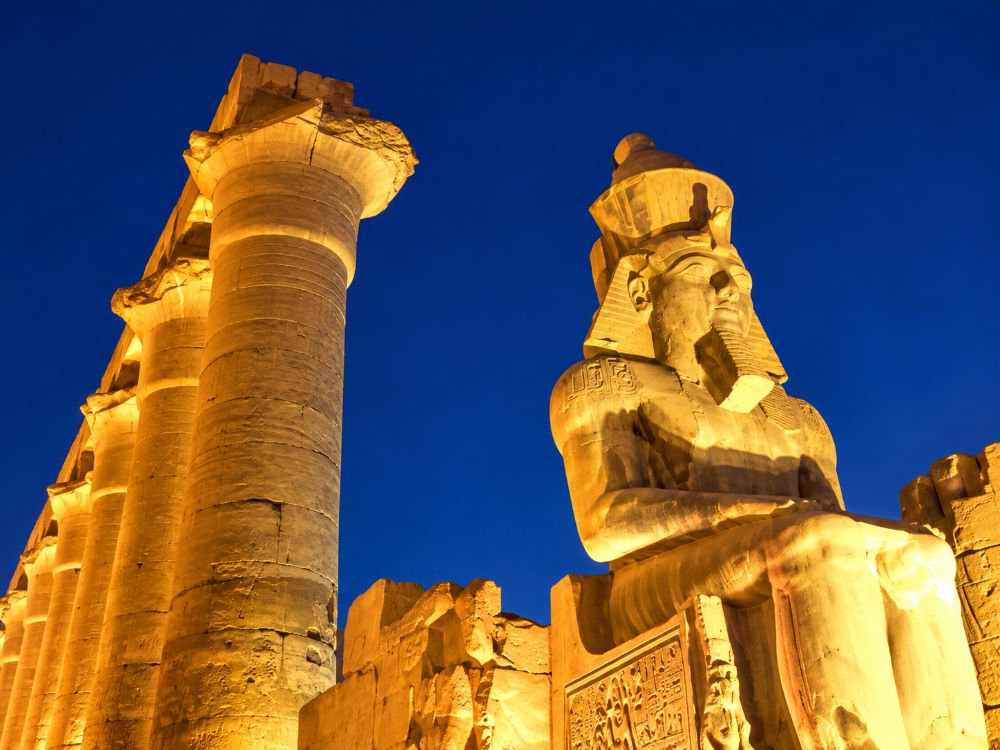
After sunset, illuminated columns emerge from darkness, colossal statues acquire stronger shadows and the surrounding streets largely disappear.
The temple becomes more theatrical but also more legible.
For a first visit, late afternoon offers both experiences in one sequence.
Best Time of Day
Arrive approximately 90 minutes before sunset.
Use the remaining daylight to examine reliefs, especially the pylon, courtyard and Opet scenes.
As the light softens, sandstone turns warmer and carved details become easier to photograph.
Remain after sunset while illumination transforms the columns and statues.
Early morning is the alternative for travellers prioritising lower temperatures and smaller crowds.
Midday offers the least attractive combination: harder light, stronger heat and reduced relief contrast.
Photography
The first pylon and surviving obelisk work best when photographed with enough distance to preserve their scale.
Inside the court of Ramesses II, use the columns to frame colossal statues rather than photographing each one frontally.
The Great Colonnade needs strong perspective. Stand close to the central axis and allow the parallel columns to pull the eye towards Amenhotep III’s court.
Late-afternoon side light reveals shallow relief much more clearly than frontal midday sun.
After dark, expose for the illuminated stone rather than the black sky.
The temple does not need exaggerated saturation.
Its natural transition from honey-coloured sandstone to deep amber under artificial light is dramatic enough.
The Temple and the Nile
Luxor Temple stands close to the Nile, and that proximity mattered enormously in antiquity.
The river was transport route, economic artery and part of the ritual landscape.
Festival processions could involve sacred barques moving along the water between religious sites, while stone, supplies and people reached Thebes through river transport.
Modern embankments and urban development make the relationship less obvious than it once was.
After leaving the temple, walk briefly towards the Corniche.
The monument makes more sense when the Nile re-enters the picture.
How Long Do You Need?
Allow around two hours.
A fast circuit can be completed in roughly one hour, but it reduces the monument to pylon, statues and columns.
Two hours allow enough time to study the Opet reliefs, inspect the Roman chamber, understand the Abu al-Haggag Mosque and spend time among the inner rooms.
Architecture and Egyptology enthusiasts can comfortably spend two and a half to three hours.
The site is compact enough that extra time comes from looking rather than walking.
Current Opening Hours
Luxor Temple is currently open daily from 06:00 to 20:00.
The long opening window makes it one of the easiest major archaeological sites in Luxor to schedule around the heat.
Evening access is a major advantage.
Use it.
Current Admission
Current standard admission is approximately:
- International adult: EGP 500
- International student: EGP 250
- Egyptian adult: EGP 40
- Egyptian student: EGP 20
Student reductions normally require valid identification that meets local ticketing requirements.
Getting There
Luxor Temple stands directly in the centre of modern Luxor on the east bank of the Nile.
Visitors staying around the Corniche or central railway district can usually reach it on foot.
The railway station lies roughly a kilometre away, while Karnak Temple stands several kilometres to the north.
Taxis and local transport are useful when combining the site with Karnak or crossing towards west-bank attractions.
The central location makes Luxor Temple particularly convenient for an evening visit after other archaeological sites have closed.
A Strong Luxor Temple Visit
Begin at the northern end beside the Avenue of Sphinxes rather than rushing directly through the ticket entrance.
Study the pylon and surviving obelisk from a distance.
Pass between the colossal statues into Ramesses II’s court, then stop to understand why the Abu al-Haggag Mosque sits so strangely high above the pharaonic floor.
Continue through the Great Colonnade, giving serious attention to the Opet Festival reliefs.
Move into Amenhotep III’s courtyard and the hypostyle spaces before reaching the Roman imperial chamber, Divine Birth scenes and inner sanctuaries.
Then walk back out through the same architectural sequence.
Egyptian temples reveal different things when viewed in reverse.
Avenue of Sphinxes: Walk It or Not?
The restored processional avenue allows modern visitors to understand the physical connection between Luxor Temple and Karnak.
Walking the entire route can be rewarding, particularly in cooler weather, but it should not replace serious visits to the temples at either end.
The distance is roughly 2.7 kilometres, and exposed conditions can make it tiring in strong heat.
If time is limited, walk a shorter section near Luxor Temple and study its alignment.
The historical idea matters more than completing every metre.
Luxor Temple and the City
One of the site’s greatest strengths is that the modern city has not been removed from the experience.
Traffic passes nearby.
The mosque remains active.
The Corniche is close.
Restaurants, shops and hotels surround the archaeological zone.
For some visitors this makes Luxor Temple feel less romantic than an isolated desert monument.
Historically, however, it is appropriate.
This has never really been an isolated ruin.
Sacred and urban life have overlapped here for millennia.
The Temple as a Record of Religious Change
Luxor Temple can be read almost vertically through history.
At the bottom lies pharaonic Egypt.
Alexander inserted Macedonian kingship into Egyptian ritual.
Rome turned sacred rooms towards imperial ideology.
Christians built churches inside and around the ancient structure.
Muslim worship established another religious layer above them.
The Mosque of Abu al-Haggag remains active today.
Few places make the danger of the phrase “ancient ruin” so obvious.
Luxor Temple never had one single afterlife.
It kept acquiring new lives.
What Most Visitors Miss
The first mistake is treating Luxor Temple as a smaller version of Karnak. Its purpose and architectural character are different, with the Opet Festival and renewal of kingship at the centre of its identity.
The second is photographing the Ramesses II pylon and moving too quickly through the Great Colonnade. The Opet scenes there explain why the temple exists.
The third is overlooking the slight change in alignment between Ramesses II’s additions and the older temple. Architecture records how later rulers negotiated with earlier sacred space.
The fourth is regarding the Abu al-Haggag Mosque as an awkward modern intrusion. It is one of the most important pieces of evidence for the monument’s extraordinary continuity.
The fifth is missing the Roman imperial chamber because pharaonic reliefs seem more visually attractive. Few rooms in Egypt preserve such a striking collision between Egyptian and Roman political religion.
The sixth is imagining ancient temples as bare sandstone. Much of the decoration was originally painted.
The seventh is visiting only at midday.
Luxor Temple deserves darkness.
Luxor Temple and Karnak in One Day
The strongest sequence is Karnak first, Luxor Temple second.
Visit Karnak early in the morning before the heat becomes severe.
Spend the middle part of the day resting, visiting Luxor Museum or avoiding the strongest sun.
Reach Luxor Temple in late afternoon.
This chronological rhythm also mirrors the logic of the Opet Festival: the sacred procession began at Karnak and moved south towards Luxor.
The modern itinerary unintentionally recreates the ancient direction of travel.
Luxor Temple and Luxor Museum
Luxor Museum makes an excellent companion visit because it contains significant objects discovered within the temple, including material from the extraordinary 1989 statue cache.
Museum lighting also allows sculpture to be examined in a way that is difficult within outdoor archaeological sites.
The combination works particularly well for travellers interested in the artistic quality of New Kingdom sculpture rather than architecture alone.
Visit the museum before the temple if you want objects to provide context.
Visit afterwards if you prefer to understand where they came from first.
Luxor Temple for Architecture Lovers
Concentrate on the transitions.
The pylon compresses entry.
Ramesses II’s court opens suddenly.
The Great Colonnade narrows movement into a monumental corridor.
Amenhotep III’s courtyard releases it again.
Inner spaces become progressively darker and more restricted.
Different rulers altered the sequence but never destroyed its overall sacred logic.
The power of Luxor Temple lies in this rhythm of compression and release.
Architecture controls both body and attention.
Luxor Temple for History Lovers
Look for chronological collisions rather than trying to isolate one perfect pharaonic period.
Hatshepsut represents the earlier Eighteenth Dynasty.
Amenhotep III establishes the architectural core.
Tutankhamun restores traditional cult after Akhenaten.
Horemheb rewrites part of that restoration.
Ramesses II monumentalises the entrance.
Alexander becomes an Egyptian pharaoh in ritual imagery.
Diocletian converts sacred space into Roman imperial representation.
Christians reuse the temple.
A mosque rises above it.
Few monuments allow three thousand years of political history to remain so physically close together.
Is Luxor Temple Worth Visiting?
Absolutely, and not because it is simply one of Egypt’s major temples.
Luxor Temple is exceptional because it explains how sacred places survive by changing.
Amenhotep III created the architectural core for a festival of Amun and divine kingship. Tutankhamun covered its walls with the return of traditional religion. Ramesses II placed colossal images of himself before it. Alexander the Great entered its ritual system rather than rejecting it. Roman emperors covered pharaonic walls with their own political imagery. Christians worshipped inside the ancient sanctuary. A medieval mosque rose above its courtyard and remains active today.
Meanwhile, the Avenue of Sphinxes still points north towards Karnak.
The architecture therefore preserves something larger than the history of one temple.
It preserves the persistence of a sacred place even when the civilisation that created it has disappeared.
Visit in daylight for the reliefs.
Remain after dark for the columns.
But pay closest attention to the layers.
That is where Luxor Temple becomes extraordinary.
Useful Information
- Name: Luxor Temple
- Ancient name: Ipet-resyt, the Southern Sanctuary
- Location: East bank of the Nile, central Luxor
- Ancient city: Thebes
- Principal deity: Amun in his Luxor form, within the wider Theban triad of Amun, Mut and Khonsu
- Main surviving construction: Eighteenth and Nineteenth Dynasties
- Major builder: Amenhotep III
- Major later builder: Ramesses II
- Earlier surviving work: Hatshepsut
- Important later contributors: Tutankhamun, Horemheb and Alexander the Great
- Major festival: Opet Festival
- Processional connection: Karnak Temple
- Avenue of Sphinxes: approximately 2.7 km
- Great Colonnade: 14 monumental columns
- Ramesses II obelisks: originally 2
- Surviving obelisk at Luxor: 1
- Second obelisk: Place de la Concorde, Paris
- Original obelisk height: approximately 25 m
- Roman reuse: late 3rd century AD
- Active later religious monument: Mosque of Abu al-Haggag
- Major archaeological discovery: Luxor Temple statue cache, 1989
- UNESCO context: Ancient Thebes and its Necropolis
- Opening: 06:00–20:00 daily
- International adult ticket: EGP 500
- International student ticket: EGP 250
- Egyptian adult ticket: EGP 40
- Egyptian student ticket: EGP 20
- Recommended visit: around 2 hours
- Best overall time: late afternoon through sunset
- Best quiet visit: early morning
- Best companion site: Karnak Temple
- Best museum pairing: Luxor Museum
- Best architectural detail: Great Colonnade
- Most important relief cycle: Opet Festival
- Best later historical layer: Roman imperial chamber and Abu al-Haggag Mosque

