
Jaipur Travel Guide: Amber Fort, Hawa Mahal and the Genius Behind India’s Pink City

Jaipur is one of India’s rare cities where the plan beneath your feet is as important as the monuments around you. Its broad market streets, monumental gates, palace precincts and great public squares were conceived as parts of a new royal capital founded in 1727 by Maharaja Sawai Jai Singh II, a ruler whose interests stretched from warfare and commerce to mathematics and astronomy. With the Bengali scholar and architect Vidyadhar Bhattacharya, Jai Singh created a city divided into ordered sectors and laid out around wide commercial avenues, an urban experiment sufficiently distinctive for UNESCO to inscribe the walled city on the World Heritage List in 2019.
The famous pink façades came later, but Jaipur’s real originality was there from the beginning: this was a capital designed to make trade, administration, religion and royal ceremony function together. Jewellery merchants, textile workers and artisans were encouraged to occupy specialised streets; the City Palace sat close to the geographical centre; Jantar Mantar turned astronomical calculations into architecture; and the older Kachhwaha stronghold of Amer remained visible in the hills to the north.
That connection with Amer is fundamental. Jaipur was not the beginning of Kachhwaha history but its next chapter. Before the Pink City, the dynasty ruled from a fortified valley dominated by Amber Palace and the heights of Jaigarh. The shift from Amer to Jaipur therefore tells a much larger story: from hill fortress to rational commercial capital, from defensive geography to planned urbanism.
Give Jaipur at least three full days. Two days cover the major monuments; three let the markets, temples, food and crafts become part of the experience. Four are better if you want to visit textile workshops at Bagru or Sanganer, spend meaningful time in the old city and avoid turning Rajasthan’s capital into a succession of palace entrances.
What to See in Jaipur
- Hawa Mahal
- City Palace
- Jantar Mantar
- Govind Dev Ji Temple
- Johari Bazaar
- Tripolia Bazaar
- Bapu Bazaar
- Amber Palace
- Jaigarh Fort
- Jal Mahal
- Nahargarh Fort
- Gaitore Ki Chhatriyan
- Galta Ji
- Albert Hall Museum
- Ram Niwas Garden
- Patrika Gate
- Sanganer
- Bagru
- Jaipur’s gemstone and jewellery workshops
- The gates, chaupars and street grid of the Pink City
Before Jaipur: The Kachhwahas of Amer
Jaipur’s royal history begins in the hills north of the modern city. The Kachhwaha Rajputs developed Amer into their political centre long before Jai Singh II created Jaipur on the plain below. The landscape made strategic sense: narrow valleys, rocky Aravalli ridges and high defensive positions could be controlled far more easily than open terrain.
The dynasty’s rise accelerated under rulers who entered the political orbit of the Mughal Empire. Raja Man Singh I, one of Akbar’s most important commanders, accumulated extraordinary military prestige and wealth while serving the emperor across India and beyond. This close relationship did not erase Kachhwaha identity; instead, it produced a court culture in which Rajput and Mughal traditions became deeply intertwined.
That fusion remains visible at Amber. Hindu temples stand beside Persianate gardens; Rajput balconies overlook symmetrical courtyards; mirrored halls draw on Mughal luxury while fortified walls climb the surrounding hills. Jaipur inherited that cosmopolitan court culture but reorganised it within a completely different urban plan.
Why Jai Singh II Built a New Capital
By the early eighteenth century, Amer had become increasingly restrictive. The steep valley limited physical expansion, water presented long-term difficulties and the court needed a city better adapted to administration and trade.
Sawai Jai Singh II, who ruled from 1699 to 1743, approached the problem with unusual ambition. Rather than simply extending an existing town, he created a new capital approximately eleven kilometres south of Amer.
Work began in 1727. The basic city developed remarkably quickly, with the principal street hierarchy, royal precinct and commercial sectors established over the following years.
The decision marked a major shift in political geography. Amer had been built around defence. Jaipur was built around circulation.
People, goods, processions, information and money could move through broad intersecting streets in a way impossible in the compressed hill settlement.
Vidyadhar Bhattacharya and the Plan of Jaipur
The name most closely associated with Jaipur’s urban design is Vidyadhar Bhattacharya, a Bengali scholar working at Jai Singh’s court.
The city was organised through a rectilinear plan divided into nine principal sectors, with major streets intersecting at large civic squares. The design drew from Indian architectural theory, including principles associated with Vastu Shastra and Shilpa Shastra, while also responding to practical requirements such as trade, drainage, defence and access.
The genius of the plan is that geometry never became purely ceremonial.
Main streets doubled as bazaars. Commercial frontages were regularised. Gates controlled movement through the walls. Palace and temple occupied key positions without isolating themselves from city life.
Three centuries later, Jaipur’s historic centre still functions according to much of this logic.
The Chaupars
Two large squares, Badi Chaupar and Chhoti Chaupar, remain essential to understanding the Pink City.
These were not decorative piazzas inserted between monuments. They were fundamental intersections within the original street system, places where major commercial avenues met and public movement intensified.
Hawa Mahal rises beside Badi Chaupar precisely because this was one of Jaipur’s great urban stages. Royal women looking through its latticed windows were not staring into an empty square; they were observing processions, religious celebrations and one of the busiest commercial arteries in the capital.
Modern traffic and metro infrastructure have altered the experience, but the geometry remains remarkably legible.
Why Jaipur Is Pink
The city’s famous colour does not date from its foundation.
In 1876, Maharaja Sawai Ram Singh II ordered prominent parts of Jaipur painted in a warm terracotta-pink colour for the visit of Albert Edward, Prince of Wales and future King Edward VII. Pink was associated with hospitality, and the visual effect proved so successful that the colour became part of Jaipur’s civic identity.
Successive regulations and repainting campaigns helped preserve the palette.
Calling Jaipur “pink” is slightly misleading. Much of the historic city is closer to salmon, burnt peach, terracotta and ochre, changing dramatically with the light. Early morning can make façades look almost orange; evening softens them into dusty rose.
The result is far more attractive than a uniform coat of pastel paint.
Hawa Mahal
No building represents Jaipur more immediately than Hawa Mahal.
Maharaja Sawai Pratap Singh commissioned it in 1799, with architect Lal Chand Ustad creating an extraordinary five-storey façade containing 953 jharokhas, or small windows and projecting openings. From the street it resembles an enormous palace, yet the building behind the façade is surprisingly shallow.
Its purpose was both social and climatic.
Women of the royal household could observe processions and activity in the streets while remaining largely hidden behind screens in accordance with conventions of royal seclusion. At the same time, the multitude of openings encouraged air circulation through the upper levels.
Hawa Mahal is therefore not simply ornamental architecture. It is a highly sophisticated solution to visibility, privacy and heat.
The 953 Jharokhas
The number of openings matters because the visual effect depends on repetition.
One jharokha is simply a window. Nine hundred and fifty-three transform the entire façade into something between architecture and textile: niches, screens, small cupolas and curved forms repeating across five levels.
The latticework allowed someone inside to look towards the street while remaining difficult to see from outside.
This asymmetrical relationship between seeing and being seen lies at the heart of Hawa Mahal.
The façade is most beautiful in morning light, when the sun hits it directly.
Inside Hawa Mahal
Many visitors photograph the façade from across the road and leave. That misses the architecture’s purpose.
Inside, the building is considerably plainer. Courtyards, narrow upper galleries and long ramps connect spaces behind the ornate street elevation. As you climb, views over Jaipur expand towards City Palace, Jantar Mantar and the dense roofs of the old city.
The upper storeys are extremely narrow. This makes the building’s nature clear: Hawa Mahal is closer to a monumental viewing screen than to a conventional palace residence.
The best way to understand it is therefore to see both sides.
Photograph the façade first.
Then go behind it.
City Palace
The City Palace formed the ceremonial and political heart of Jai Singh II’s new capital.
Construction began during the foundation period of Jaipur, but successive rulers altered and expanded the complex over more than two centuries. The result is not a single stylistic statement but a sequence of courtyards, gates, audience halls, private apartments and museum spaces representing different phases of Kachhwaha rule.
Parts of the complex remain associated with Jaipur’s former royal family, while other areas operate as the Maharaja Sawai Man Singh II Museum.
The palace rewards at least two hours. Architecture enthusiasts should consider spending considerably longer, particularly if entering the more exclusive rooms of Chandra Mahal.
Mubarak Mahal
The nineteenth-century Mubarak Mahal, or Welcome Palace, sits near the entrance to the museum complex.
Its appearance differs from Jaipur’s earlier eighteenth-century buildings. Decorative arches, balconies and carved stone reflect a court increasingly exposed to multiple Indian and European architectural influences.
Today the building houses important royal textiles.
These are worth more attention than they often receive. Court clothing was a form of political communication: fabric, embroidery, colour, cut and jewellery helped indicate rank, ceremonial role and access to expensive materials.
Jaipur’s contemporary textile culture becomes far more interesting once seen against this royal background.
Sarvato Bhadra
The open pavilion known as Sarvato Bhadra formed part of the ceremonial core of the palace.
Among the most memorable objects associated with the space are two monumental silver vessels made for Maharaja Sawai Madho Singh II before his journey to Britain for the coronation of Edward VII in 1902. The vessels were used to carry water from the Ganges so that the maharaja could maintain religious practices while travelling abroad.
The story captures a fascinating moment in princely India.
Railways, steamships and international diplomacy were creating unprecedented mobility, while ritual ideas about purity remained deeply important.
Modernity did not replace tradition.
The two travelled together.
Pritam Niwas Chowk
One of City Palace’s most beautiful spaces is Pritam Niwas Chowk, a relatively intimate courtyard famous for its four painted gateways.
Each gate carries different seasonal and religious associations. The Peacock Gate is the most celebrated, covered with vivid peacocks, floral decoration and blue-green painting associated with autumn and Vishnu. Other gates use lotus imagery, green tones or rose decoration to create a symbolic cycle around the courtyard.
The appeal comes from concentrated workmanship rather than scale.
These are not gigantic imperial façades. They are exquisitely controlled surfaces designed to be experienced at close range.
Chandra Mahal
The seven-storey Chandra Mahal dominates the palace skyline.
Some parts remain linked with the former royal family, while selected rooms can be visited through higher-level palace tours. These interiors contain some of Jaipur’s most memorable decoration.
Chhavi Niwas is dominated by blue-and-white painted surfaces; Shobha Niwas uses mirror work, gilding and coloured glass; other apartments shift between floral painting, decorative stucco and ceremonial furniture.
Standard admission does not provide the complete experience of Chandra Mahal, so architecture-focused travellers should decide in advance whether the premium access is worthwhile.
For anyone seriously interested in royal interiors, it usually is.
Govind Dev Ji Temple
Within the wider palace precinct stands one of Jaipur’s most important living religious centres: Govind Dev Ji Temple.
The temple houses an image of Krishna historically associated with the Kachhwaha rulers and transferred from Vrindavan during a period when sacred images in northern India faced political danger.
Worship is organised around several daily darshan periods. Curtains open at specific times, revealing the deity to crowds of worshippers before closing again.
The experience is completely different from a museum visit.
People sing, pray, press towards the sanctuary and respond emotionally when the deity appears.
This is one of the best places in central Jaipur to remember that the royal city was structured around sacred life as well as administration and commerce.
Jantar Mantar
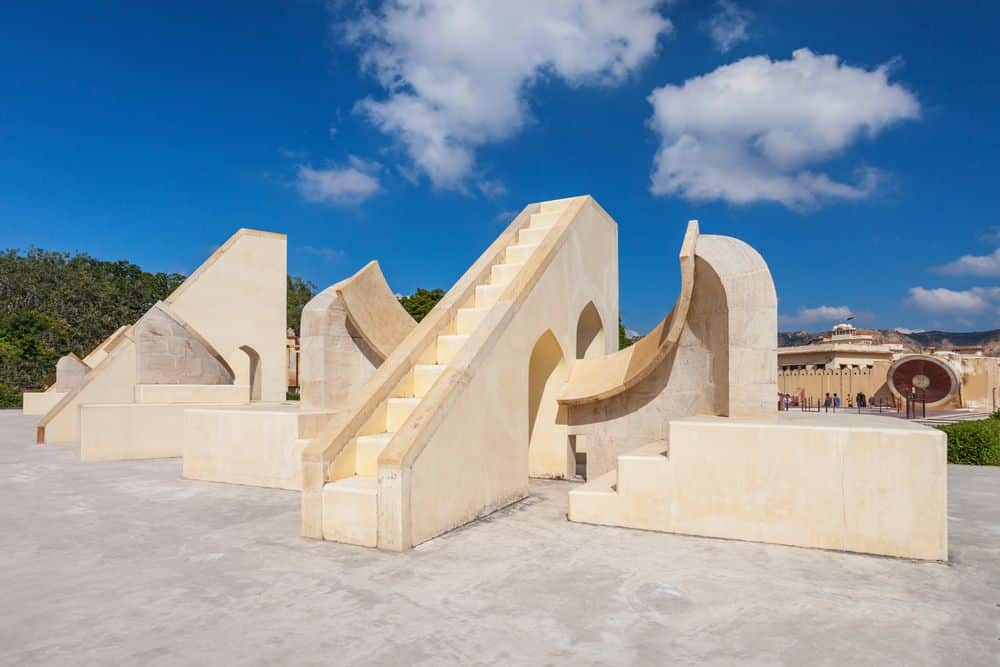
Next to City Palace stands Jaipur’s most intellectually extraordinary monument.
Jantar Mantar is an astronomical observatory composed of monumental masonry instruments built under Jai Singh II during the first half of the eighteenth century. UNESCO inscribed it on the World Heritage List in 2010, recognising the exceptional scale and sophistication of the surviving instruments.
At first sight, the complex can resemble abstract modern sculpture: enormous triangles, curved bowls, ramps and walls standing in an open garden.
That resemblance is accidental.
Every significant angle exists for measurement.
Jantar Mantar turns mathematics into architecture.
Why Jai Singh Built Giant Instruments
Jai Singh was deeply interested in astronomy and the accuracy of existing astronomical tables.
His court studied Indian, Islamic and European astronomical traditions, comparing calculations and observational methods. He commissioned observatories in several cities, including Delhi, Ujjain, Mathura and Varanasi, but Jaipur preserves the largest and most complete ensemble.
Why build instruments from masonry rather than metal?
Scale could increase observational precision. A larger graduated arc allowed smaller differences to be measured more clearly, provided construction itself was accurate.
The result is science at architectural scale.
Samrat Yantra
The most visually spectacular instrument is the Samrat Yantra, essentially an enormous equinoctial sundial.
Its triangular gnomon is aligned in relation to Earth’s axis, while curved graduated quadrants allow the moving shadow to indicate solar time.
The structure is monumental enough to climb visually even when access to particular surfaces is restricted.
What looks like a staircase is part of an astronomical machine.
The precision is remarkable, but the conceptual leap matters more: Jai Singh made the movement of the Sun readable across stone.
Jai Prakash Yantra
The Jai Prakash instruments are among the most elegant in the complex.
Hemispherical bowls contain carefully marked coordinate systems. By observing shadows and suspended reference points, astronomers could relate the position of celestial bodies to the engraved geometry.
Without explanation, the structures appear baffling.
With explanation, they become giant analogue calculators.
Jantar Mantar is one Jaipur monument where a competent guide adds enormous value.
Ram Yantra
The paired Ram Yantra structures use cylindrical walls, radial lines and an open central geometry to measure the altitude and azimuth of celestial bodies.
Observers could physically enter the instrument and move through the coordinate system they were using.
This is one of Jantar Mantar’s most memorable ideas: the scientist does not merely stand beside the equipment.
He stands inside the measurement.
Current public entry runs from 09:00 to 19:00, with last tickets issued at 18:30; the standard foreign ticket is ₹200.
The Pink City Bazaars
Jaipur’s markets are part of the historic city plan rather than tourist additions.
Jai Singh’s capital depended on attracting merchants and skilled craftspeople, and commercial streets were organised around particular trades. Several of those associations survive.
Johari Bazaar remains connected with jewellery and gemstones.
Tripolia Bazaar is known for metalware, lac bangles and traditional goods.
Bapu Bazaar specialises heavily in textiles, leather slippers and products aimed at both local and visitor markets.
The most rewarding approach is to stop thinking of these streets purely as shopping destinations.
Look above the storefronts.
The repetitive pink façades, arcades, temple entrances, roof terraces and alignment of the road reveal the eighteenth-century city beneath the advertising.
Johari Bazaar
The name derives from johari, a jeweller or gem merchant.
Jaipur grew into one of India’s major centres for cutting, polishing and trading coloured stones. Emeralds, rubies and sapphires entered workshops where specialist skills developed over generations.
The city also became closely associated with kundan jewellery, in which gemstones are set into refined gold structures, and meenakari, the enamel decoration often applied to the reverse of jewellery pieces.
These techniques were strongly connected with elite court culture but eventually spread into broader commercial production.
Serious jewellery purchases require caution. Expertise and artistry are real; so are inflated tourist prices, dubious gemstone claims and commissions paid to guides or drivers.
Amber Palace
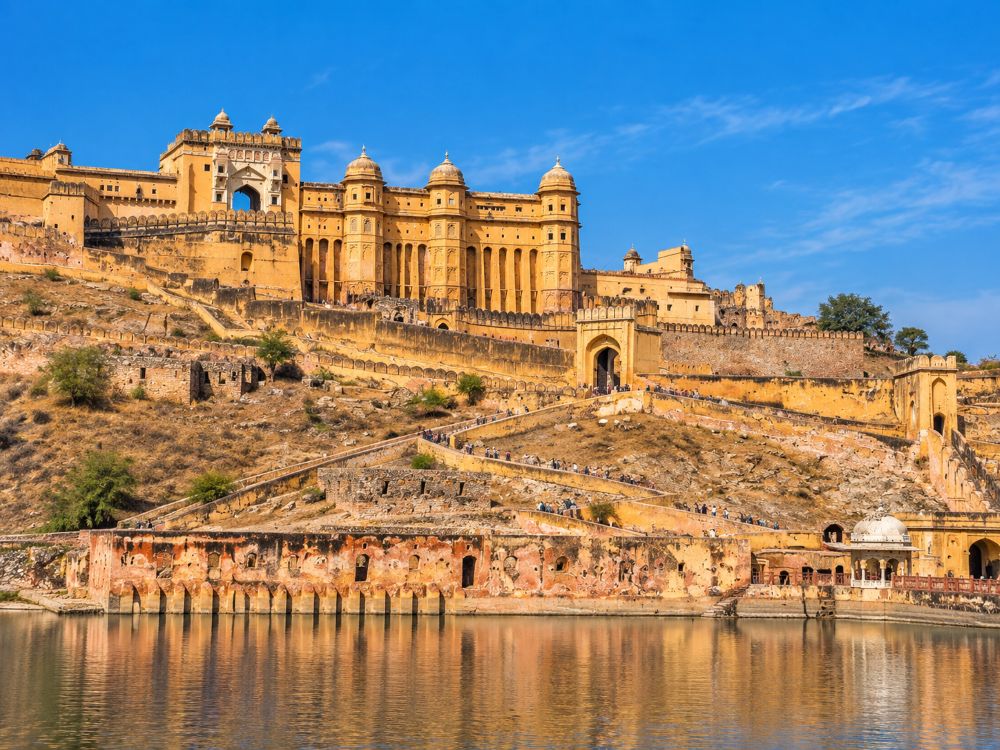
Around eleven kilometres north of Jaipur, Amber Palace rises above Maota Lake, marking the centre of the Kachhwaha world before Jai Singh II created the Pink City.
The present palace complex developed primarily from the late sixteenth century onwards. Raja Man Singh I initiated major construction, while later rulers expanded and transformed the site.
Amber is sometimes called Amber Fort or Amer Fort, but the term “palace-fort” captures its character better. Massive defensive walls climb the hills around it, yet the interior contains gardens, temples, mirrored rooms, audience pavilions and elaborate private apartments.
The complex divides into several principal courtyards, each representing a deeper level of royal access.
Arrive early.
The architecture is too important to experience behind hundreds of tour groups.
Maota Lake and the Approach
Amber’s relationship with Maota Lake is part of its visual power.
The palace rises directly above the water, with defensive walls climbing the ridges behind it. An island garden sits within the lake, strengthening the contrast between harsh Aravalli geology and highly controlled court landscape.
The climb towards the palace creates a carefully staged approach.
As the elevation increases, the lake and valley expand below while walls continue above.
This verticality is the exact opposite of Jaipur’s broad horizontal plan.
Jaleb Chowk
The first great courtyard is Jaleb Chowk.
Returning military forces could assemble here, while troops, officials and royal processions entered through gateways such as Suraj Pol and Chand Pol.
The space therefore belonged to the more public and military face of the palace.
From here, movement becomes increasingly restricted.
Amber should be read as a progression: army and ceremony outside, government further in, pleasure and domestic space deepest within the complex.
Shila Devi Temple
Within the palace stands Shila Devi Temple, dedicated to a form of the goddess Durga.
The sanctuary was closely associated with the Kachhwaha rulers and remains active.
Its presence inside a fortified royal palace demonstrates how inseparable religion and kingship were. The protection of the dynasty was understood in both military and sacred terms.
During Navratri, the temple becomes particularly busy.
Remove shoes and treat the shrine as living religious space rather than palace decoration.
Diwan-i-Aam
The Diwan-i-Aam, or Hall of Public Audience, is an open pillared pavilion where the ruler could appear before officials and petitioners.
Architecture controlled political visibility.
The ruler occupied a privileged position, while groups below stood according to hierarchy and access. At the same time, the open hall allowed air to circulate through a space used in Rajasthan’s intense heat.
The same architectural feature therefore served both ceremony and climate.
Ganesh Pol
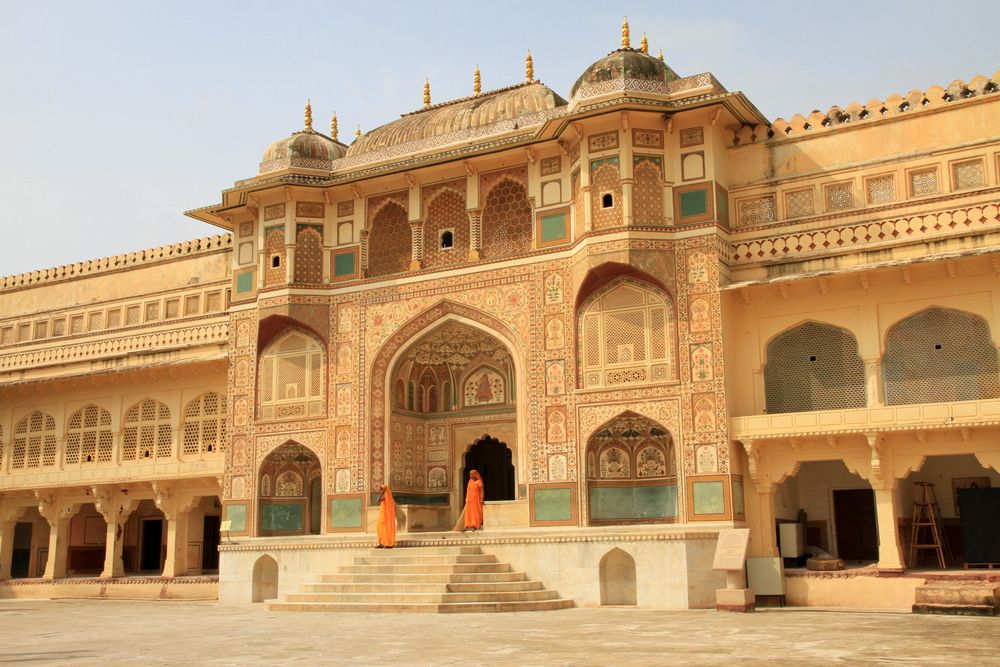
The richly painted Ganesh Pol marks one of Amber’s most beautiful transitions.
Floral decoration and geometric designs cover the gateway, while an image of Ganesha occupies a prominent position above the entrance.
Beyond it lie increasingly private parts of the palace.
The gate’s effectiveness depends partly on contrast. The surrounding sandstone is comparatively restrained, making the painted surface appear even more elaborate.
Stand close to examine the painting.
Then step back across the courtyard.
Sheesh Mahal
The Sheesh Mahal is Amber’s most celebrated interior.
Thousands of tiny mirrored pieces are embedded within floral and geometric decoration, transforming minimal light into countless reflections. The familiar story that a single candle could make the ceiling resemble a night sky may be romanticised, but it captures the physical principle accurately: a small amount of light becomes multiplied across the room.
Mirror palaces are sometimes dismissed as decorative excess.
They were actually highly sophisticated experiments in light, surface and atmosphere.
Move while looking upward.
The room changes with every angle.
Sukh Niwas
Across the garden lies Sukh Niwas, a royal pleasure space designed around climate.
Water once moved through channels within the architecture, encouraging cooling as air passed across it. Shaded rooms, stone surfaces and controlled openings added further relief from Rajasthan’s heat.
The principle is simple but effective: evaporation lowers air temperature.
Long before mechanical cooling, palace architecture manipulated water and airflow to create microclimates.
The Zenana
The women’s residential quarters occupy another deep layer of the palace.
Separate apartments opened onto shared circulation spaces, allowing members of the royal household to live in proximity while maintaining privacy and hierarchy.
Screens and concealed viewpoints created controlled visual access to ceremonies elsewhere in the palace.
The zenana should not be romanticised as a luxurious private world without restriction. Royal women could possess wealth, influence and political importance while still living within systems that closely regulated movement and visibility.
Amber and the Mughal World
Amber’s architecture becomes much easier to understand once the Kachhwaha alliance with the Mughals is remembered.
Man Singh served Akbar at the highest military levels, and later Jaipur rulers remained deeply involved in Mughal politics. Court artists, builders, materials and ideas moved between imperial and regional centres.
Persianate gardens, mirror decoration and ceremonial organisation therefore coexist naturally with Rajput balconies, Hindu temples and local construction traditions.
Amber is not “half Mughal, half Rajput.”
It is the product of a political world where those categories constantly interacted.
The Amer–Jaigarh Tunnel
A fortified route connects Amber with Jaigarh Fort on the ridge above. Portions are accessible to visitors. Rajasthan Tourism specifically identifies the underground passage between the complexes as part of the historic defensive system.
Its purpose becomes obvious when seen in the landscape.
Amber contained the royal residential complex.
Jaigarh represented the harder military position.
In a crisis, the palace below could connect with the stronger fortress above.
Walking part of the route, when open and weather permits, makes the relationship far clearer than driving separately between the two.
Jaigarh Fort
Jaigarh occupies one of the commanding ridges above Amber.
Its architecture is less seductive than the palace below because that was never its principal purpose. Walls, reservoirs, workshops and military infrastructure dominate rather than mirrored rooms and painted gates.
Jai Singh II strengthened the complex during the early eighteenth century, and the site developed strong associations with artillery manufacture and the protection of Amer.
The fort’s austere atmosphere makes it a valuable contrast.
Amber shows what royal power looked like ceremonially.
Jaigarh shows what protected it.
The Jaivana Cannon
Jaigarh’s most famous object is the enormous Jaivana cannon, cast in the early eighteenth century.
Descriptions often compete over whether it was the world’s largest wheeled cannon of a particular period. The exact superlative is less important than the engineering.
Producing a gun of this scale required metalworking expertise, foundry infrastructure, transport systems and an administrative state capable of organising large technical projects.
Rajasthan’s courts produced armourers and engineers as well as jewellers and painters.
Jaivana makes that side of royal power impossible to ignore.
Water at Jaigarh
The hilltop position created a fundamental problem: water.
Jaigarh developed substantial rainwater harvesting and storage infrastructure, using channels and reservoirs to capture monsoon water.
This is one of the least glamorous and most important aspects of Rajasthan’s forts.
Walls can resist soldiers.
They cannot resist dehydration.
Water engineering explains survival.
Jal Mahal
On the road between Jaipur and Amer, Jal Mahal appears to float in the centre of Man Sagar Lake.
The palace is associated with royal leisure and hunting rather than functioning as a conventional permanent residence. Much of the structure sits below or close to water level, leaving the upper pavilion as the visually dominant element.
For normal visitors, Jal Mahal remains primarily an exterior view.
Do not schedule it as a major interior palace visit.
Ten or fifteen minutes are enough for most itineraries, preferably in early morning or late afternoon when reflections improve.
The surrounding lake is also significant for birdlife, giving the stop an ecological interest beyond architecture.
Nahargarh Fort
Nahargarh Fort stands on the Aravalli ridge overlooking Jaipur.
Jai Singh II founded the original fort in 1734, partly strengthening the defensive system around the new capital. Later rulers expanded and transformed it, and sections gradually acquired the character of a royal retreat.
The panorama is the obvious attraction.
From the ridge, Jaipur’s urban logic becomes visible in a way impossible at street level. The old gridded city sits against a much larger modern metropolis, making the contrast between eighteenth-century plan and contemporary expansion strikingly clear.
Arrive before sunset rather than at sunset.
The last hour becomes crowded.
Madhavendra Bhawan
Inside Nahargarh stands Madhavendra Bhawan, one of the fort’s most intriguing residential sections.
A sequence of royal apartments was created around corridors and courtyards, with repeated suites traditionally associated with the ruler and women of the household.
Painted decoration, intimate rooms and interconnecting passages create a radically different atmosphere from the fortifications outside.
Nahargarh therefore contains two architectural personalities.
From a distance, it is military.
Inside Madhavendra Bhawan, it becomes domestic and theatrical.
Gaitore Ki Chhatriyan
Between Jaipur and Amer lies Gaitore, the royal cremation ground of the Kachhwaha rulers.
The site contains a collection of elegant chhatris, or cenotaphs, commemorating Jaipur’s former kings. Unlike Islamic mausoleums, these structures do not contain intact royal burials; they belong to a Hindu cremation and memorial tradition.
The white-marble cenotaph associated with Sawai Jai Singh II is particularly refined, with carved floral, geometric and peacock decoration.
Gaitore is quieter than Jaipur’s major monuments and rewards close observation.
It also provides an important counterpart to City Palace.
There the rulers appear in life.
Here they appear as ancestors.
Galta Ji
East of Jaipur, the city suddenly disappears into a rocky Aravalli valley.
Galta Ji is a Hindu pilgrimage complex built around a natural spring whose water feeds a series of sacred pools, or kunds. The site’s principal eighteenth-century architectural development is associated with Diwan Rao Kriparam, a court figure during the period of Jai Singh II.
Pink and ochre buildings climb the narrow valley while pilgrims bathe in sacred water beneath the surrounding cliffs.
The setting makes Galta Ji one of Jaipur’s most atmospheric excursions.
Come early or late.
Midday heat can be severe.
Why Galta Ji Is Called the Monkey Temple
Large groups of macaques occupy the complex, creating the foreign nickname Monkey Temple.
The name is convenient but reductive.
Galta Ji is first and foremost a pilgrimage site centred on sacred water, temples and ritual bathing.
The monkeys are wild animals, not performers. Avoid carrying visible food, secure glasses and phones and do not encourage close interaction for photographs.
The religious landscape is considerably more interesting than the animals.
The Sun Temple
Above the Galta valley stands a temple dedicated to Surya, the sun god.
The uphill walk provides broad views over Jaipur and the surrounding Aravallis.
The route makes particular sense in the morning, when temperatures are lower and the association with sunrise gives the site additional atmosphere.
Avoid the exposed climb in extreme afternoon heat.
Albert Hall Museum
At the edge of Ram Niwas Garden, Albert Hall represents another phase of Jaipur’s history.
The elaborate nineteenth-century building belongs to the Indo-Saracenic vocabulary that developed under British colonial influence, combining Indian motifs with European institutional planning.
Its collections include decorative arts, metalwork, textiles, painting, weapons and archaeological material.
The building is as important as many of the exhibits.
Visit after City Palace and Amber rather than before them. Once you have seen Jaipur’s court culture in its original architectural setting, museum objects become much easier to contextualise.
Jaipur’s Gates
The walled city was entered through a series of monumental gateways, including Ajmeri Gate, Sanganeri Gate, Chandpole and Surajpole.
They are now surrounded by traffic, shops and urban clutter, making it easy to miss their original function.
These gates controlled entry into a carefully organised commercial capital.
Their placement corresponds with the city’s larger street hierarchy and helps reveal Jaipur as a complete urban composition rather than a set of isolated monuments.
Walk whenever traffic permits.
The Pink City explains itself best at street level.
Block Printing in Sanganer
South of Jaipur, Sanganer developed one of Rajasthan’s most recognisable hand-block printing traditions.
Sanganeri textiles are typically associated with fine floral motifs, small repeating butis and relatively pale or white backgrounds. Artisans use hand-carved wooden blocks to transfer patterns onto cotton, building colour gradually through repeated impressions.
Alignment is everything.
A complex pattern can require several blocks, each applied in precise relationship to those before it. One careless impression can disrupt metres of fabric.
When watching a serious printer work, speed is almost as impressive as accuracy.
Bagru and Dabu
The printing traditions of Bagru, west of Jaipur, have a different visual character.
Bagru is particularly associated with earthy colours and dabu resist printing. A mud-based resist mixture is applied with carved blocks before cloth is dyed. Areas protected by the resist remain lighter, creating patterns when the paste is removed.
Indigo is particularly striking, although traditional Bagru work also uses blacks, reds and warm mineral tones.
Seeing Sanganer and Bagru as separate traditions improves textile shopping enormously.
“Block print” stops being a generic tourist label and becomes a collection of specific techniques.
Blue Pottery
Jaipur’s blue pottery is technically unusual.
Traditional pieces are made from a body rich in quartz rather than conventional clay, producing a pale surface ideally suited to blue, turquoise, green and yellow decoration.
The designs often combine flowers, birds, animals and geometric motifs influenced by Persian and Central Asian decorative traditions.
Quality varies dramatically.
Look at line precision, consistency of glaze and how carefully the decoration follows the shape of the object.
Cheap blue pottery is everywhere.
Excellent blue pottery is not.
Lac Bangles
Lac bangles remain closely associated with Jaipur’s old markets, particularly areas around Tripolia Bazaar and Maniharon ka Rasta.
The material is heated, rolled and shaped before being decorated with colour, stones, mirrors or metallic elements.
Wedding culture sustains much of the craft.
Watching bangles being shaped over heat is far more informative than encountering them only as rows of finished jewellery in a tourist shop.
Gemstones, Kundan and Meenakari
Jaipur’s gem industry is not a modern invention created for visitors.
The city became a major centre for cutting and polishing gemstones, supported by royal patronage and merchant networks. Skilled workshops developed around coloured stones and sophisticated jewellery styles.
Kundan work uses refined gold to set gemstones into elaborate structures.
Meenakari introduces coloured enamel, often onto surfaces not immediately visible from the front. The reverse of a necklace can therefore be almost as richly decorated as the stones seen when worn.
This is jewellery conceived as craftsmanship in the round rather than a decorative front attached to a plain back.
What to Eat in Jaipur
Rajasthani cuisine makes more sense once climate is considered.
Historically, low rainfall and limited access to fresh vegetables encouraged extensive use of millet, pulses, gram flour, yoghurt, ghee, dried ingredients and preserved desert plants.
The essential meal is dal baati churma. Dense wheat baati are baked until browned, broken open and soaked with ghee before being eaten with spiced lentils. Churma uses crushed wheat mixed with sugar and ghee, supplying a sweet counterpart to the savoury elements.
A proper serving is heavy.
Plan accordingly.
Gatte Ki Sabzi
Gatte ki sabzi replaces vegetables with dumplings made from gram flour.
The gatte are cooked, sliced and simmered in a yoghurt-based gravy scented with spices.
The dish is an excellent example of cooking developed for conditions where fresh produce could not always be relied upon.
The absence of vegetables does not make it austere.
Yoghurt, besan and spices create a sauce with substantial richness.
Ker Sangri
Ker sangri may be Rajasthan’s most geographically expressive vegetable dish.
Ker berries and sangri beans survive in harsh desert conditions and can be dried for long storage. Once soaked and cooked with spices, they produce a concentrated, tangy preparation with flavours unlike conventional fresh vegetables.
Modern restaurants often present ker sangri as heritage cuisine.
Historically, it was also practical survival food.
That connection between landscape and plate is what makes it important.
Laal Maas
For meat, Jaipur’s essential Rajasthani dish is laal maas.
Mutton is cooked with yoghurt, spices and red chilli into a dark, intense gravy. Poor versions deliver only heat. Better kitchens build layers of chilli, meat, smoke and fat into something far more controlled.
Traditional associations with Mathania chilli are strong, although restaurant recipes vary considerably.
Eat it with roti rather than treating rice as obligatory.
The bread handles the thick gravy far better.
Pyaaz Kachori
The great Jaipur snack is pyaaz kachori.
A flaky fried shell encloses an aggressively seasoned onion filling, usually sharpened with chilli and aromatic spices. Tamarind and coriander chutneys add acidity, sweetness and freshness.
Eat it immediately.
Fresh kachori shatters.
Cold kachori simply exists.
Mirchi Vada
A large green chilli stuffed with spiced potato, dipped in gram-flour batter and fried becomes mirchi vada.
Despite the intimidating appearance, the chilli itself is often milder than expected. The appeal lies in the combination of crisp batter, soft potato and vegetal bitterness.
Masala chai is the obvious companion.
Ghewar
Jaipur’s defining sweet is ghewar.
Batter is poured gradually into hot fat to create a delicate honeycomb disc, which is then soaked with syrup and sometimes finished with rabri, saffron, nuts or silver leaf.
Ghewar becomes particularly prominent around Teej and Raksha Bandhan, when sweet shops build enormous seasonal displays.
The texture matters as much as sweetness: a good piece retains a fragile, porous crispness beneath the syrup.
Where to Eat in Jaipur
Laxmi Misthan Bhandar
LMB sits in Johari Bazaar and remains one of Jaipur’s best-known addresses for sweets and vegetarian food. Its own current range still places ghewar, pyaaz kachori, mishri mawa and Rajasthani preparations at the centre of the business.
Come for the sweet counter first.
Address: 98–99 Johari Bazaar Road
Telephone: +91 90246 09609
Price: $$
Best for: ghewar, sweets, kachori and a Pink City food stop
Spice Court
Set in Civil Lines, Spice Court is a useful sit-down address when meat is the priority. The current menu remains strongly associated with Rajasthani and North Indian cooking, including laal maas, keema baati and gatta curry.
Address: Achrol House, Jacob Road, Civil Lines
Telephone: +91 91166 42231
Price: $$–$$$
Best for: laal maas and a substantial Rajasthani dinner
Suvarna Mahal
Inside Rambagh Palace, Suvarna Mahal represents the opposite end of Jaipur’s food spectrum.
The former royal dining room is filled with high ceilings, gilded mirrors and formal palace decoration, while dinner focuses on Rajasthani and broader Indian cooking. Current dinner service runs 19:00–23:45.
Address: Rambagh Palace, Bhawani Singh Road
Telephone: +91 141 6671234
Price: $$$$
Best for: formal palace dining and a special-occasion dinner
What to Drink
Jaipur’s most characteristic drinks are uncomplicated.
Lassi should be thick, cold and gently tangy, with sweetness balanced rather than overwhelming the yoghurt. Chaas, the salted version, uses yoghurt, water, cumin and salt and is far better adapted to extreme heat.
Masala chai remains the everyday stimulant.
The city also has an increasingly sophisticated bar scene in heritage hotels and design-driven restaurants, but alcohol is not central to Jaipur’s traditional culinary identity in the way chai and yoghurt drinks are.
One good lassi tells you more about the city than a generic rooftop cocktail.
Where to Stay
Rambagh Palace
Few Jaipur hotels carry more historical weight than Rambagh Palace.
The estate evolved from a royal residence and eventually became closely associated with Maharaja Sawai Man Singh II and Maharani Gayatri Devi before its conversion into a luxury hotel.
The experience is intentionally grand: gardens, ceremonial rooms and large-scale palace architecture rather than boutique intimacy.
Address: Bhawani Singh Road
Telephone: +91 141 6671234
Best for: landmark luxury and a full palace-hotel experience
Samode Haveli
Samode Haveli offers a more intimate heritage atmosphere inside the city.
Courtyards, painted interiors and traditional architectural elements make it feel more closely connected with Jaipur’s haveli culture than the vast palace hotels.
Its location also works well for travellers who want easier access to the Pink City.
Best for: heritage character, courtyards and a smaller-scale luxury stay
The Raj Palace
Near the old city, The Raj Palace developed from an aristocratic residence and retains an intentionally theatrical heritage style.
Courtyards, old furnishings and elaborate suites create a more ornate experience than contemporary luxury hotels.
Best for: historic interiors and access between the Pink City and Amer road
A Perfect First Day in Jaipur
Begin with Hawa Mahal early, while direct morning light warms the façade and traffic is still manageable. Enter the building instead of stopping at the famous street photograph, then walk towards City Palace.
Give City Palace at least two hours and consider upgraded Chandra Mahal access if decorative interiors are a priority.
Continue immediately to Jantar Mantar. Do not rush the observatory; understanding four or five instruments properly is more rewarding than photographing all of them without knowing their function.
After lunch, walk through Johari Bazaar, Badi Chaupar and Tripolia Bazaar.
End near the old-city streets as the terracotta façades soften in evening light.
This is already a complete day.
Do not add Amber simply because a driver says it is possible.
A Second Day: Amber, Jaigarh and Nahargarh
Reach Amber near opening time and allow at least two and a half hours.
Move through the palace in sequence: Jaleb Chowk, Shila Devi Temple, Diwan-i-Aam, Ganesh Pol, Jai Mandir and Sheesh Mahal, Sukh Niwas and the zenana.
Continue uphill to Jaigarh and give its military architecture, reservoirs and Jaivana cannon another ninety minutes.
Return towards Jaipur with a short stop at Jal Mahal.
If energy remains, spend late afternoon at Gaitore before continuing to Nahargarh for views over the city.
This is a long day.
It is also geographically logical.
A Third Day: Galta Ji, Museum and Crafts
Start early at Galta Ji before the valley becomes hot.
Walk through the temple complex and sacred kunds, then climb towards the Sun Temple if conditions are comfortable.
Return to central Jaipur for Albert Hall Museum and lunch.
Use the afternoon for craftsmanship rather than another palace. Choose a serious block-printing workshop, blue-pottery studio or jewellery workshop where production is genuinely visible.
Finish with laal maas or a complete Rajasthani vegetarian meal.
This third day is the point at which Jaipur stops being a collection of royal monuments.
Four Days in Jaipur
A fourth day allows the city to breathe.
Visit Sanganer or Bagru specifically for textile printing, spend more time in neighbourhood markets, return to Govind Dev Ji for darshan or explore lesser-known havelis and temples inside the walled city.
Food travellers can begin the morning with kachori and chai, spend midday among markets and sweets and reserve the evening for a palace dinner.
Photography-focused visitors can revisit Hawa Mahal at dawn or spend more time around Gaitore and the old city instead of chasing additional attractions.
Jaipur improves when not every hour requires a ticket.
If You Have Only One Day
The strongest compressed route is:
Amber Palace → Jal Mahal → City Palace → Jantar Mantar → Hawa Mahal → Johari Bazaar.
Start at Amber as early as possible.
Skip Jaigarh, Nahargarh, Galta Ji and craft excursions.
Trying to include them all produces a Jaipur itinerary spent mostly inside vehicles.
How Long Do You Need in Jaipur?
Two days cover the major monuments.
Three days create a convincing first visit.
Four days allow crafts, food and the old city to emerge properly.
Five days become worthwhile if Jaipur is being used as a base for excursions such as Bagru, Sanganer or Samode.
The common Golden Triangle habit of giving Jaipur one afternoon and one morning significantly underestimates the city.
Getting to Jaipur from Delhi
Jaipur lies roughly 260 kilometres southwest of Delhi.
Rail is often the best balance between speed and comfort, with several daily services linking the cities. Road travel can work well with a private vehicle but is more vulnerable to congestion around Delhi and Jaipur.
Flights are available, though airport transfers and security can reduce much of the theoretical time saving.
Jaipur sits naturally within the classic Delhi–Agra–Jaipur Golden Triangle.
Getting to Jaipur from Agra
Agra lies roughly 240 kilometres east of Jaipur by road.
The transfer is particularly useful because Fatehpur Sikri can be incorporated into a private-car journey between the two cities, avoiding the need to visit it as a separate return trip from Agra.
Rail is generally more comfortable if there are no planned stops.
The route also makes historical sense.
Agra represents the centre of Mughal imperial architecture.
Jaipur reveals how one of the great Rajput courts negotiated and ultimately moved beyond that Mughal political world.
Getting Around
The historic Pink City is best explored partly on foot.
Auto-rickshaws are ideal for short urban movements, while app-based taxis and cars become more practical for Amber, Jaigarh, Nahargarh and Galta Ji.
Jaipur Metro can save time on selected routes but does not yet replace road transport for the principal sightseeing circuit.
Commission-based shopping stops remain common when hiring drivers.
A driver suggesting “one very good textile factory” or “government jewellery shop” may be thinking about commission rather than cultural education.
Best Time to Visit
The best period is October to March.
November, February and early March provide particularly comfortable conditions for long outdoor visits. December and January bring colder mornings and evenings but generally pleasant afternoons.
April to June can be brutally hot, regularly pushing sightseeing into an early-morning and late-afternoon rhythm.
The monsoon generally arrives during summer and can transform the surrounding Aravalli hills from dusty brown to green.
Jaipur after rain can look unexpectedly lush.
Teej
The monsoon festival of Teej is one of Jaipur’s great public celebrations.
Processions traditionally move through parts of the old city, with decorated animals, musicians, performers and an image of the goddess Parvati.
The event gives Hawa Mahal’s architecture a completely different meaning.
Those hundreds of screened windows were created precisely for a city in which royal processions and religious ceremonies filled the streets below.
Teej also belongs to ghewar season, making it one of the best times to understand the relationship between festival and food.
Gangaur
Gangaur honours Gauri, a form of Parvati, and remains an important festival across Rajasthan.
Jaipur’s celebrations include processional traditions, music, decorated images and elaborate clothing.
As with Teej, the festival transforms the old city from architecture into theatre.
The streets themselves become ceremonial space.
Jaipur Literature Festival
The Jaipur Literature Festival has become one of India’s largest internationally recognised literary gatherings.
Writers, historians, journalists and readers converge for several days of talks and performances during winter.
The event significantly increases accommodation demand, so visitors whose travel dates overlap should book early.
Even travellers uninterested in the festival should know when it takes place because hotel availability changes rapidly.
Diwali
Jaipur’s old markets become particularly dramatic during Diwali.
Johari Bazaar and neighbouring streets compete through elaborate lighting, turning the regular commercial façades into huge illuminated compositions.
The atmosphere is extraordinary.
So is the congestion.
Stay close enough to walk rather than trying to move repeatedly across the old city by car.
Shopping Without Buying Junk
Jaipur rewards visitors who understand what they are buying.
For textiles, learn the visual difference between Sanganeri florals and Bagru resist printing.
For blue pottery, examine line quality and glazing.
For gemstones, use established specialists and demand meaningful documentation for valuable stones.
For jewellery, look at the reverse as well as the front; good meenakari can turn an unseen surface into one of the most beautiful parts of the piece.
For hand-block textiles, slight irregularities can reveal actual manual production.
Perfect repetition sometimes deserves suspicion.
What Most Visitors Get Wrong
The first mistake is calling Jaipur an ancient or medieval city. The historic Pink City is principally an eighteenth-century planned capital, and that is exactly what makes it exceptional.
The second is visiting Hawa Mahal only from outside. The façade is famous, but its architecture makes sense only when you understand what happens behind the jharokhas.
The third is walking through Jantar Mantar without serious explanation. Without astronomy, the site becomes abstract sculpture; with astronomy, it becomes one of the most remarkable scientific monuments in India.
The fourth is treating Amber as an isolated fairy-tale palace. Its architecture reflects centuries of Kachhwaha politics and close interaction with the Mughal Empire.
The fifth is assuming Jaipur has always been pink.
It has not.
The sixth is spending hours in workshops chosen by drivers while missing actual craftspeople elsewhere.
And the seventh is eating only hotel curry. Jaipur deserves pyaaz kachori, ghewar, gatte, ker sangri and laal maas as much as it deserves palaces.
Jaipur for Food Travellers
Begin with pyaaz kachori and chai rather than a hotel buffet.
Use lunch for dal baati churma, gatte or ker sangri.
Eat ghewar in the afternoon, especially during festival season.
Reserve laal maas for dinner.
One meal inside a palace is worth doing for atmosphere, but Rajasthan’s food culture is too interesting to spend every evening beneath chandeliers.
The strongest Jaipur food itinerary moves between street counter, sweet shop, traditional restaurant and royal dining room.
Jaipur for Photographers
Hawa Mahal needs morning light.
Amber benefits from arriving at opening, when courtyards remain readable and stone textures are not overwhelmed by crowds.
Gaitore is excellent under softer late-afternoon light, particularly around carved marble.
Nahargarh is the classic sunset position, though the city grid is easier to photograph before darkness.
Galta Ji benefits from morning activity and directional light within the valley.
In the bazaars, architecture is usually more interesting than portraits obtained by placing a lens close to strangers.
Jaipur or Jodhpur?

The two cities express Rajasthan very differently.
Jaipur is horizontal, planned and commercial. Its identity depends on wide streets, controlled geometry, palaces and an intellectual ruler who turned astronomy into architecture.
Jodhpur is vertical. Mehrangarh dominates an irregular old city that grew beneath a fortress.
Jaipur explains urban planning.
Jodhpur explains the relationship between fort and city.
Neither substitutes for the other.
Jaipur or Udaipur?
Jaipur is the stronger destination for monumental diversity, markets and the history of a major planned capital.
Udaipur is more intimate and scenic, organised around lakes, palaces and the distinctive political identity of Mewar.
Jaipur feels like a royal city that became a metropolis.
Udaipur feels like a palace landscape that remained closely tied to water.
Travellers interested primarily in architecture and urban history should give Jaipur more time than its Golden Triangle scheduling usually allows.
Is Jaipur Worth Visiting?
Without question.
What makes Jaipur exceptional is not simply the number of monuments but the relationship between them.
Amber explains the dynasty before the new capital.
Jaigarh explains the military infrastructure behind royal power.
City Palace establishes Jai Singh II’s political centre.
Jantar Mantar reveals his intellectual ambition.
Hawa Mahal connects the palace household with the life of the street.
Johari Bazaar demonstrates that the commercial organisation of the eighteenth-century city never entirely disappeared.
Gaitore remembers its rulers after death, while Galta Ji shows sacred geography escaping the rational order of the grid and retreating into a rocky valley.
And around everything else, Jaipur still makes jewellery, prints cloth, shapes lac, paints pottery, fries kachori and fills its market streets in ways that would remain recognisable to people who lived here generations ago.
The colour is memorable.
The urban intelligence behind it is the real masterpiece.
Useful Information
- State: Rajasthan
- Founded: 1727
- Founder: Maharaja Sawai Jai Singh II
- Principal historic planner: Vidyadhar Bhattacharya
- UNESCO World Heritage City: since 2019
- Jantar Mantar UNESCO inscription: 2010
- Ideal stay: 3–4 days
- Minimum stay: 2 full days
- Best season: October–March
- Hawa Mahal built: 1799
- Hawa Mahal architect: Lal Chand Ustad
- Hawa Mahal jharokhas: 953
- Jantar Mantar: 09:00–19:00
- Jantar Mantar last ticket: 18:30
- Jantar Mantar foreign admission: ₹200
- Amber Palace: approximately 11 km from central Jaipur
- Best Amber visit: early morning
- Best Hawa Mahal light: morning
- Jal Mahal: primarily an exterior visit
- Best panorama: Nahargarh
- Best royal memorials: Gaitore Ki Chhatriyan
- Best pilgrimage excursion: Galta Ji
- Essential crafts: block printing, blue pottery, gemstones, kundan, meenakari and lac bangles
- Essential vegetarian meal: dal baati churma
- Essential meat dish: laal maas
- Essential snack: pyaaz kachori
- Essential sweet: ghewar
- Main railway station: Jaipur Junction
- Airport: Jaipur International Airport
- Best transport within old city: walking and auto-rickshaw
- Best transport for the fort circuit: car or app-based taxi
- Tourism helpline: 1363

