
What to See in Jodhpur: Fort Palaces, Blue Houses and Rajasthan’s Great Desert City

Jodhpur has one of the most dramatic urban silhouettes in India. Mehrangarh Fort rises almost vertically from a dark volcanic-rock escarpment, its sandstone walls fused so tightly with the hill that the entire structure seems carved rather than built. Below it spreads the old city, a dense maze of flat roofs, temples, courtyards and houses washed in shades of cobalt, indigo and powder blue.
The colour is famous, but the fort is what gives Jodhpur its identity. Founded in 1459 by Rao Jodha of the Rathore clan, the city became the capital of Marwar, one of Rajasthan’s major Rajput states. For more than five centuries, rulers expanded Mehrangarh, fought wars from its ramparts, negotiated with Mughal emperors, built palaces inside its walls and gradually transformed a defensive stronghold into a repository of court culture.
Jodhpur is therefore more than a photogenic Blue City. It contains one of India’s strongest fort museums, an eighteenth-century water system hidden inside the old streets, marble royal cenotaphs, desert ecology, a twentieth-century palace created during famine relief, one of Rajasthan’s richest textile traditions and a food culture built around fried chillies, onion kachori, desert vegetables, rich meat curries and absurdly thick lassi.
Give Jodhpur three full days if possible. Two cover the essentials; three let the old city, Mandore, desert-edge traditions and food emerge from behind Mehrangarh. Four are worthwhile if you add Osian, Bishnoi country or a serious craft excursion.
What to See in Jodhpur
- Mehrangarh Fort
- Moti Mahal
- Phool Mahal
- Sheesh Mahal
- Takhat Vilas
- Jhanki Mahal
- Mehrangarh Museum collections
- Chamunda Mata Temple
- Jaswant Thada
- Rao Jodha Desert Rock Park
- The Blue City lanes
- Toorji Ka Jhalra
- Clock Tower and Sardar Market
- Stepwell Square
- Umaid Bhawan Palace
- Mandore Gardens
- The royal cenotaphs at Mandore
- Kaylana Lake
- A Bishnoi village excursion
- Osian as a desert extension
Before Jodhpur: The Rathores and Mandore

Jodhpur begins before Jodhpur.
The Rathore dynasty established itself in Marwar after moving westwards into Rajasthan following political upheavals in northern India. By the late fourteenth and early fifteenth centuries, Mandore, north of modern Jodhpur, had become their capital.
Mandore possessed established religious, political and residential structures, but its position was strategically weaker than the isolated rock south of the settlement that eventually attracted Rao Jodha.
In 1459, he began constructing a new fortress on that rock and gradually shifted political power towards the settlement growing below it.
The new city took his name: Jodhpur.
Rao Jodha and the Founding of Mehrangarh
Rao Jodha ruled Marwar from 1438 to 1489 and became one of the defining figures of Rathore history. His new fortress occupied a steep outcrop roughly 125 metres above the surrounding plain, offering much stronger natural defences than Mandore.
The fort became known as Mehrangarh, often interpreted as the “Fort of the Sun,” linking the Rathores with their traditional claim of descent from the solar dynasty.
The earliest fort was smaller than what visitors see today. Successive rulers expanded the walls, gates, palaces and defensive works for more than five centuries, creating an architectural complex where fifteenth-century foundations coexist with eighteenth- and nineteenth-century interiors.
This long evolution is one reason Mehrangarh feels unusually alive historically. It was never one ruler’s monument.
The Legend of the Hermit
Like many great Indian forts, Mehrangarh carries a foundation legend.
The rocky hill was associated with a hermit commonly remembered as Cheeria Nathji, the “lord of the birds.” Tradition says Rao Jodha displaced him when choosing the fort site, provoking a curse connected with water scarcity.
Stories then describe ritual attempts to neutralise the curse, including the sacrifice or voluntary entombment of a man named Raja Ram Meghwal, whose descendants were supposedly granted protection and land.
The details belong to legend rather than secure administrative documentation, but the story matters because it reveals how political power, landscape and sacred legitimacy were woven together in Rajput foundation narratives.
Mehrangarh Fort

Mehrangarh is the essential monument of Jodhpur and one of the most convincing fortress-palace complexes in Rajasthan.
Its walls extend for more than 500 metres, rising in places to around 36 metres and reaching extraordinary thickness. From below, the rock and masonry appear almost continuous, making the fortress look less constructed than geological.
The entrance route climbs through a sequence of gates before reaching the palace courts. This matters. Rajput forts were designed to slow attackers, break momentum and expose advancing forces to defenders above.
Inside, the atmosphere changes completely. Severe defensive architecture gives way to carved sandstone façades, latticed windows, painted chambers, gilded ceilings and collections documenting royal life across Marwar.
The museum currently opens daily from 09:00 to 17:00, with ticket sales closing at 17:00. International admission is currently ₹800, including the audio guide, while the one-way elevator costs ₹50.
Allow at least three hours.
Four is better.
The Gates of Mehrangarh
The approach passes through several fortified gateways associated with different periods of conflict and commemoration.
One of the most historically resonant is Jayapol, the Gate of Victory, associated with Maharaja Man Singh and military success in the early nineteenth century. Fatehpol commemorates another phase of Rathore military history, while older gateways preserve evidence of earlier defensive strategies.
Cannonball marks can still be seen on sections of the entrance architecture, reminders that Mehrangarh’s imposing walls were not ceremonial theatre.
Look at the route rather than simply the gate façades. Sharp turns, inclines and constricted passages were designed to disrupt cavalry and elephants.
The Fort Walls
Mehrangarh’s walls are among the rare defensive structures whose scale remains difficult to comprehend even when standing directly beside them.
The contrast with the palace interiors is deliberate in effect, even if it developed over centuries. Outside: mass, height and control. Inside: courtyards, music rooms, silk, gold, glass and painted decoration.
This dual identity defines many Rajput forts, but Mehrangarh expresses it particularly clearly.
Walk onto the ramparts after seeing the museum rooms. From above, the military logic of the hill finally becomes obvious.
Maldeo and the Strengthening of the Fort
One of Mehrangarh’s major construction phases came during the reign of Rao Maldeo, who ruled from 1531 to 1562.
In 1544, forces connected with Sher Shah Suri temporarily took control of the fort. After regaining it, Maldeo strengthened defensive walls, gates and interior fortifications in an effort to prevent another capture.
This episode is important because it removes Mehrangarh from the realm of romantic invincibility. The fort was formidable, but Rajasthan’s politics involved powerful neighbours, shifting alliances and repeated warfare.
Architecture evolved because military reality demanded it.
The Mughal Relationship
Marwar’s rulers did not exist outside the Mughal political system.
At different times the Rathores fought against, negotiated with and served the Mughal emperors. Several rulers held important imperial positions, while dynastic marriages and court service bound Rajasthan’s princely houses to Mughal power.
This relationship influenced art and architecture. Mughal painting, textiles, garden design and courtly taste moved into Rajput courts while local traditions remained strong.
The interiors of Mehrangarh therefore should not be read through an artificial divide between “Rajput” and “Mughal” culture. Elite courts borrowed constantly from one another.
Moti Mahal
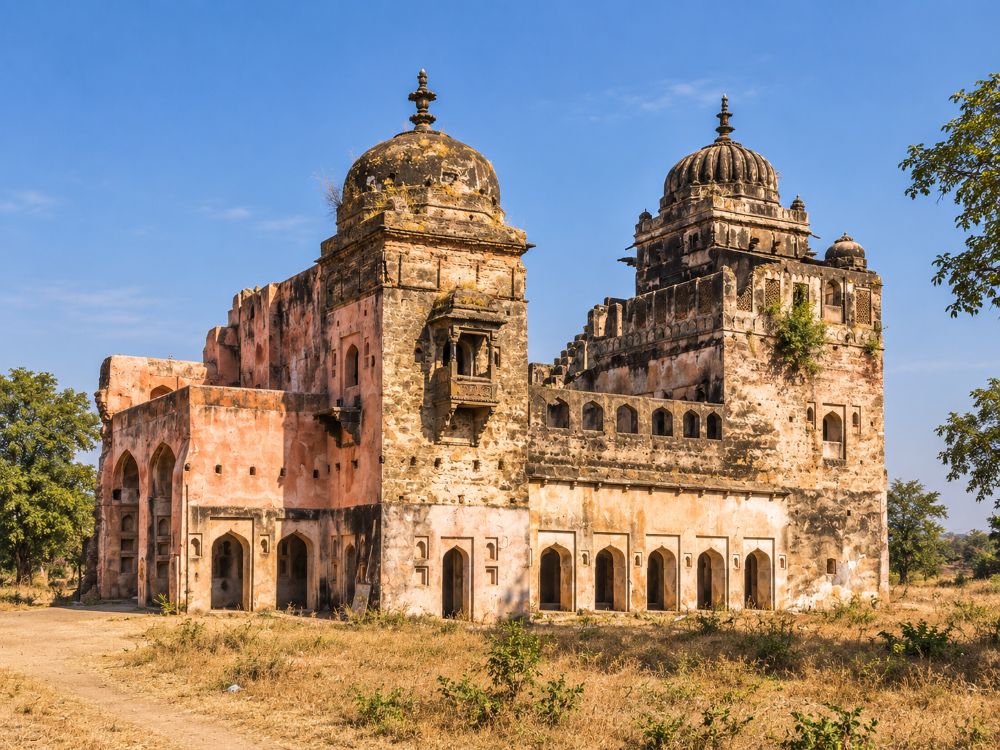
The Moti Mahal, or Pearl Palace, is one of the oldest surviving major rooms inside the fort.
Built in the late sixteenth or early seventeenth century under Sawai Raja Sur Singh, it functioned as a hall of public audience. The walls are coated in polished lime plaster, giving them a soft luminous quality that explains the “pearl” name more effectively than simple colour.
Small niches once held lamps, while the ceiling uses gilt and mirror decoration to intensify light.
The room demonstrates how political ceremony could be staged without enormous architectural scale. Surface, lighting, seating and controlled access created authority.
The Hidden Balconies of Moti Mahal
High in the walls are screened openings traditionally associated with royal women observing proceedings without being visible from below.
These discreet viewing points reveal something about palace organisation. Public political life was highly gendered, but architectural devices such as jalis and screened windows allowed women of the zenana to witness ceremonies while maintaining conventions of seclusion.
The same architectural principle appears across Rajasthan, from palace balconies to Hawa Mahal in Jaipur.
Phool Mahal
The Phool Mahal, or Palace of Flowers, is the most opulent room in Mehrangarh.
Maharaja Abhay Singh, who ruled from 1724 to 1749, created it as a private audience and ceremonial chamber. Gold dominates the ceiling, while later wall paintings depict royal portraits, deities and themes connected with classical music.
Several panels represent ragas and raginis, visual interpretations of musical modes and moods.
The room therefore worked through several senses at once: music, colour, gilded light, textiles and court performance combined to create an environment deliberately removed from the severity of the fort outside.
Why Phool Mahal Matters
This chamber is one of the best places in Jodhpur to understand the transformation of Mehrangarh from fortress to court.
The Rathores still needed walls, weapons and soldiers, but eighteenth-century kingship also required music, painting, poetry and elaborate etiquette.
Power had to look cultivated.
Phool Mahal is architecture performing refinement.
Sheesh Mahal
Mehrangarh’s Sheesh Mahal belonged to the private apartments of Maharaja Ajit Singh in the early eighteenth century.
Mirror work covers parts of the room, but the decorative programme differs from the almost abstract reflective interiors seen at Amber Fort. Painted panels depict Hindu gods and narrative scenes, including Krishna, Rama, Sita, Hanuman, Shiva and Parvati.
The combination of mirror and sacred imagery makes the room unusually intimate.
Later additions include a European chandelier and nineteenth-century changes to the ceiling, reminding visitors that palace interiors were continually updated rather than preserved untouched from one date.
Takhat Vilas
Takhat Vilas may be the most visually eccentric room inside Mehrangarh.
It served as the bedchamber of Maharaja Takhat Singh, who ruled from 1843 to 1873 and became the last Jodhpur ruler to live fully within the fort.
Paintings cover walls, ceiling and even the floor, mixing Hindu deities, courtly scenes and European women. The result is dense, restless and completely different from the disciplined gilding of Phool Mahal.
By the nineteenth century, Rajput courts were interacting more intensely with British colonial culture, imported prints, European furniture and new visual references.
Takhat Vilas records that collision directly on its surfaces.
Jhanki Mahal
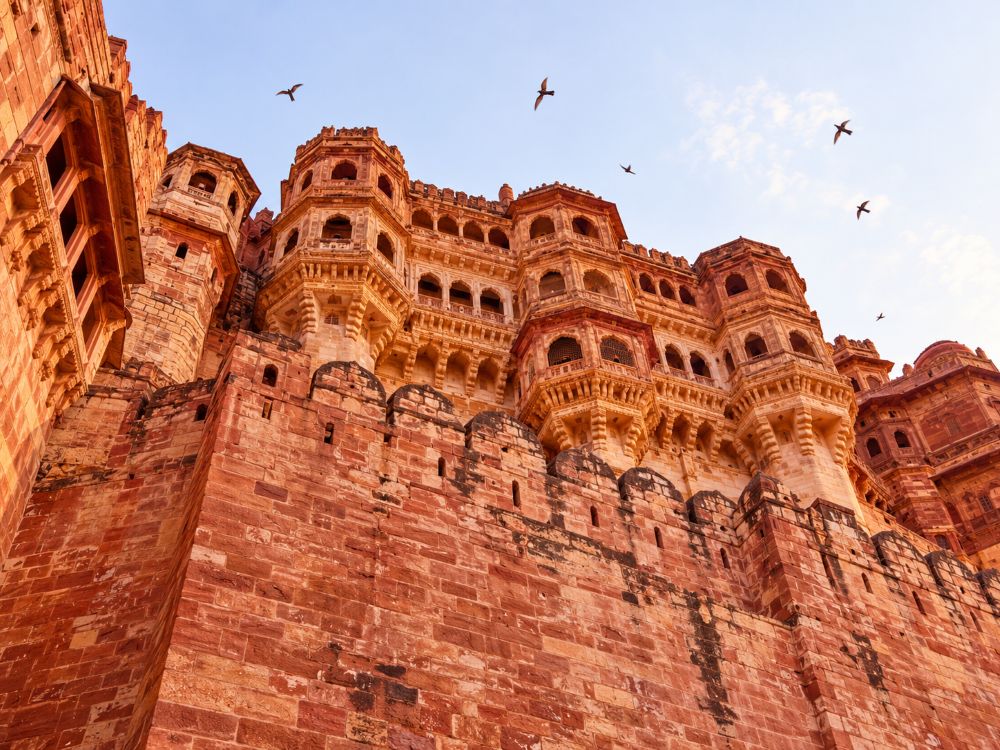
The Jhanki Mahal was associated with the women of the royal household.
Its name refers to the idea of a “glimpse.” Screened windows allowed women to observe ceremonies in courtyards below while remaining unseen.
Today the space displays a remarkable collection of royal cradles and swings, some intended for royal infants and others for sacred images used during religious festivals.
The collection transforms what could have been a purely architectural stop into an intimate view of dynastic life.
Kingship began in infancy, and royal objects reinforced that identity long before a ruler reached a throne.
Dipak Mahal
The Dipak Mahal formed part of the fort’s administrative world.
Officials responsible for governing Marwar worked here, while the ruler or senior authority occupied a more elevated position within the room.
That function matters because palace visits often overemphasise bedrooms, jewels and ceremonial halls. Royal states required taxation, correspondence, land administration, diplomacy and court bureaucracy.
Dipak Mahal is a reminder that Mehrangarh was also a government headquarters.
Mehrangarh Museum
Mehrangarh’s museum is unusually strong because the building and collections belong to the same court culture.
Galleries contain palanquins, elephant howdahs, weapons, textiles, miniature paintings, furniture and decorative arts from the seventeenth through nineteenth centuries.
The palanquin collection is especially revealing. Modes of transport were statements of hierarchy; shape, decoration and privacy communicated the status of the person being carried.
Similarly, elephant howdahs turn military and ceremonial mobility into objects of extraordinary craftsmanship.
Do not race through these galleries on the way to the decorated rooms. They explain how court life functioned physically.
Marwar Miniature Painting
Jodhpur developed its own important tradition of Marwar painting, influenced by Mughal court art but increasingly distinctive in palette, figures and local subject matter.
Royal processions, hunting scenes, lovers, religious stories and portraits appear in strong colours and highly controlled compositions.
Later works often become increasingly narrative and regional.
The museum’s painting galleries are useful preparation for understanding how courts constructed their own visual histories long before photography.
Arms and Armour
Mehrangarh’s armoury contains swords, shields, firearms and weapons associated with several periods of Marwar history.
Rajput martial culture is easy to romanticise, especially within a fortress this dramatic. The objects become more interesting when viewed technically: steel quality, blade curvature, decoration, grip design and the transition from edged weapons to increasingly important firearms all reflect changing warfare.
Ceremonial weapons could be works of art while remaining functional symbols of political authority.
Chamunda Mata Temple
Near the southern end of the fort stands the temple of Chamunda Mata, the protective deity closely associated with the Rathore rulers.
Rao Jodha brought the goddess’s image to the new fort, embedding religious protection within the political foundation of Jodhpur.
The shrine remains active and carries meaning beyond tourism. For many residents, Chamunda Mata is still closely connected with the identity of the city and former royal house.
Visit with the same respect you would bring to any functioning temple. The fact that it stands inside a museum complex does not make it an exhibit.
The Blue City from Mehrangarh
The ramparts provide the classic view over Jodhpur.
Directly below lies the densest concentration of blue-painted houses, especially around the old Brahmin neighbourhoods at the foot of the fort. Farther out, the city becomes increasingly beige, white and modern.
The idea that all of Jodhpur is blue is therefore a photographic exaggeration.
The old quarter is the real Blue City.
Why Are the Houses Blue?
The most familiar explanation says blue traditionally identified Brahmin households, particularly within older neighbourhoods close to the fort.
That association is real, but the colour later spread beyond strict caste identification. Lime-based washes were inexpensive, visually distinctive and sometimes credited with helping reflect heat or discourage insects, although climatic and insect-repellent claims are frequently repeated more confidently than evidence justifies.
Today blue is simultaneously inheritance, personal choice and tourism identity.
The result is not one uniform cobalt shade. Houses range from turquoise and indigo to faded lavender and pale sky blue, often patched and repainted unevenly.
That imperfection is what makes the lanes visually convincing.
Walking the Blue City
The old neighbourhood beneath Mehrangarh deserves at least two hours without a fixed checklist.
Start around the lanes between Navchokiya, Brahmapuri and the fort, where the concentration of blue houses remains strongest. Narrow passages twist around shrines, small shops, cattle, scooters and domestic courtyards.
This is not an open-air museum.
People live here.
Photograph architecture freely from public streets, but treat doorways, courtyards and residents as private life rather than visual material supplied for visitors.
The best walks happen early in the morning or in late afternoon, when heat falls and light begins sliding across the walls.
Toorji Ka Jhalra
Hidden inside the old city, Toorji Ka Jhalra is one of Jodhpur’s most elegant examples of water architecture.
The stepwell was commissioned in 1748 by Queen Tanwar Ji, consort of Maharaja Abhay Singh. Deep flights of symmetrical stone steps descend towards the water, allowing access as the level changed across seasons.
Structures like this were essential in arid Rajasthan. Water collection was not merely infrastructure but architecture, social space and environmental adaptation.
Toorji’s geometry becomes more impressive from below, where the walls rise around the water like an inverted building.
Stepwells and Desert Engineering
Rajasthan’s stepwells solve a fundamental problem: water levels fluctuate.
A conventional well provides a narrow vertical access point. A stepwell turns the entire descent into usable architecture, letting people reach water at different depths.
Shade also improves as the structure descends, creating cooler microclimates.
The sophistication lies in making scarcity manageable through geometry.
Jodhpur’s palaces may dominate travel photography, but water systems often reveal more about how desert cities survived.
Stepwell Square
The streets surrounding Toorji Ka Jhalra have undergone substantial restoration and commercial revival, with cafés, small hotels and shops occupying old structures around the stepwell.
The area has become one of the more polished parts of the old city.
That does not erase its value, but it creates a different atmosphere from the lanes only a few minutes away. Use it as a base for walking rather than assuming the restored square represents all of historic Jodhpur.
It is particularly atmospheric after dark, when Mehrangarh rises illuminated above the surrounding rooftops.
Clock Tower and Sardar Market
The Ghanta Ghar, or Clock Tower, marks the centre of one of Jodhpur’s busiest traditional market districts.
The tower was built during the reign of Maharaja Sardar Singh, who ruled from 1895 to 1911, and the surrounding market carries his name.
Sardar Market spreads outward through lanes filled with spices, textiles, bangles, vegetables, household goods, shoes, snacks and endless informal commerce.
Do not come only to buy souvenirs.
Come to watch how the old city trades.
Makhaniya Lassi at the Clock Tower
Close to the Clock Tower, Jodhpur’s famous makhaniya lassi reaches almost dessert consistency.
A classic version combines thick yoghurt with sugar, saffron, cardamom and fragrant elements such as kewra before being crowned with malai or butter.
One of the longstanding local references has been making it since 1927.
Drink it slowly.
Calling this a refreshing beverage understates the amount of dairy involved.
Jaswant Thada

A short distance from Mehrangarh stands Jaswant Thada, the white-marble memorial to Maharaja Jaswant Singh II.
His son, Maharaja Sardar Singh, commissioned the cenotaph after the ruler’s death, and the complex was completed in 1906.
The contrast with Mehrangarh could hardly be stronger. The fort is massive, dark and defensive; Jaswant Thada is pale, delicate and reflective.
Thin sheets of marble allow light to penetrate sections of the structure, giving some surfaces a soft translucence.
The monument opens daily from 09:00 to 17:00.
Jaswant Singh II and Modern Jodhpur
Maharaja Jaswant Singh II, who ruled from 1873 to 1895, belongs to a period when princely states were negotiating modernisation under British paramountcy.
Administrative change, infrastructure and urban development increasingly accompanied traditional court culture.
Jaswant Thada therefore commemorates a ruler belonging not to medieval fortress politics but to late nineteenth-century princely India.
Portraits and genealogical material inside connect the memorial to the broader history of the Rathore dynasty.
Rao Jodha Desert Rock Park
Beside Mehrangarh lies one of Jodhpur’s most intelligent modern conservation projects.
Rao Jodha Desert Rock Park was created in 2006 to restore the natural ecology of rocky land around the fortress that had been heavily invaded by non-native vegetation.
The park focuses on species adapted to the harsh conditions of the Thar Desert and rocky Aravalli-Marwar landscape rather than importing lush garden aesthetics into an arid environment.
That makes it an excellent companion to Mehrangarh. The fort becomes easier to understand when seen within the geology and vegetation that shaped its defensive setting.
Opening varies seasonally: 07:00–18:30 from April to September and 08:00–17:30 from October to March.
The Geology Beneath Mehrangarh
The fort sits on an ancient volcanic rock formation considerably older than the architecture above it.
The steep outcrop provided Rao Jodha with exactly what defensive planning required: visibility, natural elevation and surfaces difficult to attack.
Walking through the Desert Rock Park reveals how closely Mehrangarh follows the contours of the hill.
The builders did not simply place a fort on the landscape.
They absorbed the landscape into the fort.
Umaid Bhawan Palace
Jodhpur’s most important twentieth-century monument sits on the opposite side of the city from Mehrangarh.
Umaid Bhawan Palace was commissioned by Maharaja Umaid Singh in 1929, during a period of severe economic hardship and drought. Construction created employment for local people over many years, giving the palace an unusual social dimension alongside its royal purpose.
British architect Henry Vaughan Lanchester developed a monumental design combining classical massing, Indo-Deco elements and strong Art Deco influence. Local golden-yellow Chittar sandstone gives the palace a warm desert colour very different from Mehrangarh.
Construction took roughly sixteen years.
A Palace Built During Famine
Royal palace projects are usually explained through luxury.
Umaid Bhawan requires more nuance.
The project created employment during prolonged hardship, using a massive construction programme as a form of relief. Thousands of workers participated over the years, and the use of local stone and labour embedded the building within Jodhpur’s economy.
This does not transform royal expenditure into modern social welfare in a simple sense, but it makes Umaid Bhawan substantially more interesting than a straightforward display of princely wealth.
Art Deco in Rajasthan
From a distance the palace appears almost classical, dominated by its vast central dome.
Up close, Art Deco becomes much clearer in its geometry, streamlined details, interiors and decorative vocabulary.
The building belongs to the same global interwar era that produced cinemas, hotels and civic buildings from Mumbai to Miami, yet its sandstone construction and princely symbolism root it firmly in Rajasthan.
Few Indian cities allow such a direct architectural comparison between a fifteenth-century hill fort and a twentieth-century Art Deco palace.
Visiting Umaid Bhawan
The palace is divided into distinct functions.
One section remains connected with the Jodhpur royal family, another operates as a luxury hotel and a public museum occupies a smaller accessible section. The museum includes royal memorabilia, photographs, clocks and material documenting the palace and twentieth-century dynasty.
Day visitors should understand this before arriving: you are not touring the complete palace.
The architecture remains worthwhile even with limited access.
Mandore Gardens
About nine kilometres north of central Jodhpur lies Mandore, the former Rathore capital.
The site preserves temples, gardens, memorial architecture and the imposing dewals, cenotaphs of former Marwar rulers.
Unlike the familiar domed chhatris found elsewhere in Rajasthan, several Mandore memorials resemble tall, multi-storey temples constructed in red sandstone.
Their verticality produces one of the site’s most distinctive architectural effects.
Why Mandore Matters
Mandore should not be treated as an optional garden stop after “real” Jodhpur.
It was the political centre from which Rao Jodha moved.
Visiting after Mehrangarh therefore creates a meaningful historical sequence: old capital, new fortress, expanding city.
The contrast also helps explain Rao Jodha’s strategic decision. Mandore sits within a more open landscape, while Mehrangarh occupies a dramatically defensible isolated hill.
Hall of Heroes
Mandore’s Hall of Heroes commemorates regional figures through carved and painted imagery associated with local legend and martial memory.
Nearby religious structures connect heroic memory with the enormous pantheon of Hindu tradition.
These spaces demonstrate how history in Rajasthan was preserved not only through chronicles and palace archives but through bardic traditions, shrines and visual storytelling.
Kaylana Lake
West of Jodhpur, Kaylana Lake provides a quieter contrast to the fort and old city.
The artificial lake forms part of Jodhpur’s broader relationship with scarce water resources and now attracts birdlife as well as residents seeking open space away from dense urban neighbourhoods.
Late afternoon is the most rewarding period, particularly when the desert light softens.
It is not essential on a short visit, but works well on a third or fourth day.
Bishnoi Country
A rural excursion south of Jodhpur introduces one of Rajasthan’s most distinctive communities.
The Bishnoi tradition emerged in the fifteenth century around the teachings of Guru Jambheshwar, whose ethical principles emphasised restraint, protection of living creatures and respect for trees.
Bishnoi villages became particularly associated with conservation of blackbuck, chinkara and khejri trees.
The most famous episode occurred at Khejarli in the eighteenth century, when villagers led by Amrita Devi resisted the cutting of khejri trees and were killed.
The story later became one of India’s strongest symbols of community conservation.
How to Approach a Bishnoi Village Visit
Avoid treating the excursion as an “ethnic village safari” staged for photographs.
A good visit should concentrate on agriculture, ecology, craft, water, wildlife and community history rather than turning residents into visual attractions.
Salawas is known for dhurry weaving, while other villages in the wider area maintain pottery, textile and agricultural traditions.
Use an operator with long-term relationships rather than choosing solely by the promise of blackbuck sightings.
Osian
Around sixty-five kilometres north of Jodhpur, Osian offers a useful extension towards the Thar Desert.
The town flourished as an important trading and religious centre during the early medieval period and preserves significant Hindu and Jain temples.
The Sachiya Mata Temple and Mahavira Jain Temple are among the major religious sites, while nearby dunes have turned Osian into a popular base for camel rides and desert camps.
The temples are more historically important than a generic “desert safari.”
Give them time before heading towards the sand.
Jodhpur and the Thar Desert
Jodhpur sits on the eastern edge of the Thar rather than in the deep dune landscape associated with Jaisalmer.
This geography shaped almost everything: cuisine, water systems, clothing, architecture and trade.
Thick stone walls manage temperature. Stepwells store water. Foods such as ker sangri rely on ingredients capable of surviving arid conditions. Bright textiles intensify against an otherwise muted landscape.
The desert is not simply an excursion outside the city.
It is the reason the city developed as it did.
Bandhani
Jodhpur is closely associated with bandhani, Rajasthan’s resist-dyed textile tradition.
The technique begins by pinching tiny sections of cloth and binding them tightly with thread before dyeing. When the ties are removed, the protected points remain undyed, producing dots that can be organised into complex patterns.
Multi-coloured pieces require repeated tying and dyeing.
Fine bandhani should therefore be judged partly by the scale and regularity of the tied points. Very cheap printed imitations reproduce the visual pattern without the labour.
Leheriya
Another important Rajasthani textile tradition is leheriya, recognised by diagonal wave-like stripes.
Cloth is rolled, tied and dyed so that colour creates rhythmic bands when the fabric is opened.
The pattern is particularly associated with monsoon-season clothing and festive wear.
Bandhani and leheriya are often grouped together in tourist shops, but their techniques and visual structures are distinct.
Jodhpur Furniture
The region has also become an important centre for wooden furniture and architectural salvage, with workshops producing carved cabinets, doors, tables and decorative objects for both domestic and international markets.
Some pieces genuinely use old architectural fragments; others are modern products deliberately distressed to look antique.
If age affects value, documentation matters.
“Old-looking” is not the same thing as old.
Marwari Horses
The wider Jodhpur-Marwar region is associated with the distinctive Marwari horse, famous for inward-curving ears whose tips can almost touch.
The breed became closely connected with Rajput cavalry traditions and adapted well to the demanding climate of western Rajasthan.
Marwari horses remain symbols of regional identity and appear during festivals, ceremonies and equestrian events.
Their presence is another reminder that Marwar’s political culture evolved through mobility across large arid territories, not simply from static palaces.
What to Eat in Jodhpur
Jodhpur is one of Rajasthan’s strongest food cities because its defining dishes are easy to find outside formal restaurants.
Start with mirchi bada, a large green chilli filled with spiced potato, coated in gram-flour batter and fried until crisp. The chilli itself is usually milder than its size suggests; the combination works through heat, starch and crunchy besan.
Then move to pyaaz kachori, flaky pastry filled with onion, spices and often a gram-flour mixture. It should be eaten hot enough that the interior still releases steam when broken open.
These are not delicate snacks.
That is part of the point.
Mawa Kachori
The sweet counterpart is mawa kachori, one of Jodhpur’s most distinctive desserts.
A fried pastry shell is filled with khoya or mawa, nuts and cardamom before being soaked or glazed with sugar syrup.
The first bite combines crisp pastry with dense sweet milk solids and perfume from spices.
Share one unless you are particularly ambitious.
Makhaniya Lassi
Jodhpur’s makhaniya lassi is almost a meal disguised as a drink.
Thick yoghurt is blended with sugar, cardamom, saffron and aromatic flavourings before being topped with rich cream or butter.
The classic version at Shri Mishrilal near the Clock Tower has been associated with the city since 1927.
Try it after a spicy snack rather than alongside a full thali unless your appetite is unusually durable.
Ker Sangri
Few dishes express western Rajasthan better than ker sangri.
Ker berries and sangri beans survive in arid landscapes where fresh vegetables have historically been difficult to obtain. The ingredients are dried, soaked and cooked with spices to create a tangy, concentrated vegetable dish.
Preservation made food available through long dry periods.
What now appears as a regional delicacy began as practical desert intelligence.
Bajra Roti
Pearl millet, or bajra, tolerates dry conditions better than many grains and therefore became fundamental across Rajasthan.
Bajra roti has an earthy flavour and dense texture that pairs naturally with ghee, garlic chutney, ker sangri and meat curries.
Eat it hot. As millet flatbread cools it becomes firmer and loses much of its appeal.
Laal Maas
The famous Rajasthani meat curry laal maas belongs naturally in Jodhpur.
Traditionally built around mutton, yoghurt and red chillies, it should taste deep, savoury and smoky rather than merely painfully hot.
Mathania chillies are closely associated with the dish and regional cooking, although modern restaurant versions vary widely in both chilli variety and intensity.
A good laal maas demands bread capable of handling the gravy.
Bajra roti is ideal.
Kabuli
One less internationally known Jodhpuri dish is kabuli, a layered rice preparation combining rice with vegetables, dried fruit, fried bread or other rich components depending on the kitchen.
It occupies an interesting space between festive rice dish and local comfort food.
Seek it in traditional vegetarian restaurants rather than expecting it on every hotel menu.
Gulab Jamun Ki Sabzi
Jodhpur also has dishes that deliberately upset familiar categories.
Gulab jamun ki sabzi uses dumplings resembling the famous sweet but places them in a savoury curry rather than sugar syrup.
The result can sound gimmicky until tasted in context. Rajasthan has a long tradition of transforming shelf-stable, fried and dairy-based ingredients into substantial dishes in a climate where fresh produce historically required more careful management.
Where to Eat in Jodhpur

Kalinga Restaurant
Near the railway station, Kalinga remains a practical address for North Indian and Rajasthani meat dishes. The reason to come is laal maas, followed by mutton handi or kebabs rather than generic international food.
Address: Station Road, Ratanada
Telephone: +91 73000 54888
Opening: approximately 12:00–23:00
Price: $$
Best for: laal maas, mutton dishes and a straightforward sit-down meal
On The Rocks
On The Rocks combines a garden-like setting with a broad menu, but the useful order remains regional: laal maas, paneer preparations and tandoor dishes.
The courtyard gives it more atmosphere than the average hotel restaurant and makes it better suited to a long dinner than a quick lunch.
Address: Circuit House Road, near Ajit Bhawan
Telephone: +91 91193 64555
Opening: approximately 12:00–23:00
Price: $$–$$$
Best for: dinner, drinks and Rajasthani dishes in a landscaped setting
Indigo Restaurant
Set on a rooftop in the old city, Indigo combines North Indian and Rajasthani food with a direct view towards Mehrangarh.
The setting matters most at sunset and after dark, when the illuminated fort dominates the skyline.
Address: Gouri Haveli, Gulab Sagar area
Telephone: +91 98295 24809
Opening: approximately 07:30–22:30
Price: $$
Best for: rooftop dinner and fort views
Panorama 360
Above Pal Haveli near the Clock Tower, Panorama 360 is another strong option when the view matters as much as dinner.
Order a thali or straightforward North Indian curries rather than overcomplicating the meal.
Address: Pal Haveli, opposite Clock Tower
Telephone: +91 94141 45479
Opening: approximately 07:30–22:30
Price: $$
Best for: sunset, old-city atmosphere and Mehrangarh views
Street Food Stops
Janta Sweet Home
Janta is useful when you want several Jodhpur staples in one place: kachori, chaat, sweets and rich lassi.
Address: Jaljog Circle, Jodhpur
Telephone: +91 291 2616763
Opening: approximately 07:00–23:00
Best for: sweets, snacks and a quick introduction to local flavours
Shri Mishrilal
Near the Clock Tower, this is the city’s classic stop for makhaniya lassi.
The shop dates its history to 1927, and the drink remains the reason to come.
Best for: makhaniya lassi and rabri
Where to Stay
Umaid Bhawan Palace
For landmark luxury, the setting is difficult to match. The palace remains partly a royal residence, partly a museum and partly a luxury hotel, allowing guests to experience a building that day visitors see only in part.
Address: Circuit House Road area, Jodhpur
Telephone: +91 291 2510101
Best for: historic luxury, gardens and a destination stay
RAAS Jodhpur
RAAS occupies an eighteenth-century haveli complex inside the old city and combines restored sandstone buildings with contemporary architecture.
Its great advantage is location: Toorji Ka Jhalra sits beside it, Clock Tower is walkable and Mehrangarh dominates the view.
Address: Tunwarji Ka Jhalra, Makrana Mohalla
Telephone: +91 291 3505200
Best for: design, old-city access and direct fort views
Ajit Bhawan
Ajit Bhawan offers a more resort-like heritage experience, with courtyards, gardens, traditional decorative elements and multiple dining spaces.
It works especially well for travellers who want historic character without the tight lanes of the old city.
Address: Circuit House Road, Ajit Colony
Telephone: +91 291 2513333
Best for: heritage atmosphere, pool and quieter surroundings
Jhankar Haveli
Near Toorji Ka Jhalra, Jhankar Haveli offers a smaller old-city stay with a courtyard and rooftop views towards Mehrangarh.
Address: Makrana Mohalla, near Toorji Ka Jhalra
Telephone: +91 98280 31291
Best for: walkability, heritage atmosphere and a smaller-scale stay
A Perfect First Day in Jodhpur
Start at Mehrangarh at 09:00 and give it the entire morning. Follow the fort chronologically rather than racing directly towards the terraces: gates, museum galleries, Moti Mahal, Phool Mahal, Sheesh Mahal, Takhat Vilas and the ramparts.
Walk or drive down towards Jaswant Thada before lunch, then enter the old city in the afternoon.
Spend the later hours around Toorji Ka Jhalra, Stepwell Square, the Blue City lanes and Sardar Market.
Finish on a rooftop facing Mehrangarh.
This sequence works because Jodhpur begins with the fort and gradually descends into the city it created.
A Second Day
Begin at Umaid Bhawan Palace, where twentieth-century princely architecture provides an almost shocking contrast with Mehrangarh.
Continue north to Mandore, giving the gardens, dewals and older capital proper time.
Return to Jodhpur for a food-focused evening around the Clock Tower: mirchi bada, pyaaz kachori and makhaniya lassi before a later dinner if appetite survives.
A Third Day
Use the morning for Rao Jodha Desert Rock Park, especially between October and March when temperatures allow a longer walk.
Then choose between a Bishnoi countryside excursion or a more urban craft day focused on bandhani, textiles and furniture workshops.
If landscapes matter more than craft, finish at Kaylana Lake.
Three days gives the city enough room to stop being simply “Mehrangarh plus blue houses.”
Four Days: Add Osian
A fourth day allows a proper excursion to Osian.
Visit the early medieval temples before the strongest heat, then continue towards the surrounding desert landscape.
If taking a camel ride, use it as one part of the day rather than allowing the entire excursion to become a generic dune package.
The architecture is the historically distinctive reason to go.
If You Have Only One Day
Start with Mehrangarh at opening.
Continue to Jaswant Thada, descend through the Blue City, visit Toorji Ka Jhalra and end at Clock Tower and Sardar Market.
Skip Umaid Bhawan and Mandore unless twentieth-century royal history is a higher priority than the old city.
One day can reveal Jodhpur’s essential visual identity.
It cannot explain all of Marwar.
How Long Do You Need?
Two full days are the practical minimum.
Three are ideal.
Four make sense with Osian or a rural excursion.
Compared with Jaipur, Jodhpur is more compact in its central historic core, but the experience benefits from time because walking the old city is one of the destination’s strongest elements.
Getting to Jodhpur from Jaipur
Jaipur and Jodhpur are separated by roughly 330 kilometres by road, with journey times commonly around five to six hours depending on traffic and route.
Trains are often more comfortable than driving if no intermediate stop is planned.
Flights also connect the cities through limited schedules, though rail often remains more practical once airport transfers are included.
Getting to Jodhpur from Jaisalmer
The route between Jodhpur and Jaisalmer is one of Rajasthan’s classic desert journeys.
Road travel takes roughly four to five hours, while trains provide another practical option.
The landscape becomes progressively more arid heading west, making the transfer itself a useful geographical transition between Marwar and the deeper Thar.
Getting Around Jodhpur
The old city is best explored on foot.
Auto-rickshaws are useful between the Clock Tower, fort approaches and surrounding neighbourhoods, while app-based taxis and cars work better for Umaid Bhawan, Mandore, airport transfers and outlying sights.
Large vehicles struggle in some historic lanes.
If staying inside the walled city, expect to complete the final section of some journeys by tuk-tuk or on foot.
Best Time to Visit
The best period runs from October to March.
November through February offers the most comfortable daytime temperatures, though winter mornings can feel surprisingly cool.
April to June is extremely hot and requires early sightseeing plus long midday breaks.
The monsoon is shorter and less intense than in many parts of India, but late-summer rain can bring welcome colour to the rocky landscape.
For fort walking and the Blue City: winter.
For dramatic skies and greener surroundings: late monsoon.
Marwar Festival
Jodhpur’s Marwar Festival celebrates the music, legends and martial memory of the region.
In 2026 it takes place on 24–25 October, with programmes connected to venues across Jodhpur and the surrounding region.
Traditional music, dance, turban competitions, equestrian events and other performances turn the festival into one of the strongest moments to encounter Marwar’s public cultural identity.
The dates also place it within one of the best climatic periods for visiting.
Jodhpur RIFF
The Rajasthan International Folk Festival brings Indian and international musicians to Mehrangarh and other venues.
In 2026 the festival runs from 22 to 26 October, creating an unusual overlap with the Marwar Festival period.
Mehrangarh after dark is already extraordinary; music inside its courtyards changes the entire scale of the place.
Accommodation around these dates should be secured early.
Photography
Mehrangarh needs both morning and late-afternoon light.
The Blue City photographs best from the ramparts when angled sunlight begins revealing texture rather than flattening rooftops.
Inside the lanes, avoid hunting only for the bluest wall. Jodhpur works through layers: turquoise plaster, laundry, sandstone doorframes, shrines and domestic life.
Jaswant Thada is strongest in softer light, while Toorji Ka Jhalra benefits from high enough sun to reach deeper into the stepwell.
For a fort-at-night photograph, choose a rooftop inside the old city.
What Most Visitors Get Wrong
The first mistake is assuming Jodhpur became blue for one simple reason. Brahmin identity, lime wash, later adoption and tourism all contributed; the city was never one enormous planned blue paint project.
The second is spending only ninety minutes at Mehrangarh. The museum and period rooms deserve half a day.
The third is skipping Mandore because it looks less polished than the main sights. Without Mandore, Rao Jodha’s decision to found a new capital loses context.
The fourth is treating Toorji Ka Jhalra as an Instagram staircase instead of water infrastructure built for a desert city.
The fifth is assuming Umaid Bhawan is an old Rajput palace. It belongs firmly to the twentieth century and is one of India’s great Art Deco-era princely buildings.
The sixth is leaving without eating Jodhpur’s street food. Mirchi bada, pyaaz kachori, mawa kachori and makhaniya lassi explain the city at least as effectively as one more palace room.
Jodhpur for Architecture Lovers
The strongest sequence begins at Mandore, moves to Mehrangarh and ends at Umaid Bhawan.
Mandore represents the pre-1459 capital. Mehrangarh records five centuries of Rathore power, moving from military architecture to increasingly sophisticated palace interiors. Umaid Bhawan then jumps directly into twentieth-century princely modernity and Art Deco.
Add Toorji Ka Jhalra and the story expands beyond rulers into environmental engineering.
Few Rajasthan cities offer such a clear architectural chronology within one compact destination.
Jodhpur for Food Travellers
Start breakfast with pyaaz kachori or mirchi bada rather than hotel eggs.
Use the late morning for makhaniya lassi and split a mawa kachori if necessary.
At lunch, concentrate on vegetarian desert dishes: ker sangri, gatte, bajra roti and dal.
Dinner is the right time for laal maas.
One full Rajasthani thali is useful, but individual specialist dishes reveal more than repeating enormous set menus at every meal.
Jodhpur or Jaipur?
They belong to the same Rajasthan journey but feel fundamentally different.
Jaipur is a deliberately planned eighteenth-century capital built around broad commercial streets, scientific ambition and palace-centred urban order.
Jodhpur grows outward from a fortress. Its strongest experience is vertical and irregular: Mehrangarh above, blue neighbourhoods below, markets compressed into winding streets.
Jaipur explains planning.
Jodhpur explains the relationship between fort, dynasty and city.
Visit both if possible.
Jodhpur or Jaisalmer?
Jodhpur is the stronger city for monumental court architecture and museum collections.
Jaisalmer offers the more complete desert-fort urban experience, with inhabited lanes inside its golden citadel and easier access to dune landscapes.
Jodhpur is red sandstone and blue plaster.
Jaisalmer is yellow sandstone and desert horizon.
Together they make one of Rajasthan’s most coherent regional journeys.
Is Jodhpur Worth Visiting?
Absolutely.
Mehrangarh alone would justify the journey. Its combination of military scale, intact palace rooms and strong collections makes it one of Rajasthan’s most rewarding historic complexes.
But Jodhpur becomes far more interesting once you descend from the fort.
The blue lanes reveal how a royal capital grew beneath defensive walls. Toorji Ka Jhalra explains how the city dealt with water. Mandore preserves the political world that came before Rao Jodha’s new foundation. Umaid Bhawan shows a princely state responding to twentieth-century crisis through architecture of completely different ambition.
Then food fills in the practical side of desert life: millet, dried berries, preserved beans, fried snacks, chilli, yoghurt and ghee.
Jodhpur’s beauty comes from contrast—fort and house, sandstone and blue lime, arid rock and hidden water, martial history and delicate palace interiors.
The Blue City nickname is memorable.
Marwar is the deeper story.
Useful Information
- State: Rajasthan
- Historic region: Marwar
- Founded: 1459
- Founder: Rao Jodha
- Former capital: Mandore
- Essential monument: Mehrangarh Fort
- Mehrangarh height above plain: approximately 125 metres
- Mehrangarh Museum: 09:00–17:00 daily
- Mehrangarh international ticket: ₹800
- Mehrangarh elevator: ₹50 one way
- Jaswant Thada: 09:00–17:00 daily
- Rao Jodha Desert Rock Park, Apr–Sep: 07:00–18:30
- Rao Jodha Desert Rock Park, Oct–Mar: 08:00–17:30
- Ideal stay: 3 days
- Minimum stay: 2 full days
- Best season: October–March
- Best old-city walk: Blue City → Toorji Ka Jhalra → Clock Tower
- Best panorama: Mehrangarh ramparts
- Best architectural contrast: Mehrangarh and Umaid Bhawan
- Best historical extension: Mandore
- Best rural extension: Bishnoi villages
- Best desert extension: Osian
- Essential street food: mirchi bada and pyaaz kachori
- Essential sweet: mawa kachori
- Essential drink: makhaniya lassi
- Essential main dish: laal maas
- Essential desert vegetable: ker sangri
- Main railway station: Jodhpur Junction
- Airport: Jodhpur Airport
- 2026 Marwar Festival: 24–25 October
- 2026 Jodhpur RIFF: 22–26 October

