
Bửu Long Buddhist Temple: Complete Guide to Saigon’s Golden Pagoda
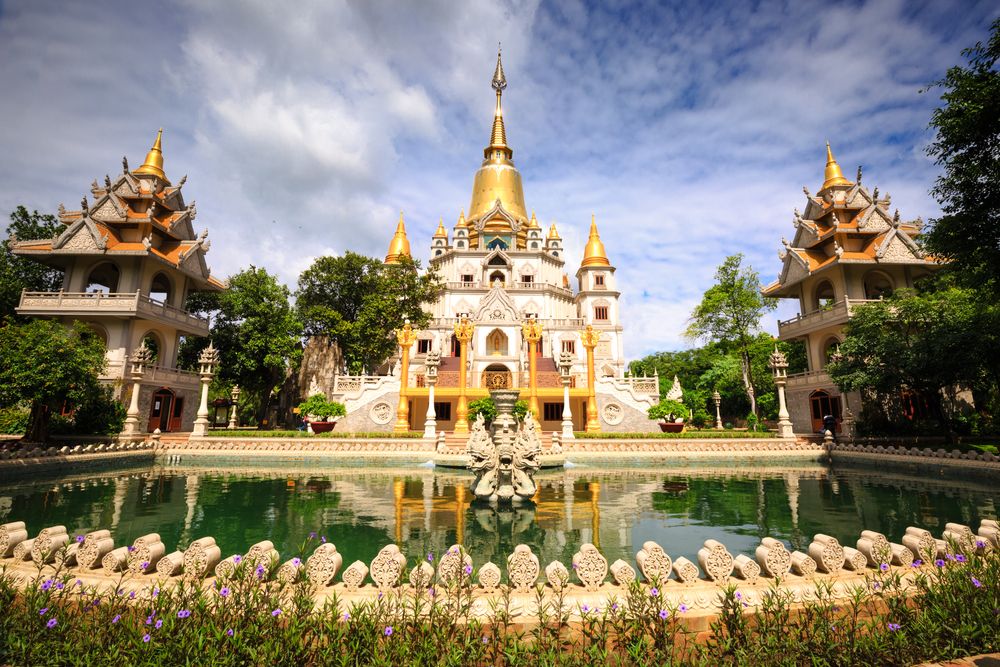
Bửu Long is one of the most visually surprising temples in Ho Chi Minh City. Hidden among trees on the eastern edge of the metropolis, it looks almost transplanted from Thailand or Myanmar: white walls, monumental staircases, gilded spires, dragon balustrades and a huge central stupa rising above a reflecting pool. Yet the complex is neither a Thai temple copied into Vietnam nor a decorative fantasy. It belongs to the Theravada Buddhist tradition and combines architectural ideas from India, Sri Lanka, Myanmar, Thailand, Laos and Vietnam into a deliberately Southeast Asian religious language.
The temple stands in Long Bình, around 20 kilometres from central Saigon, on elevated ground not far from the Đồng Nai River. Its atmosphere is radically different from incense-heavy Chinese-Vietnamese temples such as the Jade Emperor Pagoda or Thiên Hậu Temple. Bửu Long is more spacious, quieter and more geometrically ordered, with the enormous Gotama Cetiya dominating the complex.
It is also relatively young. The first religious foundation dates only to 1942, while much of the architecture visitors admire today results from major rebuilding and expansion completed in the early twenty-first century. That recent date matters: Bửu Long is not an ancient ruin but a modern expression of Vietnamese Theravada Buddhism.
What to See at Bửu Long Temple
- Gotama Cetiya
- The main golden stupa
- The four smaller surrounding stupas
- The grand ceremonial staircase
- Dragon and naga balustrades
- The reflecting pool
- The main prayer hall
- The monastery buildings
- The Bodhi tree
- The landscaped gardens
- The panoramic setting above eastern Saigon
- The vegetarian canteen
The Origins of Bửu Long
The temple was established in 1942, when a small Buddhist sanctuary was created on wooded land overlooking the eastern approaches to Saigon. The foundation was modest compared with the monumental complex seen today, and the site developed gradually rather than according to one original master plan.
A decisive change came in 1958, when the temple became connected with Vietnamese Theravada Buddhism, sometimes called Southern or Nam Tông Buddhism in Vietnam. The tradition differs in several important respects from the Mahayana Buddhism more commonly encountered in Vietnamese pagodas.
In 1961, Sri Lankan monk Narada Mahathera, an important figure in the international revival and dissemination of Theravada Buddhism during the twentieth century, presented the temple with a Bodhi tree descended from the sacred Bodhi tradition associated with Bodh Gaya, where Siddhartha Gautama is believed to have attained enlightenment.
The modern temple therefore emerged from both Vietnamese religious history and wider transnational Buddhist connections linking Vietnam with Sri Lanka and mainland Southeast Asia.
Theravada Buddhism in Vietnam
Vietnam is usually associated with Mahayana Buddhism, particularly traditions shaped by Chinese religious culture. Those temples often contain several Buddhas, bodhisattvas, guardian deities, ancestors and figures from Chinese popular religion.
Bửu Long feels different because it follows Theravada Buddhism, the tradition dominant in Sri Lanka, Thailand, Myanmar, Cambodia and Laos. Worship centres much more directly on the historical Buddha, monastic discipline and canonical teachings preserved in the Pali tradition.
This difference is immediately visible. The architectural complex is dominated by a cetiya rather than crowded deity halls, and devotional practice tends to be quieter and more restrained.
One of Bửu Long’s most unusual characteristics in the Vietnamese context is the absence of the dense incense smoke and elaborate offering culture found at many other pagodas. Visitors come primarily to pray, meditate and pay respect rather than covering altars with incense sticks and votive objects.
That gives the complex an unusually clear, calm atmosphere.
Gotama Cetiya
The architectural centrepiece is Gotama Cetiya, a monumental reliquary structure rising more than 70 metres above the temple grounds.
The word cetiya broadly refers to a sacred monument associated with the Buddha, relics or places of remembrance. In architectural terms, it belongs to the same family of religious structures usually called stupas.
At Bửu Long, the composition is far more elaborate than a single dome. A huge central golden stupa rises from a multi-level white base surrounded by smaller towers, pointed arches and intricate relief decoration. Four secondary stupas frame the main mass, producing the symmetrical silhouette that makes the building appear almost palace-like when seen from the reflecting pool.
The scale can be difficult to appreciate in photographs. From ground level the upper spire seems to continue much farther into the sky than expected, particularly when approached along the central axis.
Why It Looks Thai
The first reaction of many visitors is that Bửu Long looks like Thailand.
There is some truth to that impression, but it oversimplifies the architecture.
Golden stupas, sharply pointed roofs and the strong white-and-gold colour scheme clearly evoke Theravada architecture found in Thailand. Yet the complex also incorporates influences from Myanmar, Sri Lanka, India, Laos and Cambodia, as well as Vietnamese decorative traditions.
The main cetiya draws particularly strongly on the architectural vocabulary of Theravada Southeast Asia rather than traditional northern Vietnamese pagoda design. The result is intentional: the temple visually connects Vietnamese Theravada Buddhism with the wider religious world to which it belongs.
Look closely at the stairways and façade, however, and Vietnamese motifs begin to appear alongside the broader regional vocabulary.
Bửu Long is therefore better described as Southeast Asian Theravada architecture developed in Vietnam rather than simply a Thai-style temple.
The White and Gold Palette
The colour scheme is one of the reasons the temple appears so striking.
Bright white masonry forms the architectural base, while gold concentrates attention on stupas, finials, columns and sacred details. Against blue sky and tropical greenery, the contrast becomes almost graphic.
Gold in Buddhist architecture represents more than wealth. It is associated with sacred radiance, spiritual purity and the transcendent nature of the Buddha. White reinforces ideas of clarity and purity while allowing the gilded elements to remain visually dominant.
This controlled palette also differentiates Bửu Long from the deep reds, dark timber and incense-blackened surfaces typical of older Chinese-influenced temples in Saigon.
The Central Stupa
The main stupa is the most important vertical element in the composition. Its large golden body rises above successive terraces before narrowing into a tall finial, giving the monument the unmistakable profile associated with Theravada Buddhist reliquary architecture.
Stupas developed from ancient Indian burial and reliquary monuments. Over centuries, their form travelled with Buddhism and changed radically across Asia. Sri Lankan dagobas became massive white domes, Burmese stupas developed elegant bell shapes and Thai architecture introduced increasingly slender golden profiles.
Bửu Long deliberately draws from that broader tradition.
The important point is that the stupa is not simply decorative. It represents the sacred presence of Buddhism through architecture itself.
The Four Smaller Stupas
Around the central structure stand four subsidiary stupas, each reinforcing the symmetry of Gotama Cetiya.
These smaller towers make the main stupa appear even larger while creating a stepped skyline rather than one isolated vertical spike. From a distance, the entire structure resembles a compact sacred city rising above the trees.
Move sideways rather than photographing only from directly in front. The overlapping forms become far more complex from oblique angles, and individual smaller stupas begin to separate visually from the central mass.
The architecture rewards movement.
The Ceremonial Staircase
A wide staircase leads towards the main sacred structure, flanked by elaborate sculptural balustrades.
Like many Buddhist monuments, Bửu Long uses elevation deliberately. Visitors physically climb from the ordinary ground level towards increasingly sacred space. The ascent is therefore both practical and symbolic.
The staircase also slows movement. You cannot simply walk straight into the main structure at street level; the architecture forces a gradual approach, giving time to look upward and become aware of the monument’s scale.
This is one reason the cetiya feels considerably larger in person than in photographs.
Dragons, Naga and Sacred Guardians
The staircases and terraces are decorated with long serpent-like forms that can be read through both Vietnamese dragon imagery and the broader Buddhist tradition of the naga.
Nagas are serpent beings found throughout South and Southeast Asian mythology. In Buddhist tradition, the naga king Mucalinda famously protected the meditating Buddha from rain by spreading his hood above him.
As Buddhism moved across Southeast Asia, naga imagery became closely associated with temple staircases, balustrades and entrances. Cambodia, Laos and Thailand preserve particularly elaborate examples.
At Bửu Long, these sinuous guardians help connect Vietnamese visual culture with this wider Theravada symbolic world.
The Reflecting Pool
The large pool directly in front of Gotama Cetiya is one of the temple’s strongest architectural devices.
On calm days, the entire white-and-gold façade reflects in the water, nearly doubling the monument visually. The pool also creates physical distance between visitor and building, preventing the enormous cetiya from feeling compressed.
Water has longstanding symbolic associations in Buddhist and Southeast Asian architecture, including ideas of purification, calm and separation between sacred and ordinary space.
Here it also works extremely well as landscape design.
For photography, early morning provides the best chance of still water and softer light.
The Bodhi Tree
The temple’s Bodhi tree carries particular religious importance.
In Buddhist tradition, the Bodhi tree represents the tree beneath which Siddhartha Gautama attained enlightenment at Bodh Gaya in northern India. Descendants and symbolic reproductions of that tree have been planted throughout the Buddhist world for more than two thousand years.
The tree at Bửu Long was presented in 1961 by Narada Mahathera of Sri Lanka, linking the Vietnamese monastery directly with the international Theravada community.
It is easy to overlook beside the spectacular architecture, but spiritually it is one of the most significant elements in the complex.
Narada Mahathera and the International Buddhist Connection
Narada Mahathera was one of the most influential Sri Lankan monks involved in the spread of Theravada Buddhism beyond Sri Lanka during the twentieth century.
He travelled extensively through Asia and other parts of the world, establishing relationships with Buddhist communities and encouraging the revival of Pali-based Theravada practice.
His connection with Bửu Long illustrates something important about modern Buddhism: religious traditions did not simply remain within national borders. Monks, texts, relics and Bodhi trees circulated internationally, creating networks between Sri Lanka, Vietnam and the Theravada countries of mainland Southeast Asia.
Bửu Long’s architecture later gave those connections a monumental visual form.
The 2007 Reconstruction
The temple’s present appearance owes much to a major restoration and redevelopment completed around 2007.
This explains why the complex looks so pristine compared with centuries-old pagodas elsewhere in Ho Chi Minh City. The monumental cetiya is not an ancient survivor but part of a modern architectural project built around an older religious foundation.
That distinction is worth making because age is not what makes Bửu Long interesting.
Its significance lies in how a twentieth- and twenty-first-century Vietnamese Theravada community chose to express itself architecturally, deliberately drawing from a shared Southeast Asian sacred vocabulary.
In that sense, the temple is an architectural statement about identity.
Why There Is So Little Incense
Visitors familiar with Vietnamese pagodas may immediately notice the lack of smoke.
Bửu Long is sometimes nicknamed the “pagoda without incense smoke.” Devotion here is not centred on burning large quantities of incense or leaving extensive votive offerings. Prayer, meditation and respectful presence take precedence.
This is partly connected with Theravada religious practice and partly with the monastery’s own devotional culture.
The difference becomes particularly striking if you visit the Jade Emperor Pagoda or Thiên Hậu Temple on the same trip. Those temples can be visually dense, crowded with altars, statues, smoke and offerings; Bửu Long feels spacious and almost contemplatively empty by comparison.
Neither approach is more authentically Buddhist. They belong to different religious histories.
The Monastery
Bửu Long remains a functioning monastery, not merely an architectural attraction.
Resident monks follow Theravada monastic practice, and parts of the complex are devoted to study, meditation and everyday community life. Visitors should therefore distinguish between public architectural areas and spaces intended for monastic use.
Monks in Theravada communities traditionally wear saffron or ochre robes, although shades vary considerably by country and individual monastic tradition.
The sight of monks moving through the immense white-and-gold complex is visually striking, but they are not part of the scenery. Photograph discreetly and never interrupt religious activity for a posed image.
The Gardens
The temple occupies roughly 11 hectares, unusually generous for a religious complex inside modern Ho Chi Minh City.
Trees and landscaped areas soften the monumental architecture and help isolate the monastery from surrounding urban expansion. This greenery is one of the reasons Bửu Long feels more remote than it actually is.
The setting also makes the temple particularly pleasant early in the morning, when birds, wind through the trees and occasional temple sounds replace Saigon’s usual mechanical background.
Do not rush directly from entrance to cetiya. The landscape is part of the experience.
A Different Face of Saigon
Bửu Long is valuable precisely because it contradicts the stereotype of Ho Chi Minh City.
Central Saigon is dense, noisy, commercial and highly vertical. Bửu Long is spacious, green and deliberately contemplative. It demonstrates that the expanded metropolis contains religious landscapes completely different from the old colonial centre.
Its location also reveals how dramatically Saigon has expanded eastward. Areas once considered peripheral now belong to an increasingly continuous metropolitan landscape stretching towards the Đồng Nai River.
Visiting Bửu Long therefore gives you both a religious monument and a lesson in the geography of modern Ho Chi Minh City.
The Vegetarian Canteen
The monastery includes a simple vegetarian canteen, generally operating during the daytime.
Meals are inexpensive and uncomplicated, designed more for monks, pilgrims and ordinary visitors than for culinary tourism. Expect rice, vegetables, tofu and straightforward Vietnamese vegetarian preparations rather than elaborate restaurant-style dishes.
Eating here can be a pleasant extension of the visit if the timing works, but do not approach it expecting a destination restaurant.
The canteen usually operates roughly 08:00–14:00.
When to Visit
Early morning is the best period overall.
Temperatures are lower, the complex is quieter and the white architecture photographs far better before the intense midday light flattens detail. Reflections in the pool are also more likely to remain undisturbed.
Late afternoon is another good option, particularly when warmer sunlight catches the golden stupas.
Avoid arriving between 11:00 and 14:00 if interior access matters. The outer grounds remain accessible during the midday period, but visitors are generally not admitted into the main interior spaces while the monastery observes its quieter midday schedule.
How Long Do You Need?
Allow 60–90 minutes for a normal visit.
Architecture enthusiasts and photographers can easily spend two hours studying the cetiya, gardens and decorative details. Add lunch at the vegetarian canteen and the excursion becomes a comfortable half-day once transport from central Saigon is included.
Do not combine it with six other temples simply because each looks close on a city map.
The journey east consumes real time.
How to Get to Bửu Long from Central Saigon
The temple lies around 20 kilometres northeast of the historic centre, at 81 Nguyễn Xiển Street, Long Bình.
A Grab car is the simplest option for most travellers. Depending on traffic, expect roughly 40–60 minutes from central Saigon, although rush-hour conditions can extend that considerably.
Motorbike rides are faster but involve a long journey through heavy traffic and should only be considered by travellers comfortable with that environment.
Metro Line 1 can reduce part of the road journey if you combine rail with a taxi or Grab from the eastern stations, making Bửu Long increasingly practical to reach without travelling entirely by car.
Combine It with Suối Tiên
Bửu Long lies relatively close to the eastern end of Metro Line 1 and the Suối Tiên area.
If you are curious about contemporary Saigon infrastructure, taking the metro east and completing the journey by Grab makes more sense than treating the railway simply as an attraction in itself.
The contrast is also interesting: one of the city’s newest pieces of transport infrastructure leads towards one of its most distinctive modern religious complexes.
Dress Code
This is an active Buddhist monastery, so dress accordingly.
Cover shoulders and knees, avoid very tight or revealing clothing and remove shoes where required. Hats should come off inside sacred interiors.
Visitors are expected to speak quietly and avoid disrupting monks or worshippers.
The temple is exceptionally photogenic, but the architecture does not turn the monastery into a fashion-shoot location. Avoid intrusive posing on sacred steps or directly in front of people praying.
Photography
The reflecting pool provides the classic symmetrical photograph, particularly in the morning.
For something better, walk to the sides and use the smaller stupas to frame the central tower. The grand staircase also produces excellent upward perspectives that emphasise the scale of Gotama Cetiya.
Cloudy weather can actually help. White walls retain texture while gold remains saturated, whereas harsh midday sun can create extreme contrast.
Aerial photographs make the temple look isolated in forest. Ground-level views reveal more clearly how the complex sits on the edge of the modern metropolis.
What Most Visitors Miss
The first mistake is describing Bửu Long simply as a “Thai temple.” Its architecture belongs to a much broader Theravada world and deliberately combines several South and Southeast Asian traditions.
The second is assuming the complex is centuries old because it looks monumental. The religious foundation dates from 1942, and much of the spectacular architecture reflects modern reconstruction.
The third is photographing Gotama Cetiya without noticing the Bodhi tree donated through Sri Lankan Buddhist connections.
The fourth is expecting a typical Vietnamese incense-filled pagoda. The relative absence of smoke and elaborate offerings is one of the clearest signs that you are entering a different Buddhist tradition.
And the fifth is rushing. Bửu Long is one of the few major Saigon sights where deliberately doing very little improves the visit.
Bửu Long vs Jade Emperor Pagoda
The contrast between the two temples is useful.
Jade Emperor Pagoda is dense, dark and atmospheric, rooted in Chinese-Vietnamese Taoist and Mahayana traditions. Incense fills small chambers crowded with deities, guardians and elaborate wooden carving.
Bửu Long is bright, open and symmetrical. Theravada architecture, spacious gardens and the huge central stupa dominate instead of a dense pantheon.
Visit both and the religious diversity of Ho Chi Minh City becomes far easier to understand.
Bửu Long vs Thiên Hậu Temple
Thiên Hậu in Chợ Lớn represents another world again.
Its Cantonese community heritage, worship of the sea goddess Mazu, ceramic roof figures and enormous incense coils tell the story of Chinese migration and mercantile Saigon.
Bửu Long belongs to modern Vietnamese Theravada Buddhism and connects the city with Sri Lanka, Thailand, Myanmar, Laos and Cambodia.
Architecturally and religiously, they are almost opposites.
Together they demonstrate why using the generic phrase “Buddhist temple” can conceal more than it explains.
Is Bửu Long Worth the Journey?
Yes, particularly if you have already seen central Saigon.
The temple is too far from Đồng Khởi and Bến Thành to treat as a casual twenty-minute detour, but that distance is also part of its appeal. The traffic gradually thins, buildings become lower and the immense golden cetiya eventually appears above the trees in a setting that feels disconnected from the commercial city left behind.
Bửu Long offers something rare in Ho Chi Minh City: monumental architecture with enough surrounding space to breathe.
More importantly, it adds a religious layer that many Saigon itineraries completely miss. The city is not only colonial Catholic architecture, Chinese temples and war history. It also contains a significant Theravada Buddhist tradition connected to the wider religious geography of South and Southeast Asia.
Come for the extraordinary stupa.
Stay long enough to understand why it looks so different.
Useful Information
- Name: Bửu Long Buddhist Temple / Chùa Bửu Long
- Location: Long Bình, Ho Chi Minh City
- Address: 81 Nguyễn Xiển Street, Long Bình, Ho Chi Minh City
- Distance from central Saigon: approximately 20 km
- Founded: 1942
- Buddhist tradition: Theravada / Nam Tông
- Major modern restoration: 2007
- Main monument: Gotama Cetiya
- Height of Gotama Cetiya: more than 70 metres
- Temple grounds: approximately 11 hectares
- Bodhi tree: presented in 1961 through Sri Lankan monk Narada Mahathera
- Admission: free
- General opening: approximately 08:00–18:00 daily
- Interior midday restriction: approximately 11:00–14:00
- Recommended visit: 60–90 minutes
- Best time: early morning
- Vegetarian canteen: generally 08:00–14:00
- Best transport from centre: Grab or taxi; Metro Line 1 plus road transfer is another option
- Dress: shoulders and knees covered
- Photography: permitted in public areas with respect for religious activity
- Essential nearby contrast: Jade Emperor Pagoda or the Chinese temples of Chợ Lớn

