
Saigon Travel Guide: Best Things to See, Eat and Do in Ho Chi Minh City

Saigon does not reveal itself through a single monument. Its identity is built from collisions: French boulevards and Chinese temples, communist memorials and old American-era hotels, incense-filled shrines and cocktail bars forty floors above the traffic, elegant villas disappearing behind tropical trees and alleys where breakfast is cooked at pavement level before most visitors have opened their curtains.
Officially, the city has been Ho Chi Minh City since 1976, but “Saigon” remains deeply embedded in everyday language, commercial names, food culture and the emotional geography of the historic centre. The distinction became even more interesting after Vietnam’s major administrative reorganisation in 2025. Modern Ho Chi Minh City now includes the former territories of Bình Dương and Bà Rịa–Vũng Tàu and has a population of roughly 14 million, while the old district structure was replaced by a two-tier system of wards and communes. Yet travellers, taxi drivers and residents still commonly use names such as District 1, District 3 and District 5 because they remain useful cultural and geographical shorthand.
For a visitor, “Saigon” is best understood as the historic urban core that developed around the Saigon River, the old colonial centre, Gia Định and Chợ Lớn, the great Chinese commercial city that eventually merged into metropolitan Saigon. This guide concentrates on that city: the place of Nguyễn Huệ and Đồng Khởi, Notre-Dame and the Central Post Office, the Independence Palace, Bến Thành, Chợ Lớn, cơm tấm, coffee, rooftop bars and the dense historical layers left by empire, war, migration and commerce.
Allow three full days at minimum. Four is better, especially if you want to explore Chợ Lớn properly and spend a day at the Củ Chi tunnels. Add the Mekong Delta and Saigon becomes a five- or six-day base rather than a stopover.
What to See in Saigon
- Independence Palace
- War Remnants Museum
- Notre-Dame Cathedral Basilica of Saigon
- Saigon Central Post Office
- Saigon Opera House
- Đồng Khởi Street
- Nguyễn Huệ Walking Street
- Ho Chi Minh City Hall exterior
- Bến Thành Market
- Ho Chi Minh City Museum of Fine Arts
- Jade Emperor Pagoda
- Tân Định Church
- Tao Đàn Park
- Chợ Lớn
- Thiên Hậu Temple
- Bình Tây Market
- Quan Âm Temple
- Hải Thượng Lãn Ông medicinal street
- Saigon River
- Bitexco and the modern skyline
- The Củ Chi tunnels
- The Mekong Delta
Saigon or Ho Chi Minh City?
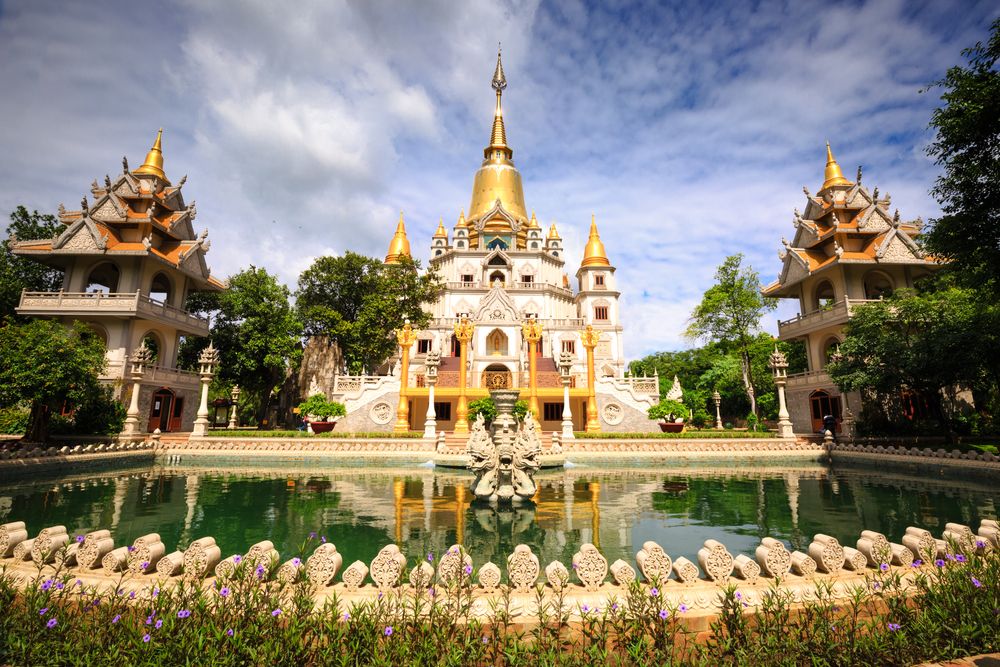
Both names are correct in different contexts. Ho Chi Minh City is the official name adopted in July 1976, when the National Assembly formally renamed Saigon–Gia Định after Hồ Chí Minh. “Saigon,” however, never disappeared from everyday speech. It remains especially common when referring to the historic centre, older institutions, southern food culture and the city’s pre-1975 history.
The situation changed again in 2025. Ho Chi Minh City was administratively enlarged through the merger of the former Ho Chi Minh City, Bình Dương Province and Bà Rịa–Vũng Tàu Province, creating a huge municipality of more than 6,700 square kilometres. At the same time, the former district governments disappeared and new wards were created, including a central Sài Gòn Ward.
This means an address written in 2026 may look different from the address printed in an older guidebook even though the building has not moved. Do not let this complicate your visit unnecessarily. Historic neighbourhood names remain extremely useful, and apps such as Grab generally recognise both older and newer address conventions.
Before Saigon: Khmer Prey Nokor and the Southern Frontier
Saigon’s history did not begin with the French or even with Vietnamese settlement. The wider lower Mekong region belonged to a complex Khmer cultural and political world, and the settlement often associated with early Saigon is known in Khmer historical memory as Prey Nokor.
From the seventeenth century, Vietnamese migration towards the south accelerated under the Nguyễn lords. Trading posts, agricultural settlements and administrative structures gradually expanded through the fertile river landscape. In 1698, Nguyễn Hữu Cảnh was sent south to establish formal Nguyễn administration in Gia Định, a date frequently treated as a major institutional milestone in the development of Vietnamese Saigon.
The story was never simply one of an empty frontier being occupied. Khmer communities, Chinese migrants, Vietnamese settlers and regional trading networks all contributed to the city that emerged. This multi-ethnic foundation becomes particularly visible later in Chợ Lớn, where Chinese merchant communities created one of Southeast Asia’s great urban commercial cultures.
Gia Định and the Nguyễn Citadels
By the late eighteenth century, Gia Định had become one of the crucial political centres of southern Vietnam. Nguyễn Ánh, the future emperor Gia Long, used the city as a strategic base during his long struggle against the Tây Sơn.
In 1790, an enormous fortified citadel known as the Bát Quái, or Eight Trigrams Citadel, was constructed. Its geometric defensive plan reflected a combination of Vietnamese priorities and contemporary military engineering. After the Lê Văn Khôi rebellion of the 1830s, Emperor Minh Mạng ordered the old fortress destroyed and replaced with a smaller citadel.
Almost nothing of these monumental fortifications survives in an immediately visible form today. Modern streets, colonial redevelopment and later construction erased the dramatic walls. Yet the citadel story matters because Saigon’s famous French urban plan was imposed over an older Vietnamese political landscape rather than created from nothing.
The French Capture of Saigon
French forces attacked Gia Định in 1859, and by the early 1860s France had established control over Saigon and much of southern Vietnam. The Treaty of Saigon in 1862 formalised the cession of several southern provinces, and Saigon became the capital of the French colony of Cochinchina.
The city was subsequently rebuilt with extraordinary ambition. Canals were filled, roads widened, government buildings erected and tropical boulevards planted with trees. Colonial planners sought to produce a recognisably French administrative city adapted to a hot, humid climate.
This is the origin of much of central Saigon’s surviving architecture: Notre-Dame Cathedral, the Central Post Office, Opera House, hotels on Đồng Khởi and the urban grid around what is now Nguyễn Huệ.
The phrase “Pearl of the Far East” is often attached to colonial Saigon. It should be used cautiously. The elegant boulevards and villas reflected genuine architectural sophistication, but they also represented a colonial system built on political domination and sharp social inequality. The city’s beauty and the structures of empire that produced it are part of the same history.
Rue Catinat: The Street That Became Đồng Khởi
Few streets tell Saigon’s history better than Đồng Khởi.
During the French period it was Rue Catinat, one of colonial Saigon’s most fashionable addresses, running from the river towards Notre-Dame Cathedral. Hotels, cafés, government buildings and shops catered to administrators, merchants, journalists and wealthy residents.
After French rule ended, it became Tự Do Street, meaning Freedom Street, and emerged as a central social corridor of South Vietnamese Saigon. Hotels such as the Continental and Caravelle became gathering places for correspondents, diplomats and military officials during the Vietnam War.
After reunification, the street was renamed Đồng Khởi, referring to the uprising movement against the South Vietnamese government in 1959–60.
One street, three names, three political orders.
Walk it slowly from the cathedral towards the river. Architecture becomes a chronological document if you know what you are looking at.
Independence Palace
The Independence Palace, also known historically as the Reunification Palace, is the single most important building for understanding twentieth-century Saigon.
The site first held the nineteenth-century Norodom Palace, built for the French colonial governor. After the French withdrawal, it became the presidential residence of Ngô Đình Diệm, leader of the Republic of Vietnam. In 1962, two South Vietnamese air force pilots bombed the building during an attempted coup, damaging it so severely that the old palace was demolished.
The present structure was designed by Ngô Viết Thụ, the first Vietnamese architect to win the Grand Prix de Rome. Completed in 1966, it is one of Southeast Asia’s most interesting examples of modernist state architecture. Concrete brise-soleil reinterpret bamboo forms, horizontal lines control the tropical light and ceremonial rooms combine modern design with Vietnamese symbolism.
The palace deserves at least ninety minutes. Its fascination lies not only in the famous rooms but in the building’s completeness: presidential offices, banquet spaces, diplomatic salons, maps, communications rooms, bunker corridors and rooftop helicopter area remain unusually legible.
In 2026 the palace is open daily from 07:00 to 18:00. A combined adult ticket covering the palace and the historical exhibition costs 80,000 VND, while palace-only admission is 40,000 VND.
30 April 1975
The most famous episode in the building’s history took place on 30 April 1975. North Vietnamese and National Liberation Front forces entered central Saigon as the Republic of Vietnam government collapsed. Tanks reached the presidential palace in the late morning, with tank 390 breaking through the main gate after tank 843 struck a side gate.
President Dương Văn Minh, who had assumed office only days earlier, announced surrender. The event marked the end of the Republic of Vietnam and the effective conclusion of the Vietnam War, followed formally by national reunification the following year.
Vietnamese state commemoration describes 30 April as Liberation Day and Reunification Day; many overseas Vietnamese communities associated with the former South Vietnam remember the same event through a very different historical and personal lens. The palace is therefore not simply a military victory monument. It remains one of the most emotionally and politically charged sites in modern Vietnamese history.
Visit the rooms before going into the bunker. The contrast between polished ceremonial modernism upstairs and the maps, radios and confined command spaces below is one of the strongest experiences in Saigon.
The Presidential Bunker
The basement changes the mood immediately. Narrow corridors lead into communications rooms, map rooms and reinforced spaces intended to keep command functioning during air raids and attack.
Telephones, radio equipment and military maps reveal the technological world of a government fighting a modern war before digital communication. Unlike reconstructed war attractions, the bunker is powerful because it remains physically attached to the presidential residence above.
The building becomes a vertical diagram of power: ceremony on the upper floors, administration in the middle and emergency command underground.
War Remnants Museum
The War Remnants Museum is emotionally difficult and essential.
Established in September 1975, it documents the wars fought in Vietnam during the twentieth century, with particular emphasis on the conflict involving the United States and the Republic of Vietnam. Exhibitions cover military operations, civilian casualties, imprisonment, unexploded ordnance, Agent Orange and the work of international war photographers.
The museum presents the conflict primarily through the interpretive framework of the Vietnamese state. That perspective should be understood rather than ignored, just as museums in the United States, France or former South Vietnam can frame the same events differently. The photographs and physical evidence, however, often carry a weight that goes beyond institutional interpretation.
One of the strongest sections is the collection of work by war photographers, including journalists killed during the conflict. Images of civilians, soldiers and destroyed landscapes prevent the war from remaining an abstract sequence of military campaigns.
Do not schedule another emotionally intense museum immediately afterward. Allow space to process what you have seen.
The museum is open daily from 07:30 to 17:30, with last admission at 17:00.
Notre-Dame Cathedral Basilica of Saigon
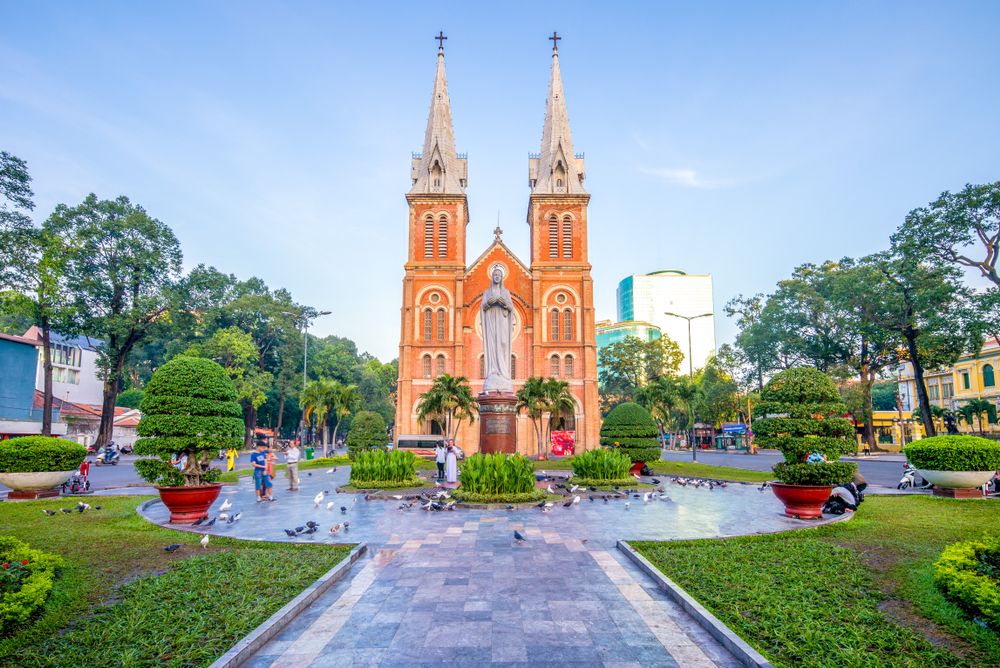
The red-brick towers of Notre-Dame Cathedral remain one of Saigon’s defining images, although the building is currently undergoing one of the most ambitious restorations in its history.
Construction began in 1877 and the cathedral was completed in 1880, using materials imported from France. Its neo-Romanesque structure, twin towers and red masonry were designed to establish a monumental Catholic presence in the colonial centre.
The bell towers were later extended with spires, giving the building the silhouette familiar today. In March 2026, two restored gold-plated crosses weighing more than 800 kilograms together were installed at roughly sixty metres above the ground, marking an important stage in the restoration.
For travellers, the critical practical point is simple: the cathedral remains closed to ordinary tourist visits during restoration in September 2026. It continues to function for Mass and religious worship, but sightseeing access to the interior is suspended.
The exterior remains worth seeing, particularly because the Central Post Office, Book Street and Đồng Khởi all begin within a few minutes’ walk.
A Restoration Without a Firm End Date
Restoration began in 2017 after more than a century of tropical weather had seriously deteriorated roofs, masonry, metalwork and towers. The project proved far more complicated than initially expected because replacement materials had to match historic components and much of the fabric was in worse condition than anticipated.
Earlier plans pointed towards completion in 2027, but by 2026 that target was no longer considered secure. Do not book a future trip on the assumption that the interior will definitely reopen by a particular year.
Even under scaffolding, the building remains historically important. The restoration itself is becoming another chapter in the cathedral’s biography.
Saigon Central Post Office
Across the square stands the Central Post Office, completed between 1886 and 1891 and still functioning as a post office.
The interior is more interesting than the façade. A vast vaulted hall uses iron structure, clerestory lighting and repeated arches to create something halfway between a railway station and a civic palace. Historic maps on the side walls show Saigon and regional communication networks, reminding visitors that this was once infrastructure at the heart of the colonial information system.
One detail deserves correction because it has been repeated endlessly: the current building is commonly attributed to Gustave Eiffel, but surviving historical evidence points instead to Alfred Foulhoux, chief architect of colonial Cochinchina, as the principal designer. Eiffel’s fame and the building’s iron structure made the false attribution irresistible.
Look up at the maps rather than spending the entire visit photographing the main hall. They explain what the building was originally for: connecting Saigon with an empire through post and telegraph.
Saigon Opera House
The Saigon Opera House, officially the Municipal Theatre, opened in 1900 as an entertainment venue for the colonial elite. Architect Eugène Ferret produced an ornate façade influenced by late nineteenth-century French theatrical architecture, with sculptural decoration, arches and a grand approach from Lam Sơn Square.
Its history changed with politics. In the 1950s it served as the assembly building of South Vietnam before later returning to theatrical use.
The exterior is easy to see at any time, but the interior is best experienced through a performance rather than a rushed architecture visit. Productions vary, ranging from concerts to contemporary Vietnamese stage shows.
The surrounding block is also unusually rich in historical architecture: the Continental Hotel, Caravelle, Park Hyatt and Đồng Khởi all sit within a few minutes.
Continental Hotel and the Journalists’ Saigon
The Hotel Continental, opened in 1880, is part of Saigon’s literary and wartime mythology. Graham Greene stayed here and used the atmosphere of colonial and early Cold War Saigon in The Quiet American. Later, correspondents covering the Vietnam War gathered in hotels around Lam Sơn Square, particularly the Continental and nearby Caravelle.
It is tempting to romanticise the foreign-correspondent era into typewriters, whisky and rooftop sunsets. The reality was more serious. Journalists used these hotels as working bases while reporting a war unfolding throughout the country.
You do not need to stay here to appreciate the location. Walk the short section of Đồng Khởi between the Opera House and river and imagine how tightly concentrated diplomatic, military, commercial and journalistic life once was.
Nguyễn Huệ Walking Street
Nguyễn Huệ is modern Saigon presenting itself confidently.
The long pedestrian boulevard runs towards the Saigon River, with the ornate former Hôtel de Ville—today Ho Chi Minh City Hall—at one end and modern towers at the other. The space becomes especially lively after dark, when families, teenagers, street performers and coffee drinkers occupy the broad pavement.
The city hall itself dates from the French colonial period and is one of Saigon’s most elegant civic façades. It is primarily an exterior sight, although limited public opening programmes have occasionally allowed interior visits.
The boulevard is also the best place to understand the scale of modern central Saigon. Colonial landmarks survive, but glass towers, malls and high-rise apartments increasingly frame them.
Come once during daylight and again after dinner.
The Apartment Café Building
At 42 Nguyễn Huệ, an old apartment block was gradually transformed into a vertical collection of cafés, boutiques and small businesses. Its irregular balconies, signs and hidden staircases became a symbol of Saigon’s ability to repurpose old urban fabric rather than demolish everything immediately.
The building is not an ancient monument and individual tenants change frequently. That instability is part of the appeal. It represents contemporary Saigon more accurately than a preserved colonial museum.
Enter, climb several levels, choose a café and look back over Nguyễn Huệ.
Bến Thành Market
Bến Thành has become so famous that it is easy to dismiss it as touristy. It is touristy. It is also historically important.
Markets operated near the old Gia Định citadel and river wharves for centuries. The current Bến Thành market building was begun in 1912 and inaugurated in 1914, creating a new central commercial landmark with its recognisable clock tower.
Inside, stalls sell spices, dried foods, fruit, coffee, textiles, cookware, souvenirs and prepared dishes. Bargaining remains normal in many non-food sections, though fixed-price shops are increasingly common.
Come early if you want to see more produce and local activity. Come later if shopping is the priority. Do not expect every souvenir to be locally handmade simply because it is sold inside an old market.
For food, try hủ tiếu, bánh bèo, bánh xèo, chè or fresh fruit rather than relying solely on a restaurant lunch.
Ben Thanh Metro Station: A New Layer Beneath the Old Market
Saigon finally opened its first metro line in December 2024, connecting Bến Thành with Suối Tiên over a 19.7-kilometre route with fourteen stations.
The symbolism is hard to miss. Bến Thành, a commercial hub for more than a century, has become the central station of the city’s new urban rail era.
For travellers staying downtown, the metro is useful for moving east towards newer districts and attractions along the corridor. It does not yet replace taxis, Grab or walking for most sightseeing, but it represents a significant change in a city historically dominated by motorcycles.
The line also changes the experience of Bến Thành Square itself. What was long a chaotic construction zone now functions as a transport gateway.
Ho Chi Minh City Museum of Fine Arts
The Museum of Fine Arts occupies one of the most attractive early twentieth-century mansions in central Saigon. The building blends European planning with Asian decorative elements, coloured glass, patterned tile and elegant internal staircases.
The museum is worth visiting for both building and collection. Vietnamese modern art, lacquer painting, sculpture and twentieth-century works provide an important counterweight to the city’s war-heavy museum circuit.
Allow around 90 minutes. The museum currently opens daily from 08:00 to 17:00, with standard adult admission around 30,000 VND.
The surrounding streets between the museum and Bến Thành also reward wandering. This part of the centre retains old warehouses, narrow shophouses and small food businesses increasingly squeezed between redevelopment projects.
The Jade Emperor Pagoda
The Jade Emperor Pagoda, also known as Phước Hải Tự, is one of Saigon’s most atmospheric religious spaces. Built by Cantonese migrants in the late nineteenth and early twentieth centuries and inaugurated in 1906, it combines Taoist, Buddhist and Chinese popular religious traditions.
Inside, incense darkens the air and carved figures fill cramped rooms with a density completely unlike the spacious Buddhist temples of Luang Prabang or Bangkok. The principal deity is the Jade Emperor, supreme ruler of heaven in Chinese religious cosmology, surrounded by an elaborate divine bureaucracy of guardians, judges and spirits.
One chamber is particularly associated with fertility and childbirth, where worshippers pray before the Mother Goddess and figures representing midwives.
The temple remains active. Move slowly, avoid blocking worshippers and do not treat incense smoke as decorative theatre.
Barack Obama visited in 2016, which increased international attention, but the pagoda was important to Saigon’s Chinese-Vietnamese religious world long before presidential motorcades arrived.
Tân Định Church
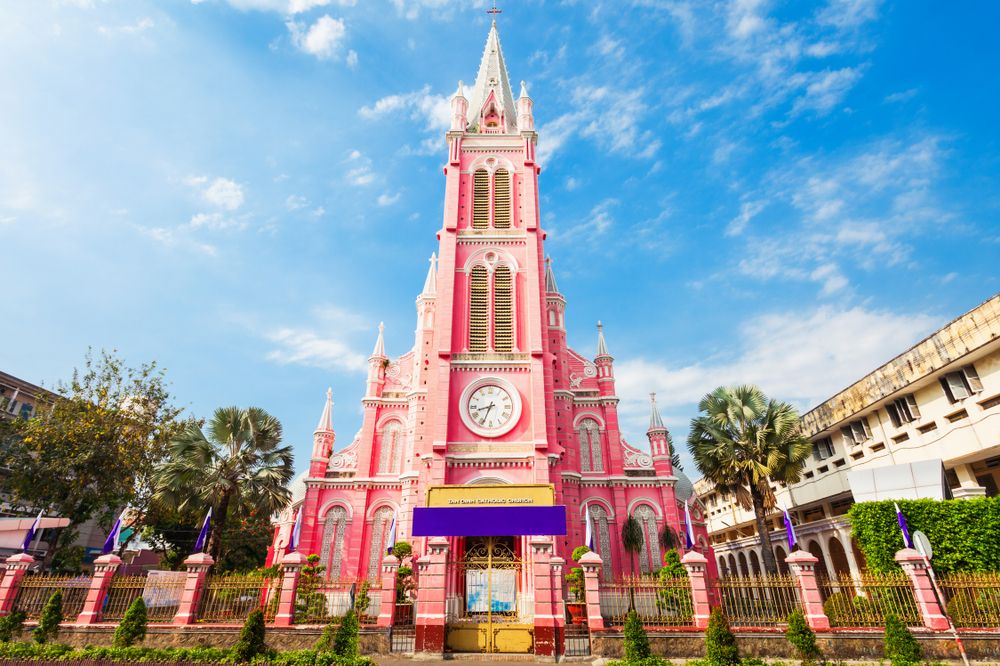
The vivid pink Tân Định Church is impossible to confuse with any other landmark. Its current appearance combines nineteenth-century Catholic origins with later additions, Gothic and Romanesque references, and a colour scheme that has made it one of the city’s most photographed buildings.
The church belongs to a different Saigon from monumental Notre-Dame. It sits within a busy neighbourhood of markets, cafés and houses rather than an imperial colonial square.
Combine it with Tân Định Market and a walk through nearby streets. The surrounding district gives a much better impression of everyday central Saigon than a route confined entirely to the ceremonial core.
Tao Đàn Park
Tao Đàn provides forty hectares of shade and breathing room close to the Independence Palace. Mature tropical trees, exercise areas and informal social groups make it useful both historically and practically.
Early morning is the most interesting time. Residents exercise, walk, practise badminton and gather with coffee. The city feels radically different before traffic peaks and midday heat builds.
For years the park was also famous for gatherings of men bringing caged songbirds, a tradition that has become less visible but remains part of the park’s cultural memory.
Use Tao Đàn as a pause between monuments rather than another attraction to tick off.
Chợ Lớn: The Other Historic City
Do not leave Saigon without spending half a day in Chợ Lớn.
Its name literally means “Big Market.” Chinese communities, especially Cantonese, Teochew, Hokkien, Hakka and Hainanese migrants, developed the area into a major trading centre from the eighteenth century. Saigon and Chợ Lớn were once distinct urban entities before their growth gradually fused them together.
Today the old Chinatown spreads through areas historically associated with Districts 5 and 6, including the modern wards of Chợ Lớn, An Đông and Bình Tây. The architectural language changes immediately: Chinese assembly halls, medicine shops, narrow trading streets, market warehouses and temples replace the French monumental axis of central Saigon.
This is not a theme-park Chinatown. Chinese-Vietnamese religious, culinary and commercial life remains active, even though demographic change and redevelopment have transformed the area.
Start at Thiên Hậu Temple, then walk through the medicine streets before continuing to Bình Tây Market.
Thiên Hậu Temple
Built around 1760 by the Cantonese community, Thiên Hậu Temple is dedicated to Mazu, the protective sea goddess worshipped throughout maritime Chinese communities.
The architecture is extraordinarily dense. Ceramic figurines crowd the roofline, carved wood panels frame the halls and enormous spiral incense coils hang from the ceiling, slowly burning for hours or days.
Mazu’s presence tells the story of migration. Communities travelling by sea from southern China placed enormous spiritual importance on a deity capable of protecting sailors and families during dangerous voyages.
The temple becomes especially busy around Mazu’s birthday on the twenty-third day of the third lunar month, when processions and celebrations animate the surrounding streets.
Visit in the morning when shafts of light cut through incense smoke and the temperature remains bearable.
Bình Tây Market
If Bến Thành is Saigon’s internationally famous market, Bình Tây is Chợ Lớn’s commercial engine.
The current market was developed in the early twentieth century with major support from Chinese-Vietnamese businessman Quách Đàm, whose commercial success became inseparable from the growth of Chợ Lớn.
The architecture combines a large central courtyard with tiled roofs, clock elements and Chinese decorative references. Wholesale trading remains important, and the atmosphere is generally more functional than Bến Thành.
This makes it particularly rewarding in the morning, when goods move through the market rather than merely sitting on souvenir shelves.
Do not come expecting a polished attraction. Come to see commerce operating.
Hải Thượng Lãn Ông Street
One of Chợ Lớn’s most distinctive streets is dedicated to traditional Chinese and Vietnamese medicine. Shops are stacked with roots, dried bark, seeds, herbs, fungi and ingredients whose smells mix into a dense medicinal perfume.
The street is named after Hải Thượng Lãn Ông, one of Vietnam’s most famous historical physicians.
Even if you are not buying anything, walk slowly and look at the drawers, weighing scales and bundles of ingredients. This is commercial heritage still performing its original function.
Avoid buying medicinal products you cannot identify or legally import home.
Quan Âm Temple
Not far from Thiên Hậu, Quan Âm Temple provides another glimpse into Chợ Lớn’s religious diversity. Associated with Fujian/Hokkien communities and dedicated to Guanyin, the bodhisattva of compassion, it combines carved wood, ceramic decoration, incense and numerous secondary deities.
Visiting several Chinese temples in succession is useful because their differences become easier to see. Deities, community affiliations and ritual practices vary considerably even when the architectural language appears similar at first.
Give Chợ Lớn time. A taxi from temple to market to temple destroys much of the experience; the commercial streets between them are the real connective tissue.
The Saigon River

For centuries, the river was the reason Saigon mattered. Goods, soldiers, migrants and colonial administrators all entered through waterways connecting the city with the Mekong Delta and South China Sea.
Modern development turned much of the central waterfront into roads and infrastructure, but the relationship between city and river is becoming more visible again through promenades, water buses and major redevelopment projects.
Walk from Nguyễn Huệ towards the river after sunset. The view east has changed dramatically as towers and development expanded across the water.
A water-bus trip is inexpensive and gives the skyline a completely different scale.
Saigon’s Modern Skyline
Colonial Saigon was famously horizontal. Modern Ho Chi Minh City is not.
The Bitexco Financial Tower, completed in 2010, became the first truly iconic symbol of the new skyline with its projecting helipad and curved profile. It was later surpassed in height by Landmark 81, which rises in the eastern metropolitan area and dominates long-distance views.
These towers are not architectural replacements for old Saigon. They represent a different city produced by the post-Đổi Mới economic transformation that accelerated after market-oriented reforms beginning in 1986.
Seeing the skyline after visiting the Independence Palace is particularly revealing. Few cities display the transition from wartime command economy to globalised commercial metropolis so physically.
Rooftop Saigon
Saigon’s rooftop culture predates the current skyscraper boom. During the Vietnam War, hotel rooftops were observation points, social venues and informal newsrooms for foreign correspondents.
Today the experience is less dramatic but still worth doing once. Choose a rooftop with a real connection to the historical centre rather than simply the highest possible floor. A view over the Opera House, Đồng Khởi and river tells more of the city’s story than an anonymous panorama from a distant residential tower.
Go shortly before sunset and remain until the lights come on. The transition from tropical haze to neon is more interesting than either moment alone.
What to Eat in Saigon
Saigon may be Vietnam’s most democratic food city. Fine dining exists, but the defining dishes are still built around street stalls, family shops and neighbourhood specialities.
Start with cơm tấm, broken rice traditionally associated with inexpensive rice fragments once considered less desirable than whole grains. In Saigon it became a complete meal topped with grilled pork chop, shredded pork skin, egg cake, pickles and scallion oil, finished with fish sauce. A plate at Cơm Tấm Ba Ghiền shows the maximalist version: huge smoky pork chops, rich accompaniments and enough food to remove lunch from your schedule.
Hủ tiếu Nam Vang reflects southern Vietnam’s Cambodian-Chinese culinary networks, combining clear pork broth, rice or tapioca noodles, minced pork, prawns and herbs. Bún thịt nướng layers grilled pork over rice vermicelli with herbs, peanuts, pickled vegetables and fish sauce, while bánh xèo turns rice batter, turmeric, pork and shrimp into a crisp pancake wrapped in greens.
Then come the foods that define Saigon evenings: snails, clams, scallops, crab claws and shellfish cooked with tamarind, garlic, chilli, coconut milk or salted egg. At Ốc Đào, the meal works best as a table full of shared plates rather than a conventional starter-main-dessert progression.
Bánh Mì in Saigon
The Vietnamese baguette is a direct product of cultural adaptation. French bread arrived through colonialism; Vietnamese cooks transformed it through rice flour blends, lighter crumb, local pâtés, pickles, herbs, chilli, pork and sauces.
Saigon versions are often aggressively filled. At Bánh Mì Huynh Hoa – Lê Thị Riêng, the sandwich is famous for an almost absurd quantity of cold cuts, pâté and butter. It is expensive by street-food standards and not remotely delicate, but it demonstrates the city’s exuberant interpretation of bánh mì.
For comparison, eat another from a smaller neighbourhood cart. Bánh mì is not one standard recipe; it is a format with endless local variations.
Pho in Saigon
Phở originated in northern Vietnam, but Saigon created its own distinctive expression. Southern bowls tend to arrive with abundant herbs, bean sprouts, chilli, lime and sauces, allowing diners to modify the broth more aggressively than in many northern traditions.
Phở Hòa Pasteur is one of the long-established names worth knowing. The broth is fuller and the garnish culture unmistakably southern.
Do not turn the Hanoi-versus-Saigon phở argument into a search for the objectively superior bowl. They express different regional histories and eating habits.
Coffee: From Colonial Crop to Urban Ritual
Vietnamese coffee culture emerged from colonial agricultural systems but developed into something entirely its own. Strong dark-roasted coffee filtered through a phin and mixed with condensed milk became a practical response to local ingredients, climate and taste.
Order cà phê sữa đá for the classic iced combination of strong coffee, condensed milk and ice. Try cà phê đen đá if you want the coffee without sweetness.
Modern Saigon also has a serious speciality-coffee scene working with Vietnamese arabica from Đà Lạt and other highland regions. Drinking one traditional dark phin coffee and one lighter modern pour-over is a useful way to see how rapidly the country’s coffee culture is changing.
Do not rush café time. Saigon uses coffee socially, commercially and almost architecturally; cafés occupy everything from pavement stools to old apartment towers.
Beer, Bia Hơi and Drinking Culture
Saigon’s drinking culture is built less around formal bars than around nhậu, the long social ritual of eating and drinking with friends. Beer arrives with grilled seafood, hotpots, snails and endless shared plates.
Bia Saigon remains the obvious local brand, with Saigon Special and Saigon Lager widely available. Craft beer has also developed rapidly, often using Vietnamese ingredients such as passion fruit, coffee and local spices.
The key to a proper nhậu meal is pace. Food keeps coming, glasses keep filling and nobody expects the evening to move efficiently.
Where to Eat: Modern Vietnamese Cooking
Anan Saigon
Anan Saigon occupies a narrow tube house inside the old Tôn Thất Đạm market area and is the city’s most internationally recognised contemporary Vietnamese restaurant. Chef Peter Cường Franklin treats street-food forms as material for modern restaurant cooking rather than replacing them with generic luxury ingredients. Bánh xèo becomes a taco, cơm tấm is reinterpreted through fine-dining technique and fish sauce can appear in dessert.
Current tasting menus run from roughly US$115 to US$145 before pairings, so this is not everyday Saigon cooking. The value lies in seeing how a chef raised in Vietnam and trained internationally translates street-food memory into contemporary gastronomy.
Address: 89 Tôn Thất Đạm
Opening: Tuesday–Sunday from 17:00
Best for: modern Vietnamese tasting menus and a deliberate contrast with street food
Vietnam House
Vietnam House Restaurant Đồng Khởi offers a polished interpretation of Vietnamese cooking directly on Đồng Khởi. It is less experimental than Anan and better suited to travellers who want refined versions of recognisable dishes in a formal setting.
Address: 93–97 Đồng Khởi
Best for: elegant Vietnamese dinner in the historic centre
Secret Garden
Secret Garden became popular for its rooftop setting and home-style Vietnamese dishes served in a deliberately nostalgic environment. It is more visitor-oriented than a neighbourhood canteen, but remains useful when a group wants a broad range of familiar southern dishes in one place.
Address: 158 Pasteur
Best for: casual shared dishes and atmosphere
Where to Stay
Park Hyatt Saigon
Park Hyatt Saigon occupies one of the strongest locations in the city, directly on Lam Sơn Square beside the Opera House. Its design consciously references French-colonial Saigon without reproducing an old building, while 245 rooms and a large courtyard pool provide a degree of calm difficult to find in the centre.
Address: 2 Lam Sơn Square
Telephone: +84 28 3824 1234
Best for: luxury, historical location and walking access to central landmarks
Hôtel des Arts Saigon – MGallery
Hôtel des Arts Saigon – MGallery Collection mixes mid-century references, contemporary luxury and a strong rooftop-pool identity. It sits slightly away from the riverfront but close to the cathedral, War Remnants Museum and District 3.
Address: 76–78 Nguyễn Thị Minh Khai
Best for: design, rooftop atmosphere and a central position without being directly on Đồng Khởi
The Myst Đồng Khởi
The Myst Dong Khoi uses reclaimed materials, planted balconies and references to old Saigon houses rather than conventional international-hotel aesthetics. The river and Nguyễn Huệ are close enough to reach on foot.
Address: 6–8 Hồ Huấn Nghiệp
Best for: character, design and central river access
A Perfect First Day in Saigon
Start at Independence Palace when it opens and spend at least ninety minutes inside. From there walk through Tao Đàn Park towards the War Remnants Museum, allowing another ninety minutes for the exhibitions.
After lunch, continue to Notre-Dame Cathedral and the Central Post Office. Walk down Đồng Khởi past the Continental and Opera House, then turn towards Nguyễn Huệ.
Stay in the area until evening rather than returning to the hotel. The historic centre makes more sense after dark, when colonial façades are illuminated and pedestrian life takes over Nguyễn Huệ.
Finish with Vietnamese dinner followed by one rooftop drink overlooking the old central district.
A Second Day: Chợ Lớn and the Chinese City
Begin at Thiên Hậu Temple before the incense coils and courtyards become crowded. Walk rather than immediately calling another car, exploring the surrounding shophouses and medicinal streets.
Continue to Quan Âm Temple and then Bình Tây Market. Have lunch in Chợ Lớn; this is the day to look for Cantonese-Vietnamese noodles, duck, dim sum or hủ tiếu rather than another generic city-centre restaurant.
Return towards central Saigon in the late afternoon and stop at the Museum of Fine Arts before closing if energy allows.
At night, eat snails or seafood. Chợ Lớn during the day and ốc culture after dark reveal two sides of Saigon that many short itineraries miss entirely.
A Third Day: Temples, Markets and Modern Saigon
Begin with the Jade Emperor Pagoda and continue to Tân Định Church and market. Have coffee in the surrounding neighbourhood rather than heading immediately back to District 1.
After lunch, explore Bến Thành and the streets around the Fine Arts Museum, then ride Metro Line 1 simply to experience the new transport system.
Return for sunset along the Saigon River. End with either a more ambitious dinner at Anan or a relaxed cơm tấm and beer meal.
Three days gives enough time to stop treating Saigon as a catalogue of war and colonial monuments.
Four Days: Add the Củ Chi Tunnels
The Củ Chi tunnel network lies northwest of central Saigon and developed into an immense underground system used by communist forces during the wars against the French and later the United States and South Vietnam.
The tunnels contained fighting positions, shelters, storage, communications areas and medical spaces. Their military significance lay partly in concealment and partly in the ability to operate within territory heavily contested by South Vietnamese and American forces.
Two principal visitor areas are commonly used: Bến Đình and Bến Dược. Bến Đình is closer and more heavily oriented towards short tourist visits, while Bến Dược generally provides a broader historical context and is often preferred by visitors who want more than a quick crawl through widened tunnels.
Some sections accessible to tourists have been enlarged for safety. Do not mistake the visitor route for the exact physical experience endured by wartime fighters.
If you are claustrophobic, skip the crawl. The history remains meaningful above ground.
The Củ Chi Experience Needs Context
Củ Chi can become strangely theatrical because demonstrations, traps and shooting-range activities sit beside genuinely serious historical sites.
Keep those elements separate in your mind. The tunnel network tells a story of guerrilla warfare, civilian displacement, bombing and extraordinary physical endurance. It should not be reduced to posing inside a trapdoor.
Allow half a day minimum. A private guide with serious historical knowledge adds considerably more value here than at central Saigon monuments.
Five Days: Add the Mekong Delta
The Mekong Delta begins within practical reach of Saigon, but a hurried day tour only scratches the surface. Bến Tre, around two hours from the city, offers coconut groves, small waterways and cycling routes and is a better introduction than squeezing several staged attractions into one bus excursion.
If you have time, spend one night in the delta. The region changes early in the morning and after day-trippers leave.
For a deeper journey, continue farther towards Cần Thơ and the larger delta system. Saigon makes an excellent gateway, but the Mekong deserves to be understood as a region rather than an attraction attached to the city.
Best Time to Visit Saigon
Saigon has a tropical climate with relatively little temperature variation. The main difference is rainfall.
The drier season, roughly December to April, provides easier sightseeing conditions, although March and April can become extremely hot. December and January are the most comfortable months for long walks.
The rainy season, approximately May to November, does not mean continuous rain. Mornings may be bright before intense afternoon downpours flood streets for an hour and disappear almost as quickly. The city becomes greener and hotel prices can be attractive.
Carry a compact umbrella and shoes that tolerate water. Tropical rain in Saigon is not drizzle.
Tet in Saigon
Tết, Vietnamese Lunar New Year, transforms the city. Families travel, businesses close, flower markets appear and Nguyễn Huệ is often converted into an elaborate festival street.
The atmosphere can be extraordinary, but practical travel becomes more complicated. Many restaurants and shops close for several days, transport demand rises and opening hours become unreliable.
Visit during Tết for culture, not operational efficiency.
30 April and National Celebrations
Late April is another important period. 30 April commemorates the end of the Vietnam War and is a major national holiday, often paired with Labour Day on 1 May.
In anniversary years, central streets may close for rehearsals, parades and public events. Hotels fill quickly and access to historical sites can change.
For visitors interested in Vietnamese public memory, the period can be fascinating. For anyone seeking a quiet museum itinerary, it requires more planning.
Getting Around
Walking works well within the historic centre, but Saigon is larger and hotter than the map suggests. Use Grab for longer urban trips; motorcycle taxis can be dramatically faster in heavy traffic, though passengers should use a helmet and choose based on personal comfort.
Metro Line 1 now runs from Bến Thành east towards Suối Tiên and offers a useful alternative along that corridor. The system remains small compared with Bangkok or Singapore, so it does not yet structure the entire tourist experience.
Traditional taxis remain widely available. Use reputable companies or app-based booking rather than entering an unmarked car.
Crossing the Street Without Losing Your Nerve
Traffic appears chaotic because motorcycles flow through spaces Western visitors mentally classify as unavailable. The solution is not to sprint unpredictably.
At uncontrolled crossings, wait for a manageable flow, move steadily and remain visible. Drivers often adjust around a pedestrian whose direction is predictable. Sudden backward movements are more dangerous than calm forward progress.
Whenever a proper traffic light exists, use it. Romantic advice about “just walking into the motorcycles” should not replace basic road safety.
Tan Son Nhat Airport
Tân Sơn Nhất International Airport sits unusually close to central Saigon, but traffic can make the short geographical distance deceptive.
Allow considerably more time during weekday rush periods. Grab, taxis and hotel transfers are generally the easiest options.
The airport has undergone substantial terminal expansion, so check your airline and terminal rather than relying on an old transfer guide.
For an early international flight, sleeping centrally remains practical, but leave a generous traffic margin.
Safety and Scams
Saigon is generally straightforward for experienced urban travellers, but petty theft matters. Phone snatching from motorcycles can happen quickly, especially near road edges. Hold your phone away from traffic and do not stand at the curb staring at a map with the device extended in one hand.
At markets, agree prices before purchasing and count change. Taxi problems are largely avoided through apps.
The Tourism Department operates the 1022 extension 8 visitor-support line for travel information and assistance.
The city rewards alertness, not paranoia.
Dress and Temple Etiquette
Central Saigon is cosmopolitan and casual, but temples remain functioning religious spaces. Cover shoulders and knees when entering more conservative shrines, remove shoes where required and do not obstruct worshippers for photographs.
Chinese temples often appear visually spectacular because of incense, statues and elaborate decoration, but they are not film sets.
Photography is normally less restrictive outside formal ceremonies, yet basic discretion matters.
What Most Visitors Get Wrong
The first mistake is thinking Saigon is only about the Vietnam War. The war shaped the city profoundly, but Chợ Lớn, Nguyễn dynastic history, Chinese migration, colonial urbanism and contemporary economic change are equally important.
The second is spending all three days in the old District 1 core. Central architecture is essential, but the city becomes far richer once you enter Chợ Lớn or neighbourhoods around Tân Định and Phú Nhuận.
The third is treating Bến Thành as the definitive local market. It is historically significant and convenient, but countless neighbourhood markets are more closely tied to everyday shopping.
The fourth is eating only phở and bánh mì. Saigon’s signature food culture is broader: cơm tấm, hủ tiếu, ốc, phá lấu, bún thịt nướng, chè and the extraordinary world of southern snacks deserve equal attention.
The fifth is assuming every French-looking building was designed by Eiffel. It was not.
Saigon’s Most Useful Historical Sequence
If history is your priority, visit the city in chronological rather than geographical order. Start in Chợ Lớn and the History Museum for precolonial and early southern contexts, then move through the colonial city around Đồng Khởi, Notre-Dame and the Post Office.
Follow with Independence Palace for the Republic of Vietnam period and finish at the War Remnants Museum for the conflict’s human cost and official Vietnamese memory.
This order makes the city far more intelligible than jumping randomly between landmarks.
Saigon for Architecture Lovers
The city deserves more architectural attention than it receives. Begin with French colonial works such as Notre-Dame, the Central Post Office, Opera House and city hall, but do not stop there.
The Independence Palace is a masterpiece of Vietnamese modernism. Chợ Lớn contains Chinese assembly halls, tiled temples and commercial shophouses. The Fine Arts Museum shows a hybrid colonial domestic style, while contemporary towers demonstrate the post-1986 transformation of the skyline.
Look for ventilation, shade and brise-soleil. In tropical architecture, climate is as important as style.
Saigon for Food Travellers
Food alone can justify four days.
Use breakfast for phở, hủ tiếu or bánh mì. Eat cơm tấm at lunch, when the grilled pork smoke is at its most persuasive. Reserve one evening for ốc and another for a modern Vietnamese restaurant. Between meals, drink coffee and visit markets.
Do not chase every famous address. Saigon’s food culture is too large for a definitive checklist, and neighbourhood specialists often outperform tourist landmarks.
What matters is variety: one historic shop, one street stall, one market counter, one seafood night and one contemporary restaurant. That combination tells the story better than five Michelin reservations.
Is Saigon Worth Visiting?
Absolutely, but its greatness is different from Hanoi’s.
Hanoi possesses a stronger monumental sense of national history and an older surviving urban texture. Huế has imperial coherence. Hội An offers preservation on an almost theatrical scale.
Saigon is compelling because it does not stay coherent. It absorbs successive identities without completely erasing the earlier ones. Khmer and Vietnamese frontier history survives beneath colonial planning; French buildings became South Vietnamese institutions; wartime hotels became luxury properties; revolutionary symbols stand beside international banks; Chinese temples remain active a few kilometres from glass skyscrapers.
The city is loud, humid, commercially aggressive and constantly rebuilding itself. Some heritage has already disappeared and more will vanish. Yet that instability is not incidental to Saigon.
It is the defining condition of the place.
Come for the Independence Palace and Notre-Dame if you must. Stay for Chợ Lớn, broken rice, old apartment staircases, medicinal shops, incense, tropical modernism, coffee and the moment after sunset when millions of motorcycles begin moving through a city that seems to have decided stopping would be more dangerous than continuing.
Useful Information
- Official name: Ho Chi Minh City
- Common historic name: Saigon
- Country: Vietnam
- Expanded municipality since: 2025
- Current municipal population: approximately 14 million
- Ideal stay for first visit: 3–4 full days
- With Củ Chi: 4 days
- With Mekong Delta: 5–6 days
- Essential historical site: Independence Palace
- Essential museum: War Remnants Museum
- Best colonial architecture walk: Notre-Dame → Central Post Office → Đồng Khởi → Opera House → Nguyễn Huệ
- Best cultural district: Chợ Lớn
- Best Chinese temple: Thiên Hậu Temple
- Best local-food focus: cơm tấm, hủ tiếu, ốc and bánh mì
- Independence Palace 2026: 07:00–18:00
- Combined palace ticket: 80,000 VND adult
- War Remnants Museum: 07:30–17:30 daily
- Notre-Dame Cathedral in September 2026: tourist interior access suspended during restoration
- Fine Arts Museum: 08:00–17:00; adult ticket around 30,000 VND
- Metro: Line 1 connects Bến Thành with Suối Tiên
- Best dry-weather period: December–February
- Hottest period: March–April
- Rainiest part of year: generally May–November
- Airport: Tân Sơn Nhất International Airport
- Urban transport: walking, Grab, taxi, bus and Metro Line 1
- Visitor assistance: 1022, extension 8
- Currency: Vietnamese đồng

