
Beyond the Atolls: Discover the Forgotten Charms of the Marshall Islands

The air is crisp and salty on the thousand or so long, flat coral islands that make up the Republic of the Marshall Islands (RMI). This enchanting island nation, inhabited by just over 55,000 people, is located in the middle of the Pacific Ocean, within Micronesia, which is part of Oceania. The Marshall Islands consist of two archipelagos, Ratak and Ralik, comprising 30 coral atolls and three main islands, with a total surface area of about 180 km². All islands are quite low above ocean level, with the highest points rising only 15-20 meters above sea level. The Marshallese, accustomed to living on these narrow strips of land between ocean and lagoon, are expert fishermen and sailors, with a way of life still closely linked to the sea.
The first European to sight the Marshall Islands was Spanish captain Garcia de Loyasa, who landed briefly in 1526. Contact with the Spanish was the only link between the natives and Western culture until 1788, when the archipelago was rediscovered by English Admiral Marshall, after whom the islands were named. The Marshall Islands fell under German control in 1885 and remained so until the outbreak of World War I. In 1914, Japan declared war on Germany and occupied much of Micronesia, including the Marshall Islands, until World War II, when the US Army took control of the region. Though the Americans eventually returned the islands to their inhabitants, they began a series of nuclear tests in the Bikini and Enewetok atolls. The Marshallese government joined the Congress of Micronesia in 1965, and in 1979 approved its own constitution, leading to independence in 1986. Since 1991, the islands have been part of the United Nations.
The Outer Islands and Majuro Atoll
The charm of the Marshall Islands is preserved especially in the outer islands; despite some having faced the trauma of nuclear tests, these islets have retained much of their pristine atmosphere. The two main atolls are distinctly different. Majuro, the capital, despite some Western influences, has kept much of its tropical paradise feel. Kwajalein, on the other hand, was ceded to the US, which still uses it for military purposes—it remains almost inaccessible to civilians, and most people working there live in crowded homes on Majuro.
Majuro Atoll, the capital, serves as the main political, economic, and logistical center of the Marshall Islands. Its 53 islets are spread along a 108-kilometer arc, famously described by Robert Louis Stevenson in 1889 as the “Pearl of the Pacific.” The larger islets are connected by a 45-kilometer road. Despite modernization, Majuro has managed to maintain a simple, relaxed island atmosphere. Visitors can start their journey by enjoying a Polynesian canoe ride in the atoll lagoon, followed by a picnic at Laura Beach, which offers opportunities for swimming and snorkeling. Back in DUD (Delap, Uliga, Darrit), explore the local culture at the Alele Museum, then relax with a drink on the veranda of the Marshall Islands Resort. For those seeking more beaches, Eneko and Kiddenen offer quiet, secluded coasts perfect for diving.
Kwajalein Atoll, with its massive lagoon, is the largest coral atoll in the world, spanning 2,175 square kilometers. Due to its strategic importance, it is largely closed off to visitors, with only limited glimpses possible from the airport. Most of the workers who support the military installations live on Ebeye Island, just 5 kilometers north.
The Outer Atolls
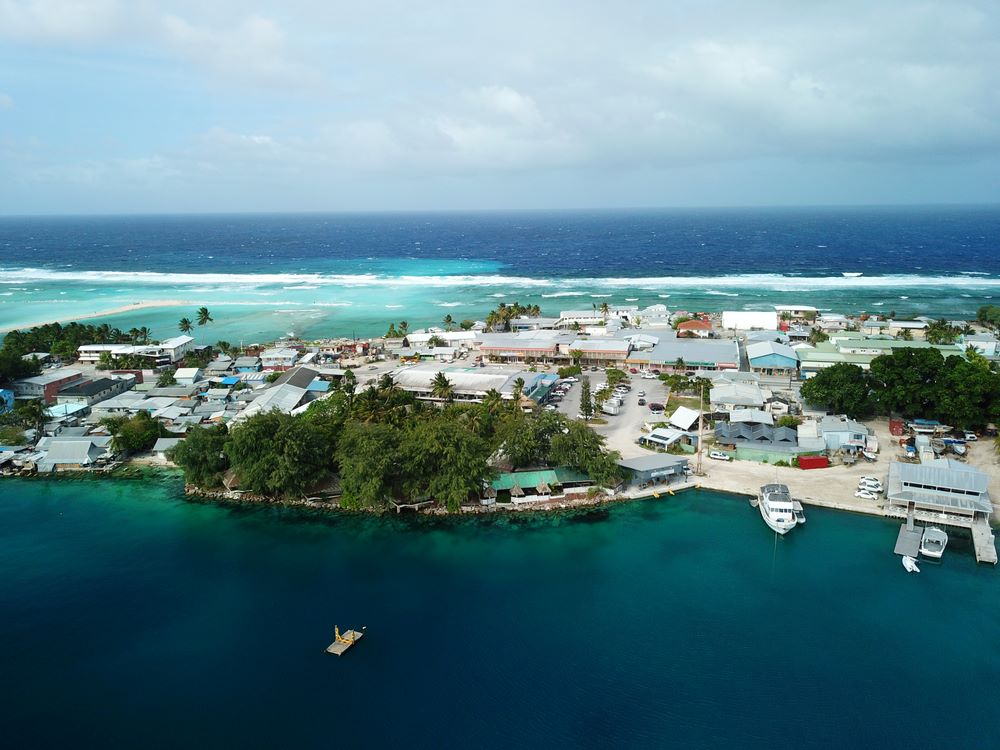
The outer islands remain some of the most enchanting locations in the Marshall Islands. In the quiet, traditional villages off Majuro and Kwajalein, the locals are friendly and deeply connected to their traditions. These places are perfect for diving and sport fishing, although most of the atolls are not set up to accommodate tourists. Only a few atolls, such as Arno, Bikini, Rongelap, Jaluit, and Likiep, have guesthouses—on other islands, you might need to ask locals for accommodation. Food here is primarily fresh local produce, such as breadfruit, squash, taro, and fish.

The most accessible of the outer atolls are Arno, Bikini, Enewetok, Jaluit, Likiep, Maloelap, Mili, Rongelap, and Wotje. Arno, made up of 133 islets, is closest to Majuro and is served by regular public transport. The Longar area of Arno is famous for its “love school,” where young women once perfected their sexual skills. The waters off Longar Point are ideal for deep-sea fishing, with ample yellowfin tuna, marlin, and mahimahi. Bikini Atoll, chosen by US President Truman as the site for the first atomic explosion in peacetime, is now denuclearized and ideal for diving. Enewetok, by contrast, has little to offer beyond its conventional landscape. Jaluit attracts many tourists to the Jaluit Eco-Resort, while Likiep features Western-style houses with porches and gates. Maloelap and Wotje are scattered with remnants from World War II, and Mili and Rongelap boast beautiful coastlines.
Events and Festivals
The Marshall Islands host several unique festivals and celebrations. The New Year’s Eve Block Party in Majuro is a major event, as are the Coconut Cup Sailing Regatta in late March, the President’s Cup on May 1st, National Fisherman’s Day in early July, the All-Micronesia Fishing Tournament in September, and Alele Week at the end of September, which culminates in a day of culture.
Climate and Transportation
The climate is tropical, hot, and humid for much of the year. Average temperatures in Majuro hover around 27°C, with the southern islands receiving up to 4,000 mm of rain annually. The wet season from September to November is the least favorable time to visit. Fortunately, cyclones are rare in the Marshall Islands.
The Marshall Islands have fifteen airports, but only Amata Kabua International Airport in Majuro is international. Airlines serving Majuro include Continental Airlines and Japan Airlines. For an adventurous journey, ferries are available, primarily from Jaluit, Likiep, Bikini, and Rongelap, offering easy internal travel. Without an established public transport system, bicycles are the ideal way to get around, although visitors will need to bring their own due to the lack of rental options.

