
A Complete Guide to San Gimignano, with Torre Grossa, the Collegiata, Vernaccia and the Best Things to See

San Gimignano is famous for its towers, but the skyline is only the beginning.
During the Middle Ages, wealthy families raised dozens of stone tower-houses above this small Tuscan town, turning architecture into a public declaration of money, lineage and political ambition. Around 72 towers may once have stood here. Fourteen survive, enough to preserve a skyline that disappeared almost completely from cities such as Florence, Siena and Bologna.
That survival is partly the result of misfortune.
San Gimignano prospered through trade and the Via Francigena, became an independent commune in 1199 and reached its greatest wealth during the thirteenth and early fourteenth centuries. Then plague, famine and political decline reduced its importance. In 1353 the town submitted to Florence and never recovered the economic power that might have encouraged later generations to demolish medieval buildings and replace them with Renaissance palaces.
Stagnation preserved the towers.
Today the entire historic centre is protected as a UNESCO World Heritage Site, but the city is much richer than its famous silhouette suggests. The Collegiata contains extraordinary fresco cycles by Lippo Memmi, Bartolo di Fredi and Domenico Ghirlandaio. Palazzo Comunale preserves paintings by artists including Pinturicchio. Sant’Agostino contains Benozzo Gozzoli’s cycle devoted to Saint Augustine. The Rocca di Montestaffoli opens onto vineyards producing Vernaccia di San Gimignano, historically one of Italy’s most important white wines.
San Gimignano can be seen in a long day.
It becomes considerably better if you stay overnight.
Once the afternoon buses leave, stone towers stop behaving like tourist attractions and return to being architecture.
Things to See in San Gimignano
- Piazza della Cisterna
- Piazza del Duomo
- Torre Grossa
- Palazzo Comunale
- Pinacoteca
- Collegiata di Santa Maria Assunta
- Cappella di Santa Fina
- Torre Rognosa
- Torre dei Salvucci
- Torre dei Becci
- Torre dei Cugnanesi
- Rocca di Montestaffoli
- Vernaccia di San Gimignano Wine Experience
- Sant’Agostino
- Benozzo Gozzoli’s frescoes
- Via San Matteo
- Via San Giovanni
- Porta San Giovanni
- Porta San Matteo
- Medieval walls
- San Lorenzo in Ponte
- Museo Archeologico
- Spezieria di Santa Fina
- Via Francigena
- surrounding Vernaccia vineyards
The Manhattan of the Middle Ages? Not Quite
San Gimignano is frequently described as the “Manhattan of the Middle Ages.”
It is memorable.
It is also historically misleading if taken too literally.
The towers were not medieval skyscrapers designed to maximise rentable floor space. They emerged from a completely different social system in which leading families competed for prestige, security and political visibility.
Some towers were incorporated into larger residential complexes. Others performed defensive or representative functions. Their height advertised status in a society fragmented by family alliances and factional conflict.
The skyline was essentially aristocratic competition expressed vertically.
That makes San Gimignano more interesting than the nickname.
Why Were There So Many Towers?
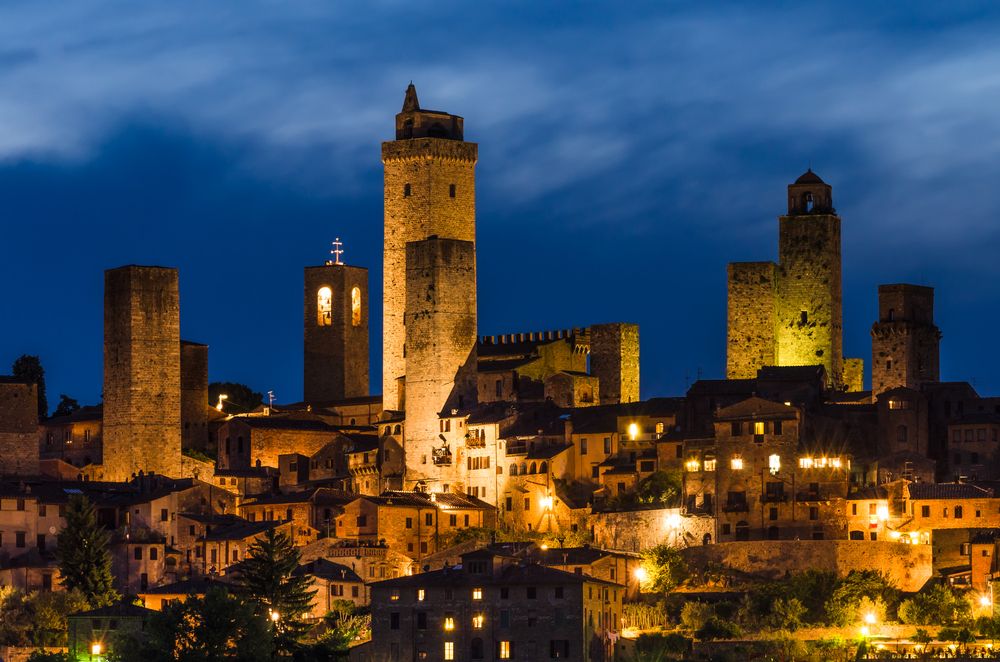
Medieval Tuscan cities were intensely political environments.
Power did not belong exclusively to an abstract municipal government. Noble families, merchant groups, guilds and political factions competed constantly for influence.
A fortified family residence provided protection.
A tall tower also provided status.
San Gimignano’s prosperity allowed this architectural competition to become unusually extreme, and tradition speaks of around 72 tower-houses during the town’s medieval peak.
Municipal authorities eventually attempted to control the race for height.
No private tower was supposed to exceed the principal civic tower.
Even medieval urban planning occasionally had to tell rich people that enough was enough.
Only Fourteen Towers Survive
Wars, structural instability, deliberate demolition and changing residential needs gradually removed most of the towers.
Fourteen survive today.
That number remains extraordinary because the medieval tower landscapes of other Tuscan cities were transformed far more radically.
Florence once possessed numerous family towers.
So did Siena.
San Gimignano preserves something closer to the visual logic of those cities before later architectural development changed them.
This is one reason UNESCO inscribed the historic centre in 1990.
The importance lies not simply in individual monuments but in the survival of an entire medieval urban system.
Piazza della Cisterna
The triangular Piazza della Cisterna is the social centre of San Gimignano.
Its name comes from the octagonal stone cistern standing near the middle of the square, built above an underground water system during the medieval period.
Tower houses and palazzi rise around the irregular space, producing a setting that feels coherent precisely because it was never designed as a single architectural project.
Families built at different moments.
Façades changed.
Openings were modified.
Towers rose and fell.
The square accumulated rather than being created all at once.
This is where San Gimignano is at its most theatrical during the day.
Come back after dinner.
It becomes a completely different place.
Piazza del Duomo
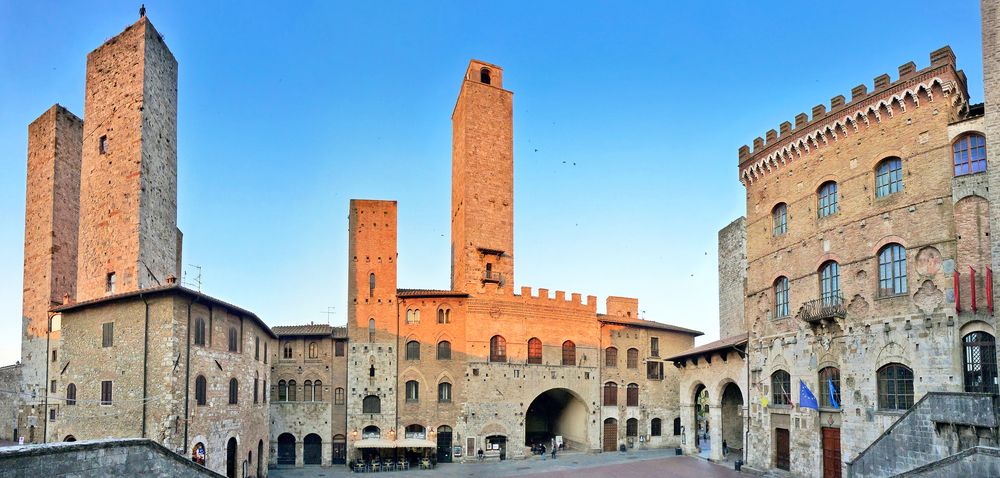
A narrow passage connects Piazza della Cisterna with Piazza del Duomo, where civic and religious power confront one another directly.
On one side stands the Collegiata.
Opposite rises Palazzo Comunale with Torre Grossa.
Around them stand additional towers and palaces, including the Torre Rognosa and the paired Salvucci towers nearby.
The space is tighter and more politically charged than Piazza della Cisterna.
This was the monumental centre of the medieval commune.
Church, government and aristocratic residences competed for the same few metres of urban space.
Palazzo Comunale
The Palazzo Comunale, also known as Palazzo del Popolo or Palazzo Nuovo del Podestà in different historical contexts, developed principally from the late thirteenth century.
It remains the seat of civic memory as much as municipal authority.
Inside, rooms preserve medieval and Renaissance paintings connected with San Gimignano’s political history.
The most famous secular image is the cycle traditionally associated with the theme of love in the Camera del Podestà, attributed to Memmo di Filippuccio.
These scenes are striking because medieval art inside public buildings is often assumed to be entirely religious or political.
Here, courtship and intimate domestic imagery enter the civic palace.
Medieval people were not permanently attending council meetings or contemplating death.
Pinacoteca
The upper floors of Palazzo Comunale contain the Pinacoteca, whose collection traces painting in San Gimignano between the Middle Ages and Renaissance.
Artists represented include Filippino Lippi, Pinturicchio, Benozzo Gozzoli and Niccolò di Ser Sozzo, alongside local and Sienese masters.
The collection matters because San Gimignano sat between major artistic centres.
Florence and Siena influenced the town differently at different periods, and local patrons had enough money to attract important painters.
Do not climb Torre Grossa and skip the museum attached to it.
The view explains the geography.
The paintings explain the culture.
Torre Grossa
At approximately 54 metres, Torre Grossa is the tallest surviving tower in San Gimignano.
Construction began in 1300, during the political and economic height of the commune.
Its civic ownership distinguished it from the private family towers surrounding it.
The climb is the best introduction to the town’s structure.
From the upper platform, the surviving towers stop appearing as isolated vertical objects and become parts of a compact fortified city surrounded by vineyards, olive groves and rolling Tuscan farmland.
You also see how small San Gimignano really is.
Its international fame occupies considerably more space than the town itself.
The View from Torre Grossa
The panorama extends across the Val d’Elsa towards the broader Tuscan interior.
Closer to town, the pattern of vineyards becomes particularly important.
San Gimignano is not an architectural island surrounded by generic countryside.
The landscape belongs directly to its economic history.
Wine, saffron and agriculture helped finance the medieval city.
Vernaccia still connects the stone centre with the surrounding farms.
Visit the tower before a wine tasting rather than after it.
The stairs are more persuasive than any responsible-consumption warning.
The Collegiata Is Not Technically a Cathedral

The large church in Piazza del Duomo is usually called the Duomo of San Gimignano.
Technically, it is not a cathedral.
A cathedral is the seat of a bishop.
San Gimignano never became an episcopal seat.
The correct institutional title is the Collegiata di Santa Maria Assunta.
Calling it the Duomo in ordinary conversation is completely normal.
Calling it a cathedral in a historical guide is not.
The distinction matters because the church achieved extraordinary artistic importance without the institutional status that normally produced major episcopal monuments.
Inside the Collegiata
The relatively restrained Romanesque exterior gives almost no warning of what happens inside.
The walls are covered by one of the most complete surviving cycles of fourteenth-century narrative fresco painting in Tuscany.
The nave effectively becomes an illustrated theological history.
Scenes from the Old Testament occupy one side.
The New Testament unfolds opposite.
Rather than encountering isolated altarpieces accumulated over centuries, visitors experience an enormous coordinated visual programme.
This is the monument that changes San Gimignano from a photogenic town into a serious art destination.
The Old Testament Frescoes
The Old Testament cycle is associated principally with Bartolo di Fredi and was painted during the fourteenth century.
Creation, Adam and Eve, Noah, Joseph, Moses and other episodes unfold through successive registers.
The scenes were intended to be read visually in sequence.
That may sound obvious now.
For medieval worshippers without books, images created an accessible monumental narrative covering the entire wall.
The church functioned partly as a painted Bible.
The New Testament Cycle
The opposite wall contains scenes from the life of Christ associated with the workshop of Lippo Memmi, closely connected with Simone Martini and the Sienese school.
The differences between the two sides are worth noticing.
Painting style, figure construction and narrative rhythm reveal artistic traditions developing within the broader Sienese world during the fourteenth century.
Do not walk down the centre aisle looking randomly left and right.
Choose one wall.
Follow the story.
Then turn around and read the other.
The Last Judgment
The entrance wall contains a monumental Last Judgment, transforming departure from the church into a final reminder of salvation and damnation.
Heaven and hell belonged to the normal visual language of medieval Christianity.
Placement mattered.
The faithful did not merely see theological images while approaching the altar.
They encountered judgment again when returning towards the outside world.
Medieval church decoration was spatially strategic.
Cappella di Santa Fina
The most refined Renaissance space inside the Collegiata is the Chapel of Santa Fina.
The chapel was created for the cult of Fina dei Ciardi, a young San Gimignano woman who died in 1253 and became the town’s most important local saintly figure.
Architect Giuliano da Maiano designed the chapel.
His brother Benedetto da Maiano created important sculptural work.
The frescoes were painted by Domenico Ghirlandaio in 1475.
That concentration of major Florentine artists gives the small chapel extraordinary importance.
The Story of Santa Fina
Fina was born in San Gimignano in 1238.
According to hagiographic tradition, illness left her immobilised for several years, during which she chose to lie on a wooden board rather than seek physical comfort.
Saint Gregory the Great is said to have appeared to her and predicted the day of her death.
Ghirlandaio painted the episode inside the chapel.
The story belongs to medieval religious culture rather than modern biography.
What matters historically is the strength of Fina’s local cult.
A young woman who never held political office became one of San Gimignano’s most enduring identities.
Ghirlandaio in San Gimignano
Ghirlandaio painted two principal scenes for the chapel.
One shows Saint Gregory announcing Fina’s death.
The other depicts Fina’s funeral, surrounded by miracle narratives associated with her passing.
The compositions demonstrate the clarity that later made Ghirlandaio one of Florence’s great fresco painters.
Architecture organises the scenes.
Faces are individualised.
Small details make supernatural events enter believable domestic spaces.
A young Michelangelo would later train in Ghirlandaio’s workshop in Florence.
The San Gimignano frescoes predate that relationship but show the artistic world the young sculptor would eventually enter.
Museo d’Arte Sacra
Beside the Collegiata, the Museo d’Arte Sacra preserves paintings, sculpture, manuscripts and liturgical objects removed from churches in the surrounding territory.
It works best as an extension of the church rather than as an independent museum.
After seeing the fresco cycles in their original architectural setting, the collection allows closer study of objects designed for altars, processions and worship.
The combined ticket makes sense for anyone already spending serious time in Piazza del Duomo.
Torre Rognosa
The Torre Rognosa rises beside the Palazzo Vecchio del Podestà.
At approximately 51 metres, it was one of the most important towers in the medieval town and became the benchmark against which private building heights were regulated.
The commune attempted to prevent private families from constructing towers higher than this civic standard.
Naturally, ambitious families tested the rule.
The history of San Gimignano can occasionally be reduced to architecture saying, “Mine is taller.”
The Salvucci Towers
The Salvucci family built two adjacent towers near Piazza del Duomo.
Their rivalry with the Ardinghelli family belonged to the political competition dividing the town’s elite.
According to the traditional narrative, the Salvucci towers originally challenged municipal height restrictions and were subsequently reduced.
One of the towers has now been transformed into an extraordinary vertical residence distributed across multiple tiny floors.
Its historical significance lies in the pair.
Family prestige was being duplicated in stone.
One tower was apparently insufficient.
Piazza delle Erbe
Behind the Collegiata, Piazza delle Erbe provides one of the best close views of the towers.
The space is smaller and less formal than the two principal piazzas.
That makes it useful.
San Gimignano’s monumental skyline becomes more understandable from secondary spaces where the towers appear embedded inside ordinary buildings rather than isolated against a postcard horizon.
Via San Matteo
Via San Matteo follows part of the medieval north-south axis through town.
Stone houses, tower fragments, palaces and shops line the route towards Porta San Matteo.
Despite the concentration of visitors, architectural details survive above retail level.
Look up.
Windows, masonry changes and truncated tower structures reveal buildings altered repeatedly over centuries.
The medieval city did not consist of fourteen towers floating above souvenir shops.
It consisted of hundreds of interconnected houses, courtyards, churches and passages.
Via San Giovanni
South of Piazza della Cisterna, Via San Giovanni continues the urban axis towards Porta San Giovanni.
Historically, travellers arriving from the direction of Siena entered through this side of the town.
The street still functions as one of the main approaches.
Walking from one gate to the other demonstrates how compact the walled city is.
Do it early or late.
At midday in high season, the experience becomes less medieval and more human traffic management.
Via Francigena
San Gimignano’s rise cannot be separated from the Via Francigena.
The great medieval pilgrimage route connected northern Europe with Rome through a network of roads and stopping places.
Pilgrims, merchants and travellers needed food, accommodation, animals, medical assistance and religious institutions.
San Gimignano’s position along that movement generated opportunities.
The route was not one single paved road resembling a modern highway.
Its paths changed over time.
What mattered was the corridor.
San Gimignano prospered because people kept moving through it.
Sigeric and the Medieval Route
One of the most famous early records of the Via Francigena comes from the itinerary of Sigeric, Archbishop of Canterbury, who travelled to Rome around the end of the tenth century.
The area around San Gimignano belonged to that larger pilgrimage geography.
Later commercial development transformed what had begun as a strategic stopping area into a wealthy fortified town.
The pilgrimage route explains why an apparently isolated hill settlement became internationally connected long before modern tourism.
Saffron Made San Gimignano Rich
Wine was important.
So was saffron.
During the Middle Ages, saffron became one of the valuable agricultural products associated with San Gimignano and its territory.
The spice had several uses beyond cooking.
It entered medicine, cosmetics and dyeing, and its high value relative to weight made it suitable for long-distance trade.
That detail changes the familiar Tuscan picture.
San Gimignano’s medieval wealth was not financed only by picturesque vineyards.
Some of it came from tiny red stigmas harvested from crocus flowers.
Sant’Agostino
At the northern end of town, Sant’Agostino receives fewer casual visitors than the central piazzas.
Artistically, it should not.
The church contains one of Benozzo Gozzoli’s major fresco cycles, devoted to the life of Saint Augustine.
The quieter atmosphere also provides useful relief after Piazza della Cisterna.
San Gimignano is small enough that “outside the centre” often means a ten-minute walk.
Take it.
Benozzo Gozzoli’s Saint Augustine Cycle
Benozzo Gozzoli painted the fresco cycle in the choir between 1464 and 1465.
The scenes follow Augustine from education and intellectual ambition through conversion and religious life.
Architecture, landscapes and carefully observed figures transform the biography of a fourth-century North African saint into a visual world recognisable to a fifteenth-century Tuscan audience.
That historical displacement was normal.
Renaissance artists frequently dressed ancient and early Christian stories in contemporary buildings and clothing.
For viewers, sacred history became immediate.
San Sebastiano and the Plague
Gozzoli also painted Saint Sebastian in connection with plague devotion.
Sebastian became one of the saints most strongly invoked against epidemic disease in late medieval and Renaissance Europe.
Arrows piercing his body were understood symbolically in relation to divine punishment and plague.
In a town whose history had been profoundly altered by the Black Death, the image carried more than abstract theological meaning.
It addressed collective memory.
The Black Death Changed San Gimignano
The plague of 1348 struck a town that had already begun encountering economic and political difficulties.
Population declined severely.
Repeated crises weakened the independent commune.
In 1353, San Gimignano submitted to Florence.
This political decline is one of the reasons so much medieval architecture survived.
Later economic centres often demolished obsolete towers, widened streets and rebuilt houses according to new fashions.
San Gimignano lacked the resources and need to transform itself as aggressively.
Its misfortune became modern heritage.
Florentine Rule
After submission to Florence, San Gimignano became part of a much larger political system.
The town remained strategically relevant but no longer controlled its own destiny as an independent commune.
Florentine institutions and artistic influences increased.
The fortress at Montestaffoli belongs directly to the new political order.
Its position above town reminds visitors that medieval walls were not always built to protect residents from distant outsiders.
Fortifications also helped larger states control recently acquired towns.
Rocca di Montestaffoli
The Rocca di Montestaffoli was built after San Gimignano came under Florentine control.
Much of the fortress later disappeared, leaving walls and a tower within what is now a public green space.
Climb the surviving lookout.
The view over the towers is excellent.
The opposite direction may be even more important.
Vineyards extend into the countryside where Vernaccia is produced.
Architecture and wine finally occupy the same panorama.
Vernaccia di San Gimignano

San Gimignano possesses something rare among famous Tuscan hill towns: a historically important white wine bearing its name.
Vernaccia di San Gimignano was the first Italian wine to receive DOC recognition when the modern denomination system began in 1966.
It became DOCG in 1993.
The wine must be based predominantly on the local Vernaccia di San Gimignano grape, with production restricted to the municipal territory.
This geographic precision is fundamental.
Vernaccia di San Gimignano is not a generic Tuscan white.
It belongs to these hills.
Vernaccia in Dante
The wine’s historical reputation reaches deep into Italian literature.
Dante mentions Vernaccia in the Divine Comedy, placing Pope Martin IV among gluttonous souls and connecting him with an excessive appetite for eels and Vernaccia.
The reference demonstrates that the wine had acquired a sufficiently recognisable reputation by the early fourteenth century to work as a literary signifier of luxury and indulgence.
Few modern wine marketing campaigns can compete with appearing in Purgatory.
What Does Vernaccia Taste Like?
Styles vary according to vineyard, producer, ageing and winemaking.
At its best, Vernaccia can combine citrus, white flowers, herbs and orchard fruit with a firm mineral or saline impression and a characteristic slightly bitter almond-like finish.
Young examples can be direct and refreshing.
More ambitious wines, particularly Riserva bottlings and carefully selected vineyards, can develop surprising structure and ageing capacity.
Do not assume “Tuscan white” means something to drink while waiting for the serious red wine.
Vernaccia has been serious for several centuries.
Vernaccia di San Gimignano Wine Experience
At the Rocca di Montestaffoli, the wine territory can be approached through the Vernaccia di San Gimignano Wine Experience, created in connection with the local producers’ consortium.
This is useful if you do not have time for a winery visit.
It provides context on territory, grape variety, history and production while allowing visitors to taste several local wines in one place.
For a first trip, taste Vernaccia before deciding which estate to visit.
You will understand stylistic differences far more quickly once you reach the vineyard.
The Medieval Walls
San Gimignano retains substantial sections of its defensive walls.
The outer circuit developed largely during the thirteenth century as the town expanded beyond an earlier fortified core.
Gates controlled roads entering from different directions.
Walking sections of the perimeter provides a useful alternative to remaining inside the main commercial axis.
The exterior also allows the towers to reappear as part of a defensive urban silhouette rather than vertical ornaments above crowded streets.
Porta San Giovanni
Porta San Giovanni forms the southern entrance into the historic centre.
Travellers arriving from the direction of Siena and southern Tuscany historically approached through this side.
The gate opens directly onto Via San Giovanni, creating one of the town’s strongest surviving sequences from fortification into commercial street.
Enter through it on foot if possible.
Driving to a peripheral car park and appearing magically in Piazza della Cisterna removes half the geographical logic of the city.
San Lorenzo in Ponte
The small Church of San Lorenzo in Ponte sits away from the most famous monuments but belongs to the civic museum circuit.
Its interior preserves medieval frescoes, including imagery connected with the afterlife.
The church’s modest scale provides a useful contrast with the Collegiata.
San Gimignano’s artistic culture was not concentrated exclusively inside its most prestigious church.
Images covered smaller religious spaces throughout the town.
The Santa Chiara Museum Complex
The Complesso Museale Santa Chiara brings together several collections, including the archaeological museum, material connected with the Via Francigena, the historic pharmacy of Santa Fina and modern and contemporary art.
It is not essential for a rushed first visit.
It becomes worthwhile on a second day.
The Spezieria di Santa Fina is particularly useful for understanding healthcare before modern medicine, preserving material connected with the historic hospital and pharmacy tradition.
Again, the town becomes more interesting when you move beyond towers.
Piazza della Cisterna After Dark
San Gimignano has a tourism problem that is also a timing problem.
During the central hours of high season, enormous numbers of day visitors occupy an extremely small historic centre.
By evening, the population changes radically.
Shops close.
Groups leave.
Residents and overnight guests inherit the squares.
Stone façades respond beautifully to low artificial light, and the absence of traffic noise makes the scale of the medieval centre more convincing.
Sleeping here is therefore not simply about convenience.
You are purchasing access to another version of the town.
What to Eat in San Gimignano
The local table belongs to inland Tuscany: bread, pork, game, legumes, olive oil, fresh pasta and seasonal vegetables.
But San Gimignano has several distinctive products.
Saffron remains part of local agricultural identity.
Vernaccia is unavoidable.
Wild boar appears frequently in ragù and braised preparations.
Pecorino from the wider Sienese territory works naturally with honey and local preserves.
Look for pici, ribollita, pappa al pomodoro and grilled meat, but do not confuse regional Tuscan dishes with products uniquely invented inside the walls.
San Gimignano does not need fake culinary exclusivity.
Its real food history is good enough.
Saffron
The local saffron tradition has medieval roots and has been revived through protected cultivation.
A genuine saffron dish should use the spice carefully.
The point is not to turn everything fluorescent yellow.
Its aroma is floral, earthy and slightly bitter.
Risotto, fresh pasta and delicate sauces can carry it effectively.
Historically, the spice was valuable precisely because a tiny quantity could have a substantial effect.
The kitchen should remember the economics.
Wild Boar
The wooded Tuscan landscape supports a strong tradition of hunting and game cooking.
Cinghiale appears particularly often as a slow-cooked ragù served with pappardelle or other substantial pasta.
Long cooking softens the meat and integrates its flavour with wine, tomato, herbs and aromatics.
Pair it with a structured local red rather than Vernaccia.
Regional loyalty does not require forcing one wine onto every plate.
Where to Eat
Cum Quibus – Ristorante Toscano
Cum Quibus takes a more ambitious approach to Tuscan cooking than the average restaurant around the central piazzas. Local ingredients are handled through contemporary technique while the menu remains recognisably connected with Tuscany rather than drifting into generic international fine dining.
Address: Via San Martino 17, 53037 San Gimignano
Telephone: +39 0577 943199
Cuisine: contemporary Tuscan
Price level: approximately €40–100
Best for: a more elaborate dinner inside the historic centre.
Il Ceppo Toscano
Il Ceppo Toscano focuses strongly on meat and traditional inland Tuscan flavours. It is particularly appropriate if bistecca, grilled cuts and robust local cooking matter more than elaborate presentation.
Address: Via delle Romite 13, 53037 San Gimignano
Telephone: +39 0577 940594
Cuisine: Tuscan, grilled meat
Price level: approximately €40–100
Best for: meat, Tuscan reds and a substantial dinner.
Ristorante Fuoriluogo
Fuoriluogo sits just beyond the most crowded central streets and offers a useful combination of Tuscan cooking and a calmer setting. Pasta, local meat and seasonal ingredients make it a good choice when you want a proper lunch or dinner without remaining inside Piazza della Cisterna.
Address: Via Niccolò Cannicci 2/A, 53037 San Gimignano
Telephone: +39 0577 1392917
Cuisine: Tuscan
Price level: approximately €20–60
Best for: regional cooking away from the busiest central axis.
Da I’ Mariani
Da I’ Mariani is the practical choice for a quick meal built around cured meats, cheese and Tuscan products rather than a full restaurant service.
It works especially well when museums are the priority and lunch should not consume two hours.
Address: Via di Quercecchio 19, 53037 San Gimignano
Telephone: +39 338 2334399
Cuisine: Tuscan products, sandwiches and boards
Price level: approximately €10–20
Best for: a fast local lunch between monuments.
Where to Stay
Staying inside the walls is the strongest choice for a first visit because it gives access to San Gimignano before and after the day-trip crowds.
Countryside accommodation becomes preferable for longer stays centred on vineyards, pools and driving through Tuscany.
Hotel la Cisterna
Hotel La Cisterna occupies one of the most remarkable locations in town, directly on Piazza della Cisterna.
The main advantage is not luxury infrastructure.
It is being able to step into the principal medieval square before breakfast and after dinner.
Address: Piazza della Cisterna 23, 53037 San Gimignano
Telephone: +39 0577 940328
Category: historic-centre hotel
Price level: €€–€€€
Best for: sleeping directly on San Gimignano’s most beautiful square.
Hotel Leon Bianco
Leon Bianco shares the same extraordinary piazza and provides another strong option for travellers prioritising atmosphere and walkability.
Everything essential lies only minutes away.
Address: Piazza della Cisterna 13, 53037 San Gimignano
Telephone: +39 0577 941294
Category: historic hotel
Price level: €€–€€€
Best for: a traditional stay in the absolute centre.
Hotel L’Antico Pozzo San Gimignano
L’Antico Pozzo occupies a historic building on Via San Matteo, slightly removed from the busiest square while remaining completely inside the medieval centre.
That position offers a useful compromise between atmosphere and relative quiet.
Address: Via San Matteo 87, 53037 San Gimignano
Telephone: +39 0577 942014
Category: historic-centre hotel
Price level: €€
Best for: a quieter stay inside the walls.
Mormoraia
Mormoraia sits in the countryside outside San Gimignano among vineyards and open Tuscan landscape.
This is a different type of stay: less useful for walking back from dinner, far better for travellers who want a pool, rural views and wine-country atmosphere.
Address: Località Sant’Andrea, 53037 San Gimignano
Telephone: +39 0577 940096
Category: agriturismo and countryside accommodation
Price level: €€€
Best for: vineyard landscapes and a multi-night Tuscan stay.
How Many Days Do You Need?
A half day shows you the skyline, two squares and perhaps Torre Grossa.
That is what most visitors do.
A full day is the minimum for the real town.
It allows the Collegiata, Palazzo Comunale, tower, Sant’Agostino and Rocca di Montestaffoli without constant rushing.
Two days are ideal if you care about art or wine.
Use the second for Santa Chiara, minor churches, a winery and the quieter streets beyond the central axis.
One overnight stay changes the experience disproportionately.
A One-Day San Gimignano Itinerary
Arrive early and enter through Porta San Giovanni.
Walk along Via San Giovanni to Piazza della Cisterna before the central streets become crowded.
Continue immediately to Piazza del Duomo and visit Palazzo Comunale, the Pinacoteca and Torre Grossa.
Then enter the Collegiata, giving proper time to both fresco cycles and the Cappella di Santa Fina.
Have lunch away from the most crowded square.
During the afternoon, walk north to Sant’Agostino for Benozzo Gozzoli.
Return through Via San Matteo and finish at Rocca di Montestaffoli with a Vernaccia tasting and the late-afternoon view.
This is a serious day.
It is also the correct way to discover that San Gimignano contains considerably more than towers.
A Two-Day San Gimignano Itinerary
Keep the first day focused on the major medieval and Renaissance monuments.
On the second morning, visit the Santa Chiara complex and San Lorenzo in Ponte.
Then leave the centre for a winery in the surrounding Vernaccia territory.
Return to town during the late afternoon.
Walk sections of the walls and secondary streets rather than repeating Piazza della Cisterna.
The second day should feel slower.
That is precisely the advantage of having it.
San Gimignano Pass in 2026
The San Gimignano Pass is the most practical ticket for a serious first visit.
In 2026 the pass costs €15 for adults and €12 for visitors aged 6–17.
It covers the principal civic museum circuit together with the Collegiata complex, including Palazzo Comunale, Pinacoteca, Torre Grossa, Santa Chiara, San Lorenzo in Ponte, the Collegiata and Museo d’Arte Sacra.
The current museum system lists the pass as valid for three days.
For anyone entering both Torre Grossa and the Collegiata, the additional flexibility makes more sense than purchasing attractions piecemeal.
Museums and Torre Grossa in 2026
From 1 April through 31 October, the civic museums — including Palazzo Comunale, Pinacoteca and Torre Grossa — open daily from 10:00 to 19:30, with last admission at 19:00.
From 1 November through 31 March, the normal schedule is 11:00 to 17:30, with extended festive hours between 26 December and 6 January.
The civic museum circuit ticket costs €10, reduced to €8.
It includes more than the tower.
That matters because many visitors treat the ticket as though they were buying access to a viewpoint.
Use the museum.
The Collegiata in 2026
Between 1 April and 31 October, the Collegiata generally opens:
Monday–Friday: 10:00–19:30
Saturday: 10:00–17:00
Sunday and religious holidays: 12:30–19:30
Winter hours are shorter.
Because the building remains an active church, extraordinary liturgical activity can alter tourist access.
The standard Collegiata ticket is €5, while the combined Collegiata and Museo d’Arte Sacra ticket costs €7.
Again, the €15 San Gimignano Pass becomes attractive if you intend to see the principal monuments properly.
Driving and Parking
Do not drive into the historic centre expecting to improvise.
San Gimignano operates with restricted traffic inside the walls, and public parking areas sit outside the main gates.
Several numbered parking facilities serve different approaches to town.
In high season, the closest spaces can fill early.
If staying inside the walls, ask the hotel for arrival instructions before entering the area.
Dragging luggage uphill across medieval paving becomes considerably less romantic after the first hundred metres.
Getting to San Gimignano Without a Car
San Gimignano has no railway station.
The most common public-transport approach is through Poggibonsi, which has railway connections with Siena and Florence via Empoli.
Buses connect Poggibonsi with San Gimignano.
The journey is entirely manageable for a day trip, but public transport requires more planning than travelling to major Tuscan cities directly on the railway network.
A car becomes useful if the itinerary continues through wineries, Volterra or smaller villages.
San Gimignano and Siena
Siena and San Gimignano combine naturally but should not be compressed into one frantic half-day each.
Siena is a major medieval city with an enormous artistic and political history.
San Gimignano is a much smaller commune whose surviving tower landscape provides something Siena no longer preserves at the same scale.
If staying in Siena, San Gimignano works as a day trip.
If you have enough time, sleep here one night and continue to Siena the next morning.
San Gimignano and Volterra
The pairing with Volterra is even more interesting.
Both occupy dramatic Tuscan ridges.
Their histories are completely different.
San Gimignano is dominated by the medieval commune, family towers, pilgrimage and Vernaccia.
Volterra reaches much deeper into Etruscan civilisation and adds Roman archaeology, alabaster and major Mannerist painting.
Together they make one of the strongest two-town cultural combinations in central Tuscany.
A car makes the pairing substantially easier.
When to Visit San Gimignano
April, May, late September and October are the strongest months for a cultural visit.
Spring brings green vineyards and moderate temperatures.
Early autumn provides warm light, wine harvest activity and generally easier walking conditions.
June is beautiful but increasingly busy.
July and August bring the greatest pressure from day tourism and summer heat.
If travelling then, use timing aggressively: enter early, rest during the busiest central hours and stay into evening.
November through March is much quieter.
Museum schedules are shorter, some businesses reduce opening, and weather can be cold or wet.
But Piazza della Cisterna without hundreds of visitors is a convincing argument for winter.
San Gimignano in 2026
The core visitor system remains straightforward in 2026.
The San Gimignano Pass costs €15 for adults and integrates the civic museums with the Collegiata complex. The principal civic museums operate until 19:30 during the April–October season, giving considerably more flexibility than towns where cultural sites close in late afternoon.
The tourism calendar continues through summer with events at the Rocca di Montestaffoli, including the 2026 Cinema in Rocca programme through the end of August.
What has not changed is more important.
San Gimignano is extremely crowded during peak daytime hours and exceptionally atmospheric after them.
The most useful practical decision remains the simplest one:
stay overnight.
Useful Information
Region: Tuscany
Province: Siena
UNESCO World Heritage inscription: 1990
Historic role: medieval commune and Via Francigena stopping point
Municipal independence: from 1199
Traditional number of medieval tower-houses: approximately 72
Surviving towers: 14
Tallest surviving tower: Torre Grossa
Torre Grossa height: approximately 54 m
Torre Grossa construction began: 1300
Main civic square: Piazza della Cisterna
Main monumental square: Piazza del Duomo
Main civic building: Palazzo Comunale
Principal church: Collegiata di Santa Maria Assunta
The Collegiata is technically a cathedral: no
Major fresco artists: Lippo Memmi workshop, Bartolo di Fredi, Domenico Ghirlandaio
Major local saint: Santa Fina
Santa Fina died: 1253
Ghirlandaio frescoes: 1475
Major church outside central piazzas: Sant’Agostino
Benozzo Gozzoli cycle: 1464–1465
Florentine submission: 1353
Principal wine: Vernaccia di San Gimignano DOCG
Vernaccia DOC recognition: 1966
Vernaccia DOCG recognition: 1993
Historic agricultural product: saffron
Major pilgrimage route: Via Francigena
San Gimignano Pass 2026: €15 adult / €12 junior
Civic museum ticket: €10 adult / €8 reduced
Civic museum summer hours: 10:00–19:30
Collegiata standard ticket: €5
Collegiata + Sacred Art Museum: €7
Railway station: none
Nearest useful rail hub: Poggibonsi
Car required inside town: no
Car useful for surrounding wineries: yes
Recommended stay: 1–2 full days
Best months: April–May and late September–October

