
Oxford Beyond the Dreaming Spires, from Christ Church and the Bodleian to Medieval Colleges and River Walks

Oxford is not a university with a city around it. It is a city whose streets, churches, libraries, gardens and pubs have been reshaped by more than nine centuries of academic life.
Teaching existed here by 1096, making Oxford the oldest university in the English-speaking world. Its growth accelerated after 1167, when Henry II prevented English students from attending the University of Paris. Colleges followed, each developing its own chapel, hall, gardens and traditions, until the city acquired the extraordinary architectural density visible today: medieval quadrangles beside Baroque theatres, Gothic chapels opening onto narrow lanes, libraries built like temples and towers rising above honey-coloured limestone.
The famous phrase “city of dreaming spires” captures the skyline but not Oxford’s complexity.
This is also the city of religious conflict, civil war, scientific debate, literary invention and political power. Cardinal Wolsey attempted to build one of Europe’s great Renaissance colleges here. Henry VIII completed it after destroying Wolsey. Christopher Wren designed the Sheldonian Theatre and later Tom Tower. John Radcliffe financed the circular library that became Oxford’s visual symbol. Lewis Carroll transformed a dean’s daughter into Alice. J.R.R. Tolkien and C.S. Lewis belonged to the city’s twentieth-century literary world, while generations of prime ministers, scientists, writers and philosophers passed through its colleges.
A hurried day trip from London can cover Christ Church, the Bodleian quarter and one museum.
Two days are far better. That gives enough time to enter several colleges rather than photographing their gates, climb a tower, walk Christ Church Meadow and see the museums without turning Oxford into a checklist.
Things to See in Oxford
- Christ Church
- Christ Church Cathedral
- Tom Quad
- Great Hall
- Bodleian Library
- Duke Humfrey’s Library
- Divinity School
- Radcliffe Camera
- Old Schools Quadrangle
- Bridge of Sighs
- Sheldonian Theatre
- University Church of St Mary the Virgin
- All Souls College
- New College
- Magdalen College
- Balliol College
- Broad Street
- Ashmolean Museum
- Oxford University Museum of Natural History
- Pitt Rivers Museum
- Covered Market
- Christ Church Meadow
- River Cherwell
- River Thames / Isis
- Magdalen Bridge
- punting
- Oxford Castle
- Carfax
- historic pubs
- Jericho
- Port Meadow
How Oxford Became a University City
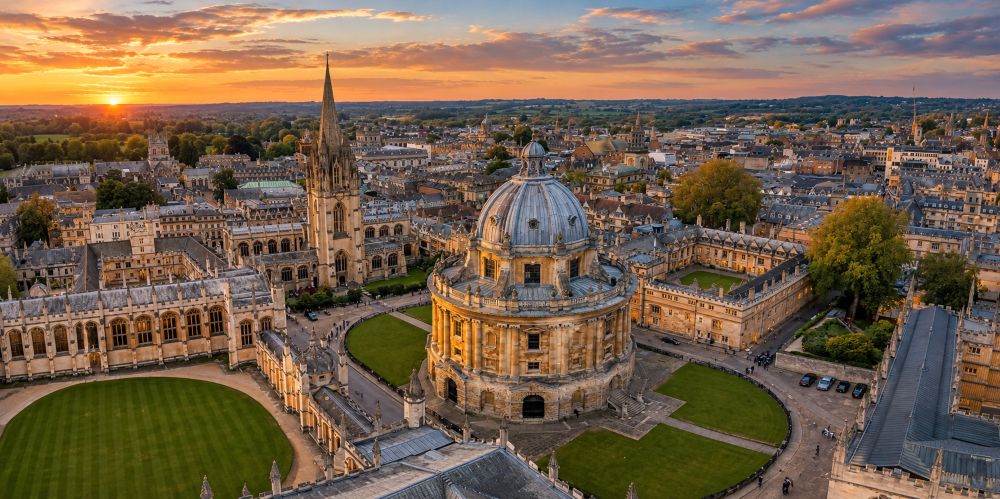
Oxford has no single foundation date.
Teaching was taking place by 1096, but the institution developed gradually rather than being established through one royal charter.
The decisive moment came in the twelfth century.
When Henry II prohibited English students from attending the University of Paris in 1167, scholars returned to England and Oxford expanded rapidly as a centre of teaching.
Students originally lived in halls rather than purpose-built colleges.
The collegiate system emerged gradually during the thirteenth century, creating permanent communities where scholars could live, eat, study and worship together.
University College, Balliol and Merton all trace their origins to the thirteenth century and are among Oxford’s oldest foundations.
From that point onward, the physical city and university became inseparable.
Town and Gown
The relationship was not always peaceful.
Students enjoyed privileges that separated them from ordinary civic jurisdiction, while townspeople resented the economic and legal power of the University.
Tensions repeatedly exploded.
The most notorious incident came on St Scholastica’s Day in 1355, when a dispute in a tavern developed into several days of violence between scholars and townspeople.
Dozens were killed.
The aftermath strengthened University privileges and produced a ceremonial humiliation imposed on the city authorities for centuries.
Oxford’s elegant quads can therefore conceal a remarkably combative past.
“Town and gown” was not originally a picturesque academic phrase.
It described two communities occupying the same streets while operating under different systems of authority.
Christ Church

For a first visit, begin with Christ Church.
It is Oxford’s grandest college and one of its most historically complicated.
Cardinal Thomas Wolsey, chief minister to Henry VIII, founded Cardinal College in 1525 on the site of the medieval Priory of St Frideswide.
The ambition was enormous.
Wolsey intended a college capable of advertising his wealth, education and political power.
Then he fell.
Unable to secure Henry VIII’s divorce from Catherine of Aragon, Wolsey lost royal favour in 1529. His property and unfinished college passed to the Crown.
Henry eventually re-established the institution in 1546 as Christ Church, combining two functions that still coexist: an Oxford college and the cathedral of the Diocese of Oxford.
No other Oxford college has precisely this identity.
Tom Quad
Enter through Tom Gate and Oxford suddenly becomes monumental.
Tom Quad, originally Wolsey’s Great Quadrangle, measures approximately 264 by 261 feet, making it the largest quadrangle in Oxford.
Wolsey never saw the complete project.
The abandoned bases intended for a cloister can still be detected along sections of the quadrangle.
The upper gateway is crowned by Tom Tower, designed by Christopher Wren during the seventeenth century.
Its great bell, known as Great Tom, first rang from the tower in 1684.
Traditionally, it rings 101 times at 21:05, recalling the original number of scholars in Henry VIII’s foundation and preserving Oxford’s historical difference between local and conventional time.
The Great Hall
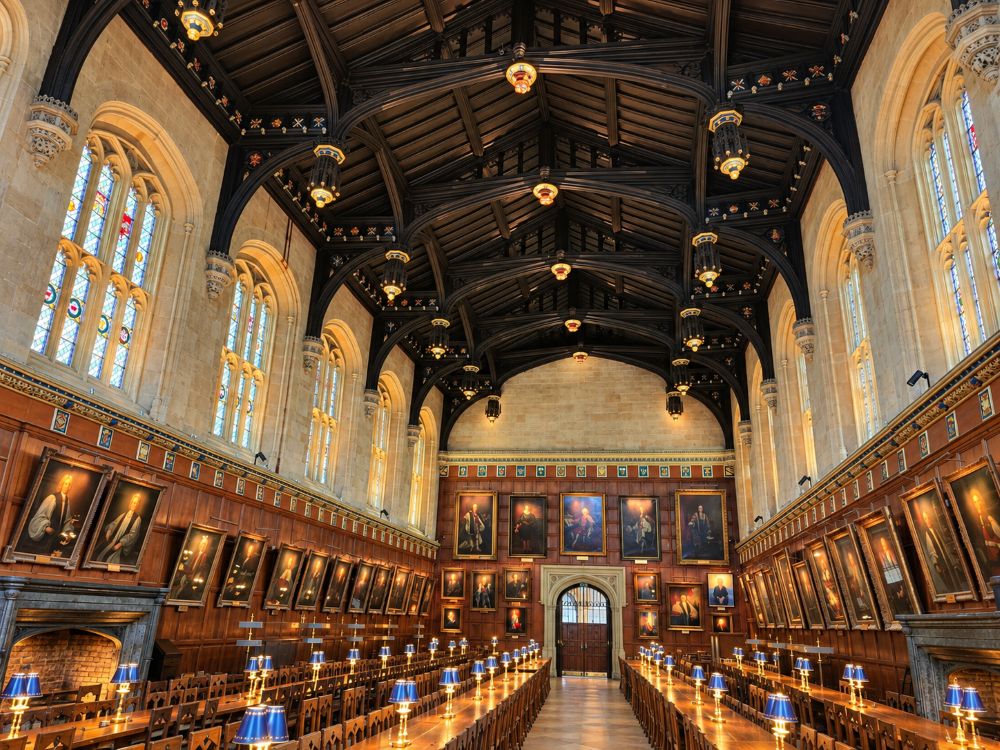
The Great Hall was completed during Wolsey’s original building campaign in the 1520s.
Its hammerbeam roof, portraits and long tables create one of Oxford’s most recognisable interiors.
It remains a functioning college dining hall.
That matters.
Christ Church is not a historical reconstruction maintained for visitors. Students still eat beneath portraits of former members, while High Table remains part of the institutional ritual.
The hall has accumulated literary associations as well.
Charles Lutwidge Dodgson, better known as Lewis Carroll, taught mathematics at Christ Church. Alice Liddell, daughter of Dean Henry Liddell, helped inspire Alice’s Adventures in Wonderland.
One stained-glass window in the hall includes references to Carroll and Alice.
Christ Church and Harry Potter
Christ Church’s association with the Harry Potter films attracts enormous numbers of visitors, but the relationship is more limited than popular shorthand sometimes suggests.
The staircase leading to the Hall appeared in film sequences.
The Great Hall itself was not used as the permanent Hogwarts dining-hall set, although its proportions and collegiate atmosphere influenced the cinematic imagination surrounding Hogwarts.
Do not visit Christ Church merely as a film location.
Its real history is substantially more extraordinary.
Christ Church Cathedral
The Cathedral predates Wolsey’s college.
Most of the surviving medieval church was built in the late twelfth century for the Augustinian canons of St Frideswide’s Priory.
When Henry VIII reorganised the site in 1546, the former priory church became simultaneously the college chapel and cathedral of Oxford.
This makes it one of the smallest cathedrals in England.
The architecture contains Norman and Gothic phases, later modifications and important nineteenth-century work by Sir George Gilbert Scott.
The cloisters were rebuilt around 1499, while the cathedral spire, dating from around 1230, is considered the oldest surviving stone spire in England.
St Frideswide
Oxford’s patron saint, Frideswide, belonged to the early medieval religious history of the site.
Tradition places her in the eighth century and associates her with a religious community at Oxford.
Her shrine became an important local cult before the Reformation.
The later history of Christ Church absorbed rather than erased this earlier sacred landscape.
The college created by a Tudor cardinal therefore sits on top of a religious history reaching many centuries further back.
Visiting Christ Church in 2026
Christ Church uses timed visitor entry and should be booked ahead.
From 2 September to 3 October 2026, on-the-day adult admission costs £24.95 on weekdays and £26.95 at weekends. Online advance tickets are £2 cheaper.
During Michaelmas Term, from 4 October to 12 December, adult on-the-day admission drops to £22.95 weekdays and £24.95 weekends.
Tickets are normally released each Friday for the following week.
The multimedia guide is included and available in several languages.
The Great Hall closes regularly for college use, particularly around lunch, and parts of the Cathedral may close for worship.
Address: St Aldate’s, Oxford OX1 1DP
Telephone: +44 1865 276150
Recommended visit: 90 minutes to 2 hours
Do not leave Christ Church without walking through Christ Church Meadow.
Christ Church Meadow
The meadow provides one of the best transitions between monumental Oxford and the landscape around it.
Paths follow open grassland towards the River Cherwell and the Thames, known locally through Oxford as the Isis.
The skyline of towers and college buildings remains visible behind trees.
This is also where Oxford’s academic image begins dissolving into rowing, grazing cattle and river paths.
The meadow is open free of charge through most of the year.
Allow 30–60 minutes if weather is good.
The Bodleian Library
Oxford’s intellectual mythology concentrates around the Bodleian Library.
The present institution developed principally through Sir Thomas Bodley, who restored and expanded the University library at the end of the sixteenth century after earlier collections had suffered during the Reformation.
It reopened in 1602.
Today the Bodleian forms part of one of the largest library systems in Britain.
For visitors, the important point is practical:
you cannot simply wander freely through its historic reading rooms.
Access to the most important spaces is controlled through tours.
Duke Humfrey’s Library
One of the most atmospheric interiors is Duke Humfrey’s Library, whose origins reach back to the fifteenth century.
The room retains the spatial character of a medieval and early modern library: timber ceiling, bookcases arranged in bays and volumes historically chained for security.
The present collection is part of a much larger library system, but the room remains a rare survival of the environment in which scholars actually worked.
Access normally requires a Bodleian tour.
Photography restrictions apply in certain historic library spaces.
The Divinity School
The Divinity School is one of Oxford’s finest late-medieval interiors.
Built during the fifteenth century, it was created for lectures, examinations and formal academic exercises in theology.
The ceiling is the reason to linger.
An elaborate lierne vault spreads across the room with hundreds of carved bosses, creating stonework of extraordinary visual complexity.
The building also represents something essential about medieval Oxford:
education was performed publicly and ceremonially.
A university examination was not simply a private written test.
It could be an event staged within architecture designed to embody institutional authority.
Bodleian Tours in 2026
Several guided formats provide access to different parts of the historic library complex.
Tours depart from the Bodleian visitor area around Broad Street and the Weston Library.
Reservations are advisable, particularly at weekends and during university vacations.
Address: Broad Street, Oxford OX1 3BG
Telephone: +44 1865 287400
Email: [email protected]
A dedicated guided walking tour of central Oxford also runs in association with accredited local guides and lasts around two hours.
Radcliffe Camera
Oxford’s most recognisable building was not originally part of the Bodleian.
Physician John Radcliffe, who died in 1714, left money for a new library.
Architect James Gibbs designed the monumental circular building between 1737 and 1748, and it opened in 1749.
The name “Camera” comes from the Latin for room.
Its circular form and great dome introduced an assertive classical architecture into a city dominated by medieval and Gothic forms.
For many years the library operated independently.
It became part of the Bodleian in the nineteenth century.
Today the interior functions as a reading room and is generally not open to casual visitors.
This is why the best understanding comes from the surrounding square and from elevated viewpoints.
Radcliffe Square
Walk the complete perimeter.
On one side stands All Souls College.
On another rises Brasenose.
The University Church of St Mary the Virgin occupies the southern edge.
The Radcliffe Camera dominates the centre without physically touching any of them.
This is one of Oxford’s most successful urban compositions.
It was created over centuries rather than by one master plan.
University Church of St Mary the Virgin

Before the Sheldonian existed, the University Church of St Mary the Virgin performed many of the ceremonial functions of Oxford University.
University business, lectures and formal occasions took place here.
The church also became central to major religious controversies.
During the sixteenth century, Protestant reformers Thomas Cranmer, Hugh Latimer and Nicholas Ridley were connected with proceedings in Oxford before their executions.
Three centuries later, St Mary’s became deeply associated with the Oxford Movement, which sought to restore Catholic elements of tradition and theology within Anglicanism.
The church is therefore not simply a viewpoint beside the Radcliffe Camera.
It is one of the institutions through which Oxford’s religious and intellectual conflicts can be read.
Climb St Mary’s Tower
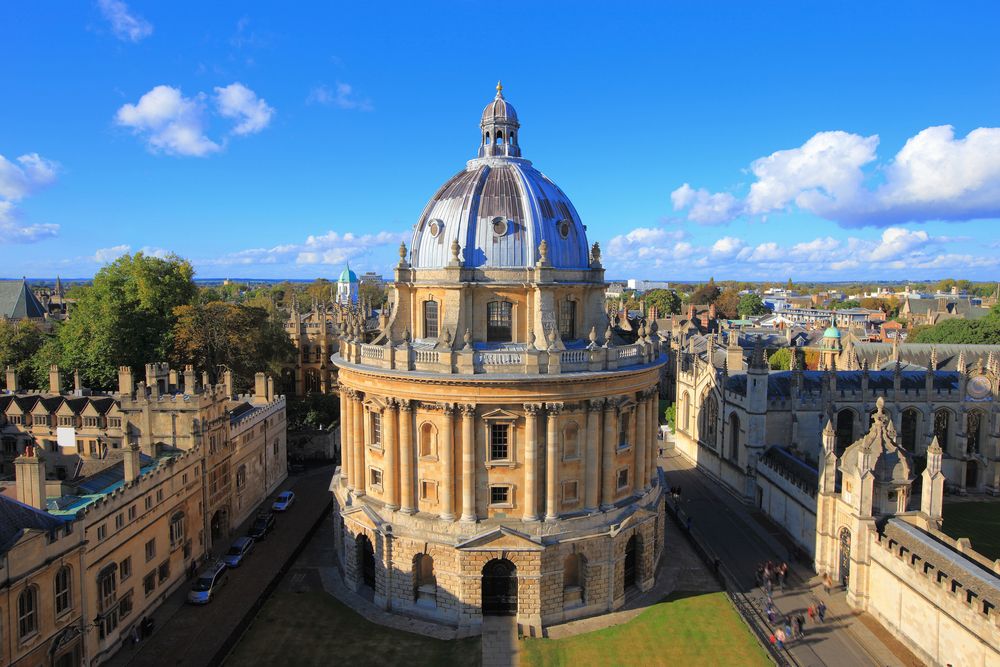
The tower provides one of the best elevated views in Oxford.
From the top, the Radcliffe Camera appears immediately below, while All Souls, Brasenose and the surrounding college roofs create the classic “dreaming spires” panorama.
The stairs are steep and narrow.
Visit early if photography matters.
Late morning and afternoon can bring queues.
All Souls College
Across Radcliffe Square stands All Souls College, founded in 1438 by Henry Chichele, Archbishop of Canterbury.
Its unusual institutional identity has long distinguished it from ordinary undergraduate colleges.
The college’s famous twin towers and quadrangles contribute significantly to central Oxford’s skyline.
For visitors in 2026, the front and Great Quadrangles and chapel are normally open 14:00–16:00 on weekdays and Sundays.
Admission is free.
The college closes to visitors through August and during major Christmas and Easter periods.
Address: High Street, Oxford OX1 4AL
Telephone: +44 1865 279379
The Bridge of Sighs
Oxford’s so-called Bridge of Sighs belongs to Hertford College.
Despite the nickname, it is not a copy of Venice’s famous bridge.
Built in the early twentieth century, it links college buildings over New College Lane.
The Venetian association became irresistible because of its enclosed form and decorative architecture.
The best view is from the lane below.
Do not waste time trying to cross it unless you have legitimate access to the college.
Sheldonian Theatre
At the end of Broad Street stands one of Christopher Wren’s earliest major buildings.
The Sheldonian Theatre was constructed during the 1660s and formally opened in 1669.
Oxford needed a secular ceremonial building because university functions had previously taken place in religious spaces such as St Mary’s.
Wren provided one.
The theatre’s unusual form was inspired in part by ancient Roman theatrical architecture, but its most ingenious element lies above.
The roof spans the auditorium without conventional internal supports, using a sophisticated timber structure.
Inside, Robert Streater’s painted ceiling creates a triumphal allegory appropriate to Restoration Oxford.
The Sheldonian Cupola
Climb 114 steps to the cupola and Oxford’s architecture rearranges itself beneath you.
The Radcliffe Camera, Bodleian, college towers and church spires become part of one coherent cityscape.
The Sheldonian is usually open 10:00–17:00, although ceremonies, concerts and private events frequently modify access.
Thirty-minute guided tours normally run at 11:15 and 14:30.
Address: Broad Street, Oxford OX1 3AZ
Telephone: +44 1865 277299
Recommended visit: 30–60 minutes
New College
The name is wonderfully misleading.
New College was founded in 1379 by William of Wykeham, Bishop of Winchester.
Its original name was the College of St Mary of Winchester in Oxford.
“New College” simply distinguished it from an older foundation dedicated to St Mary.
The layout became enormously influential.
Chapel, hall, cloister, accommodation and quadrangle were arranged with a degree of coherence that helped establish a model for later colleges.
The medieval chapel and cloisters are among the strongest reasons to visit.
Sections of Oxford’s old city wall also survive within the college grounds.
New College in 2026
From 10 March through 31 October, visitors are normally admitted daily from 10:00 to 17:00, with last entry at 16:30.
Adult admission is £12.
Concessions are £11.
Address: Holywell Street, Oxford OX1 3BN
Telephone: +44 1865 279544
Recommended visit: 45–60 minutes
Magdalen College
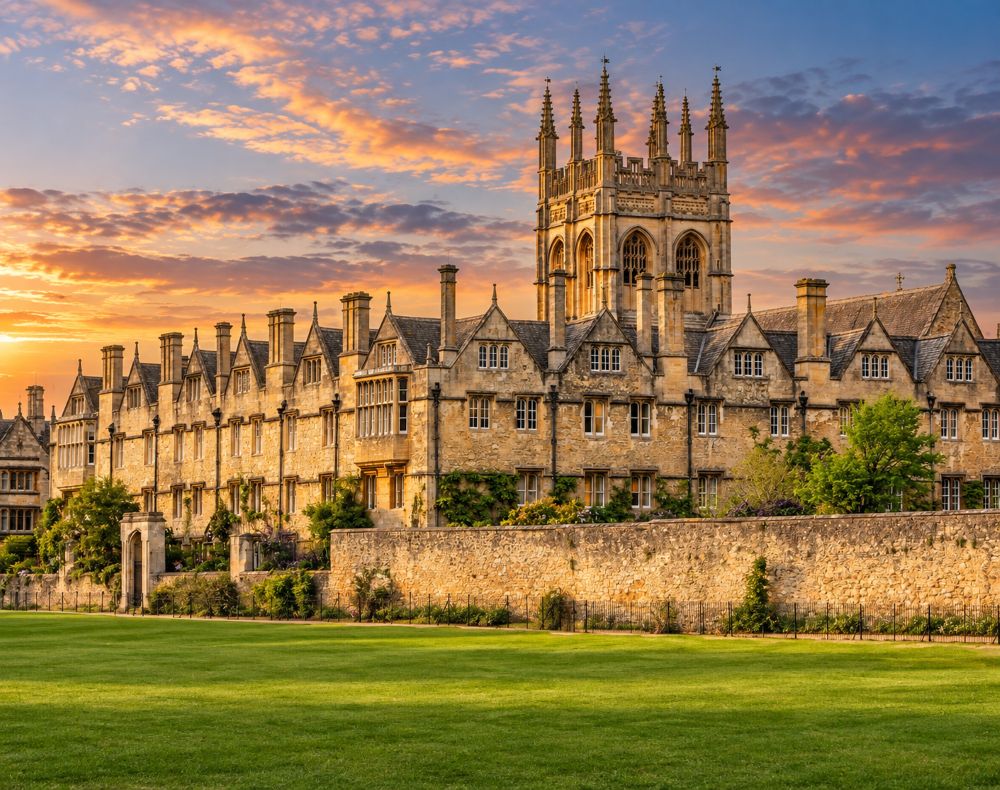
If Christ Church demonstrates Oxford on a monumental scale, Magdalen College shows how architecture and landscape can work together.
Founded in the fifteenth century by William of Waynflete, Bishop of Winchester, Magdalen developed around an imposing tower, cloisters, chapel and extensive grounds beside the River Cherwell.
The tower, completed around the beginning of the sixteenth century, became one of Oxford’s defining vertical landmarks.
The college is also famous for May Morning.
At dawn on 1 May, the choir sings from the top of Magdalen Tower while crowds gather below.
The tradition has evolved over centuries and now forms one of Oxford’s most distinctive annual rituals.
Addison’s Walk
The grounds contain Addison’s Walk, a tree-lined circuit beside branches of the Cherwell.
The name commemorates essayist Joseph Addison, a former fellow.
The walk later became associated with C.S. Lewis and Oxford’s twentieth-century literary world.
It provides exactly what many central colleges lack: room.
After several hours of cloisters and libraries, the combination of water, meadow and trees is extremely welcome.
Magdalen College in 2026
The college is generally open daily from 10:00 to dusk or 17:00, whichever comes earlier.
During July, August and September it remains open until 18:30.
Adult admission is £10.
Address: High Street, Oxford OX1 4AU
Telephone: +44 1865 276000
Recommended visit: 60–90 minutes
Balliol College
Balliol traces its foundation to the 1260s, making it one of Oxford’s oldest colleges.
Its Broad Street entrance is easy to overlook compared with the theatrical architecture around the Bodleian, but the interior provides a useful contrast with the larger tourist-heavy colleges.
Courtyards, chapel and gardens preserve the accumulated character of an institution rebuilt and expanded over centuries.
Balliol also has an extraordinary political history, with numerous British political leaders and public figures among its alumni.
In 2026 it is usually open 10:00–17:00 or until dusk, with adult admission at £6.
Address: Broad Street, Oxford OX1 3BJ
Telephone: +44 1865 277777
Oxford Castle
Oxford’s university buildings can obscure the older history of the city.
The castle corrects that.
A Norman fortress was established here shortly after the Norman Conquest, traditionally associated with Robert d’Oilly.
Over time the military castle declined and parts became integrated into a prison complex.
The site later functioned for centuries as Oxford Prison.
Today surviving medieval structures coexist with later prison buildings and modern commercial redevelopment.
The guided experience includes historic prison spaces and surviving castle elements.
If you have only one day, colleges take priority.
With two days, Oxford Castle provides useful context for the city before and beyond the University.
The Ashmolean Museum
The Ashmolean is not merely Oxford’s university museum.
Its institutional origins reach back to 1683, making it the first public museum established in Britain and one of the earliest of its kind in the world.
The collections range astonishingly widely: ancient Egypt, Greece and Rome, Near Eastern archaeology, European painting, decorative arts, coins and Asian collections.
Trying to see everything is pointless.
Choose sections.
The museum is especially effective for ancient art because university collecting and archaeology developed so strongly at Oxford.
General admission is free.
In 2026, some Western Art galleries on Level 3M are temporarily closed from 1 June until mid-October for environmental improvements.
Address: Beaumont Street, Oxford OX1 2PH
Opening: daily, generally 10:00–17:00
Admission: free
Recommended visit: 90 minutes to 3 hours
Oxford University Museum of Natural History
The Museum of Natural History occupies one of Oxford’s most remarkable Victorian interiors.
Iron and glass rise above a central court filled with specimens, while stone columns and decorative details turn scientific classification into architecture.
The museum opened in the nineteenth century during a period when natural science was redefining intellectual life.
One event became particularly famous.
In 1860, the museum hosted a debate associated with the reception of Charles Darwin’s theory of evolution, involving figures including Thomas Henry Huxley and Bishop Samuel Wilberforce.
Popular retellings often turn the exchange into a neat scientific victory over religion.
The actual historical episode was more complex.
What matters is that Oxford’s museum became one of the places where a new scientific worldview was argued publicly.
Practical Information
Address: Parks Road, Oxford OX1 3PW
Opening: daily 10:00–17:00
Last admission: 16:45
Admission: free
Telephone: +44 1865 272950
Allow about 60–90 minutes before continuing directly into the Pitt Rivers Museum.
Pitt Rivers Museum
The Pitt Rivers Museum is entered through the Museum of Natural History.
The contrast is immediate.
Where the first museum is bright, ordered and architecturally open, Pitt Rivers is darker and extraordinarily dense.
Thousands of anthropological and archaeological objects are arranged historically by type and function rather than primarily by geographic region.
Weapons, tools, textiles, ritual objects, musical instruments and everyday objects crowd cases across multiple levels.
The result reflects nineteenth-century ideas of classification and anthropology, and the museum today actively engages with the colonial histories through which many collections were assembled.
Admission is free.
In 2026, essential access works affect one secondary entrance during part of the summer, but public entry remains available through the Museum of Natural History on Parks Road.
Allow at least one hour.
The Covered Market
Oxford’s Covered Market opened in 1774.
It was created partly to move market stalls away from increasingly congested city streets.
Architect John Gwynn, also associated with Magdalen Bridge, designed the original scheme.
The market began with around twenty butcher shops.
Today roughly sixty independent traders occupy the covered lanes, ranging from food and produce to cafés, flowers and specialist shops.
This is not a medieval market despite its atmosphere.
It is an eighteenth-century urban-planning solution that became part of Oxford’s daily identity.
Use it for lunch or a break between the Bodleian quarter and Christ Church.
Carfax
The junction of High Street, Queen Street, Cornmarket Street and St Aldate’s has long functioned as Oxford’s principal crossroads.
Its name derives from the idea of quatre voies — four ways.
The surviving Carfax Tower belonged to the former Church of St Martin.
Climbing it provides another compact viewpoint, though St Mary’s tower and the Sheldonian cupola offer more compelling panoramas of the University quarter.
Carfax remains useful mainly as orientation.
Nearly every central Oxford route crosses it eventually.
Broad Street
Broad Street concentrates several centuries of Oxford history into a remarkably short walk.
Balliol and Trinity face one side.
The Sheldonian, Bodleian and Clarendon Building occupy another.
Look down near the road surface and you encounter one of the darkest episodes of the English Reformation.
A cross marks the traditional location associated with the executions of Protestant bishops Hugh Latimer and Nicholas Ridley in 1555, followed by former Archbishop of Canterbury Thomas Cranmer in 1556.
Their deaths became central to English Protestant memory.
Oxford’s streets therefore carry the history of religious conflict as visibly as academic tradition.
Oxford and the English Civil War
During the English Civil War, Oxford became the principal royalist capital after Charles I withdrew from London.
The king established his court here.
Christ Church became particularly important, with royal administration occupying college spaces and the Great Hall used for a royalist Parliament in 1644.
The city’s collegiate buildings suddenly became political and military infrastructure.
The episode demonstrates another recurring feature of Oxford history:
academic architecture repeatedly became entangled with national power.
Lewis Carroll and Alice
Oxford’s strongest literary connection may be Alice’s Adventures in Wonderland.
Charles Dodgson taught mathematics at Christ Church.
His friendship with the children of Dean Henry Liddell, especially Alice Liddell, contributed to the stories that eventually developed into Alice’s Adventures in Wonderland, published in 1865 under the name Lewis Carroll.
Christ Church contains several physical connections with this history, while Alice imagery has spread throughout modern Oxford.
The story is worth remembering precisely because it began within ordinary college life before becoming one of the most influential works of children’s literature ever written.
Tolkien, C.S. Lewis and the Inklings
Oxford later became associated with another extraordinary literary circle.
J.R.R. Tolkien and C.S. Lewis spent substantial parts of their academic careers here.
They belonged to the informal group later known as the Inklings, whose members discussed literature, manuscripts and ideas.
Oxford pubs became part of the mythology surrounding the group.
The Eagle and Child is the most famous connection, although the literary network extended beyond one pub and modern storytelling often simplifies decades of changing meeting places.
The important point is broader.
Oxford did not merely inspire fantasy literature through medieval architecture.
It provided the academic environment in which major works were discussed while still unfinished.
Historic Pubs
Oxford’s pubs are embedded in student and university culture.
Turf Tavern hides down a narrow passage close to Holywell Street and the Bodleian quarter. Its low rooms and enclosed courtyards provide exactly the kind of setting visitors expect from an old Oxford pub.
Address: 4 Bath Place, Oxford OX1 3SU
Telephone: +44 1865 243235
Best for: a pint after the Bodleian and New College.
For a more scenic detour, The Perch lies in Binsey beyond the dense historic centre, reached pleasantly on foot across Port Meadow or riverside paths.
Address: Binsey Lane, Binsey, Oxford OX2 0NG
Telephone: +44 1865 728891
Best for: a countryside-style pub walk without leaving Oxford.
Punting in Oxford
Oxford’s rivers provide an entirely different perspective on the city.
Punting is traditionally associated with the Cherwell, particularly around Magdalen Bridge.
A flat-bottomed boat is propelled using a long pole against the riverbed.
The technique looks simple from the bank.
It is not.
If you do not particularly want to spend twenty minutes learning how to rotate slowly in front of strangers, hire a chauffeured punt.
The best time is late afternoon when the light softens and college gardens meet the water.
The Cherwell and the Isis
Oxford stands between two important river landscapes.
The Cherwell passes the eastern edge of the centre and is the classic punting river.
The Thames becomes known locally as the Isis through Oxford and provides the setting for rowing, boathouses and Christ Church Meadow.
These rivers prevent Oxford from feeling like a continuous mass of stone.
Walk at least one waterside route.
The city becomes more intelligible when seen from its edges.
Port Meadow
Northwest of the centre lies Port Meadow, an extraordinary open landscape preserved beside the Thames.
Cattle and horses graze across broad grassland while Oxford’s skyline remains visible in the distance.
The meadow has been used for grazing for centuries.
It feels improbably rural considering how close it lies to the University.
For a two-day stay, walk from Jericho towards Port Meadow and continue towards Binsey.
This is the correct antidote to spending six hours inside chapels.
What to Eat in Oxford

Oxford does not possess one dominant regional dish.
Its food identity is shaped more by Oxfordshire produce, historic pubs, university dining culture and a highly international modern population.
Traditional English pub food remains useful: pies, roast meats, fish, seasonal game and puddings.
Oxfordshire cheeses and local farm produce appear on better menus.
The Covered Market works for an informal lunch.
The city’s student and academic population also supports restaurants that range far beyond traditional English cooking.
Do not spend two days here eating only pies because the buildings are medieval.
Oxford has not been culturally sealed since 1400.
Where to Eat in Oxford
No.1 Ship Street
No.1 Ship Street is the strongest central choice for a polished but recognisably British meal. Its position just off Cornmarket makes it particularly practical after the Bodleian, Ashmolean or Covered Market.
Address: 1 Ship Street, Oxford OX1 3DA
Telephone: +44 1865 806637
Cuisine: modern British
Price level: approximately £30–90
Best for: a serious central dinner without excessive formality.
The Perch
The Perch is not chosen because it is the easiest option.
It is chosen because the walk is part of the meal.
The pub sits in Binsey beside open meadow and river landscapes, giving a completely different impression of Oxford after a day among stone colleges.
Address: Binsey Lane, Oxford OX2 0NG
Telephone: +44 1865 728891
Cuisine: British pub and seasonal cooking
Price level: ££–£££
Best for: lunch or dinner combined with a Port Meadow walk.
Arbequina
Arbequina on Cowley Road provides the deliberate alternative to historic-pub Oxford. The compact Spanish restaurant focuses on sharing plates and works particularly well for a second evening when another formal British dining room feels unnecessary.
Address: 72–74 Cowley Road, Oxford OX4 1JB
Telephone: +44 1865 792777
Cuisine: Spanish / tapas
Price level: approximately £20–60
Best for: small plates and a livelier neighbourhood beyond the historic core.
Where to Stay in Oxford
Oxford accommodation is expensive relative to the city’s size.
For a first visit, paying for a central location usually makes sense because practically everything important can then be reached on foot.
Budget – Premier Inn Oxford City Centre Westgate
Premier Inn Oxford City Centre (Westgate) hotel provides the practical option: modern rooms, no historic pretence and a useful location beside the western side of the centre.
Address: Greyfriars Court, Paradise Square, Oxford OX1 1BE
Category: city hotel
Price level: ££
Best for: keeping accommodation relatively controlled while remaining walkable to Christ Church and Carfax.
Mid-range – Courtyard by Marriott Oxford City Centre
Courtyard by Marriott Oxford City Centre sits near Oxford Castle and is within easy walking distance of the station, Westgate and central colleges.
Address: 15 Paradise Street, Oxford OX1 1LD
Telephone: +44 1865 306900
Category: modern 4-star hotel
Price level: £££
Best for: rail travellers and a reliable central base.
Splurge – The Randolph Hotel
The Randolph Hotel Oxford, a Graduate by Hilton occupies one of Oxford’s classic hotel buildings directly opposite the Ashmolean Museum.
Its location is exceptional: Broad Street, Balliol, the Bodleian quarter and the Covered Market are all only minutes away.
Address: Beaumont Street, Oxford OX1 2LN
Telephone: +44 344 879 9132
Category: luxury historic hotel
Price level: ££££
Best for: a traditional Oxford splurge in the centre.
How Many Days Do You Need?
One day works if Oxford is a London excursion.
Choose Christ Church, Bodleian/Divinity School, Radcliffe Square, one college and one museum.
That is enough.
Do not attempt seven colleges.
Two days are ideal.
The second day allows Magdalen, New College, the Natural History Museum, Pitt Rivers and a river or Port Meadow walk.
A third day makes sense if you add Blenheim Palace, Woodstock or the Cotswolds.
The Best One-Day Oxford Itinerary
Begin at Christ Church with a timed morning entry.
Allow around two hours for the Hall, Tom Quad, Cathedral and cloisters.
Walk briefly through Christ Church Meadow.
Continue north through St Aldate’s to Carfax and the Covered Market for lunch.
Spend the early afternoon around Radcliffe Square, then take a Bodleian tour including the Divinity School and historic library spaces.
Walk beneath the Bridge of Sighs and enter New College if time allows.
Finish by climbing either the University Church tower or Sheldonian cupola.
Have a drink around Broad Street or the Turf Tavern before dinner.
This produces a coherent day instead of crossing the city repeatedly.
The Best Two-Day Oxford Itinerary
Day 1 – The Classic University
09:30–10:00: Christ Church
12:00: Christ Church Meadow
13:00: Covered Market lunch
14:00: Bodleian and Divinity School tour
15:30: Radcliffe Square and St Mary’s
16:30: New College
Evening: Broad Street, Turf Tavern and dinner
Day 2 – Colleges, Museums and Water
10:00: Ashmolean Museum
11:30: Broad Street and Balliol
12:30: lunch
14:00: Museum of Natural History
15:00: Pitt Rivers Museum
16:30: Magdalen College and Addison’s Walk
18:00: punt on the Cherwell or walk towards Port Meadow
Evening: Jericho or central Oxford
The two-day version is substantially better because it includes Oxford as a landscape rather than only a collection of famous interiors.
Oxford with Children
Oxford is unusually effective with children if you stop treating every college as mandatory.
The Museum of Natural History is the obvious first choice.
Dinosaurs, skeletons and zoological collections provide relief from medieval architecture.
Pitt Rivers can be equally absorbing because of the sheer density of objects.
Christ Church works particularly well for children familiar with Harry Potter or Alice.
Finish with punting or Christ Church Meadow.
Three consecutive college chapels rarely improve family morale.
Oxford from London
Oxford is one of the easiest substantial day trips from London.
Direct Great Western Railway services leave London Paddington and reach Oxford in around one hour, with the fastest trains taking approximately 52 minutes.
Services are frequent.
From Oxford station, the historic centre begins around ten minutes away on foot.
For a single day, train is far easier than driving.
Do You Need a Car?
No.
A car is actively inconvenient in central Oxford.
The historic core is dense, parking is expensive and many streets prioritise buses, bicycles and pedestrians.
If arriving by car, use Park and Ride.
Keep the car only if Oxford is part of a wider itinerary through Blenheim, Woodstock or rural Oxfordshire.
Park and Ride in 2026
Oxford has five principal Park and Ride sites:
Pear Tree
Oxford Parkway
Thornhill
Redbridge
Seacourt
From 17 August 2026 through 31 March 2027, a special £3 combined ticket covers up to 16 hours of parking plus return bus travel for as many as five people.
For travellers arriving from London or the M40, Thornhill is usually the most convenient.
From the south, use Redbridge.
From the west, Seacourt is the logical approach.
This is substantially easier than attempting to drive into central Oxford.
Getting Around Oxford
Walk.
Almost every major university sight sits inside a compact central zone.
Christ Church to the Radcliffe Camera takes around ten minutes.
The Radcliffe Camera to Magdalen College takes another ten.
The Ashmolean to the Natural History Museum is similarly short.
Buses become useful mainly for outer districts.
A bicycle is part of Oxford culture, but visitors staying one or two days rarely need one.
Best Time to Visit Oxford
April to June and September to October provide the best overall conditions.
Spring brings long evenings, college gardens and more pleasant river walks.
September is particularly good because the weather can remain mild while the academic year has not yet reached full intensity.
Summer brings the largest number of visitors and language-school groups.
College opening hours may be generous, but crowds can be substantial.
The University’s main undergraduate Open Days in 2026 fall on 1–2 July and 18 September. On those dates, many colleges become unusually accessible, but the city is also much busier.
Winter has its own atmosphere.
Fog, early darkness and illuminated college windows suit Oxford surprisingly well.
Just expect shorter visiting hours and more restricted access.
Oxford in 2026
Christ Church continues to operate with timed entry and prices that vary between term and vacation periods. During the September vacation period, adult on-the-day admission is £24.95 on weekdays and £26.95 at weekends, with online advance booking saving £2.
New College is open daily from 10:00 to 17:00 through 31 October, with adult admission at £12.
Magdalen charges £10 for adults and stays open until 18:30 through September.
The Sheldonian normally opens from 10:00 to 17:00, with guided visits at 11:15 and 14:30 when university events permit.
The Ashmolean remains free, although several Western Art galleries are closed until approximately mid-October for essential work.
The Natural History Museum and Pitt Rivers remain free.
For drivers, the £3 combined Park and Ride promotion introduced in August 2026 provides one of the best-value city-access options in England.
Useful Information
Country: England, United Kingdom
County: Oxfordshire
University teaching documented: by 1096
Major expansion: from 1167
Oldest English-speaking university: University of Oxford
Main college for first visit: Christ Church
Christ Church founded as Cardinal College: 1525
Founder: Cardinal Thomas Wolsey
Re-founded by Henry VIII: 1546
Christ Church identity: university college and cathedral
Tom Quad: approximately 264 × 261 ft
Tom Tower architect: Christopher Wren
Great Tom first rang from tower: 1684
Radcliffe Camera built: 1737–1748
Radcliffe Camera opened: 1749
Architect: James Gibbs
Bodleian reopened under Thomas Bodley: 1602
Sheldonian Theatre opened: 1669
Sheldonian architect: Christopher Wren
Sheldonian cupola climb: 114 steps
New College founded: 1379
New College adult admission 2026: £12
Magdalen adult admission: £10
Balliol adult admission: £6
Ashmolean admission: free
Natural History Museum admission: free
Pitt Rivers admission: free
Covered Market opened: 1774
Covered Market original architect: John Gwynn
Best central viewpoint: St Mary’s tower or Sheldonian cupola
Main river for punting: Cherwell
Thames in Oxford: commonly called the Isis
Fast London train: Paddington–Oxford
Fastest journey: approximately 52 minutes
Typical journey: around 1 hour
Car needed: no
Park and Ride sites: Pear Tree, Oxford Parkway, Thornhill, Redbridge, Seacourt
2026 combined Park and Ride offer: £3, up to five people and 16 hours parking
Minimum visit: 1 full day
Ideal stay: 2 days
Best months: April–June and September–October

