
Magdalen College Oxford Guide: Great Tower, Cloisters, Addison’s Walk and What to See
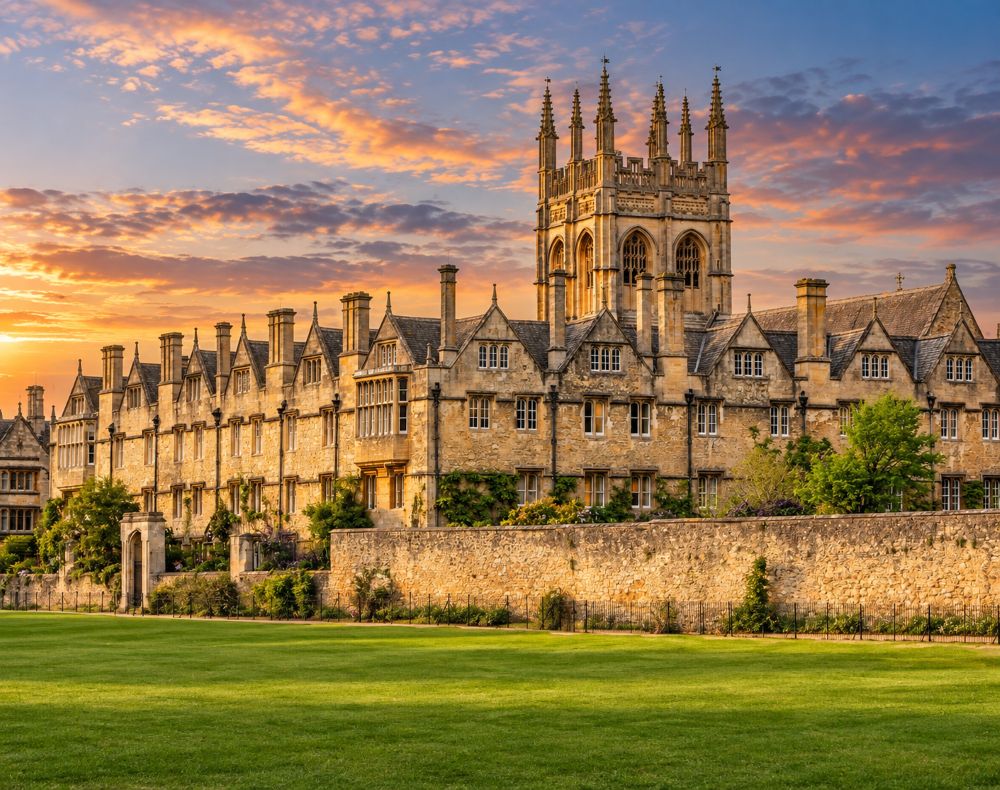
Magdalen College is one of the places where Oxford stops feeling like a collection of historic buildings and becomes an entire landscape.
Its Great Tower rises above the eastern end of the High Street. Behind the gate lie late-medieval cloisters, a chapel whose choir has been singing for more than five centuries, an old library, a vast eighteenth-century range, a deer park and meadows surrounded by branches of the River Cherwell. Beyond them, Addison’s Walk disappears beneath trees only minutes from one of Oxford’s busiest streets.
Few colleges combine architecture and open space so successfully.
Founded in 1458 by William Waynflete, Bishop of Winchester and Lord Chancellor of England, Magdalen was conceived from the beginning on an exceptional scale. Waynflete did not create a small residence for a handful of scholars. His foundation included 40 Fellows, 30 scholars known as Demies and a substantial choir, supported by an income capable of maintaining an ambitious academic institution.
Much of what visitors see today was built within the following half-century. Work on the enclosing Longwall began in 1467. Construction of the Cloister, Chapel, Hall and Library followed from 1474. The Great Tower was begun in 1492 and became usable in the opening years of the sixteenth century.
The result is one of Oxford’s most coherent late-medieval ensembles.
But Magdalen is not important only because of its stone.
Thomas Wolsey was a Fellow here before becoming Henry VIII’s immensely powerful chief minister. Edward Gibbon studied here and hated much of the experience. Oscar Wilde arrived as an undergraduate in the nineteenth century. C.S. Lewis spent nearly three decades as a Fellow and walked repeatedly through the college grounds. Ten Nobel laureates have been associated with Magdalen, including Erwin Schrödinger, Howard Florey and Seamus Heaney.
Then there is May Morning.
At 6:00 a.m. every 1 May, the college choir climbs the Great Tower and sings above thousands of people gathered on the High Street below. The ceremony, in evolving forms, reaches back more than five centuries and remains one of Oxford’s most remarkable living traditions.
Allow at least 90 minutes for Magdalen. Two hours is better if Addison’s Walk and the grounds are included properly.
What to See at Magdalen College
- Great Tower
- St John’s Quadrangle
- Chapel
- medieval Cloister
- Hall
- Old Library
- Founder’s Tower
- Cloister “hieroglyphics”
- New Building
- Deer Park
- Water Meadow
- Addison’s Walk
- River Cherwell
- Fellows’ Garden
- Longwall
- views towards Magdalen Bridge
- May Morning traditions
- C.S. Lewis connections
- historic portraits and memorials
- surviving elements connected with the Hospital of St John
Before Magdalen: The Hospital of St John
Magdalen did not begin on an empty site.
Before Waynflete created his college, this part of Oxford was occupied by the Hospital of St John the Baptist, a medieval charitable institution established outside the old eastern gate of the city.
Hospitals in medieval England were not hospitals in the modern clinical sense. They combined religious life with hospitality and care, receiving poor people, travellers and the sick according to the resources and rules of each foundation.
When Magdalen acquired the site, parts of the older institution were absorbed rather than immediately demolished.
Some surviving structures along the High Street range preserve this earlier history, while the old hospital hall eventually became part of the college kitchen complex.
This gives Magdalen an architectural history older than its conventional foundation date.
The great fifteenth-century college grew out of an existing medieval institution.
William Waynflete
The founder, William Waynflete, was one of the major ecclesiastical and political figures of fifteenth-century England.
Born William Patten, he adopted the name Waynflete from his Lincolnshire birthplace. His career took him through education, royal service and the Church, culminating in his appointment as Bishop of Winchester in 1447.
He also became Lord Chancellor of England under Henry VI.
Education occupied a central place in his ambitions.
Before Magdalen College, he had already founded Magdalen College School in 1480s? No—the relationship developed out of his broader educational programme associated with his Oxford foundation and its grammar teaching.
The Oxford college became his principal institutional legacy.
Waynflete intended it to possess enough wealth, buildings, books and academic staff to compete with the strongest collegiate foundations already established in Oxford.
He succeeded.
By the time of his death in 1486, Magdalen possessed substantial resources, statutes defining its academic life and much of the architectural framework that would determine its later development.
Why It Is Called Magdalen
The college is dedicated to Saint Mary Magdalene.
The spelling creates one of Oxford’s classic traps.
“Magdalen” is traditionally pronounced approximately “Maudlin”, not as a modern reader might pronounce the biblical name Magdalene.
The pronunciation preserves an older English linguistic form and is shared with Magdalen College School and Magdalene College, Cambridge, despite their different spellings.
It is a small detail, but using the traditional pronunciation immediately distinguishes anyone who has spent more than five minutes in Oxford.
Building a College on a Grand Scale
Construction accelerated during the second half of the fifteenth century.
The Longwall, begun in 1467, helped define the large perimeter of the college grounds.
In 1474, work began on the principal collegiate buildings: Chapel, Hall, Library and Cloister.
The principal mason was William Orchard, who was also involved with Oxford’s extraordinary Divinity School.
The connection is useful because both projects demonstrate the technical ambition of late-medieval Oxford masonry.
By around 1480, much of the central ensemble was sufficiently complete to function.
Rather than accumulating random buildings around an irregular courtyard, Magdalen developed as a planned academic community with worship, dining, study and residence organised in close architectural relationship.
St John’s Quadrangle
Visitors enter through the High Street and quickly reach St John’s Quadrangle.
This first court acts as a transition between urban Oxford and the more enclosed medieval college.
The Great Tower dominates one side while buildings of different periods reveal Magdalen’s gradual expansion.
The quadrangle also preserves connections with the earlier Hospital of St John.
Do not move through it simply because the Cloister lies beyond.
Magdalen is most rewarding when the building phases are read sequentially.
The entrance side recalls the earlier site.
The medieval Cloister represents Waynflete’s great foundation.
The eighteenth-century New Building then shows how later generations attempted to reshape the college according to completely different architectural ideals.
The Great Tower
The Great Tower is Magdalen’s visual signature.
Construction began in 1492 during the period immediately after Waynflete’s death, and the tower was ready for use in the early sixteenth century. Its final completion is conventionally associated with 1509.
Rising approximately 144 feet, around 44 metres, it dominates the eastern approach to central Oxford.
Its verticality is unusual even in a city famous for towers and spires.
Four corner turrets extend above the principal parapet while Gothic openings break the surfaces into increasingly lighter stages as the tower rises.
From Magdalen Bridge, the tower becomes part of one of Oxford’s classic compositions: water below, college walls along the High Street and Gothic architecture rising above them.
It was also built to be heard.
The bells remain central to college ritual.
May Morning
No Magdalen tradition is more famous than May Morning.
At 6:00 a.m. on 1 May, the choir sings from the top of the Great Tower while crowds fill the High Street and Magdalen Bridge below.
The principal piece is traditionally the Hymnus Eucharisticus, composed in the seventeenth century by Benjamin Rogers, a Fellow and former Informator Choristarum of the college.
The exact origins of the ceremony are not completely documented.
Traditions associated with singing from the tower stretch back for centuries, but the event changed repeatedly before acquiring its modern form during the nineteenth century.
Historian and Magdalen Fellow John Bloxam played an important role in shaping the modern ceremony.
The result combines medieval college identity, Victorian reinvention and contemporary city festival.
It is precisely this layering that makes Oxford traditions so interesting.
They often feel immemorial while having been repeatedly redesigned.
May Morning in 2026
The 2026 ceremony took place at 6:00 a.m. on Friday 1 May.
The Choir of Magdalen College sang the Hymnus Eucharisticus from the Great Tower, continuing the tradition before the crowds assembled along the High Street.
The climb itself requires 172 steps.
For visitors arriving at another time of year, the tower cannot normally be climbed as an ordinary tourist viewpoint.
Its role is ceremonial rather than observational.
The Chapel
The foundation stone of Magdalen College Chapel was laid on 5 May 1474.
Services probably began around 1480.
The Chapel formed part of Waynflete’s integrated collegiate plan and was never conceived merely as a decorative architectural element.
Worship structured everyday college life.
The original foundation included a substantial choir, giving music an institutional importance that has survived for more than five centuries.
The interior visible today is not a perfectly untouched fifteenth-century room.
The Reformation produced major destruction.
In 1551, the altar, organ and medieval stained glass were damaged or removed as England’s religious policies became increasingly Protestant.
Further upheaval followed during the seventeenth-century Civil War.
Successive generations then restored, redecorated and reorganised the space according to changing religious tastes.
This mixture is essential to its character.
The Chapel is medieval in origin but carries the consequences of the English Reformation, Civil War, Anglican revival and modern liturgical life within the same walls.
The Choir
Magdalen’s choir dates from the foundation period and has been singing in the Chapel since around 1480.
It remains one of Oxford’s major collegiate choirs.
During Full Term, choral worship normally takes place at 18:00 on most days except Monday, while Sunday includes a sung service in the morning.
The traditional title of the choirmaster is Informator Choristarum, a Latin designation preserved from the medieval institutional structure.
The choir is composed of boy choristers from Magdalen College School together with undergraduate Academical Clerks and Organ Scholars.
The musical tradition connects ordinary weekly worship with the internationally recognised May Morning ceremony.
Visitors interested in the college as a living institution should consider attending a service.
A sung Evensong explains the Chapel more effectively than another twenty minutes of architectural photography.
The Organ
The Chapel’s musical life has always depended heavily on the organ, although successive instruments have been installed as tastes and technology changed.
A new organ built by Hermann Eule Orgelbau was installed in 2023.
Its presence continues a musical tradition repeatedly interrupted and reconstructed since the sixteenth century.
As elsewhere in Oxford, apparently immutable tradition often rests on constant adaptation.
The Medieval Cloister
Beyond the Chapel lies the architectural heart of Magdalen.
The Cloister was begun during the same major building campaign of the 1470s and remains one of Oxford’s finest late-medieval collegiate spaces.
Four ranges enclose a broad grass quadrangle.
Stone arcades, windows, battlements and projecting sculptural details create a much richer architectural surface than the restrained geometry of several later Oxford colleges.
The effect is simultaneously monastic and academic.
That is deliberate.
Collegiate architecture borrowed heavily from religious institutions because both communities depended upon collective worship, shared meals, enclosed living and regulated daily routines.
Walking through the Cloister therefore reveals how closely the medieval idea of a university college remained connected with monastic architectural models without being a monastery itself.
The Hieroglyphics
Then look upwards.
Around the Cloister appears a collection of bizarre carved figures traditionally known as the Magdalen “hieroglyphics.”
They were added around 1508–1509, after Waynflete’s death.
Human faces, animals, grotesques and strange hybrid forms project from the stonework.
Modern visitors naturally want each creature to possess a precise symbolic meaning.
The history is less convenient.
An elaborate interpretation was produced in the seventeenth century by Magdalen Fellow William Reeks, who attempted to explain individual carvings as a coherent allegorical programme.
His reading became influential.
It should not automatically be treated as the original intention of the sixteenth-century sculptors.
The carvings are better approached as part of the extraordinarily rich visual vocabulary of late-medieval and early Tudor architecture, where moral imagery, grotesque humour, heraldic forms and imaginative creatures could occupy the same building.
Spend several minutes searching for them.
They are one of the details most easily missed by visitors looking only at the tower.
The Hall
Magdalen’s Hall belongs to the institutional core created in the late fifteenth century.
Like other Oxford college halls, it was designed for communal dining but also performed a broader ceremonial function.
College life historically revolved around several shared spaces:
the Chapel for worship;
the Hall for meals;
the Library for study;
the quadrangle and cloister for movement and community.
The Hall remains in active use.
Visitor access can therefore be restricted around meal times.
This is one of the recurring realities of Oxford sightseeing: the most atmospheric historical rooms are still part of functioning colleges rather than museums.
The Old Library
Waynflete regarded books as a fundamental part of his foundation.
When the medieval Library was created during the 1470s, he paid close attention to its design, working with William Orchard and insisting upon impressive windows.
He also assembled a substantial foundation collection of roughly 800 volumes.
For the late fifteenth century, this represented an exceptional academic resource.
Many books were chained to reading furniture, a normal security measure in a period when a manuscript or early printed volume could represent enormous financial and intellectual value.
Other books circulated among Fellows.
The library collection continued growing through donations and purchases.
In 1549, Magdalen appointed Henry Bull to a specialist library role that may represent one of the earliest examples of a Fellow Librarian at Oxford or Cambridge.
The Old Library remains a scholarly space rather than an ordinary tourist room, but its history helps explain Waynflete’s ambitions.
Magdalen was designed around books from the beginning.
Thomas Wolsey
Among Magdalen’s most consequential early members was Thomas Wolsey.
He became a Fellow during the 1490s, long before reaching the summit of Tudor political power.
Wolsey later served Henry VIII as Lord Chancellor and Cardinal, accumulating extraordinary ecclesiastical offices and political influence.
He would eventually establish his own immense college at Oxford, originally Cardinal College, in 1525.
After his downfall, Henry VIII took over the project.
That institution became Christ Church.
Oxford therefore contains an architectural connection between the two colleges:
Waynflete’s Magdalen educated Wolsey.
Wolsey then attempted to create an even grander Oxford foundation of his own.
Christ Church emerged from that ambition.
The Reformation
Wolsey’s rise and fall anticipated an upheaval that would transform Oxford.
The Reformation placed institutions such as Magdalen in a difficult position.
Religious practice changed repeatedly under Henry VIII, Edward VI, Mary I and Elizabeth I.
Altars, images, liturgical traditions and church furnishings became politically charged.
Magdalen survived.
Its Chapel did not survive unchanged.
The destruction of its altar, organ and stained glass in the middle of the sixteenth century demonstrates that Oxford colleges were not detached observers of national religious conflict.
They were among its principal battlegrounds.
Magdalen and the English Civil War
A century later, Magdalen was drawn into another national crisis.
During the English Civil War, Oxford became the Royalist capital of Charles I.
Magdalen supported the Royalist cause.
Following Parliament’s victory, the college experienced a purge in which its President and numerous Fellows were removed.
The physical grounds also became part of the city’s defensive landscape.
Earthworks constructed during the Civil War affected the gardens, and traces of this military intervention later became absorbed into the designed landscape.
A college famous today for peaceful riverside walking therefore once stood within a fortified wartime city.
The Crisis of 1687
One of the most dramatic episodes in Magdalen’s history came during the reign of James II.
When the presidency became vacant in 1687, the king attempted to impose a candidate on the college.
The Fellows resisted.
James tried again with another royal nominee.
Resistance continued.
The confrontation became a national test of royal power, institutional privilege and religious politics.
Eventually, many of the Fellows who opposed the king were expelled.
The episode created considerable public outrage.
By late 1688, James restored them.
It was too late to reverse the broader political crisis.
Within weeks, the king had lost his throne during the events conventionally known as the Glorious Revolution.
Magdalen’s dispute did not single-handedly overthrow James II, but it became one of the emblematic examples of resistance to his methods of government.
The Eighteenth Century
Magdalen’s eighteenth century was quieter and, academically, not always glorious.
The historian Edward Gibbon, later author of The History of the Decline and Fall of the Roman Empire, arrived as a student in the 1750s and developed a famously poor opinion of Oxford education.
His experience became one of the sharpest critiques of eighteenth-century collegiate complacency.
At the same time, Magdalen was changing architecturally.
The great medieval complex no longer satisfied Georgian ideas of elegance and comfort.
The result was the enormous New Building.
The New Building
The name once again requires context.
The New Building dates to the eighteenth century.
Designed in a grand classical manner, it forms a striking contrast with the Gothic Cloister and Tower.
Only one principal range of a much more ambitious quadrangular scheme was completed.
Its long symmetrical façade faces the meadow and creates one of Magdalen’s finest views.
This architectural interruption is valuable.
Instead of a college frozen in the fifteenth century, Magdalen presents a dialogue between two very different visions of institutional prestige:
late-medieval Gothic enclosure and eighteenth-century classical order.
Plans for further transformation continued.
Landscape designer Humphry Repton even produced proposals in the early nineteenth century that would have substantially altered the grounds and New Building, including ideas for creating a more picturesque landscape.
They were not implemented.
The survival of the meadow was fortunate.
The Deer Park
Magdalen possesses some of the most extensive private grounds of any Oxford college.
The Grove, commonly known as the Deer Park, is one of their most distinctive elements.
A herd of deer still lives within the college landscape.
The animals should not be treated as a zoo attraction.
They form part of a long-established managed landscape in which architecture, water, meadow and parkland coexist only minutes from the High Street.
This transition is one of Magdalen’s defining experiences.
Walk out of the medieval Cloister, pass the New Building and Oxford appears to disappear.
The Water Meadow
The Water Meadow occupies the interior of a long loop formed by branches of the Cherwell.
It is one of the great pieces of natural landscape hidden inside Oxford.
During spring, the meadow becomes particularly celebrated for snake’s-head fritillaries, whose purple and white chequered flowers thrive in the damp grassland.
The college has carefully preserved this habitat.
Kingfishers, herons and other wildlife also inhabit the waterways and surrounding vegetation.
The meadow cannot simply be crossed wherever convenient.
Visitors remain on the established circuit.
That restriction is precisely why the landscape survives.
Addison’s Walk
The path surrounding the Water Meadow is known as Addison’s Walk.
Its name commemorates Joseph Addison, writer, politician and Fellow of Magdalen from 1697 to 1711.
Addison became one of the great essayists of early eighteenth-century England, particularly through The Spectator, produced with Richard Steele.
He enjoyed walking through the college grounds, and the riverside route later took his name.
The complete circuit runs for roughly a mile.
Allow around thirty minutes if walking continuously.
You probably will not.
The views across the meadow, Cherwell and college buildings encourage repeated stops.
C.S. Lewis and Addison’s Walk
In the twentieth century, Addison’s Walk acquired another literary association.
C.S. Lewis was a Fellow of Magdalen from 1925 to 1954 and remained an Honorary Fellow thereafter.
He taught English literature and spent years walking through these grounds.
One particularly important walk occurred on the night of 19 September 1931, when Lewis walked and talked with J.R.R. Tolkien and Hugo Dyson about mythology, Christianity and the nature of religious truth.
The conversation formed part of the intellectual process through which Lewis moved towards Christian belief.
It later became one of the most frequently discussed episodes in the story of the Inklings.
The importance of the location is easy to understand.
Addison’s Walk is not spectacular in a conventional landscape-garden sense.
Its power comes from seclusion.
Water separates the path from the meadow, trees reduce views of the city and the academic buildings repeatedly disappear.
It creates the conditions for uninterrupted conversation.
C.S. Lewis at Magdalen
Lewis’s connection with the college lasted nearly three decades.
Before becoming internationally known for The Chronicles of Narnia, he was a medieval and Renaissance literature scholar whose academic life was centred here.
His rooms are part of the private college rather than a tourist reconstruction.
Magdalen consequently offers a more authentic Lewis connection than locations organised primarily around literary tourism.
The landscape remains.
The walks remain.
The scholarly institution in which he worked remains active.
That is enough.
Oscar Wilde
Another extraordinary former student was Oscar Wilde, who came to Magdalen in 1874.
Oxford played an important role in shaping his aesthetic interests.
Wilde encountered the intellectual environment created by figures such as John Ruskin and Walter Pater, absorbed contemporary debates about art and beauty and developed the cultivated persona that would later become inseparable from his public identity.
He won the Newdigate Prize in 1878 for his poem Ravenna.
The restrained medieval atmosphere of the college may seem an unlikely background for Wilde’s later theatrical flamboyance.
That contrast is precisely what makes the connection interesting.
Edward Gibbon, T.E. Lawrence and Other Magdalen Figures
Magdalen’s historical roll call is unusually broad.
Edward Gibbon passed through in the eighteenth century.
T.E. Lawrence, later famous as Lawrence of Arabia, is associated with the college’s alumni history.
Poet John Betjeman studied here.
Historian A.J.P. Taylor became a Fellow.
Poet Seamus Heaney, Nobel laureate in Literature, later held a connection with the college.
Scientific figures associated with Magdalen include Erwin Schrödinger, Howard Florey, Peter Medawar, Charles Sherrington and Peter Ratcliffe.
Ten Nobel Prize winners have been associated with Magdalen as students or Fellows.
The architecture attracts visitors.
The intellectual history explains why the buildings mattered.
Science at Magdalen
The nineteenth and twentieth centuries transformed the college’s academic profile far beyond classical and theological education.
Charles Daubeny became a significant figure in the development of scientific teaching at Oxford during the nineteenth century and helped press for formal university recognition of natural science.
The transformation continued dramatically in the twentieth century.
Howard Florey, associated with Magdalen and later awarded the 1945 Nobel Prize in Physiology or Medicine, played a crucial role in developing penicillin into an effective therapeutic drug.
Magdalen’s history therefore extends from medieval manuscript libraries to modern biomedical science without breaking its institutional continuity.
Women at Magdalen
For most of its history, Magdalen was a male institution.
That changed in 1979, when women were admitted as full members of the college.
The date is surprisingly recent when set against a foundation dating to 1458.
It also marks one of the most important transformations in the modern history of Oxford colleges.
Magdalen today is a mixed academic community of more than 600 students together with Fellows and staff.
The medieval structures remain.
The institution living inside them has changed profoundly.
How to Visit Magdalen College
The best visit follows the college’s spatial development rather than moving directly towards Addison’s Walk.
Begin beneath the Great Tower and enter St John’s Quadrangle.
Continue towards the Chapel and spend time inside rather than treating it as a corridor towards the Cloister.
Then enter the Cloister, walk all four sides and look upwards for the sculpted hieroglyphics.
Pass towards the New Building, where the architectural language changes completely.
Only then continue into the grounds.
Walk past the Deer Park and complete Addison’s Walk around the Water Meadow if it is open.
Return towards the High Street through the college rather than leaving by the quickest possible route.
This sequence gives you medieval Magdalen first and landscape Magdalen second.
Allow 90 Minutes
A focused visit requires approximately:
15 minutes: entrance, St John’s Quadrangle and Great Tower
20 minutes: Chapel and Cloister
10 minutes: Hall/New Building area
35–45 minutes: Deer Park and Addison’s Walk
Add more time if a Chapel service is included.
The Best Time of Day
Morning provides quieter architecture.
Late afternoon provides better landscape.
During summer, the extended 18:30 closing time makes Magdalen particularly rewarding after many day visitors have already moved towards restaurants or railway stations.
Light across the New Building and meadow becomes softer during the final hours.
Spring is the most distinctive season because of the vegetation and fritillaries in the Water Meadow.
May has an obvious attraction because of May Morning, but the ceremony brings enormous crowds.
Do not expect an intimate college visit on the morning of 1 May.
Magdalen College in 2026
Magdalen is open to visitors from 5 January to 21 December 2026.
The normal visiting period is:
10:00 until dusk or 17:00, whichever comes first.
During July, August and September, the college remains open until 18:30.
Last admission is 30 minutes before closing.
There are several exceptional restrictions during 2026.
On 24 September, the college is open only from 10:00 to 13:00.
It is completely closed to visitors on 25 September and 4 October.
The college closes for the Christmas period from 22 to 31 December.
Opening arrangements can also be affected by college ceremonies and academic events.
Tickets in 2026
Adult: £10
Over 65: £9
Student: £9
Child aged 7 and above: £9
Children under 7: free
Family ticket: £28 for two adults and up to three children aged seven or above
A combined ticket with the Oxford Botanic Garden is also available:
Adult: £17
Concession: £15
The combined ticket allows one entry to each attraction within twelve months.
Payment at Magdalen is card only.
Tickets can be purchased in advance or on arrival.
Access and Visitor Rules
Magdalen remains a working academic college.
Private staircases, student rooms and clearly restricted areas are not open to visitors.
The Hall may close around meal periods.
Walking on most lawns is prohibited.
Picnics are not permitted inside the college grounds.
Dogs are not admitted except assistance dogs.
There is no visitor parking inside the college.
Visitors with reduced mobility should be aware that historic surfaces, steps and some medieval areas can create limitations, although substantial parts of the route are accessible.
How to Get to Magdalen College
Magdalen stands at the eastern end of Oxford’s historic centre, immediately beside Magdalen Bridge.
From the Radcliffe Camera, allow around 10 minutes on foot.
From Christ Church, around 12–15 minutes.
From Oxford railway station, the walk takes approximately 25 minutes.
Buses along the High Street make the college easy to reach, but walking through central Oxford remains the best option.
Address: Magdalen College, Oxford OX1 4AU
Telephone: +44 1865 276000
Combine Magdalen with Oxford Botanic Garden
The most natural pairing is the Oxford Botanic Garden, immediately beyond Magdalen Bridge.
The two sites complement each other unusually well.
Magdalen provides a carefully preserved medieval college landscape.
The Botanic Garden introduces a scientific approach to plants within an institution founded in 1621, making it Britain’s oldest botanic garden.
The combined 2026 ticket makes the pairing particularly straightforward.
Allow approximately two hours for Magdalen and another 60–90 minutes for the Botanic Garden.
Combine Magdalen with New College
For architecture, pair Magdalen with New College.
The two colleges were founded less than a century apart and allow an excellent comparison of late-medieval Oxford collegiate planning.
New College was founded by William of Wykeham in 1379.
Magdalen followed in 1458.
Both use quadrangles, chapels, halls and communal spaces to organise academic life, but Magdalen adds a scale of landscaped grounds that changes the experience completely.
A strong half-day can include:
New College – Bridge of Sighs – Queen’s Lane – High Street – Magdalen College.
Combine Magdalen with the University Museums
The Oxford University Museum of Natural History and Pitt Rivers Museum lie roughly fifteen minutes away on foot.
This pairing is particularly effective because it moves from medieval and early modern academic culture into Victorian science and anthropology.
Magdalen’s own connections with scientists including Daubeny, Florey and Schrödinger make the transition more coherent than it first appears.
Is Magdalen Better Than Christ Church?
They offer very different experiences.
Christ Church is more monumental and politically important. Wolsey, Henry VIII, Charles I, Lewis Carroll and the Cathedral create an extraordinary concentration of national history.
Magdalen is more complete as a collegiate landscape.
Its Great Tower, Chapel, Cloister, New Building, deer park, Water Meadow and Addison’s Walk allow visitors to experience academic architecture and nature as a single environment.
For a one-day first visit to Oxford, Christ Church is difficult to omit.
For a second college, Magdalen is one of the strongest choices in the city.
Useful Information
Name: Magdalen College
University: University of Oxford
Founded: 1458
Founder: William Waynflete
Founder’s offices: Bishop of Winchester and Lord Chancellor
Original foundation: 40 Fellows, 30 Demies and a large choir
Earlier institution on site: Hospital of St John the Baptist
Longwall construction began: 1467
Main medieval building campaign began: 1474
Principal medieval mason: William Orchard
Chapel foundation stone: 5 May 1474
Chapel in use: around 1480
Choir origins: around 1480
Great Tower begun: 1492
Great Tower: approximately 144 ft / 44 m
Great Tower completed: early 16th century, traditionally associated with 1509
May Morning: 6:00 a.m., 1 May
May Morning principal hymn: Hymnus Eucharisticus
Tower climb used by choir: 172 steps
Cloister hieroglyphics: 1508–1509
Main grounds: Deer Park, Water Meadow and Addison’s Walk
Addison’s Walk: roughly one mile
Named after: Joseph Addison
C.S. Lewis: Fellow 1925–1954; Honorary Fellow from 1955
Important Lewis walk with Tolkien and Hugo Dyson: September 1931
Thomas Wolsey: Fellow during the 1490s
Oscar Wilde: undergraduate from 1874
Edward Gibbon: student in the 1750s
James II crisis: 1687–1688
Women admitted: 1979
Nobel laureates associated with college: 10
Current opening 2026: 10:00 to dusk or 17:00, whichever comes first
July–September closing: 18:30
Last admission: 30 minutes before closing
24 September 2026: open 10:00–13:00 only
25 September 2026: closed
4 October 2026: closed
22–31 December: closed
Adult admission: £10
Over 65 / student / child: £9
Family ticket: £28
Under 7: free
Magdalen + Oxford Botanic Garden: £17 adult / £15 concession
Payment: card only
Visitor parking: none
Dogs: assistance dogs only
Recommended visit: 90 minutes–2 hours
Address: Magdalen College, Oxford OX1 4AU
Telephone: +44 1865 276000

