Beyond Pinot Noir: How Pinot Meunier is Defining Modern Champagne
Pinot Meunier is the grape variety that no one expects to be the protagonist, and instead it carries on its shoulders the history of millions of bottles of Champagne. Always considered the humble “sidekick” of Pinot Noir and Chardonnay, today it takes revenge as a true outsider: some still call it a supporting actor, but increasingly it shines alone in surprising single-varietal versions, capable of astonishing both enthusiasts and purists of the great maisons. If you are looking for freshness, immediacy and a rustic but irresistible touch in your sparkling wines, Pinot Meunier is the secret key.
The Basics
Name: Pinot Meunier
Origin: France, mainly Champagne (Vallée de la Marne, Montagne de Reims)
Category: Black grape variety
Vineyard area: about 10,000 hectares in Champagne (about 32% of the region’s vineyards), also grown in Germany (Schwarzriesling), Australia, California, UK
Botanical characteristics: medium bunch, small grapes, white bloom on the leaves (it looks like “dusted with flour”—meunier means miller)
Ripening: early compared to Pinot Noir
Profile: fresh, fruity wines, less austere than Pinot Noir
Typical alcohol content: 12-12.5% vol.
Serving temperature: 8-10°C (sparkling), 14-16°C (vinified in red)
Average price: from 30-45 euros for classic Champagnes, up to over 90 euros for the best single-variety
Origins and History
Pinot Meunier was born as a spontaneous variant of Pinot Noir, probably in the north of France. Its fortune, however, is inextricably linked to Champagne: thanks to its greater resistance to cold and spring frosts, Meunier has established itself on the banks of the Marne, where other vines often struggle. Until a few years ago, it was considered the “poor brother” of the more renowned Pinot Noir and Chardonnay, used mainly to give freshness and roundness to the cuvées. Today, however, its reputation is growing rapidly, thanks to small producers who have been able to valorize it even on its own.
Ampelographic Characteristics
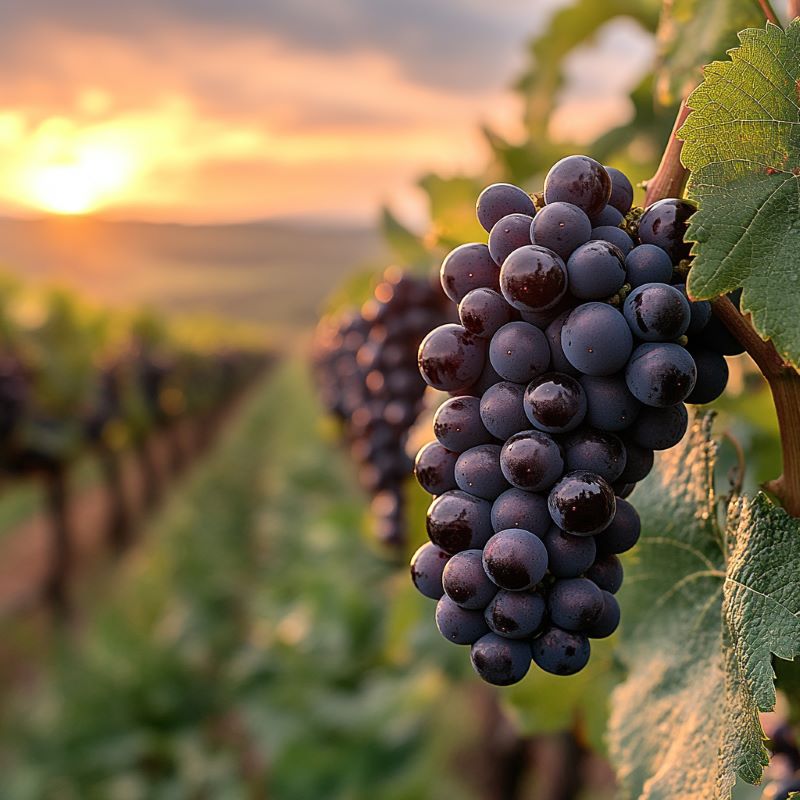
What distinguishes Pinot Meunier are its leaves covered with a white, almost powdery bloom—hence the name “meunier,” the miller. The bunch is medium-sized, with small, round grapes and a thick skin rich in anthocyanins. It buds later and ripens earlier than Pinot Noir, which makes it ideal for the cold areas of Champagne, where frosts can ruin the crops of other varieties. It is resistant to humidity and disease, but gives its best only in certain microclimates and well-drained soils.
Where It Grows: Areas and Terroir
Pinot Meunier is the protagonist of the Vallée de la Marne, especially on the right bank, between Epernay and Dormans. Here, the clay-limestone soils and cool climate help maintain freshness and fragrance in the wines. It is also found in the Montagne de Reims and the Côte des Bar, but in smaller percentages. Outside of Champagne, Meunier is grown in small quantities in Alsace, in Germany as Schwarzriesling, and in recent years also in England, California, Australia and New Zealand—where it produces elegant and surprising sparkling wines.
Winemaking Method
In the Champagne tradition, Meunier is used mainly in blending, often for the base cuvée of the great maisons, because it brings freshness, immediacy and a fruity bouquet that “shortens” the maturation time in the bottle. In recent years, however, the production of Champagne Blanc de Noirs made only from Meunier has grown: clean, tasty wines, often more accessible when young but with surprising potential for evolution. It can also be found vinified as a white (without skins), as a rosé, and, in rare cases, as a still red.
Organoleptic Characteristics
Pinot Meunier gives wines with a lively and recognizable aroma: hints of strawberry, raspberry, red apple, wild flowers, notes of aromatic herbs and, over time, hints of toasted bread and hazelnut. In the mouth it is immediate, fresh, never too hard, with balanced acidity, creamy bubbles and a finish that is often fruity and “crunchy”. The best single-varietal Meuniers can surprise with depth, spiciness, minerality and an aging capacity that belies all prejudices.
Food Pairings and Recipes
Champagne based on Meunier is perfect for an aperitif, but it pairs well with many dishes: noble cured meats (high quality cooked ham, culatello, jambon persillé), beef tartare, vegetable tempura, sushi and sashimi, herb risottos, roast poultry, fresh cheeses such as goat cheese and Brie de Meaux. Also try with ethnic dishes such as pad thai, shrimp ceviche, quinoa and citrus salad. Structured Blanc de Meuniers also accompany white meats, lacquered duck, foie gras escalopes and shellfish in a delicate sauce.
Price and Recommended Producers
The price of a Meunier-based Champagne varies greatly: classic cuvées start at 30-45 euros, the most prestigious single-varietals exceed 70-100 euros.