
Venomous Delight: Exploring the Fascinating World of Habushu
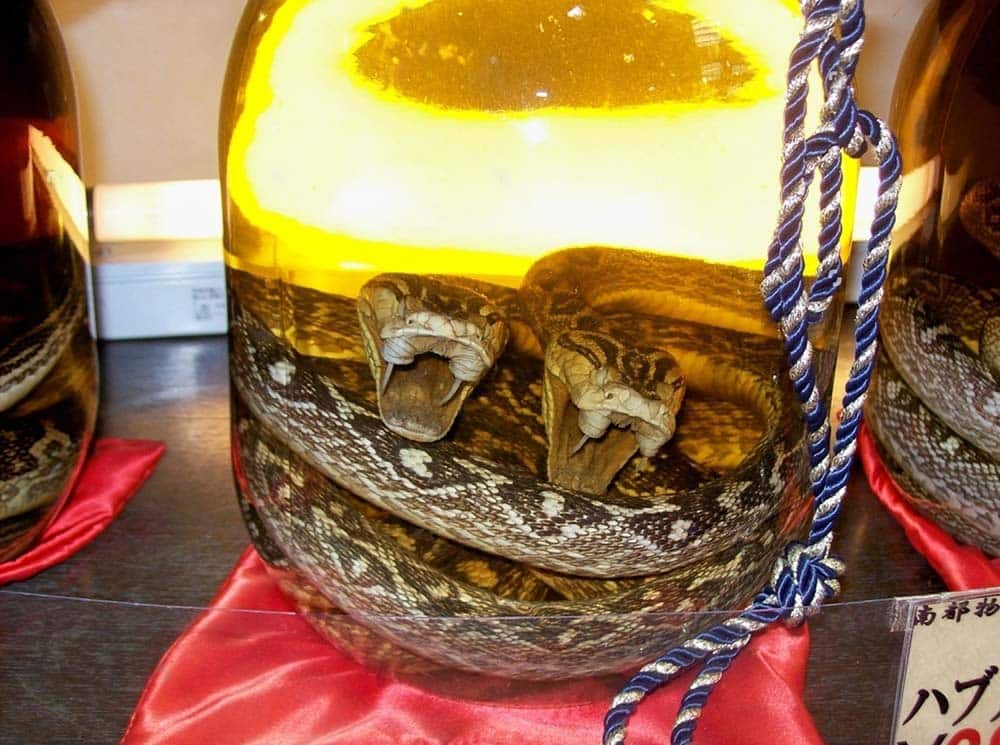
Have you grown bored with your ordinary amaro Montenegro and crave a once-in-a-lifetime adventure?
It’s your lucky day, because today we will taste one of the most particular and mysterious distillates in the world: Habushu!
A delicious venomous distilled beverage that’s sure to leave a lasting impression. Infused with the venom of the Habu snake, a deadly serpent found in the southern islands of Okinawa, Japan, Habushu is a drink that’s both fascinating and mysterious, with a rich history and cultural significance that’s sure to intrigue even the most adventurous spirits.
How is Habushu Made?
Habushu is made by infusing the venomous Habu snake in Awamori, a distilled beverage made from long-grain Indica rice.
The Habu snakes are typically raised in captivity and are usually fed with a special diet of frogs and mice to enhance their venom’s potency.
The venom is then collected and added to the Awamori, along with other herbs and spices, to create a unique and potent drink.
The venom is believed to have medicinal properties and is used in traditional Okinawan medicine.
Who Invented Habushu?
It is not known for sure who invented Habushu, however it is widely held that it was a man named Chojun Miyagi in the early 20th century.
Miyagi was a martial arts master who was known for his expertise in Okinawan Goju-Ryu Karate.
He believed that Habushu had medicinal properties that could enhance the strength and speed of his students, and he encouraged them to drink it before training.
History of Habushu
Habushu has a rich history in Okinawan culture and has been used for centuries in traditional medicine.
According to the legends, it was a liquor that could perform miracles. It was believed to have curative properties and was employed in the treatment of a wide range of conditions, including arthritis, respiratory issues, and even infertility.
The substance was also employed as a vigor and strength tonic, as well as a protective talisman against bad spirits.
In the 20th century, Habushu became increasingly popular as a drink, and it was sold in Okinawan bars and restaurants. However, its production was banned in 1979 due to concerns about the safety of consuming snake venom. Since then, Habushu has been produced in limited quantities and is mostly consumed as a novelty drink or souvenir.
Producing Zone and Styles
Habushu is produced exclusively in Okinawa, Japan, and is made using traditional methods that have been passed down for generations. There are several styles of Habushu, each with its unique flavor profile and potency. Some Habushu is made with higher concentrations of venom, while others are milder and more palatable.
Some are aged in oak barrels, giving them a smokey flavor, while others are flavored with honey or other sweeteners.
Flavors and Scents
The flavor and aroma of habushu are peculiar, resembling a combination of sweet and bitter notes, along with undertones of various herbs and spices.
It has a potent, slightly alcoholic taste, with a subtle aftertaste of snake venom that lingers on the palate.
The venom of some Habushu species is more strong than that of others, causing a nasty tingling feeling in the mouth and throat, so take it easy.
And now you will ask me: Alfredo, have you tasted this delicious nectar? Yes, with an enormous effort and overcoming my pseudo-phallic fear of snakes, I forced myself to taste it.
I was sick for two days, but for a mental fact, the taste itself is typically Japanese, a test of courage rather than an elegant Zen-style taste.
In the sense that it has such a passively aggressive bitterness that, in the end, it doesn’t flatten your palate, but it adds nothing to your experiences as a globetrotting drinker.
written and directed by Alfredo Ravanetti

