
Yosemite’s Fiery Illusion: The Secret Waterfall That Turns to Lava Each February
Yosemite National Park, in central California, draws nearly five million visitors each year, who come to see its redwood forests, granite mountains, scenic waterfalls, and abundant wildlife.
Many choose summer as their travel season, but to experience the spectacular sight of the great Yosemite Falls, come in spring, when the increased flow of water caused by the meltwater creates the most impressive drops. Summer, on the other hand, tends to decrease the flow of water and temporarily dry them up.
Horsetail Fall at Yosemite National Park
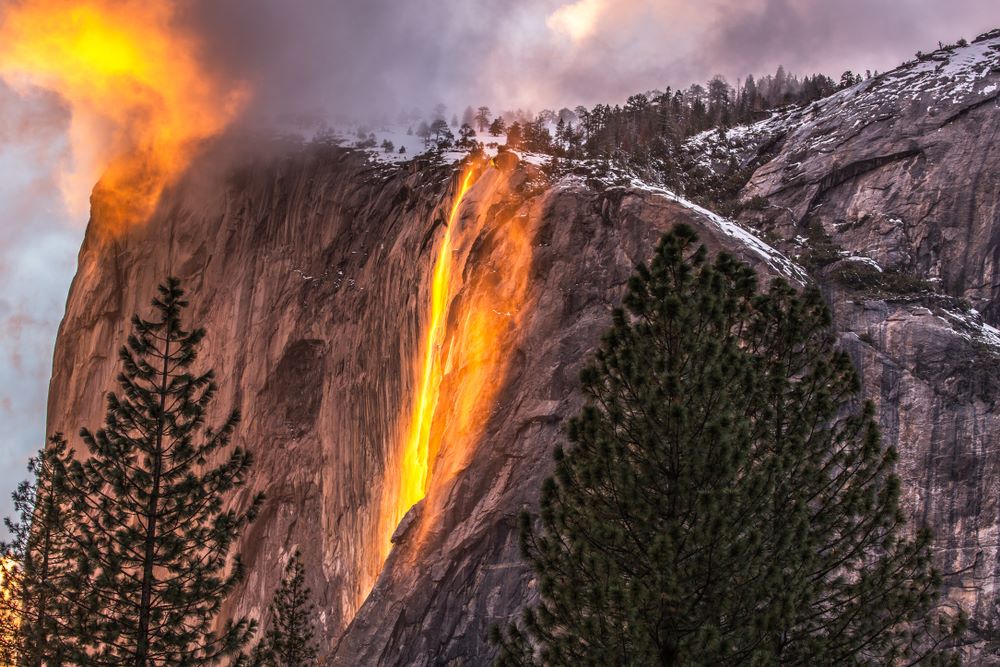
There is a waterfall in Yosemite National Park that is at its best in late winter. Roughly between mid and late February, the small Horsetail Fall (Cascata della Coda di Cavallo, in Italian), which flows seasonally from the steep eastern rock face of El Capitan in Yosemite Valley, transforms into a firefall.
The images are impressive and make you wonder if it is not the eruption of a volcano. The answer is no: not lava, despite appearances, but simple water that, when certain weather conditions occur, takes on a fiery glow.
When and how to see the firefall?
The “transformation” occurs annually on some afternoons in late February, but the most evocative moments are around 5:30 pm, when the sun approaches the horizon, before sunset.
There are no fixed dates or times in nature, of course, but that is usually the period. According to scholars, in 2024 this phenomenon is more likely to occur between 10 and 25 February.
The necessary condition is that the sky is clear; with fog or cloudy skies the show is lost and we must hope for the following year.
If all goes well, when the shadows lengthen, the sun’s rays hit the upper part of the rock face, which is reflected in the overflowing water and emits a yellow-orange glow, as if it were a fire.
The brightness of the phenomenon is surprising. From some observation points in the park it really seems like you are seeing lava falling down the side of a volcano, but in reality the orange glow is simply that of the water that flows down the mountain.
A 19th-century fire show and modern fame
In the 19th century, this natural event may have inspired the idea of a local hotelier: in 1870, the owner of a local hotel pushed bark embers down from the nearby Glacier Point Cliff, creating a cascade of fire and sparks to amaze visitors.
The idea, as you might imagine, was definitively banned in 1968, obviously due to the fire risks that threatened the safety of the park.
In recent years, the firefall has become a very popular topic on social networks, so much so that even the US Department of the Interior has started posting photos and commenting on them.
This is also why winter visitors to Yosemite are increasing every year, even without the guarantee of being able to witness the spectacle.
Environmental impact and access restrictions
Precisely because of the large influx of people (in 2022, for example, more than 2,000 visitors gathered in areas mostly without parking and adequate facilities, positioning themselves on the banks of the Merced River, increasing its erosion and trampling the vegetation, in addition to having filled the area with garbage), stricter rules and suitable routes for visiting have been introduced.
On weekends, for example, a reservation is required to drive inside the park.
How to get to Horsetail Fall?
To reach Horsetail Fall, the most convenient parking lot to use is the Yosemite Falls parking lot (just west of Yosemite Valley Lodge).
Once you have left your car, from there you walk for 1.5 miles to the observation point located near the equipped picnic area of El Capitan.
For the occasion, Northside Drive closes one lane to traffic to allow visitors to walk safely between the observation area and the Yosemite Falls parking lot.
In any case, to be updated on the conditions of access and prohibitions, it is advisable to visit the official website of Yosemite National Park, where all the notices are published.

