
Why Tasmania is the Ultimate Adventure Destination in Australia

Tasmania, probably the geographical destination that most evokes the magic of travel, is Australia’s only island state, spanning almost 68,000 square kilometers and home to over 474,000 people. The island is bordered by Bass Strait to the north, the Tasman Sea to the east, and the Southern Ocean to the south. The capital, Hobart, is a beautiful location well worth a visit.
A Brief History of Tasmania

Early in its Western history, Tasmania was seen as an ideal site for a penal colony, much like the Australian mainland. Abel Tasman, as his name suggests, was the first European to see Tasmania in 1642, naming it Van Diemen’s Land after the governor of the Dutch East Indies. In the 18th century, many navigators mistook Tasmania for part of mainland Australia. Even famous explorers like James Cook and William Bligh made this mistake, until Lieutenant Mathew Flinders circumnavigated Van Diemen’s Land in 1798 and proved it to be an island.
This discovery led to the founding of key locations like Hobart (1804), Macquarie Harbour, Maria Island, and Port Arthur (1832), which became notorious penal settlements. In 1856, the transportation of convicts ceased, and Tasmania adopted its current name to distance itself from its penal past. The same year, Tasmania held its first parliamentary elections, marking the start of a new era.
How to Get to Tasmania
To reach Tasmania, you can take a flight from major Australian cities like Sydney, Adelaide, or Melbourne to the island’s airports: Hobart, Launceston, Burnie, and Devonport. Alternatively, a ferry service operates between Melbourne and Devonport, crossing Bass Strait.
Best Time to Visit Tasmania
Tasmania has an oceanic climate, rather cool throughout the year. Its location means it is subject to direct influence from Antarctic winds, which blow here with significant intensity. The driest period is during the Tasmanian summer (December to March), when temperatures can reach a maximum of 20°C near the capital, Hobart. However, the sea remains quite cold, barely reaching 17-18°C at the end of summer. In winter, temperatures drop, sometimes approaching 0°C in Hobart, with highs around 10°C and frequent rainfall. Snow is also common in the mountains of the interior.
What to See and Do in Tasmania
National Parks and Natural Beauty

Tasmania is renowned for its numerous National Parks, each offering breathtaking scenery, wonderful trails, and a wide range of outdoor activities. Russell Falls is among the most popular waterfalls, but it is trekking that draws nature enthusiasts from all over the world.
The South West National Park is the largest National Park in Tasmania, located in the south of the island. This park is a paradise for hikers, featuring rare and endangered plants and spectacular waterfalls. Bruny Island is also in the south and consists of North and South Bruny, connected by an isthmus. A ferry service from Kettering (about 40 minutes’ drive south of Hobart) makes visiting the island easy.
The Eastern Coast: History and Beaches
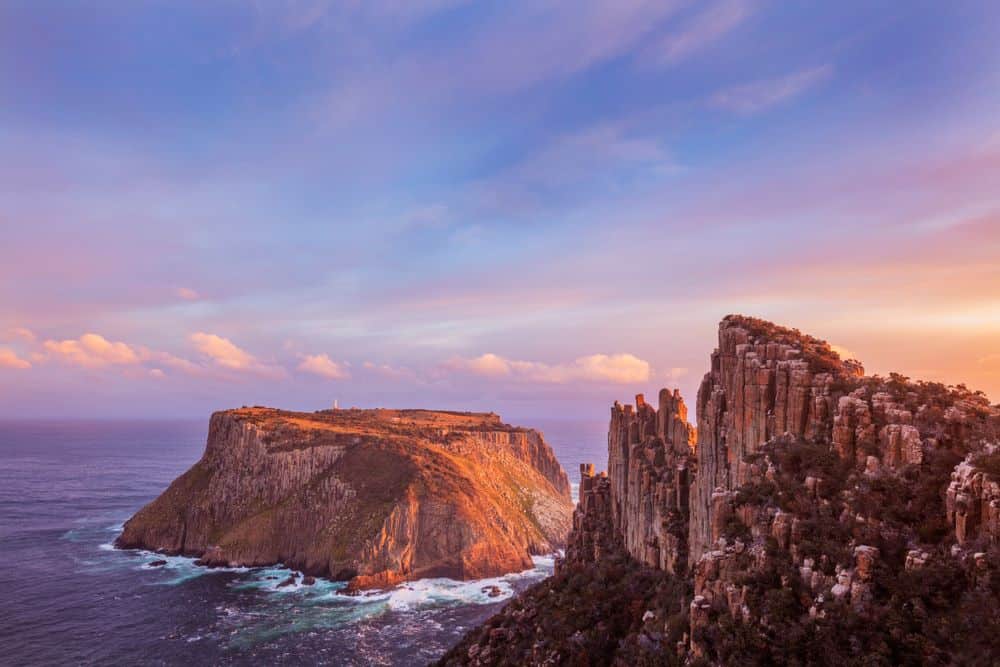
Eastern Tasmania offers picturesque beaches, the state capital Hobart, and fascinating historical sites like Port Arthur. The Tasman Peninsula also boasts unique rock formations, beautiful walks, and the Tasman National Park.
Further north, still on the east coast, lies Swansea, which overlooks Great Oyster Bay. This area offers historic buildings and stunning views of the Freycinet Peninsula, which can be reached by boat. North of Swansea is Bicheno, a charming town known for spearfishing and its harbor, where fresh fish is sold directly from the day’s catch.
Exploring Tasmania’s North Coast
Tasmania’s North Coast is known for its breathtaking scenery, interesting coastal areas, inland cities, and numerous rivers to explore. The North Coast is home to Devonport, a famous port featuring several museums and galleries. Make sure to visit the beautiful Mt William National Park as well as Launceston, the oldest city in Australia.
Outdoor Adventures
Tasmania’s iconic Overland Track is a must for trekking enthusiasts. This famous route winds through the peaks of Cradle Mountain, passing frozen lakes and windswept plains. Another popular trek is the South Coast Track, which runs along the rugged southern coastline, offering spectacular rainforest views and a chance to encounter the unique Tasmanian devil, a marsupial native to the island.

