
Weekend in Pavia? Here’s Why This Ancient City Should Be Your Next Escape

Pavia is often treated as an easy day trip from Milan, which is true geographically and misleading historically. Few cities of comparable size in northern Italy have occupied so many different positions of power. The Roman Ticinum became the capital of the Ostrogothic kingdom under Theodoric, then the political centre of the Lombard kingdom for almost two centuries. Medieval emperors were crowned in its churches, the Visconti turned it into a court city connected to an immense hunting park, and one of Europe’s oldest universities brought Alessandro Volta, Lazzaro Spallanzani, Antonio Scarpa and Camillo Golgi into its lecture halls and laboratories.
The architecture still carries all of those layers. San Michele Maggiore is one of the great Romanesque churches of Lombardy and the place where Frederick Barbarossa received the Iron Crown in 1155. San Pietro in Ciel d’Oro preserves the remains of Saint Augustine beneath a magnificent fourteenth-century marble ark. The Visconti Castle sits at the northern edge of the centre, while the cathedral’s enormous dome dominates a city whose medieval skyline was once crowded with aristocratic towers.
Then everything opens towards the Ticino. The covered bridge crosses the river into Borgo Ticino, rowing clubs line the banks and the urban fabric gives way surprisingly quickly to the wetlands and woodland of the Ticino Valley. Pavia feels much less metropolitan than its forty-minute rail connection with Milan suggests.
It also deserves more than a rushed monument circuit. The university courtyards are part of everyday city life, aperitivo still belongs more to students and residents than to visitors, and the food connects the rice fields of the Pavese and Lomellina with the wines and salumi of the Oltrepò hills.
A full day covers the essentials. Two nights are better, particularly if you want to add the Certosa di Pavia without sacrificing the city itself.
Things to See in Pavia
- Basilica di San Michele Maggiore
- Basilica di San Pietro in Ciel d’Oro
- Castello Visconteo and Musei Civici
- University of Pavia
- Piazza della Vittoria
- Broletto
- Duomo di Pavia
- Medieval towers
- Santa Maria del Carmine
- San Teodoro
- Ponte Coperto
- Borgo Ticino
- Lungoticino
- Museo per la Storia dell’Università
- Kosmos Natural History Museum
- Museo Diocesano
- Certosa di Pavia
- Ticino Valley and riverside cycling routes
From Roman Ticinum to the Lombard Capital

Roman Pavia was known as Ticinum, a strategically positioned settlement near the Ticino and the major roads crossing the Po Valley. The Roman city never achieved the status of nearby Mediolanum, but its military and logistical position became increasingly important during the troubled final centuries of the Western Roman Empire.
The decisive political transformation came after the fall of Rome. Theodoric made Pavia one of the principal centres of the Ostrogothic kingdom, and in 572 the Lombards captured the city after a long siege. Pavia — by then commonly known as Papia — became the capital of the Lombard Kingdom of Italy.
That status lasted until 774, when Charlemagne defeated King Desiderius and incorporated the Lombard kingdom into his empire. The political centre shifted, but Pavia retained extraordinary symbolic importance. Kings of Italy continued to be crowned here, royal monasteries remained powerful and the city’s churches accumulated relics and dynastic memory.
This early-medieval past explains why Pavia feels fundamentally different from many Lombard cities whose principal monuments begin with the communal or Renaissance period. Here the sixth, seventh and eighth centuries are not obscure archaeology. They sit directly beneath some of the most important churches in town.
The Lombard City
Little survives intact from the Lombard capital above ground, but traces appear throughout the historic centre. Several churches were founded by members of the royal family, including San Salvatore and San Giovanni Domnarum, while San Pietro in Ciel d’Oro became one of the kingdom’s most prestigious religious foundations under King Liutprand.
The strongest surviving objects are now preserved in the Musei Civici inside the Castello Visconteo, where the archaeological and early-medieval collections include material from Roman, Gothic and Lombard Pavia.
Do not expect an intact Lombard palace district. Medieval and later construction repeatedly transformed the city. What remains is more fragmented and, historically, more interesting: royal foundations absorbed into Romanesque churches, reused sculpture, burials and objects preserved after the political world that created them had disappeared.
Basilica di San Michele Maggiore

If you see only one church in Pavia, make it San Michele Maggiore.
The present building belongs principally to the 11th and 12th centuries, replacing an earlier church associated with the Lombard royal period. Its pale sandstone façade is immediately different from the brick architecture that dominates so much of Lombardy. The stone allowed extraordinarily rich carving, although centuries of weathering have softened many figures almost to abstraction.
Look carefully before entering. Fantastic animals, human figures, intertwined vegetation and narrative scenes spread across the façade and portals. Much of the sculpture has suffered because the sandstone is relatively fragile, but that erosion is part of the building’s physical history rather than a reason to rush past it.
Inside, the architecture becomes darker and heavier. Massive piers divide the nave, galleries rise above the aisles and the crossing leads towards an elevated presbytery above the crypt. The building has the density of mature Lombard Romanesque architecture: structure, sculpture and ritual space operate as one system.
San Michele’s political importance was equally significant. Italian kings had long been associated with coronation ceremonies in Pavia, and Frederick I Barbarossa was crowned King of Italy here in 1155 before continuing south towards his imperial coronation in Rome.
A floor mosaic in the presbytery still marks the traditional coronation area. The church was not simply a religious monument. It was one of the ceremonial stages on which medieval political legitimacy was performed.
The Crypt of San Michele
Beneath the presbytery lies a compact three-aisled crypt, supported by numerous columns and capitals. Some are reused from earlier structures; others carry carved dragons, vegetation and human forms.
The low space provides a useful counterpoint to the elevated nave above. Romanesque architecture often works through compression and release: dark crypt below, higher liturgical space above, heavy stone supporting a carefully organised hierarchy.
Among the most precious objects associated with San Michele is the Crocifisso di Teodote, a silver-sheet crucifix dating to the second half of the tenth century. It belongs to the artistic world immediately preceding the present Romanesque church and preserves another fragment of Pavia’s exceptional early-medieval continuity.
San Pietro in Ciel d’Oro
A few minutes north lies a church whose importance extends far beyond Pavia.
San Pietro in Ciel d’Oro contains the remains of Saint Augustine of Hippo, one of the central thinkers of Western Christianity, together with the tomb of the philosopher and statesman Boethius.
The church has ancient origins, probably extending into the Ostrogothic period, but reached its greatest prestige under the Lombard king Liutprand. In the eighth century Liutprand acquired Augustine’s relics, which had been moved from North Africa to Sardinia, and brought them to Pavia.
The present basilica is principally Romanesque, rebuilt between the eleventh and twelfth centuries. Its restrained brick and sandstone façade gives little indication of the extraordinary monument inside.
Above Augustine’s remains rises the Arca di Sant’Agostino, completed in 1362. The elaborate marble structure is covered with dozens of sculpted figures and narrative scenes from the saint’s life. It belongs to a completely different visual world from the austere Romanesque church surrounding it, and the contrast gives the monument much of its impact.
Dante also made San Pietro famous. In Paradiso he refers to Boethius resting in the “golden heaven” of Pavia, a reference to the gilded ceiling that once gave the church its name.
The basilica is currently open every day from 08:30 to 12:00 and 15:30 to 19:00.
Boethius
Boethius deserves more than a footnote because his presence connects Pavia directly with the collapse of the Roman political world.
A Roman senator, philosopher and official at the court of Theodoric, Boethius was accused of conspiracy and imprisoned near Pavia before being executed around 524–525. During his imprisonment he wrote The Consolation of Philosophy, one of the most influential works transmitted from late antiquity into medieval European culture.
His tomb lies in the crypt of San Pietro in Ciel d’Oro.
Within one building, therefore, Pavia holds two extraordinary intellectual biographies: Augustine, whose writing shaped Christian theology, and Boethius, whose final work helped transmit classical philosophical thought through the Middle Ages.
Castello Visconteo
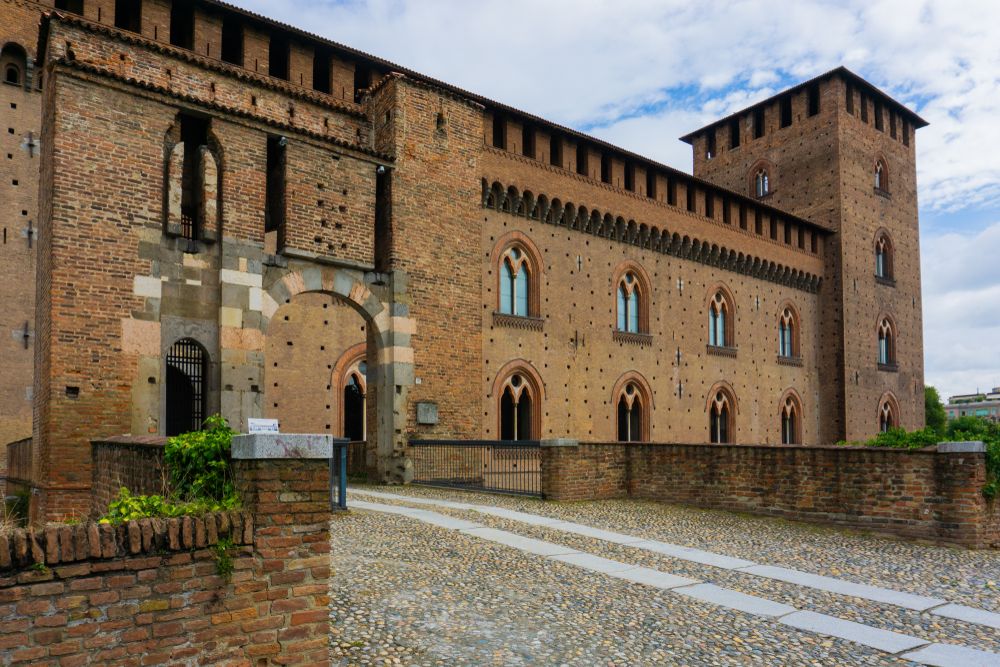
The Castello Visconteo marks another decisive shift in Pavia’s history.
Galeazzo II Visconti began construction in 1360, shortly after establishing his court in the city. The work proceeded remarkably quickly, and by 1365 the principal residence was essentially complete.
Calling it simply a castle is slightly misleading. Although the structure had defensive elements, it was conceived primarily as an aristocratic residence for one of the most powerful dynasties in northern Italy. Large windows, painted rooms, arcaded courtyards and extensive gardens belonged to court life rather than to a fortress designed only to survive siege.
The building originally had four wings. The northern side was later destroyed, leaving the present U-shaped plan. From the castle extended the enormous Parco Visconteo, a controlled landscape of woodland, agriculture and hunting grounds stretching north towards what would eventually become the Certosa di Pavia.
The Visconti were effectively redesigning territory, not simply constructing a palace.
Musei Civici
Today the castle houses the Musei Civici, and this is the strongest museum for understanding Pavia as a historical city rather than a collection of churches.
The archaeological and early-medieval sections are particularly important. Roman material establishes Ticinum before the Lombards, while Gothic and Lombard objects reconstruct the centuries when Pavia became a royal capital.
Other collections move through Romanesque and Renaissance sculpture, the Malaspina Pinacoteca, nineteenth-century painting and the Risorgimento. Surviving Visconti and Sforza frescoes remain visible in parts of the castle itself.
Allow at least 90 minutes. Two hours are reasonable if early medieval history is one of the main reasons for visiting Pavia.
The large courtyard and surrounding garden also provide a break from the tighter streets of the centre.
The University of Pavia
Pavia is not simply a historic university city. The university still determines the rhythm of the centre.
Its official foundation dates to 13 April 1361, when Emperor Charles IV authorised the creation of a Studium Generale after the initiative of Galeazzo II Visconti. This makes it one of Europe’s oldest universities and the oldest university in Lombardy.
An older educational tradition did exist in Pavia. A capitulary issued under Emperor Lothair in 825 designated the city as an important centre for advanced teaching. For centuries the university used that date as part of its institutional origin story. Modern historical research, including work promoted by the university itself, now distinguishes clearly between the ninth-century school and the formal foundation of the Studium in 1361.
That distinction is worth preserving. Pavia has enough genuine history without needing to collapse different institutions into one uninterrupted foundation myth.
The Central University Courtyards
The main university buildings occupy a vast block along Strada Nuova. From the street, the complex can appear surprisingly restrained. Enter the courtyards.
Successive expansions absorbed older palaces, monasteries and institutional buildings, producing a sequence of interconnected courts rather than one monumental façade. Much of the present architectural identity developed during the eighteenth century, when the Habsburg reforms of Maria Theresa and Joseph II transformed both the university’s teaching and its physical infrastructure.
New scientific spaces appeared: anatomical and physics theatres, laboratories, museums and a major library. The university became one of the principal centres of Enlightenment science in Italy.
The courtyards are still active university spaces, which is precisely why they should not be experienced like a conventional monument. Students cross them between lectures, bicycles accumulate under porticoes and centuries-old inscriptions coexist with everyday academic life.
Alessandro Volta
The most famous professor associated with Pavia is Alessandro Volta.
He held the chair of Experimental Physics, served as rector and conducted research that led ultimately to the invention of the electric battery. His lectures attracted not only students but members of the public interested in witnessing experimental demonstrations.
The historic Aula Volta preserves the memory of that teaching culture.
Pavia’s scientific history extends far beyond one name. Lazzaro Spallanzani transformed experimental biology; Antonio Scarpa shaped modern anatomy and surgery; Camillo Golgi developed the silver staining technique that made nerve cells visible and received the Nobel Prize in Physiology or Medicine in 1906.
This scientific tradition is one reason Pavia deserves museum time rather than a purely architectural itinerary.
Museo per la Storia dell’Università
The University History Museum preserves historical instruments, anatomical preparations and material associated with the university’s great period of eighteenth- and nineteenth-century science.
Physics and medicine form the core of the collections, making the museum particularly strong for visitors interested in the history of scientific practice rather than abstract biographies.
One current practical detail matters in August 2026: the museum is closed for the entire month. If you are visiting now, concentrate instead on the university courtyards and other museums, and do not build the itinerary around an interior visit that is unavailable.
When open, the standard ticket begins at approximately €5, with a university museum pass also available.
Piazza della Vittoria
From the university, walk towards Piazza della Vittoria, historically the city’s principal civic square.
The medieval name was Piazza Grande, and the space developed beside the Broletto, the old communal palace. Arcades now frame much of the square, with cafés and restaurants occupying the ground floors.
This is the part of Pavia where the city feels least like an archaeological destination. Students, market activity, aperitivo and everyday shopping fill a square that has been used continuously for civic and commercial life for centuries.
Do not spend ten minutes photographing it and leave. Return around early evening.
Pavia becomes much easier to understand once the monuments stop being the only people in the room.
The Broletto

The Broletto served as Pavia’s municipal palace until 1875.
Like many medieval civic complexes in Lombardy, it changed repeatedly rather than being constructed in one coherent campaign. Its proximity to the cathedral reflects the intense concentration of civic and religious power typical of medieval Italian cities.
The surrounding piazzas also help explain why the city centre feels architecturally layered. Renaissance and later interventions did not erase the medieval urban framework; they occupied and reshaped it.
Duomo di Pavia
The Cathedral of Santo Stefano and Santa Maria Assunta is one of the most ambitious Renaissance church projects in northern Italy and one of the longest construction stories in Lombardy.
Work began in 1488, replacing two earlier medieval cathedrals. Several major architects contributed ideas during the early phases, and Leonardo da Vinci visited Pavia while the project was being developed.
The building adopted a centralised Renaissance conception around an enormous crossing. Construction, however, moved slowly and repeatedly changed direction. The church was not essentially completed until the twentieth century.
That chronology becomes visible from the exterior. The cathedral feels monumental but strangely unfinished in places, the inevitable result of more than four centuries of changing architectural priorities.
The Dome
The dome is what reorganises the entire skyline.
Its octagonal structure rises to roughly 97 metres with an internal span of about 34 metres, placing it among Italy’s largest masonry domes. The great cupola was completed only in the nineteenth century.
Stand in Piazza del Duomo and move away rather than remaining directly beneath it. The dome is too large to understand at close range.
Inside, the centralised volume becomes much clearer. Light falls from high above into a building whose scale feels fundamentally different from the compact Romanesque churches elsewhere in Pavia.
The cathedral also contains the relics of San Siro, traditionally regarded as Pavia’s first bishop and now patron saint of the city.
The Lost Torre Civica
Piazza del Duomo also contains an absence.
Beside the cathedral once stood Pavia’s medieval civic tower, one of the dominant structures of the city skyline. On 17 March 1989, the tower suddenly collapsed, killing four people.
Its disappearance radically changed the square.
The tragedy remains part of living urban memory, and the empty space beside the cathedral can be difficult to read without knowing what once stood there. Historical photographs show how different the relationship between civic tower and cathedral dome used to be.
Pavia is a city of surviving medieval towers, but one of the most important is now represented principally by memory.
The Medieval Towers
During the Middle Ages Pavia was famous for its aristocratic towers. Chroniclers and later tradition described a city of a hundred towers, although the exact historic number is impossible to establish with certainty.
Several substantial examples survive around Piazza Leonardo da Vinci, immediately beside the university. Their severe brick shafts have very few openings and make the old competitive skyline easier to imagine.
These towers were partly defensive, but their height also advertised family status. Building upward became a form of urban rivalry.
Do not expect the densely preserved tower forest of San Gimignano. Pavia’s surviving examples are fragments.
Their position beside the university creates one of the city’s best juxtapositions: medieval aristocratic power beside an institution devoted to knowledge.
Santa Maria del Carmine
The Church of Santa Maria del Carmine is one of the clearest expressions of Lombard Gothic architecture in Pavia.
Its enormous brick façade is structured by vertical buttresses, pointed arches and decorative terracotta, producing a completely different effect from the sandstone Romanesque of San Michele.
The building was begun in the fourteenth century and developed over a long construction period. Inside, the scale is considerable, with a broad nave, side chapels and surviving fifteenth-century painting.
It deserves inclusion particularly because Pavia’s best-known churches can otherwise create a misleading impression that the city jumps directly from Romanesque to Renaissance.
Santa Maria del Carmine fills the Gothic gap.
San Teodoro
Close to the river, San Teodoro is smaller and easier to overlook.
Do not.
The Romanesque church contains one of the most valuable visual documents of Renaissance Pavia: frescoed views of the city dating from the early sixteenth century.
These panoramas show the city from above, with walls, towers, churches and the river represented in extraordinary detail. For visitors who have already walked the centre, the paintings become an architectural reconstruction exercise.
Look for buildings you recognise.
Then look for those that disappeared.
Few works of art in Pavia explain the historical city more directly.
Ponte Coperto
The Ponte Coperto looks medieval.
It is not.
A Roman bridge crossed the Ticino in antiquity, and a covered bridge with towers was constructed during the fourteenth century. That medieval structure survived for centuries but was badly damaged during Allied bombing in 1944.
After the war, the decision was made to demolish what remained and construct a new covered bridge nearby. The present structure opened in the 1950s, deliberately echoing the historic bridge with five arches and a tiled roof.
This distinction matters because Pavia’s most recognisable monument is essentially a post-war reconstruction of a medieval urban symbol.
That does not make it insignificant.
The bridge still reconnects the centre with Borgo Ticino, preserves the historic pedestrian relationship between the two banks and remains the best place to understand how strongly Pavia is oriented towards the river.
Walk across at sunset.
Borgo Ticino
On the opposite bank, Borgo Ticino changes the scale immediately.
Low houses, trattorias and riverside streets replace the denser city centre. Historically, this was a neighbourhood closely associated with fishermen, boatmen and activities dependent on the river.
From the southern bank you also get one of the best views back towards Pavia, particularly with the Ponte Coperto leading towards the cathedral dome.
Do not cross simply to take the photograph and return. Walk a little along the river.
The Ticino is not decorative scenery around Pavia. It has shaped transport, trade, food and the physical limits of the city for two thousand years.
The Ticino and the Natural Landscape
Pavia sits inside the wider landscape of the Ticino Valley, one of the most important river ecosystems in northern Italy.
Cycle paths and walking routes extend from the city towards woodland, agricultural land and the regional park. The transition is remarkably quick. Within a short ride, university courtyards and medieval churches are replaced by poplars, canals and river landscapes.
This is worth building into a two-day stay, particularly in spring and early autumn.
Pavia is often described as a city of art. It is equally a river city, and the visit feels incomplete if the Ticino is experienced only through the roofed corridor of the bridge.
The Via Francigena
Pavia also stands on the Via Francigena, the medieval pilgrimage route connecting northern Europe with Rome.
The route enters the city across the Ticino and continues south towards the Po. This gives Pavia another historical identity beyond capital, university and court: it has long been a place of passage.
The city is also the endpoint of the Cammino di Sant’Agostino, whose final section reaches Pavia through the Certosa before concluding at San Pietro in Ciel d’Oro.
For walkers, the location of Augustine’s relics gives the destination an unusually precise spiritual endpoint.
Certosa di Pavia

Despite the name, the Certosa di Pavia is not in Pavia city. It stands roughly eight kilometres north, surrounded by flat agricultural land.
It is nevertheless the essential excursion.
Gian Galeazzo Visconti founded the monastery in 1396, intending it partly as a dynastic mausoleum and connecting it conceptually with the enormous Visconti park extending north from the castle. The project continued for generations under both Visconti and Sforza patronage.
The result is one of the great transitional monuments between Lombard Gothic and Renaissance architecture.
The church retains the vertical structure and star-vaulted interiors associated with late Gothic building. The façade moves in another direction entirely: marble sculpture, reliefs, medallions, biblical scenes and classical references create one of the most elaborate surfaces of the Italian Renaissance.
The Façade of the Certosa
Do not try to understand the façade from ten centimetres away.
Start at a distance.
Its broad horizontal structure and central portal first establish the architecture. Only then move closer and allow the sculptural detail to take over.
Prophets, saints, Roman emperors, biblical stories and decorative motifs cover the marble. The programme became progressively richer as artists worked across generations.
Inside, the contrast is strong. The church remains more recognisably Gothic, with high vaults, painted stars and deep chapels. Tombs and dynastic imagery reinforce the Visconti-Sforza character of the foundation.
Beyond the church lie the two cloisters. The Chiostro Grande, completed during the fifteenth century, surrounds the monks’ individual cells and reveals the scale of Carthusian life far better than the spectacular façade does.
Visiting the Certosa in 2026
There has been an important change in 2026.
The old system based on an offering to the monastic community has ended. The monumental complex now operates with a mandatory €10 admission ticket, available through the Musei Italiani system or on site.
During the current summer period, the official visitor page lists opening Tuesday to Sunday from 10:00 to 18:00, with last admission at 17:30. Monday is closed. Seasonal schedules change, so verify the exact time if travelling later in the year.
The first Sunday of the month follows the national free-entry system for state museums.
This is no longer a place to approach with the old assumption that a monk will simply lead an informal donation-based visit.
Allow at least two hours, excluding transport from Pavia.
What to Eat in Pavia
Pavia sits between three distinct food landscapes: the rice-growing plain of the Pavese and Lomellina, the vineyards and salumi of the Oltrepò Pavese, and the river environment of the Ticino and Po.
Rice is fundamental. The province is one of the major rice-producing territories in Europe, and Carnaroli has particularly strong associations with the area. Risotto therefore makes far more sense here than another generic plate of pasta ordered simply because you are in Italy.
Traditional combinations include sausage, vegetables and — historically — frogs, a reflection of the wet rice-field environment in which frogs were once an easily available source of food.
The city’s most famous named dish, however, is much simpler.
Zuppa alla Pavese
Zuppa alla Pavese is traditionally made from bread, broth, egg and cheese.
According to local tradition, its origin is connected with Francis I of France after the Battle of Pavia in 1525. Defeated and captured by Imperial forces, the king was supposedly given a simple meal by a local woman using the ingredients available in her house.
As with many dishes attached to famous historical figures, the precise story belongs partly to culinary legend.
The dish itself is entirely plausible within the food economy of the region: stale bread, broth, egg and cheese transformed into something warming and substantial.
It is much more interesting when understood as economical domestic cooking than as the “soup of a king.”
The Battle of Pavia
The culinary legend also provides a useful reminder that one of the decisive battles of sixteenth-century Europe took place immediately outside the city.
On 24 February 1525, Imperial forces defeated the French army of Francis I during the Italian Wars. Francis was captured, and the battle demonstrated with brutal clarity how firearms and infantry tactics were changing European warfare.
The fighting occurred largely in the landscape north of Pavia associated with the Visconti park.
Modern urban expansion has altered the terrain, but the battle belongs to the same historical geography linking the Castello Visconteo with the Certosa.
Risotto and Frogs
Risotto con le rane belongs more broadly to Lomellina and the rice country than to the urban centre itself, but it is one of the most distinctive dishes in the province.
Frogs thrived around flooded rice fields and became part of the rural diet. Their delicate meat was used in broths and risotti, turning an abundant local resource into a dish now regarded as a speciality.
Do not order it simply for shock value.
When prepared well, the flavour is subtle and the rice remains the principal component.
Oltrepò Pavese Wine
South of the Po, the flat landscape rises into the Oltrepò Pavese, one of Italy’s historically important wine regions and one of the country’s principal territories for Pinot Noir.
Traditional local reds include Bonarda dell’Oltrepò Pavese, generally based on Croatina, while Barbera and other varieties remain important. Pinot Noir is used both for red wine and, increasingly prominently, for traditional-method sparkling wines.
For a city dinner, an Oltrepò bottle makes considerably more geographical sense than automatically choosing Tuscany or Piedmont.
With risotto and lighter dishes, look towards Pinot Noir or Metodo Classico. With salumi and richer meat cooking, Croatina-based Bonarda becomes more appropriate.
Torta Paradiso
Pavia’s defining dessert is Torta Paradiso.
The recipe was made famous in the nineteenth century by pastry chef Enrico Vigoni, whose shop still stands opposite the university on Strada Nuova. The cake combines butter, eggs, sugar, flour, potato starch and lemon zest into an unusually soft, fine-textured crumb finished with powdered sugar.
Its simplicity is exactly the point.
There is nowhere for poor ingredients or careless mixing to hide.
The historic connection with Pavia dates to around 1878, and the cake remains far more specifically linked with the city than many supposedly “local” desserts sold indiscriminately throughout Italy.
Where to Eat
For a traditional dinner, Osteria della Madonna da Peo is one of the strongest choices inside the historic centre. The cooking is rooted in Lombard and Pavese traditions rather than built around a generic tourist menu.
Address: Via dei Liguri 28, 27100 Pavia
Telephone: +39 0382 302833
Cuisine: Pavese and Lombard
Price: approximately €30–50
Best for: traditional regional dinner in the centre.
Across the river in Borgo Ticino, Osteria della Malora makes particular sense because the setting reinforces the river-city side of Pavia rather than keeping every meal within the monument circuit.
Address: Via Milazzo 79, 27100 Pavia
Telephone: +39 0382 34302
Cuisine: Italian and regional
Price: approximately €30–40
Best for: dinner in Borgo Ticino after crossing the Ponte Coperto.
Also in Borgo Ticino, Antica Osteria del Previ | Ristorante a Pavia offers another traditional option close to the river.
Address: Via Milazzo 65, 27100 Pavia
Telephone: +39 0382 26203
Cuisine: regional Italian
Price: approximately €30–40
Best for: a classic osteria meal away from the busiest central squares.
For something slightly more contemporary while remaining close to the city centre, Angolo di Casa Pavia is a useful alternative.
Address: Piazza XXIV Maggio 1, 27100 Pavia
Telephone: +39 0382 33220
Cuisine: contemporary Italian
Price: approximately €30–40
Best for: a more modern dinner without leaving central Pavia.
For dessert, go to the historic Vigoni pastry shop on Strada Nuova and order Torta Paradiso rather than treating it as something to buy prepacked at the station.
Where to Stay
For the strongest historic-centre position, Arnaboldi Palace occupies a restored nineteenth-century building only a short walk from Piazza della Vittoria, the university and Duomo.
Address: Via Varese 8, 27100 Pavia
Telephone: +39 0382 22219
Category: boutique accommodation
Best for: architecture and immediate access to the pedestrian centre.
B&B Le Stanze del Cardinale sits almost beside the Duomo and works particularly well for a short cultural stay where location matters more than extensive hotel facilities.
Address: Via Cardinale Riboldi 46, 27100 Pavia
Telephone: +39 0382 571072
Category: B&B
Best for: staying directly in the historic core.
Near the railway station, Hotel Moderno Pavia is the more traditional full-service option and is convenient if Pavia forms part of a rail itinerary.
Address: Viale Vittorio Emanuele II 41, 27100 Pavia
Telephone: +39 0382 303401
Category: hotel
Best for: rail travellers and a conventional hotel setup.
A slightly simpler station-area choice is Hotel Aurora.
Address: Viale Vittorio Emanuele II 25, 27100 Pavia
Telephone: +39 0382 23664
Category: hotel
Best for: practical access to both the station and centre.
For a first visit, I would stay between the station and Piazza della Vittoria rather than outside the centre. Pavia is compact enough that being able to walk everywhere changes the quality of the stay.
How Many Days Do You Need?
A single day is enough to see San Michele, San Pietro in Ciel d’Oro, the university, Duomo, Ponte Coperto and at least the exterior of the Castello Visconteo.
That is the efficient version.
Two nights are substantially better. The first day can remain entirely inside Pavia; the second gives enough time for the Certosa without abandoning the museums, river or university.
Three nights become worthwhile if you want to cycle along the Ticino, visit wineries in the Oltrepò or continue through the wider province.
Pavia is small.
Its historical density is not.
A One-Day Pavia Itinerary
Begin at the Castello Visconteo and San Pietro in Ciel d’Oro while the northern part of the centre is still quiet. Walk south through the medieval towers and university courtyards, then continue towards Piazza della Vittoria and the Duomo.
Have lunch in the centre before visiting San Michele Maggiore. This order matters: San Michele deserves attention rather than being squeezed into the final ten minutes before closing.
Continue towards the river, enter San Teodoro if open and cross the Ponte Coperto into Borgo Ticino.
Stay there through late afternoon.
The best final view is from the southern bank looking back towards the bridge and cathedral dome.
A Two-Day Pavia Itinerary
Use day one for the historic centre: castle, San Pietro, university, medieval towers, Piazza della Vittoria, Duomo, San Michele and Ponte Coperto.
On day two, visit the Certosa di Pavia in the morning. Return to town for lunch and use the afternoon for the Musei Civici, Museo Diocesano or university museums according to interest.
If museums are not the priority, replace the afternoon with a bicycle ride along the Ticino.
This creates a much better rhythm than attempting the Certosa as a ninety-minute detour during an already crowded city day.
Getting to Pavia from Milan
Pavia is one of the easiest cultural day trips from Milan.
Regional and suburban trains leave frequently from Milano Centrale, Milano Rogoredo and other stations, with the fastest services generally taking around 30–40 minutes depending on the departure and train category.
Pavia railway station is approximately a fifteen-minute walk from Piazza della Vittoria.
There is little reason to drive unless Pavia is part of a wider itinerary through the Certosa, Lomellina or Oltrepò.
The train delivers you almost directly into the historic centre and avoids parking restrictions.
Getting to the Certosa
The Certosa lies north of Pavia and can be reached by car, bus or train, although the final approach from the railway station requires additional walking.
Cycling is another interesting option. The route following the Naviglio Pavese links the city with the surrounding plain and turns the monastery into a destination rather than a detached roadside monument.
If you are comfortable cycling, this is one of the better ways to understand the historical relationship between Pavia and the Certosa.
Do You Need a Car?
Not in Pavia.
Almost every major urban attraction lies within a compact walkable centre, and driving between churches would create more problems than it solves.
A car becomes useful for the Oltrepò Pavese, rural restaurants, wineries and smaller provincial monuments.
For a Pavia-plus-Certosa weekend, public transport and bicycles remain perfectly realistic.
When to Visit
April and May are probably the best months. Temperatures favour walking, the Ticino landscape is green and outdoor tables return without the oppressive humidity of high summer.
June is also good, although the Po Valley begins warming quickly.
July and August can be hot and humid. The city becomes quieter when university activity slows, which may appeal to some visitors, but museum schedules can be reduced. In August 2026, for example, the University History Museum is closed for the entire month.
September and October are excellent, particularly if the trip also includes Oltrepò wine country.
Autumn light suits the brick architecture and the riverbanks particularly well.
Winter can be cold, damp and occasionally foggy. That atmosphere is not necessarily a disadvantage. Romanesque Pavia looks entirely convincing in mist.
Festa del Ticino 2026
The principal late-summer city event runs from 4 to 6 September 2026.
The Festa del Ticino spreads through the historic centre and riverfront with music, markets, a white-night programme and other events before concluding with the traditional fireworks over the river.
The dates are particularly useful for visitors who want to see the relationship between Pavia and the Ticino expressed as contemporary civic life rather than only historical geography.
Expect busier streets around Ponte Coperto and Lungoticino during the festival weekend.
Pavia in 2026
Several practical details have changed or deserve attention this year.
The Certosa di Pavia introduced a new ticketing system from January 2026. Admission now costs €10, replacing the former donation-based arrangement. During the summer season the official visitor information currently lists opening Tuesday to Sunday from 10:00 to 18:00, with Monday closure.
The Museo per la Storia dell’Università is closed throughout August 2026, so visitors this month should not rely on older general opening schedules.
The city is also running Pavia Città dei Cammini 2026 from March into December, reflecting the growing emphasis on the Via Francigena, Cammino di Sant’Agostino and other walking routes connected with the city.
The Festa del Ticino returns from 4 to 6 September 2026.
For church visits, remember that many Pavia churches still close around lunchtime. Build the morning around San Michele, San Pietro and the cathedral rather than assuming continuous museum-style opening.
What I Would Prioritise
If you have only a few hours, do not try to see every church.
Start with San Michele Maggiore. It gives you Pavia as a coronation city and one of the best Romanesque interiors in Lombardy.
Then enter the university courtyards, because Pavia without its students and scientific history is only half the city.
Walk through Piazza della Vittoria and Duomo, then reach the Ponte Coperto and cross into Borgo Ticino.
If another hour remains, choose San Pietro in Ciel d’Oro rather than another minor monument. Augustine, Boethius and Liutprand give Pavia a historical scale few cities this size can match.
With two days, the Certosa becomes essential.
Useful Information
Region: Lombardy
Province: Pavia
River: Ticino
Roman name: Ticinum
Lombard capital: approximately 572–774
Main Romanesque church: San Michele Maggiore
Major coronation: Frederick Barbarossa, 1155
Saint Augustine’s tomb: San Pietro in Ciel d’Oro
Main castle: Castello Visconteo
Castle construction: 1360–1365
University foundation: 13 April 1361
Major university figures: Alessandro Volta, Lazzaro Spallanzani, Antonio Scarpa, Camillo Golgi
Cathedral construction begun: 1488
Duomo dome: approximately 97 m high
Main river monument: Ponte Coperto
Present bridge: post-war reconstruction of the medieval crossing
Essential excursion: Certosa di Pavia
Certosa founded: 1396
Certosa admission in 2026: €10
Traditional dishes: Zuppa alla Pavese, risotto, risotto with frogs
Traditional dessert: Torta Paradiso
Main local wine region: Oltrepò Pavese
Main 2026 city festival: Festa del Ticino, 4–6 September
Distance from Milan: approximately 35 km south
Rail journey from Milan: roughly 30–40 minutes on faster services
Car required in centre: no
Recommended stay: 1–2 nights
Best months: April, May, September and October

