
Volterra Through Three Thousand Years, from Etruscan Velathri to Medieval Tuscany and the Art of Alabaster

Volterra is one of the few Tuscan hill towns where the medieval city is only the middle chapter.
Long before towers and communal palaces defined its skyline, Velathri was one of the major cities of Etruria. Its enormous defensive walls enclosed a settlement far larger than the historic centre visitors see today, while monumental gates, tombs and thousands of carved funerary urns reveal a sophisticated society already flourishing centuries before Rome absorbed the region.
The Romans added a theatre and baths. Medieval Volterra compressed itself inside a smaller defensive circuit and built one of Tuscany’s earliest great communal palaces. Renaissance power arrived more violently: Florence conquered the city in 1472, and the Medici fortress still dominates the eastern edge of town. Beneath all of this runs another Volterran story, one based not on armies or politics but on a luminous stone extracted from the surrounding hills: alabaster.
The result is a town with unusual historical density. Walk from the Etruscan Porta all’Arco to Piazza dei Priori and you cross more than two thousand years in ten minutes. Enter the Museo Guarnacci and the famous elongated bronze Ombra della Sera looks startlingly modern despite dating from antiquity. A few streets away, Rosso Fiorentino’s violent 1521 Deposition demonstrates how radically Renaissance painting could break with harmony and classical balance.
Volterra also occupies one of Tuscany’s most dramatic positions. The town stands at roughly 545 metres above sea level, between the Era and Cecina valleys, with broad views over cultivated hills, clay landscapes and the eroded cliffs known as the Balze. On exceptionally clear days, the horizon stretches towards the Tyrrhenian coast.
Many visitors arrive for three hours between San Gimignano and somewhere else.
That is a mistake.
One full day is the minimum. Two days are better, particularly if you want the Guarnacci Museum, Roman Theatre, Pinacoteca, alabaster workshops and the archaeological areas without reducing the city to a checklist.
Things to See in Volterra
- Piazza dei Priori
- Palazzo dei Priori
- Porta all’Arco
- Etruscan walls
- Museo Etrusco Guarnacci
- Ombra della Sera
- Urna degli Sposi
- Roman Theatre
- Roman baths
- Etruscan Acropolis
- Roman cistern
- Cathedral of Santa Maria Assunta
- Baptistery of San Giovanni
- Pinacoteca e Museo Civico
- Rosso Fiorentino’s Deposition
- Palazzo Minucci-Solaini
- Ecomuseo dell’Alabastro
- Alabaster workshops
- Medici Fortress
- Parco Archeologico Enrico Fiumi
- San Francesco and the Cappella della Croce di Giorno
- Palazzo Viti
- Teatro Persio Flacco
- Le Balze
- Badia Camaldolese
Velathri: The Etruscan City
The Etruscans called Volterra Velathri.
By the fourth and third centuries BC it had become one of the principal urban centres of northern Etruria, controlling a large territory that extended towards mineral-rich areas and important routes connecting inland Tuscany with the coast.
Its strategic position was exceptional.
The settlement occupied a high ridge naturally protected by steep slopes, while the surrounding territory provided agricultural land, minerals and access towards the Tyrrhenian Sea. Archaeological evidence shows that Volterra was not an isolated hilltop refuge but the centre of a complex economic territory.
The scale of the Etruscan walls makes this immediately clear.
Their circuit once enclosed an area considerably larger than the later medieval town. In several places the medieval city effectively retreated inside its ancient predecessor.
That reversal is unusual.
Normally we imagine cities expanding outward.
At Volterra, part of the story involves contraction.
The Etruscan Walls
Large sections of the Etruscan defensive system survive around the city.
The walls were built using enormous blocks of local stone, often without mortar, and developed through several construction phases. Their most monumental sections are generally associated with the fourth and third centuries BC, when Velathri had the resources and political importance required for an enormous urban fortification project.
Do not expect a complete uninterrupted circuit.
Medieval rebuilding, erosion and centuries of construction transformed many stretches.
Instead, the ancient walls appear intermittently: beneath later fortifications, beside roads and around surviving gates.
This fragmentary survival actually makes Volterra more interesting.
The Etruscan city is not contained inside one archaeological park.
It remains embedded in the modern town.
Porta all’Arco
The Porta all’Arco is Volterra’s most extraordinary ancient monument.
The gateway occupies the southern side of the old city and incorporates different construction phases. Massive stone jambs belong to the Etruscan defensive system, while the arch above was modified later.
Three weathered stone heads project from the outer face.
Their identity remains uncertain.
The most persuasive interpretation connects them with protective divinities guarding the entrance to the city, although no definitive identification has survived.
That uncertainty is part of the gate’s power.
The faces have been exposed to wind and rain for more than two millennia, eroding them almost to abstraction.
Walk through rather than merely photographing the exterior.
The thickness of the structure makes the engineering far more obvious.
How Porta all’Arco Survived the Second World War
The gate almost did not survive into the modern era.
On 30 June 1944, retreating German forces planned to obstruct access through Porta all’Arco in order to slow the Allied advance. The ancient gate itself risked destruction.
Volterrans negotiated an alternative.
If the inhabitants could block the passage rapidly, the monument would be spared.
Residents removed paving stones and filled the gateway with a defensive barrier in roughly one day, preserving one of the city’s most important archaeological structures.
A plaque beside the gate recalls the episode.
It is a rare case in which the survival of an ancient monument depended not on archaeologists or restoration authorities but on an entire community physically moving stones under wartime pressure.
Museo Etrusco Guarnacci
The Museo Etrusco Guarnacci is the museum that justifies travelling to Volterra even if everything else were closed.
Its origins go back to 1761, when the scholar and ecclesiastic Mario Guarnacci donated his archaeological collection and library to the city. It is therefore among Europe’s oldest public archaeological museums.
The collection is especially important because so much of it comes directly from Volterra and its surrounding necropolises.
This is not a museum filled with objects assembled from unrelated parts of the ancient Mediterranean.
It is effectively the archive of one Etruscan city.
Around 600 funerary urns form the core of the collection, alongside bronzes, ceramics, inscriptions, sculpture and objects from daily and ritual life.
Allow at least 90 minutes.
Two hours is better.
The Etruscan Funerary Urns
Volterra became one of the great centres of Etruscan funerary-urn production between roughly the fourth and first centuries BC.
The deceased was cremated, and the ashes were placed inside a decorated chest surmounted by a lid often representing the dead person reclining as though attending a banquet.
Materials varied.
Terracotta and stone were used, but Volterra developed particular expertise in alabaster, the translucent local material that would continue shaping the city’s economy centuries later.
The reliefs on the urns frequently depict Greek myths: Odysseus, Perseus, the Minotaur, centaurs, episodes from the Trojan and Theban cycles.
Yet these were not simply illustrations of stories.
Myths provided visual languages through which death, separation, violence and passage into another world could be represented.
The museum’s repetitive rows of urns become much more interesting once you start reading the scenes.
Ombra della Sera
The most famous object in the museum is tiny compared with its reputation.
The Ombra della Sera — Shadow of the Evening is an elongated bronze human figure generally dated to the third century BC.
Its head is rendered with recognisable proportions.
The body stretches downward into an impossibly thin column.
Seen without context, it could easily be mistaken for a twentieth-century sculpture by Giacometti.
It is not.
Similar elongated votive figures are known from the Etruscan world, but Volterra’s example became an icon because of the extraordinary purity of its proportions.
The romantic name appears to be modern.
The frequently repeated story that Gabriele D’Annunzio invented it is not securely documented and should not be treated as fact.
What does survive is much more interesting: an ancient artist radically simplifying the human body more than two thousand years before modernism.
The Urna degli Sposi
The museum’s other emblematic work is the Urna degli Sposi, traditionally called the Sarcophagus of the Spouses despite its funerary-urn context.
A husband and wife recline together on the lid.
Unlike idealised Greek bodies, their faces are strikingly individualised. Age has not been erased. Wrinkles, expressions and physical particularities remain visible.
The result is intimate and slightly unsettling.
Etruscan funerary imagery frequently presented the dead participating in banquets, reinforcing connections between family, status and the continuation of identity beyond death.
At Volterra, hundreds of such objects allow you to see how individual commissions operated inside a highly standardised funerary industry.
Volterra and Rome
Velathri gradually entered the Roman political system during the centuries of Roman expansion across Etruria.
The transition did not erase the city.
Instead, Volaterrae developed as a Roman centre while retaining elements of its earlier culture and aristocratic families.
One Volterran family became particularly prominent: the Caecinae.
Members of this family participated in Roman political life, and their wealth is directly connected with one of Volterra’s major archaeological monuments.
The Roman Theatre was created under their patronage.
Roman Theatre
Volterra’s Roman Theatre lies immediately outside the medieval walls near Porta Fiorentina.
Its position is spectacular because the ancient structure was partly forgotten beneath later development until archaeological excavations led by Enrico Fiumi brought it back to light during the 1950s.
The theatre belongs to the early Imperial period.
Members of the wealthy Caecina family financed the complex, creating a performance space with a cavea approximately 60 metres across and around 24 surviving seating rows. Estimates suggest it could accommodate roughly 3,500 spectators.
Part of the architectural stage building survives to considerable height.
Columns and fragments of the scaenae frons make the original theatrical setting much easier to reconstruct than at archaeological sites where only the seating remains.
After the Theatre: Roman Baths
The theatre did not remain active indefinitely.
By the end of the third century AD, theatrical use had declined and parts of the complex were transformed.
A substantial thermal establishment developed behind the former stage area, incorporating heated rooms and other bathing spaces typical of late Roman urban life.
This layering makes the site unusually useful.
You can read the changing priorities of Roman Volterra in one archaeological area: entertainment first, bathing and late-antique reuse later.
Then medieval fortifications cut across the upper part of the ancient structure.
Three cities occupy the same slope.
The Etruscan Acropolis
The highest section of Volterra contained the ancient acropolis.
Today the archaeological remains lie within the green area of Parco Enrico Fiumi, close to the Medici Fortress.
Excavations have identified foundations belonging to Etruscan religious buildings erected through several phases, including structures dating from the Hellenistic period.
The monuments do not survive to the visual height of Porta all’Arco or the Roman Theatre.
You need to read foundations rather than façades.
The reward is conceptual.
This was the sacred summit of Velathri, the monumental centre overlooking the wider Etruscan territory.
Nearby stands a large Roman cistern from the Augustan period, constructed to collect and distribute water to the neighbourhoods below.
The Roman Cistern
The cistern dates to approximately the first century BC and demonstrates how Roman infrastructure adapted the high Etruscan city.
Rainwater collected from buildings around the upper settlement could be stored and redistributed rather than relying entirely on springs lower down the hill.
The structure later found an unexpected role in cinema.
Luchino Visconti used the archaeological setting during the filming of Vaghe stelle dell’Orsa…, released internationally as Sandra, with Claudia Cardinale.
Volterra has repeatedly attracted filmmakers because its architecture rarely belongs to only one period.
Piazza dei Priori
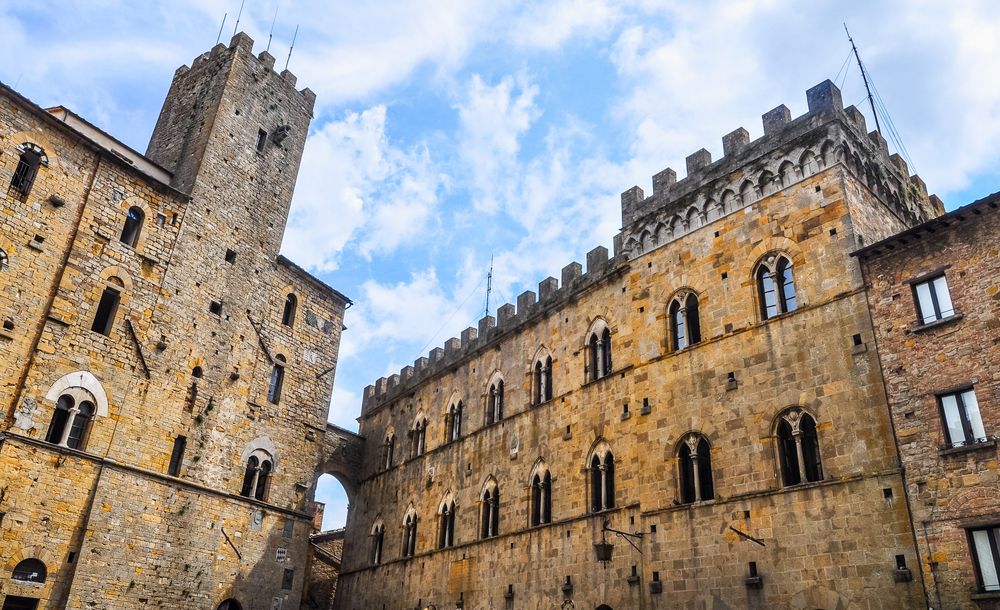
If the ancient city is defined by gates and archaeology, medieval Volterra is concentrated around Piazza dei Priori.
The square is more austere than the great civic spaces of Siena or Florence.
That severity suits Volterra.
Stone façades rise directly from an irregular paved space dominated by Palazzo dei Priori and Palazzo Pretorio. There is little ornamental softness. Towers, crenellations and narrow windows constantly remind you that civic architecture developed alongside political rivalry and defence.
The square remains the natural centre of everyday Volterra.
Come early before the day-trip traffic arrives.
Return in the evening.
Once the buses have gone, the architecture regains much of its scale.
Palazzo dei Priori
Construction of the Palazzo dei Priori began around 1208 and continued into the middle of the thirteenth century.
It is generally regarded as the oldest surviving communal town hall in Tuscany and belongs to an architectural generation that helped establish the visual vocabulary later developed in buildings such as Florence’s Palazzo Vecchio.
The façade contains Gothic bifore windows, coats of arms and symbols added during later political periods.
The tower rises above the square, while lions incorporated into the exterior recall Florentine domination.
Inside, civic rooms preserve frescoes and institutional decoration.
The upper levels can be visited, and climbing the tower gives one of the strongest views over Volterra and the surrounding countryside when access is open.
The Canna Volterrana
Look carefully at the façade rather than heading directly inside.
A measurement standard known as the Canna Volterrana was carved into the exterior stone.
Public standards of length were essential in medieval commercial cities.
Before national units of measurement existed, towns maintained official measures so merchants and buyers could verify lengths used in trade.
It is an easily missed detail but exactly the kind of thing that turns a monumental palace back into a functioning civic building.
Palazzo dei Priori was not created merely to look powerful.
It regulated everyday urban life.
Palazzo Pretorio and the Torre del Porcellino
Across the square stands Palazzo Pretorio, formed through the combination of several medieval structures.
Its tower is popularly called Torre del Porcellino because of the small animal figure projecting from it.
The building housed judicial and administrative functions, completing Piazza dei Priori’s concentration of communal authority.
Together the buildings explain why the square feels so different from a cathedral piazza.
This was a political space first.
Florence Conquers Volterra
Volterra’s independent communal history ended dramatically in 1472.
Conflict over control of alum resources and wider political tensions brought Florentine military intervention. Lorenzo de’ Medici’s Florence sent forces against the city, and Volterra was violently sacked.
The consequences were profound.
Florentine control became definitive, and the fortress at the eastern end of the city was expanded into a powerful military structure.
The event also changed the political meaning of Volterra’s architecture.
Palazzo dei Priori remained standing, but the commune it represented no longer enjoyed the same autonomy.
The Medici Fortress
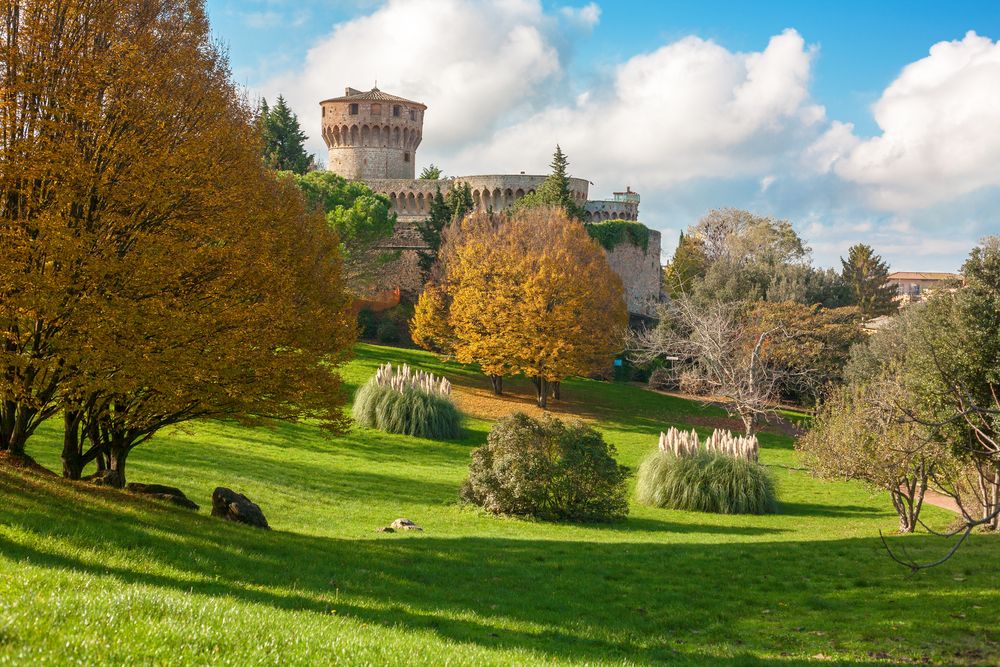
The Fortezza Medicea dominates the eastern end of Volterra.
Its architecture combines two main phases: the older Rocca Vecchia and the later fortress built after the Florentine conquest of 1472.
The mass of walls and towers is impressive from the archaeological park.
Do not plan to tour the interior as though it were an ordinary castle.
The complex functions as a state prison, one of the more unusual examples of a Renaissance fortress retaining an active institutional use.
Its continued occupation has also contributed to the preservation of the structure.
The fortress is therefore best understood externally, from the park and surrounding streets.
The Cathedral of Santa Maria Assunta
Volterra’s cathedral stands only a short walk from Piazza dei Priori.
The church was consecrated in the twelfth century following rebuilding associated with damage from an earlier earthquake, although repeated interventions changed its interior considerably over subsequent centuries.
The façade is restrained.
Inside, the atmosphere becomes richer, with polychrome decoration, chapels, paintings and sculpture spanning several periods.
The central nave is divided by columns whose later painted surfaces imitate red granite.
The cathedral does not have the immediate visual unity of Siena.
It is more archaeological in character: medieval structure, Renaissance additions and later decoration coexist.
The Deposition Group
One of the cathedral’s most unusual works is a medieval wooden Deposition from the Cross, an exceptionally rare surviving example of sculptural groups created for liturgical drama.
The figures originally allowed the Passion narrative to be staged visually inside the church.
Objects like this remind us that medieval religious sculpture was not always static decoration.
Images participated in ceremonies, processions and performances that transformed church interiors according to the liturgical calendar.
The Baptistery of San Giovanni
Opposite the cathedral stands the octagonal Baptistery of San Giovanni.
Its exterior combines local stone with bands of white and dark marble, immediately connecting the building with the broader Romanesque architectural language of Tuscany.
The portal provides the principal decorative focus.
Inside, baptismal fonts from different periods reflect the building’s long ritual use.
The cathedral and baptistery should be considered together.
Their placement across the same piazza preserves the medieval relationship between initiation into the Christian community and the principal episcopal church.
Pinacoteca e Museo Civico
Volterra’s Pinacoteca occupies Palazzo Minucci-Solaini, a refined late-fifteenth-century residence traditionally connected with Antonio da Sangallo the Elder.
The collection began developing in the nineteenth century from paintings removed from suppressed or endangered churches and religious institutions.
Its unquestioned masterpiece is Rosso Fiorentino’s Deposition from the Cross of 1521.
Do not enter simply to look at Rosso and leave.
Works by Taddeo di Bartolo, Luca Signorelli, Pieter de Witte and other artists provide a broader picture of Volterra’s position between Florentine, Sienese and wider central Italian artistic culture.
But Rosso changes the room.
Rosso Fiorentino’s Deposition
The painting was created in 1521 for the Cappella della Croce di Giorno attached to San Francesco.
Nothing about it is calm.
Figures climb unstable ladders around the Cross. Bodies twist. Drapery becomes angular. Colours collide rather than harmonise, and grief appears physically dislocated.
The painting is one of the great early works of Mannerism.
Compared with the balanced spatial order developed by earlier Renaissance painters, Rosso creates deliberate tension and artificiality.
Christ’s pale body seems almost suspended inside a mechanical structure made from ladders, limbs and fabric.
This is not a minor provincial altarpiece.
It is one of the strongest reasons for including Volterra in an art itinerary through Tuscany.
Rosso Fiorentino in Volterra
The Deposition was not Rosso’s only important Volterran commission.
The same year he painted an altarpiece for the parish church at Villamagna, now preserved in the Museo Diocesano d’Arte Sacra.
Seeing the two works together is unusually useful.
The famous Deposition is fractured, emotionally violent and compositionally radical.
The Villamagna altarpiece is more controlled.
The difference demonstrates how dramatically Rosso could adapt his language to different commissions while retaining his characteristically sharp colour and unusual figures.
San Francesco and the Cappella della Croce di Giorno
The church of San Francesco still contains the chapel for which Rosso’s Deposition was originally commissioned.
Although the painting moved centuries ago, the Cappella della Croce di Giorno preserves an important fresco cycle completed by Cenni di Francesco in 1410.
Scenes relating to Christ, the Virgin and the True Cross cover the walls and vaults.
Visit the Pinacoteca first.
Then walk to San Francesco.
Seeing the original architectural context changes the scale of Rosso’s altarpiece even though the work itself is no longer there.
Volterra and Alabaster
Alabaster is not a decorative footnote to Volterra.
It is one of the city’s defining materials.
The surrounding territory contains deposits of gypsum alabaster, a soft translucent stone that can be cut, turned, carved and polished with extraordinary precision.
The Etruscans already used alabaster extensively for funerary urns.
Centuries later, Volterran craftsmen transformed it into sculpture, lighting, decorative objects and architectural pieces.
The material can be almost white, honey-coloured, veined, clouded or semi-transparent depending on the deposit.
Hold a thin piece against light and the reason for its appeal becomes obvious.
Stone begins behaving like wax.
The Alabaster Workshops
Volterra’s alabaster tradition survives in active workshops rather than only inside museums.
Historically, production involved specialists performing different tasks: extraction, sawing, turning, carving, ornament and finishing.
Mechanical equipment changed parts of that process, but skilled handwork remains fundamental for detailed carving and restoration.
Visit a workshop if one is open.
The important thing is not watching someone manufacture a souvenir.
It is seeing how quickly an experienced artisan understands the direction of the stone, its veins, softness and weaknesses.
Alabaster is easier to carve than marble.
That does not make carving alabaster easy.
Ecomuseo dell’Alabastro
The Ecomuseo dell’Alabastro occupies spaces connected with Palazzo Minucci-Solaini and explains the material from geology to finished object.
The collection documents extraction, tools, workshop organisation, artistic production and the social world built around the alabaster industry.
This is especially valuable after the Guarnacci Museum.
There you see what Etruscan craftsmen achieved with the material.
Here you follow the same stone into modern Volterran identity.
The continuity is more than two thousand years long.
Alabaster and the Nineteenth Century
Alabaster production expanded dramatically during the nineteenth century as Volterran objects entered international markets.
Workshops produced classical sculpture, architectural models, decorative vases, lamps and highly elaborate objects for export.
Travellers helped spread the reputation of the material, while skilled Volterran artisans worked for customers far beyond Tuscany.
The industry experienced repeated cycles of fashion and decline, particularly as inexpensive industrial products began competing with hand-carved work.
Its survival today depends increasingly on craftsmanship rather than mass production.
When buying alabaster, ask where the object was made.
A shop in Volterra is not automatic proof of Volterran manufacture.
Palazzo Viti
Palazzo Viti offers a different view of Volterra.
Instead of archaeology or medieval government, the rooms preserve the atmosphere of an affluent nineteenth-century family residence.
The palace is associated with Giuseppe Viti, whose fortune came from the international alabaster trade.
Furnished rooms contain paintings, porcelain, furniture and decorative objects accumulated through a commercial network extending well beyond Tuscany.
This makes the building particularly relevant.
The wealth inside is connected directly with the material being carved in workshops elsewhere in town.
Alabaster shaped not only objects.
It shaped social mobility.
Teatro Persio Flacco
The elegant Teatro Persio Flacco opened in the early nineteenth century inside the wider Palazzo Incontri-Viti complex.
Its horseshoe auditorium, boxes and decorated interior belong to the Italian theatrical culture of the period when even relatively small cities invested heavily in opera and public performance.
The theatre remains active.
Access outside performances depends on programming, but its presence adds another layer to Volterra’s cultural life beyond archaeology.
Le Balze
West of town, the landscape appears to collapse.
The Balze di Volterra are steep erosional cliffs created as softer geological deposits progressively disappear beneath weather and water.
This is not just a scenic phenomenon.
The advancing erosion has destroyed archaeological remains, ancient burial areas and parts of the medieval landscape.
The most striking victim is the former Badia Camaldolese, portions of which now stand dangerously close to the eroded edge.
The landscape makes Volterra’s position feel temporary in a way medieval stone streets rarely do.
The city may appear immovable.
The hill beneath it is not.
The Badia Camaldolese
The former Camaldolese abbey was founded during the eleventh century outside the principal urban centre.
Over centuries, erosion around the Balze progressively undermined the surrounding terrain.
Parts of the monastic complex disappeared, leaving surviving structures isolated close to the cliffs.
The ruins are most valuable in relation to the geology.
Volterra’s history is not preserved solely through human decisions.
The landscape itself has repeatedly erased sections of the archaeological record.
The Views from Volterra
The city’s elevation produces broad views in almost every direction, but the landscape is particularly compelling towards the west and south.
This is not the manicured postcard Tuscany of continuous vineyards.
The Val di Cecina includes clay hills, woodland, agricultural fields, geothermal territory and more severe geological formations.
That variety gives Volterra a visual identity distinct from central Chianti or the Val d’Orcia.
The coastline can sometimes be visible in the distance.
More often, layers of hills dissolve gradually into haze.
Late afternoon is the best time to walk the perimeter roads and gates.
What to Eat in Volterra
Volterra belongs to inland western Tuscany, and the cooking reflects agriculture, pastoral traditions, hunting and the forests of the wider Val di Cecina.
Start with Pecorino delle Balze Volterrane DOP, one of the area’s most distinctive products.
The cheese is made from sheep’s milk and traditionally uses vegetable rennet derived from wild cardoon, a detail that produces a different aromatic profile from cheeses made with conventional animal rennet.
Soups remain fundamental.
Look for zuppa volterrana, ribollita-style vegetable preparations, beans and bread-based dishes.
Game appears regularly, especially wild boar, together with rabbit and slow-cooked meats.
Fresh pasta may arrive with ragù, mushrooms or truffle depending on season.
This is food built for hills rather than coastal heat.
Pecorino delle Balze Volterrane DOP
The local pecorino deserves specific attention because its production zone is tightly connected with the hills around Volterra.
Wild cardoon rennet gives the cheese a distinctive link with older Mediterranean cheesemaking traditions.
Different ageing periods change the texture considerably.
Young versions remain softer and more lactic.
Longer maturation produces a firmer structure and more pronounced savoury character.
Try several ages side by side rather than buying whichever wedge looks most picturesque.
Wild Boar
Wild boar is common across Tuscan menus, but around Volterra it belongs naturally to a landscape of woodland and hunting culture.
It appears in ragù for pappardelle, slow braises and occasionally older sweet-and-sour preparations.
A properly cooked boar ragù should be deep and savoury without becoming aggressively gamey.
Pair it with a structured Tuscan red rather than automatically choosing the most famous bottle on the list.
Nearby territories provide excellent Sangiovese, while the broader Tuscan coast opens the possibility of more Mediterranean blends.
Where to Eat
Ristorante Enoteca Del Duca
Del Duca occupies a historic setting near the centre and takes a more polished approach to Tuscan cooking than a basic trattoria. Seasonal game, local meats, mushrooms and truffles sit naturally beside one of the stronger wine selections in town.
It is the restaurant to consider when dinner is meant to be part of the Volterra visit rather than simply fuel between monuments.
Address: Via di Castello 2, 56048 Volterra
Telephone: +39 0588 81510
Email: [email protected]
Cuisine: Tuscan, game, seasonal produce
Price level: approximately €50–80
Best for: a more ambitious Tuscan dinner with a serious wine cellar.
La Vecchia Lira
La Vecchia Lira sits directly on Via Matteotti and concentrates on recognisable Tuscan flavours, grilled meat and local products. It works particularly well when you want a proper meal in the centre without adopting the pace or cost of fine dining.
Fiorentina, slow-cooked meat, game and local cured products make more sense here than looking for elaborate reinterpretations.
Address: Via Giacomo Matteotti 19, 56048 Volterra
Telephone: +39 0588 86180
Email: [email protected]
Cuisine: Tuscan, grilled meat and local products
Price level: approximately €25–45
Best for: traditional meat dishes and a straightforward central dinner.
Osteria La Pace
La Pace is close to the Guarnacci Museum and remains firmly connected with traditional Tuscan cooking. Soups, pasta, game and meat dominate the menu, making it particularly convenient after a morning dedicated to Etruscan Volterra.
The atmosphere is informal and suited to a substantial lunch rather than a carefully choreographed tasting menu.
Address: Via Don Giovanni Minzoni 55, 56048 Volterra
Telephone: +39 0588 86511
Email: [email protected]
Cuisine: traditional Tuscan
Price level: approximately €20–35
Best for: a relaxed lunch near the Museo Guarnacci.
Osteria Fornelli
Tucked into a small piazza inside the historic centre, Osteria Fornelli is useful when you want regional cooking in a quieter setting away from the busiest pedestrian streets.
The menu stays within the vocabulary of Tuscan pasta, meat and seasonal ingredients rather than trying to reinvent local cuisine.
Address: Piazzetta dei Fornelli 3, 56048 Volterra
Telephone: +39 0588 88641
Cuisine: Tuscan and Italian
Price level: approximately €20–35
Best for: an informal dinner in a small historic-centre setting.
La Sosta del Priore
For lunch without losing two hours at the table, La Sosta del Priore is the practical alternative.
Filled focaccia and sandwiches built around Tuscan cured meats, cheese and vegetables allow you to keep the day moving while still eating something rooted in local ingredients.
Address: Vicolo delle Prigioni 1/2, 56048 Volterra
Telephone: +39 0588 87447
Cuisine: Tuscan sandwiches and local products
Price level: approximately €5–15
Best for: a quick lunch between museums.
Where to Stay
Sleeping inside Volterra changes the experience considerably.
Between late morning and mid-afternoon the centre receives substantial day-trip traffic. By evening, streets empty, stone façades darken and Piazza dei Priori once again feels proportionate to the size of the town.
For a first visit, staying within the walls is preferable unless a countryside pool and car access matter more.
Hotel La Locanda
Hotel La Locanda occupies a central position on Via Guarnacci, only a short walk from the Etruscan museum and Piazza dei Priori.
The building retains historic character while offering the facilities of a conventional small hotel, making it one of the easiest choices for travellers arriving without wanting to drive again until departure.
Address: Via Guarnacci 24/28, 56048 Volterra
Telephone: +39 0588 81547
Category: 4-star hotel
Price level: €€–€€€
Best for: central location near the Guarnacci Museum.
Albergo Etruria
Albergo Etruria sits on Via Matteotti almost immediately beside Piazza dei Priori.
Its strongest feature is exactly that position. Almost every major monument in the historic centre is reachable in a few minutes, and the hotel works particularly well for a short car-free stay.
Address: Via Giacomo Matteotti 32, 56048 Volterra
Telephone: +39 0588 87377
Category: 3-star historic-centre hotel
Price level: €€
Best for: simple accommodation in the absolute centre.
Hotel San Lino
Hotel San Lino occupies a quieter position inside the walls towards the western side of Volterra and offers something unusual in the historic centre: a swimming pool.
The location remains walkable to Piazza dei Priori while providing slightly more space than the hotels embedded in the busiest central streets.
Address: Via San Lino 26, 56048 Volterra
Telephone: +39 0588 85250
Email: [email protected]
Category: 4-star hotel
Price level: €€–€€€
Best for: historic-centre access combined with a pool.
Villa Rioddi
Villa Rioddi lies outside the walls in the countryside immediately below Volterra.
The trade-off is straightforward: you lose the ability to step directly into Piazza dei Priori but gain open views, garden space and a swimming pool.
It makes more sense for travellers touring Tuscany by car than for a single-night cultural stop.
Address: Strada Provinciale del Monte Volterrano 8, 56048 Volterra
Telephone: +39 0588 88053
Category: country hotel
Price level: €€–€€€
Best for: views, pool and travellers exploring Tuscany by car.
How Many Days Do You Need?
One full day is enough for the principal monuments if you arrive early and stay until evening.
You can see Porta all’Arco, Piazza dei Priori, Palazzo dei Priori, the Guarnacci Museum, Roman Theatre and Pinacoteca.
That is already an exceptional cultural day.
But it leaves little room for alabaster workshops, San Francesco, the acropolis, Palazzo Viti or the Balze.
Two days are ideal.
The second day allows Volterra to stop behaving like an archaeological itinerary and start functioning as a town.
A One-Day Volterra Itinerary
Begin with Porta all’Arco before the central streets become busy.
Walk towards Piazza dei Priori and visit Palazzo dei Priori early, including the tower if open.
Continue to the Museo Etrusco Guarnacci and give it at least ninety minutes.
Have lunch nearby.
During the afternoon, descend to the Roman Theatre, then return towards Palazzo Minucci-Solaini for the Pinacoteca and Rosso Fiorentino’s Deposition.
Finish with an alabaster workshop and walk back towards Piazza dei Priori after the largest visitor groups have left.
This itinerary is dense but coherent.
It moves from Etruscan Volterra through Rome and the medieval commune to Renaissance art.
A Two-Day Volterra Itinerary
Keep the first day focused on the essential museums and archaeological monuments.
On the second morning, visit the Etruscan Acropolis and Roman cistern, then walk around the Medici Fortress.
Continue to the cathedral, baptistery and Museo Diocesano before heading to San Francesco and the Cappella della Croce di Giorno.
Use the afternoon for Palazzo Viti and the Ecomuseo dell’Alabastro.
Drive or walk towards the Balze late in the day.
This second day is less spectacular in individual monuments.
It is the day that makes the first one make sense.
Volterra Card in 2026
For visitors planning several museums, the Volterra Card is usually the logical ticket.
In 2026 it is valid for 72 hours and includes the Museo Etrusco Guarnacci, Pinacoteca, Ecomuseo dell’Alabastro, Palazzo dei Priori, Museo Diocesano d’Arte Sacra, Roman Theatre and Etruscan Acropolis with Roman cistern.
The standard adult price is €23.
A reduced ticket costs €18, while a family ticket covering one or two adults with accompanying children costs €32 under the current conditions.
Even on a one-day visit, the card can make sense if you intend to enter four or more major sites.
Museum Opening Hours in 2026
The principal civic museums use a broadly coordinated schedule.
From 9 March to 1 November 2026, major sites such as Palazzo dei Priori, the Pinacoteca and Ecomuseo dell’Alabastro generally open daily from 10:00 to 18:30.
During the winter period from 2 November to 8 March, opening is reduced, with several civic museums closed on Tuesday and shorter weekday hours.
The Roman Theatre and Etruscan Acropolis use slightly different seasonal schedules. From 1 May to 30 September 2026, they open daily from 10:30 to 18:30.
Because winter arrangements differ considerably from summer, check the exact date when visiting outside the main season.
Volterra AD 1398
Every August, Volterra deliberately moves backward several centuries.
Volterra AD 1398 transforms the historic centre and archaeological park into a large medieval re-enactment with craftsmen, musicians, merchants, soldiers, falconers, performers and reconstructed activities.
The event uses its own temporary currency, the Grosso Volterrano, for food and purchases inside the festival.
In 2026 the principal festival days are Sunday 9 August and Sunday 16 August.
The town becomes extremely busy.
If the medieval festival is the reason for travelling, reserve accommodation early.
If you want quiet archaeology and empty streets, choose another week.
Getting to Volterra
Volterra has no railway station in the historic town.
That is the most important transport fact.
Rail travellers normally approach through stations such as Cecina, Pontedera or Pisa, depending on the itinerary, and continue by bus.
Bus connections exist, but journey times and frequencies make Volterra less convenient than places directly connected to the Tuscan rail network.
This relative isolation has an advantage.
Volterra receives large numbers of visitors, but it has avoided some of the constant transit traffic affecting towns positioned directly on major railway routes.
Do You Need a Car?
A car is not necessary once you are inside Volterra.
The historic centre is compact and entirely walkable.
Reaching it is another matter.
A car is extremely useful if Volterra forms part of a wider itinerary involving San Gimignano, the Val di Cecina, Larderello, wineries, country hotels or smaller villages.
Do not attempt to drive through the historic centre looking for your hotel unless the property has explicitly given you access instructions.
ZTL restrictions and narrow streets make improvisation a poor strategy.
Park outside the walls and walk.
Parking
Several parking areas surround the historic centre at different elevations.
The correct choice depends on which side of the city you approach and whether you are carrying luggage.
Because Volterra sits on a ridge, a parking space that appears extremely close on a map can involve a substantial climb.
If staying overnight, ask the hotel which parking area is most practical before arrival.
That single message can save a surprising amount of uphill experimentation.
Volterra and San Gimignano
Volterra and San Gimignano are often combined because the drive between them is relatively short.
The pairing works well.
The towns are also fundamentally different.
San Gimignano is defined by its medieval towers, mercantile wealth and extraordinary fresco cycles.
Volterra reaches much further back through Etruscan archaeology and has a stronger museum culture.
If you have one day for both, split the time carefully rather than assuming Volterra needs only a quick lunch stop.
For cultural depth, Volterra deserves at least as much time.
Volterra and the Val di Cecina
The wider Val di Cecina becomes progressively wilder south and west of town.
The landscape includes forest, mining history, geothermal areas and villages far less visited than Tuscany’s standard routes.
Larderello is particularly important for the history of geothermal energy, while Montecatini Val di Cecina developed around mining.
This makes Volterra an excellent base for travellers who have already seen the canonical Florence–Siena–Chianti version of Tuscany and want something geographically and historically different.
When to Visit Volterra
April, May, September and October provide the strongest balance of weather and visitor numbers.
Spring gives green landscapes and comfortable walking temperatures.
September retains long days while avoiding much of the peak summer pressure.
October works particularly well for food, game and the changing countryside.
July and August can be hot and crowded during the central hours of the day, although Volterra’s elevation helps evenings cool more quickly than lower Tuscan towns.
August becomes particularly intense during Volterra AD 1398.
Winter is quiet and atmospheric.
Some museums operate reduced hours, but empty medieval streets and cold clear views across the Val di Cecina can compensate.
Volterra in 2026
The main practical change for cultural visitors is the current €23 Volterra Card, now covering the major civic archaeological and artistic sites for 72 hours.
Palazzo dei Priori, the Pinacoteca and Ecomuseo dell’Alabastro operate daily from 10:00 to 18:30 through the principal March-to-November season.
The Roman Theatre and Etruscan Acropolis remain open every day during the main season, with summer hours extending to 18:30.
The Volterra AD 1398 medieval festival takes place on 9 and 16 August 2026.
The city’s 2026 cultural calendar also continues well beyond the medieval event, with exhibitions, music and contemporary-art programming extending into late summer.
The essential Volterra, however, remains remarkably stable.
Etruscan gates, Roman archaeology, medieval government, Renaissance painting and alabaster still sit within walking distance of one another.
That is what makes the city exceptional.
Useful Information
Region: Tuscany
Province: Pisa
Elevation: approximately 545 m
Ancient Etruscan name: Velathri
Roman name: Volaterrae
Major ancient civilisation: Etruscan
Principal Etruscan monument: Porta all’Arco
Main archaeological museum: Museo Etrusco Guarnacci
Museum founded: 1761
Iconic Etruscan work: Ombra della Sera
Main Roman monument: Roman Theatre
Roman Theatre capacity: approximately 3,500 spectators
Theatre excavation: begun in the 1950s under Enrico Fiumi
Principal medieval square: Piazza dei Priori
Palazzo dei Priori construction began: around 1208
Florentine conquest: 1472
Principal Renaissance military monument: Medici Fortress
Fortress interior: active prison, not an ordinary visitor attraction
Principal Renaissance painting: Rosso Fiorentino, Deposition from the Cross, 1521
Main art museum: Pinacoteca e Museo Civico
Traditional craft: alabaster carving
Main alabaster museum: Ecomuseo dell’Alabastro
Local protected cheese: Pecorino delle Balze Volterrane DOP
Major landscape feature: Balze di Volterra
Volterra Card 2026: €23
Volterra Card validity: 72 hours
Main civic museum summer hours: generally 10:00–18:30
Roman Theatre summer hours: 10:30–18:30
Volterra AD 1398 in 2026: 9 and 16 August
Railway station in town: none
Car useful: yes for the wider Val di Cecina
Car needed inside Volterra: no
Recommended stay: 1–2 full days
Best months: April–May and September–October

