
Vipiteno Through the Centuries, from Habsburg Mining Wealth to Canederli, Christmas Markets and Monte Cavallo

Vipiteno — Sterzing in German — is one of the smallest Italian towns that can genuinely justify a journey rather than a quick motorway stop.
Its historic centre sits barely thirty kilometres south of the Brenner Pass, where the Alps funnel traffic between Austria and Italy. That position created the town. Merchants, miners, emperors and carriers passed through the Upper Isarco Valley for centuries, while silver extracted from the surrounding mountains brought enough wealth during the fifteenth and sixteenth centuries to finance Gothic churches, merchant houses and the 46-metre Torre delle Dodici, still the unmistakable centrepiece of the town.
Vipiteno is culturally Tyrolean and politically Italian, and there is little contradiction between the two. Street signs are bilingual, Sterzing appears as naturally as Vipiteno, dumplings sit beside Italian wine on restaurant tables, and pastel façades look north towards the German-speaking Alpine world rather than south towards Mediterranean Italy.
The centre itself is remarkably compact. Città Nuova and Città Vecchia form one long urban axis divided by the Torre delle Dodici, with arcaded merchant houses, bay windows and wrought-iron signs creating one of South Tyrol’s most coherent streetscapes. Yet Vipiteno becomes considerably more interesting once you move beyond the postcard: Hans Multscher’s great late-Gothic altarpiece fragments survive in the Museo Multscher, Castel Tasso preserves an unusually complete medieval interior, and the Monte Cavallo cable car begins almost within walking distance of the old town and reaches 1,860 metres in minutes.
A full day is enough for the historic centre, museum and church. Two days are better if you want Castel Tasso and Monte Cavallo without converting the trip into a sequence of opening hours.
Things to See in Vipiteno
- Torre delle Dodici
- Città Nuova – Neustadt
- Città Vecchia – Altstadt
- Piazza Città
- Municipio di Vipiteno
- Gothic Council Chamber
- Museo Multscher
- Museo Civico
- Deutschhaus – Commenda dell’Ordine Teutonico
- Chiesa Parrocchiale di Nostra Signora della Palude
- Hans Multscher’s altarpiece sculptures
- Chiesa dello Spirito Santo
- Jöchlsthurn
- Castel Tasso – Burg Reifenstein
- Monte Cavallo – Rosskopf
- Panorama Lift
- mountain trails and Alpine huts
- Val di Vizze
- Maria Trens
- local dairy and yogurt traditions
- Christmas Market
- Sagra dei Canederli
A Town Created by the Brenner Route
Vipiteno occupies one of the most strategically useful positions in the Alps.
To the north lies the Brenner Pass, the lowest major passage across the central Alpine chain and one of Europe’s great transport corridors. To the south, routes follow the Isarco Valley towards Bressanone and Bolzano.
People have moved through this corridor since antiquity.
Roman routes crossed the region, and archaeological material around Vipiteno confirms settlement long before the medieval town developed. Yet the city visitors recognise today took shape principally during the Middle Ages, when control of Alpine commerce created opportunities for tolls, storage, markets and transport services.
Vipiteno became a town of movement.
That still explains its architecture.
The long main street is not an accidental urban composition. It developed along a commercial route through which goods, animals and travellers continually passed.
From Sterzing to Vipiteno
The German name Sterzing is the name most commonly used by the local German-speaking population.
The Italian name Vipiteno derives from the ancient place-name tradition connected with Vipitenum, although the precise relationship between the Roman settlement references and the medieval town has been debated.
Today both names are official.
That bilingual identity is essential to understanding South Tyrol. The region belonged to the Habsburg world until the end of the First World War and became part of Italy only afterward.
Walking through Vipiteno, the historical geography remains obvious.
Architecturally, linguistically and gastronomically, you are in Tyrol.
Administratively, you are in Italy.
The Medieval Town
Vipiteno received increasingly important commercial privileges during the later Middle Ages.
The right to hold markets was fundamental. Goods moving along the Brenner corridor could be traded, stored and taxed, while local craftsmen supplied travellers and surrounding mountain communities.
The town’s most prosperous period came during the fifteenth and sixteenth centuries, when mining transformed the economic scale of the entire region.
Silver and other ores extracted from valleys around Vipiteno attracted entrepreneurs and capital from farther north.
The result is still visible in the architecture of Città Nuova.
These were not decorative Alpine cottages.
They were the houses of merchants operating inside an international economy.
Silver, Mining and the Fugger Connection
Mining changed Vipiteno.
The wider Tyrolean mining economy became one of the major sources of European silver during the late medieval and early modern periods. Entrepreneurs arrived from the German-speaking world, and commercial families including the enormously powerful Fuggers of Augsburg established interests in the region.
The Fuggers were not ordinary merchants.
By the early sixteenth century, their financial network extended across Europe, lending money to rulers and helping finance Habsburg political power.
Vipiteno’s connection with that world explains why such a small Alpine town could commission work from important artists and build civic architecture far beyond what its population alone might suggest.
Money was moving through the valley.
Some of it remained here.
Città Nuova
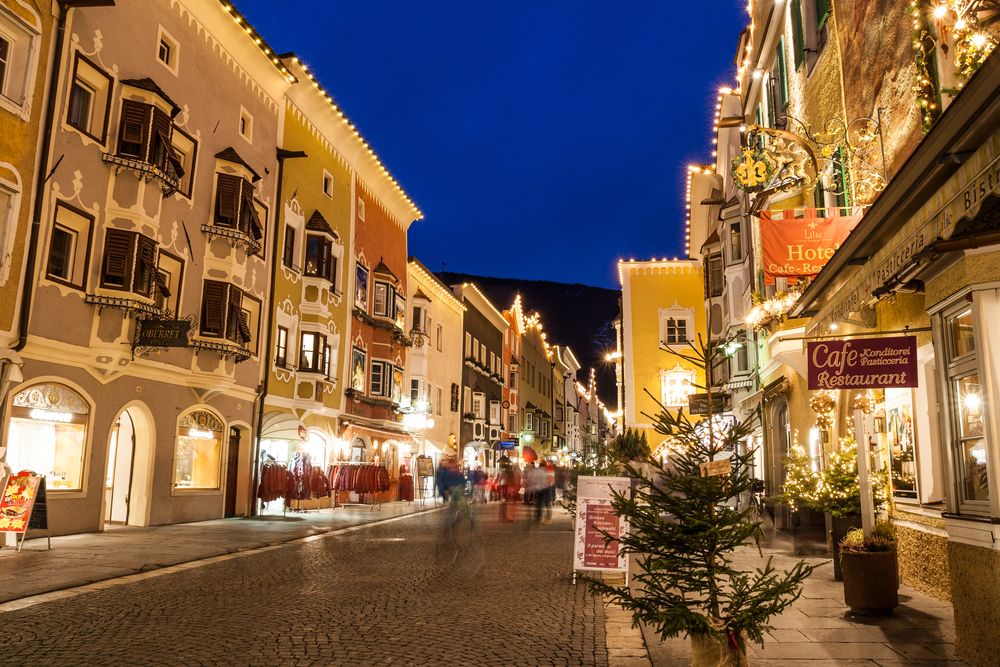
Città Nuova — Neustadt is Vipiteno’s most impressive urban space.
The term “new” is relative.
Much of its characteristic appearance emerged during the fifteenth and sixteenth centuries, particularly after a major fire in 1443 damaged part of the district. Reconstruction produced wider and more elaborate merchant houses than those of the older town.
Tall pastel façades line both sides of the street.
Many contain Erker, projecting bay windows characteristic of Tyrolean architecture, together with stone portals, arcades and wrought-iron shop signs.
Several houses extend surprisingly far behind their narrow street façades.
Commercial property was valuable.
Street frontage communicated status.
Courtyards and storage areas stretched inward.
Walk slowly enough to look into the arcades rather than concentrating entirely on the tower ahead.
Torre delle Dodici
The Torre delle Dodici — Zwölferturm divides Città Nuova from the older part of Vipiteno and remains the town’s defining monument.
It was built between 1468 and 1472 above the medieval city gate.
The architect was Hans Feur, a local master who had also worked on the Gothic choir of the parish church.
Preparatory work began in 1468, while Duke Sigismund of Austria laid the foundation stone in 1469.
The tower reaches 46 metres.
That height was not ornamental excess.
Vipiteno needed a structure high enough to function as an observation and warning point above the roofs of the town.
Why Is It Called the Twelve Tower?
The name is wonderfully practical.
The bell marked midday, calling townspeople to the noon break.
Hence Zwölferturm — Twelve Tower.
The structure also served as a lookout for threats including fire, flooding and military danger. A night watchman continued using the tower into the twentieth century.
Its present upper profile is not entirely medieval.
A major fire in 1868 damaged the original roof, and the stepped gable form visible today dates from the rebuilding completed in the nineteenth century.
That change is easy to miss because the silhouette now feels inseparable from medieval Vipiteno.
Can You Climb the Torre delle Dodici?
Not as a normal daily attraction.
The interior opens on selected occasions rather than maintaining conventional year-round tower hours.
Access is traditionally organised during events such as the Lantern Festivals, Knödel Festival and Christmas Market.
This is worth knowing before arriving with the expectation of climbing every historic tower visible from the street.
The exterior is accessible at any time.
And frankly, the best view of the Torre delle Dodici is from the street it was built to dominate.
Piazza Città
Immediately beside the tower, Piazza Città forms the civic heart of Vipiteno.
The square and adjoining streets concentrate cafés, historic buildings and public events throughout the year.
In summer, festival tables and lanterns transform the centre.
In winter, the Christmas Market occupies the space below the tower.
The scale is intimate enough that events genuinely take over the entire town rather than disappearing into one peripheral square.
The Town Hall
Vipiteno’s Municipio was built during the same extraordinary period of prosperity that produced the Torre delle Dodici.
Construction took place largely between 1468 and 1473.
The exterior gives only a partial indication of what survives inside.
Its most important room is the late-Gothic Council Chamber, a reminder that civic wealth in mining and trading towns could produce interiors every bit as ambitious as religious commissions.
The building also preserves historic civic objects connected with local government and commercial privileges.
Vipiteno was small.
Its citizens clearly did not consider that a reason for modest municipal architecture.
The Mining Boom Changes the Town

The late-fifteenth-century reconstruction of Vipiteno happened at exactly the right economic moment.
Mining brought new wealth.
The Brenner corridor brought traffic.
Habsburg rulers granted privileges.
Foreign entrepreneurs established commercial offices.
The architectural result is the unusual coherence visible today.
Torre delle Dodici and the Town Hall were built almost simultaneously.
The parish church expanded.
Hans Multscher had already received one of the most important artistic commissions in the town.
This is why Vipiteno should not be treated merely as an attractive Alpine village.
Its historic centre is essentially a preserved commercial city from the moment Tyrolean mining wealth reached its peak.
Museo Multscher
The Museo Multscher is the cultural stop that most visitors underestimate.
It occupies the Deutschhaus, the former Commandery of the Teutonic Order beside the parish church, together with the Museo Civico.
The central works are surviving components of the monumental altarpiece created by Hans Multscher of Ulm between 1456 and 1459 for the parish church of Nostra Signora della Palude.
Multscher was one of the major artists of the late Gothic period in southern Germany.
Commissioning him was another demonstration of Vipiteno’s economic ambition.
This was not a local craftsman asked to decorate a provincial church.
The town hired one of the most important masters available.
Hans Multscher
Hans Multscher worked in Ulm and became a central figure in the transformation of late-Gothic sculpture and painting in southern Germany.
His work moved towards stronger naturalism, more individualised faces and increasingly convincing human emotion.
The Vipiteno altarpiece came near the end of his career.
It combined sculpture and painted wings into an enormous visual structure for the parish church.
Only part of the original ensemble survives together in Vipiteno today, but the remaining panels and sculptures are sufficient to show the ambition of the commission.
Look at the faces.
Multscher’s figures are not weightless religious symbols.
They have bodies.
An Altarpiece with an Extraordinary Twentieth-Century History
The Multscher altarpiece survived the dismantling and transformation of the church, but its history became stranger during the twentieth century.
Some of its painted panels were transferred away from Vipiteno and, during the Second World War, became connected with Hermann Göring’s art collection.
After the war, the works passed through Florence before efforts succeeded in returning important panels to Vipiteno in 1959.
The story is worth remembering while looking at them.
Late-Gothic art, Fascist diplomacy, Nazi collecting and post-war restitution intersect in the biography of one South Tyrolean altarpiece.
Museo Civico
The same museum complex contains the Museo Civico, documenting Vipiteno’s institutional and commercial history.
Feudal documents, imperial confirmations, seals, guild material and municipal records explain the systems behind the attractive façades outside.
This is particularly useful because merchant towns functioned through privileges.
Who could hold a market?
Who could collect tolls?
Which guild controlled which trade?
Which ruler confirmed civic rights?
Those administrative questions determined economic life.
The museum gives the Torre delle Dodici a bureaucracy.
Museo Multscher in 2026
The combined Museo Multscher and Museo Civico operates seasonally.
In the principal 2026 periods between May and October, opening is generally 10:00–12:30 and 14:00–17:00.
The standard adult ticket is €5.
Reduced admission for eligible students and younger visitors is €2.50, while children under six enter free.
The museum is also included with the local ActiveCard where applicable.
Allow around 60–90 minutes.
Deutschhaus and the Teutonic Order
The museum occupies the former local commandery of the Teutonic Order, whose presence in Vipiteno extended from the Middle Ages into the early nineteenth century.
The order operated institutions across the German-speaking world and beyond, combining religious, charitable and political functions.
Its Vipiteno complex reflects the importance of the town’s position on a major north-south route.
Pilgrims and travellers were as much a part of the medieval Alpine world as merchants.
The buildings around the parish church should therefore be understood as a complex rather than isolated monuments.
Nostra Signora della Palude
The Parish Church of Our Lady of the Marsh — Nostra Signora della Palude / Unsere Liebe Frau im Moos stands just south of the historic centre.
Its scale is immediately surprising.
It is one of the largest Gothic churches in Tyrol and far larger than a town of Vipiteno’s present size seems to require.
Construction began during the fifteenth century on the site of an earlier Romanesque church documented in the thirteenth century.
Expansion continued into the early sixteenth century.
The building reflects precisely the same prosperity that produced the civic monuments in the centre.
Maximilian I and the Parish Church
The south portal records an important moment in the church’s construction.
Emperor Maximilian I participated in the ceremonial laying of the foundation stone for an important phase of the nave in 1497.
Maximilian appears repeatedly across Tyrol because the region occupied an essential place in his political world.
Innsbruck became his most obvious monumental centre, but prosperous towns along the Brenner corridor also benefited from Habsburg attention.
Vipiteno was useful.
Useful places tend to attract emperors eventually.
Inside the Parish Church
White marble columns divide the expansive interior.
Later Baroque alterations changed the visual language of the medieval structure, including ceiling frescoes by Adam Mölk.
The high altar is Neo-Gothic.
Yet five original sculptures from Multscher’s dismantled fifteenth-century altarpiece survive within the church, reconnecting the present interior with its great medieval commission.
There is also an archaeological surprise.
A Roman funerary inscription associated with Postumia Victorina, probably dating to the second or third century AD, was discovered during foundation work in 1497 and is preserved inside.
One church therefore brings together Roman Vipiteno, Gothic prosperity, Habsburg ceremonial politics and Baroque transformation.
Chiesa dello Spirito Santo
Back in the centre, the Church of the Holy Spirit is considerably smaller and easier to miss.
Its importance comes from its medieval fresco decoration and its relationship with the former hospital complex.
Hospitals in medieval towns were not modern medical institutions in the contemporary sense.
They served travellers, pilgrims, poor residents and people requiring care or shelter.
In a town built around traffic through the Alps, such an institution was particularly significant.
Include the church while walking the centre rather than making it a separate expedition.
Jöchlsthurn
The Jöchlsthurn is one of the historic tower houses associated with Vipiteno’s wealthy urban families.
Its architecture reflects the defensive and representative character of late-medieval residences.
Families who became rich through mining, administration or trade did not merely build larger houses.
They built status vertically.
Vipiteno contains several architectural details of this kind once you move attention away from the Torre delle Dodici.
Castel Tasso – Burg Reifenstein
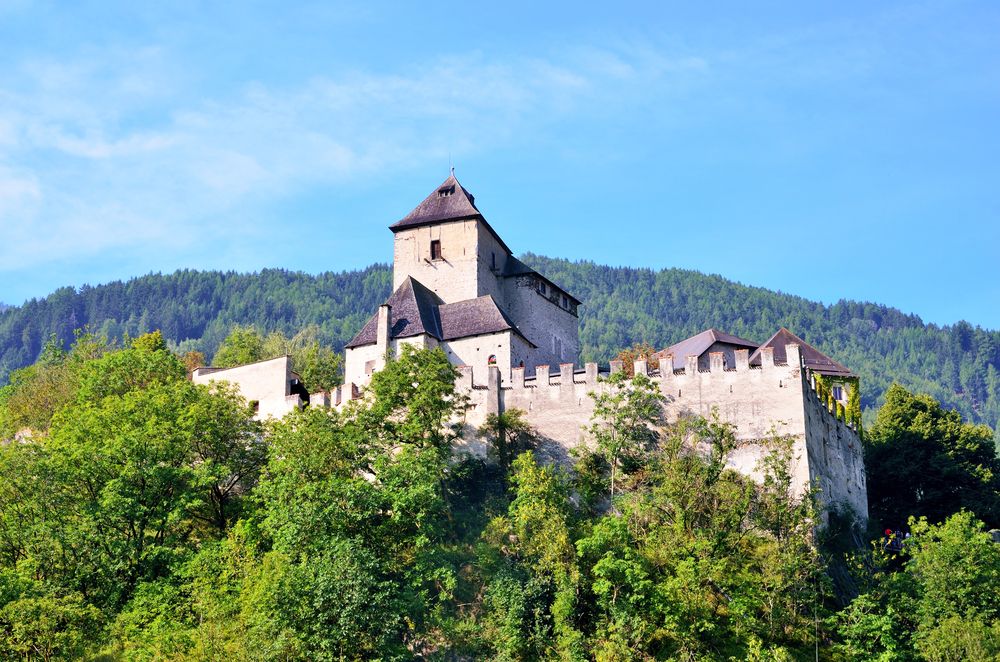
A few kilometres south of Vipiteno stands Castel Tasso — Burg Reifenstein, one of the best-preserved medieval castles in South Tyrol.
The fortress appears in documentary sources around 1100.
Its position on a rocky elevation above the valley allowed control over movement through the surrounding territory.
For centuries it changed hands among ecclesiastical and noble owners. In 1469 it passed to the Teutonic Order, which retained it until the Napoleonic period.
Since the early nineteenth century it has belonged to the Thurn und Taxis / Torre e Tasso family.
The remarkable aspect is not simply the exterior.
It is what survives inside.
Inside Castel Tasso (Reifenstein Castle)
Many medieval castles impress from a distance and disappoint once you enter a series of empty rooms.
Reifenstein does the opposite.
Historic spaces retain wood panelling, sleeping rooms, a kitchen, domestic areas and the celebrated Green Hall, whose Gothic elements and decorated surfaces preserve an unusually convincing sense of medieval residential life.
The castle was not transformed extensively into a Baroque palace.
That is why it matters.
The interior still behaves architecturally like a medieval fortress.
Castel Tasso in 2026
From March through October 2026, Castel Tasso is generally open 10:00–17:00.
The standard adult admission is €9.
Children aged six to sixteen pay €7, while younger children enter free.
Guided tours for groups can be arranged during the main season.
Outside the principal season, access is more limited and may require advance booking.
The castle is reached by a short uphill path.
Wear proper shoes.
Historic authenticity also means historic stairs, uneven surfaces and poor accessibility.
Monte Cavallo – Rosskopf
Vipiteno has an unusually convenient mountain.
Monte Cavallo — Rosskopf rises directly above the town, and the lower cable-car station sits close enough to the centre that you can move from Gothic merchant houses to Alpine meadows without using a car.
The main cable car reaches approximately 1,860 metres.
From there, walking trails spread across the slopes, mountain huts serve food, and a further Panorama Lift can continue towards approximately 2,120 metres during the summer operating period.
This proximity changes how Vipiteno works as a destination.
The mountain is not a separate day trip.
It is an extension of town.
Monte Cavallo in Summer
Summer is the easiest season for combining culture and landscape.
Take the first cable car up and walk before afternoon clouds develop.
Routes range from straightforward family walks to longer mountain itineraries.
The upper landscape is open enough to provide broad views across the surrounding Alps and towards the Vipiteno basin.
You do not need to plan an expedition.
Even a few hours above the tree line makes the medieval town below look completely different when you return.
The Panorama Lift
During the principal summer season, the Panorama Lift extends access higher towards approximately 2,120 metres.
This is useful for visitors who want a high-level panorama without committing to a substantial ascent on foot.
The lift operates on a more limited seasonal schedule than the main Rosskopf cable car.
In 2026, the Panorama Lift operates during the core summer period rather than the entire May-to-November cable-car season.
Always distinguish between the two when planning.
“Cable car open” does not automatically mean every mountain installation is running.
Mountain Coaster
Monte Cavallo also has a 1.3-kilometre Mountain Coaster descending through approximately 273 metres of vertical difference.
It is essentially the opposite of contemplative Alpine tourism.
The ride operates during the summer season when conditions allow and closes in rain.
Families will understand the appeal immediately.
Purists can walk past it and discuss mountain silence.
Both groups can meet at the hut afterward.
Monte Cavallo Prices in 2026
The Rosskopf cable car operates from 23 May to 1 November 2026, generally from 08:30 to 17:00.
A standard adult return ticket costs €28.
The one-way ascent costs €22.
The Panorama Lift and Mountain Coaster operate during the central summer period, generally from 09:00 to 16:00.
An adult ascent combining the main cable car and Panorama Lift costs €27, while the cable-car and Mountain Coaster combination is €39.
These are reasonable enough that staying in Vipiteno for two nights becomes much more attractive than treating the town as a motorway coffee stop.
Vipiteno in Winter
In winter the same mountain becomes a ski and toboggan area.
The altitude and compact scale make Rosskopf particularly practical for families and short stays.
You can sleep in the historic centre, walk towards the lift and ski without moving to a separate purpose-built resort.
That combination is unusually attractive for travellers who want both town and mountain rather than spending a week inside a ski village.
Val di Vizze
East of Vipiteno opens Val di Vizze — Pfitschtal, one of the less theatrical and more authentic valleys around the Brenner region.
The valley extends towards the high Alpine border with Austria.
Farms, villages, forests and mountain terrain dominate rather than large resort infrastructure.
For hikers, it provides numerous routes without the density of famous Dolomite destinations.
For cultural travellers, even a short drive demonstrates how quickly urban Vipiteno gives way to rural mountain South Tyrol.
Maria Trens
South of Vipiteno lies Maria Trens, one of South Tyrol’s most important pilgrimage centres.
Its church developed around a venerated image of the Virgin and became a major destination for pilgrims from the surrounding Alpine regions.
The village combines naturally with Castel Tasso.
Visit the castle first, then continue towards Maria Trens rather than returning immediately to Vipiteno.
Together they produce a half-day excursion built around two very different aspects of medieval and early-modern Alpine life: fortress and pilgrimage.
The Brenner Railway
The arrival of the Brenner Railway during the nineteenth century transformed the region again.
Rail connection accelerated movement through the valley and integrated Vipiteno into a modern European transport network.
Yet it also damaged older local economies.
Carriers and transport workers who had earned livelihoods moving goods through the mountains suddenly faced mechanised competition.
The railway revived the valley economically while simultaneously destroying one of Vipiteno’s traditional sources of income.
Progress rarely checks whether everyone is ready.
Italian Vipiteno After 1918
After the First World War, South Tyrol passed from Austria-Hungary to Italy.
The change was particularly profound in places such as Vipiteno, where local culture and language were overwhelmingly German-speaking.
The Fascist period brought systematic Italianisation policies across South Tyrol, affecting place names, schools, administration and public life.
The later development of provincial autonomy eventually produced the bilingual system visible today.
For travellers, this history explains why calling the town both Vipiteno and Sterzing is not stylistic decoration.
The two names belong to one complicated political landscape.
What to Eat in Vipiteno
Vipiteno’s food is Tyrolean before it is generically Italian.
Bread, cured meat, cheese, dumplings, potatoes and dairy products dominate the traditional table.
Start with Speck Alto Adige, preferably cut thicker than supermarket prosciutto.
Then move to canederli — Knödel.
They may contain speck, cheese or spinach and arrive in broth, with cabbage or as an accompaniment to meat.
Schlutzkrapfen connect South Tyrol with the broader Tyrolean filled-pasta tradition: half-moon parcels generally stuffed with spinach and ricotta or potato and finished with butter and chives.
For dessert, apple strudel is unavoidable.
Here, avoiding it would require effort for no obvious reward.
Canederli
Canederli are fundamentally a technology for not wasting bread.
Stale bread is mixed with milk, egg and ingredients such as speck, cheese or herbs before being formed into substantial dumplings.
The result could turn leftovers into an entire meal.
That economy explains why dumplings became so fundamental across Alpine food cultures.
Modern restaurant versions may be carefully plated.
Their DNA remains agricultural.
Order a trio with different fillings if available.
It is the fastest way to understand the basic grammar of South Tyrolean cooking.
Sagra dei Canederli
Vipiteno takes dumplings seriously enough to give them their own festival.
During the Sagra dei Canederli — Knödelfest, an enormous line of tables occupies the historic centre while restaurants and producers serve multiple variations of the dish.
Traditional versions coexist with more inventive recipes.
In 2026 the festival takes place on 13 September.
The setting matters almost as much as the food.
Città Nuova becomes one enormous dining room with the Torre delle Dodici at its centre.
Book accommodation early if you intend to stay overnight.
Vipiteno Yogurt
Dairy farming is fundamental to the surrounding valleys, and Vipiteno yogurt became one of the best-known commercial products associated with the town.
The local dairy tradition developed naturally from an environment where Alpine livestock farming provided milk that could be transformed into longer-lasting products.
Modern industrial production is far removed from the tiny farm dairies of the past, but the economic connection remains.
In summer, the Yogurt Days celebrate this local identity through events, tastings and activities.
The 2026 programme runs from 3 to 31 July.
South Tyrolean Speck
Speck sits precisely at the cultural crossroads that defines Vipiteno.
It is cured like Mediterranean ham but lightly smoked according to Alpine preservation traditions.
The result belongs neither completely to Italian prosciutto nor to northern European smoked meat.
Serve it with dark bread, pickles and local cheese.
Do not overcomplicate matters.
Where to Eat
Vinzenz – zum feinen Wein
Vinzenz is one of the strongest choices in the historic centre when wine matters as much as the food. The kitchen combines South Tyrolean ingredients with a more contemporary approach than the town’s most traditional inns, while the wine selection reaches well beyond predictable tourist bottles.
Its position on Città Nuova makes it particularly convenient for dinner after the centre has emptied of day visitors.
Address: Città Nuova 4, 39049 Vipiteno
Telephone: +39 0472 760342
Cuisine: contemporary South Tyrolean and Alpine
Price level: approximately €30–90
Best for: a more refined dinner with a serious wine list.
Kleine Flamme
Kleine Flamme takes another step away from the conventional mountain inn. The cooking is contemporary and precise, using Alpine and Italian influences rather than reproducing a fixed list of Tyrolean standards.
This is the address to choose when you have already eaten canederli and speck and want to see what a more ambitious modern kitchen does in Vipiteno.
Address: Città Nuova 31, 39049 Vipiteno
Telephone: +39 0472 766065
Cuisine: contemporary Alpine and Italian
Price level: approximately €30–90
Best for: modern cooking in the historic centre.
Zur Traube
Zur Traube sits in Città Vecchia and follows a more informal restaurant format. The menu covers regional cooking alongside pizza, making it useful for mixed groups or a less structured evening.
Its location beyond the Torre delle Dodici also gives you a reason to spend more time on the older side of town rather than concentrating exclusively on Città Nuova.
Address: Via Città Vecchia 12, 39049 Vipiteno
Telephone: +39 349 5055049
Cuisine: South Tyrolean, Italian and pizza
Price level: €€
Best for: an informal central meal with broad choice.
Prantneralm
Prantneralm belongs to the mountain rather than the urban restaurant circuit.
Come for Alpine cooking, open views and the atmosphere of a genuine excursion meal rather than simply for another address inside town.
Dumplings, substantial mountain dishes and simple local cooking make considerably more sense after walking than before it.
Address: mountain area above Vipiteno, 39049
Telephone: +39 338 4959084
Cuisine: South Tyrolean mountain cuisine
Price level: €€
Best for: a mountain lunch combined with hiking.
Where to Stay
The best choice for a first visit is inside the historic centre or within a few minutes on foot.
Vipiteno is small enough that there is little advantage in driving back and forth from a peripheral hotel unless spa facilities or rural views matter more than the town itself.
Hotel Schwarzer Adler
Schwarzer Adler occupies an exceptional position directly on Piazza Città, placing the Torre delle Dodici and Città Nuova outside the door.
The building combines historic-centre architecture with a contemporary renovation rather than attempting to recreate a fake medieval interior.
Address: Piazza Città 1, 39049 Vipiteno
Telephone: +39 0472 628162
Category: upscale historic-centre hotel
Price level: €€€
Best for: the most central possible stay beneath the Torre delle Dodici.
Haus am Turm
Haus am Turm sits directly on Città Nuova beside the historic axis and is smaller and more intimate than a conventional large hotel.
Its location makes it particularly suitable for a short cultural stay when you want to leave the car parked and walk everywhere.
Address: Città Nuova 4, 39049 Vipiteno
Telephone: +39 0472 765428
Category: boutique hotel
Price level: €€€
Best for: a small-scale stay in the heart of the historic centre.
Hotel Restaurant Lilie
Hotel Lilie occupies another excellent address on Città Nuova and combines accommodation with a traditional restaurant.
The historic building gives the stay more local character than an international chain while retaining full hotel services.
Address: Città Nuova 49, 39049 Vipiteno
Telephone: +39 0472 760063
Category: historic hotel and restaurant
Price level: €€€
Best for: classic South Tyrolean atmosphere directly inside the centre.
Boutique Hotel Sole
Boutique Hotel Sole offers a more contemporary design-led alternative slightly outside the most intensely historic street.
The centre remains easily walkable, while the property suits travellers who prefer modern interiors to traditional Tyrolean wood panelling.
Address: Via Geizkofler 17, 39049 Vipiteno
Telephone: +39 0472 310499
Category: boutique hotel
Price level: €€€
Best for: modern design within easy walking distance of the old town.
How Many Days Do You Need?
A half day is enough to photograph Città Nuova, walk beneath the tower and eat lunch.
That is not enough to understand Vipiteno.
A full day allows the historic centre, Town Hall, parish church and Museo Multscher.
With two days, add Castel Tasso and Monte Cavallo.
Two nights are particularly effective because the town changes after shops close and day visitors disappear.
The Torre delle Dodici looks better at dusk anyway.
A One-Day Vipiteno Itinerary
Begin in Città Nuova before the shops and cafés become busy.
Walk towards the Torre delle Dodici, study the merchant façades and continue into the older town.
Visit the Town Hall if accessible, then walk south towards the parish church and Museo Multscher.
Give the museum at least an hour.
Have lunch back in the centre.
During the afternoon, return through Città Vecchia and walk towards the lower station of Monte Cavallo.
Take the cable car up for a short mountain walk if the weather is clear.
Return for dinner after the historic centre becomes quiet.
This combination of art, architecture and mountain is exactly what makes Vipiteno work.
A Two-Day Vipiteno Itinerary
Keep the first day centred on town and Monte Cavallo.
On the second morning, drive or take the bus towards Castel Tasso.
Allow around two hours including the approach and interior visit.
Continue to Maria Trens for the pilgrimage church and lunch in the surrounding area.
Return to Vipiteno during the afternoon.
If you prefer landscape to churches, replace Maria Trens with an excursion into Val di Vizze.
The second day should expand the geography rather than repeat the same central street.
Getting to Vipiteno
Vipiteno lies directly on the Brenner railway corridor, making it unusually easy to reach without a car.
Regional trains connect the town south towards Bressanone and Bolzano and north towards the Brenner border, where onward Austrian connections continue towards Innsbruck.
The railway station lies within walking distance of the historic centre.
This makes Vipiteno particularly useful for travellers moving between South Tyrol and Austria by train.
You can stop for a night without restructuring the entire journey.
Vipiteno from Innsbruck
Innsbruck lies north across the Brenner Pass.
Rail is the logical connection.
The journey moves through one of Europe’s historic trans-Alpine corridors without requiring a car, tolls or parking.
The cultural transition is also interesting.
You leave Austrian Tyrol and enter Italian South Tyrol while the language, architecture and food change only gradually.
The border is politically decisive.
The landscape barely notices.
Vipiteno from Bolzano
Bolzano lies to the south and connects easily by rail.
The journey follows the Isarco Valley through Bressanone before climbing towards Vipiteno.
This makes the town an easy one- or two-night addition to a broader South Tyrol itinerary.
If you have a car, the same route is fast, but parking it for most of the stay is still the sensible choice.
Do You Need a Car?
For Vipiteno itself, no.
The railway station, historic centre and Monte Cavallo cable-car station can all be combined on foot.
A car becomes useful for reaching smaller valleys, remote hiking starts and some surrounding villages.
Castel Tasso is also accessible by public bus, with the 310 service providing a practical connection.
If your itinerary is Vipiteno plus Innsbruck, Bressanone and Bolzano, rail is perfectly viable.
Vipiteno and Bressanone
Vipiteno and Bressanone complement one another well.
Bressanone has the stronger ecclesiastical history, cathedral complex and episcopal architecture.
Vipiteno has the more concentrated merchant-town character and a more immediate relationship with mining and the Brenner route.
Do not decide that one replaces the other because both have pastel façades and German street names.
Their histories are quite different.
Vipiteno and Innsbruck
The comparison with Innsbruck is even more revealing.
Innsbruck became an imperial residence.
Vipiteno remained a merchant and mining town.
The Habsburgs shaped both.
One received palaces and monumental tombs.
The other received trade privileges, visits from emperors and the wealth necessary to hire Hans Multscher.
Travelling between them shows how one Alpine political system produced very different urban environments.
Lantern Festivals
Summer evenings bring the Feste delle Lanterne, when the centre is closed to ordinary traffic and filled with food, music and illuminated streets.
The events are among the occasions when access to the Torre delle Dodici may also be possible.
In 2026, the remaining late-summer Lantern Festival date is 19 August, following earlier editions through July and August.
The format suits Vipiteno particularly well because the historic centre is narrow enough for one event to animate the whole urban axis.
Vipiteno Christmas Market
From late November, Piazza Città becomes one of South Tyrol’s principal Christmas-market settings.
The scale is more intimate than Bolzano.
Approximately 35 stalls gather beneath the Torre delle Dodici, selling food, handicrafts and seasonal decorations.
The town has increasingly built the event around a bell-themed Christmas identity, including a carillon associated with the tower.
The 2026–27 market runs from 27 November 2026 to 6 January 2027.
For atmosphere, stay after dark.
Visiting at 11:00 and leaving before the lights come on defeats much of the purpose.
When to Visit Vipiteno
June, September and early October are excellent for combining town and mountain.
June provides long daylight and green Alpine landscapes.
September brings cooler walking temperatures and the Knödel Festival.
October is quieter and particularly attractive before the mountain cable-car season finishes.
July and August are lively, with the Yogurt Days, Lantern Festivals, farmers’ markets and mountain events.
December is completely different.
Come for snow, lights and the Christmas Market.
Winter also makes sense if Monte Cavallo is part of a ski itinerary.
Spring can be less predictable because mountain conditions and lift maintenance do not always align neatly with pleasant weather in the valley.
Vipiteno in 2026
The Museo Multscher and Museo Civico continue to operate seasonally from the Deutschhaus, with a standard adult admission of €5.
At Castel Tasso, standard admission is €9, with regular access through the main March-to-October period.
The Monte Cavallo cable car operates for the 2026 summer season from 23 May to 1 November, daily from 08:30 to 17:00. The adult return fare is €28.
The Panorama Lift and Mountain Coaster operate during the central summer season, with the coaster remaining weather-dependent.
Vipiteno’s main remaining 2026 event dates include the Knödel Festival on 13 September, the autumn Red Carpet Saturdays beginning on 19 September, the Harvest Festival on 30–31 October and the Christmas Market from 27 November 2026 to 6 January 2027.
For a town this small, the calendar is unusually active.
That is another reason an overnight stay works better than a two-hour stop.
Useful Information
Region: Trentino-Alto Adige / Südtirol
Province: Bolzano / Bozen
Italian name: Vipiteno
German name: Sterzing
Main river valley: Upper Isarco / Wipptal
Distance from Brenner Pass: approximately 15 km
Cultural identity: predominantly Tyrolean and German-speaking
Main historic street: Città Nuova / Neustadt
Symbol of the town: Torre delle Dodici / Zwölferturm
Tower construction: 1468–1472
Tower architect: Hans Feur
Tower height: 46 m
Foundation stone: laid under Duke Sigismund of Austria in 1469
Town Hall construction: principally 1468–1473
Major historic industry: silver and mineral mining
Important merchant connection: Fugger family of Augsburg
Main art museum: Museo Multscher
Major artist: Hans Multscher of Ulm
Vipiteno altarpiece: 1456–1459
Museo Multscher adult admission 2026: €5
Main Gothic church: Nostra Signora della Palude
Church opening: generally daily 09:00–19:00
Major nearby castle: Castel Tasso / Burg Reifenstein
Castel Tasso adult admission 2026: €9
Main mountain: Monte Cavallo / Rosskopf
Cable-car upper station: approximately 1,860 m
Panorama Lift: up to approximately 2,120 m
Monte Cavallo summer season 2026: 23 May–1 November
Cable-car adult return ticket: €28
Main local food: canederli, speck, Schlutzkrapfen, strudel
Knödel Festival 2026: 13 September
Christmas Market 2026–27: 27 November–6 January
Railway station: yes
Car needed in town: no
Recommended stay: 1–2 full days
Best months: June and September–early October
Best winter period: Advent through early January

