
Venzone Travel Guide: The Medieval Town Rebuilt Stone by Stone After the 1976 Earthquake

Venzone appears at first to be one of Italy’s most perfectly preserved medieval towns.
A double ring of walls surrounds narrow streets, stone houses, Gothic palaces and a cathedral built from pale local rock. Mountains rise beyond the rooftops, while the broad gravel bed of the Tagliamento River opens nearby. The town is compact, orderly and visually coherent enough to suggest that very little has changed since the Middle Ages.
That impression is only partly true.
On 6 May 1976, a devastating earthquake struck Friuli Venezia Giulia. Venzone lost 47 residents, and much of its historic centre was destroyed or rendered unsafe. Strong aftershocks in September caused further collapses. The cathedral fell, palaces broke apart and streets filled with thousands of displaced stones.
What visitors see today is therefore both medieval and modern. Venzone was reconstructed through one of Europe’s most remarkable post-earthquake conservation projects. Original stones were catalogued, recovered and returned to their architectural positions wherever possible. Buildings were not replaced with approximate façades or a modern interpretation of the past. The town fought to recover its historic form, street plan and material identity.
This history makes Venzone more than a photogenic walled village. It is a case study in reconstruction, collective memory and the difficult question of what authenticity means after destruction.
The town also holds one of Friuli’s strangest collections: five naturally preserved human bodies known as the Mummies of Venzone. Their survival is linked not to deliberate embalming but to environmental conditions and the action of a microscopic fungus within the cathedral burial spaces.
Venzone can be seen in a few hours, but a full day allows time for its walls, museums, cathedral, earthquake history and surrounding landscape. An overnight stay reveals a quieter town after cyclists and day visitors have continued towards Austria, Udine or the Adriatic.
Where Is Venzone?
Venzone lies in the northern part of Friuli Venezia Giulia, in the province of Udine.
The town occupies a strategic point where the Tagliamento Valley narrows between the Carnic Prealps and Julian Prealps. For centuries, this position controlled movement between the Adriatic plain and the Alpine routes leading towards Austria and central Europe.
Udine is approximately 35 kilometres south. Gemona del Friuli lies around 10 kilometres away, while Tarvisio and the Austrian border stand farther north along the Canal del Ferro.
The historic centre sits slightly above the Tagliamento plain and is completely enclosed by medieval walls. Modern residential areas, the railway station and the wider municipality extend beyond the fortifications.
Venzone also lies directly on the Alpe Adria Cycle Route, one of Europe’s best-known long-distance cycling itineraries connecting Salzburg with Grado on the Adriatic coast.
Why Is Venzone So Important?
Venzone is considered the best-preserved fortified medieval settlement in Friuli Venezia Giulia.
Its importance comes from the survival and reconstruction of an entire urban system rather than one isolated monument. Walls, gates, streets, churches, houses and civic buildings still form a recognisable 14th-century town.
The reconstruction after 1976 gave Venzone international significance within architecture, conservation and disaster recovery. Instead of treating the damaged centre as expendable, residents, scholars and institutions documented the ruins and reconstructed the town through a detailed process often described by the principle “where it was, as it was.”
The result is not literally untouched medieval architecture. Many structures contain modern seismic reinforcements, restored elements and reconstructed sections. Yet the historic materials, proportions and urban relationships were preserved to an exceptional degree.
Venzone was declared a national monument in 1965, before the earthquake, recognising the value of the complete fortified town. Its later destruction and rebirth made that designation even more meaningful.
The History of Venzone
Roman Routes and Early Settlement
The Venzone area was important long before the construction of the medieval walls.
Its position controlled a route through the Alps connecting the Adriatic region with the territories beyond the mountains. Roman roads passed through the Tagliamento and Fella valleys, carrying soldiers, traders and goods towards Noricum.
Archaeological evidence suggests occupation and commercial movement in the wider territory, although the visible urban form of Venzone developed primarily during the Middle Ages.
The name may derive from the nearby Venzonassa stream, although linguistic explanations vary.
The Patriarchate of Aquileia
Venzone grew under the influence of the Patriarchate of Aquileia, one of medieval Friuli’s most important political and religious powers.
By the 13th and 14th centuries, the town had become a fortified commercial centre. Its position allowed local authorities to collect duties and protect routes carrying salt, wine, timber, livestock and other goods between the Alpine regions and the plain.
The walls were expanded into an imposing defensive system. Towers, gates and a moat surrounded the town, while civic and religious buildings reflected increasing prosperity.
The cathedral, town hall and noble residences transformed Venzone from a frontier settlement into a compact urban centre.
Venetian Rule
In 1420, much of Friuli came under the control of the Republic of Venice.
Venzone retained strategic and commercial importance, but political power shifted towards Venetian institutions. Architectural decoration, civic symbols and commercial relationships reflected this new alignment.
The town continued to benefit from traffic through the valley, although changing routes and military technology gradually reduced the defensive importance of its walls.
Plague, Trade and the Discovery of the Mummies
Burials took place within and around the cathedral for centuries.
In 1647, workers reportedly discovered the first naturally preserved body while removing or reorganising graves. The mummy later became known as the Gobbo, or Hunchback, because of the body’s curved posture.
Additional naturally preserved bodies were found over time. Their unusual condition attracted scientific interest and visitors, including Napoleon’s soldiers during the French occupation.
The mummies became one of Venzone’s defining curiosities, although they were originally local dead rather than objects intended for public display.
The 1976 Friuli Earthquake
At 21:00 on 6 May 1976, a powerful earthquake struck Friuli.
Venzone suffered catastrophic damage. Forty-seven people died, homes collapsed and much of the architectural heritage was destroyed or severely compromised.
The cathedral remained partly standing after the first shock, but major aftershocks on 11 and 15 September caused further collapse. Buildings already weakened in May were reduced to rubble.
The disaster affected a large part of Friuli, killing almost one thousand people and leaving tens of thousands homeless.
For Venzone, the question was not only where residents would live but whether the historic town itself could survive.
The Reconstruction of Venzone
The reconstruction became an exceptional operation in architectural archaeology.
Thousands of stones and architectural fragments were recovered from the ruins. Many were measured, photographed, classified and stored. Specialists studied historic surveys, photographs, masonry patterns and surviving sections to determine where individual elements belonged.
The cathedral reconstruction was particularly complex. Approximately 12,000 original stones were reused, allowing the Gothic structure to recover its historic geometry and material appearance.
The wider town was reconstructed in phases, with priority given to the principal streets, squares and monuments. Modern structural systems were incorporated where necessary to improve seismic resistance.
The process took years and involved debate. Reconstruction of this kind raises difficult questions: should ruins remain visible as evidence of trauma, or should the original town be rebuilt? How much replacement material can be introduced before authenticity is lost? Should residents’ needs take precedence over archaeological precision?
Venzone’s answer was determined largely by its community. The rebuilt town would remain a place to live, not merely a preserved ruin or memorial landscape.
Things to Do in Venzone
Walk Through Porta San Genesio
The most atmospheric entrance into Venzone is Porta San Genesio.
The gate preserves its medieval defensive character, including the tower and narrow passage controlling access through the walls. Entering here immediately reveals the compact scale of the fortified town.
The gate once formed part of a system designed to regulate travellers, goods and possible attackers. It was connected with the walls, moat and guarded circulation around the settlement.
Pause outside before passing through. The transition from open landscape to enclosed stone streets remains one of Venzone’s strongest spatial experiences.
Follow the Medieval Walls
Venzone’s defensive circuit consists of two lines of walls reinforced by towers.
The fortifications developed mainly between the 13th and 14th centuries. The walls reached approximately eight metres in height in some sections and were surrounded historically by a deep moat.
A complete walk around the exterior reveals the structure better than viewing it only from inside the town. The double wall, towers and relationship with the surrounding terrain become much clearer.
Several sections were reconstructed after the earthquake using recovered stone. Others retain substantial historic masonry.
The circuit is relatively easy and can be completed without a formal hiking route. Allow extra time for photographs and views towards the mountains.
Enter Piazza Municipio
Piazza Municipio is Venzone’s civic centre.
The square is enclosed by arcaded buildings, stone façades and the Gothic town hall. Its proportions reflect the medieval town’s administrative and commercial functions.
Markets, public ceremonies and political decisions took place here. The arcades protected merchants and residents from rain and snow, while the upper rooms contained civic offices.
Today the square contains cafés, accommodation and the tourist office. It becomes particularly lively during festivals and summer cycling season.
Visit the Palazzo Comunale
The Palazzo Comunale, or town hall, is one of Venzone’s finest Gothic buildings.
Its exterior combines pointed arches, an open loggia, stone stairways and decorative elements associated with Venetian Gothic architecture. The building was severely damaged in 1976 and subsequently reconstructed.
The upper rooms contain civic spaces and exhibitions. One permanent display documents the earthquake and reconstruction, using photographs and material evidence to show how completely the town was transformed.
The palace is not simply an attractive municipal building. It is one of the best places to understand why present-day Venzone looks so intact.
See the Tiere Motus Earthquake Exhibition
The permanent exhibition known as Tiere Motus is dedicated to the 1976 earthquake and reconstruction.
The Friulian title refers to the movement of the earth. Photographs, films, models and documentary material show Venzone before the disaster, immediately after the shocks and during the long rebuilding process.
Images of the cathedral in ruins are particularly powerful because visitors can compare them directly with the reconstructed building outside.
The exhibition also explains the technical and civic choices behind reconstruction. It avoids presenting the process as an effortless miracle. The recovery involved years of documentation, political negotiation, skilled labour and community pressure.
Opening hours generally follow those of the local museum and tourist system rather than remaining identical throughout the year. The tourist office can confirm access on the day.
Visit the Cathedral of Saint Andrew the Apostle

The Cathedral of Saint Andrew, or Duomo di Sant’Andrea Apostolo, is Venzone’s principal monument.
The present Gothic building was consecrated in 1338, replacing an earlier Romanesque church. Its exterior is characterised by pale stone, pointed arches, sculpted portals and a free-standing bell tower.
The cathedral was almost entirely destroyed during the 1976 earthquakes. Its reconstruction required the identification and replacement of thousands of original stones.
Inside, the structure feels restrained and monumental. Gothic arches, stone surfaces and surviving works create an atmosphere that is very different from the richly decorated Baroque churches found elsewhere in Friuli.
The church contains important frescoes, sculptures and funerary monuments, although several works were damaged, recovered or repositioned following the earthquake.
The cathedral remains active and should be visited outside religious services whenever possible.
Examine the Exterior Sculptures
The cathedral portals and external carvings deserve careful attention.
Reliefs, saints, animals and decorative motifs reflect medieval craftsmanship and the symbolic language of Gothic religious architecture.
Some elements are original, while others were restored or reconstructed after 1976. The distinction is not always immediately visible, which is part of the reconstruction’s success.
Walk completely around the building rather than entering through the nearest door and leaving by the same route.
Visit the Chapel of San Michele and the Mummies of Venzone
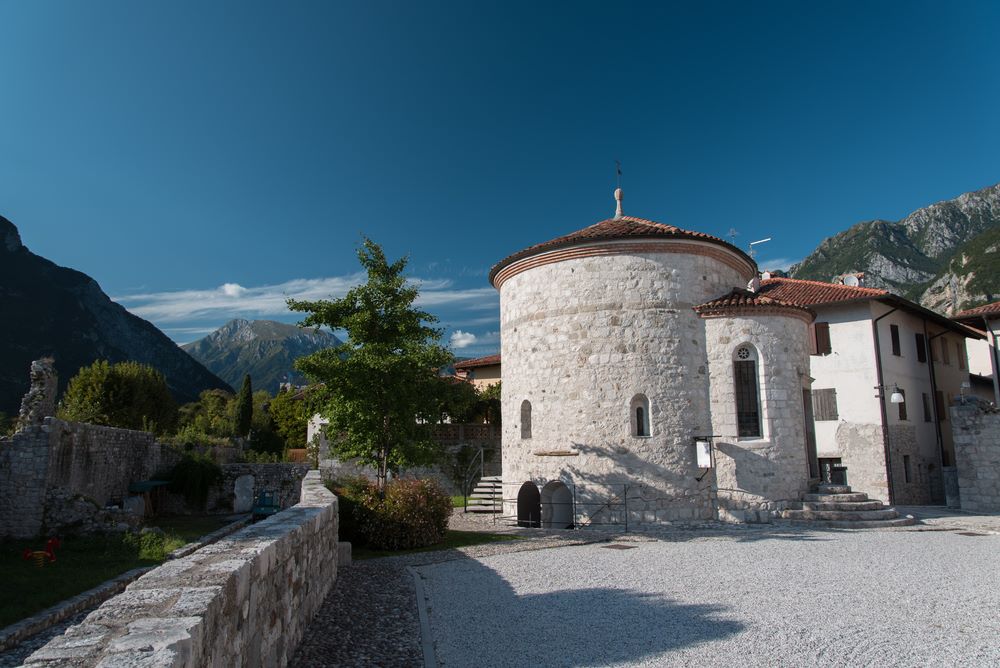
The small cemetery chapel of San Michele stands beside the cathedral.
Its crypt contains five naturally preserved human bodies known as the Mummies of Venzone. The display is compact, direct and likely to feel more confronting than a conventional archaeological museum.
The bodies were not embalmed. Their preservation resulted from a combination of burial conditions and the activity of a microscopic fungus historically identified as Hypha bombycina, which contributed to dehydration and inhibited decomposition.
The oldest and most famous mummy is the Gobbo, discovered during the 17th century. Other preserved bodies were recovered from cathedral burial spaces over time.
Before the earthquake, more mummies were held within the chapel complex. Fifteen bodies were recovered substantially intact from the ruins after May 1976, although only five are now displayed publicly.
The exhibition is open throughout the year. Published hours are generally 09:00–19:00 in summer and 09:00–17:00 in winter.
A small admission charge may apply. Confirm the current price locally.
The mummies should be approached as human remains, not a theatrical horror attraction. Photography rules must be respected, and children may find the display unsettling.
Understand the Science Behind the Mummies
Natural mummification is uncommon but not unique to Venzone.
It occurs when environmental conditions slow or prevent bacterial decomposition. Low humidity, ventilation, mineral content, temperature and microorganisms can all play a role.
In Venzone, the particular conditions of the cathedral tombs appear to have dehydrated bodies before ordinary decomposition could occur.
Scientific explanations have changed over time, and the precise contribution of the fungus remains part of the mummies’ continuing study. The display is valuable because it connects local burial practice, microbiology and changing attitudes towards death.
Visit the Church of San Giovanni Battista
The Church of San Giovanni Battista survives principally as a reconstructed and partly ruined memorial structure.
Its damaged form preserves visible evidence of the 1976 earthquake, creating a contrast with the more complete reconstruction of the cathedral and civic buildings.
This selective preservation is important. If every trace of destruction had disappeared, visitors might interpret Venzone as an untouched medieval town. San Giovanni provides a physical reminder of the disaster.
The building is not always open, but its exterior can be viewed during a walk through the centre.
See the Church of Santa Caterina
The small Church of Santa Caterina stands within the walled town and contributes to Venzone’s dense religious landscape.
Its architecture is modest compared with the cathedral, yet it reflects the number of confraternities, chapels and devotional spaces that once served a relatively small community.
Opening may be limited to religious occasions and special events.
Find the Former Augustinian Convent
Religious communities shaped Venzone’s education, charity and social life.
The former Augustinian complex and other monastic properties were modified over the centuries and damaged during the earthquake. Their surviving and reconstructed elements reveal how religious institutions were integrated into the compact urban plan.
Some buildings now serve civic or cultural purposes rather than monastic functions.
Walk Through the Minor Streets
Venzone’s principal monuments can be seen quickly, but the minor streets reveal the quality of the reconstruction most clearly.
Stone houses, covered passages, internal courtyards and small gardens create a town that feels architecturally unified without becoming monotonous.
Look closely at masonry surfaces. Variations in colour and weathering often reveal the relationship between recovered medieval stone and later replacement material.
The town is small enough to wander without navigation. Every street eventually returns towards the walls or central square.
Venzone and the 1976 Earthquake
Why Was the Reconstruction So Different?
Post-earthquake rebuilding often replaces damaged historic centres with modern apartment blocks or simplified reproductions.
Venzone followed a more demanding path. The original urban structure was considered inseparable from the community’s identity and economic future.
Reconstruction therefore prioritised the historic street pattern and principal civic spaces. Original materials were reused wherever possible. Buildings were reconstructed according to detailed evidence rather than broad stylistic imitation.
This method required patience. It was slower and more expensive than standard replacement construction, but it prevented Venzone from becoming a generic modern town enclosed by a few surviving walls.
Is Venzone Still Authentic?
Authenticity in Venzone is complicated.
Many structures contain reconstructed walls, new structural supports and replacement materials. The town is not untouched medieval fabric.
Yet its form, scale, materials and relationship with the surrounding landscape remain historically grounded. Original stones were reused extensively, and the rebuilt architecture follows documentary evidence.
Venzone’s authenticity therefore lies partly in continuity of place and community rather than only in uninterrupted masonry.
The reconstruction itself has become part of the town’s history.
The Fiftieth Anniversary in 2026
The year 2026 marks fifty years since the Friuli earthquake.
Commemorations, exhibitions, conferences and public events throughout the region examine the disaster, reconstruction and continuing questions of seismic safety.
Venzone is one of the central locations for this anniversary because its recovery became an international symbol of Friulian resilience.
Visitors in 2026 may encounter temporary exhibitions, ceremonies and changes to museum access connected with the commemorative programme.
Nature Around Venzone
The Tagliamento River
The Tagliamento is one of Europe’s most important remaining Alpine river systems.
Its broad braided channel, gravel islands and shifting branches create a landscape that changes according to rainfall, snowmelt and season.
Near Venzone, the river appears very different from a controlled urban waterway. Large expanses of pale stone surround separate channels, while the Alps rise beyond the plain.
The riverbed can look dry and harmless, but water levels and currents can change. Do not drive or walk into active channels without local knowledge.
Walk Along the Venzonassa Valley
The Venzonassa stream flows from the mountains towards Venzone.
Roads and trails enter the valley through woodland, rocky slopes and former rural settlements. The landscape provides immediate access to the Prealps without requiring a long drive.
Some routes pass through areas affected historically by landslides, floods and abandoned settlements. Check trail conditions after heavy rain.
Hike Towards Monte Plauris
Monte Plauris rises east of Venzone and dominates the surrounding landscape.
Routes towards the mountain are significantly more demanding than a village walk. They require proper footwear, sufficient water, weather awareness and mountain experience.
The area includes Malga Confin, a mountain accommodation and agricultural structure reachable through seasonal routes.
Do not interpret proximity on a map as an easy climb. Elevation gain is substantial, and conditions can change rapidly.
Visit the Prealpi Giulie Natural Park
Venzone lies near the Julian Prealps Natural Park, a protected area extending towards Resia and the Slovenian border.
The park contains forests, mountain ridges, alpine flora, wildlife and communities with distinctive linguistic traditions.
Venzone can serve as a southern gateway, although many of the park’s principal walks require driving farther into the valleys.
Cycling Through Venzone
The Alpe Adria Cycle Route
Venzone is one of the most appealing stops on the Ciclovia Alpe Adria Radweg.
The route follows former railway lines and valley corridors between Salzburg and Grado. In Friuli, cyclists travel through Tarvisio, Pontebba, Moggio Udinese, Venzone, Gemona and Udine before reaching the Adriatic plain.
Venzone provides accommodation, restaurants, repair access and a compact historic centre directly beside the route.
The former railway sections north of the town include tunnels, bridges and dramatic mountain scenery.
Cycling from Gemona to Venzone
The ride from Gemona is relatively short and works well as a day excursion.
The route crosses the Tagliamento landscape and approaches Venzone beneath the surrounding mountains. Combining both reconstructed towns gives a deeper understanding of the 1976 earthquake.
Electric bicycles make the itinerary accessible to a wider range of riders, though wind and summer heat still matter.
Bike Services
Several accommodation providers accept bicycles or offer secure storage, but facilities should be confirmed directly.
Cyclists should also ask about charging for electric bikes, drying space after rain and early breakfast.
Venzone becomes busy with cyclists during spring and summer, so rooms can sell out despite the town’s small size.
The Pumpkin Festival
Why Is Venzone Associated with Pumpkins?
The Festa della Zucca, or Pumpkin Festival, is Venzone’s largest annual event.
The celebration combines food, medieval-inspired performances, costumes, music, street theatre and elaborate pumpkin displays. Historic streets are transformed with lanterns, market stalls and fantasy characters.
The festival is connected with local legends, including the story of a golden sphere commissioned for the cathedral bell tower and the inhabitants’ reputation as cogoçârs, a Friulian nickname associated with pumpkins.
The event is intentionally playful rather than a strict historical reconstruction.
The 2026 Pumpkin Festival
Official Venzone tourism channels confirm that the festival returns in 2026 after the 2025 edition was cancelled.
The event traditionally takes place during the final weekend of October. Secondary event calendars indicate 25 and 26 October 2026, but the dates should be confirmed through the Pro Loco before booking non-refundable travel.
During the festival, Venzone becomes extremely crowded. Roads close, parking moves outside the centre and accommodation across the wider area fills quickly.
Visit on a normal day for architecture and tranquillity. Attend the festival for atmosphere, food and performance, accepting that careful monument viewing will be difficult.
Lavender in Venzone
Venzone has also developed an association with lavender.
Shops sell lavender products, cosmetics, sachets and local crafts, while seasonal events and cultivation have contributed to the town’s contemporary identity.
Lavender is not historically as central to Venzone as the earthquake, medieval trade or pumpkin festival. It is better understood as a modern local product and tourism theme.
Avoid assuming every lavender item sold in town was cultivated directly within the municipality. Ask producers about origin and processing when authenticity matters.
What to Eat in Venzone
Venzone’s cuisine combines Friulian traditions with the stronger mountain influence of Carnia and the Canal del Ferro.
Cheese, potatoes, polenta, mushrooms, pork, game and preserved foods appear frequently. Slovenian, Austrian and Venetian influences overlap throughout the region.
Frico
Frico is the essential Friulian dish.
The most familiar version combines Montasio cheese with potatoes and sometimes onions, cooked until the exterior becomes crisp while the centre remains soft.
An older, thinner style uses cheese alone and produces a brittle, intensely savoury wafer.
Good frico should taste deeply of cheese without becoming greasy or rubbery. The potato version is substantial enough to serve as a main course.
Cjarsons
Cjarsons are filled pasta associated particularly with Carnia.
Recipes vary dramatically between valleys and families. Fillings may combine potato, herbs, dried fruit, cinnamon, cocoa, biscuits, ricotta or other sweet and savoury ingredients.
They are generally served with melted butter and smoked ricotta.
The result can surprise travellers expecting ordinary ravioli. Sweetness, spice, smoke and savoury pasta coexist within the same dish.
Gnocchi and Potato Dishes
Potatoes are central to mountain Friulian cooking.
Gnocchi may be served with meat ragù, herbs, cheese or seasonal mushrooms. Pumpkin gnocchi become common during autumn and around the Festa della Zucca.
Muset e Brovada
Muset is a spiced pork sausage traditionally served with brovada, turnips fermented in grape marc and slowly cooked.
The dish is strongly associated with winter and festive meals. Its flavours are robust, acidic and deeply regional.
Polenta and Game
Polenta accompanies sausages, braised beef, venison, wild boar and mushroom dishes.
In the mountain areas north of Venzone, game becomes particularly important during autumn.
Montasio Cheese
Montasio DOP is Friuli’s most famous cheese.
Young Montasio is mild and elastic. More mature examples become firm, nutty and savoury.
It forms the basis of frico but also works well on a cheese board with local honey or fruit preserves.
Gubana
Gubana is a spiral-shaped festive cake filled with nuts, raisins, pine nuts, spirits and spices.
It belongs most closely to the Natisone Valleys but is found throughout Friuli.
The dense filling and aromatic dough pair naturally with coffee, grappa or sweet wine.
Friulian Wine
Venzone lies north of Friuli’s principal vineyard zones, but restaurants draw from some of Italy’s most distinctive white-wine territories.
Friulano works with cured meats, mild cheese and vegetable dishes. Ribolla Gialla suits fried foods, fresh cheese and lighter starters. Malvasia Istriana pairs well with herbs and aromatic dishes.
With frico, cjarsons and richer pork preparations, choose a structured Friulano, Pinot Bianco or an orange wine from a careful producer.
Refosco dal Peduncolo Rosso, Schioppettino and Pignolo provide stronger red options for game, muset and aged cheese.
Where to Eat in Venzone
Opening hours and weekly closing days vary according to season. Venzone’s dining capacity is limited, so reservations are advisable on weekends, during cycling season and throughout the Pumpkin Festival.
Locanda Al Municipio
Locanda Al Municipio occupies a central position inside the walls, close to the town hall.
The restaurant serves regional Friulian cooking, including frico, handmade pasta, meat, seasonal dishes and local wine. Its location makes it the most convenient full restaurant for visitors spending the day in the historic centre.
The kitchen follows a traditional rather than experimental approach.
Address: Via Glizoio di Mels 4, 33010 Venzone, Italy
Telephone: +39 0432 985801
Email: [email protected]
Cuisine: Friulian regional cooking, meat, pasta and seasonal dishes
Price level: mid-range
Weekly closing: Monday
Reservations: recommended for weekends and dinner
A consistently maintained independent website was not available through the official local tourism directory at the time of verification. Telephone or email is the safest contact method.
Allo Spiedo
Allo Spiedo operates outside or close to the main fortified centre along Via Pontebbana.
As the name suggests, spit-roasted and grilled meats form an important part of the menu. The restaurant also serves pizza, fried dishes and traditional regional food.
It is a practical option for families, drivers and travellers wanting a more informal meal than the restaurants inside the walls.
Address: Via Pontebbana 29, 33010 Venzone, Italy
Telephone: +39 0432 985443
Email: [email protected]
Website: allospiedo.it
Cuisine: spit-roasted meat, pizza, fried food and Friulian dishes
Price level: inexpensive to mid-range
Reservations: advisable for dinner and groups
Caffè Vecchio
Caffè Vecchio combines a restaurant, grill and café within Venzone.
The kitchen specialises in grilled meat and traditional first courses, making it a useful choice for lunch or dinner after exploring the historic centre.
Location: Venzone historic area
Website: caffevecchio.eu
Cuisine: grilled meat, traditional pasta and regional dishes
Price level: mid-range
Reservations: recommended
Current telephone, email and opening hours should be checked through the official contact page immediately before visiting because seasonal schedules can change.
Osteria alle Mura
Osteria alle Mura operates close to the fortifications and functions as a café, beer bar and informal food stop.
Sandwiches, drinks and simple dishes make it more suitable for a quick lunch or aperitif than a formal regional dinner.
Address: Via Gemona 23, 33010 Venzone, Italy
Telephone: +39 347 6346050
Cuisine: sandwiches, beer, café service and informal dishes
Price level: inexpensive
Weekly closing: Monday
Reservations: usually unnecessary except for groups
Hotel Ristorante Carnia
Hotel Carnia lies in the hamlet of Stazione Carnia, approximately five kilometres north of Venzone.
Its restaurant serves regional cuisine and is particularly convenient for travellers driving through the valley, cyclists and hotel guests.
The dining room offers a broader and more conventional service than many small businesses inside Venzone.
Address: Via Canal del Ferro 28, Stazione Carnia, 33010 Venzone, Italy
Telephone: +39 0432 978013
Fax: +39 0432 978187
Email: [email protected]
Website: hotelcarnia.it
Cuisine: Friulian and Carnic regional cooking, meat, pasta and seasonal dishes
Price level: mid-range
Reservations: recommended
Alma Living Hotel Restaurant
The Alma Living Hotel has a restaurant and pizzeria serving regional dishes, pizza and options adapted to dietary requirements.
Its location outside the historic centre makes it practical for drivers and travellers staying in the hotel.
Address: Via Pontebbana 74/2, 33010 Venzone, Italy
Telephone: +39 0432 978011
Email: [email protected]
Website: almalivinghotel.it
Cuisine: regional dishes, pizza and Italian cooking
Price level: mid-range
Dietary requirements: contact the restaurant in advance
Reservations: advisable
Where to Stay in Venzone
Accommodation inside the walls provides the strongest atmosphere and easiest access to monuments. Most options are rooms, apartments and small guesthouses rather than full-service hotels.
Travellers driving or cycling may prefer properties outside the centre with easier parking and storage. Stazione Carnia offers conventional hotels but requires transport to the medieval town.
Albergo Da Michele
Albergo Da Michele is a small, simple hotel along Via Pontebbana, within practical walking distance of the historic centre.
The property suits travellers looking for straightforward accommodation without luxury services.
Address: Via Pontebbana 20, 33010 Venzone, Italy
Telephone: +39 0432 985045
Email: [email protected]
Website: albergodamichele.it
Category: one-star hotel
Facilities: guest rooms and restaurant service according to season
Price level: inexpensive to mid-range
Check-in and check-out: confirm directly
Parking: ask when booking
Hotel Carnia
Hotel Carnia is a three-star hotel in Stazione Carnia, around five kilometres from the walled town.
It is especially convenient for travellers using the main road, cyclists on the Alpe Adria route and guests continuing north towards Tarvisio or Austria.
The hotel includes a restaurant, parking and traditional accommodation facilities.
Address: Via Canal del Ferro 28, Stazione Carnia, 33010 Venzone, Italy
Telephone: +39 0432 978013
Fax: +39 0432 978187
Email: [email protected]
Website: hotelcarnia.it
Category: three-star hotel
Facilities: restaurant, parking, Wi-Fi and cyclist-friendly location
Price level: mid-range
Check-in and check-out: confirm for the selected booking
Alma Living Hotel
Alma Living is a modern three-star superior property north of the historic centre.
The hotel provides a restaurant, pizzeria and easier vehicle access than accommodation within the walls. It suits drivers, business travellers and visitors looking for contemporary rooms.
Address: Via Pontebbana 74/2, 33010 Venzone, Italy
Telephone: +39 0432 978011
Email: [email protected]
Website: almalivinghotel.it
Category: three-star superior hotel
Facilities: restaurant, pizzeria, Wi-Fi and parking
Price level: mid-range
Check-in and check-out: confirm directly
La Loggia
La Loggia offers accommodation inside the historic centre near Piazza Municipio.
Its location is ideal for travellers wanting to experience Venzone after day visitors leave.
Address: Via Glizoio di Mels 2, 33010 Venzone, Italy
Telephone: +39 347 0902069
Email: [email protected]
Accommodation: rooms or guesthouse lodging in the historic centre
Price level: mid-range
Check-in and check-out: arranged directly
Parking: confirm before arrival because access inside the walls may be restricted
Venzhome
Venzhome occupies a central position directly on Piazza Municipio.
The location is exceptionally convenient for the town hall, cathedral, restaurants and evening walks.
Address: Piazza Municipio 3/4, 33010 Venzone, Italy
Telephone: +39 366 7055150
Email: [email protected]
Website: venzhome.com
Accommodation: central guesthouse or apartment-style lodging
Price level: mid-range to upper mid-range
Check-in and parking: arrange directly before arrival
Al Borgo
Al Borgo provides guest accommodation a short distance from the fortified centre.
Address: Via Antonio Bidernuccio 20, 33010 Venzone, Italy
Telephone: +39 353 4564608
Email: [email protected]
Website: alborgovenzone.it
Accommodation: guest rooms
Price level: mid-range
Check-in and check-out: confirm directly
Parking: contact the property
Casali Scjs
Casali Scjs offers rooms in a quieter rural position outside the central streets.
It suits travellers seeking more space and direct access to the surrounding landscape.
Address: Strada di Scjs 1, 33010 Venzone, Italy
Telephone: +39 340 3284301
Email: [email protected]
Accommodation: countryside rooms
Price level: mid-range
Transport: car or bicycle useful
Check-in and check-out: confirm directly
Malga Confin
Malga Confin provides mountain accommodation in the Monte Plauris area.
This is not a conventional village hotel. Access is seasonal and linked with mountain roads or trails, weather and local operating conditions.
Address: Località Monte Plauris, 33010 Venzone, Italy
Telephone: +39 340 2274311
Email: [email protected]
Website: altulin.com
Accommodation: mountain lodging and rural hospitality
Price level: varies by experience and season
Access: confirm carefully before departure
Best suited to: hikers and travellers seeking a mountain stay
How Many Days Do You Need in Venzone?
Half a day is enough to walk through the walls, see the cathedral, visit the mummies and stop in Piazza Municipio.
A full day allows time for the earthquake exhibition, the complete wall circuit, lunch and a walk towards the Tagliamento or Venzonassa Valley.
One night is worthwhile for cyclists, photographers and travellers combining Venzone with Gemona, the Alpe Adria route or the Julian Prealps.
Two nights make sense when adding mountain walks, the natural park or a slower itinerary through northern Friuli.
A One-Day Venzone Itinerary
Enter through Porta San Genesio and walk first around the principal streets before the centre becomes busier.
Visit Piazza Municipio, the Palazzo Comunale and the earthquake exhibition. Continue to the Cathedral of Saint Andrew and the Chapel of San Michele to see the mummies.
Walk around the exterior of the cathedral, then follow the medieval walls and towers.
Have lunch inside the town or near Via Pontebbana.
In the afternoon, walk towards the Tagliamento or follow part of the Alpe Adria Cycle Route. Return for a final circuit of the centre in softer evening light.
Venzone and Gemona in One Day
Venzone and Gemona del Friuli are naturally connected by geography and history.
Both towns were devastated during the 1976 earthquake and rebuilt through ambitious conservation programmes. Gemona is larger and contains a dramatic reconstructed cathedral, castle hill and several museums.
Begin in Gemona in the morning, then continue to Venzone for lunch and an afternoon visit.
Travelling by train is possible, but a car or bicycle provides greater flexibility. The two historic centres should not be treated as interchangeable. Gemona feels larger and more urban; Venzone preserves the clearer form of a complete fortified town.
How to Get to Venzone
By Train
Venzone has a railway station on the Udine–Tarvisio line.
Regional trains connect the town with Udine, Gemona del Friuli, Carnia, Pontebba and Tarvisio. Connections from Venice, Trieste and other cities generally require a change in Udine.
The station lies outside the fortified centre but remains within walking distance. Allow approximately ten to fifteen minutes depending on luggage and route.
Check the current Trenitalia timetable because service frequency varies by day and engineering works can affect the Alpine line.
By Car
Venzone is easy to reach from the A23 motorway and the SS13 Pontebbana road.
From Udine, the drive usually takes around forty minutes. From Tarvisio, allow approximately fifty minutes. Venice requires roughly one hour and forty-five minutes to two hours depending on traffic.
Parking is available outside the medieval walls. Do not attempt to drive through the historic gates unless access is explicitly permitted for accommodation or local services.
During major events, particularly the Pumpkin Festival, roads and parking arrangements change substantially.
By Bicycle
The Alpe Adria route passes directly through Venzone.
Cyclists arriving from Gemona approach along relatively gentle terrain, while the northern route enters the narrower Alpine valleys.
The historic centre is ideal for a meal or overnight stop. Dismount in crowded pedestrian areas and respect local access rules.
By Bus
Regional buses connect Venzone with surrounding communities, but rail is generally more practical for visitors travelling along the main valley.
Bus schedules may be reduced on Sundays and holidays.
Parking in Venzone
The historic centre is compact and should be explored on foot.
Parking areas lie outside the walls near the principal roads and entrances. From there, the centre is reached within a few minutes.
During ordinary weekdays, parking is generally manageable. Weekends, festivals and peak cycling periods create greater pressure.
Never block residential gates or access for emergency vehicles. The medieval streets are narrow, and incorrect parking can create serious local disruption.
Accessibility
The central streets are relatively compact, but historic paving can be uneven.
Wheelchair users and travellers with limited mobility can reach Piazza Municipio and the cathedral area through the main gates, though some surfaces require assistance.
The San Michele crypt containing the mummies involves steps and may not be fully accessible.
Sections of the wall circuit, towers and smaller historic buildings may include stairs without lifts.
Contact the tourist office before arrival for the most suitable entrance and current access conditions.
Best Time to Visit Venzone
April and May
Spring brings green mountains, active rivers and comfortable walking temperatures.
Rain is common, but the surrounding landscape is particularly attractive. Cyclists begin returning to the Alpe Adria route.
June
June provides long daylight and generally pleasant conditions.
The town becomes busier without reaching the concentration of festival weekends.
July and August
Summer is the main cycling and touring season.
Days can be hot in the valley, though evenings are cooler than on the Adriatic plain. Afternoon thunderstorms are possible.
Reserve accommodation ahead, especially for weekends.
September
September offers excellent conditions for walking and cycling.
The landscape remains green, temperatures become milder and visitor numbers begin to fall.
October
October brings autumn colour and the Pumpkin Festival.
Normal weekends can be quiet and atmospheric. Festival weekend is the opposite: crowded, theatrical and highly organised.
Winter
Winter reveals the stone architecture clearly and brings very few visitors.
Temperatures can fall below freezing, and snow is possible. Some restaurants and accommodation providers reduce hours.
The mummies remain open under the published winter schedule, but other museums may operate limited days.
What to See Near Venzone
Gemona del Friuli
Gemona is the essential companion to Venzone.
Its reconstructed cathedral, old town, castle and earthquake history require at least half a day.
Moggio Udinese
Moggio lies north along the Fella Valley.
The abbey, mountain landscape and access to hiking routes make it a useful stop on the way towards Pontebba and Tarvisio.
Tolmezzo
Tolmezzo is the principal town of Carnia.
Its museums, shops and restaurants provide a broader introduction to mountain Friulian culture.
San Daniele del Friuli
San Daniele is internationally known for its prosciutto.
The town also contains a historic centre, cathedral, library and broad views over the hills and Alps.
Udine
Udine combines Venetian Gothic architecture, Tiepolo frescoes, museums and one of Friuli’s strongest food and wine scenes.
It makes an easy rail or road excursion from Venzone.
Tarvisio and the Fusine Lakes
Farther north, Tarvisio provides access to Alpine landscapes, the Fusine Lakes and the borders with Austria and Slovenia.
Resia Valley
The Resia Valley preserves distinctive music, dance and linguistic traditions.
It lies within the Julian Prealps and provides one of the region’s most culturally specific mountain excursions.
Practical Information for Venzone in 2026
The 2026 season marks the fiftieth anniversary of the Friuli earthquake. Temporary exhibitions and commemorative events may alter normal museum schedules.
The Mummies of Venzone are normally open daily from 09:00 to 19:00 in summer and 09:00 to 17:00 in winter.
The Venzone tourist office is located at Via Glizoio di Mels 5/4. It is normally open Tuesday to Sunday from 10:00 to 13:00 and 15:00 to 18:00, with Monday closing.
The tourist office can be contacted at +39 0432 985034 or [email protected].
The Pumpkin Festival returns in 2026. Dates indicated by current event sources are 25 and 26 October, but final confirmation should come from the Pro Loco.
Restaurant and accommodation capacity is limited. Reserve for weekends, cycling season and festival dates.
The railway station is walkable from the centre, making Venzone one of the easiest fortified towns in Friuli to visit without a car.
Mountain excursions require proper planning even though the peaks appear very close.
Venzone Essential Information
Region: Friuli Venezia Giulia
Province: Udine
River: Tagliamento
Main monument: Cathedral of Saint Andrew
Most unusual attraction: Mummies of Venzone
Historic distinction: complete medieval fortified town reconstructed after the 1976 earthquake
Main square: Piazza Municipio
Railway station: Venzone
Major cycling route: Alpe Adria Cycle Route
Recommended visit: one full day
Recommended stay: one night for cycling or regional excursions
Best months: May, June, September and October
Nearest major city: Udine
Best suited to: architecture travellers, cyclists, history enthusiasts, photographers and visitors exploring northern Friuli

