
Ultimate Guide to Amsterdam 2024: Hidden Gems, Iconic Spots, and the City’s Irreverent Soul

Born in the thirteenth century as a simple fishing village around a castle of the Counts of Holland, built on the Amstel dam (Amsteldam), the city developed on the water, thanks to it and sometimes despite it. Becoming part of the powerful Hanseatic League, Amsterdam experienced great commercial success, especially when Spanish troops invaded Antwerp, its rival in maritime trade. In 1490, Emperor Maximilian of Austria granted the city imperial insignia. Later, due to the arrival of numerous Jewish artisans emigrating from Spain and Portugal, it also became the major European center for diamond trade and cutting. Its power peaked in the seventeenth century. In 1813, it was the first Dutch city to rebel against Napoleon’s rule.
The Origins of Amsterdam: From a Fishing Village to a Major European City
Telling the story of Amsterdam is essentially telling the story of Holland, which was part of the Netherlands until the end of the 16th century. At that time, the population rebelled against Habsburg rule, overthrowing it and placing Amsterdam at the heart of events for years to come. The 17th century is known as the “Golden Age”, during which the city became the largest commercial and cultural center in the country. Although the 18th century saw a brief downturn, it did not prevent the city’s rise, and by the 19th century, Amsterdam had become one of Europe’s most influential metropolises. The hippie culture took root in the 1960s, when the city was flooded by thousands of young people drawn to its ultra-progressive social policies.
Amsterdam’s Golden Age and Rise to Power
When talking about Amsterdam, the first things that come to mind are the open-mindedness that defines it. Many tourists visit for the coffee shops that sell marijuana, the legalized prostitution, where workers have their own union and are available nearly 24/7, and the possibility of same-sex marriage officiated by the mayor. However, it’s important not to overlook that Amsterdam is also one of the most avant-garde cities in the world, with an artistic and cultural heritage that rivals few, along with a culinary scene that shouldn’t be underestimated. Add to this the unique atmosphere that characterizes its center, whether you’re walking or cycling, and you’ll see the irreverent soul of a capital unlike any other in Europe.
What to See in Amsterdam
The area most loved by tourists is the medieval old town, an oval crossed by a maze of narrow streets and picturesque canals. It is bordered by the Singel River to the southwest and the IJ River to the north. Arriving by train, you’ll disembark at Centraal Station, which leads to Stationsplein and onto Damrak, the street that separates the Oude Zijde (“Old Side”) from the Nieuwe Zijde (“New Side”) to the west. Along the way, you’ll notice the Beurs van Berlage, the old stock exchange, a red brick building designed by Hendrik Petrus Berlage. Today, the Beurs no longer functions as an exchange, hosting concerts and modern art exhibitions instead. At the end of Damrak lies Dam Square, the heart of the city center, dominated by the Koninklijk Paleis (Royal Palace), built in 1665, and the Nieuwe Kerk (New Church), where Dutch monarchs are crowned.
Exploring the Heart of Amsterdam: Historic Sights and Neighborhoods

On the eastern side of Dam Square is the Nationaal Monument, which commemorates the victims of World War II, while further south is Spui Square, a popular meeting spot surrounded by bookshops, bars, and pubs. North of Spui is the Begijnhof, a group of old noble houses arranged around a large courtyard built for a semi-religious community founded in the 1340s. Nearby is the Amsterdams Historisch Museum, housed in the former municipal orphanage, containing hundreds of religious artifacts and porcelain that tell the long history of Dutch trade. From the courtyard, visitors can access the Civic Guard Gallery, which showcases the contrast between Rembrandt’s dynamic subjects in “The Night Watch” and the static figures of the medieval civic guards.
Modern Architecture and Contemporary Culture in Amsterdam
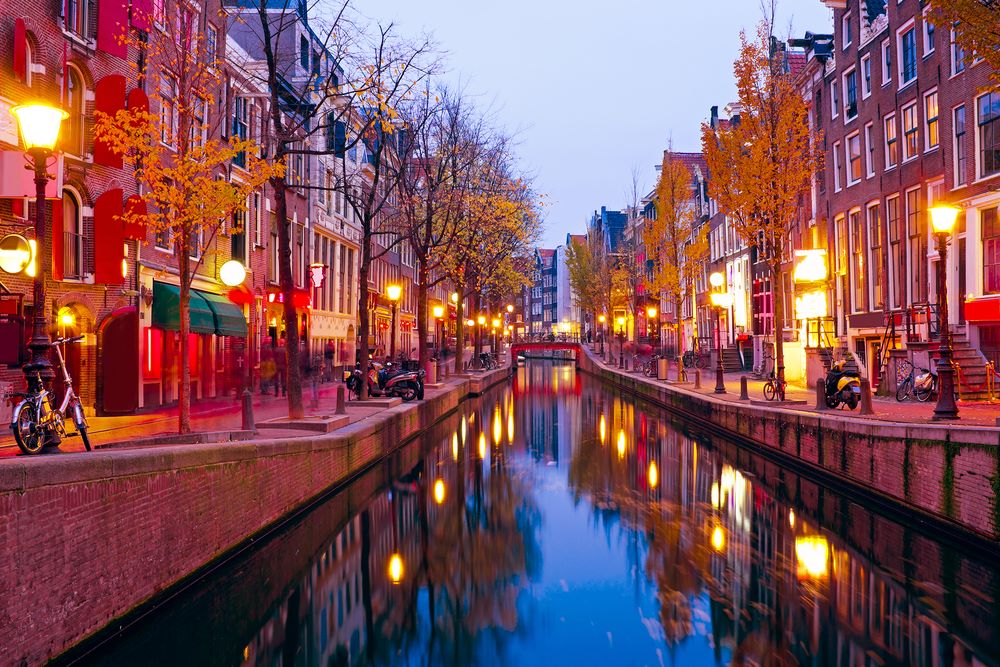
Despite ongoing ethical debates, much of the Oude Zijde is still occupied by the sprawling red-light district, which stretches along Warmoesstraat and two canals: Oudezijds Voorburgwal and Oudezijds Achterburgwal, which formed the heart of medieval Amsterdam. The squalor of some streets may overshadow the architectural merits of the buildings, but reminders of the district’s history remain, such as the Amstelkring, a charming 17th-century clandestine Catholic church, and the Oude Kerk, built in 1306 in honor of St. Nicholas, Amsterdam’s patron saint. The Oude Kerk’s bell tower is considered the most beautiful in the city.

East of the Oude Kerk is Nieumarkt, a large square marking the start of Kloveniersburgwal, a stately canal that edges the red-light district. Nearby, you can visit several museums, including the Museum het Rembrandthuis, the residence where Rembrandt had his studio, and the Joods Historisch Museum, set in a complex of four Ashkenazi synagogues from the 17th and 18th centuries. Further east, the Groenburgwal Canal marks one of the most attractive areas of the old center, known for its beautiful houses lining the picturesque waterway.
Medieval Amsterdam was bordered to the west by the Singel, originally part of the city’s defenses. Today, it is the first of five concentric canals extending from Brouwersgracht to the Amstel River, forming the Grachtengordel (canal belt). The three main canals—Herengracht, Keizersgracht, and Prinsengracht—create a harmonious cityscape of great sophistication. The most notable buildings are found along the Gouden Bocht (Golden Bend), a stretch of Herengracht, although the true charm of the Grachtengordel lies in its atmosphere rather than any single monument, with the exception of the Anne Frank House, which attracts nearly a million visitors annually.

In the 19th century, Amsterdam expanded beyond the canals, incorporating the surrounding countryside into largely residential suburbs. The aristocratic Oud Zuid neighborhood, known as the museum district, houses the Rijksmuseum and the Van Gogh Museum. The Rijksmuseum, the largest art museum in the Netherlands, contains works by Rembrandt, Vermeer, and Frans Hals, while the Van Gogh Museum, opened in 1973, displays the collection of Vincent van Gogh’s younger brother Theo, including masterpieces like “The Potato Eaters”, “The Yellow House in Arles”, and “Wheatfield with Crows.” Nearby, the Stedelijk Museum, built in 1895, houses works by Monet, Picasso, Mondrian, and Chagall.
Vondelpark
Adjacent to the museum district is Vondelpark, the city’s largest urban park, popular for its English-style design with ponds, groves, and winding paths. Nearby, you’ll find the Nederlands Filmmuseum and the Heineken Experience, where the famous Dutch beer’s old brewery has been transformed into a museum that concludes with a tasting.
Tower of Tears
Among the must-see landmarks is the Tower of Tears (Screijersttoren), built in 1482, where a plaque marks the spot from which Hendrik Hudson departed for America in 1609. Not far from here are the old West India Company warehouses.
Modern architecture enthusiasts will find Amsterdam a paradise. The NEMO science museum, designed by Renzo Piano, and the Amsterdam Architecture Center (ARCAM) are ideal starting points for exploring the city’s contemporary architecture. The Borneo-Sporenburg neighborhood and the Wozoco and The Whale buildings are other noteworthy examples.

