
The Secrets of Trinity College: Newton’s Apple Tree, Great Court Run and the Wren Library
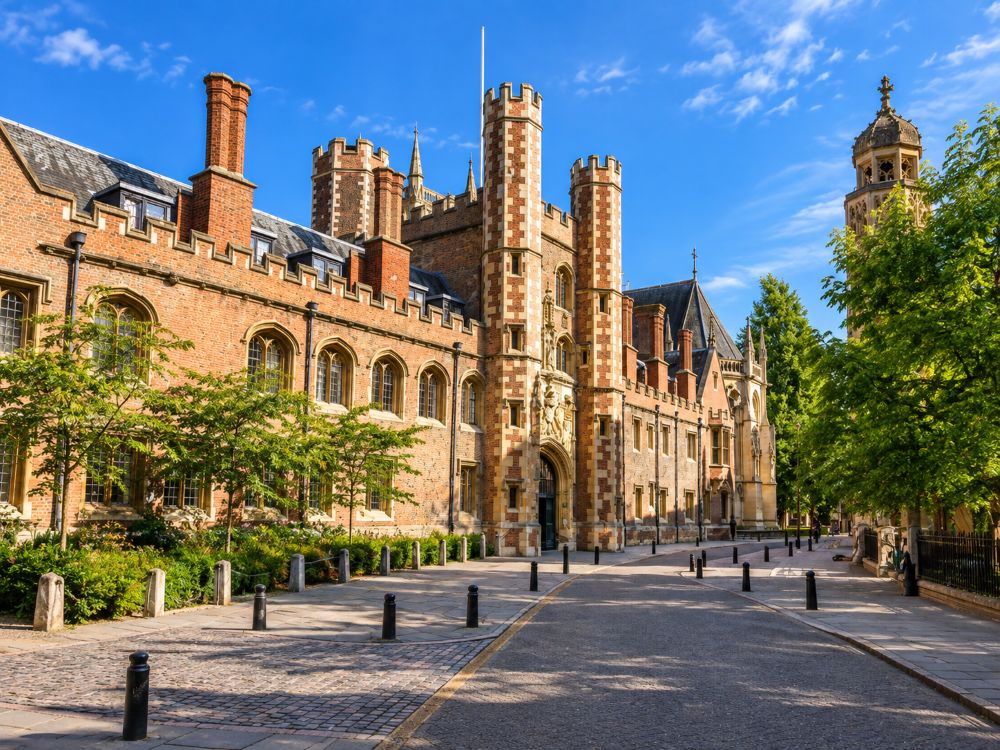
Trinity College does not need to shout.
It occupies the centre of Cambridge with the quiet confidence of an institution that has produced Isaac Newton, Francis Bacon, Lord Byron, Bertrand Russell, Ludwig Wittgenstein, Jawaharlal Nehru and dozens of Nobel laureates.
Walk through the Great Gate and the scale becomes immediately clear.
Great Court opens in front of you with a monumental fountain, medieval and Tudor buildings, the Clock Tower and the long façade of the Chapel. Beyond it lie Nevile’s Court, the Wren Library, gardens stretching towards the River Cam and a network of rooms that have housed students and scholars for centuries.
Trinity is not the oldest college in Cambridge. It is not even a single medieval foundation.
It was created in 1546 by Henry VIII, who merged two older institutions, King’s Hall and Michaelhouse, together with several hostels to form a much larger and richer college.
That decision changed Cambridge.
Within a generation Trinity had become one of the dominant institutions in the university, and over the following centuries it developed an extraordinary concentration of intellectual power.
The science alone is intimidating: Newton, James Clerk Maxwell, J. J. Thomson, Ernest Rutherford.
Then come philosophers, poets, politicians and mathematicians.
Yet Trinity is not compelling simply because famous people once slept here.
Its real appeal lies in the way architecture, ritual, scientific history and eccentric student traditions occupy the same courts.
A clock strikes the hour twice.
Students race around Great Court before the final chime.
A descendant of Newton’s apple tree grows outside the gate.
Lord Byron’s statue ended up in the Wren Library because Westminster Abbey apparently did not want him.
And behind all of this stands a working college rather than a historical theme park.
Trinity is one of the most important places to understand in Cambridge.
What to See at Trinity College
- Great Gate
- The statue of Henry VIII
- Great Court
- The Great Court Fountain
- The Clock Tower
- The Trinity Clock
- Trinity College Chapel
- The statues inside the Chapel
- Newton’s connection with Trinity
- Newton’s apple tree
- The Great Court Run
- The Great Hall
- Nevile’s Court
- The Wren Library
- Newton’s annotated Principia
- The medieval manuscripts
- Lord Byron’s statue
- Trinity Bridge and the Backs
- The College gardens
- New Court
- Trinity’s Nobel Prize legacy
How Trinity College Began
Trinity College was founded in 1546, one of the final major acts of Henry VIII’s reign.
But Trinity did not appear from nothing.
Henry combined two much older Cambridge institutions:
King’s Hall, founded in the fourteenth century and closely connected with the Crown, and Michaelhouse, founded in 1324.
He also incorporated several smaller hostels.
This explains one of Trinity’s most interesting architectural characteristics: parts of the college are considerably older than Trinity itself.
The surviving buildings of King’s Hall are woven into the later college, while Great Court was created by reorganising and connecting earlier structures.
Henry VIII’s motivations were not purely philanthropic.
The English Reformation had transformed the religious and political structure of the country, and the monarchy needed educated clergy, administrators and intellectual allies.
Trinity was conceived as a major institution capable of producing them.
The formal name is still magnificently Tudor:
The College of the Holy and Undivided Trinity of King Henry VIII in the University of Cambridge.
Not exactly concise.
Great Gate
The monumental entrance from Trinity Street immediately establishes the tone.
Great Gate predates the foundation of Trinity itself and was built in the early sixteenth century for King’s Hall.
Above the entrance stands a statue of Henry VIII.
Look at his right hand.
He should be holding a royal sceptre.
Instead, he is holding what appears to be a wooden chair leg.
The original object disappeared long ago, and at some point a mischievous replacement was inserted.
Nobody has convincingly established exactly when.
Cambridge has wisely left it there.
Few universities would allow one of England’s most formidable monarchs to preside over their entrance while holding part of the furniture.
Trinity considers the arrangement perfectly acceptable.
Great Court
Pass through Great Gate and Cambridge suddenly expands.
Great Court is one of the largest enclosed college courts in Europe and the architectural heart of Trinity.
Most of its present form is associated with Thomas Nevile, who became Master of Trinity in 1593.
Nevile did not simply construct a new quadrangle.
He reorganised existing medieval and Tudor buildings into a coherent ceremonial court, moving structures, extending ranges and creating the grand spatial composition visible today.
The court is dominated by four elements:
the Chapel, the Hall, the Clock Tower and the central fountain.
Each represents a different part of collegiate life:
worship, dining, time and water.
The proportions are impressive without being rigidly symmetrical.
That slight irregularity is part of the charm.
Great Court does not feel like an architectural model.
It feels accumulated.
Thomas Nevile: The Man Who Made Trinity Look Like Trinity
Henry VIII founded Trinity.
Thomas Nevile gave it much of its architectural identity.
When Nevile became Master in the late sixteenth century, Trinity was already wealthy and prestigious, but its buildings remained a mixture inherited from earlier institutions.
Nevile transformed the college through ambitious construction and reorganisation.
Great Court took on its present scale.
The Clock Tower was physically relocated.
Nevile’s Court was begun towards the river.
The result was a visual language appropriate to an institution increasingly conscious of its status.
Without Nevile, Trinity would still be historically important.
It would look completely different.
The Clock Tower Was Moved
One of the strangest facts about Great Court is easy to miss because nothing looks unusual.
The Clock Tower once stood somewhere else.
The tower belonged to King’s Hall and originally occupied a position roughly thirty metres from its current location.
During Thomas Nevile’s transformation of Great Court, it was dismantled stone by stone and reconstructed farther north.
Moving a medieval gate tower simply because it interfered with the desired proportions of a courtyard sounds extravagant.
Trinity had the money.
And Nevile had the ambition.
The relocation allowed Great Court to become much larger and more coherent.
What looks ancient and inevitable is partly a late-sixteenth-century exercise in architectural editing.
The Trinity Clock
The clock itself has another peculiar habit.
When the hour arrives, it strikes twice.
First comes one set of notes.
Then the hour is repeated at a different pitch.
The bell installed in 1610 still survives and carries a Latin inscription translating approximately as:
“The Trinity resounds in unity.”
The present mechanism evolved through later rebuilding, but the double striking has become one of the college’s most distinctive auditory signatures.
Several stories attempt to explain why it strikes twice.
One popular tradition connects the two sets of strikes with Trinity and neighbouring St John’s.
The historical development is more complicated than the neat legend suggests.
What matters when standing in Great Court is the effect.
Midday does not simply arrive.
It arrives twice.
The Great Court Run
The double-striking clock created one of Cambridge’s most famous and unnecessary challenges.
At noon, students attempt to run around the perimeter of Great Court before the clock finishes striking twelve.
The course is roughly 370 metres.
That sounds manageable until you consider the time available.
Depending on how the run is measured and the clock is striking, the challenge requires something close to elite sprinting speed while negotiating corners rather than running a straight track.
The Great Court Run became internationally famous through Chariots of Fire.
In the film, runners attempt the challenge as part of the story inspired by the lives of Eric Liddell and Harold Abrahams.
The sequence was not actually filmed in Trinity.
The college refused permission, so another location stood in for Great Court.
The irony is excellent: the cinematic scene that made a Trinity tradition famous does not show Trinity.
Has Anyone Actually Completed the Great Court Run?
Yes, but the answer depends heavily on the conditions.
Students have completed versions of the run over the years, particularly when the clock strikes slowly enough or the route is measured favourably.
Olympic-level athletes have also attempted it.
The traditional challenge takes place around noon on the day of the Matriculation Dinner, adding ceremony to something fundamentally absurd.
The combination is extremely Cambridge:
formal gowns, centuries of tradition and someone sprinting desperately around a lawn because a clock is making noise.
The Great Court Fountain
At the centre of Great Court stands the elegant fountain constructed during the Nevile transformation.
It originally provided something much more practical than decoration:
water.
Colleges required reliable supplies long before modern plumbing.
Water was brought from springs west of Cambridge through a conduit system.
The fountain became the visible endpoint of that infrastructure inside the court.
Today it looks purely ornamental.
Historically, it was part of the college’s basic functioning.
This is a useful rule when looking at old university architecture: many beautiful features began with extremely practical jobs.
Trinity College Chapel
The Chapel occupies the northern side of Great Court.
Construction began under Mary I and was completed during the reign of Elizabeth I, making it a building shaped by one of the most turbulent periods in English religious history.
England moved between Catholic restoration and Protestant settlement while the Chapel was being built.
Yet the finished interior is surprisingly restrained.
The broad windows, wooden stalls and relatively simple architecture differ dramatically from the soaring spectacle of King’s College Chapel.
Do not compare them directly.
King’s is monumental late Gothic architecture.
Trinity Chapel is more intimate and closely tied to collegiate worship.
Its greatest interest lies inside.
The Statues in Trinity Chapel
The ante-chapel contains a remarkable collection of statues commemorating major Trinity figures.
Here you encounter intellectual history in marble.
Among the best known are:
Isaac Newton
Francis Bacon
Alfred Tennyson
William Whewell
Thomas Babington Macaulay
and other scholars associated with the college.
Newton’s statue is particularly memorable.
Sculpted by Louis-François Roubiliac, it depicts Newton standing with a prism, linking him directly with his experiments on light and optics.
The pose avoids turning him into a remote classical philosopher.
Newton appears almost as if interrupted while thinking.
Isaac Newton at Trinity
Newton arrived at Trinity in 1661.
He was not immediately recognised as the greatest scientist of his age.
He entered as a relatively obscure student from Lincolnshire and initially held the status of a sizar, traditionally involving reduced costs in exchange for certain duties.
Within a few years, everything changed.
Newton became a Fellow in 1667 and remained at Trinity until 1696.
During this period he developed foundational work in:
- calculus
- mechanics
- optics
- gravitation
- mathematics
His Philosophiæ Naturalis Principia Mathematica, published in 1687, transformed the understanding of motion and the physical universe.
The Trinity years therefore overlap with the period in which Newton became Newton.
The Plague Years and Newton’s Greatest Ideas
There is an important complication.
Some of Newton’s most famous discoveries did not happen physically inside Trinity.
In 1665, plague forced Cambridge University to close temporarily.
Newton returned to his family home at Woolsthorpe Manor in Lincolnshire.
During this period he made remarkable progress in mathematics, optics and ideas surrounding gravitation.
Later generations called these his annus mirabilis, or miraculous years.
The episode undermines the romantic idea that genius depended entirely on the great university.
One of Trinity’s greatest minds produced some of his most revolutionary thinking after the university sent everyone away.
Newton’s Apple Tree
Outside Great Gate stands an apple tree linked symbolically with Newton.
It is not the original tree beneath which he observed the falling apple.
That tree grew at Woolsthorpe Manor.
The Cambridge specimen is traditionally described as a descendant propagated from the famous original.
The real apple story is less ridiculous than the cartoon version.
There is no reliable evidence that an apple hit Newton on the head.
Newton later recalled seeing an apple fall and wondering why objects always moved towards the ground rather than sideways or upward.
The observation became part of a much larger chain of thinking about gravitational attraction.
The tree therefore represents a question, not a concussion.
Newton’s Rooms
Newton lived in rooms associated with Great Court during his Trinity career.
Visitors often want to identify the exact windows connected with him.
The historical room arrangements changed over time, and not every popular tour-guide claim should be accepted too literally.
The important point is broader.
Newton spent decades embedded in the daily life of Trinity.
He taught, researched, argued, conducted experiments and eventually became Lucasian Professor of Mathematics.
His connection with the college was sustained and formative rather than a brief student episode.
The Great Hall
On the western side of Great Court stands the Great Hall.
College halls were never simply dining rooms.
Meals formed part of the social and institutional structure of collegiate life.
Hierarchy was literally built into the room.
Fellows and senior members sat at the elevated High Table while students occupied the lower tables.
Formal Hall preserves aspects of that tradition today.
The architecture developed during Trinity’s early centuries and reflects the college’s wealth and status.
Portraits of important members and benefactors reinforce the sense that dining here means participating in an institutional lineage.
For visitors, access can be limited because the Hall remains actively used.
Trinity is still a college first.
Nevile’s Court
Pass through from Great Court and Trinity changes character.
Nevile’s Court is smaller, more refined and architecturally more unified.
Thomas Nevile began the court as part of his great building campaign.
Later, the addition of the Wren Library closed the western side and transformed it into one of Cambridge’s most elegant architectural compositions.
Arcaded walks run around the grass.
Above them are residential and academic rooms.
At the far end, the classical façade of the Wren Library creates a striking break with the Tudor and Jacobean architecture surrounding it.
That contrast is precisely what makes the court memorable.
The Wren Library
The Wren Library is one of Cambridge’s finest interiors and one of Trinity’s absolute highlights.
It was designed by Sir Christopher Wren, architect of St Paul’s Cathedral.
Construction took place between 1676 and 1695.
The commission came through Isaac Barrow, Master of Trinity and a friend of Wren.
Wren supplied the design without charging a fee.
The building was placed above an open colonnade at the western end of Nevile’s Court.
That elevated position was clever.
It allowed covered circulation beneath while raising the books away from damp ground.
The library also benefits from large windows, flooding the reading room with natural light.
Remember: libraries were designed long before electric illumination.
Daylight was an architectural resource.
Inside the Wren Library
The room is long, high and almost theatrical.
Books line the walls rather than filling the centre.
Busts of major writers and thinkers occupy positions above the shelves.
Large windows face both Nevile’s Court and the river.
The spatial arrangement makes the room feel more like an Enlightenment gallery than a dark medieval library.
Wren considered not only the exterior architecture but also shelving, furniture, lighting and the security of rare objects.
The library therefore works as a complete design rather than a beautiful shell later filled with books.
It remains a working research library.
That matters.
Researchers still consult material here, and students sometimes work in the space.
The Oldest Treasure in the Wren Library
Among the library’s oldest manuscripts is an eighth-century copy of the Epistles of Saint Paul.
This means the manuscript predates Trinity College by roughly eight centuries.
Objects like this radically alter the sense of time inside the room.
The building is seventeenth century.
The college is sixteenth century.
Some of the books are medieval.
And the oldest manuscript belongs to a world centuries before Cambridge University existed.
The institution became a custodian of histories far older than itself.
Newton’s Principia
One of the most important objects associated with the Wren is a first edition of Newton’s Principia Mathematica.
The copy contains Newton’s own handwritten annotations made while preparing changes for a later edition.
This is far more interesting than simply seeing a rare first edition.
The marginal notes reveal knowledge in motion.
Newton was revising, correcting and reconsidering a work that had already transformed physics.
Great scientific books do not emerge from their authors as untouchable monuments.
They continue to be argued with, including by the people who wrote them.
Newton’s Library
Around 900 books from Newton’s personal library are now held at Trinity.
His original collection contained more than two thousand volumes and was dispersed after his death.
The surviving books reveal interests extending far beyond what modern readers classify as physics.
Newton studied theology, chronology, alchemy, mathematics and ancient history with enormous intensity.
The modern tendency to imagine him as a purely rational scientist is misleading.
Newton occupied an intellectual world where boundaries between science, theology and esoteric investigation were much less rigid.
That complexity makes him considerably more interesting.
A. A. Milne and Winnie-the-Pooh
The Wren Library is not all equations and medieval theology.
It also holds material connected with A. A. Milne, who studied mathematics at Trinity.
Among the collection is a manuscript associated with Winnie-the-Pooh.
The juxtaposition is difficult to improve:
Newton’s Principia, medieval biblical manuscripts and Winnie-the-Pooh occupy the same library.
Trinity’s intellectual history is broad enough to accommodate gravity and honey.
Lord Byron at Trinity
George Gordon, Lord Byron entered Trinity in 1805.
He arrived with aristocratic confidence, considerable literary talent and very little enthusiasm for being controlled.
Cambridge did not cure him.
One of the best-known stories concerns college rules prohibiting students from keeping dogs.
Byron supposedly responded by keeping a bear instead.
The regulations apparently failed to mention bears.
The animal was reportedly housed in Cambridge, and Byron joked about having it admitted for a fellowship.
It is an almost suspiciously perfect Byron story.
Yet its core has substantial historical basis.
The poet’s relationship with Trinity was exactly as rebellious as the anecdote suggests.
Why Byron’s Statue Is in the Wren Library
After Byron’s death in 1824, admirers commissioned a marble statue by sculptor Bertel Thorvaldsen.
They intended it for Westminster Abbey.
The Abbey refused it.
Byron’s reputation remained too scandalous.
For years the statue struggled to find a suitably prestigious home.
Eventually Trinity accepted it.
Today Byron sits in the Wren Library among scholars, books and busts.
The rejection turned into Trinity’s gain.
There is also something deeply satisfying about the university giving permanent shelter to the poet whose behaviour it had once struggled to contain.
Francis Bacon
Another giant of early modern intellectual history studied at Trinity:
Francis Bacon.
Bacon arrived in the sixteenth century and later became philosopher, statesman and Lord Chancellor.
His writings on empirical inquiry helped shape later ideas about scientific method.
He is often reduced to the slogan “knowledge is power”.
His intellectual project was much broader.
Bacon argued that understanding nature required systematic observation and experimentation rather than excessive dependence on inherited authority.
That attitude anticipates the scientific transformation with which Trinity later became so closely associated.
James Clerk Maxwell
Move forward two centuries and Trinity appears again at a major turning point in science.
James Clerk Maxwell studied here in the nineteenth century.
His equations united electricity, magnetism and light into a coherent theoretical framework.
Einstein later regarded Maxwell’s work as foundational to modern physics.
Maxwell receives less popular attention than Newton because electromagnetic field equations make fewer good tourist souvenirs than falling apples.
Scientifically, his importance is enormous.
J. J. Thomson and the Electron
Trinity was also home to J. J. Thomson, who identified the electron through experiments at Cambridge’s Cavendish Laboratory.
His work fundamentally changed the understanding of matter.
Atoms could no longer be treated as indivisible units.
They contained smaller components.
Thomson received the Nobel Prize in Physics in 1906.
His discovery opened one of the doors leading towards modern atomic physics.
Ernest Rutherford
Then came Ernest Rutherford.
Rutherford’s experimental work demonstrated the nuclear structure of the atom and helped transform twentieth-century physics.
Although closely associated with the Cavendish Laboratory and later Cambridge science, his connection with Trinity forms part of the same remarkable institutional lineage.
Newton described motion and gravitation.
Maxwell unified electromagnetism.
Thomson found the electron.
Rutherford transformed atomic theory.
Few colleges can assemble a sequence like that without sounding fictional.
Trinity and the Nobel Prizes
Trinity has produced or been associated with an extraordinary number of Nobel laureates.
The current tally is more than thirty.
That number would be remarkable for many universities.
For one college within a university, it is exceptional.
The awards extend beyond physics into chemistry, medicine, economics and literature.
But counting Nobels can obscure something more interesting.
Trinity’s influence began centuries before the Nobel Prize existed.
Newton, Bacon, Byron and Tennyson obviously never received one.
The institutional story cannot be reduced to twentieth-century awards.
Bertrand Russell and Ludwig Wittgenstein
Trinity’s intellectual influence extends deeply into philosophy.
Bertrand Russell studied and later worked here, developing major contributions to logic, mathematics and analytic philosophy.
Then came Ludwig Wittgenstein, one of the most influential philosophers of the twentieth century.
The relationship between the two was intellectually explosive.
Russell initially recognised Wittgenstein’s extraordinary ability and helped encourage his work.
Wittgenstein subsequently moved in directions that challenged assumptions held by his mentor and much of contemporary philosophy.
The story is very Trinity:
admiration gradually turning into argument.
Jawaharlal Nehru
Trinity’s history is also connected with modern India.
Jawaharlal Nehru, later the first Prime Minister of independent India, studied natural sciences at Trinity in the early twentieth century.
His Cambridge years exposed him to political ideas, European intellectual culture and the imperial society he would later help dismantle.
His presence complicates any simple reading of Cambridge as merely an English institution.
For centuries its colleges trained people who subsequently shaped countries far beyond Britain, sometimes in ways the British establishment did not anticipate.
Trinity Bridge and the River Cam
Beyond Nevile’s Court lies the River Cam.
Trinity Bridge connects the college with its grounds on the western side.
The view back towards the buildings is one of the quieter Cambridge scenes.
From here Trinity loses some of Great Court’s monumental authority.
Trees, river and lawns soften the architecture.
Punts pass below.
The Wren Library becomes part of the landscape rather than an isolated classical monument.
This is also why viewing Trinity from a punt is worthwhile even if the interior courts are inaccessible.
Cambridge architecture was designed to be experienced from multiple directions.
The Backs
Trinity’s grounds form part of the Backs, the great sequence of college lawns and gardens stretching along the western side of the River Cam.
The college gardens cover around 36 acres.
For a central Cambridge institution, that is an enormous amount of green space.
The Backs create one of the city’s defining paradoxes.
You can stand only minutes from crowded Trinity Street and suddenly find yourself looking across broad lawns towards trees and water.
The university never feels entirely urban.
New Court
Beyond the older Tudor and Stuart architecture lies New Court, constructed in the nineteenth century.
The name has become unintentionally comic.
A building approaching two centuries old is still called New Court.
Cambridge does this constantly.
Anything constructed after the seventeenth century risks remaining “new” indefinitely.
Architecturally, New Court belongs to a different phase in Trinity’s development, when student numbers and institutional needs required expansion beyond the old quadrangles.
A College Built from Older Colleges
One subtle point makes Trinity especially interesting.
The college contains layers of institutions that technically no longer exist.
King’s Hall disappeared as an independent body in 1546.
Michaelhouse disappeared too.
Yet their physical traces survive inside Trinity.
The Clock Tower belonged to King’s Hall.
Older ranges preserve medieval fabric.
Trinity therefore did not erase its predecessors completely.
It absorbed them.
Walk around the college and you are moving through an institutional palimpsest.
The College Clock and Cambridge Time
For centuries, clocks in colleges were not merely conveniences.
They regulated the collective life of the institution.
Meals, prayers, lectures and gates all operated according to time.
In a world without wristwatches or phones, the audible clock mattered.
Trinity’s unusual double striking makes that historical function especially obvious.
The clock did not quietly tell an individual the time.
It announced time to an entire community.
Loudly.
Twice.
What Most Visitors Miss
The first mistake is focusing only on Newton.
Newton is central, but Trinity’s intellectual story becomes more impressive when you connect Bacon, Maxwell, Thomson, Rutherford, Russell and Wittgenstein.
The second is treating Great Court simply as a photograph.
Look at the Clock Tower carefully and remember that it was moved.
The third is ignoring the Wren Library.
For many visitors, it is the most beautiful space in Trinity.
The fourth is rushing through Nevile’s Court.
Its transition from Tudor architecture to Wren’s classicism is one of the strongest architectural moments in Cambridge.
And the fifth is assuming every famous Trinity anecdote is equally reliable.
Cambridge guides love stories.
The best ones become even better when you separate historical fact from centuries of embellishment.
Can You Visit Great Court in 2026?
This requires particular attention.
General public access to Trinity’s internal courts, including Great Court, is currently restricted.
The college remains an active residential and academic institution, and normal public sightseeing access is not operating in the same way as at several other Cambridge colleges.
Special access can occur during organised events, open days or particular programmes.
Prospective students also have separate arrangements.
That means you should not arrive at Great Gate assuming you can simply purchase a standard tourist ticket and wander through Great Court.
Conditions can change, so check close to your visit.
The good news is that the Wren Library has separate public opening arrangements, and parts of the Backs are also normally accessible.
Visiting the Wren Library in 2026
The Wren Library remains one of Trinity’s easiest major treasures to visit independently.
Current public opening is generally:
Monday–Friday: 12:00–14:00
with last admission shortly before closing.
Selected Saturdays also have morning opening periods during parts of the academic year.
Admission is free.
Access is usually from Brewhouse Gate at the end of Garret Hostel Lane, rather than through Great Gate.
This is important because first-time visitors frequently go to the wrong entrance.
The Library remains a working space, so silence and consideration for researchers are expected.
Large luggage is not accepted.
Accessibility at the Wren Library
The Wren Library is on the first floor.
Access requires stairs.
There is currently no lift.
This makes the historic room inaccessible to some visitors with mobility limitations.
The issue is structural rather than a small threshold or single step.
Anyone with specific access requirements should therefore plan before arriving.
The temperature also changes considerably with the seasons because the building is historic and not managed like a modern gallery.
In winter it can be cold.
In summer it can become warm.
Wren designed for books and daylight, not modern climate control.
The Best Time to Visit Trinity
If your priority is the Wren Library, plan around its limited opening window.
Arrive shortly before noon on a weekday and allow enough time to enter without rushing.
Afterwards, walk around the western side towards the Backs.
Early morning and late afternoon are better for photographing the exterior on Trinity Street because pedestrian traffic is lower.
Academic events can change access suddenly.
This is one Cambridge attraction where checking the situation immediately before visiting is particularly important.
How Long Do You Need?
If Great Court is not publicly accessible, allow approximately 45–60 minutes for the Wren Library, external architecture and nearby Backs.
If attending a special opening that includes the courts, allow at least 90 minutes.
Architecture or science enthusiasts can easily spend two hours once Newton, the Chapel, Great Court and the library are all accessible.
The mistake is squeezing Trinity between King’s and St John’s as if it were simply another courtyard.
Its history deserves more time.
How to Get to Trinity College
Trinity stands on Trinity Street, immediately north of Gonville and Caius College and only a few minutes from King’s Parade.
From King’s College, walk north along Trinity Street.
The Great Gate is impossible to miss.
Cambridge railway station is approximately 20–25 minutes away on foot.
For the Wren Library, remember that public access usually comes from the rear side of the college near Garret Hostel Lane rather than Great Gate.
What to See Nearby
Trinity occupies an exceptionally convenient position.
Within a few minutes you can reach:
- King’s College and King’s College Chapel
- Great St Mary’s Church
- Senate House
- Gonville and Caius College
- St John’s College
- The Round Church
- Cambridge Market Square
- The River Cam
- The Backs
A particularly strong route is:
King’s College → Trinity College → St John’s College → punting from the river.
This sequence gives three completely different versions of Cambridge collegiate architecture within a remarkably short walk.
Is Trinity College Worth Visiting?
Yes, although the answer in 2026 requires a qualification.
If you expect a conventional college sightseeing experience where you buy a ticket and freely wander every court, current access restrictions can be frustrating.
But Trinity remains essential to understanding Cambridge.
Even from the outside, its history is extraordinary.
And the Wren Library alone is worth arranging your schedule around.
Few places compress so much intellectual history into one institution.
Henry VIII founded it.
Newton rewrote physics here.
Byron brought chaos.
Maxwell reshaped electromagnetism.
Thomson helped reveal the structure of matter.
Russell and Wittgenstein changed philosophy.
Nehru left to help build an independent nation.
And through all of it, the Clock Tower continued striking every hour twice.
Trinity is not simply prestigious.
It is one of those places where the improbable density of history becomes the attraction.
Useful Information
- Name: Trinity College, University of Cambridge
- Location: Trinity Street, Cambridge
- Founded: 1546
- Founder: Henry VIII
- Predecessor institutions: King’s Hall and Michaelhouse
- Essential architectural space: Great Court
- Most important public interior: Wren Library
- Wren Library architect: Sir Christopher Wren
- Wren Library construction: 1676–1695
- Most famous former member: Isaac Newton
- Other major names: Francis Bacon, Lord Byron, Alfred Tennyson, James Clerk Maxwell, J. J. Thomson, Ernest Rutherford, Bertrand Russell, Ludwig Wittgenstein and Jawaharlal Nehru
- Famous tradition: Great Court Run
- Great Court public access in 2026: currently restricted outside specific events and arrangements
- Wren Library admission: free
- Wren Library weekday opening: generally 12:00–14:00
- Wren Library accessibility: first floor by stairs; no lift
- Backs: normally accessible when college grounds are open
- Best nearby sights: King’s College, St John’s College and Great St Mary’s
- Recommended time: 45–90 minutes depending on access

