
Porto Travel Guide: Ribeira, Azulejos, Port Wine Cellars and the Best Things to See Along the Douro

Porto is a city built in layers and on gradients. Granite churches stand above narrow medieval streets, iron bridges cut across the Douro, tiled façades flash blue and white between dark stone buildings, and entire neighbourhoods descend towards a river that made the city rich long before tourism discovered Ribeira.
Its historic centre is compact, but Porto is not flat and not especially orderly. That is part of the attraction. Streets drop suddenly, stairways replace roads, church towers appear between rooftops and Vila Nova de Gaia rises directly across the river with rows of Port lodges built into the hillside.
Two full days are enough for the principal monuments. Three days are better because Porto rewards time spent away from the obvious Ribeira–São Bento–Clérigos axis: at Foz beside the Atlantic, around Cedofeita and Bonfim, inside Serralves or simply crossing the Douro repeatedly to understand how Porto and Gaia developed as two halves of the same wine economy.
Things to See in Porto
- Ribeira
- Dom Luís I Bridge
- Vila Nova de Gaia and the Port wine lodges
- Porto Cathedral
- São Bento Railway Station
- Igreja de São Francisco
- Palácio da Bolsa
- Clérigos Church and Tower
- Livraria Lello
- Igreja do Carmo and Igreja dos Carmelitas
- Mercado do Bolhão
- Rua das Flores
- Miradouro da Vitória
- Jardim do Morro and Serra do Pilar
- Serralves Museum and Park
- Casa da Música
- Foz do Douro
- Matosinhos
Things to See in Porto
Ribeira

Ribeira is the part of Porto most visitors see first and one of the easiest to misunderstand.
The neighbourhood occupies the steep northern bank of the Douro immediately below the cathedral and medieval core. Narrow houses rise directly behind the riverfront, many with brightly painted façades, wrought-iron balconies and laundry suspended above streets scarcely wide enough for cars.
Its present appearance is the result of centuries of dense occupation around the commercial waterfront.
The Douro was Porto’s economic artery. Wine, food, timber and manufactured goods moved through the quays, while warehouses, taverns and merchants occupied the streets immediately above them.
Today the riverside itself is heavily oriented towards visitors, particularly around Praça da Ribeira and Cais da Ribeira. Walk one or two streets uphill and the atmosphere changes quickly.
Escadas do Barredo and the passages climbing towards Sé preserve a much rougher urban structure.
Ribeira belongs to the UNESCO-listed Historic Centre of Porto, inscribed in 1996 together with the wider historic urban landscape extending towards the Dom Luís I Bridge and Serra do Pilar.
Go early in the morning, then return after sunset. The buildings across the river in Gaia and the illuminated bridge make the waterfront far more atmospheric once day-trip traffic begins to disappear.
Dom Luís I Bridge
The Ponte de Dom Luís I is Porto’s defining piece of engineering.
Completed in 1886, the double-deck metal arch bridge was designed by engineer Théophile Seyrig, who had previously worked with Gustave Eiffel.
The enormous iron arch spans the Douro between Porto and Vila Nova de Gaia.
Its two levels solve the extreme difference in elevation between the riverside and the upper city.
The lower deck connects Ribeira directly with the Gaia waterfront and carries road traffic and pedestrians.
The upper deck runs much higher above the river and today carries Porto Metro trains together with pedestrians.
Walk across both if possible.
The lower level places you close to the river and Port warehouses. The upper crossing is one of the best free viewpoints in Porto, looking upstream towards Serra do Pilar and downstream across Ribeira.
Do not describe the bridge simply as “Eiffel’s bridge.” Eiffel did not design Dom Luís I. Seyrig did, although the engineering lineage and visual similarities explain the frequent confusion.
Vila Nova de Gaia and the Port Wine Lodges
Crossing the Douro means technically leaving Porto municipality and entering Vila Nova de Gaia, but no serious Porto itinerary should treat the distinction as a reason to ignore the southern bank.
For centuries, Port wine was transported down the Douro from the vineyard regions farther inland and matured in Gaia.
The location offered cooler, more stable conditions than the Douro Valley and direct access to shipping.
Names such as Taylor’s, Graham’s, Sandeman, Ferreira, Cálem and Kopke still occupy enormous lodges on the slopes above the river.
Many offer tours explaining fortification, ageing, blending and the principal Port styles: Ruby, Tawny, Late Bottled Vintage, Vintage and Colheita.
Do not attempt four cellar tours in one day.
One serious visit is enough for most travellers; two make sense for wine enthusiasts if they deliberately choose different styles or producers.
The Gaia waterfront itself is considerably more polished than it once was, with restaurants, tasting rooms and the World of Wine complex occupying restored industrial buildings.
Climb above the lodges rather than remaining at river level. Jardim do Morro and Serra do Pilar provide the strongest views back across Porto.
Porto Cathedral

Porto’s Sé stands above the oldest urban core.
Construction began in the 12th century and the cathedral still preserves the fortress-like character of a Romanesque building despite repeated Gothic and Baroque alterations.
The western façade is dominated by two square towers and a rose window.
Inside, the nave is relatively austere.
The cloister provides the strongest decorative contrast. Gothic architecture is combined with later walls covered in large blue-and-white azulejo panels depicting religious scenes.
The cathedral terrace also offers one of the best introductory views over Ribeira.
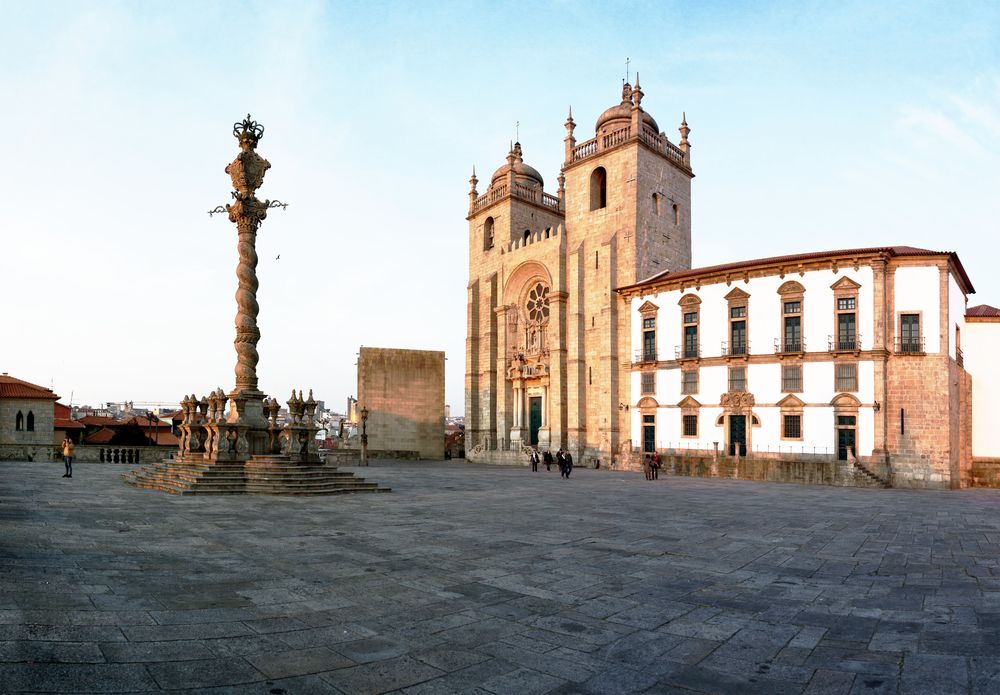
Look carefully at the streets surrounding the building. This was the centre of medieval Porto, and several lanes retain a scale completely different from the broad avenues developed during the 19th and 20th centuries.
The official Porto tourist office beside Sé is also useful for current visitor information; in summer it operates daily from 09:00 to 19:00.
São Bento Railway Station
São Bento is still a functioning railway station, but most visitors come for the entrance hall.
The station was built at the beginning of the 20th century on the site of the former Convent of São Bento de Avé-Maria.
Architect José Marques da Silva designed the building.
Inside, approximately 20,000 azulejos by Jorge Colaço cover the walls of the entrance hall. The panels depict scenes from Portuguese history together with images of transport and rural life.
The historical scenes include episodes such as the meeting of Egas Moniz with Alfonso VII and the entrance of João I and Philippa of Lancaster into Porto.
Above the narrative panels, coloured tile friezes create a very different decorative rhythm.
São Bento is useful because the azulejos are not preserved in a museum: commuters still cross the hall beneath them to board regional trains.
The station is open daily from 06:30 to 01:00.
Go before 09:00 if you want to see the hall without large groups.
Igreja de São Francisco
The Church of São Francisco is one of Porto’s strongest examples of the gap between a sober exterior and an astonishing interior.
Construction of the present Gothic church developed mainly during the 14th and 15th centuries.
The stone structure remains clearly medieval.
Inside, however, the decoration changed dramatically during the Baroque period.
Gilded carved wood — talha dourada — covers altars, columns and chapels with such density that the Gothic architecture almost disappears beneath gold.
One of the most famous works is the Tree of Jesse, an elaborate genealogical representation of Christ’s ancestry.
The church is not simply opulent for spectacle’s sake. Portuguese Baroque religious interiors were designed to create overwhelming visual experiences, transforming relatively dark medieval buildings through reflective gold, carving and movement.
The complex also includes catacombs and museum spaces.
Combine it with Palácio da Bolsa immediately next door.
Palácio da Bolsa
The former Stock Exchange Palace is one of Porto’s great 19th-century civic buildings.
Construction began in 1842 on land associated with the former Franciscan convent after a fire.
The building became headquarters of Porto’s Commercial Association, reflecting the extraordinary importance of merchants and international trade to the city.
The exterior is restrained compared with what lies inside.
The principal rooms unfold through a series of ceremonial spaces designed to impress visiting merchants, diplomats and political figures.
The highlight is the Salão Árabe, or Arab Room.
Its extraordinary Neo-Moorish decoration uses gilding, intricate patterns and Arabic-inspired ornament to create an interior completely unlike the neoclassical spaces preceding it.
Access is normally through guided visits rather than unrestricted wandering.
Allow around forty-five minutes.
Clérigos Church and Tower
The Torre dos Clérigos dominates Porto’s skyline.
Italian architect Nicolau Nasoni designed the church and tower during the 18th century.
The tower rises approximately 75 metres and became one of the city’s principal visual landmarks long before modern high-rise construction.
Reaching the top requires a narrow staircase with more than two hundred steps.
The reward is a nearly complete panorama over Porto: cathedral towers, Ribeira, Gaia, the Douro and the dense red roofs of the historic centre.
The church below is architecturally interesting in its own right, with an unusual oval plan and a richly articulated Baroque interior.
Clérigos makes particular sense late in the afternoon when the city’s granite façades begin catching warmer light.
The tower can become congested because circulation is narrow, so timed admission is preferable.
Livraria Lello
Livraria Lello is one of Porto’s most famous interiors and one of its most crowded.
The current building opened in 1906, with a neo-Gothic façade and an interior dominated by carved wood, a dramatic central staircase and stained glass overhead.
The bookstore’s international fame accelerated through repeated associations with J. K. Rowling and Harry Potter.
Rowling did live in Porto during the early 1990s, but many detailed claims that specific Hogwarts interiors were directly inspired by Livraria Lello are retrospective and poorly documented.
The architecture is interesting without requiring that mythology.
The staircase curves through the centre of the shop beneath an elaborate ceiling structure, while bookshelves run around upper galleries.
Entry now requires a ticket-voucher system designed partly to manage visitor numbers.
Current official tourism information lists opening hours of 09:00–19:30 every day, with closures on 1 January, Easter Sunday, 1 May, 24 June and 25 December.
Book the earliest available slot if photography and architecture matter.
Igreja do Carmo and Igreja dos Carmelitas
Two churches stand almost directly against one another near Praça de Carlos Alberto.
The Igreja dos Carmelitas dates mainly from the 17th century and belonged to Carmelite nuns.
The adjacent Igreja do Carmo was constructed later, during the 18th century, for the Carmelite Third Order.
Between them is an extraordinarily narrow building often described as one of Porto’s thinnest houses.
The famous side wall of Igreja do Carmo is covered with large blue-and-white azulejo panels added in the early 20th century.
The tile work depicts scenes connected with the Carmelite tradition.
The composition is particularly effective because it occupies an enormous uninterrupted exterior wall facing the street.
Come early or late; the corner becomes very busy because Livraria Lello and Clérigos are only a few minutes away.
Mercado do Bolhão
Mercado do Bolhão is Porto’s historic central market.
The original neoclassical market building dates from the 19th century and underwent a major restoration before reopening in 2022.
The renovation preserved the characteristic open central courtyard while modernising logistics, food handling and infrastructure.
Stalls sell fish, meat, fruit, vegetables, cheese, flowers and prepared food.
Unlike some famous European markets transformed almost entirely into restaurant halls, Bolhão still retains a substantial produce-market function.
Visit before lunch.
It is a useful place to understand northern Portuguese ingredients before encountering them on restaurant menus: cured pork, salted cod, sardines, regional cheese, bread and seasonal vegetables.
The surrounding streets remain strongly commercial, particularly Rua de Santa Catarina.
Rua das Flores
Rua das Flores was laid out during the early 16th century and became one of Porto’s prestigious residential and commercial streets.
It links the upper city near São Bento with the lower streets approaching Ribeira.
The route is now pedestrianised through much of its length.
Historic façades, churches, former merchant houses, shops and restaurants line the street.
Its present popularity can make it feel almost too polished, but the architecture remains important.
The Igreja da Misericórdia, redesigned by Nicolau Nasoni, provides one of the principal monuments.
Rua das Flores is most useful as a connecting route rather than a destination requiring separate sightseeing time.
Walk down towards Ribeira rather than up: Porto’s gradients make itinerary direction surprisingly important.
Miradouro da Vitória
The Miradouro da Vitória is one of the best informal viewpoints over Ribeira.
From the terrace, rooftops fall rapidly towards the Douro, with the cathedral, Dom Luís I Bridge and Gaia visible beyond.
The viewpoint itself is modest and sits within an area where historic buildings remain in varied states of restoration.
That roughness is part of the appeal.
It provides a different perspective from polished Jardim do Morro across the river.
Come around late afternoon.
The viewpoint can be combined naturally with Clérigos, São Bento and a descent towards Ribeira.
Jardim do Morro and Serra do Pilar
Cross the upper deck of Dom Luís I Bridge and you arrive almost directly at Jardim do Morro.
The park is one of the easiest places to watch sunset over Porto.
From here, the historic centre rises opposite across the river, with Ribeira at water level and Clérigos visible on the skyline.
A few minutes uphill stands the Mosteiro da Serra do Pilar.
Its circular church and cloister belong to an unusual Renaissance monastic complex and form part of Porto’s UNESCO World Heritage property.
The terrace in front offers an even broader perspective over the bridge and Douro.
Sunset attracts crowds, particularly from May through September.
Arrive at least thirty minutes early if you want space on the upper viewpoints.
Serralves Museum and Park
Serralves provides the strongest reason to leave the historic centre for contemporary art.
The complex combines the Museu de Arte Contemporânea, designed by Álvaro Siza Vieira, the Art Deco Serralves Villa and a large landscaped park.
Siza’s museum is deliberately restrained: pale walls, controlled natural light and long proportions create neutral spaces for temporary exhibitions.
The pink Serralves Villa predates the museum and represents a very different architectural language, combining Art Deco and modernist influences.
The surrounding park contains formal gardens, woodland, farmland and outdoor sculpture.
Do not visit only the galleries.
The estate works as one integrated architectural landscape.
Allow two to three hours.
Casa da Música
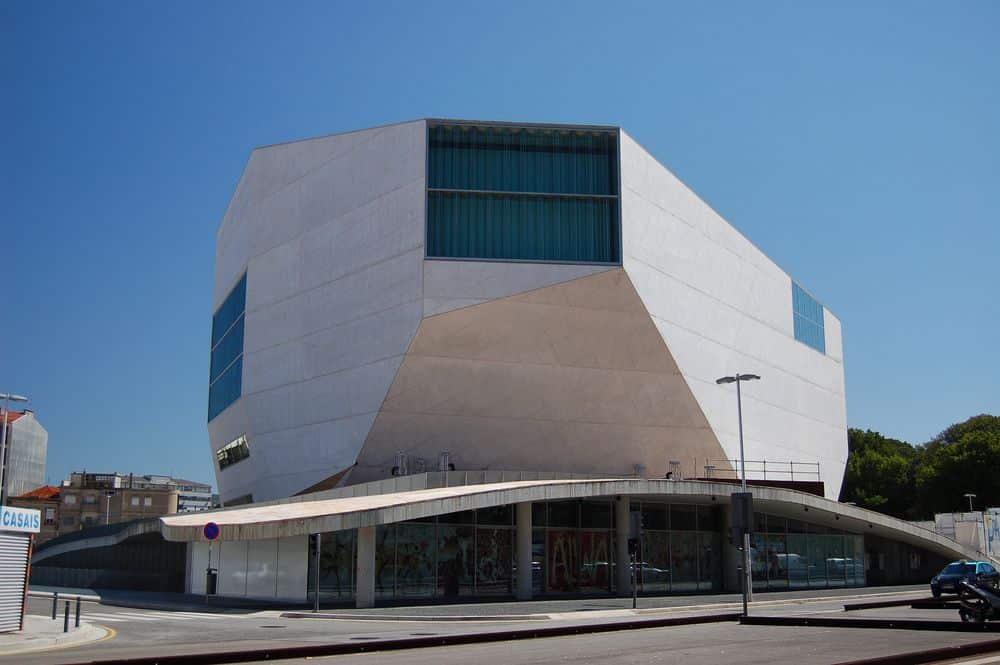
Casa da Música is Porto’s essential contemporary architectural counterpoint to the historic centre.
Dutch architect Rem Koolhaas designed the irregular polyhedral building, inaugurated in 2005.
Instead of hiding the main concert hall deep inside a conventional box, the building exposes circulation, rehearsal spaces and unusual interior materials through a complex sequence of rooms.
The principal auditorium contains large windows, unusual for a major concert hall, connecting performances visually with the city.
Casa da Música currently opens daily from 10:00 to 18:00, and guided architectural visits are available. The venue has four resident ensembles and remains a functioning performance centre rather than a museum building.
If the programme works with your dates, attend a concert rather than visiting only during the day.
Address: Avenida da Boavista 604–610
Telephone: +351 220 120 220
Email: [email protected].
Foz do Douro
Foz lies where the Douro reaches the Atlantic.
The atmosphere is completely different from Ribeira.
Granite breakwaters, beaches, sea walls and villas replace medieval density.
The old tram line follows part of the river towards Foz and remains one of Porto’s most atmospheric, if slower, transport experiences.
At the river mouth, the Farol de Felgueiras stands at the end of a long pier frequently battered by Atlantic waves.
Do not approach the exposed pier during rough seas; photographs of enormous waves breaking over it are evidence of danger, not an invitation.
Continue north along the coast for beaches, cafés and the landscaped Avenida do Brasil.
Foz is particularly good late in the day when the light moves west over the Atlantic.
Matosinhos
Matosinhos lies north of Foz and belongs to Porto’s wider metropolitan area.
Its working port and fishing identity remain central despite extensive modern redevelopment.
The main reason to come is food.
Restaurants around Rua Heróis de França and surrounding streets grill fish over charcoal directly outside their kitchens.
Sardines, sea bass, turbot, squid and octopus dominate depending on season and catch.
Matosinhos Beach is broad and easy to reach by metro, though this Atlantic coast is cooler and windier than southern Portugal.
For architecture, the Piscinas das Marés and nearby Boa Nova Tea House by Álvaro Siza make Matosinhos and neighbouring Leça da Palmeira particularly rewarding.
A Short History of Porto
The name Porto ultimately derives from Portus Cale, the settlement whose name also contributed to the formation of “Portugal.”
The city grew around a strategic crossing and harbour at the mouth of the Douro system.
During the Middle Ages, Porto developed as a commercial and maritime centre, although relations between episcopal authority, merchants and the Crown were frequently complicated.
Its connection with England became particularly important.
The Treaty of Windsor of 1386 formalised the long Anglo-Portuguese alliance, while the marriage of João I and Philippa of Lancaster strengthened political and cultural links.
Wine later made the relationship economically decisive.
From the 17th century onward, British merchants played a major role in developing the Port wine trade.
The Methuen Treaty of 1703 further encouraged commercial exchange between Portugal and England.
Porto also acquired a strong liberal political identity during the 19th century.
Its resistance during the Liberal Wars led to the nickname Cidade Invicta — the Unvanquished City.
Industrialisation expanded the metropolitan area, while iron bridges and railway infrastructure transformed movement across the Douro.
The historic centre declined during parts of the 20th century before restoration, tourism and demographic change brought extensive reinvestment.
Modern Porto therefore combines an increasingly polished centre with neighbourhoods still shaped by industrial, working-class and maritime history.
Porto and the Azulejo
Porto is one of the best cities in Portugal for seeing azulejos outside museums.
São Bento provides the monumental historical cycle.
The exterior of Capela das Almas on Rua de Santa Catarina is almost completely covered in blue-and-white religious scenes.
Igreja do Carmo uses a huge tiled lateral façade.
The façade of Igreja de Santo Ildefonso combines Baroque architecture with later azulejo decoration.
These are not all from the same period.
Porto’s tiled cityscape grew over centuries, with many famous blue-and-white façades dating from the 19th and early 20th centuries rather than from the first centuries of Portuguese tilemaking.
Walking between the buildings is more useful than treating “azulejos” as one separate attraction.
Port Wine: What You Should Know Before Visiting a Lodge
Port wine is produced from grapes grown in the Douro Demarcated Region, not in Porto itself.
After fermentation begins, grape spirit is added while residual sugar remains.
This fortification stops fermentation and creates the sweetness and higher alcohol associated with Port.
Historically, wines travelled down the Douro to Gaia for ageing and export.
The principal categories differ significantly.
Ruby retains dark fruit and relatively youthful character.
Tawny spends longer ageing oxidatively in wooden casks, developing nuts, dried fruit and spice.
LBV – Late Bottled Vintage comes from one harvest but spends longer in wood before bottling than classic Vintage Port.
Vintage Port comes from declared exceptional years, spends relatively little time in wood and develops primarily in bottle.
Colheita is a Tawny-style Port from one stated vintage, aged for years or decades in wood.
A useful tasting should compare styles rather than simply pouring three increasingly expensive wines.
What to Eat in Porto
The signature dish is the francesinha.
Slices of bread surround meat, sausage and often ham, then disappear beneath melted cheese and a hot beer-and-tomato-based sauce. It is usually served with fries and sometimes topped with an egg.
It is excessive by design.
Do not schedule another serious meal three hours later.
Tripas à moda do Porto has an older connection with the city. The tripe-and-bean stew is linked through tradition with Porto residents giving better cuts of meat to ships during the maritime expeditions, although the exact historical narrative has acquired considerable mythology.
Residents are still nicknamed tripeiros.
Bacalhau à Gomes de Sá originated in Porto and combines salted cod with potatoes, onions, olives and egg.
Fresh grilled fish becomes increasingly important towards Matosinhos.
For sandwiches, cachorrinhos are Porto’s thin, spicy take on the hot dog, typically grilled, pressed and sliced into small pieces.
Northern Portugal also brings excellent cured meats, octopus, goat, veal and substantial rice dishes.
Where to Eat in Porto
Taberna Dos Mercadores
4,5•Ristorante portogheseSito web
•Direzioni
•22 201 0510
A tiny traditional restaurant close to Ribeira that is particularly strong on Portuguese fish, octopus, rice dishes and straightforward regional cooking.
The room is small, so queues can become substantial.
Address: Rua dos Mercadores 36, Porto
Telephone: +351 222 010 510
Cuisine: traditional Portuguese
Price level: mid-range
Best for: a compact, traditional dinner near Ribeira
Reservations: worth attempting, although availability is limited.
Tapabento S.Bento
4,6•TapasSito web
•Direzioni
•912 881 272
A lively restaurant immediately behind São Bento station, useful for seafood, sharing plates and a contemporary interpretation of Portuguese and Mediterranean cooking.
Address: Rua da Madeira 221, 4000-330 Porto
Telephone: +351 912 881 272
Cuisine: Portuguese and Mediterranean sharing plates
Price level: mid-range
Best for: lunch or dinner around São Bento
Reservations: recommended.
Bota & Bira
4,8•RistoranteSito web
•Direzioni
•960 244 918
A strong option in the lower historic centre for grilled meat and contemporary Portuguese cooking.
It is a useful alternative when you want something more focused than the tourist-heavy restaurants immediately on Ribeira.
Address: Rua do Comércio do Porto 191, 4050-253 Porto
Telephone: +351 960 244 918
Cuisine: Portuguese, grilled meat
Price level: mid-range
Best for: dinner in the historic centre.
Chama
4,6•RistoranteSito web
•Direzioni
•925 168 952
Chama takes a more contemporary approach and is especially interesting for travellers who want a tasting-style dinner without the formality of luxury fine dining.
The cooking uses fire prominently and the menu changes according to produce.
Address: Rua dos Caldeireiros 111, 4050-140 Porto
Telephone: +351 925 168 952
Cuisine: contemporary Portuguese
Price level: upper mid-range
Reservations: strongly recommended.
Dama Pé de Cabra
4,9•RistoranteSito web
•Direzioni
•913 754 955
A smaller neighbourhood-style restaurant close to Jardim de São Lázaro with highly regarded Portuguese dishes and a less touristic atmosphere than Ribeira.
Address: Passeio de São Lázaro 5, 4000-507 Porto
Telephone: +351 913 754 955
Cuisine: Portuguese
Price level: inexpensive to mid-range
Best for: traditional flavours away from the riverfront.
Where to Stay in Porto
For a first visit, the area around São Bento, Rua das Flores and the upper edge of Ribeira provides the best balance of walking access and transport.
Ribeira itself is atmospheric but steep and noisy.
Boavista works better for repeat visitors, concerts and modern architecture.
Gaia is increasingly attractive if the priority is Port wine, river views and slightly more distance from the busiest historic streets.
PortoBay Flores
4,7•HotelSito web
•Direzioni
•22 004 7000
PortoBay Flores occupies a restored historic property on one of Porto’s most important central streets.
The location works exceptionally well for São Bento, Ribeira, Palácio da Bolsa and Clérigos without requiring transport.
Address: Rua das Flores 27, 4050-416 Porto
Telephone: +351 220 047 000
Category: five-star hotel
Best for: first visits, historic centre and walking access.
InterContinental Porto – Palacio Das Cardosas by IHG
4,6•HotelSito web
•Direzioni
•22 003 5600
The hotel occupies the former Palácio das Cardosas directly on Praça da Liberdade, opposite the São Bento area.
Its location is difficult to improve for a short first stay.
Address: Praça da Liberdade 25, 4000-322 Porto
Telephone: +351 220 035 600
Category: five-star luxury hotel
Best for: central transport, formal service and walking to the historic core.
Torel Palace Porto
4,8•HotelSito web
•Direzioni
•22 609 0559
A more intimate luxury property occupying a historic mansion above the eastern side of central Porto.
It works particularly well for travellers who want architectural character without staying directly on Ribeira.
Address: Rua de Entreparedes 42, 4000-198 Porto
Telephone: +351 226 090 559
Category: luxury boutique hotel
Best for: couples and quieter historic-centre stays.
Exmo. Hotel
4,8•HotelSito web
•Direzioni
•22 004 6188
A smaller contemporary hotel close to Palácio da Bolsa and the river.
The position is excellent for Ribeira while avoiding the most crowded strip directly beside the water.
Address: Rua do Infante Dom Henrique 55–61, 4050-297 Porto
Telephone: +351 220 046 188
Category: boutique hotel
Best for: Ribeira, Bolsa and São Francisco.
Pestana Palácio do Freixo
4,7•HotelSito web
•Direzioni
•22 976 6450
For a completely different stay, this grand riverside palace lies east of the historic centre.
The Baroque building is associated with Nicolau Nasoni and offers substantial grounds and river views.
Address: Estrada Nacional 108, 4300-316 Porto
Telephone: +351 229 766 450
Category: five-star historic hotel
Best for: space, river views and travellers willing to use taxis or transfers into the centre.
How Many Days Do You Need in Porto?
One day gives only the obvious core: São Bento, Sé, Ribeira, Dom Luís I Bridge and one Port lodge.
Two full days are enough for a strong first visit.
Use one for the historic centre and Gaia, then the second for Clérigos, Bolhão, Serralves or Foz.
Three days are ideal.
The third allows Casa da Música, Foz, Matosinhos or a slower wine-focused day without stripping the city down to monuments.
Four or five days make sense if Porto is also being used as the base for a Douro Valley day trip, Braga or Guimarães.
A Two-Day Porto Itinerary
On the first morning, begin at São Bento before large groups arrive.
Continue uphill to Porto Cathedral, then descend through the medieval streets towards Ribeira.
Visit Igreja de São Francisco and Palácio da Bolsa.
After lunch, cross the lower level of Dom Luís I Bridge and take one Port lodge tour in Gaia.
Climb to Jardim do Morro or Serra do Pilar before sunset and return across the upper bridge deck.
On the second day, start around Bolhão and Rua de Santa Catarina.
Walk towards Clérigos and Livraria Lello, then descend Rua das Flores.
Spend the afternoon either at Serralves and Foz or around Casa da Música and Boavista.
Finish with dinner away from the most obvious Ribeira terraces.
A Three-Day Porto Itinerary
Use the first two days above.
On the third, take the tram, bus or taxi towards Foz.
Walk along the Atlantic waterfront, then continue to Matosinhos for grilled fish.
Architecture enthusiasts should add Serralves or Álvaro Siza’s buildings in Leça da Palmeira.
Wine travellers can instead dedicate the third day to a longer Gaia programme with two contrasting Port houses and a serious tasting.
Porto or Vila Nova de Gaia: Where Should You Stay?
Porto is the stronger first-time base.
Most monuments, restaurants and historic streets lie on the northern bank.
Gaia works better for travellers who prioritise river views, Port lodges and contemporary waterfront development.
The two are close geographically, but the steep slopes matter.
Crossing from a Gaia hotel to upper Porto several times every day can involve more climbing than the map suggests.
If staying in Gaia, choose accommodation close to the upper bridge, lower waterfront or a metro connection.
How to Get from Porto Airport to the Centre
Francisco Sá Carneiro Airport lies northwest of the city.
Metro Line E – Violet connects the airport with central Porto and Trindade.
Travel time to the central area is roughly thirty minutes.
The metro is usually the best option for one or two travellers without excessive luggage.
Taxi and ride-hailing services become more practical for several people or accommodation deep inside the steep historic centre.
The airport has an official Porto tourism office, open daily from 09:00 to 18:00 under the current published schedule.
Getting Around Porto
Walk whenever the distance is reasonable, but take the topography seriously.
A route that appears ten minutes long on a map may include a steep staircase.
Metro is useful for the airport, Casa da Música, Matosinhos and suburban journeys.
Buses fill the gaps.
Historic tram routes are atmospheric rather than fast.
The Funicular dos Guindais is useful for avoiding the steep climb between Ribeira and the upper city near Batalha.
Gaia’s cable car provides another scenic rather than essential connection between the riverfront and Jardim do Morro.
For an ordinary city break, a car is unnecessary and usually inconvenient.
Porto without a Car
Porto is straightforward without one.
The main historic centre is walkable, Gaia is accessible across Dom Luís I Bridge, and metro reaches the airport, Matosinhos and several outlying districts.
Train makes day trips particularly easy.
São Bento serves regional destinations including Guimarães, Braga and the Douro line, while Campanhã handles many long-distance services.
If adding the Douro Valley, train or an organised wine excursion is usually more practical than keeping a rental car inside Porto.
The Douro Valley as a Day Trip
The Douro Valley is close enough for a day trip but deserves more than being treated as scenery outside a bus window.
The railway from Porto follows the river inland towards Peso da Régua and Pinhão.
Pinhão is particularly useful because vineyards rise almost directly from the town and several estates are reachable by taxi or organised transfer.
A proper wine-focused day should include one or two producers rather than five superficial tastings.
Port wine is only part of modern Douro production. The region also produces increasingly ambitious dry reds and whites from indigenous varieties including Touriga Nacional, Touriga Franca, Tinta Roriz, Rabigato and Viosinho.
If wine is a major reason for travelling, spend at least one night in the valley.
Porto with Children
The city’s steep streets are the main practical difficulty for families with small children.
Dom Luís I Bridge, river cruises, trams and Gaia’s cable car provide easy visual attractions.
Serralves gives children outdoor space after churches and historic interiors.
Sea Life Porto at the northern end of the urban coast is another option.
Livraria Lello is visually attractive but crowded, so it is not automatically enjoyable with very young children.
A Douro river cruise can work well when walking fatigue becomes a problem.
Accessibility
Porto’s geography creates genuine challenges.
Ribeira contains steep streets, cobbles, steps and narrow pavements.
Upper central areas around Avenida dos Aliados and Bolhão are considerably easier.
Metro stations are generally well adapted, and major contemporary attractions such as Casa da Música provide physical accessibility. Visit Porto specifically lists Casa da Música as accessible.
São Bento is also listed with physical accessibility.
For accommodation, ask specifically about step-free street access rather than relying only on whether the hotel itself has a lift.
Best Time to Visit Porto
April and May are excellent for walking, although rain remains possible.
June is particularly energetic because São João, Porto’s great popular festival, culminates on the night of 23–24 June with street parties, grilled sardines, plastic hammers, fireworks and crowds across the entire centre.
It is memorable but not remotely quiet.
July and August are warmer and generally drier, though Atlantic weather keeps Porto cooler than much of inland Portugal.
September is one of the best months overall.
October remains good for food, wine and city walking, although rain increases.
Winter is wet but rarely severe. Porto works surprisingly well for short winter breaks because churches, wine lodges, restaurants and museums remain central to the experience.
Porto in 2026
Porto remains heavily visited, so advance booking is sensible for Livraria Lello, major Port lodge tours and high-demand restaurants.
Livraria Lello currently operates daily from 09:00 to 19:30.
São Bento remains open daily from 06:30 to 01:00, and its entrance hall continues to display Jorge Colaço’s approximately twenty thousand historical azulejos.
Casa da Música operates daily from 10:00 to 18:00 for visitor services and continues to offer guided tours in addition to its concert programme.
Official Porto tourist offices at Sé, Trindade and the Porto Welcome Center currently operate 09:00–19:00 from June through September and 09:00–18:00 from October through May.
Porto Essential Information
Country: Portugal
Region: Norte
River: Douro
Historic centre UNESCO inscription: 1996
Main railway stations: São Bento and Campanhã
Main airport: Francisco Sá Carneiro Airport
Best first-time area to stay: upper historic centre around São Bento, Flores and Aliados
Main wine district: Vila Nova de Gaia
Most important bridge: Dom Luís I Bridge
Best historic railway interior: São Bento
Best panoramic tower: Clérigos
Best contemporary art complex: Serralves
Best contemporary architecture: Casa da Música
Best Atlantic extension: Foz and Matosinhos
Recommended first visit: 2–3 full days
Best overall months: May, June, September and early October
Major annual festival: São João, 23–24 June

