
Populonia Travel Guide: Etruscan Tombs, Medieval Walls and the Tuscan Sea
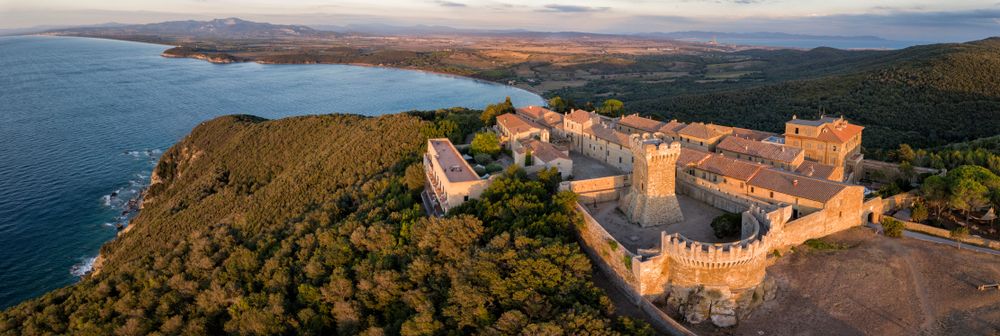
Populonia is one of the strangest and most rewarding places on the Tuscan coast.
A medieval village occupies the summit of a wooded promontory. Below it, Etruscan tombs emerge from the earth beside a crescent-shaped bay. Roman temples overlook the sea, ancient quarries cut into the hillside and the sand still glitters with dark mineral traces left by centuries of iron production.
This is not the Tuscany of cypress avenues, Renaissance palaces and vineyard estates arranged for perfect photographs. Populonia feels older, rougher and more elemental. Its history is tied to metal, ships, burial rituals and the strategic control of the coast.
Ancient Populonia was one of the principal cities of the Etruscan world and the only major Etruscan urban centre built directly beside the sea. Its wealth came largely from processing iron ore transported from the nearby island of Elba. Furnaces burned across the Gulf of Baratti, ships moved through the harbour and elite families constructed monumental tombs beneath what is now a pine forest.
The modern destination is divided between two distinct areas. Populonia Alta is the tiny fortified village on the hill, centred on a medieval castle and panoramic lanes. Baratti lies below, where the beach, harbour and principal necropolises occupy the gulf.
Trying to understand Populonia through the village alone misses most of the story. The real destination stretches from the acropolis and medieval fortress to the tombs, industrial districts, woodland paths and mineral-darkened shoreline below.
A full day is the minimum. Two days allow archaeology, swimming and the surrounding promontory to work together rather than compete for time.
Where Is Populonia?
Populonia lies on the Etruscan Coast, known in Italian as the Costa degli Etruschi, in the municipality of Piombino and the province of Livorno.
The village occupies the northern part of the Piombino Promontory, overlooking the Gulf of Baratti and the Tyrrhenian Sea. The island of Elba lies offshore, while San Vincenzo, Campiglia Marittima, Suvereto and Piombino form the main surrounding destinations.
Populonia is not a single compact attraction. The archaeological park extends across separate zones between the coast and the summit.
The Necropolis of San Cerbone lies close to the Gulf of Baratti.
The Necropolis of the Caves, or Necropoli delle Grotte, occupies higher wooded slopes shaped by ancient quarrying.
The Acropolis of Populonia stands near Populonia Alta and contains the remains of the Etruscan and Roman city.
The medieval village sits immediately above the acropolis and is reached by a separate uphill road.
Distances are not enormous, but elevation, heat and separate entrances mean that planning matters.
Why Was Populonia Different from Every Other Etruscan City?
Most of the major Etruscan cities developed inland, controlling agricultural territories and routes across central Italy. Populonia faced the sea.
Its ancient names appear in several forms, including Pupluna, Pufluna and Fufluna, possibly connected with Fufluns, the Etruscan divinity associated with wine, vegetation and ecstatic experience.
Populonia’s position allowed it to control maritime traffic and process mineral resources arriving from Elba. The island contained rich deposits of hematite, but limited fuel. Ore could therefore be transported across the short sea passage and smelted around Baratti, where woodland supplied charcoal.
The city became one of the most important metallurgical centres in the western Mediterranean. Iron working shaped its economy, landscape and social hierarchy.
Slag accumulated in enormous quantities around the gulf. During the 20th century, industrial operators reprocessed ancient slag heaps because earlier technology had left recoverable iron behind. This later activity altered parts of the archaeological landscape but also revealed tombs and structures hidden beneath centuries of industrial waste.
Populonia was therefore not simply a beautiful Etruscan port. It was noisy, smoky, technologically sophisticated and heavily industrialised.
The History of Populonia
The Etruscan City and the Iron Trade
Settlement developed on the promontory during the early Iron Age, while the city rose to prominence between the 8th and 6th centuries BC.
Populonia became part of the traditional Etruscan league of twelve major city-states, commonly known as the Dodecapolis. Its political territory extended across the coast and included access to Elba’s mineral resources.
The city consisted of several zones rather than one uniform urban centre. The acropolis occupied high ground, necropolises spread across the slopes and industrial areas developed closer to the harbour.
Elite tombs demonstrate the wealth generated by trade and metallurgy. Grave goods included imported ceramics, weapons, jewellery and luxury objects that connected Populonia with wider Mediterranean networks.
Populonia Under Roman Rule
Populonia gradually entered Rome’s political sphere, although the precise stages of control were complex.
The city remained economically important during the Roman Republic, particularly through maritime activity and mineral processing. Roman builders reshaped the acropolis with temples, streets, houses and public structures.
Populonia suffered during the conflicts of the 1st century BC and declined further under the Roman Empire as economic patterns changed.
The port continued to function, but the ancient city lost much of its former importance. Population contracted and settlement gradually shifted towards more defensible positions.
From Late Antiquity to the Medieval Village
During late antiquity and the early Middle Ages, coastal insecurity encouraged communities to occupy protected hilltop locations.
Populonia became an episcopal centre, but raids and regional instability contributed to its decline. Medieval settlement developed around defensive structures on the summit.
The village visible today took shape under the influence of Piombino’s ruling families, particularly the Appiani. The fortress was expanded during the 15th century, giving Populonia Alta its present silhouette.
The result is a rare vertical sequence of history: Etruscan and Roman remains occupy the ancient acropolis, while a medieval castle and village stand immediately above them.
Things to Do in Populonia
Begin with the Archaeological Park of Baratti and Populonia
The Archaeological Park of Baratti and Populonia is the core of the destination.
It covers a large landscape rather than a conventional fenced museum site. Woodland, ancient roads, quarry faces, tombs and sea views form part of the experience.
The park’s principal areas are geographically separate, and a complete visit requires several hours. Visitors can choose the necropolises, the acropolis or a combination ticket covering the major zones.
Guided tours are especially valuable because several tombs and underground spaces may be accessible only with park staff. Timed departures also determine which monuments can be entered during the day.
In 2026, the official park programme includes extended summer hours and Sunday afternoon-to-evening openings, allowing visitors to avoid the most punishing midday heat.
Walk Among the Monumental Tombs of San Cerbone
The Necropolis of San Cerbone contains some of Populonia’s most recognisable Etruscan tombs.
The cemetery developed close to the ancient shoreline and industrial districts. Monumental burial structures rise among umbrella pines and low vegetation, with the sea only a short distance away.
The Tomb of the Chariots, or Tomba dei Carri, is one of the most important. Its large tumulus covered a circular burial chamber reached through a corridor. The name refers to chariot remains and equipment discovered during excavation.
The Tomb of the Funeral Beds, the Tomb of the Bronze Statuette of the Offering Bearer and other monuments show how burial architecture changed between the 7th and 6th centuries BC.
Earlier elite tombs appear as imposing circular mounds built from local stone. Later burials adopted different chamber forms and smaller enclosures as society, wealth and funerary customs evolved.
The scale of the largest tumuli makes clear that these were not private graves hidden from view. They were political statements placed prominently within the landscape.
See the Edicola Tombs
Small shrine-shaped tombs, known as aedicule tombs, represent another phase in Etruscan funerary architecture.
Their façades imitate miniature houses or temples. This architectural language suggests that the tomb was understood as a permanent dwelling for the dead.
The best examples are compact but exceptionally expressive. Pediments, doorways and carefully fitted stone create the impression of an entire building reduced to funerary scale.
These tombs are easy to underestimate after the massive tumuli, yet they reveal changing ideas about family identity and commemoration.
Enter the Necropolis of the Caves
The Necropolis of the Caves occupies the upper slopes above Baratti.
Here Etruscan tombs were cut directly into quarry faces and sandstone cliffs. The landscape alternates between burial chambers, extraction surfaces, woodland and abandoned working areas.
The local stone, often called panchina, was quarried for buildings and tombs. Quarrying created vertical walls and artificial cavities later adapted for burial.
The experience is more rugged than San Cerbone. Paths climb through Mediterranean vegetation, and tomb entrances appear unexpectedly within the rock.
Some chambers contain carved benches and architectural details intended to reproduce domestic interiors. Access may depend on guided-tour times and safety conditions.
The relationship between quarry and cemetery is essential. Populonia’s inhabitants did not simply place tombs in a natural landscape; they continuously reshaped the terrain through extraction, construction and burial.
Follow the Via delle Cave
The Via delle Cave route crosses the upper archaeological landscape through quarries, tombs and woodland.
It is one of the park’s most atmospheric walks, particularly for visitors interested in geology and ancient construction.
The path helps explain where Populonia obtained the stone used for funerary monuments and urban architecture. Tool marks and cut surfaces reveal extraction methods more clearly than finished buildings do.
The route can be hot and uneven. Closed footwear and water are essential, while heavy rain may make sections slippery.
Walk the Via della Romanella
The Via della Romanella follows an ancient route connecting the lower industrial and funerary zones with the acropolis.
The climb reveals the physical organisation of Populonia. Workers, merchants, mourners and residents moved between harbour, furnaces, cemeteries and upper city along this landscape.
A full ascent is more demanding than a casual archaeological visit. It suits walkers who want to experience Populonia as a connected city rather than separate ticketed zones.
Check current trail access before committing to the route, particularly outside the main season.
Visit the Acropolis of Populonia
The acropolis stands on high ground close to the medieval village.
Roman remains dominate the visible site, although the area had earlier Etruscan religious and political functions. Excavations have revealed temples, paved streets, houses, baths and monumental terraces.
The Temple of Loggia, the Sacred Area of the Acropolis and the imposing terrace structures demonstrate how Roman Populonia transformed the summit into a formal urban centre.
The remains are less immediately dramatic than the tombs below. Low walls require interpretation, but the setting is extraordinary. The sea appears beyond the archaeological structures, and the islands of the Tuscan Archipelago become visible in clear weather.
The acropolis is best visited with a guide or after reading the site panels carefully. Without context, temple platforms and residential foundations can blend into a confusing field of masonry.
Climb the Terrace of the Loggias
The monumental Terrace of the Loggias formed part of the Roman architectural reorganisation of the acropolis.
Vaulted substructures supported a large upper terrace and controlled the steep slope. The surviving construction shows Roman engineering adapted to a dramatic coastal position.
From the area around the terrace, the city’s command over the sea becomes obvious. Populonia was not merely near the coast; its upper settlement visually controlled the maritime landscape.
Walk Through Populonia Alta
Populonia Alta is one of Tuscany’s smallest and most atmospheric fortified villages.
Stone houses gather behind medieval walls, with narrow lanes leading towards the fortress and church. Shops, cafés and restaurants occupy a compact area that can be crossed in minutes.
Its tiny size is part of the appeal, but it also means summer crowding becomes noticeable quickly. Arrive early in the morning or remain into the evening after day visitors leave.
The village is not an open-air theme park, although tourism dominates its public spaces. A small number of residents still live within and around the walls.
Climb the Rocca di Populonia
The Fortress of Populonia dominates the medieval village.
The present complex was largely developed during the 15th century under the Appiani, rulers of Piombino. Defensive walls connect a strong square tower with battlements and elevated walkways.
Climbing the fortress provides the best panorama over the Gulf of Baratti, the archaeological park, the Piombino Promontory and the Tuscan Archipelago.
On clear days, Elba appears across the water, while Corsica may be visible under exceptional atmospheric conditions.
The climb includes stairs and exposed sections. The view is the principal reward; the interior does not contain the extensive furnished rooms of a residential castle.
Opening hours can be seasonal and separate from those of the archaeological park.
Visit the Gasparri Etruscan Museum
The Gasparri Etruscan Museum stands within Populonia Alta.
Its collection developed from discoveries made on land connected with the Gasparri family and includes archaeological objects from the surrounding territory.
The museum is small but useful, particularly for visitors spending most of the day in the upper village rather than visiting the larger museum in Piombino.
Displays help connect portable objects with the tombs, houses and industrial activity visible across the archaeological park.
See the Church of Santa Croce
The Church of Santa Croce stands within the medieval village.
Its restrained interior reflects the scale of Populonia’s small community. The building has been modified over time, and its significance lies as much in continuity of worship as in individual artworks.
Dress appropriately and avoid entering during services merely to take photographs.
Baratti Bay and the Sea
Swim at Baratti Beach
Baratti Beach curves around one of the most beautiful bays on the Tuscan coast.
The sand is golden-brown with darker mineral particles, a visible reminder of the area’s iron-rich geology and ancient metallurgy. The water is generally shallow near the central bay, making it popular with families.
Pine trees provide valuable shade behind parts of the beach, although the most convenient spaces fill early in summer.
The gulf is sheltered from some winds but not all. Water clarity varies with weather, boat movement and sea conditions.
The archaeological setting makes Baratti unusual. Few European beaches allow visitors to swim within walking distance of monumental Etruscan tombs and an ancient industrial city.
Free Beach or Beach Club?
Baratti includes both free sections and organised bathing establishments.
Beach clubs provide umbrellas, loungers, changing facilities and food service. Free areas offer greater flexibility but become crowded quickly in July and August.
Parking pressure is substantial during summer. Arrive early, use designated spaces and never leave vehicles along restricted roads or archaeological access routes.
Walk Around the Small Harbour
The small harbour at Baratti occupies the southern side of the gulf.
Fishing boats, sailing vessels and small recreational craft give it a working atmosphere, although summer tourism now dominates much of the waterfront activity.
The harbour area is pleasant for a short walk, seafood lunch or evening aperitif. It also provides another perspective towards Populonia Alta, which rises dramatically above the trees.
Hike to Buca delle Fate
Buca delle Fate, usually translated as the Fairies’ Cove, lies on the western side of the Piombino Promontory.
The beach is reached on foot via marked trails beginning near the Reciso parking area above Baratti. The CAI 301 route crosses woodland before descending towards the rocky coast.
Buca delle Fate is not a sandy beach. Flat rocks, clear water and steep surrounding cliffs create a wild swimming location with little infrastructure.
Bring water, food, sun protection and sea shoes. There are no guaranteed services at the cove, and the return climb becomes tiring in heat.
The sea can become rough quickly. Avoid swimming far from shore when conditions deteriorate.
Continue Towards Cala San Quirico
More experienced walkers can continue along sections of the coastal path towards Cala San Quirico.
The route crosses Mediterranean woodland and exposed coastal terrain. It is quieter than Buca delle Fate but also more demanding.
Trail conditions can change after storms or vegetation growth. Download a reliable map and avoid treating the walk as an improvised beach stroll.
What to Eat in Populonia and Baratti
The local kitchen combines Tuscan coastal cooking with the agricultural traditions of the Val di Cornia.
Fish and seafood dominate around Baratti, while restaurants in Populonia Alta often include wild boar, handmade pasta, grilled meat and local cheese.
Fresh Fish from the Tyrrhenian Coast
Menus commonly feature sea bass, sea bream, red mullet, anchovies, octopus, squid and mixed fried seafood.
Ask what is genuinely fresh and confirm the price before ordering whole fish by weight. The gulf setting does not guarantee that every item comes from local boats.
Grilled fish with olive oil, lemon and herbs usually works better than complicated sauces.
Cacciucco
Cacciucco is the defining fish stew of the Livorno coast.
Traditionally made with several varieties of fish and shellfish, it is cooked with tomato, garlic, wine and chilli and served over toasted bread.
The dish should taste deep and maritime rather than sweet or overloaded with tomato. It is substantial enough to serve as a complete meal.
Palamita
Bonito, known locally as palamita, is strongly associated with the nearby Piombino coast.
It may be served fresh, grilled, marinated or preserved in oil. Its flavour is richer and more assertive than many white fish, making it particularly good with tomato, onions, herbs and local olive oil.
Wild Boar and Handmade Pasta
The wooded interior of the Val di Cornia supports a strong game tradition.
Pappardelle or pici with wild-boar ragù provide a natural alternative to seafood, particularly outside summer.
The sauce should be slow-cooked, savoury and balanced rather than aggressively heavy.
Wine from the Etruscan Coast
Populonia lies within reach of several important Tuscan wine areas.
Vermentino is the obvious choice with seafood. Coastal examples tend to combine citrus, herbs and salinity.
Rosato based on Sangiovese, Grenache or local blends works well with cacciucco, tomato-based fish dishes and fried seafood.
For meat, choose a red from Suvereto, Val di Cornia or Bolgheri. Cabernet Sauvignon, Merlot, Sangiovese and Mediterranean varieties all appear in regional blends.
Torre di Baratti also produces biodynamic wines from vineyards overlooking the gulf, including Munica Vermentino and Fartan Grenache.
Where to Eat in Populonia and Baratti
Opening days and hours change seasonally. Restaurants near the gulf may close or reduce service outside spring and summer. Contact businesses directly before travelling for a specific meal.
Ristorante Torre di Baratti
Torre di Baratti combines a panoramic bio-resort, biodynamic farm, wine production and restaurant overlooking the gulf.
The kitchen for the 2026 season focuses on local produce, vegetables from the property, regional ingredients and wines made on site. The setting among olive trees provides a quieter and more polished alternative to the busiest beachfront restaurants.
Wine and olive-oil tastings are available by reservation, with daily experiences from 11:00 beginning in April 2026.
Address: Strada Comunale di Populonia 3, Località Baratti, 57025 Piombino, Italy
Restaurant telephone: +39 348 419 2327
Resort telephone: +39 0565 29379
Mobile: +39 391 476 3484
Restaurant email: [email protected]
General email: [email protected]
Reservations email: [email protected]
Website: torredibaratti.com
Cuisine: contemporary Tuscan coastal cooking, local produce and estate wines
Price level: upper mid-range
Reservations: strongly recommended
Osteria La Torre di Populonia
Osteria La Torre occupies the medieval village and serves Tuscan dishes in a setting closely tied to Populonia Alta.
The menu generally combines seafood, handmade pasta, game and seasonal ingredients. Its position makes it convenient after visiting the fortress or acropolis, though summer tables should be reserved ahead.
Current opening hours and contact details should be checked directly before travel, as the restaurant operates seasonally and online listings are not always consistent.
Beachfront Restaurants at Baratti
Several seasonal establishments operate around the gulf and harbour.
These are convenient for seafood, salads, pasta and aperitifs after the beach. Quality and ambition vary considerably, so examine the daily menu rather than choosing solely by proximity to the water.
Reservations become useful for sunset dining in July and August.
Where to Stay in Populonia and Baratti
Accommodation around Populonia is limited compared with San Vincenzo or Piombino. Booking early is essential for summer and long weekends.
Torre di Baratti Bio Resort
Torre di Baratti occupies a panoramic position between the gulf and the road climbing towards Populonia.
The property contains three suites, two one-bedroom apartments and a tower suite with sea views. Guests have access to private parking, breakfast, an organic garden, outdoor spaces and the estate restaurant.
Services available on request include wine and olive-oil tastings, archaeological guides, trekking guides, boat trips, massages, private chefs and transfers from Campiglia Marittima railway station.
Address: Strada Comunale di Populonia 3, Località Baratti, 57025 Piombino, Italy
Telephone: +39 0565 29379
Mobile: +39 391 476 3484
Email: [email protected]
General email: [email protected]
Website: torredibaratti.com
Reception: 09:00–17:00
Accommodation: suites and apartments
Facilities: breakfast, daily cleaning, Wi-Fi, air conditioning, parking, restaurant and wine tastings
Price level: high
Check-in and check-out: confirm for the selected room or apartment
Castello di Populonia Apartments
The Castello di Populonia accommodation occupies buildings within the medieval village.
Apartments have different sizes and layouts, some with commanding views over the sea and surrounding landscape. Staying inside Populonia Alta provides an exceptional evening atmosphere after visitors leave, but luggage access, parking and stairs require planning.
The reception office is located inside the village.
Address: Via di San Giovanni 15, Populonia Alta, 57025 Piombino, Italy
Telephone: +39 0565 29666
Mobile: +39 339 434 9811
Email: [email protected]
Website: castellodipopulonia.it
Accommodation: self-catering apartments within the medieval village
Facilities: vary by apartment
Price level: mid-range to high according to season and view
Check-in and parking: confirm directly before arrival
Agriturismo di Baratti
Agriturismo di Baratti occupies a restored farmhouse on the hills near the gulf, approximately 900 metres from the sea.
The property offers independent apartments with outdoor areas and countryside views. It suits families and travellers who want more space, a kitchen and a quieter setting than the beach or medieval village.
A car is strongly recommended.
Address: Via Poggio Piovanello 1, 57025 Populonia–Piombino, Italy
Mobile: +39 371 374 7930
Telephone: +39 0565 29518
Email: [email protected]
Website: agriturismobaratti.com
Accommodation: independent apartments for four or five guests
Distance from the sea: approximately 900 metres
Price level: mid-range to upper mid-range in high season
Check-in and check-out: confirm directly for the selected apartment
How Many Days Do You Need in Populonia?
One day allows enough time for one archaeological zone, Populonia Alta and a short stop at Baratti Beach.
A complete archaeological visit covering San Cerbone, the Cave Necropolis and the acropolis requires most of a day without including a long swim or coastal hike.
Two days provide the best balance. Use the first for the necropolises and Baratti, then dedicate the second to the acropolis, medieval village and Buca delle Fate.
Three days suit travellers who want beach time, kayaking, wine tasting or additional excursions around the Val di Cornia.
A One-Day Populonia Itinerary
Begin at the Necropolis of San Cerbone when the park opens.
Join the first useful guided visit and allow time for the monumental tombs before continuing to the Cave Necropolis or selected upper route.
Have lunch near Baratti, then drive to Populonia Alta for the acropolis, Gasparri Museum and fortress.
Remain for the late-afternoon view over the gulf before returning to the coast.
Trying to add Buca delle Fate to this schedule will make the day unnecessarily rushed.
A Two-Day Populonia Itinerary
On the first day, visit San Cerbone and the Cave Necropolis, then spend the afternoon swimming at Baratti Beach. Finish with dinner near the gulf.
On the second morning, hike to Buca delle Fate before temperatures rise. Continue to Populonia Alta for lunch, the acropolis, museum and fortress.
This division allows archaeology and landscape to complement one another rather than compete for attention.
How to Get to Populonia
By Car
A car is the most practical way to visit Populonia.
From Piombino, follow signs towards Baratti and Populonia. The journey takes approximately 20 minutes depending on traffic.
From San Vincenzo, allow around 20 to 30 minutes.
From Livorno, the drive takes roughly one hour and fifteen minutes, while Florence requires around two hours.
Summer traffic can slow the final road into Baratti considerably.
Parking at the Archaeological Park
The Casone car park serves the lower archaeological area near the necropolises. Visitors to the park can use it without charge according to the official park information.
Populonia Alta has a separate private pay-and-display car park close to the village and acropolis.
Beach parking follows separate seasonal rules and can be expensive. Spaces fill early in July and August.
Never park along protected roads, pine forest edges or emergency access routes.
By Train
The nearest useful railway stations are Campiglia Marittima and Piombino.
Campiglia Marittima lies on the principal coastal railway line and receives more regional and intercity services. From there, travellers need a bus, taxi or pre-arranged transfer.
Populonia railway station exists inland, but it is not conveniently positioned for the archaeological park, village or beach and should not be confused with arrival directly at the attractions.
By Bus
Local bus services connect Piombino with Baratti and Populonia, particularly during the visitor season.
Schedules vary by day and month. They can work for a straightforward beach or village visit but make combining all archaeological zones more difficult.
Check the current Autolinee Toscane timetable before departure.
Getting Around Populonia
A combination of driving and walking works best.
The lower necropolises, acropolis and medieval village have separate access points. Visitors can move between them by car or follow longer archaeological and hiking routes when open.
The park’s internal paths include slopes, stone, loose surfaces and limited shade.
Bicycles are possible on surrounding roads, but the climb to Populonia Alta is demanding and summer traffic reduces the pleasure.
Best Time to Visit Populonia
April and May
Spring provides green vegetation, comfortable walking temperatures and fewer beach crowds.
Some seasonal restaurants and services may operate reduced hours, but archaeological visits are far more pleasant than in midsummer.
June
June offers warm sea temperatures, long days and manageable visitor levels.
This is one of the best months for combining archaeology, hiking and swimming.
July and August
Summer brings intense heat, crowded beaches and parking pressure.
The archaeological park’s extended 2026 hours make early and late visits more practical. Sunday afternoon and evening openings are especially useful.
Reserve accommodation and restaurants well ahead.
September
September may be the strongest overall month.
The sea remains warm, light softens and the archaeological routes become more comfortable. Beach services remain active through much of the month.
October
October suits archaeology, hiking and food-focused travel.
Swimming remains possible in warm weather, but opening days and restaurant schedules become less predictable later in the month.
What to See Near Populonia
Piombino
Piombino has a historic centre, seafront viewpoints and the principal Archaeological Museum of Populonia.
The museum occupies Palazzo Nuovo and contains objects from the ancient city and surrounding territory, including funerary goods, ceramics, metalwork and maritime finds.
It is the best museum complement to the archaeological park and deserves at least two hours.
Campiglia Marittima
Campiglia Marittima is one of the most attractive hill towns in the Val di Cornia.
Its medieval lanes, fortress and restaurants provide a strong inland contrast with Populonia’s maritime landscape.
San Silvestro Archaeological Mines Park
The park near Campiglia explores mining history from antiquity through the modern period.
Underground routes, industrial structures and a small mining train help explain the wider mineral economy that shaped this part of Tuscany.
Suvereto
Suvereto combines medieval architecture with one of the region’s strongest wine identities.
The surrounding denomination produces structured reds from Sangiovese, Cabernet Sauvignon, Merlot and other varieties.
San Vincenzo
San Vincenzo offers a marina, long sandy beaches, restaurants and a larger range of accommodation.
It works well as a base for travellers who want to combine Populonia with a conventional seaside holiday.
The Island of Elba
Ferries from Piombino connect the mainland with Elba.
The island’s iron mines complete the Populonia story: ore extracted on Elba supplied the furnaces and wealth of the ancient coastal city.
Practical Information for Populonia in 2026
The Archaeological Park of Baratti and Populonia publishes a detailed daily calendar rather than one fixed annual timetable.
In summer 2026, standard days generally extend into the evening, while several Sundays operate from 15:00 to 21:00. Autumn hours become shorter, and the park closes on selected weekdays outside peak season.
The official full ticket for the complete park visit is €27, with reduced and family tickets available. A two-area ticket is also offered.
Guided-tour departure times determine access to certain tombs and sections. Arrive before the chosen visit rather than at the general closing time.
The park booking office can be contacted at +39 0565 226445 or [email protected].
Summer heat is a serious issue. Carry water and avoid exposed archaeological routes at midday.
Beach parking, archaeological parking and village parking operate under different rules.
Dogs may face restrictions inside tombs, museums and archaeological structures. Confirm before travelling.
Populonia Essential Information
Region: Tuscany
Province: Livorno
Municipality: Piombino
Ancient Etruscan names: Pupluna, Pufluna or Fufluna
Main archaeological attraction: Archaeological Park of Baratti and Populonia
Main village: Populonia Alta
Main beach: Baratti Beach
Recommended stay: one or two days
Best months: May, June and September
Nearest main railway station: Campiglia Marittima
Best transport: car
Best suited to: archaeology travellers, swimmers, hikers, photographers and families combining culture with the coast

