
Pannonhalma Archabbey: Hungary’s Timeless Spiritual Beacon
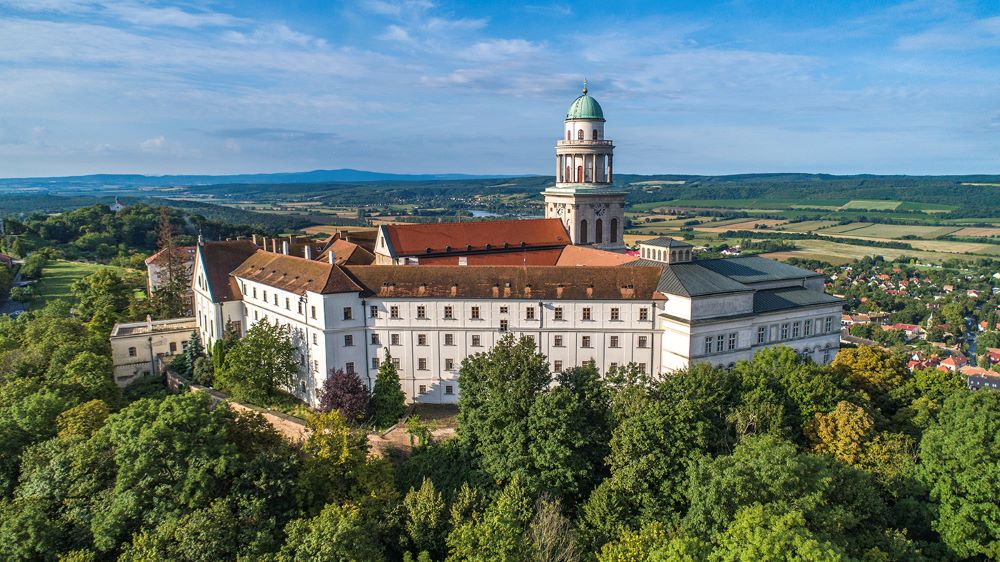
The history of the abbey built on the sacred mountain of the Roman province Pannonia (Mons Sacer Pannonia) begins with the history of Hungary. The pagan tribes of Hungarians arrived in the Carpathian Basin from the east (around 896). Prince Géza and his son King Stephen I (I. István) recognised that the Hungarian people could only survive with a solid feudal state and Christianity. To spread the ideas of Christianity and European culture, Italian and Czech Benedictine monks were called to the country by Géza. The first monastery was erected in honour of the bishop of the French city Tours, a native of Pannonia, St Martin (Szent Márton).
Architectural Evolution
The first buildings were destroyed, but both the church and the monastery were renovated several times on these foundations. The western apse is probably left from the first church, the walls are from the church consecrated in 1137, while the columns and the early Gothic arch were built in the first quarter of the 13th century. Damage suffered during Turkish rule was restored around 1700 in the Baroque style, and it is to these years that most of the monastery, including the refectory, dates back. The classical tower and library building were built in the early decades of the 19th century, while the gymnasium and boarding school, with Italian features, date back to the 20th century.
Entering the Abbey
Entering through the modern main entrance, the Baroque abbey building greets us from the right, while the peristyle of the gymnasium and college is on the left. More than 40 monks live in the abbey, and around 320 boys study in the school. Continuing the walk, one enters the inner courtyard, where the neoclassical façade already designates the medieval part of the building.
The Abbey Church
The abbey church, which has the status of a basilica, is composed of Romanesque, early and late Gothic, and Renaissance parts, which, during the 19th-century restoration works, were brought into harmony. The Late Gothic (1486) transverse corridor on the south side of the church is connected to it by the ‘Speziosa Gate’ (Ékes kapu), the most valuable architectural and sculptural work in the monastery. Near the cloister, there is the Baroque refectory and also the abbey archive (Főapátsági Levéltár), which contains documents of the highest value, such as the oldest Hungarian and Finno-Ugric writings, the letter of constitution of Tihany Abbey, and the Pannonhalma census letter, published around 1090, with the first list of books in Hungary.
The Library and Collections
The abbey’s classical library, dating back to the 19th century, holds almost 350,000 tomes, making it one of the richest monastery libraries in Europe. The most important items in the collection include incunabula and codices, featuring many unique pieces of ecclesiastical and secular culture. Among the abbey’s collections are medals, stones, carvings, and paintings, displayed in the exhibition hall below the library in a permanent exhibition.
Nature and Surroundings
In front of the main entrance is a grove with almost 400 different plant species. From the nearby belvedere, visitors can admire the hilly area of the Pannonhalma Protected Nature Area (Pannonhalmi Tájvédelmi Kőrzet). A guided tour allows visitors to explore parts of the thousand-year-old abbey, though the basilica cannot be visited during services. Organ concerts are held in the basilica during the summer months.
Recommended Excursions
- Győr: Known as the city of rivers, Győr sits at the confluence of three rivers and offers beautiful Baroque buildings, museums, and romantic riverside boulevards.
- Csesznek Fortress: A 13th-century Gothic castle, once used as a prison, located in the Bakony Mountains.
- Zirc Abbey: Founded in 1182 by King Béla III, this Cistercian abbey features an ornate Baroque church, a library with Bakony wood interiors, and a picturesque grove.
- Veszprém: One of Hungary’s oldest towns, often called the Town of Queens because Hungarian queens were crowned by its bishop.

