
Inside Otranto, Where a Medieval Tree of Life, 800 Martyrs and an Aragonese Fortress Face the Adriatic

Otranto stands at the eastern edge of Italy with the sea in front of it and several civilisations beneath its streets.
Messapians lived here before Rome. Byzantium turned the harbour into an important link with the eastern Mediterranean. Norman rule produced one of southern Italy’s great cathedrals, whose twelfth-century floor mosaic spreads for roughly 600 square metres beneath the nave, transept and apse. In 1480 an Ottoman army captured the city in one of the most traumatic episodes in the history of the Kingdom of Naples. The Aragonese response reshaped Otranto again, enclosing it within powerful walls and rebuilding the castle into the massive fortress that still guards the old town.
The result is far more than a beach destination.
Inside the walls, narrow limestone streets climb between the Cathedral, the Byzantine church of San Pietro and the Castello Aragonese. Outside them, the coast changes rapidly. North of town lie sandy beaches and the protected landscapes of Baia dei Turchi and the Laghi Alimini. Southwards, the shore becomes rockier and more dramatic, passing the intensely coloured former bauxite quarry, Torre del Serpe and eventually Punta Palascia, where the Salento reaches Italy’s easternmost extremity.
This geography explains almost everything about Otranto.
The Adriatic brought commerce, Greek culture, armies, pilgrims and ideas. Across the water lie Albania and the Balkans; farther south and east, routes continue towards Greece and the wider Mediterranean. Otranto has always looked east as naturally as the rest of Puglia looks inland.
A rushed half-day is enough to walk through the old town.
It is not enough for Otranto.
Allow one full day for the historic centre and nearby coast, two days to add Alimini, Baia dei Turchi and Punta Palascia, and three days if you want Otranto to become a base for the southern Adriatic coast of Salento.
Things to See in Otranto
- Cathedral of Santa Maria Annunziata
- Pantaleone’s Tree of Life mosaic
- Chapel of the Martyrs
- Cathedral crypt
- Museo Diocesano
- Byzantine Church of San Pietro
- Castello Aragonese
- Otranto’s fortified walls
- Porta Alfonsina
- Torre Matta
- old town
- Lungomare degli Eroi
- harbour
- Torre del Serpe
- former bauxite quarry
- Baia delle Orte
- Punta Palascia and its lighthouse
- Baia dei Turchi
- Laghi Alimini
- Torre Sant’Emiliano
- Porto Badisco
- coastal road towards Santa Cesarea Terme
- former Abbey of San Nicola di Casole area
- local beaches
- Salento food and seafood
Otranto Before Rome

The history of Otranto begins long before the medieval fortress visible today.
The Salento peninsula was inhabited by the Messapians, an ancient population whose settlements occupied strategic positions across southeastern Puglia. Archaeological evidence beneath and around the Cathedral confirms that the site of the present city was already occupied well before the medieval period.
The position was exceptionally useful.
Otranto sits on a natural harbour along the shortest maritime approaches between Italy and the opposite Adriatic shore. Long before national borders existed, this stretch of sea connected rather than separated communities.
Greek influence consequently reached the region early and deeply.
The ancient name Hydruntum, later Hydruntum or Hydrunto in Latin forms, survives indirectly in the adjective idruntino, still used for Otranto and its inhabitants.
Roman control incorporated the settlement into a much larger commercial system.
Roads linked the Adriatic ports with inland Apulia, while maritime traffic connected the Italian peninsula with Epirus, Greece and the eastern Mediterranean.
Otranto was already what it would remain for centuries:
a western city facing east.
The Byzantine City
After the fragmentation of Roman authority in the West, Otranto became increasingly connected with the Byzantine world.
Greek language, liturgy and religious culture remained deeply rooted in southern Salento for centuries. Even after Norman conquest brought the area into a Latin Christian political system, Greek traditions did not disappear immediately.
The clearest surviving monument to this eastern identity is the small Church of San Pietro inside the historic centre.
But Byzantine Otranto was larger than one church.
Monasteries, scriptoria and communities using the Greek rite made the region one of the most culturally complex borderlands in medieval Italy.
The greatest lost institution was the Monastery of San Nicola di Casole, a few kilometres south of town.
San Nicola di Casole: Otranto’s Lost Intellectual Centre
The monastery of San Nicola di Casole was founded during the period of Norman rule but developed within the Greek religious and intellectual culture of the region.
It became famous for its library and scriptorium.
Manuscripts were copied, studied and circulated here, making Casole one of the significant centres of Greek learning in medieval southern Italy.
Its importance extended beyond theology.
Greek classics, philosophy and scientific knowledge belonged to an intellectual world that connected Salento with Constantinople and the eastern Mediterranean.
The monastery was devastated during the Ottoman invasion of 1480 and never recovered its former importance.
Little survives architecturally today.
Its disappearance is nevertheless essential to understanding Otranto.
The city’s eastern identity was not a picturesque cultural mixture created for modern tourism. It once supported a serious Greek-speaking scholarly tradition on Italian soil.
The Norman Cathedral

The Cathedral of Santa Maria Annunziata is the monument around which the entire history of Otranto can be organised.
Construction began in 1080, only a few years after Norman power had consolidated control of much of southern Italy.
The Cathedral was solemnly consecrated on 1 August 1088.
Its basic plan is a Latin-cross basilica approximately 53 metres long and 25 metres wide, divided into three naves.
Fourteen columns separate the central nave from the aisles.
Some capitals and architectural elements reuse older material, a common practice in medieval churches built in cities with long histories of settlement.
Beneath the floor, archaeological investigation has revealed traces of buildings that predate the Norman church, including remains associated with Messapian, Roman, late-antique and early Christian occupation.
The Cathedral therefore does not simply stand in the oldest part of Otranto.
It physically contains it.
Pantaleone’s Mosaic
Then you look down.
Between 1163 and 1165, a priest named Pantaleone created one of the most enigmatic medieval pavements in Europe.
The mosaic extends through the central nave, transept and sanctuary, covering approximately 600 square metres.
At its centre rises an enormous Tree of Life.
Around it appears a visual universe in which biblical stories coexist with animals, monsters, kings, mythical creatures, moral allegories and episodes that seem to come from literature and folklore rather than a conventional church decoration programme.
Adam and Eve appear.
So do Noah, Samson and Jonah.
But the mosaic also contains centaurs, elephants, griffins and other extraordinary creatures.
A figure traditionally identified as Alexander the Great rises towards the sky.
King Arthur appears within the pavement decades before some of the canonical literary versions of the Arthurian tradition were written down.
The effect is bewildering because the work refuses modern categories.
Sacred history, medieval cosmology and fantastic imagination occupy the same floor.
How to Read the Tree of Life
The tree runs longitudinally through the church and creates the principal organising structure.
It is tempting to interpret every branch as though Pantaleone left behind a clear manual.
He did not.
Scholars have proposed different readings of individual scenes and of the programme as a whole.
What remains clear is that the mosaic is concerned with human history, sin, salvation, knowledge and the ordering of creation.
The medieval viewer did not divide biblical, historical and legendary material according to the same boundaries used today.
Alexander the Great could belong inside a Christian visual universe.
Fantastic animals could communicate moral meaning.
Biblical episodes could coexist with signs of the zodiac and secular narrative.
The mosaic is not confused.
It comes from a culture that organised knowledge differently.
The Summer Solstice and the Mosaic
The Cathedral’s orientation produces a particularly striking effect around the summer solstice.
Morning light enters the church and falls along the central Tree of Life.
The phenomenon creates a moment in which the architecture, natural light and mosaic align across the nave.
Whether every aspect of that alignment was intentionally calculated in the twelfth century remains a more complex question than modern storytelling sometimes suggests.
The physical effect is nevertheless real and compelling.
Pantaleone’s tree was always designed to be seen inside a building where daylight changes continuously across stone.
Who Was Pantaleone?
Very little is known with certainty.
The inscription identifies him as Pantaleone, a priest responsible for the mosaic during the episcopate of Archbishop Gionata.
He may have been connected with the intellectual environment of San Nicola di Casole, although the exact nature of that relationship cannot be reconstructed securely.
The work itself demonstrates extraordinary cultural range.
Its creator or creators knew biblical traditions, medieval bestiaries, classical material and stories circulating across Europe and the Mediterranean.
This makes the pavement one of the most valuable documents for understanding the intellectual world of twelfth-century southern Italy.
The Cathedral Crypt
Do not leave after seeing the mosaic.
Descend into the crypt.
Rows of columns divide the low space, producing a completely different architectural rhythm from the large basilica above.
Capitals vary in style and origin.
Several appear to reuse earlier architectural material.
The result has the dense, almost forest-like atmosphere characteristic of medieval crypts assembled through multiple construction traditions.
The crypt also demonstrates how deeply the Norman Cathedral absorbed older Mediterranean building culture.
Classical fragments, Byzantine memory and Romanesque architecture are not presented as separate museum periods.
They coexist structurally.
The Ottoman Siege of 1480
No event shaped Otranto’s historical identity more deeply than the summer of 1480.
An Ottoman fleet crossed from the eastern Adriatic under the command of Gedik Ahmed Pasha, acting within the expansionist strategy of Sultan Mehmed II, the conqueror of Constantinople.
The fleet appeared off the Salento coast at the end of July.
Otranto was strategically attractive because possession of the harbour could provide an Ottoman foothold in southern Italy and place pressure on the Kingdom of Naples.
The city was defended by a much smaller force.
After roughly two weeks of siege and artillery bombardment, Ottoman troops broke through the defences on 11 August 1480.
The consequences were catastrophic.
The Martyrs of Otranto
The episode that followed became central to the religious identity of Otranto.
A large group of male survivors was taken outside the city to the Colle della Minerva.
Christian tradition records that they were offered conversion and refused.
They were executed.
They became known collectively as the Martyrs of Otranto.
The conventional number is approximately 800, although documentary traditions vary in precise totals.
Their remains were later gathered and placed inside the Cathedral.
The Catholic Church formally canonised the Otranto martyrs in 2013.
Today their bones occupy large glass reliquaries in the Cathedral’s Cappella dei Martiri.
Whatever a visitor’s religious perspective, the chapel is difficult to treat simply as another artistic stop.
Hundreds of human skulls and bones line the walls behind glass.
Otranto’s most traumatic historical event is therefore not commemorated only by an inscription.
It remains physically present inside the city’s principal church.
Bishop Stefano Pendinelli
The Cathedral itself became part of the violence.
Archbishop Stefano Pendinelli was killed during the Ottoman capture of the city.
Contemporary and later accounts transformed the fall of Otranto into a powerful story of resistance, martyrdom and the vulnerability of Christian Europe to Ottoman expansion.
The historical episode subsequently acquired layers of political and religious interpretation.
It is important to distinguish the documented military event from the many narratives that developed around it.
What is beyond dispute is the scale of the destruction and the profound transformation that followed.
Otranto Under Ottoman Rule
The Ottoman occupation lasted roughly a year.
The expected broader conquest of southern Italy never developed.
Mehmed II died in 1481, changing Ottoman strategic priorities, while forces loyal to the Kingdom of Naples organised the recovery of the city.
Otranto returned to Aragonese control in September 1481.
The city that emerged from the conflict was severely damaged.
Its rulers had learned a brutal lesson about the vulnerability of the Salento coast.
The answer was stone.
The Aragonese Reconstruction
After the recovery of Otranto, the defensive system was rebuilt extensively.
The medieval walls had proved inadequate against artillery and a large organised siege.
The Aragonese created stronger curtains, towers, bastions and a substantially reconstructed castle capable of responding to new methods of warfare.
The historic centre visible today is therefore largely contained within a military landscape born directly from the events of 1480.
The walls are not generic medieval scenery.
They are the architectural consequence of invasion.
Castello Aragonese

The Castello Aragonese dominates the eastern side of the old town.
Its current form developed mainly after the Ottoman occupation, although earlier fortifications existed on the site.
Massive cylindrical towers, thick walls and a deep moat create a fortress designed for artillery warfare rather than romantic medieval defence.
Later modifications continued into the sixteenth century as military technology evolved.
The building eventually acquired an irregular polygonal plan strengthened by towers and bastions.
Walk around the exterior before entering.
From Piazza Castello, the scale is already impressive.
The seaward sides reveal the relationship between fortress, harbour and walls even more clearly.
Castello Aragonese in 2026
The castle is open daily from 09:00 to 12:00 and from 15:00 to 18:00.
Address: Piazza Castello, Otranto
Telephone: +39 0836 212745
Email: [email protected]
Exhibitions and cultural programming regularly occupy the interior rooms, so the experience can change depending on the period.
The architecture remains the constant.
Allow at least 60 minutes.
The Castle That Invented Gothic Fiction
The title The Castle of Otranto became famous far beyond Puglia because of Horace Walpole.
Published in 1764, Walpole’s novel is conventionally regarded as the first Gothic novel.
It contains giant helmets, supernatural events, prophecies and a castle governed by fear and dynastic obsession.
There is one important complication.
Walpole had never visited Otranto when he wrote it.
The real fortress did not provide an architectural blueprint for his fictional castle.
The name became part of literary history almost accidentally.
That makes the connection more interesting, not less.
A real southern Italian fortress became the title of a book that helped create an entire genre of European literature without needing to resemble the building imagined inside it.
The Walls of Otranto
The fortified circuit is one of the most pleasurable ways to understand the old town.
Rather than following only the commercial streets at ground level, look for the elevated passages and views where the walls open towards the Adriatic.
The limestone colour changes throughout the day.
Morning produces a pale, almost white fortress above blue water.
Late afternoon turns the walls honey-coloured.
At night, illumination restores the defensive geometry.
Porta Alfonsina
The principal monumental access into the old town is Porta Alfonsina.
The gate belongs to the Aragonese reconstruction after the Ottoman occupation and forms part of the powerful fortified approach to the centre.
Passing through it produces one of Otranto’s strongest urban sequences.
Outside lies the modern seafront.
Inside, the streets narrow immediately.
The Cathedral, San Pietro and castle are all only minutes away, but the irregular lanes prevent them from appearing simultaneously.
The town reveals itself piece by piece.
Torre Matta
One of the most instructive defensive structures is Torre Matta, incorporated into the southern wall system near the harbour.
Its unusual history demonstrates how quickly military architecture evolved after 1480.
An earlier cylindrical defensive tower was later absorbed into a more advanced bastion as artillery requirements changed.
The result is essentially a fortification preserved inside a fortification.
Restoration has made the space accessible and easier to read.
It is a small monument compared with the castle but useful for understanding why Otranto’s walls cannot be assigned to one construction date.
Defence was a continuous technological process.
The Byzantine Church of San Pietro
Hidden inside the old town, the Church of San Pietro is one of Otranto’s most precious monuments.
The small building belongs to the Byzantine religious tradition that survived in Salento for centuries.
Its precise dating has been debated, with construction generally placed somewhere between the early medieval and high medieval periods.
The compact cross-in-square plan is unmistakably eastern in character.
A central dome rises above four supporting columns, while small apses organise the interior.
The architecture is tiny compared with the Cathedral.
Its cultural importance is enormous.
The Frescoes of San Pietro
Fragments of fresco painting cover the walls, apses, vaults and dome.
They belong to different campaigns stretching across centuries.
Biblical episodes, saints and devotional imagery once created a nearly continuous painted environment.
Particularly important scenes include episodes associated with the life of Christ.
The iconographic language remains strongly connected with Byzantine traditions even as later painting entered the church.
San Pietro continued to be associated with the Greek rite long after political rule had passed to Latin Christian dynasties.
The building therefore represents cultural persistence rather than simply Byzantine political occupation.
San Pietro in 2026
The church is open to visitors during the 2026 cultural season.
Standard admission is €3.
A combined ticket covering the Cathedral, Museo Diocesano and San Pietro costs €5, while the Cathedral + San Pietro combination costs €4.
For an independent visit to the Cathedral without a guide, access remains free.
Groups and guided visits follow separate ticket and reservation rules.
Museo Diocesano
The Museo Diocesano, close to the Cathedral in Piazza Basilica, provides useful context for the religious history of Otranto.
Paintings, sculpture, liturgical objects, vestments and archaeological fragments extend the narrative beyond the monuments that remain in their original positions.
The museum becomes particularly worthwhile if San Pietro and the Cathedral are being treated as a single historical sequence.
In 2026 the standard museum ticket is €3, with the €5 combined ticket covering Cathedral, San Pietro and museum.
The Old Town
The old town is extremely compact.
Do not turn that into a reason to walk through it quickly.
The main commercial routes fill with visitors during summer, but secondary passages remain quieter.
Stone stairs climb between whitewashed and honey-coloured façades.
Balconies project above lanes.
Small courtyards appear behind arches.
The castle repeatedly interrupts views towards the south while glimpses of the sea appear unexpectedly between buildings.
The best strategy is not to follow a route.
Once the Cathedral and San Pietro have been visited, get lost deliberately.
You cannot remain lost for long.
The walls are too close.
Lungomare degli Eroi
Outside the fortifications, Lungomare degli Eroi opens the city towards the Adriatic.
This is Otranto’s social counterpoint to the enclosed old town.
Bars, beaches, harbour views and evening promenades occupy the waterfront.
During summer it becomes intensely busy.
Early morning is much better.
Fishing boats and small craft move through the bay before the promenade fills, while the old town appears above the water without the midday glare.
Return again after dark.
Otranto has one of Salento’s most effective transitions from beach town to evening passeggiata.
The Harbour
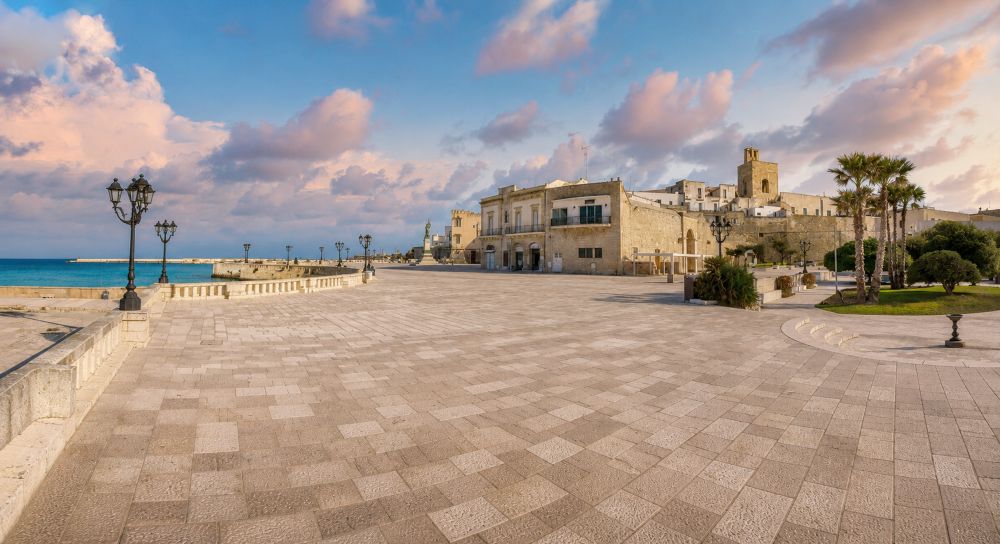
The harbour explains why Otranto exists.
Its scale today is modest, but historically this was one of the ports connecting southern Italy with the Balkans and Greek world.
Ships brought goods, officials, pilgrims and soldiers.
The same water that enriched the city also exposed it to attack.
Walk to the harbour edge and look back.
The walls, castle and Cathedral align far more logically from the water than from inside the streets.
Otranto was built to be seen from the sea.
Torre del Serpe
South-east of town, the ruined Torre del Serpe has become one of Otranto’s symbols.
The surviving vertical fragment stands on an exposed coastal hill above the Adriatic.
The site is associated with older watch and lighthouse structures used to guide maritime traffic.
Its name generated one of Otranto’s most persistent legends.
According to tradition, a serpent climbed the tower and drank the oil intended to keep the navigation light burning.
One night the extinguished light caused a hostile fleet to miss the harbour and continue elsewhere.
It is a good story.
Treat it as a legend.
The real importance of the tower lies in Otranto’s long dependence on coastal signalling and surveillance.
The Bauxite Quarry

Few landscapes around Otranto produce such violent colour contrast as the former bauxite quarry south of town.
Mining exposed iron-rich earth whose red and orange tones surround a small pool of intensely coloured water.
Mediterranean vegetation grows around the edges.
The Adriatic lies nearby.
The landscape looks almost extraterrestrial in photographs.
It is not a natural lake.
The quarry is an abandoned industrial extraction site gradually reclaimed by vegetation and water.
Visit for the landscape, but stay on established paths.
The steep quarry edges are unstable and the coloured water is not a swimming spot.
Baia delle Orte
Continue beyond the quarry and the landscape becomes quieter.
Baia delle Orte is far less urban than Otranto’s central beaches and belongs to the protected coastal environment south of town.
Rocky shoreline, low Mediterranean vegetation and clear water replace beach infrastructure.
This is an excellent area for walking, especially outside the hottest summer hours.
From here the coast continues towards Punta Palascia.
Punta Palascia: The Eastern Edge of Italy
At Punta Palascia, or Capo d’Otranto, the Salento reaches the point conventionally identified as the easternmost point of mainland Italy.
The location is more powerful than the geographical statistic.
Low scrub covers the rocky coast.
The Adriatic opens uninterrupted towards the eastern horizon.
On exceptionally clear days, the mountains across the sea may become visible.
Sunrise is the obvious moment.
Otranto receives the eastern light before most of Italy.
That simple geographical fact has given Punta Palascia a symbolic importance far beyond the small lighthouse standing there.
Faro di Punta Palascia
The lighthouse was constructed in 1867 and served maritime navigation for more than a century.
After a period of abandonment, it was restored in the early twenty-first century.
The building now functions as one of the principal cultural and environmental symbols of the Otranto coast.
Do not assume unrestricted interior access every day.
Opening arrangements can change according to season and programming.
The coastal walk and exterior landscape remain worthwhile regardless.
The Otranto–Leuca Coastal Road
South of Punta Palascia begins one of the most beautiful drives in Puglia.
The SP87/SP358 coastal route towards Santa Maria di Leuca follows cliffs, coves, watchtowers and small settlements.
Torre Sant’Emiliano appears above the coast.
Porto Badisco creates a natural inlet.
Santa Cesarea Terme introduces nineteenth- and early-twentieth-century resort architecture.
Castro occupies another dramatic coastal setting farther south.
Trying to complete the entire route as a rapid out-and-back from Otranto misses the point.
Choose stops.
The coastline deserves time.
Porto Badisco
Porto Badisco lies south of Otranto in a narrow bay protected by rocky headlands.
Classical tradition connected the area with Aeneas, who was believed to have landed along this coast after escaping Troy.
Virgil’s Aeneid describes an Italian landfall in the region, although attempting to identify one precise modern beach as the literary site requires caution.
The bay’s real significance is not dependent on epic poetry.
It is also close to one of the most important prehistoric discoveries in southern Italy.
Grotta dei Cervi
Near Porto Badisco lies the Grotta dei Cervi, discovered in 1970.
Its underground chambers contain thousands of prehistoric painted and abstract signs, making it one of the most extraordinary Neolithic ritual complexes in Europe.
Human figures, geometric symbols, animals and hunting scenes cover sections of the cave system.
The paintings are extremely fragile.
The cave is not open for ordinary tourist visits.
That restriction is essential to their preservation.
Reproductions and interpretive material elsewhere in the region provide the only practical way for most visitors to encounter the imagery.
Do not plan a trip expecting to enter the cave.
Baia dei Turchi
North of Otranto, the coastline changes.
Baia dei Turchi is one of the most celebrated beaches in Salento, protected by low cliffs, Mediterranean vegetation and pine woodland.
The name connects the bay with the Ottoman invasion of 1480, although the precise geography of troop landings and movements was more complex than the modern place-name suggests.
The beach is small enough that summer pressure matters enormously.
July and August mornings should begin early.
Outside peak season, the same coast becomes almost completely different.
May, June, September and October are far better for walking and landscape.
Laghi Alimini
Farther north lie the Laghi Alimini, two coastal water bodies surrounded by wetland, woodland and Mediterranean vegetation.
Alimini Grande and Alimini Piccolo differ in hydrology and ecological characteristics.
The surrounding environment creates an important habitat for birds and plant life, while the nearby coast contains long sandy beaches more spacious than those immediately around Otranto.
This is the best direction if your priority is sand rather than rock.
The Best Beaches Around Otranto
The answer depends on what you want.
For convenience, use the small beaches immediately beside the town.
For a classic protected Salento bay, choose Baia dei Turchi.
For longer sandy stretches, continue towards Alimini.
For rocky water and fewer facilities, go south towards Baia delle Orte.
For dramatic coastal scenery rather than conventional beach time, drive towards Porto Badisco and Santa Cesarea Terme.
Otranto works particularly well because all of these landscapes sit within a relatively short distance.
What to Eat in Otranto
Otranto’s table belongs to Salento, but the sea changes the balance.
Fish and seafood are naturally important: octopus, mussels, squid, sea urchins when legally available and in season, red mullet, local catch and shellfish all appear regularly.
Then come the inland staples.
Orecchiette arrive with tomato, vegetables or stronger sauces.
Ciceri e tria combines chickpeas with pasta in which part of the pasta is fried, creating a mixture of soft and crisp textures.
Fave e cicorie pairs dried broad-bean purée with bitter wild greens.
Friselle are twice-baked breads softened with water and dressed with tomato, olive oil and other toppings.
Pittule are small fried dough pieces, particularly associated with festive periods.
Then there is pasticciotto, better associated with Lecce and the wider Salento than Otranto specifically, but entirely at home on a breakfast counter here.
Seafood in Otranto
The most important rule is seasonal simplicity.
A fish restaurant beside the Adriatic does not become better because it places twelve species on one plate.
Look for the catch of the day.
Grilled fish, raw preparations when carefully handled, pasta with shellfish and simple frying often reveal more than elaborate sauces.
Sea urchins deserve particular caution.
Harvest is regulated and stocks are vulnerable.
Availability should follow legal seasons and sustainable sourcing, not visitor expectations.
Ciceri e Tria
This is one of Salento’s most distinctive pasta dishes.
Chickpeas provide the base.
Fresh pasta is divided into two preparations: one portion is boiled, another fried.
The fried pasta gives the finished dish an irregular crunch that transforms what would otherwise resemble a straightforward chickpea soup.
The recipe demonstrates how scarcity can generate technique.
A few simple ingredients produce several textures.
Wine Around Otranto
The wider Salento wine landscape is dominated by red grapes capable of handling intense heat.
Negroamaro is the principal regional reference.
Primitivo becomes increasingly important farther west.
Rosato has deep traditions in Salento and deserves much more attention than generic summer-drinking stereotypes suggest.
Around Otranto, ask for local Negroamaro-based reds and rosati rather than automatically choosing international varieties.
The salty, herbal character of the coast often makes rosato particularly convincing with seafood.
Where to Eat in Otranto
LaltroBaffo Ristorante
Only a few steps from the Cathedral, LaltroBaffo is the address to choose when dinner should move beyond a conventional seaside trattoria. The kitchen remains connected with Salento and the Adriatic but uses a more contemporary, carefully composed approach.
Address: Via Cenobio Basiliano 23, 73028 Otranto
Telephone: +39 0836 801636
Cuisine: contemporary Salento, seafood
Price level: approximately €40–90
Best for: the more ambitious dinner inside the historic centre.
Materia Hostaria in Otranto
Materia is another strong option for travellers who want contemporary cooking without losing the connection with Puglian ingredients. It sits outside the most concentrated tourist streets, making it particularly useful for a slower evening away from the central promenade.
Address: Via Rita Levi Montalcini 105, 73028 Otranto
Telephone: +39 376 0899980
Cuisine: contemporary Italian and Salento
Price level: approximately €30–80
Best for: modern regional cooking and a quieter dinner.
Vecchia Otranto
Vecchia Otranto stays closer to the classic maritime identity of the town. Fish and seafood dominate, making it a useful choice when the objective is a traditional meal rather than contemporary reinterpretation.
Address: Corso Garibaldi 52, 73028 Otranto
Telephone: +39 0836 801575
Cuisine: seafood, Salento
Price level: approximately €20–40
Best for: a straightforward fish dinner in the old town.
La Pignata
La Pignata is the better choice when you want to move away from an exclusively seafood-driven meal and return to the broader Salento repertoire. Pasta, vegetables, meat and regional recipes give it a more traditional trattoria identity.
Address: Corso Garibaldi 7, 73028 Otranto
Telephone: +39 0836 801284
Cuisine: traditional Salento
Price level: approximately €20–30
Best for: ciceri e tria, local pasta and regional cooking.
Vicolo Matto Fishbar
For a less formal seafood meal, Vicolo Matto provides a practical alternative to a full restaurant dinner. The format suits lunch particularly well during a day divided between the historic centre and the coast.
Address: Via Ciatara 13, 73028 Otranto
Telephone: +39 389 5936251
Cuisine: fish and seafood
Price level: approximately €20–50
Best for: casual seafood and lunch.
Where to Stay in Otranto
For a first visit, there are two sensible strategies.
Stay inside or immediately beside the historic centre if the priority is walking to the Cathedral, castle and restaurants.
Stay in a masseria outside town if swimming pools, countryside and a car-based Salento itinerary matter more.
Historic-Centre Choice – Palazzo De Mori
Palazzo De Mori occupies an exceptional position on the bastions overlooking the sea. This is the best fit for travellers who want Otranto itself to remain present even when they are inside the hotel.
The old town, Cathedral and castle are only minutes away on foot.
Address: Bastione dei Pelagi, 73028 Otranto
Telephone: +39 0836 801088
Category: B&B / historic residence
Price level: €€€
Best for: sea views and sleeping directly inside the fortified centre.
Mid-range – Relais Valle dell’Idro
Valle dell’Idro sits slightly outside the most compact historic streets while remaining comfortably walkable to the centre. It provides a useful balance for travellers who want more hotel facilities without moving into a rural resort.
Address: Via Giovanni Grasso 4, 73028 Otranto
Telephone: +39 333 1249301
Category: hotel
Price level: €€–€€€
Best for: walking access to town with a quieter setting.
Countryside Choice – Masseria Muntibianchi AgriResort Restaurant & SPA
Muntibianchi works better for a multi-night Salento stay than for a one-night cultural stop. The masseria setting, pool and spa make the property part of the holiday rather than simply accommodation between monuments.
Address: SP277, 73028 Otranto
Telephone: +39 327 6993625
Category: masseria / agritourism resort
Price level: €€€
Best for: countryside, relaxation and travellers with a car.
Splurge – Baglioni Masseria Muzza
Masseria Muzza is the full luxury option outside Otranto, positioned near the Alimini area and combining traditional masseria architecture with resort services.
This makes most sense for travellers spending several nights on the coast rather than using Otranto as a quick overnight stop.
Address: Contrada Fontanelle 80, 73028 Otranto
Telephone: +39 0836 237686
Category: luxury masseria resort
Price level: €€€€
Best for: a resort stay with easy access to Otranto and the northern beaches.
How Many Days Do You Need?
One full day is enough for the old town, Cathedral, San Pietro and Castello Aragonese, followed by sunset along the walls.
That is the minimum.
Two days are ideal.
Use the second for Baia dei Turchi or Alimini in the morning and Punta Palascia, Torre del Serpe and the bauxite landscape during the afternoon.
Three days allow Otranto to become a base for the southern Adriatic coast.
Add Porto Badisco, Santa Cesarea Terme and Castro without abandoning the town every morning immediately after breakfast.
A One-Day Otranto Itinerary
Begin at the Cathedral shortly after opening.
Give the mosaic at least thirty minutes rather than walking directly down the central nave towards the Martyrs’ Chapel.
Visit the crypt.
Then move to San Pietro.
Continue through the old streets towards Castello Aragonese and spend around an hour inside.
Walk the walls and Torre Matta before lunch.
During the afternoon, take the seafront south towards the bauxite quarry and Baia delle Orte if you have a car or are comfortable with a longer walk.
Return to town for the evening.
Have an aperitivo along the waterfront, then dinner inside the old centre.
A Two-Day Otranto Itinerary
Keep day one entirely focused on historical Otranto.
On day two, drive north early to Baia dei Turchi before the beach fills.
Continue towards Alimini for a broader coastal landscape.
Return to Otranto for lunch.
During the late afternoon, drive south to the former bauxite quarry, walk towards Baia delle Orte and finish around Punta Palascia.
This sequence gives the city two different seas.
The north is sandy and protected.
The south is rocky, exposed and more dramatic.
A Three-Day Otranto Itinerary
Use the third day for the Adriatic coast towards Santa Maria di Leuca.
Do not attempt to reach Leuca without stopping.
Start at Punta Palascia if you did not see it properly the previous day.
Continue towards Torre Sant’Emiliano and Porto Badisco.
Then stop at Santa Cesarea Terme and Castro.
Return to Otranto for the final night rather than relocating constantly.
The distances are manageable enough that one base works well.
Otranto with Children
Otranto is relatively easy with children because the historic centre is compact and beaches sit close to town.
The Cathedral mosaic can become surprisingly effective if treated as a medieval search game rather than an art-history lecture: elephants, fantastic creatures, biblical stories and strange figures are easy to spot.
The castle provides another obvious success.
For beaches, Alimini generally provides more space than the smallest coves immediately around town.
The old town contains stairs and irregular paving, so strollers are not equally comfortable everywhere.
Getting to Otranto
Otranto lies roughly 45 kilometres southeast of Lecce.
By car, the journey is straightforward and gives the greatest freedom once the itinerary begins extending towards beaches and the southern coast.
Public transport is possible, especially during the main season, but it requires more planning.
The local railway belongs to the Ferrovie del Sud Est network and links Otranto with the Salento rail system through connections inland.
Journey times are significantly slower than driving.
If the trip is based entirely around Otranto town and one or two organised beach transfers, a car is not essential.
For a serious exploration of the coast, it is.
Otranto by Train
The railway station lies outside the fortified centre but remains within walking distance.
Services connect through the Ferrovie del Sud Est network rather than the high-speed national railway system.
Travellers arriving from Bari, Brindisi or other major Italian cities normally reach Lecce by Trenitalia and continue using regional connections or road transport.
Do not assume a direct fast Lecce–Otranto rail journey comparable with a conventional mainline route.
This is a branch-line system through Salento.
Do You Need a Car?
For the old town: no.
For the best beaches and coastal landscapes: yes, ideally.
Baia dei Turchi, Alimini, Punta Palascia, Porto Badisco and the coastal road towards Castro are much easier with independent transport.
The best compromise is to stay within walking distance of central Otranto and leave the car parked in the evening.
ZTL in 2026
During the main summer season, access restrictions become particularly important.
From 15 June to 15 September 2026, seasonal ZTL controls operate again.
The electronic gate on Via Cappuccini is active from 20:00 to 06:00.
The gate on Via San Francesco di Paola is active from 18:00 to 06:00.
Do not follow satellite navigation blindly into the centre.
If your hotel lies within a restricted area, obtain the hotel’s precise access and licence-plate instructions before arrival.
Parking in Otranto
In summer, parking strategy matters much more than the physical distance between the car and the old town.
Arrive early for day visits.
Use designated public parking outside the most restricted centre and continue on foot.
If staying overnight, choose accommodation with parking arrangements or obtain clear instructions before driving into Otranto.
A ten-minute walk is preferable to spending forty minutes circulating around the walls looking for a closer space that does not exist.
Best Time to Visit Otranto
For the best balance of sea, culture and manageable crowds, choose May, June, September or early October.
June is particularly effective.
Days are long, the water begins becoming comfortable and the extreme August pressure has not yet arrived.
September may be even better.
The Adriatic remains warm, evenings become more comfortable and the old town regains some breathing room.
July and August deliver the full seaside atmosphere but also the highest temperatures, busiest beaches and most intense evening crowds.
If travelling then, change your schedule.
Visit monuments early.
Go to the beach before lunch.
Rest during the hottest afternoon hours.
Return to the old town after sunset.
Winter is a completely different Otranto.
Restaurants and accommodation options reduce considerably, but the walls, Cathedral and sea acquire a stark atmosphere impossible to experience in August.
The Feast of the Martyrs
The most important annual religious period comes around 13–14 August, when Otranto commemorates the Martyrs of 1480.
Civil ceremonies, religious celebrations and processions bring the historical memory of the Ottoman siege directly into contemporary city life.
The dates fall in the middle of the busiest tourism period of the year.
If you want to experience the celebrations, book accommodation well ahead.
If your objective is a quiet historical visit, choose another week.
Otranto in 2026
The Cathedral opens 08:30–12:00 and 15:30–18:30.
Independent entry remains free. Visitors joining guided tours follow the current cultural-visit ticket structure, while groups of eight or more require advance booking.
From 1 March through 31 December 2026, the Museo Diocesano and Church of San Pietro are open again to cultural visitors.
San Pietro costs €3.
The Museo Diocesano costs €3.
The combined Cathedral + Museo Diocesano + San Pietro ticket costs €5.
The Castello Aragonese is open every day 09:00–12:00 and 15:00–18:00.
Summer ZTL restrictions run from 15 June to 15 September, with evening and overnight electronic controls on Via Cappuccini and Via San Francesco di Paola.
These details make the ideal schedule straightforward:
historic monuments in the morning, coast during the afternoon, old town again after sunset.
Useful Information
Region: Puglia
Province: Lecce
Area: Salento
Sea: Adriatic
Ancient name: Hydruntum
Main historical influences: Messapian, Roman, Byzantine, Norman, Aragonese and Ottoman
Main monument: Cathedral of Santa Maria Annunziata
Cathedral construction: 1080–1088
Cathedral consecration: 1 August 1088
Cathedral length: approximately 53 m
Cathedral width: approximately 25 m
Principal artistic work: Pantaleone’s floor mosaic
Mosaic date: 1163–1165
Mosaic surface: approximately 600 m²
Central mosaic motif: Tree of Life
Ottoman siege: 1480
Fall of Otranto: August 1480
Recovery by Aragonese forces: 1481
Martyrs traditionally commemorated: approximately 800
Martyrs canonised: 2013
Main fortress: Castello Aragonese
Castle address: Piazza Castello
Castle hours 2026: daily 09:00–12:00 / 15:00–18:00
Castle telephone: +39 0836 212745
Main Byzantine monument: Church of San Pietro
San Pietro ticket 2026: €3
Museo Diocesano ticket: €3
Combined Cathedral + Museum + San Pietro: €5
Cathedral autonomous visit: free
Cathedral hours: 08:30–12:00 / 15:30–18:30
Main northern beaches: Baia dei Turchi and Alimini
Main southern landscapes: bauxite quarry, Baia delle Orte, Punta Palascia
Punta Palascia: easternmost point of mainland Italy
Lighthouse construction: 1867
Major prehistoric site nearby: Grotta dei Cervi
Grotta dei Cervi public access: no
Historic Greek monastery: San Nicola di Casole
Main literary connection: Horace Walpole, The Castle of Otranto, 1764
Main August commemoration: Martyrs of Otranto, 13–14 August
Seasonal ZTL 2026: 15 June–15 September
Via Cappuccini gate: 20:00–06:00
Via San Francesco di Paola gate: 18:00–06:00
Nearest major rail hub: Lecce
Car necessary in old town: no
Car useful for coast: strongly recommended
Minimum stay: 1 full day
Ideal stay: 2 days
Best extended stay: 3 days
Best months: May–June and September–early October

