
Molfetta on the Adriatic, with Romanesque Architecture, Fresh Seafood and One of Puglia’s Great Maritime Festivals

Molfetta does not behave like the Puglia of whitewashed alleys and polished resort towns.
Its old centre sits directly against the Adriatic, wrapped around the peninsula of Sant’Andrea, with fishing boats moored beneath Romanesque towers and a working port extending west from the medieval streets. The stone is pale, the sea is close enough to smell from almost everywhere in the historic core, but this is still unmistakably a maritime city rather than a seaside stage set.
That difference is the reason to come.
Molfetta grew through trade, pilgrimage and fishing. Medieval ships connected it with Venice, Constantinople, Ragusa, Alexandria and Amalfi; pilgrims travelling between the Holy Land, Bari and Monte Sant’Angelo passed through its territory; its fishermen turned the harbour into one of the most important maritime economies on the central Adriatic coast of Puglia. The city was attacked and devastated in 1529, rebuilt, expanded beyond its medieval walls and eventually created the larger nineteenth-century port still visible today.
Two buildings immediately explain that history. The Duomo di San Corrado, with three domes aligned along its roof and two square towers facing the sea, is among the clearest expressions of Apulian Romanesque architecture. A short walk inland stands the later Cathedral of Santa Maria Assunta, created from the former Jesuit church and made cathedral in 1785 when the relics of San Corrado were transferred there.
Then Molfetta changes again.
Outside the compact centre lies the Basilica della Madonna dei Martiri, tied for centuries to pilgrims, fishermen and the great September sea procession. Farther inland, the Pulo di Molfetta opens suddenly in the limestone countryside: a large karst depression containing caves, prehistoric archaeological evidence and the remains of a Bourbon nitrate works.
The result is a destination with a much broader chronology than its harbour suggests.
One day is enough to understand the essentials.
Two nights are better if you want the Pulo, museums, seafood and the city after the evening passeggiata has replaced daytime traffic.
Things to See in Molfetta
- The old town on the Sant’Andrea peninsula
- Duomo di San Corrado
- The twin towers and cathedral terraces
- Via Piazza
- Piazza Municipio
- The harbour and Banchina Seminario
- Cathedral of Santa Maria Assunta
- Museo Diocesano
- Church of Santo Stefano
- Church of Santa Maria Consolatrice degli Afflitti
- Basilica della Madonna dei Martiri
- The Holy Sepulchre reconstruction
- The fishermen’s harbour
- Pulo di Molfetta
- Museo Civico Archeologico del Pulo
- The waterfront and Lungomare Colonna
- Festa della Madonna dei Martiri
The Old Town
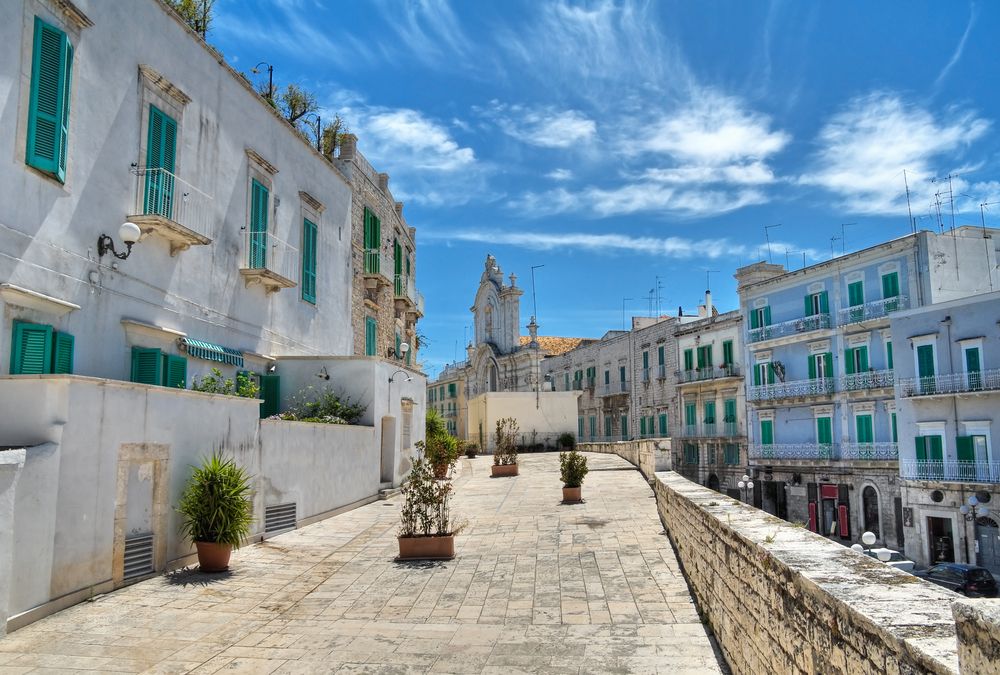
The historic centre occupies the peninsula of Sant’Andrea, projecting into the Adriatic between the harbour and open sea.
Its current appearance developed principally during the Middle Ages, although occupation around Molfetta is much older.
Municipal historical documentation is refreshingly cautious about romantic origin stories. While local tradition sometimes pushes the foundation back to Greek or Roman antiquity, secure written evidence for the urban settlement becomes much clearer between the 10th and 11th centuries. The medieval town already contained several churches and defensive structures.
The street plan remains particularly interesting.
Parallel streets run largely east-west across the narrow peninsula, originally linking the cathedral area with the former castle zone around what is now Piazza Municipio. Via Piazza cuts through them north-south and developed into the principal route across the old centre.
This is not the labyrinthine medina often imagined when people hear “Puglia old town.”
There is structure beneath the apparent irregularity.
Walk Via Piazza first.
Then deliberately leave it.
The smaller cross streets reveal stone stairways, arches, balconies, old palazzi and sudden fragments of sea at the end of narrow passages.
The Palazzata towards the Sea
One of the most distinctive features of old Molfetta is the line of buildings facing the Adriatic.
Municipal historical sources describe this as a kind of palazzata with both residential and defensive functions. Houses formed part of the town’s protective edge rather than sitting innocently behind a separate wall.
That relationship explains why the old centre sometimes feels almost sealed from the sea despite being surrounded by it.
The harbour side opens dramatically.
Other stretches remain architecturally defensive.
Molfetta grew from the assumption that the Adriatic brought opportunity and danger in equal measure.
Duomo di San Corrado
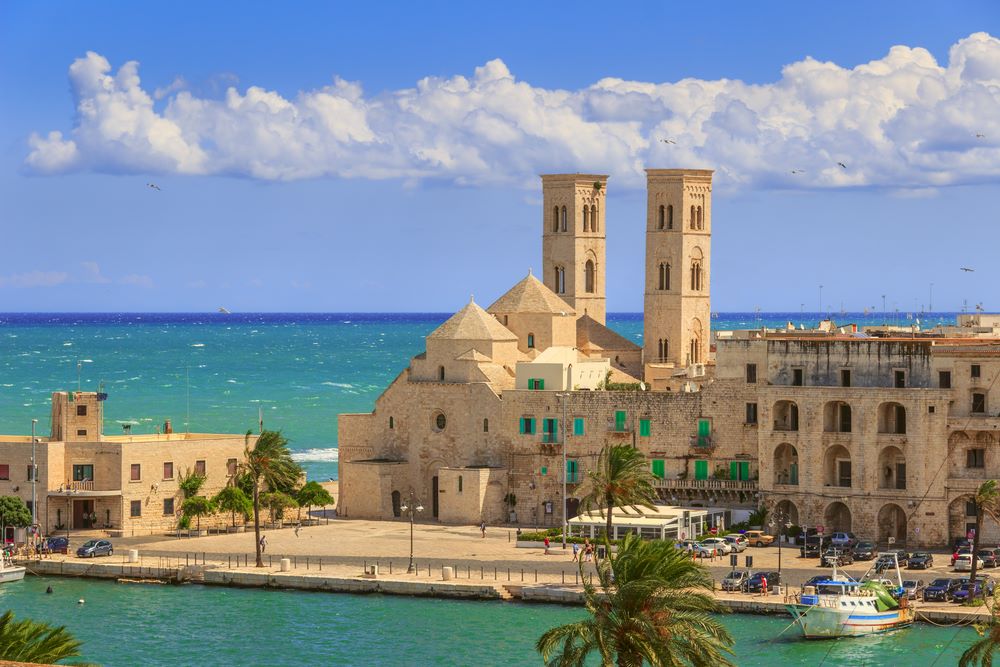
The Duomo di San Corrado, often called the Duomo Vecchio, is the monument that defines Molfetta visually.
It stands directly beside the harbour, its pale limestone mass rising almost from the water behind fishing boats and the old Dogana.
Construction took place between the 12th and 13th centuries, and the building belongs to the great Romanesque architectural culture that produced some of Puglia’s finest medieval churches.
Yet Molfetta’s cathedral does not simply copy Bari or Trani.
Its silhouette is unmistakable.
Three domes rise in sequence along the central nave, while two tall square towers dominate the eastern end.
One functioned as a bell tower.
The other also had a defensive and lookout role towards the sea.
That dual function could hardly be more appropriate for Molfetta.
Church and maritime defence occupy the same skyline.
The Three Domes
The most characteristic feature of the Duomo is the sequence of three domes aligned along the central axis.
From ground level they are partly hidden by the surrounding structures.
From elevated viewpoints or the harbour, the rhythm becomes much clearer.
The central nave does not terminate under one monumental crossing dome. Instead, the roof develops as a sequence of vaulted volumes.
Inside, this creates changing vertical emphasis as you move along the church.
The oldest and most richly articulated dome stands around the transept.
This is one of those buildings where looking at the roof plan is almost as important as looking at the façade.
The Twin Towers
The towers are what make the church visible from the sea.
Their square mass, narrow openings and relative austerity give the eastern side something close to the profile of a fortified religious complex.
The maritime context matters.
Medieval Molfetta was a commercial and pilgrimage port exposed to instability along the Adriatic.
A tower capable of surveillance was practical infrastructure.
Today the pair produces one of Puglia’s strongest harbour silhouettes.
In summer 2026, special Saturday evening visits during July and August again allow access to normally restricted areas, including the apsidal corridors and the connecting terrace between the towers, by prior reservation.
If one of those dates matches your stay, book it.
The view over the harbour gives a far clearer understanding of medieval Molfetta than another photograph from the quay.
The Exterior
Do not judge the Duomo from one façade.
The southern side preserves particularly important details, including the coat of arms of the former Bishop of Molfetta who became Pope Innocent VIII in 1484 and a small sundial.
At the apse, blind arches interlace with decorative motifs showing the Mediterranean vocabulary typical of Apulian Romanesque architecture.
One window includes pseudo-Cufic decoration and stylophorous lions, revealing how Islamic and eastern visual languages entered Christian stone carving through the intense cultural exchanges of medieval southern Italy.
This is why “Romanesque” should never be understood as a single European style repeated from Normandy to Puglia.
In Molfetta, the Romanesque faced the Adriatic.
Its visual vocabulary absorbed that geography.
Inside the Duomo
The interior is divided into three naves by substantial cruciform piers.
Their capitals carry zoomorphic, anthropomorphic and vegetal carving.
The spatial effect is robust rather than delicate.
This is not the soaring Gothic architecture of northern Europe.
The building works through stone mass, rhythmic arches and domed volumes.
One particularly unusual object stands near the southern entrance: the 12th-century acquasantiera del Saraceno, supported by a carved figure with African features.
A 13th-century stone relief traditionally called the Redentore has meanwhile been reused as the base of the altar.
These pieces remind you that medieval churches are not static constructions.
Objects move, functions change and later liturgy reorganises older material.
San Corrado of Bavaria

The Duomo’s present dedication is linked with San Corrado il Guelfo, patron saint of Molfetta.
Corrado was a young nobleman associated with the Welf dynasty who entered religious life and attempted a pilgrimage towards the Holy Land during the early twelfth century.
He died in Puglia around 1126 and was buried near Modugno.
After the monastic community there disappeared, his remains were transferred to Molfetta, probably during the first half of the fourteenth century, and he became patron of the city.
His relics remained in the old cathedral until 10 July 1785, when they were transferred to the new Cathedral of Santa Maria Assunta.
That distinction matters.
The Duomo still carries his name and historical identity.
The relics are now elsewhere.
Piazza Municipio
Move deeper into the old centre towards Piazza Municipio.
This area marks the other principal pole of medieval Molfetta.
The town’s castle once stood nearby before being destroyed in 1416, leaving the Duomo and this civic zone as opposite anchors of the old street network.
The square itself does not have the theatrical coherence of a famous Italian piazza.
That is not the reason to come.
It helps explain the dimensions of the medieval settlement.
From here, old Molfetta suddenly feels very small.
Via Piazza
Via Piazza is the structural spine of the old centre.
Its apparent simplicity is useful after the enclosed side streets.
Walk north and south through it several times during the day.
Morning belongs more to residents and deliveries.
Evening belongs to walking, conversation and restaurant tables.
The difference is significant.
Molfetta is much more convincing after sunset than during the middle of a hot August afternoon.
The Harbour
Molfetta and its port cannot be separated.
A first small harbour structure existed beside the Duomo by the early modern period, but the expansion of fishing and commercial traffic made a larger protected harbour increasingly necessary.
In 1824, the municipality commissioned a major new port project. Construction began in 1844 under a programme supported by King Ferdinand II, with the creation of the San Corrado and San Michele piers and a lighthouse. Expansion continued later in the nineteenth century as maritime traffic increased.
This is important because visitors sometimes interpret the harbour as merely picturesque scenery.
It was industrial infrastructure.
And in many ways it still is.
Fishing Boats and the Working Port
Molfetta remains one of Puglia’s major fishing centres.
That does not mean every colourful boat in the harbour belongs to a romantic disappearing world.
Fishing is business.
Boats leave, return, unload, require repair and occupy working quays.
Respect barriers and working areas rather than treating every mooring as an extension of the promenade.
The reward is a waterfront that feels considerably more alive than many over-curated coastal destinations.
Banchina Seminario
The quay beside the old centre is one of the best walking areas.
The Duomo, old palace architecture, fishing boats and harbour water compress into a few hundred metres.
Come twice.
Morning provides working-port activity.
Evening provides reflections, warmer light and a much slower atmosphere.
If photography matters, blue hour is excellent.
The towers of San Corrado become far more dramatic once the harbour lights begin reflecting across the water.
Cathedral of Santa Maria Assunta
The current cathedral stands outside the oldest medieval nucleus.
Its history is almost the opposite of the Duomo.
Where San Corrado is Romanesque, compact and maritime, Santa Maria Assunta belongs to the Baroque and post-Tridentine expansion of Molfetta.
The church began during the seventeenth century as the Jesuit church of Sant’Ignazio di Loyola, attached to the Jesuit college. After the suppression of the order, the complex acquired a new diocesan function.
In 1785, Bishop Gennaro Antonucci transferred the cathedral, episcopal residence, seminary and parish functions to the former Jesuit complex. The relics of San Corrado arrived here at the same time.
Molfetta therefore has an old cathedral and a new one only a short walk apart.
Visit both.
The comparison is far more useful than deciding which is prettier.
Inside Santa Maria Assunta
The interior abandons Romanesque austerity.
Polychrome marble, stucco, decorative cartouches, floral ornament and sculpture create a much richer late-Baroque environment.
Six side chapels open from the nave, many historically connected with prominent local families.
The major painting is the Assumption by Corrado Giaquinto, dated 1747.
Giaquinto was born in Molfetta and became one of the major decorative painters of the European eighteenth century, working in Naples, Rome, Turin and Madrid.
Seeing one of his large works in his home city is therefore particularly appropriate.
A second important painting, the Addolorata by Fedele Fischetti, dates to 1778.
Corrado Giaquinto
Giaquinto deserves more than a passing name in an artwork label.
Born in Molfetta in 1703, he developed a brilliant late-Baroque and Rococo style built around luminous colour, theatrical movement and sophisticated decorative composition.
His career became international.
He eventually worked for the Spanish court and influenced later painters in Madrid.
Molfetta’s cathedral reconnects that cosmopolitan career with the city where it began.
If you are interested in painting, this section of the trip matters just as much as the Romanesque churches.
Museo Diocesano
The Museo Diocesano occupies the elegant rooms of the former seventeenth-century Jesuit college.
Its collections are much broader than the name suggests.
The visit begins with archaeology, including Neolithic and pre-Roman material largely associated with the Pulo di Molfetta. Pottery fragments, flint tools, loom weights and traces of prehistoric settlement reconstruct daily life thousands of years before the medieval port existed.
The museum then moves through liturgical textiles, sculpture, reliquaries and material from Molfetta’s religious institutions.
One lapidary section preserves fragments from the old Duomo.
Other rooms contain the historic statues used in Holy Week processions, one of the city’s strongest surviving traditions.
Giuseppe Maria Giovene
The museum’s archaeological collections also tell an interesting eighteenth-century intellectual story.
Many prehistoric objects were gathered by Giuseppe Maria Giovene, an archpriest with strong interests in natural science, archaeology and mineralogy.
He later donated collections of archaeological material, minerals, natural history objects, coins, Italic-Greek pottery and books to the diocesan seminary.
This is worth noticing.
The Pulo was not “discovered” by modern tourism.
It had already attracted scientific curiosity during the Enlightenment.
Basilica della Madonna dei Martiri
Northwest of the centre stands the Basilica della Madonna dei Martiri, one of the key places for understanding Molfetta’s relationship with pilgrimage and the sea.
The original church was founded in 1162 outside the medieval walls.
It developed beside a hospital serving pilgrims travelling the Adriatic route connecting the Holy Land, Bari and the sanctuary of San Michele on the Gargano.
The current sanctuary is largely the result of a major 1829 enlargement, although medieval traces remain in the older structures around the main altar.
This is not just another church on the edge of town.
For centuries it functioned as a religious point on an international pilgrimage corridor.
Why “Madonna dei Martiri”?
The title is connected with pilgrims described as martyrs of Christ, including travellers associated in local tradition with deaths during journeys towards the Holy Land.
The sanctuary developed around both Marian devotion and the memory of pilgrims.
That maritime association has never disappeared.
The Madonna dei Martiri remains closely linked with Molfetta’s fishermen and seafaring community.
The Icon
The basilica preserves the revered icon of the Madonna dei Martiri, which local tradition says arrived from the sea.
The documented growth of the cult became particularly important during the late Middle Ages.
In 1399, King Ladislaus granted Molfetta the right to hold the fair associated with the Madonna, fixed around 8 September.
That connection between devotion and commerce is thoroughly medieval.
A major pilgrimage feast did not simply fill churches.
It filled markets.
Innocent VIII and Molfetta
The sanctuary has another connection with Giambattista Cibo, formerly bishop of Molfetta and later Pope Innocent VIII.
During the late fifteenth century, Cibo supported the sanctuary and commissioned a stone setting for the icon.
After becoming pope, he granted indulgences associated with pilgrimage to the church.
That papal connection adds another layer to Molfetta’s religious importance during the late Middle Ages.
The Holy Sepulchre
Beside the sanctuary is one of its most unusual features.
An underground environment contains a 16th-century reconstruction of the Holy Sepulchre of Jerusalem, traditionally said to have been built using stones brought from the Holy Land by the nobleman Bernardino Lepore.
Whether approached devotionally or architecturally, the meaning is clear.
Medieval and early modern pilgrimage tried to compress distant sacred geography into local space.
Jerusalem became physically imaginable in Molfetta.
Michele Damasceno
The basilica also contains a Madonna del Rosario dated 1574 by Michele Damasceno, a Cretan painter associated with the late Byzantine tradition.
The painting includes historical figures such as Cesare Gonzaga and Bishop Maiorano Maiorani.
This is another reminder of the Adriatic dimension of Molfetta.
The city’s cultural history did not run only west towards Naples and Rome.
It also faced Greece and the eastern Mediterranean.
The Festa della Madonna dei Martiri
If there is one event capable of showing Molfetta at maximum intensity, it is the Festa della Madonna dei Martiri in September.
The central ritual is the Sagra a Mare on 8 September.
The statue leaves the basilica and is entrusted to fishermen before being carried to the harbour and placed aboard a decorated fishing vessel, accompanied by other boats.
The relationship between saint, fishermen and sea could hardly be more explicit.
This is not maritime folklore invented for visitors.
The modern procession continues a tradition documented since the nineteenth century and rooted in a much older devotional relationship between the sanctuary and seafaring community.
The Festa in 2026
The 2026 fair is scheduled for 7, 8 and 9 September, with the Sagra a Mare again forming the central moment on 8 September. Municipal documentation confirms the 2026 fair dates, while the current festival programme extends celebrations beyond those central days.
If you want ordinary Molfetta, do not come that week.
If you want the city at its most emotionally and visually intense, come specifically for it.
Accommodation should be booked in advance.
Pulo di Molfetta
The most surprising attraction lies away from the sea.
The Pulo di Molfetta is a large karst doline created in the limestone landscape outside town.
Its steep walls contain caves, vegetation and archaeological deposits revealing human occupation from prehistoric periods.
The site is important enough that objects recovered from the Pulo form a significant section of the Museo Diocesano and local archaeological collections.
Standing there after a morning in the harbour feels almost like changing region.
The sea disappears.
Geology takes over.
A Prehistoric Landscape
Archaeological evidence around the Pulo includes material connected with Neolithic settlement, including pottery, stone tools, loom weights and traces of huts.
This moves Molfetta’s human history back thousands of years before its medieval documentation.
The Pulo therefore should not be treated simply as a natural curiosity.
It is both geological and archaeological.
The Bourbon Nitriera
Then the site changes period dramatically.
During the second half of the eighteenth century, caves around the Pulo attracted attention because deposits contained nitrates, important in the manufacture of gunpowder.
The Bourbon administration encouraged scientific investigation and developed a nitriera, a proto-industrial complex associated with nitrate processing.
Archaeological work has since brought parts of that operation back to light.
So within one depression you move from Neolithic settlement to Enlightenment science and military chemistry.
That is why the Pulo deserves more than a quick photo stop.
Visiting the Pulo
Access is controlled.
The municipality currently states that visits are organised by reservation, with small groups and appropriate footwear required.
Reservations are handled through the Molfetta Info Point.
Do not simply arrive at the entrance and assume it operates like an urban park.
The controlled format is appropriate.
This is an archaeological and natural site with uneven terrain.
Museo Civico Archeologico
Combine the Pulo with the local archaeological museum if opening arrangements allow.
The two work much better together than independently.
At the site you see geology and spatial context.
At the museum you can study the material left by people who actually inhabited or used that landscape.
The same logic applies in Molfetta as it does at major archaeological destinations:
landscape without objects is incomplete.
Objects without landscape become abstract.
Santo Stefano
The Church of Santo Stefano is particularly important during Molfetta’s Holy Week traditions.
The city’s confraternities preserve processional rituals involving sculptural groups and devotional images carried through the streets.
Visitors arriving outside Easter may find the church quieter and less visually dramatic than the Duomo or cathedral.
Its importance is cultural.
Molfetta’s religious identity has never been expressed only through monumental architecture.
Processions matter just as much.
Holy Week
Holy Week is one of the strongest periods for traditional religious culture in Molfetta.
The Museo Diocesano preserves old processional statues connected with these rites, while local confraternities continue to organise ceremonies through the city.
This is another excellent time to visit if ritual culture interests you more than beach weather.
Spring also avoids the hardest summer heat.
The Waterfront
Molfetta’s waterfront should not be reduced to one promenade.
The character changes as you move from the historic harbour towards Lungomare Marcantonio Colonna and the more open coast.
Near the Duomo, fishing boats and stone architecture dominate.
Farther along, the sea opens and the city becomes more modern.
This is where Molfetta stops resembling a medieval port and becomes a contemporary Adriatic town.
Walk at sunset.
The centre looks better from a distance than it does from many of its enclosed streets.
Swimming and Beaches
Molfetta is on the Adriatic.
That does not automatically make it the best classic beach destination in Puglia.
The coastline is more urban and rocky than the long sandy stretches found elsewhere, and parts are heavily connected with harbour infrastructure.
There are bathing areas and beach clubs outside the immediate centre, but if the primary objective is a week of effortless sand-and-sea tourism, other sections of the Puglian coast are easier.
Choose Molfetta for history, seafood, urban maritime character and access to the Adriatic.
Treat swimming as an addition.
What to Eat in Molfetta
This is a fishing city.
Begin there.
Raw seafood can include prawns, shellfish, cuttlefish and local fish according to season and availability.
Cooked preparations range from grilled or baked fish to seafood pasta, fried small fish and octopus.
One local name worth remembering is ciambotto, a mixed fish stew whose exact composition changes according to catch and household tradition.
Do not expect one canonical recipe.
That would contradict the entire point of fishermen’s cooking.
You cook what came back in the boat.
Raw Seafood
Puglia’s raw-seafood culture is serious, but use judgement.
Freshness and proper handling matter.
A beautiful plate of raw shellfish served beside the harbour still requires the same hygiene standards as anywhere else.
Choose reputable restaurants with obvious seafood turnover rather than buying romance by the kilo.
Octopus
Octopus belongs naturally to the local repertoire.
It may appear boiled, grilled, in salads or incorporated into more contemporary preparations.
The important distinction is texture.
Poorly cooked octopus is either rubber or paste.
Good octopus retains resistance without requiring combat.
Orecchiette and the Inland Kitchen
Do not spend every meal on fish.
Molfetta still belongs to central Puglia.
Orecchiette, vegetables, legumes, focaccia, burrata, local cheeses and olive oil connect the coastal city with the agricultural hinterland.
A good food itinerary should alternate.
Seafood at dinner is far more enjoyable when lunch was not also seven courses of seafood.
Focaccia
The Bari-style focaccia culture extends naturally north along this coastline.
Tomato, olive oil, olives and a crisp, oily base work particularly well as a casual lunch.
Buy a piece and eat it while walking rather than turning every meal into a reservation.
Travel writing occasionally forgets that food can simply be lunch.
Where to Eat
Malie
Malie
Malie is the more ambitious option in the historic centre, with a contemporary approach that moves beyond the standard fish-trattoria formula.
Its location on Via Macina makes it particularly useful for dinner after an evening walk through the old town.
Address: Via Macina 61, 70056 Molfetta
Telephone: +39 351 3038951
Cuisine: contemporary Italian and Puglian
Price level: approximately €30–40
Best for: a more polished dinner in old Molfetta
Sea Chef
Sea Chef
Sea Chef concentrates on fish and seafood and sits close enough to the historic centre to remain practical without depending on a car.
Address: Via San Domenico 7, 70056 Molfetta
Telephone: +39 080 9648076
Cuisine: seafood
Price level: approximately €20–30
Best for: a straightforward seafood meal near the centre
Ciambotto
Ciambotto
The name makes the intention obvious.
This is another useful choice for fish and seafood, particularly if you want a less formal dinner and are happy to move outside the tight medieval core.
Address: Via Tommaso Fiore 48, 70056 Molfetta
Telephone: +39 333 7780863
Cuisine: seafood
Price level: approximately €10–20
Best for: casual fish dinner
Chotto Chotto – Nippo Apulo Cuisine
Chotto Chotto – Nippo Apulo Cuisine
Chotto Chotto takes the least traditional direction, combining Japanese ideas with Puglian seafood.
Purists looking for a canonical Molfetta dinner should go elsewhere.
Travellers who have already eaten several traditional fish meals may find the crossover far more interesting.
Address: Lungomare Marcantonio Colonna 22, 70056 Molfetta
Telephone: +39 377 3403580
Cuisine: Japanese-Puglian seafood
Price level: approximately €40–80
Best for: contemporary seafood and a change from traditional cooking
Where to Stay
Molfetta has a smaller hotel market than Bari, Trani or some of Puglia’s major resort towns.
That can be an advantage if you choose carefully.
For a first visit, stay close to the old centre and harbour.
The ability to walk along the port before breakfast is worth more than a swimming pool beside a ring road.
Dogana Resort
Dogana Resort
Dogana Resort has by far the strongest location for a historic-centre stay.
It occupies a restored waterfront building on Banchina Seminario, immediately beside the old Duomo, with rooms overlooking either the sea or old town, plus spa facilities and a roof terrace facing the harbour. Its own material also confirms a restaurant and paid parking.
Address: Banchina Seminario 3, 70056 Molfetta
Telephone: +39 080 3978089
Email: [email protected]
Category: five-star hotel
Best for: the best harbour position, Duomo views and a higher-end city stay
MoMa – Molfetta Mare Sea Suites
MoMa – Molfetta Mare Sea Suites
MoMa is a smaller waterfront alternative occupying stone architecture close to the old centre.
Its format suits travellers who prefer intimate accommodation over a full-service resort.
Address: Via San Girolamo 38, 70056 Molfetta
Telephone: +39 080 3973406
Category: sea-view rooms / small accommodation
Best for: staying directly inside the historic waterfront area
SOGLOW Business Class Hotel
SOGLOW Business Class Hotel, Molfetta
SOGLOW sits outside the medieval core and has only 13 suites, positioning itself around contemporary design and larger accommodation rather than historical atmosphere.
Address: Via Terlizzi 1, 70056 Molfetta
Telephone: +39 080 3355812
Email: [email protected]
Category: suite hotel
Best for: space, business travel and guests arriving by car
BorgoAntico34
BorgoAntico34 – Luxury Room
BorgoAntico34 provides a small-scale room option closer to the central urban fabric.
Address: Via Domenico Picca 34, 70056 Molfetta
Telephone: +39 348 4121455
Category: rooms / B&B
Best for: a simpler independent stay close to the centre
How Many Days Do You Need?
A half day gives you the harbour, old town and Duomo.
That is enough for a stop.
It is not a guide to Molfetta.
A full day allows you to include Santa Maria Assunta, Museo Diocesano and the Basilica della Madonna dei Martiri.
Two nights are better.
Use the second day for the Pulo, archaeological collections and a slower walk along the coast.
Three nights make sense if Molfetta becomes a base for Giovinazzo, Bisceglie, Trani or Bari.
There is little benefit in staying longer if every day involves leaving by train or car for another city.
A One-Day Molfetta Itinerary
Begin at the harbour early.
Walk along Banchina Seminario before traffic and heat increase, then visit the Duomo di San Corrado.
Spend the rest of the morning inside the old centre, using Via Piazza as the main axis and exploring the side streets.
Continue towards Santa Maria Assunta and the Museo Diocesano before lunch.
Afterwards, walk to the Basilica della Madonna dei Martiri and explore the sanctuary and Holy Sepulchre area if accessible.
Return towards the waterfront in late afternoon.
Have dinner around the old centre or harbour.
Do not leave before sunset.
Molfetta’s architecture needs evening light.
A Two-Day Itinerary
Use day one entirely for urban Molfetta: Duomo, historic centre, port, cathedral, Museo Diocesano and Basilica.
On day two, reserve a visit to the Pulo di Molfetta.
Combine it with the archaeological museum and then return to town for a relaxed lunch.
Use the afternoon for the waterfront, swimming if conditions and season suit, or additional religious sites such as Santo Stefano.
This rhythm works much better than trying to fit the Pulo between cathedral visits.
The two experiences belong to completely different landscapes.
Getting to Molfetta from Bari
Molfetta is exceptionally easy to combine with Bari because it lies on the main Adriatic railway line heading north.
Regional trains connect Bari Centrale with Molfetta frequently, making the town practical without a car.
The railway station sits inland from the historic centre.
Allow roughly 15–20 minutes on foot to reach the harbour depending on pace and route.
For a day trip focused on the old town, train is easier than driving.
Getting to Molfetta from Bari Airport
Bari Karol Wojtyła Airport lies relatively close.
The simplest public-transport strategy usually involves connecting through Bari or another appropriate rail interchange according to the service available.
A taxi or transfer becomes more convenient with luggage.
If Molfetta is the beginning of a larger road trip through central and northern Puglia, collecting a car at the airport is reasonable.
If your trip consists of Bari, Molfetta, Giovinazzo and Trani, rail is perfectly viable.
Driving and Parking
Do not drive into the medieval peninsula without a specific reason.
The old centre is compact, roads are limited and walking is vastly easier.
Use parking around the broader waterfront or modern centre and continue on foot.
Hotel guests should request precise arrival instructions because properties inside or near the historic district may have different access arrangements.
Molfetta without a Car
Yes.
This is one of the more practical Puglian coastal destinations for rail travel.
The station gives access to Bari and the north-coast towns, while the major urban monuments are walkable.
The exception is the Pulo.
For that, independent transport, a taxi or an organised visit simplifies matters considerably.
When to Visit
April and May are excellent.
Temperatures suit walking and Holy Week can add substantial cultural interest.
June provides longer evenings without the most aggressive summer heat.
July and August bring full summer energy, but daytime temperatures make the inland streets considerably less pleasant.
Use mornings for monuments and evenings for walking.
September is probably the most culturally distinctive month because of the Madonna dei Martiri celebrations.
If you are not interested in the festival, come after the central dates and enjoy warm sea conditions with fewer crowds.
October remains attractive and considerably quieter.
Winter is viable because Molfetta is a real working city rather than a seasonal resort.
You lose beach weather.
You gain the harbour without summer staging.
Molfetta in 2026
The most useful current development is the renewed programme of access to the Duomo towers.
During July and August 2026, Saturday evening openings again provide reserved visits to normally inaccessible areas, including the apsidal corridors and terrace connecting the towers.
The Festa della Madonna dei Martiri remains the principal annual event. The municipal 2026 programme confirms the traditional fair on 7, 8 and 9 September, while the broader celebrations again centre on the 8 September Sagra a Mare and continue with religious and civic events afterward.
The Pulo continues to operate through reserved guided access rather than unrestricted entry, with bookings handled through the local tourism Info Point.
The municipal Info Point is open daily, with extended spring-summer hours from April through the beginning of November.
What I Would Prioritise
If you have only one day, there are five essentials.
First, the Duomo di San Corrado, because no other building explains Molfetta’s maritime Romanesque identity so quickly.
Second, the harbour, because the cathedral without the fishing port loses half its meaning.
Third, Santa Maria Assunta and Corrado Giaquinto, because medieval Molfetta is only one phase of the city.
Fourth, the Basilica della Madonna dei Martiri, because pilgrimage and fishing tradition are inseparable from local identity.
Fifth, the Pulo, if you have enough time for a second day.
That final site changes the chronology completely.
Molfetta suddenly stops beginning in the Middle Ages.
Useful Information
Region: Puglia
Metropolitan city: Bari
Sea: Adriatic
Historic nucleus: Sant’Andrea peninsula
Main medieval monument: Duomo di San Corrado
Duomo style: Apulian Romanesque
Duomo construction: 12th–13th centuries
Characteristic architecture: three aligned domes and two towers
Current cathedral: Santa Maria Assunta
Cathedral transferred: 1785
Patron saint: San Corrado of Bavaria
Major local painter: Corrado Giaquinto
Main religious sanctuary: Basilica della Madonna dei Martiri
Original sanctuary foundation: 1162
Main festival: Festa della Madonna dei Martiri
Sagra a Mare: 8 September
Fiera Madonna dei Martiri 2026: 7–9 September
Main archaeological site: Pulo di Molfetta
Pulo access: reservation required
Main museum: Museo Diocesano
Main economy traditionally associated with the city: fishing and maritime trade
Nearest major airport: Bari Karol Wojtyła
Railway: Adriatic line
Car necessary for historic centre: no
Car useful for Pulo: yes
Recommended stay: 1–2 nights
Best months: May, June, September and October

