
Luang Prabang for Curious Travellers: Royal Laos, Buddhist Ritual and a City Built Between Rivers

Luang Prabang is one of Southeast Asia’s rare cities where beauty does not depend on one monument. It comes from accumulation: saffron-robed monks moving silently through dawn streets, teak houses beneath frangipani trees, gilded temple roofs dropping almost to the ground, faded French façades, narrow lanes slipping between the Mekong and Nam Khan rivers, and green mountains rising immediately beyond the roofs.
The city sits on a peninsula at the confluence of the Mekong and Nam Khan, and that geography gives Luang Prabang much of its unusual harmony. There are no vast ceremonial avenues or aggressive modern towers. Instead, royal history, Buddhist monasteries, vernacular Lao houses and French colonial architecture remain woven together on a human scale. UNESCO recognised precisely this combination when Luang Prabang was inscribed as a World Heritage Site in 1995.
It is also a city with genuine historical weight. Once known as Muang Sua and later Xieng Thong, it became the capital of the powerful kingdom of Lan Xang, the “Kingdom of a Million Elephants,” before political power eventually shifted towards Vientiane. Luang Prabang nevertheless retained enormous religious and royal prestige, later becoming the seat of the Lao monarchy under the French protectorate.
Give it at least three days. Two cover the essential temples, palace and Kuang Si Falls, but a third day allows the city to breathe: morning market, Mekong boat, Pak Ou Caves, coffee, food and the quieter temples that make Luang Prabang feel like a living place rather than an architectural collection.
What to See in Luang Prabang
- Wat Xieng Thong
- Royal Palace Museum
- Mount Phousi
- Wat Mai Suwannaphumaham
- Wat Visoun
- Wat Aham
- Wat Sensoukharam
- Wat Xieng Mouane
- The old town and colonial streets
- Morning Market
- Night Market
- Mekong River
- Nam Khan River
- Tak Bat, the morning alms ceremony
- Kuang Si Falls
- Tat Kuang Si Bear Rescue Centre
- Pak Ou Caves
- Ban Xang Hai
- Traditional Lao textiles and craft workshops
A Short History of Luang Prabang
Luang Prabang has been settled for more than a thousand years and occupied a strategically valuable position where river routes connected northern Laos with China, Thailand and the wider Mekong region. Earlier names included Muang Sua and Xieng Thong, while the modern name derives from the Pha Bang, a highly revered Buddha image that became intimately linked with royal legitimacy.
In the fourteenth century the city became the capital of Lan Xang, founded by Fa Ngum and remembered as the Kingdom of a Million Elephants. The kingdom became one of mainland Southeast Asia’s significant political powers, controlling large territories along the Mekong and establishing Theravada Buddhism as a major element of royal identity.
King Setthathirath transferred the capital to Vientiane around 1560, partly for strategic reasons, but Luang Prabang retained its sacred importance. After Lan Xang fragmented in the early eighteenth century, the city became the centre of a smaller kingdom of Luang Prabang.
A catastrophic episode came in 1887, when Black Flag forces attacked and burned much of the city. French colonial intervention followed, and from 1893 Laos became part of French Indochina. Luang Prabang was rebuilt as a royal and religious centre, creating the architectural mixture that survives today: Lao monasteries and traditional wooden houses beside brick villas, balconies and administrative buildings influenced by French design.
The monarchy remained associated with Luang Prabang until the communist revolution of 1975, when the Lao People’s Democratic Republic was established.
Why Luang Prabang Is a UNESCO World Heritage Site
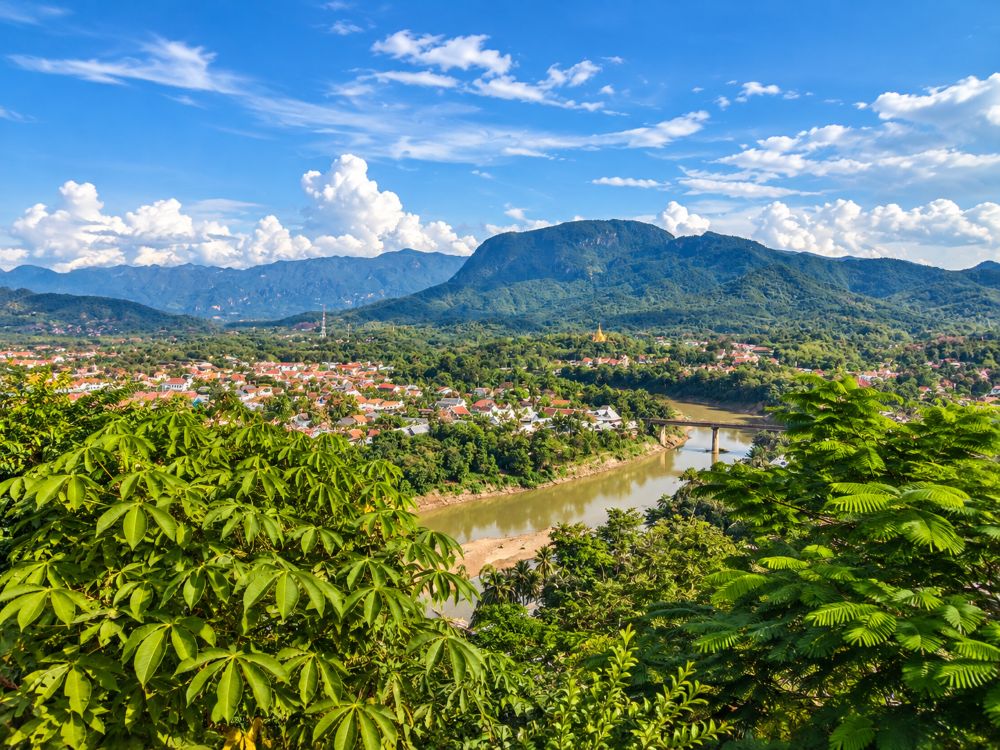
Luang Prabang was placed on the UNESCO World Heritage List in 1995, not simply because it contains old temples, but because the entire urban fabric preserves an unusually coherent fusion of traditions.
Traditional Lao houses are generally low, often built in wood with steep roofs and shaded verandas. Buddhist monasteries introduce richly decorated stone and timber architecture, while nineteenth- and early twentieth-century colonial buildings add stucco façades, wooden shutters, balconies and more European street proportions.
The result could easily have become visually chaotic. Instead, buildings remain unusually harmonious because scale, materials and vegetation tie them together.
The natural setting strengthens everything. Mount Phousi rises directly in the middle of town, while the Mekong and Nam Khan form the edges of the historic peninsula. Temples, gardens and riverbanks therefore remain connected in ways that rapidly modernising Asian cities have often lost.
Wat Xieng Thong
If you visit only one temple in Laos, make it Wat Xieng Thong.
King Setthathirath founded the monastery around 1560, shortly before transferring the capital from Luang Prabang to Vientiane. For centuries it remained closely connected with the Lao monarchy, serving as a setting for coronations, major religious ceremonies and royal funerals.
The main sim is one of the finest surviving examples of the classic Luang Prabang architectural style. Its multi-tiered roof sweeps dramatically downward until the lowest eaves seem almost to touch the ground, giving the building a broad, protective silhouette rather than the vertical emphasis common in many other Buddhist traditions.
Look carefully at the exterior walls. Gold stencil decoration covers dark surfaces with mythological figures, floral patterns and scenes from Buddhist stories, while one rear façade carries the famous Tree of Life mosaic, assembled from coloured glass against a deep red background.
Wat Xieng Thong is currently open daily from approximately 08:00 to 17:00, with foreign admission around 30,000 kip. Visit early: the architecture is easier to appreciate before tour groups arrive and morning light catches the roofs particularly well.
The Tree of Life Mosaic
The Tree of Life is one of Luang Prabang’s most recognisable decorative works, but it deserves closer attention than a quick photograph.
The mosaic dominates the rear wall of the main sim. A vast tree spreads across the surface, surrounded by animals and smaller figures rendered in coloured glass. The composition belongs to a broader Southeast Asian symbolic world in which trees connect different layers of existence and ideas of fertility, continuity and cosmology.
Its modern appearance can be misleading. Although Wat Xieng Thong is sixteenth century, parts of the decorative programme were restored or developed considerably later. Luang Prabang temples are living buildings, repeatedly repaired, repainted and renewed rather than archaeological ruins frozen at one historical moment.
That continuity is part of their authenticity.
The Royal Funeral Chariot Hall
Within the Wat Xieng Thong complex stands a building housing the enormous royal funeral carriage used for King Sisavang Vong, who died in 1959. The gilded vehicle is around twelve metres high and carries multiple naga heads projecting dramatically from the front.
Inside are elaborate funerary urns associated with members of the royal family, while exterior carvings recount episodes from the Lao version of the Ramayana, known as Phra Lak Phra Ram.
The hall provides an important reminder that Wat Xieng Thong was not simply a monastery admired for beautiful roofs. It was tied directly to the political and ceremonial life of the monarchy, including its final rites.
How Wat Xieng Thong Survived the Destruction of 1887
Much of Luang Prabang was devastated in 1887, but Wat Xieng Thong survived.
A frequently repeated local tradition explains that the leader of the attacking Black Flag forces had once spent time as a novice monk at the temple and therefore ordered it spared. The story is plausible and deeply embedded in the history of the site, although the exact circumstances surrounding the destruction of the city remain complex.
Whatever the reason, the survival is extraordinary. Without it, one of the clearest architectural links with royal Luang Prabang would have disappeared.
Royal Palace Museum
The former Royal Palace, or Haw Kham, sits on Sisavangvong Road directly opposite Mount Phousi. It was constructed between 1904 and 1909 for King Sisavang Vong, during the French protectorate, and its architecture deliberately combines European Beaux-Arts influence with Lao forms.
The palace is not enormous. That is one of its strengths. Rooms remain human in scale and make the vanished monarchy easier to imagine than the gigantic ceremonial residences of Bangkok or Phnom Penh.
Inside are royal reception rooms, religious objects, diplomatic gifts, furniture, weapons and personal possessions. One of the most historically important objects associated with the complex is the Pha Bang, the sacred Buddha image from which Luang Prabang takes its present name.
After the revolution of 1975, the royal residence was transformed into a museum. The last royal family did not continue living here, and their subsequent fate remains one of the darkest chapters in modern Lao history.
Allow at least an hour. Photography and baggage restrictions inside are strict, and modest clothing is expected.
The Pha Bang Buddha
Luang Prabang’s identity is tied to a Buddha image rather than a king.
The Pha Bang is a standing Buddha traditionally associated with Khmer craftsmanship and the spread of Theravada Buddhism into Laos. Its history is surrounded by legend, but by the Lan Xang period possession of the image had become closely linked with royal legitimacy.
The statue moved several times as kingdoms fought and capitals shifted, eventually becoming so strongly associated with the city that Xieng Thong acquired the name Luang Prabang, effectively the “Royal Pha Bang”.
The image is periodically carried in ceremonial procession, showing that it remains a sacred object rather than merely a museum treasure.
Mount Phousi
Mount Phousi rises directly from the centre of Luang Prabang, turning what might otherwise be a flat riverside town into a three-dimensional landscape.
The standard climb involves approximately 328 steps from the side facing the Royal Palace. At the top stands the golden That Chomsi stupa, rising about 20 metres above the summit and visible from much of the old town.
The panorama is excellent: Mekong on one side, Nam Khan on the other, temple roofs below and mountains closing the horizon.
Sunset is the famous time to climb.
It is also the busiest.
If you prefer the view to the crowd, go early in the morning or roughly an hour before peak sunset arrivals. Watching the town wake beneath mist can be more atmospheric than sharing the summit with several hundred phones.
Remember that Phousi remains a sacred site. Shoulders and knees should be covered, and alcohol is prohibited.
A Better Way Up Mount Phousi
Most visitors climb directly from Sisavangvong Road and return the same way. A better route is to cross over the hill.
Climb from the Royal Palace side, visit That Chomsi, then descend the opposite slope towards the Nam Khan. This route passes smaller shrines, Buddha images and shaded stairways before emerging into quieter streets.
The walk provides a much better sense of Phousi as a sacred hill rather than merely a sunset platform.
Wat Mai Suwannaphumaham
Next to the Royal Palace stands Wat Mai Suwannaphumaham, commonly shortened to Wat Mai. Originally founded in the eighteenth century, it developed into one of Luang Prabang’s most important monasteries and became closely connected with the royal family and senior Buddhist clergy.
The broad, multi-tiered roof is impressive, but the gilded relief work on the façade deserves the most time. Dense narrative panels depict scenes from Buddhist stories, everyday life, mythological beings and ceremonial processions, creating an almost continuous golden surface.
Wat Mai also plays an important role during Pi Mai Lao, the Lao New Year festival in April, when the Pha Bang Buddha is ceremonially displayed and ritually washed.
Visit it immediately before or after the Royal Palace rather than returning separately.
Wat Visoun
Wat Visoun, also known as Wat Wisunarat, is one of the oldest temples in Luang Prabang, originally founded in the early sixteenth century during the reign of King Visoun.
The current structure reflects later reconstruction after the devastation of 1887, but it remains historically significant and architecturally distinct from Wat Xieng Thong.
Its most memorable feature is the nearby That Makmo, literally the “Watermelon Stupa,” named for its unusually rounded dome. The shape is immediately recognisable and unlike the slender stupas scattered throughout much of the city.
Wat Visoun also preserves Buddha images and religious objects that give the interior a quieter, less theatrical character than the major royal temples.
Wat Aham
Beside Wat Visoun stands Wat Aham, a monastery linked with both Buddhism and older spiritual traditions.
Luang Prabang’s religious world has never been exclusively Buddhist. Beliefs involving phi, or spirits, remain deeply embedded in Lao culture, and Wat Aham has historical associations with protective guardian spirits of the city.
This coexistence matters. Theravada Buddhism spread through a landscape that already possessed powerful spirit cults, and rather than eliminating them completely, religious practice often absorbed and reinterpreted them.
Wat Aham is therefore worth a short stop precisely because it exposes a layer of Lao spirituality less obvious in the grand royal temples.
Wat Sensoukharam
Walking east along the peninsula towards Wat Xieng Thong, you pass Wat Sensoukharam, easily recognised by its intense red façade covered with gold decoration.
The monastery dates from the eighteenth century and underwent later restoration, creating the rich appearance seen today. It is particularly attractive in morning light, when the gold stencil work stands out sharply against the dark red background.
This is also one of the temples associated with the early-morning alms route, making it a useful place to understand the daily relationship between monasteries and surrounding neighbourhoods.
The Old Town
The great pleasure of Luang Prabang is not moving from temple A to temple B. It is walking between them.
The historic peninsula is narrow enough to cross from Mekong to Nam Khan in a few minutes. Sisavangvong Road forms the main spine, while side streets descend towards both rivers through a mixture of monasteries, cafés, colonial villas and traditional wooden houses.
Look at rooflines, shutters and verandas rather than only famous monuments. French colonial architecture introduced brick, stucco and balconies, but builders often retained proportions and roof forms sympathetic to local traditions.
The result is not a preserved European colonial quarter or an untouched Lao town. It is an architectural hybrid, which is precisely why Luang Prabang is so distinctive.
Tak Bat: The Morning Alms Ceremony
Before dawn, monks from Luang Prabang’s monasteries walk through the streets collecting food from local residents. This daily alms round, known as Tak Bat or Sai Bat, is one of the city’s most famous images and one of its most frequently mishandled traditions.
For local Buddhists, the ceremony is an act of merit-making, not a performance. Residents kneel quietly and place portions of sticky rice or other food into monks’ bowls as they pass.
If you want to observe, remain at a respectful distance, keep silent and avoid blocking the procession for photographs. Flash photography is particularly intrusive.
If you genuinely want to participate, arrange appropriate food in advance and learn the correct behaviour rather than purchasing random packaged offerings from aggressive roadside sellers at the last moment.
The ceremony is beautiful when treated as religion.
It becomes ugly very quickly when treated as theatre.
The Morning Market
After Tak Bat, walk to the Morning Market, which runs through narrow lanes behind the main tourist street on the Mekong side of town.
This is where Luang Prabang wakes up properly.
Tables and mats hold herbs, river fish, vegetables, mushrooms, sticky rice, chilli pastes, meat, dried buffalo, bamboo shoots and ingredients that rarely appear in hotel breakfasts. Depending on season, you may also see forest products collected from the surrounding mountains.
The market generally begins around 05:00–06:00 and winds down by late morning.
Come hungry. Small snacks, grilled foods and fresh fruit make this a far better breakfast lesson than another plate of generic eggs.
Luang Prabang Night Market
Every evening, a long section of Sisavangvong Road closes to traffic and becomes the Night Market. Around 250 vendors sell textiles, indigo cloth, ceramics, jewellery, handmade paper, bags, carved objects, tea, coffee and souvenirs produced by communities across northern Laos.
The market generally operates from 17:00 until around 22:00.
Not every item is handmade locally, so look closely if authenticity matters. Traditional textiles require enormous labour and should not cost the same as an industrially printed scarf.
The atmosphere is relaxed compared with many Southeast Asian night markets. Sellers rarely shout, and negotiation tends to be softer rather than confrontational.
The Food Market and Buffet Lanes
The Night Market is only half the evening story. Nearby alleys fill with inexpensive food stalls serving grilled meat, sausages, fish, noodle soups and vegetarian dishes.
One Luang Prabang institution is the vegetarian buffet, where customers fill a bowl or plate from trays of vegetables, noodles, tofu and rice for a fixed price. Quality varies enormously, so choose busy stalls where food turns over quickly.
More interesting are the grills. Look for skewered fish, pork, chicken, local sausages and smoky eggplant dishes, then add sticky rice and a fiery chilli dip.
This is where Beerlao becomes extremely persuasive.
Mekong River
The Mekong defines the western edge of Luang Prabang and has shaped the city’s trade, food, religious life and geography for centuries.
Late afternoon is the best time to walk the riverfront. Boats move slowly against a background of mountains, restaurants begin filling and the light turns increasingly golden.
A sunset cruise can be enjoyable, but choose a smaller boat if possible. The Mekong is more atmospheric when the engine noise does not overwhelm the river.
For something longer, slow boats continue upstream towards Pakbeng and Houay Xai, forming part of the classic river route between Luang Prabang and northern Thailand.
Nam Khan River
The Nam Khan forms the eastern side of the historic peninsula and feels more intimate than the Mekong. Smaller boats, gardens and low riverbanks give it a gentler atmosphere, particularly in the morning.
Seasonal bamboo bridges have historically crossed the river during the dry season, although their existence varies with annual water levels and modern infrastructure.
Walking along the Nam Khan is particularly pleasant after descending the eastern side of Mount Phousi, when you emerge into one of the quieter parts of the old town.
Kuang Si Falls
If Luang Prabang has one essential excursion, it is Kuang Si Falls.
Around 30 kilometres southwest of town, water descends through a sequence of limestone terraces into pools whose colour ranges from pale turquoise to deep blue-green depending on light and season. The main waterfall drops around 50 metres, but the lower cascades are equally beautiful and easier to approach.
The colour comes from mineral-rich water interacting with limestone and suspended particles rather than artificial treatment or photographic fantasy.
Arrive early. By late morning Kuang Si becomes one of the busiest places around Luang Prabang. The first hour after opening is incomparably better if photography and quiet matter.
Allow at least three to four hours including transport, longer if you want to swim or hike beyond the main viewing area.
Swimming at Kuang Si
Swimming is permitted in designated pools, though some areas remain closed for religious, environmental or safety reasons. Respect signs rather than copying whoever happens to be in the water.
The water can be surprisingly cold even when the air temperature is high.
Bring proper footwear if you intend to explore beyond the main terraces; paths become slippery during the rainy season.
Kuang Si is beautiful enough without taking unnecessary risks for photographs.
Tat Kuang Si Bear Rescue Centre
Before reaching the main waterfalls, you pass through a rescue area housing Asiatic black bears, also known as moon bears.
The animals have often been rescued from wildlife trafficking and the illegal bile trade. Seeing them provides a serious conservation context to what could otherwise become a purely scenic excursion.
Do not treat the rescue centre as a zoo attraction detached from the falls. Wildlife trafficking remains a significant problem in the region, and the bears represent the consequences directly.
Pak Ou Caves
Around 25 kilometres upstream from Luang Prabang, limestone cliffs rise above the Mekong at the mouth of the Nam Ou River. Inside them lie the Pak Ou Caves, containing thousands of Buddha images deposited by worshippers over generations.
There are two principal caves.
The lower Tham Ting is open to daylight and immediately dramatic, with Buddha figures arranged across ledges overlooking the river. The upper Tham Theung is darker and requires a torch or phone light.
The sculptures vary enormously in age, size and quality. That irregularity is the point. Pak Ou is not a curated museum; it is an accumulation of devotional objects left over centuries.
The most atmospheric way to arrive is by boat from Luang Prabang, although road travel is considerably faster.
Pak Ou by Boat or Road?
Take the boat if the journey itself matters. The Mekong route takes several hours round trip and reveals villages, farmland and river landscapes impossible to see from the highway.
Choose road transport if time is limited. You can reach the river crossing near the caves far more quickly and use a small local boat for the final stretch.
Neither option is objectively better. Boat is experience; road is efficiency.
Ban Xang Hai
Many Pak Ou boat tours stop at Ban Xang Hai, often marketed as the “whisky village.” The village produces lao-lao, the traditional rice spirit distilled across Laos, sometimes infused with herbs or other ingredients.
Treat the stop with moderate expectations. Some stalls exist primarily for tourism, but the underlying production tradition is real and provides a useful introduction to rural distillation.
If you taste, start with a very small amount. Homemade rice spirit can be considerably stronger than its innocent appearance suggests.
Traditional Textiles
Northern Laos possesses extraordinary textile traditions, and Luang Prabang is one of the easiest places to encounter them.
Lao weaving uses cotton and silk, natural dyes, supplementary weft techniques and intricate motifs linked with ethnicity, village, status and local symbolism. Many patterns encode naga, animals, plants or geometric forms rather than functioning purely as decoration.
Quality varies sharply. A genuinely handwoven textile requires time, expertise and expensive material, so very cheap “traditional” cloth should raise questions.
Look beyond the Night Market and visit dedicated weaving workshops if textiles interest you seriously.
What to Eat in Luang Prabang
Luang Prabang has its own gastronomic personality, distinct from Vientiane and southern Laos. Sticky rice remains fundamental, but local food incorporates riverweed, mountain herbs, bitter greens, grilled meats and dishes associated specifically with the former royal capital.
Start with or lam, a thick stew typically made with meat, eggplant, herbs and sakhaan, a woody vine that gives the dish a subtle peppery numbness. Then try Luang Prabang sausage, usually packed with pork, lemongrass, kaffir lime, garlic and herbs.
Khaiphaen is even more distinctive: sheets of Mekong riverweed seasoned with sesame seeds and aromatics, dried and then quickly fried until crisp. Eat it with jaew bong, the dark, sticky chilli paste for which Luang Prabang is famous. Jaew bong balances dried chilli, garlic, sugar and often buffalo skin, producing an extraordinary mixture of heat, sweetness, smoke and chewy texture.
Add grilled river fish, laap, steamed vegetables and baskets of sticky rice and you begin to understand why Lao cuisine deserves much greater international recognition.
Two Local Foods You Should Not Miss
If time is short, focus on khaiphaen with jaew bong and or lam. Both belong strongly to Luang Prabang and reveal flavours difficult to understand through generic Lao menus elsewhere.
Khaiphaen is crisp, savoury and slightly vegetal, while jaew bong adds concentrated chilli, sweetness and smoke. Or lam works in the opposite direction: soft, herbal, earthy and almost rustic enough to feel more like mountain cooking than royal cuisine.
Together they show how broad the local flavour spectrum really is.
What to Drink
Beerlao remains the easiest answer, and the classic Beerlao Lager is exactly the sort of clean, uncomplicated beer that makes sense beside grilled pork, spicy jaew and sticky rice. For more malt and weight, Beerlao Dark is worth trying with richer meat dishes.
Coffee is more interesting than many visitors expect. Lao beans, particularly those grown on the Bolaven Plateau, now appear in cafés using espresso and pour-over preparation alongside the traditional condensed-milk style. A proper Lao iced coffee can be almost dessert-like, while better speciality cafés reveal chocolate, nut and fruit notes hidden beneath the usual sweetness.
For something stronger, try lao-lao, the local rice spirit, preferably from a reliable producer rather than the most mysterious plastic bottle on the table.
Where to Eat in Luang Prabang
Tamarind
Tamarind
Tamarind is one of the most useful restaurants for travellers who genuinely want to understand Lao food rather than simply eat familiar dishes with local decoration. The menu introduces ingredients, textures and combinations clearly, making khaiphaen, jaew, sticky rice, herbs and regional preparations much easier to navigate.
Address: Kingkitsarath Road, Luang Prabang
Telephone: +856 71 213128
Price: $$–$$$
Best for: First serious introduction to Lao cuisine
Manda de Laos
Manda de Laos
Manda de Laos offers a more polished interpretation of Lao cuisine in an exceptionally atmospheric setting around a UNESCO-protected lotus pond. The food remains recognisably local but arrives with more refined presentation than a traditional family restaurant, making it a good choice for a longer dinner.
Telephone: +856 71 253923
Price: $$$
Best for: Romantic dinner and contemporary Lao cuisine
Khaiphaen
Khaiphaen
Khaiphaen combines Lao flavours with a social-enterprise model training young people in hospitality. The menu works well for sharing and makes it easy to explore familiar Lao dishes alongside lighter contemporary interpretations.
Address: Xatikhoumman Road, Luang Prabang
Telephone: +856 30 5155221
Price: $$
Best for: Relaxed Lao lunch or dinner with a social purpose
Where to Stay in Luang Prabang
Satri House
Satri House
Satri House occupies a collection of elegant buildings surrounded by gardens and has the atmosphere of a private residence rather than a conventional resort. The design draws heavily on Lao and colonial references without turning the property into historical pastiche.
Address: Ban That Luang, Photisarath Road, Luang Prabang
Telephone: +856 71 253491
Best for: Character, quiet gardens and romantic stays
The Belle Rive Boutique Hotel
The Belle Rive Boutique Hotel
The Belle Rive spreads across restored buildings directly beside the Mekong and is one of the strongest choices for travellers who want to stay inside the historic peninsula. River views and immediate access to the old town make it particularly convenient for walking.
Address: 99 Baan Phonehueang, Luang Prabang
Telephone: +856 20 55678793
Best for: Mekong views and exploring the old town entirely on foot
Avani+ Luang Prabang
Avani+ Luang Prabang Hotel
Avani+ sits close to the Night Market and Royal Palace, combining a central position with a more contemporary resort style. The pool and spacious grounds become particularly valuable during the hotter months.
Address: Setthathirath Road, Hua Xieng Village, Luang Prabang
Telephone: +856 71 262333
Best for: Central location, pool and modern comfort
A Perfect One-Day Luang Prabang Itinerary
Begin before sunrise with Tak Bat, observing from a respectful distance rather than turning the ceremony into a photo session. Continue directly to the Morning Market while the city is still cool, then have breakfast before visiting the Royal Palace Museum and Wat Mai.
Walk east through the old town to Wat Xieng Thong, giving the complex proper time rather than rushing between buildings. Have lunch nearby and spend the early afternoon exploring smaller temples and riverside streets.
Climb Mount Phousi in late afternoon, preferably early enough to secure space without joining the densest sunset crowd. Descend towards the main street, then finish with the Night Market and dinner.
It is a full day, but everything remains within walking distance.
Two Days in Luang Prabang
Use the first day entirely for the historic city: Tak Bat, Morning Market, Royal Palace, Wat Mai, Wat Xieng Thong, Mount Phousi and Night Market.
On day two leave early for Kuang Si Falls, ideally reaching the site before large tour groups. Return to Luang Prabang after lunch and spend the afternoon slowly, perhaps with a textile workshop, massage, café or walk along the Nam Khan.
This two-day plan covers the essentials without reducing the city to a race.
Three Days in Luang Prabang
A third day changes the experience considerably.
Take a morning boat upstream to the Pak Ou Caves, stopping at Ban Xang Hai if the route includes it. Return in the afternoon and spend the final hours revisiting whichever part of Luang Prabang you liked most.
The advantage is psychological as much as practical. By day three, you stop checking a list and begin noticing small monasteries, food stalls, courtyards and river views.
Luang Prabang becomes significantly better once you stop trying to finish it.
Getting to Luang Prabang by Train
The Laos–China Railway transformed access to Luang Prabang after opening in 2021. High-speed and conventional services now connect the city with Vientiane, Vang Vieng and destinations farther north towards China.
The railway station lies about 15 kilometres outside the centre, and the road transfer generally takes around thirty minutes depending on traffic.
Do not underestimate this final transfer when booking onward travel. Luang Prabang station is not a city-centre terminal.
Train travel is now the fastest practical way to move between Luang Prabang, Vang Vieng and Vientiane.
Arriving by Air
Luang Prabang International Airport lies only about 4 kilometres from the centre, making airport transfers remarkably easy.
Flights connect the city with Vientiane and several regional destinations, including Bangkok, Chiang Mai, Hanoi and other Southeast Asian hubs depending on season and airline schedules.
A taxi from the airport reaches most hotels in the old town within roughly fifteen minutes.
Arriving by Slow Boat
The classic slow-boat journey from Houay Xai to Luang Prabang remains one of Southeast Asia’s great river trips.
The journey takes two days with an overnight stop in Pakbeng, following the Mekong through steep hills, villages and long stretches of undeveloped landscape.
Comfort is basic and the travel time is substantial, but the experience provides something high-speed rail cannot: a physical understanding of how the Mekong connected communities before roads and trains reshaped northern Laos.
This is transport as journey rather than efficiency.
Getting Around
Walk whenever possible.
The historic peninsula is compact, mostly flat and far more enjoyable on foot than from a vehicle. Tuk-tuks are useful for the airport, station and longer trips, while bicycles work well in quieter areas.
For Kuang Si Falls, shared minivans, tuk-tuks and private vehicles are widely available. A scooter offers flexibility but should only be considered if you are genuinely comfortable riding in Southeast Asian traffic and road conditions.
Inside the old town, vehicles are rarely necessary.
Best Time to Visit
The most comfortable season runs from approximately November to February, when humidity drops, evenings become cooler and rainfall is limited. December and January can feel surprisingly fresh in the early morning, especially beside the rivers.
March and April become progressively hotter, although April brings the extraordinary Pi Mai Lao New Year celebrations. The rainy season from roughly May to October produces greener landscapes and stronger waterfalls, but also humidity, heavy showers and occasionally difficult road conditions.
Kuang Si is generally most dramatic during and shortly after the rainy season, while the dry months offer clearer pools and easier walking.
For city sightseeing: November–February.
For festivals: April.
For lush landscapes and powerful waterfalls: late rainy season.
Pi Mai Lao
Lao New Year in April transforms Luang Prabang.
Water is poured over Buddha images, processions move through the streets, houses and temples are cleaned, sand stupas are built and eventually much of the city participates in enormous water fights.
The celebration retains a strong religious core despite the increasingly exuberant street atmosphere. The Pha Bang image is ceremonially brought out for ritual washing, linking modern festivities directly with Luang Prabang’s royal and sacred identity.
Accommodation becomes scarce and prices rise sharply, so book well in advance.
Temple Etiquette
Cover shoulders and knees, remove shoes before entering sacred interiors and avoid touching Buddha images. Never point your feet directly towards an altar or monk when sitting.
Women should avoid physical contact with monks and should not hand objects directly to them.
Photography is usually possible in many temple areas, but ceremonies and individual worshippers deserve privacy. Asking before photographing people at close range is basic courtesy, not an optional extra.
Small Curiosities Worth Knowing
Luang Prabang takes its name from a Buddha image, not from a royal dynasty. Mount Phousi rises almost exactly at the heart of the old city, giving the historic peninsula an unusual sacred centre rather than a conventional civic square.
Wat Xieng Thong survived the destructive attack of 1887 that devastated much of the city, preserving architecture dating back to the Lan Xang period. The Royal Palace, by contrast, is barely over a century old and deliberately mixes French Beaux-Arts planning with Lao royal design.
Khaiphaen, one of the city’s most distinctive foods, begins as riverweed collected from the Mekong and tributaries before being seasoned, dried and fried. Jaew bong, its classic partner, can contain strips of buffalo skin along with chilli, garlic and sugar.
The Morning Market and Night Market occupy almost opposite ends of the daily rhythm: one starts before most visitors wake up, the other appears only after the main street closes to traffic.
Luang Prabang or Vientiane?
They complement rather than replace one another.
Vientiane is the contemporary political capital: broader, flatter, more everyday and less preserved. Its strengths are Pha That Luang, Wat Si Saket, the Mekong waterfront and a better sense of modern Lao urban life.
Luang Prabang is smaller, more architecturally coherent and more immediately beautiful. Royal history, monastic culture and landscape remain concentrated inside a remarkably walkable historic core.
If you have only one city and visual atmosphere matters most, choose Luang Prabang.
If you want to understand Laos more fully, visit both.
Is Luang Prabang Worth Visiting?
Without question.
Few Southeast Asian cities preserve such a convincing relationship between architecture, religion and landscape. Wat Xieng Thong would justify the journey by itself, while Kuang Si adds one of the region’s most beautiful natural excursions. Yet neither explains why people often stay longer than planned.
The real appeal is slower: the sound of temple drums before breakfast, sticky rice disappearing into monks’ bowls, mist above the Mekong, shaded monastery courtyards, grilled sausage and jaew bong, colonial balconies fading behind bougainvillea and evenings when the main street becomes a market instead of a road.
Luang Prabang does not need spectacle every hour.
Its strength is continuity. Buddhism, royal memory, food, craft and river life still occupy the same compact peninsula, and despite enormous tourism pressure, enough of that relationship survives to make the city genuinely exceptional.
Come for the temples.
Leave enough time to notice everything between them.
Useful Information
- Country: Laos
- Province: Luang Prabang
- UNESCO World Heritage inscription: 1995
- Ideal stay: 3 days
- Minimum stay: 2 full days
- Essential temple: Wat Xieng Thong
- Main museum: Royal Palace Museum
- Best city view: Mount Phousi
- Mount Phousi climb: approximately 328 steps from the main western route
- Essential excursion: Kuang Si Falls
- Best cultural excursion: Pak Ou Caves
- Best morning experience: Morning Market and respectful observation of Tak Bat
- Night Market: approximately 17:00–22:00
- Morning Market: approximately 05:00–10:30
- Wat Xieng Thong: approximately 08:00–17:00; foreign admission around 30,000 kip
- Historic centre: compact and highly walkable
- Railway station: approximately 15 km from the old town
- Airport: approximately 4 km from the centre
- Best season: November–February
- Main festival: Pi Mai Lao in April
- Essential foods: or lam, Luang Prabang sausage, khaiphaen and jaew bong
- Essential drink: Beerlao, Lao coffee and lao-lao
- Currency: Lao kip
- Temple clothing: shoulders and knees covered

