
Three Days in Lagos Between a Maritime Old Town, Ponta da Piedade and the Long Sands of Meia Praia

Lagos has one of the strongest combinations of history and coastline in the Algarve.
The old town still preserves sections of medieval and 16th-century walls, Baroque churches and streets connected with the first phase of Portuguese Atlantic expansion. A few minutes away, the coastline changes into the golden limestone arches, caves and sea stacks of Ponta da Piedade, followed by small beaches such as Dona Ana and Camilo and the enormous open sweep of Meia Praia.
That beauty sits beside a much harder historical legacy. Ships connected with Henry the Navigator departed from Lagos for the West African coast, Gil Eanes sailed from here before rounding Cape Bojador in 1434, and in 1444 enslaved Africans were brought to Lagos and sold in one of the earliest documented large-scale slave auctions in Portugal. The modern city museum now treats this history directly rather than presenting the 15th century only through the heroic language traditionally associated with the “Discoveries.”
Lagos works well as a beach base, but it is worth staying at least three nights. One day can be dedicated to the old town, one to Ponta da Piedade and the beaches, and another to Meia Praia, Praia da Luz or a western Algarve excursion towards Sagres.
Things to See in Lagos
- Lagos Old Town
- Praça Infante D. Henrique
- Igreja de Santa Maria
- Núcleo Rota da Escravatura
- Igreja de Santo António
- Museu de Lagos Dr. José Formosinho
- Castelo dos Governadores and city walls
- Forte da Ponta da Bandeira
- Avenida dos Descobrimentos and Lagos Marina
- Ponta da Piedade
- Praia da Dona Ana
- Praia do Camilo
- Praia de Porto de Mós
- Meia Praia
- Praia da Batata and Praia do Pinhão
- Praia da Luz
Lagos Old Town
The old centre is compact, whitewashed and considerably more interesting than the modern resort development surrounding it.
Narrow streets run between houses trimmed in blue, yellow and ochre. Cobbled squares open unexpectedly between shops and restaurants, while surviving walls reveal the defensive importance Lagos once had on Portugal’s southwest coast.
The town’s historical layers are unusually clear.
Roman settlement developed in the wider area around ancient Lacobriga, while Muslim Lagos was fortified before Christian forces incorporated the town into Portugal in the 13th century.
The greatest transformation came during the 15th century.
Its sheltered bay and proximity to the Atlantic routes towards Africa made Lagos one of the principal ports associated with early Portuguese maritime expansion. Visit Portugal identifies the 15th century as the city’s golden age and records its role as a departure and arrival point for voyages along the African coast.
Much of the medieval and early modern city was destroyed by the 1755 earthquake and tsunami, which struck the Algarve with enormous force. The modern centre therefore combines surviving older monuments with extensive reconstruction from subsequent centuries.
Do not race through it between beach visits. Two or three hours are justified even without entering every museum.
Praça Infante D. Henrique
Praça Infante D. Henrique is the historical centre of Lagos’s maritime narrative.
A statue of Henry the Navigator faces the open square, while nearby buildings include Igreja de Santa Maria, the former slave-market building and structures connected with the port and municipal administration.
Henry was not a navigator in the modern sense implied by his English nickname. He was a royal prince, military figure and patron whose political and financial support was central to Portuguese voyages along the West African coast.
Lagos became one of the operational centres of that expansion.
The municipality continues to emphasise the direct relationship between Henry, the bay of Lagos and the maritime expeditions organised during the 15th century.
The square should therefore be understood through two connected histories.
One is the development of navigation, Atlantic geography and Portuguese maritime power.
The other is enslavement, forced transportation and the economic system that accompanied expansion.
Both are essential.
Igreja de Santa Maria
The white façade of Igreja de Santa Maria closes one side of Praça Infante D. Henrique.
The church became increasingly important after the 1755 earthquake damaged or destroyed other religious buildings in Lagos.
Its present appearance reflects repeated rebuilding rather than one untouched medieval structure.
The relatively restrained exterior contrasts with a more decorative interior containing carved altars and religious art.
The church remains active, so opening can vary with services.
It is also closely connected with ceremonies commemorating Henry the Navigator and other episodes of local history.
Spend a few minutes here before entering the museums around the square because it establishes the religious and political character of the historical centre.
Núcleo Rota da Escravatura
This is one of the most important places to visit in Lagos.
The museum occupies the building traditionally known as the Mercado de Escravos, or Slave Market, on Praça Infante D. Henrique.
The first enslaved Africans brought to Lagos in 1444 were divided and sold in the city following voyages along the African coast. However, the current building should not be simplistically described as the exact physical site of that first auction: historical evidence places the earliest market activity around Rossio da Trindade, near the old town gates.
The museum’s interpretation is strengthened by a much more disturbing archaeological discovery.
In 2009, excavations at Vale da Gafaria, outside the medieval walls, uncovered more than 150 human skeletons. Subsequent study identified them as Africans transported to Lagos through the slave trade, including individuals who appear to have been discarded in an urban rubbish area after death.
The exhibition places these human remains and documentary evidence within the wider story of Portuguese expansion and Atlantic slavery.
In 2026 the museum is open Tuesday–Sunday, 10:00–13:00 and 14:00–18:00, with last admission thirty minutes before closing.
Admission is currently €3, or €5 combined with the Dr. José Formosinho Museum.
Address: Praça do Infante
Telephone: +351 961 864 708
Allow 30–45 minutes.
Igreja de Santo António
The Church of Santo António is one of the most spectacular interiors in Lagos.
Its restrained exterior gives little warning of the dense 18th-century gilded woodwork covering the interior.
Talha dourada wraps around the high altar and side walls with the kind of visual excess associated with Portuguese Baroque religious art.
Blue-and-white azulejo panels provide another layer of decoration below the carved gold.
The church is now incorporated into the Museu de Lagos Dr. José Formosinho rather than functioning simply as an independent tourist church.
This arrangement is useful because the museum explains the history, religious culture and artistic context surrounding the interior.
The annual Mass of Saint Anthony continues to be celebrated here, including the traditional distribution of bread, showing that the church retains a living religious connection despite its museum function.
Museu de Lagos Dr. José Formosinho
The municipal museum adjoins Igreja de Santo António.
Its collections are broad rather than tightly specialised and cover archaeology, religious art, local history, ethnography and material connected with maritime Lagos.
The most useful approach is to focus on the objects that explain the city itself.
Paintings, archaeological fragments and maritime material help connect the 15th-century port with the later religious and commercial city.
The church of Santo António forms part of the same visit.
Current 2026 opening hours are:
Tuesday–Sunday: 10:00–13:00 and 14:00–18:00
Last admission is thirty minutes before closing.
The museum closes on several national and local holidays, including 1 January, Easter Sunday, 25 April, 1 May, 1 December and 24–25 December.
Admission: €3
Combined ticket with Rota da Escravatura: €5
Address: Rua General Alberto da Silveira 1
Telephone: +351 282 762 301
General museum email: [email protected].
Castelo dos Governadores and the City Walls
The surviving fortifications reveal Lagos’s strategic importance long before the modern marina.
The Castelo dos Governadores stands near the waterfront and formed part of the defensive system protecting the old town and harbour.
The surrounding walls were developed across several periods.
Muslim Lagos already possessed fortifications, while later medieval and especially 16th-century construction expanded the defensive circuit as the town grew.
From 1572, Lagos became an episcopal seat and the official residence of the governors of the Algarve, reinforcing its political importance.
The surviving towers and gateways are best seen while walking between Praça Infante D. Henrique and Ponta da Bandeira.
They do not require a long separate visit, but they give the old centre its historical structure.
Forte da Ponta da Bandeira
The low square fortress beside the harbour entrance is one of the best-preserved pieces of military architecture in Lagos.
Also known as Forte de Nossa Senhora da Penha de França, it was constructed between 1680 and 1690 to strengthen the maritime defences of the city.
Its low profile, thick walls and quadrangular plan were specifically adapted to artillery warfare.
A moat and drawbridge protect the entrance, while a small chapel inside preserves 17th-century tile decoration.
There is an important practical point for 2026:
Forte da Ponta da Bandeira is currently temporarily closed to visitors.
The exterior can still be viewed easily from Cais da Solaria, beside Praia da Batata.
Do not rely on older guides listing normal interior opening hours.
Avenida dos Descobrimentos and Lagos Marina
The broad waterfront avenue separates the old town from the modern marina and Ribeira de Bensafrim.
It is less historically atmospheric than the narrow streets inside the walls, but it explains how Lagos still functions as a maritime city.
Fishing boats, tour boats and private yachts share the water, while Ponta da Piedade excursions depart nearby.
The modern marina sits opposite the historic centre and is reached by a pedestrian bridge.
Lagos railway station lies directly behind it, making the marina one of the first places seen by travellers arriving by train. Visit Portugal specifically notes that the station is behind the marina and connected conveniently with the centre.
Early morning is the most interesting time, before the excursion boats begin their busiest departures.
Ponta da Piedade
Ponta da Piedade is the natural landmark that justifies Lagos’s reputation even for travellers with little interest in conventional beach holidays.
Golden limestone has been eroded into arches, caves, towers, narrow channels and isolated sea stacks.
The rock belongs to a coastal formation shaped continuously by wave action, weathering and collapse.
Seeing it only from one viewpoint misses much of the experience.
Walk the cliff-top paths and boardwalks first.
Then, if sea conditions are appropriate, take a small boat or kayak trip from Lagos to see the formations at water level.
The municipality has progressively reorganised the area with boardwalks, viewpoints, controlled vehicle access and landscape restoration to protect the fragile cliffs and manage heavy visitor pressure.
A long staircase near the lighthouse descends towards the water, where traditional small boats historically collected passengers for trips through the caves. The municipality still describes the location as one of the principal places from which the carved grottoes and rock formations can be explored from the sea.
Do not climb over barriers to reach unofficial cliff edges.
Erosion is active, and overhangs that look solid from above may be undercut.
Allow at least 90 minutes on foot, longer if combining the cliffs with Dona Ana and Camilo.
The Ponta da Piedade Coastal Walk
One of the best ways to experience Lagos is to walk rather than drive towards Ponta da Piedade.
The coastal route passes viewpoints over Praia da Batata, Pinhão, Dona Ana and Camilo before continuing towards the lighthouse and later towards Canavial and Porto de Mós.
Modern boardwalk sections reduce erosion and make large stretches easier to follow.
The scenery changes repeatedly.
Some viewpoints look directly into tiny beaches trapped between cliffs. Others open onto sea stacks and arches impossible to appreciate from street level.
Start early in summer.
There is relatively little natural shade, and the exposed cliffs become extremely hot by midday.
For a longer walk, continue west towards Porto de Mós.
Praia da Dona Ana

Dona Ana is one of Lagos’s classic cliff beaches.
Tall golden rock walls divide the sand into smaller visual sections, while offshore stacks break the horizon and create sheltered areas of blue-green water.
The beach is reached by stairs.
It carries Blue Flag status and seasonal lifeguard supervision.
Its main weakness is popularity.
The sand area is much smaller than Meia Praia, so July and August crowds can transform the experience.
Go before 10:00 or later in the afternoon.
The viewpoints above the beach are worth seeing even if you do not swim.
Praia do Camilo
Camilo is smaller and more enclosed than Dona Ana.
A long wooden staircase descends from the cliff to a compact sandy cove surrounded by limestone.
A short tunnel through the rock connects sections of beach.
The municipality describes Camilo as a small shell-shaped beach with clear, usually calm water and seasonal lifeguard supervision.
The scale is the problem.
Camilo is exceptionally photogenic but fills quickly.
At high tide the usable sand can shrink considerably.
Treat it as an early-morning swim or combine it with the coastal walk rather than planning an entire midsummer beach day here.
Praia de Porto de Mós
Porto de Mós is a much better option for travellers who want space.
The long beach lies west of Ponta da Piedade and is framed by lower cliffs rather than the tightly enclosed rock formations of Camilo.
The larger sand area absorbs visitors more effectively.
The municipality classifies it as one of the principal beaches of Lagos and confirms Blue Flag status, accessibility facilities and lifeguard supervision.
Restaurants operate near the principal access.
The beach is exposed enough to receive Atlantic swell, so conditions can be less sheltered than at Camilo.
It is also a useful endpoint for a long walk over the Ponta da Piedade cliffs.
Meia Praia
Meia Praia is the opposite of the small Costa d’Oiro coves.
The beach stretches for more than four kilometres along the broad bay east of Lagos towards the Alvor estuary.
A dune system separates much of the sand from low development behind it.
This is the beach to choose when the priority is swimming, walking and space rather than dramatic rock formations.
Several access points mean crowds disperse far more effectively than at Dona Ana or Camilo.
The western end lies close to the marina and railway station.
Farther east, the beach becomes progressively quieter.
Meia Praia also has accessible sections and seasonal lifeguards.
For families or anyone spending an entire day on the sand, it is often a more practical choice than the famous cliff beaches.
Praia da Batata
Praia da Batata sits immediately beside the old centre and Forte da Ponta da Bandeira.
Its principal advantage is convenience.
You can walk from Praça Infante D. Henrique to the sand in a few minutes.
The beach occupies a sheltered section close to the harbour entrance and is popular partly because no transport is required.
The municipality identifies it as an accessible Blue Flag beach with seasonal lifeguard supervision.
It is not the most beautiful beach in Lagos, but it works extremely well for a short swim after visiting the old town.
Praia do Pinhão
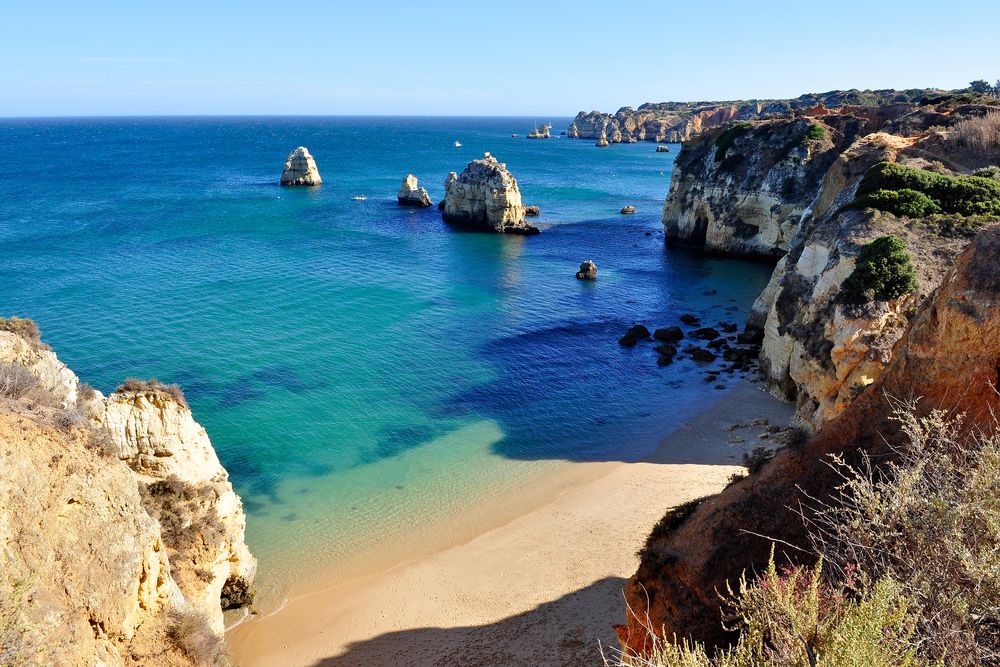
Pinhão lies between Praia da Batata and Dona Ana.
The small rocky bay is reached from the cliff-top pedestrian route and feels more tucked away than the larger neighbouring beaches.
The municipality describes it as a small bay reached by a pedestrian trail from the Dona Ana area.
There are fewer facilities than at Dona Ana.
Use it for a quieter stop rather than expecting a fully serviced beach.
Praia da Luz
Praia da Luz lies around six kilometres west of central Lagos.
The former fishing village has grown substantially but retains a broad sandy beach framed by white buildings and the dark volcanic-looking cliff of Rocha Negra.
The geology makes the coastline visually different from the golden limestone around Ponta da Piedade.
The beach is accessible, supervised in season and well supplied with cafés and restaurants.
Luz works well for a half-day away from Lagos or as the endpoint of a longer coastal walk.
It also provides a calmer alternative for families who do not need to stay directly in the historic centre.
Lagos and the Portuguese Maritime Expansion
The 15th century transformed Lagos.
After the conquest of Ceuta in 1415, Portuguese maritime activity increasingly focused on the Atlantic and West African coast.
Lagos’s bay provided a practical base for vessels, sailors and merchants.
Gil Eanes, a navigator associated with Henry the Navigator, sailed from Lagos and rounded Cape Bojador in 1434, an important milestone in Portuguese Atlantic navigation.
This period was later romanticised through the language of heroic “discoveries.”
The reality was more complicated.
Navigation, cartography and commercial expansion developed alongside warfare, forced labour and the Atlantic slave trade.
By 1444 enslaved Africans were being transported to Lagos and sold.
That history belongs to the same maritime network celebrated by statues and street names throughout the city.
A good visit should therefore include both the monuments of maritime expansion and the Rota da Escravatura museum.
King Sebastian and Lagos
Lagos remained politically important into the 16th century.
King Sebastian I elevated the city’s status and used Lagos as a departure point before his disastrous expedition to Morocco.
In 1578, Sebastian crossed to North Africa and died at the Battle of Alcácer Quibir.
He left no direct heir.
The resulting succession crisis ultimately contributed to the Iberian Union, during which the crowns of Portugal and Spain were held by the same monarch from 1580 until Portuguese independence was restored in 1640.
Lagos therefore connects two major chapters of Portuguese history: early Atlantic expansion and the political crisis that ended the independent Avis dynasty.
A modern statue of Sebastian by sculptor João Cutileiro stands in Praça Gil Eanes.
Its deliberately unconventional proportions make it one of the city’s most recognisable pieces of modern public art.
The 1755 Earthquake and Tsunami
The earthquake of 1 November 1755 is usually associated with Lisbon, but the Algarve suffered enormously.
Lagos was particularly vulnerable because of its low waterfront and Atlantic exposure.
Earthquake damage was followed by a destructive tsunami.
Large parts of the city were devastated.
Lagos had previously served as the administrative capital of the Algarve, but the catastrophe contributed to the transfer of regional importance to Faro. Visit Portugal explicitly records the destruction of much of Lagos in 1755 and its later recovery during the 19th century.
The disaster explains why apparently ancient streets contain so much later architecture.
Much of what visitors see today is the result of reconstruction layered over medieval and early-modern foundations.
Fishing and the Canning Industry
Lagos recovered economically during the 19th century through fishing, commerce and especially fish canning.
Factories processing sardines and other catches became important employers.
The industry connected Lagos to the broader industrial transformation of the Algarve coastline.
Although large-scale canning later declined, fishing remains visible today in the marina, market and local cuisine.
This later maritime history matters because the city did not simply jump from the 15th-century caravels to 21st-century tourism.
What to Eat in Lagos
Lagos cuisine is firmly rooted in the western Algarve.
Fresh fish is the obvious starting point.
Sea bass, sea bream, sardines, mackerel and monkfish appear grilled or in more elaborate preparations depending on the restaurant.
Cataplana combines seafood, shellfish or occasionally meat in the distinctive hinged copper pan associated with Algarve cooking.
Arroz de marisco is richer and wetter than Spanish paella, with shellfish cooked into a deeply flavoured rice broth.
Octopus appears grilled, stewed or in salads.
Clams are particularly good when prepared simply with garlic, coriander and olive oil.
The wider Algarve also contributes xarém, a maize-based preparation historically eaten with clams or pork.
For sweets, look for almond, fig and carob.
Lagos is traditionally associated with Dom Rodrigo, a rich convent-style sweet based on egg yolks, sugar and almonds.
Where to Eat in Lagos
Restaurante dos Artistas
Restaurante dos Artistas is one of the more established fine-dining addresses in the historic centre.
The menu is contemporary rather than strictly traditional, but Portuguese and Algarve ingredients remain central.
The garden is particularly attractive for dinner.
Address: Rua Cândido dos Reis 68, 8600-681 Lagos
Telephone: +351 282 760 659
Email: [email protected]
Cuisine: contemporary Portuguese and international
Opening: Monday–Saturday; dinner 18:30–22:00 year-round, with lunch offered in the cooler season
Reservations: recommended.
Casa do Prego
Casa do Prego is a more casual option built around Portuguese-style steak sandwiches, grilled meat, tuna and shared dishes.
It is centrally located but feels less formal than many of the restaurants around the principal tourist streets.
Address: Rua Lançarote de Freitas 18, 8600-605 Lagos
Telephone: +351 913 505 038
Email: [email protected]
Cuisine: Portuguese-inspired casual dining
Opening: daily 13:00–23:00
Price level: mid-range.
O Camilo
O Camilo sits above Praia do Camilo and is the obvious choice when the meal should be part of a day on the cliffs.
The family-run restaurant has operated for more than forty years and focuses heavily on fish and traditional Algarve seafood.
Address: Estrada da Ponta da Piedade, Praia do Camilo, 8600-544 Lagos
Telephone: +351 968 691 143
Cuisine: Algarve fish and seafood
Opening: Wednesday–Sunday 12:00–23:30; kitchen until 21:00
Closed: Monday and Tuesday
Reservations: accepted by telephone or directly at the restaurant.
Casinha do Petisco
Casinha do Petisco is one of the better choices for a small, informal dinner in the old town.
The menu concentrates on Portuguese dishes and seafood, including cataplana.
The room is compact, so availability can become difficult in summer.
Address: Rua da Oliveira 51, 8600-700 Lagos
Telephone: +351 282 084 285
Cuisine: Portuguese and Algarve
Price level: moderate
Best for: traditional dishes in the historic centre.
Where to Stay in Lagos
For a first visit, the choice comes down to three areas.
Stay near the historic centre and marina for restaurants, trains and nightlife.
Choose Porto de Mós/Ponta da Piedade for cliffs, quieter evenings and beach access.
Choose Meia Praia for a resort-style stay with a long beach directly outside.
Hotel Marina Rio
Hotel Marina Rio stands opposite Lagos Marina and only a short walk from the old town.
The location is excellent if arriving by train because the railway station lies just across the marina.
Address: Avenida dos Descobrimentos, Apartado 388, 8600-645 Lagos
Telephone: +351 282 780 830
Email: [email protected]
Category: city hotel
Best for: train travellers, marina views and walking into the centre.
Charming Residence Dom Manuel I
Hotel Dom Manuel I lies between the old centre and the beaches around Dona Ana and Ponta da Piedade.
It is a strong compromise for travellers who want to walk both to town and towards the cliffs.
Address: Rua Gago Coutinho, Lote 37, 8600-593 Lagos
Telephone: +351 282 770 880
Email: [email protected]
Type: boutique residence
Best for: couples and visitors splitting their time between town and beaches.
Boutique Hotel Vivenda Miranda
Boutique Hotel Vivenda Miranda occupies the cliffs above Porto de Mós and is considerably quieter than the centre.
The property has only a small number of rooms and suites and works especially well for a more secluded stay.
Address: Rua das Violetas, Porto de Mós, 8600-282 Lagos
Telephone: +351 282 763 222
Email: [email protected]
Category: four-star boutique hotel
Best for: couples, sea views, spa stays and Porto de Mós.
Cascade Wellness Resort
Cascade Wellness Resort lies on the cliffs west of Ponta da Piedade.
It is a much larger resort than Vivenda Miranda and suits travellers who want pools, wellness facilities and open space rather than a traditional city hotel.
Address: Rua das Ilhas, 8600-513 Lagos
Telephone: +351 282 771 500
Email: [email protected]
Category: luxury resort
Best for: families, spa, pools and access to Ponta da Piedade and Porto de Mós.
Iberostar Selection Lagos Algarve
Iberostar Selection Lagos Algarve sits directly behind Meia Praia.
Its scale and facilities make it a better choice for travellers who want the beach-resort side of Lagos rather than daily immersion in the old centre.
Address: Estrada da Meia Praia, 8600-315 Lagos
Telephone: +351 282 244 000
Email: [email protected]
Category: five-star resort
Best for: Meia Praia, families and all-inclusive stays.
How Many Days Do You Need in Lagos?
One night is too short unless Lagos is simply one stop on a fast Algarve road trip.
Two full days are enough for the old town, Ponta da Piedade and several beaches.
Three nights are ideal for a first visit.
That gives one cultural day, one cliff-and-beach day and one flexible day for Meia Praia, Praia da Luz, a boat trip or a western-Algarve excursion.
Four or five nights make sense if Lagos is your principal Algarve base.
The city has enough restaurants, coastline and transport connections that you do not need to change hotels every night.
A Two-Day Lagos Itinerary
Spend the first morning in the old town.
Start at Praça Infante D. Henrique, visit the Rota da Escravatura, Igreja de Santo António and Museu Dr. José Formosinho, then walk around the Governors’ Castle and walls.
The Forte da Ponta da Bandeira is temporarily closed in 2026, so examine it from outside before continuing to Praia da Batata.
After lunch, walk through the centre and marina.
Use late afternoon for Meia Praia or a short boat trip.
On the second day, begin early on the Ponta da Piedade coastal route.
Stop at Dona Ana and Camilo before reaching the lighthouse and principal viewpoints.
Take a boat trip if sea conditions are suitable.
Continue to Porto de Mós for a late lunch or beach afternoon.
A Three-Day Lagos Itinerary
Use the first two days above.
On the third day, choose according to interest.
For beaches, spend the day at Meia Praia.
For a slower coastal village, travel to Praia da Luz.
For history and landscape, rent a car or join an excursion towards Sagres and Cabo de São Vicente.
Lagos is one of the best bases for the southwestern Algarve because Sagres is close enough for a substantial half- or full-day trip without changing accommodation.
Boat Trips at Ponta da Piedade
Boat tours depart from the marina and smaller waterfront landing points.
The traditional small boats are particularly effective because they can enter narrow channels and arches that larger vessels cannot.
Kayaks provide more independence but require greater attention to sea state, wind and other boat traffic.
Morning is generally the strongest time.
Wind often increases later in the day, and lower-angle light can make the water and cliffs more attractive.
Do not choose solely by price.
Look for licensed operators, appropriate life jackets and clear cancellation policies for poor conditions.
A 60–90 minute small-boat trip is enough for most visitors.
Lagos or Albufeira?
Choose Lagos if history, cliffs and walking matter.
The old centre has substantially more historical interest, while Ponta da Piedade provides a coastal landscape directly adjacent to the city.
Albufeira has a larger resort and nightlife infrastructure.
It can be more practical for travellers whose priorities are large accommodation complexes and central-Algarve access.
Lagos generally feels more coherent as a town rather than a resort zone.
Lagos or Tavira?
The choice is essentially west versus east Algarve.
Lagos has dramatic cliffs, colder Atlantic-influenced water and easy access to Sagres.
Tavira has the Ria Formosa, salt pans, barrier-island beaches and a more strongly preserved river-town atmosphere.
Lagos is better for coastal geology and western-Algarve road trips.
Tavira is better for lagoon landscapes and a quieter historic base.
Both justify several nights.
How to Get to Lagos from Faro
Faro Airport lies approximately 85 kilometres from Lagos.
By car, the journey generally takes around an hour using the A22.
Rail is also practical.
The important change in 2026 is that the Algarve railway became fully electrified from Lagos to Vila Real de Santo António on 19 July, allowing electric regional trains to run across the entire line and increasing regional service by approximately 18%.
Lagos railway station lies behind the marina, within straightforward walking distance of the historic centre.
Long-distance rail journeys from Lisbon generally require connections through Tunes or Faro depending on the service.
Coach services also connect Lagos with Lisbon and other Algarve towns.
Lagos without a Car
A car is unnecessary for the core city.
The old town, marina, Praia da Batata, Dona Ana and much of Ponta da Piedade can be reached on foot.
Local buses connect farther beaches and neighbourhoods.
Meia Praia is also accessible by train and local transport.
A car becomes valuable for Praia da Luz, Sagres, Costa Vicentina beaches and inland excursions.
A good compromise is to stay in central Lagos without a car for two days and rent one only for the western Algarve.
Driving and Parking
Do not try to park deep inside the old centre.
Pedestrian streets, narrow roads and controlled access make this more frustrating than useful.
Use peripheral parking and walk.
Ponta da Piedade has undergone a long-term programme of traffic reorganisation specifically designed to reduce vehicles near the most sensitive cliff areas and expand pedestrian boardwalks and viewpoints.
Follow current signs rather than old online maps showing parking directly beside every viewpoint.
Accessibility
Lagos is relatively manageable compared with several steeper Portuguese historic towns.
Visit Portugal specifically identifies an accessible route through the city and notes that much of the central street network has gentle gradients and stable surfaces.
The Governors’ Castle area and Forte da Ponta da Bandeira exterior are comparatively straightforward.
The cliff beaches are more complicated.
Dona Ana and Camilo require substantial stairs and are not suitable for every visitor.
Meia Praia, Praia da Batata, Porto de Mós and Praia da Luz have officially designated accessible beach facilities.
Ponta da Piedade can still be appreciated from upper boardwalks and viewpoints without descending the long staircase towards the sea.
Best Time to Visit Lagos
April and May are excellent for walking Ponta da Piedade and exploring the old town.
The sea remains cool, but the cliffs are far less crowded.
June is one of the strongest overall months, with beach weather and long daylight before peak crowds.
July and August bring the busiest conditions.
Camilo and Dona Ana can feel overcrowded, accommodation prices rise and parking becomes more difficult.
For these months, visit Ponta da Piedade before 09:00 and use Meia Praia for longer beach days.
September is arguably the best month.
The ocean retains summer warmth, restaurants remain fully active and family-holiday crowds begin to fall.
October is still excellent for walking and dining, though sea conditions become less predictable.
Winter is quiet and increasingly attractive for a city-and-coast break. The cliffs remain spectacular even when swimming is irrelevant.
Lagos in 2026
Several practical details differ from older guides.
The Forte da Ponta da Bandeira is temporarily closed to interior visitors.
The Museu de Lagos Dr. José Formosinho and the Rota da Escravatura are currently open Tuesday–Sunday from 10:00–13:00 and 14:00–18:00, with individual tickets at €3 and a €5 combined ticket.
Ponta da Piedade continues to be managed through its expanded network of boardwalks, viewpoints and traffic restrictions intended to protect the cliffs and reorganise access.
The largest regional transport change is the complete electrification of the Algarve railway, which entered operation on 19 July 2026, creating electric train service all the way between Lagos and Vila Real de Santo António and increasing regional frequency.
These details make some pre-2026 Lagos guides outdated.
Lagos Essential Information
Country: Portugal
Region: Algarve
District: Faro
Nearest airport: Faro Airport, approximately 85 km
Historic importance: major 15th-century port associated with Portuguese Atlantic expansion
Gil Eanes rounded Cape Bojador: 1434
Arrival and sale of enslaved Africans: 1444
Major natural attraction: Ponta da Piedade
Longest beach: Meia Praia, more than 4 km
Best historic museum: Museu de Lagos Dr. José Formosinho
Essential historical museum: Núcleo Rota da Escravatura
2026 museum hours: Tuesday–Sunday 10:00–13:00 and 14:00–18:00
Museum ticket: €3 each / €5 combined
Forte da Ponta da Bandeira: temporarily closed in 2026
Recommended stay: 3 nights
Best overall months: May–June and September–October
Best western-Algarve excursion: Sagres and Cabo de São Vicente
Best without a car: historic centre, Ponta da Piedade, Dona Ana and Meia Praia
2026 rail change: Algarve Line fully electrified from Lagos to Vila Real de Santo António

