
Jaipur Beyond the Pink Walls: Rajput Forts, Scientific Genius and the Bazaars of Rajasthan

Jaipur is one of those rare cities where urban planning itself is an attraction. Its broad market streets, monumental gates, palace compounds and public squares were not accumulated randomly over centuries; they were conceived as parts of an ambitious new capital founded in 1727 by Maharaja Sawai Jai Singh II, a ruler equally interested in politics, commerce, architecture and astronomy.
Behind the famous terracotta-pink façades lies a much deeper story. Jaipur emerged from the older Kachhwaha capital at Amer, where hill forts and palaces still dominate a narrow valley north of the modern city. Jai Singh transferred the court onto the plains and commissioned a rational grid of streets and bazaars designed for trade as much as royal ceremony. The result was unusual enough that UNESCO inscribed the walled city of Jaipur as a World Heritage Site in 2019, recognising its fusion of traditional Indian planning principles, commercial urbanism and a remarkably coherent eighteenth-century cityscape.
Jaipur is therefore more than Hawa Mahal and Amber Fort. The city contains one of the world’s most important historical astronomical observatories, an active royal palace, huge hilltop fortifications, Hindu pilgrimage sites, royal cremation grounds, textile and gemstone traditions, painted havelis and bazaars whose commercial functions remain astonishingly close to those imagined three centuries ago.
Give Jaipur three full days at minimum. Four are better if you want to understand the city instead of simply completing its monuments. One day belongs to the Pink City, another to Amer, Jaigarh and Nahargarh, and a third to Galta Ji, museums, crafts and markets. Add Sanganer, Bagru or a serious textile workshop and Jaipur easily becomes a four- or five-day destination.
What to See in Jaipur
- Hawa Mahal
- City Palace
- Jantar Mantar
- Govind Dev Ji Temple
- Johari Bazaar
- Bapu Bazaar
- Tripolia Bazaar
- Amber Fort and Palace
- Jaigarh Fort
- Jal Mahal
- Nahargarh Fort
- Gaitore Ki Chhatriyan
- Galta Ji
- Albert Hall Museum
- Ram Niwas Garden
- Patrika Gate
- Sanganer and Bagru textile traditions
- Jaipur’s gemstone and jewellery workshops
- The old city gates and chaupars
Before Jaipur: The Kachhwaha Capital at Amer
To understand Jaipur, begin with Amer.
The Kachhwaha Rajputs established themselves in this region centuries before the Pink City existed. Their earlier capital occupied a defensible valley in the Aravalli Hills, where palaces and fortifications could be protected by steep slopes and a network of military positions.
The Kachhwahas became particularly powerful through alliances with the Mughal Empire. Under Raja Man Singh I, one of Emperor Akbar’s most important commanders, the dynasty accumulated military prestige, territory and wealth. Later rulers continued to serve at the Mughal court while strengthening their own kingdom.
Amer therefore developed through a distinctive mixture of Rajput political identity and Mughal imperial culture. That duality remains visible in its architecture: fortified walls and Hindu temples coexist with Persianate gardens, symmetrical courtyards, mirrored halls and decorative forms closely connected with Mughal court taste.
By the early eighteenth century, however, the old capital had become increasingly inconvenient. The valley restricted expansion, water resources were under pressure and Jai Singh II wanted a city better suited to trade, administration and a growing court.
The solution was radical: build a new capital.
The Founding of Jaipur in 1727
Sawai Jai Singh II founded Jaipur in 1727, on relatively open land south of the Amer hills. Instead of allowing a settlement to grow organically around a fort or market, he planned the city as a coordinated project.
The principal planner traditionally associated with Jaipur is Vidyadhar Bhattacharya, a Bengali scholar and architect who worked with Jai Singh on a city governed by geometry, street hierarchy and principles derived from Indian architectural traditions such as Vastu Shastra and Shilpa Shastra.
Most of the essential urban structure, public spaces and royal precincts were established between 1727 and 1731, an extraordinarily short period for a city of such ambition.
Jaipur’s wide avenues doubled as commercial markets. Large intersections called chaupars created major civic spaces, while different sectors were associated with trades, residences and administrative functions. The royal palace stood near the centre rather than occupying an isolated hilltop.
This was a capital designed to generate commerce as well as display power.
Why Jaipur Was So Unusual
Most medieval cities in the region had developed incrementally in response to terrain, defensive needs, water and existing settlement patterns. Jaipur represented a different philosophy.
The city was built on comparatively flat land and organised around a grid, allowing broad straight streets to intersect at regular intervals. Traders and artisans were actively encouraged to settle within the new capital, strengthening its role as a commercial centre.
That economic strategy still shapes Jaipur today. Johari Bazaar remains associated with jewellery, Tripolia with traditional goods and metalwork, while surrounding market streets continue to specialise in fabrics, wedding goods, spices, bangles and crafts.
The city therefore preserves not just historic architecture but a surprisingly durable relationship between urban form and commercial function.
Why Jaipur Is Pink
Jaipur was not originally built in the exact terracotta-pink colour now associated with the city.
The famous transformation came in 1876, when Maharaja Sawai Ram Singh II ordered façades along the ceremonial city routes painted in a warm pink-terracotta shade before the visit of Albert Edward, Prince of Wales, later King Edward VII.
Pink was associated with hospitality, and the colour proved so successful as a visual identity that it became embedded in the appearance of the old city. Regulations and repeated repainting helped maintain the distinctive palette.
What visitors call “pink” is therefore often closer to salmon, ochre and terracotta than pastel rose.
Morning and late-afternoon light intensify it beautifully.
Hawa Mahal
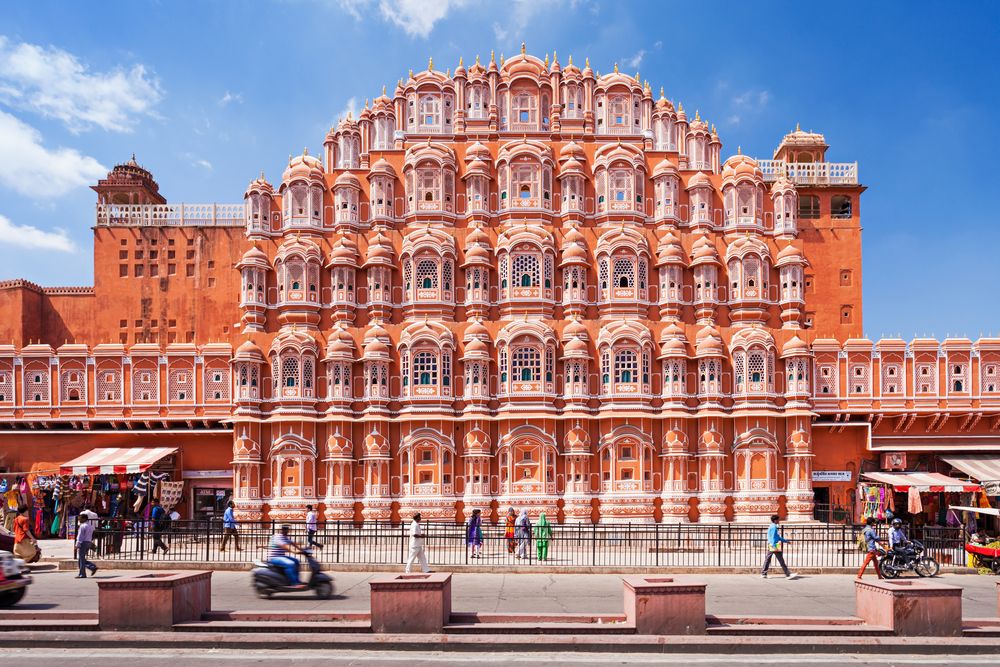
Few buildings advertise a city as effectively as Hawa Mahal.
The five-storey façade rises directly above the chaos of the old bazaar, an astonishing honeycomb of small windows, projecting jharokhas, curved roofs and carved stone screens. It looks like a vast palace from the street, yet its actual structure is surprisingly shallow.
Maharaja Sawai Pratap Singh commissioned Hawa Mahal in 1799, and architect Lal Chand Ustad designed it as an extension of the royal complex. Its most famous feature is the extraordinary grid of 953 windows and screened openings.
These jharokhas served two purposes. The perforated screens encouraged air circulation, helping cool the interior, while allowing women of the royal household to observe religious processions, market activity and public celebrations without being openly visible from the street.
This relationship with the bazaar is essential. Hawa Mahal was not designed simply to be admired from outside; it was an architectural device for watching Jaipur.
The 953 Jharokhas
The façade becomes much more interesting when you stop treating its windows as decoration.
Each jharokha creates a tiny controlled relationship between private and public space. Behind the screens, royal women could look onto the streets while remaining protected by the conventions of purdah.
At the same time, air passing through the numerous openings helped create ventilation across the upper floors. The palace therefore combines social custom, climate adaptation and theatrical architecture in a single façade.
The famous honeycomb effect emerges from repetition rather than monumental scale. No individual window is extraordinary; together they create one of the most recognisable elevations in India.
Inside Hawa Mahal
The interior is far less ornate than the street façade suggests.
Courtyards and corridors lead towards upper levels connected partly through ramps rather than conventional staircases. As you climb, views gradually open across the bazaars towards the City Palace and Jantar Mantar.
The highest floors are comparatively narrow, reinforcing how much of Hawa Mahal is essentially a monumental screen rather than a conventional deep palace.
The best exterior light arrives in the morning, when sunlight strikes the façade directly. One of the classic views comes from cafés and rooftops across the road, but enter the palace as well; otherwise you understand only half of the architecture.
City Palace
The City Palace is the political and ceremonial heart of Jai Singh’s planned capital.
Construction began alongside the city in the late 1720s, but successive rulers continued to expand and redecorate the complex for more than two centuries. This makes it less stylistically uniform than a palace built during one reign, but considerably more interesting historically.
The complex includes courtyards, audience halls, gateways, museums, temples and the imposing Chandra Mahal, parts of which remain connected with Jaipur’s former royal family.
Unlike many abandoned royal residences, City Palace retains a sense of institutional continuity. Rituals, royal heritage, museum collections and contemporary cultural programmes occupy the same precinct.
The museum currently opens daily from 09:30 to 18:30, closing only on Dhulandi, the second day of Holi.
Allow at least two hours for the standard museum areas and substantially longer if you add access to the more exclusive rooms of Chandra Mahal.
Mubarak Mahal
One of the first major buildings visitors encounter is Mubarak Mahal, a nineteenth-century reception palace whose decorative vocabulary reflects the increasingly international world of Jaipur’s court.
Today it houses important textile collections, including royal garments, delicate shawls, embroidered fabrics and examples of local printing traditions.
Textiles are not a minor subject in Jaipur. Clothing communicated rank, court ceremony, regional identity and access to luxury materials. A royal robe might incorporate imported fabrics, regional embroidery and specialist dyeing techniques from several parts of India.
The museum therefore provides an excellent introduction before shopping for textiles in the bazaars, because it makes clear how sophisticated Rajasthan’s fabric culture can be.
Sarvato Bhadra and the Great Silver Vessels
The open audience pavilion known as Sarvato Bhadra is one of the palace’s most elegant ceremonial spaces.
Among its famous objects are enormous silver vessels associated with Maharaja Sawai Madho Singh II, who travelled to Britain for the coronation of Edward VII in 1902. Large containers were made to carry water from the Ganges for the ruler’s personal religious use during the journey.
They are often described among the largest single-piece silver vessels ever produced.
The story may sound eccentric, but it reveals something serious about royal travel during the colonial era: modern international mobility had to be reconciled with ritual obligations and purity rules.
Pritam Niwas Chowk
The Pritam Niwas Chowk is one of the most visually refined courtyards in Jaipur, largely because of its four elaborately decorated seasonal gates.
The most famous is the Peacock Gate, whose painted birds, floral forms and blue-green surfaces have become almost unavoidable in photographs of the City Palace.
The other gates are traditionally associated with seasons and Hindu deities, using different colours and decorative motifs to create an architectural calendar around the courtyard.
These are not vast palace façades. Their impact comes from concentrated workmanship, carefully balanced colour and the intimacy of the space.
Visit early if possible. Once crowded, the subtle relationship between courtyard and gates becomes harder to appreciate.
Chandra Mahal
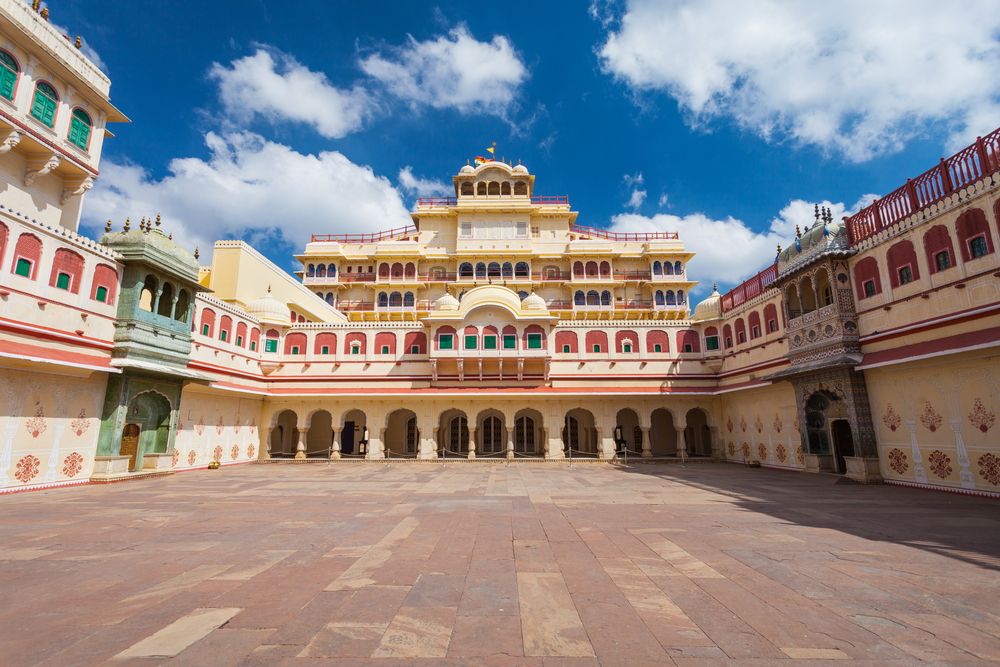
The seven-storey Chandra Mahal dominates the palace skyline and remains one of the most important sections of the royal complex.
Standard museum admission does not necessarily include all of its interiors. Higher-level guided access can open ceremonial rooms such as Sukh Niwas, Chhavi Niwas, Shobha Niwas and Sri Niwas, each decorated with a very different visual language.
Chhavi Niwas is particularly memorable for its blue-and-white decoration, while Shobha Niwas uses mirror work and richly coloured ornament to create an almost jewel-like interior.
If architecture and decorative arts matter more than simply collecting monuments, upgraded Chandra Mahal access is one of the worthwhile splurges in Jaipur.
Govind Dev Ji Temple
Within the wider palace precinct stands Govind Dev Ji Temple, one of Jaipur’s most important living religious institutions.
The temple was established in the eighteenth century and is dedicated to Krishna as Govind Dev Ji, the principal deity historically associated with the Kachhwaha rulers. The sacred image was transferred from Vrindavan to protect it during a period of political instability.
The temple operates through a sequence of daily darshan periods rather than remaining continuously open in the manner of a museum. At specific times curtains open and worshippers surge forward for a view of the deity.
That experience provides an important corrective to Jaipur’s palace-heavy itinerary. The royal city was structured around religion as well as administration, science and commerce.
Visit respectfully rather than simply stepping in for architecture.
Jantar Mantar
Next to the City Palace lies the monument that best reveals Jai Singh II’s unusual intellectual ambitions.
The Jantar Mantar is not a collection of abstract sculptures, even though that is exactly what it resembles at first. It is an early eighteenth-century astronomical observatory composed of around twenty principal fixed instruments designed to measure celestial positions, determine time and perform observational calculations with the naked eye.
Jai Singh built observatories in several Indian cities, but Jaipur preserves the most complete and significant group. UNESCO inscribed it as a World Heritage Site in 2010.
The scale matters because these are astronomical instruments translated into architecture. Angles, walls, staircases and curved surfaces become measuring devices.
Hire a knowledgeable guide or use a serious audio explanation. Without understanding what the instruments do, Jantar Mantar can look like beautiful but incomprehensible geometry.
Sawai Jai Singh II: King and Astronomer
Jai Singh was not an astronomer in the modern professional sense, but he was deeply involved with observational astronomy and the scientific debates of his time.
His court studied Indian astronomical traditions alongside Persian, Islamic and European material. He corresponded with scholars and sought improved observational data capable of refining astronomical tables.
The observatories therefore represent a meeting point between science, politics and cosmology. Accurate astronomical knowledge mattered for calendars, astrology, ritual timing and royal authority.
For Jai Singh, controlling time and understanding the heavens were not hobbies detached from government. They were part of kingship.
Samrat Yantra
The most spectacular instrument is the Samrat Yantra, a gigantic masonry sundial dominated by a triangular gnomon.
Its edges are aligned in relation to Earth’s axis, allowing the moving shadow to indicate local solar time on graduated scales. The enormous dimensions increase the precision with which that shadow can be read.
Standing beside it changes the concept of a scientific instrument. Modern astronomy tends towards compact electronics and remote telescopes; here, the instrument is large enough to walk around.
The Samrat Yantra turns mathematics into landscape.
Jai Prakash Yantra
The Jai Prakash instruments are among the most intellectually satisfying structures in the observatory.
They consist of hemispherical bowls with carefully marked surfaces representing celestial coordinates. Observers could use suspended elements and the position of shadows to interpret the movement of celestial bodies.
The geometry is easier to understand with explanation than by sight alone.
Once the principle becomes clear, the apparently surreal bowls transform into sophisticated analogue calculators made from masonry.
Ram Yantra
The paired Ram Yantra structures use cylindrical walls and radial divisions to measure the altitude and azimuth of celestial objects.
Their open geometry allows an observer to move physically inside the instrument while taking readings.
That human scale is one of the pleasures of Jantar Mantar: astronomy is not hidden inside machinery. The observer inhabits the measurement system.
The Old City and Its Bazaars
Jaipur’s bazaars are not decorative appendages to the monuments. They were part of the original urban concept.
The city’s principal roads were conceived as commercial avenues, with artisans and merchants actively encouraged to settle in specialised areas. That structure remains surprisingly visible.
Johari Bazaar is still closely associated with jewellery and gemstones. Tripolia Bazaar offers lac bangles, metalware and traditional goods. Bapu Bazaar mixes fabrics, leather slippers and tourist-oriented shopping, while smaller lanes specialise in wedding decorations, spices and household items.
The best approach is to walk without trying to buy something every five minutes.
Architecture emerges above the signs: repeating arcades, terraces, pink façades, temples embedded into commercial streets and old gateways continuing to channel traffic through the planned city.
Johari Bazaar and Jaipur’s Gemstone Trade
Jaipur developed into one of India’s great centres for cutting, polishing and trading coloured gemstones.
Emeralds, rubies, sapphires and semi-precious stones pass through specialist workshops, while kundan and meenakari jewellery techniques have deep associations with Rajasthan’s court culture.
The industry is genuine.
So are the sales commissions, tourist mark-ups and dubious certificates.
If buying expensive stones, use an established specialist, demand independent certification where appropriate and never assume that a workshop selected by a driver or guide was chosen solely for educational value.
The craft itself is fascinating. The retail ecosystem requires more caution.
Why Amber Fort Is Essential
Around eleven kilometres north of Jaipur, Amber Palace rises above Maota Lake as the architectural bridge between the older Kachhwaha kingdom and the city Jai Singh later built on the plains.
The complex developed over several reigns, with major work associated with Raja Man Singh I from the late sixteenth century and subsequent additions under Mirza Raja Jai Singh and other rulers.
Amber is both fortress and palace. Military walls follow the surrounding hills, while inner courtyards contain temples, audience halls, apartments, gardens and some of Rajasthan’s most refined decorative interiors.
Visit in the morning, ideally near the 08:00 opening. The stone remains cooler, crowds are lighter and the palace is easier to understand before the courtyards fill.
Jaleb Chowk
The principal arrival courtyard is Jaleb Chowk, entered through monumental gates including Suraj Pol and Chand Pol.
Historically, returning armies could assemble here and display spoils, while processions and court ceremonies transformed the courtyard into a public stage.
The space also demonstrates the social organisation of the palace. Military and ceremonial areas occupy the lower levels, while progressively more restricted spaces lie deeper within the complex.
Amber is best experienced as a sequence of thresholds rather than a collection of beautiful rooms.
Shila Devi Temple
Within Amber stands the Shila Devi Temple, dedicated to a form of the goddess Durga/Kali and closely connected with Kachhwaha royal worship.
The temple reinforces a theme visible throughout Jaipur: political authority and religious devotion were physically embedded into the same palace environments.
During major festivals such as Navratri, the temple becomes substantially more crowded and its devotional function far more obvious.
Remove shoes, follow local instructions and remember that this remains an active sacred space.
Diwan-i-Aam
The Hall of Public Audience consists of an open pavilion supported by rows of columns.
Here the ruler could appear before officials, petitioners and members of the court in a carefully structured public setting.
As in Mughal palaces, audience architecture transformed politics into spatial hierarchy. Position, distance and visibility made rank immediately legible.
The openness also responded to climate, allowing circulation of air while protecting occupants from direct sunlight.
Ganesh Pol
The richly decorated Ganesh Pol is one of Amber’s great architectural transitions.
Painted floral motifs, geometric forms and a central image of Ganesha cover the gateway leading towards the more private royal apartments.
It functions simultaneously as security, ceremony and visual announcement: beyond this point, the palace becomes more intimate.
Look upward from close range and then step back across the courtyard. The gate’s apparent delicacy depends on being framed by much plainer sandstone walls.
Sheesh Mahal
The Sheesh Mahal, or Mirror Palace, is Amber’s most famous interior.
Thousands of small pieces of mirrored glass and reflective material are embedded into floral and geometric patterns across walls and ceilings. In low light, a small flame could multiply across the surfaces and create the impression of a ceiling filled with stars.
The room should not be understood as simple extravagance. Reflective interiors were sophisticated exercises in manipulating scarce light, surface and atmosphere.
Move sideways while looking at the decoration. Tiny changes in angle make the entire room flicker.
Sukh Niwas and Passive Cooling
Across the garden lies Sukh Niwas, often translated as the Hall of Pleasure.
Its most interesting feature is environmental rather than purely decorative. Channels could carry water through the structure, encouraging evaporative cooling as air moved across damp surfaces.
Combined with shaded rooms, stone construction and controlled openings, this created a primitive but effective cooling system.
Jaipur’s palaces repeatedly demonstrate that architecture in Rajasthan had to manage extreme heat long before air conditioning existed.
The Zenana
The women’s quarters form a complex network of rooms arranged so that different members of the royal household could occupy separate apartments while remaining within the protected palace environment.
Courtyards provided light and air, while screened windows allowed observation without direct exposure.
As at Hawa Mahal, architecture materialised social rules around visibility, gender and hierarchy.
Do not reduce the zenana to a romantic image of royal women living in luxury. Palace life could involve strict surveillance, political rivalry and carefully controlled movement as well as privilege.
Should You Ride an Elephant to Amber Fort?
Elephant rides continue to operate on the approach to Amber and have long been marketed as a royal-style arrival.
Walking, taking a jeep or using another vehicle is the better choice if animal welfare is a concern. The climb is not difficult for reasonably fit visitors in cool weather, and mechanical transport is widely available.
Whatever method you choose, arrive early. Heat and crowding deteriorate quickly later in the morning.
Jaigarh Fort
High above Amber stands Jaigarh, the military counterpart to the palace below.
The fortification developed on the Aravalli ridge to protect Amer and control the surrounding territory. Jai Singh II strengthened the complex in the early eighteenth century, and it became associated with armouries, cannon manufacture and sophisticated water-storage systems.
Jaigarh is less decorative than Amber and considerably more martial. Ramparts, reservoirs, foundry areas and long defensive walls dominate the visit.
It currently opens daily from 09:00 to 18:30.
The Jaivana Cannon
Jaigarh’s best-known object is the enormous Jaivana cannon, cast in the early eighteenth century.
It is frequently described as the world’s largest wheeled cannon of its era or among the largest ever mounted on wheels. Such superlatives vary according to definition, but the engineering scale is unquestionable.
The cannon represents a side of Rajput courts often hidden behind palace decoration: states required metallurgy, gunpowder, logistics and technical expertise as well as painters and jewellers.
Jaigarh’s foundry history makes it much more than a panoramic extension of Amber.
The Amer–Jaigarh Connection
A fortified passage links the Amber complex with the heights of Jaigarh.
The route made strategic sense. In periods of danger, the more residential palace below could connect with the heavily defended military position above.
Parts of this historic connection can be walked today, depending on access conditions.
For energetic visitors, combining the two on foot creates a much clearer understanding of the defensive landscape than driving separately between gates.
Jal Mahal
Returning towards Jaipur, the road follows Man Sagar Lake, where Jal Mahal appears to float above the water.
The elegant sandstone building was associated with royal leisure and hunting rather than functioning as a conventional full-time palace. Much of the structure lies below the waterline, leaving the upper level visually dominant.
The interior is not generally open to ordinary public sightseeing, so Jal Mahal is primarily an exterior stop.
Do not spend an hour here expecting a palace visit. Ten or fifteen minutes beside the lake is usually enough, preferably when morning or late-afternoon light creates reflections on the water.
The lake itself also provides habitat for birdlife, adding an ecological dimension often ignored by quick photography stops.
Nahargarh Fort
If Amber looks backward towards the older Kachhwaha capital, Nahargarh explains how Jaipur defended and observed the new city.
Jai Singh II constructed the original fort in 1734 on the Aravalli ridge north of the Pink City. Later rulers expanded it, and by the nineteenth century sections had become more associated with royal retreat than warfare.
The principal reason to come today is the relationship between architecture and panorama. From the ridge, the logic of Jai Singh’s flat planned city becomes visible: gridded streets spread below while the Aravalli hills enclose the urban plain.
Arrive in late afternoon but before the final rush for sunset.
Madhavendra Bhawan
Inside Nahargarh stands Madhavendra Bhawan, a late royal residential complex whose repeated suites, corridors and painted interiors create one of the fort’s most intriguing spaces.
The palace contains a series of linked apartments created for the ruler and women of the royal household. Surviving murals mix floral motifs and later decorative influences, revealing how Jaipur’s palace culture continued evolving well beyond Jai Singh’s eighteenth-century foundation.
The interconnected rooms are almost maze-like, deliberately maintaining separation while allowing controlled movement.
Nahargarh therefore contains two very different identities: defensive ridge fort outside, pleasure palace within.
Gaitore Ki Chhatriyan
Below the hills between Jaipur and Amer lies Gaitore, the royal cremation ground of the Kachhwaha rulers.
Jai Singh II selected the site in the eighteenth century, and the complex developed into a collection of chhatris, open-sided cenotaphs commemorating Jaipur’s rulers.
These are memorials rather than tomb chambers in the Islamic sense. Hindu cremation traditions did not require the body to remain beneath the monument.
The most refined cenotaph belongs to Sawai Jai Singh II, carved in white marble with delicate geometric, floral and peacock motifs.
Gaitore is quieter than the major palaces and often one of the most rewarding places for close architectural photography. It currently opens approximately 09:30–17:00.
Galta Ji
East of the Pink City, a narrow valley in the Aravalli Hills contains Galta Ji, one of Jaipur’s most atmospheric religious sites.
The complex developed around natural springs and sacred water tanks, with eighteenth-century buildings associated with Diwan Rao Kriparam, a courtier of Jai Singh II.
Water emerges through a carved gaumukh, or cow’s-mouth spout, feeding several kunds used by pilgrims for ritual bathing. The most sacred, Galta Kund, holds deep religious importance.
The pink and ochre temple buildings appear almost to grow out of the rocky valley, producing a completely different environment from Jaipur’s ordered grid.
Come early in the morning or late afternoon. The site generally operates from around 05:00 to 21:00.
Why Galta Ji Is Called the Monkey Temple
Large populations of monkeys live around the complex, leading foreign visitors to call Galta Ji the Monkey Temple.
The nickname is memorable but reduces an important pilgrimage site to its wildlife.
The monkeys are also wild animals. Do not encourage aggressive behaviour by waving food around, and keep glasses, phones and loose objects secure.
The real reason to visit is the combination of sacred water, pilgrimage, architecture and landscape.
Surya Mandir
Above Galta Ji stands a temple dedicated to Surya, the sun god.
The climb produces broad views across the surrounding hills and city, particularly attractive near sunrise or late afternoon.
Combining the Sun Temple with Galta Ji creates one of Jaipur’s strongest walks, but avoid the exposed climb during the hottest part of the day.
Albert Hall Museum
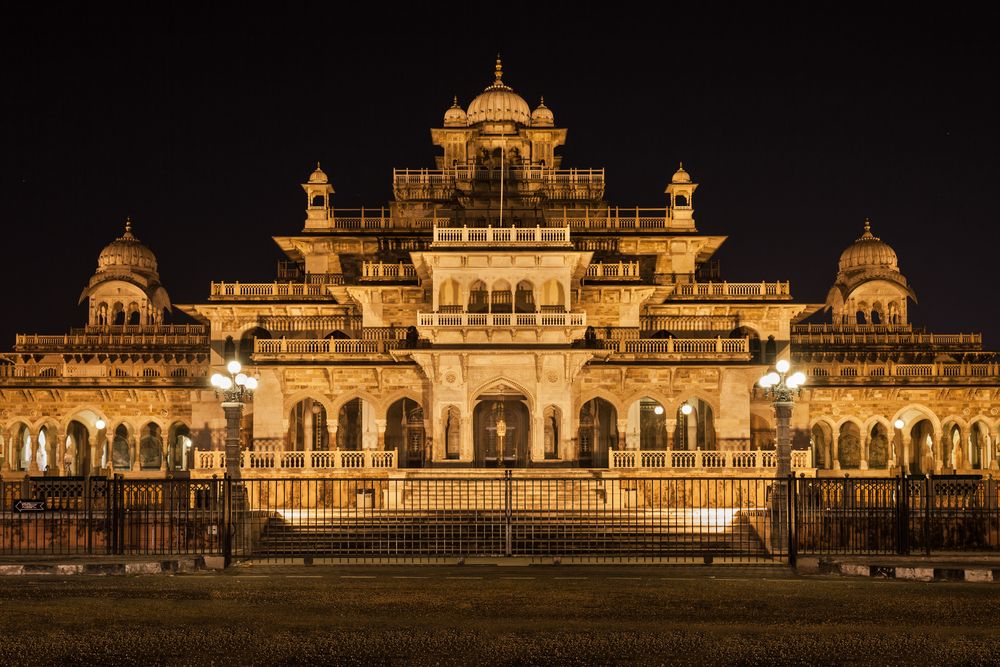
At the edge of Ram Niwas Garden stands Albert Hall, one of Jaipur’s most impressive nineteenth-century public buildings.
Its elaborate Indo-Saracenic architecture belongs to the period when princely India increasingly combined local decorative traditions with British colonial institutional forms.
The museum collections range across decorative arts, arms, textiles, metalwork, painting and archaeology. The building itself is arguably as important as the displays.
Visit after the major palace monuments; otherwise the collection can feel overwhelming before Jaipur’s craft traditions have acquired context.
The museum is particularly atmospheric when illuminated after dark.
Jaipur’s City Gates
The old walled city was entered through monumental gates positioned along its planned street network.
Ajmeri Gate, Sanganeri Gate, Chandpole and Surajpole still help define movement through the historic centre.
Their current setting amid traffic, signs and motorcycles may initially obscure their architectural role, but these were not decorative arches. They regulated access to a planned commercial capital protected by walls and surrounding forts.
Walking between the gates also reveals how much of Jaipur’s historic value lies in urban fabric rather than individual monuments.
Jaipur’s Chaupars
The large planned squares known as chaupars were integral to Jai Singh’s city.
Badi Chaupar and Chhoti Chaupar functioned as major intersections where broad avenues crossed and commercial activity intensified.
Today traffic, metro infrastructure and market life have transformed their appearance, but their basic spatial role survives.
Hawa Mahal’s position beside Badi Chaupar is no accident. The palace façade was designed to overlook exactly this kind of ceremonial and commercial urban theatre.
Sanganer Block Printing
South of Jaipur, Sanganer is historically associated with one of India’s most important hand-block printing traditions.
Sanganeri textiles are typically distinguished by fine floral motifs, delicate repeating butis and comparatively light or white backgrounds. Craftsmen press hand-carved wooden blocks onto cotton, building designs one colour at a time.
The apparent simplicity hides extraordinary technical discipline. A multi-colour pattern requires precise repeated alignment over metres of fabric; a minor registration error can disrupt the entire design.
Sanganeri hand block printing carries Geographical Indication protection, reflecting the regional importance of the craft.
A genuine working demonstration is far more valuable than a showroom that happens to contain printing blocks.
Bagru Printing and Dabu
West of Jaipur, Bagru represents a different printing vocabulary.
The town is particularly associated with earthier colour palettes and dabu, a mud-resist process. Artisans print a paste onto the fabric before dyeing; covered sections resist colour, creating patterns once the resist is removed.
Indigo, black and natural earthy tones produce a visual identity very different from Sanganer’s fine bright florals.
Seeing both traditions transforms Jaipur textile shopping. “Block print” stops being one generic category and becomes a family of specific techniques, materials and regional aesthetics.
Blue Pottery
Jaipur’s famous blue pottery is another craft that rewards technical attention.
Despite the name, traditional Jaipur blue pottery differs from ordinary clay ceramics. The body is generally based on quartz and other mineral materials, producing a smooth pale surface suited to brilliant blue, turquoise and green decoration.
Floral, animal and geometric designs reveal Persian and Central Asian influence filtered through Jaipur workshops.
Cheap souvenir pieces are everywhere; finely painted work is much less common.
Look at the precision of outlines, consistency of glazing and quality of the painted surface rather than assuming every blue bowl represents the same level of craftsmanship.
Lac Bangles
Jaipur remains an important centre for lac bangles, particularly around markets associated with Maniharon ka Rasta and Tripolia Bazaar.
The material is heated, coloured, shaped and decorated with stones, glass and metallic elements.
Wedding culture sustains much of the industry, and designs can range from inexpensive everyday pieces to elaborate ceremonial sets.
Watching bangles being shaped over heat is one of the easiest craft demonstrations to encounter naturally inside the old city.
What to Eat in Jaipur
Jaipur’s food reflects the environmental history of Rajasthan. Water scarcity, heat and the need to preserve ingredients encouraged dishes relying on dried pulses, gram flour, clarified butter, yoghurt and foods capable of surviving without fresh vegetables.
The emblematic meal is dal baati churma. Hard wheat baati are baked until deeply browned, cracked open and flooded with ghee, then eaten with spiced lentils. Churma uses crushed sweetened wheat to provide the rich, grainy counterpoint.
Gatte ki sabzi turns gram-flour dumplings into the main ingredient of a yoghurt-based curry. Ker sangri combines desert berries and beans into a tangy preparation capable of surviving Rajasthan’s harsh climate. Papad ki sabzi makes an everyday preserved ingredient the centre of a curry.
For meat, laal maas is the essential Rajasthani dish: mutton cooked with chilli and spices into a dark, intensely savoury gravy. Its heat varies dramatically by kitchen, and a good version should taste of more than raw chilli.
Pyaaz Kachori
One of Jaipur’s great snacks is pyaaz kachori, a fried pastry filled with spiced onion.
The best versions balance brittle, layered pastry with a hot filling of onion, chilli and aromatic spices. Tamarind and coriander chutneys add sweetness and acidity.
Eat one freshly fried.
Once cold, the difference is depressing.
Mirchi Vada
Large green chillies filled with spiced potato, dipped in gram-flour batter and fried create mirchi vada, another snack perfectly suited to Jaipur’s preference for fried food and strong flavours.
Despite the intimidating appearance, the chillies used are not always extremely hot. The pleasure comes from the contrast between crisp batter, soft potato and green-pepper bitterness.
A cup of masala chai makes the logical accompaniment.
Ghewar
Jaipur’s defining sweet is ghewar, a remarkable honeycomb-like disc made by pouring batter into hot ghee or oil in repeated stages.
The resulting lattice absorbs sugar syrup while retaining a fragile crispness. Versions may be topped with rabri, nuts, saffron or silver leaf.
Ghewar becomes especially important during Teej and Raksha Bandhan, when sweet shops build spectacular displays.
At Laxmi Misthan Bhandar in Johari Bazaar, paneer ghewar remains one of the historic house specialities alongside mishri mawa and other Rajasthani sweets.
What to Drink
Jaipur is more about lassi, chaas and chai than wine.
A proper lassi should be thick, cool and gently tangy rather than tasting like a liquid dessert drowned in artificial syrup. Sweet versions may carry cardamom or saffron, while salted chaas uses yoghurt, cumin and salt to produce something far more refreshing in intense heat.
Masala chai remains the everyday stimulant: strong black tea boiled with milk, sugar and spices. Small street cups are often more satisfying than elaborate café versions because the drink is consumed quickly, repeatedly and socially rather than ceremonially.
For alcohol, Rajasthan’s modern hospitality scene ranges from Indian whisky to contemporary gin and cocktails, but none is specifically essential to Jaipur’s historic identity. The city’s strongest drink experiences remain yoghurt, tea and the increasingly sophisticated bar culture inside restored havelis and palace hotels.
Where to Eat in Jaipur
Laxmi Misthan Bhandar
Laxmi Misthan Bhandar is both sweet shop and Jaipur institution, positioned directly in Johari Bazaar. Its history stretches back generations, and the current range includes ghewar, mishri mawa, savoury snacks, chaat and vegetarian Rajasthani meals.
Come for ghewar rather than expecting a quiet dining experience. The location is busy and intensely commercial, which is precisely why it makes sense in a guide to old Jaipur.
Address: 98–99 Johari Bazaar Road
Telephone: +91 90246 09609
Best for: ghewar, sweets and a classic Pink City food stop
Spice Court
Spice Court is one of the useful addresses for travellers who want traditional Rajasthani meat dishes in a more relaxed sit-down setting. Laal maas is the obvious order, while keema baati provides another substantial local combination.
Address: Jacob Road, Civil Lines
Telephone: +91 91166 42231
Opening: approximately 12:00–22:30
Best for: laal maas and a proper Rajasthani dinner
Suvarna Mahal
Suvarna Mahal occupies one of the grand dining rooms of Rambagh Palace. This is not the place to discover Jaipur’s everyday food economy; it is the place to experience royal-hotel theatre, chandeliers, high ceilings and a formal interpretation of North Indian cooking.
Address: Rambagh Palace, Bhawani Singh Road
Telephone: +91 141 6671234
Best for: special-occasion dining and palace atmosphere
Bar Palladio
Bar Palladio Jaipur has become one of Jaipur’s most recognisable contemporary interiors, using deep blue decoration, arches and garden pavilions inside the Narain Niwas Palace grounds.
The food leans Italian rather than Rajasthani, so come for the setting, cocktails and Jaipur’s modern design culture rather than local culinary archaeology.
Best for: evening drinks and contemporary Jaipur atmosphere
Where to Stay in Jaipur
Rambagh Palace
Rambagh Palace, Jaipur represents the full palace-hotel experience. The property developed from a royal residence and later became associated with Maharaja Sawai Man Singh II and Maharani Gayatri Devi before its conversion into a luxury hotel.
Large gardens, ceremonial architecture and historic interiors place it in a completely different category from conventional five-star accommodation.
Address: Bhawani Singh Road
Telephone: +91 141 6671234
Best for: landmark luxury and a genuine palace setting
Samode Haveli
Samode Haveli occupies a historic haveli near the old city and offers a much more intimate experience than Jaipur’s huge palace hotels. Painted rooms, courtyards and traditional architectural details survive within a property that still feels connected with the dense urban fabric around it.
Address: Gangapole Road, near Jorawar Singh Gate
Telephone: +91 141 2632370
Best for: heritage atmosphere and proximity to the Pink City
The Raj Palace
The Raj Palace began as an eighteenth-century noble residence and has been restored as a luxury heritage hotel filled with historic furnishings, courtyards and elaborate suites.
Its position between the Pink City and the road towards Amer is particularly practical for architecture-focused itineraries.
Address: Jorawar Singh Gate, Amer Road
Telephone: +91 141 2634077
Best for: highly theatrical heritage interiors and old-world atmosphere
Diggi Palace
Diggi Palace – A Heritage Hotel offers a less formal heritage stay within gardens close to central Jaipur. The property is also widely associated with the Jaipur Literature Festival, which helped establish it as a cultural address as much as a hotel.
Best for: history, gardens and a more relaxed heritage stay
A Perfect First Day in Jaipur
Begin early in the Pink City before traffic and heat become aggressive. Start at Hawa Mahal while the façade catches direct morning light, then enter and climb its upper levels.
Walk to the City Palace and allow two hours, longer if you choose Chandra Mahal access. Continue directly to Jantar Mantar, ideally with a guide capable of explaining the instruments rather than simply naming them.
After lunch, explore Johari Bazaar and Tripolia Bazaar slowly. Stop at Govind Dev Ji if a darshan period fits your timing.
Finish around Badi Chaupar as evening light changes the colour of the façades.
Do not add Amber Fort to this day. Jaipur’s central monuments already contain enough history for one serious itinerary.
A Second Day: Amber, Jaigarh and Jal Mahal
Leave Jaipur early enough to reach Amber Palace around opening time. Give the complex at least two and a half hours, moving systematically from Jaleb Chowk through Diwan-i-Aam, Ganesh Pol, Sheesh Mahal, Sukh Niwas and the zenana.
Continue to Jaigarh either by road or, when conditions permit and fitness allows, via the historic fortified connection. Spend another ninety minutes exploring the military architecture, water systems and Jaivana cannon.
Descend towards Jaipur and stop briefly at Jal Mahal.
Use late afternoon for Gaitore, where the white marble cenotaphs provide a quiet contrast after the monumental forts.
Sunset can then belong to Nahargarh.
This is a long day, but geographically coherent.
A Third Day: Galta Ji, Museums and Crafts
Reach Galta Ji early, when pilgrims and monkeys occupy the valley before the strongest heat. If comfortable walking, climb towards the Sun Temple for wider views.
Return towards central Jaipur and visit the Albert Hall Museum before lunch.
Spend the afternoon on craftsmanship rather than another palace. Choose one serious textile experience—Sanganer or Bagru—or visit a reputable blue-pottery workshop.
Finish with dinner built around laal maas or a full Rajasthani thali.
This third day changes Jaipur from a collection of royal monuments into a functioning craft city.
Four Days in Jaipur
A fourth day allows you to slow down.
Return to the Pink City for markets, visit lesser-known havelis and temples, spend longer in Gaitore or take a dedicated workshop in block printing or blue pottery.
Architecture specialists can devote extra time to Nahargarh and Jaipur’s defensive landscape. Food travellers can explore markets in the morning and compare traditional vegetarian cooking with palace dining at night.
Jaipur improves when not every hour contains an entrance ticket.
If You Have Only One Day
One day is not enough, but the strongest compressed itinerary is:
Amber Fort → Jal Mahal → City Palace → Jantar Mantar → Hawa Mahal exterior → Pink City bazaars.
Begin at Amber at opening and avoid Nahargarh, Jaigarh and Galta Ji unless you are willing to sacrifice depth.
Do not spend most of the day in traffic chasing every viewpoint.
How Long Do You Need in Jaipur?
Two days cover the principal monuments.
Three days produce a proper first visit.
Four days allow Jaipur’s markets, crafts and food to emerge from behind the palaces.
Five days make sense if you add Bagru, Sanganer, Samode or other excursions into the surrounding region.
The city is more substantial than its Golden Triangle reputation suggests.
Getting to Jaipur from Delhi
Jaipur lies roughly 260 kilometres southwest of Delhi and forms the western point of the classic Golden Triangle with Delhi and Agra.
Fast trains connect the cities in several hours, while road travel depends heavily on Delhi traffic. Domestic flights are also available, although airport procedures can erase much of the time saved compared with rail.
For a Golden Triangle itinerary, moving Delhi → Agra → Jaipur or the reverse avoids unnecessary backtracking.
Getting to Jaipur from Agra
The road from Agra to Jaipur takes roughly four to five hours under normal conditions and passes close to Fatehpur Sikri, making it possible to connect the Mughal city with the journey west.
Train services also link Agra and Jaipur.
A private car becomes attractive when Fatehpur Sikri is included en route, while rail is generally more comfortable when the transfer itself is the only objective.
Getting Around Jaipur
The Pink City is walkable in sections, but Jaipur as a whole is not.
Auto-rickshaws, app-based taxis and Jaipur Metro handle most practical movements. Cars are useful for Amber, Jaigarh, Nahargarh and Galta Ji, though the old city is often faster on foot or by auto during heavy traffic.
Negotiate conventional auto fares before departure or use app-based services where possible.
Avoid building a shopping itinerary around shops selected entirely by drivers. Commission-based stops are deeply embedded in the tourist economy.
Jaipur Metro
The metro is useful for selected urban journeys but does not yet replace road transport for the principal fort circuit.
Its greatest advantage is avoiding sections of surface congestion rather than providing a complete sightseeing network.
Use it opportunistically rather than designing the entire trip around it.
Best Time to Visit Jaipur
The most comfortable period is October to March.
November, February and early March offer especially pleasant conditions for walking. December and January bring cooler mornings and evenings, while daytime temperatures remain generally comfortable.
April to June can be punishingly hot, with temperatures regularly pushing beyond 40°C. During this period, begin sightseeing at opening time and treat midday as a compulsory break.
The monsoon usually arrives in July and continues into September. Rain can disrupt plans but also transforms the surrounding Aravalli hills from dusty brown to green.
Teej
The monsoon festival of Teej is one of Jaipur’s most colourful annual events.
Traditional processions move through parts of the old city, accompanied by decorated elephants, horses, musicians and ceremonial displays connected with the goddess Parvati.
The festival also coincides with the season when ghewar appears everywhere in spectacular quantities.
If visiting during Teej, expect road closures and crowds but also one of the best opportunities to see Jaipur’s ceremonial streets being used in the way their architecture anticipates.
Gangaur
Gangaur celebrates Gauri, a form of Parvati, and remains particularly important to women in Rajasthan.
Processions, decorated images, traditional clothing and music animate the old city during the spring festival period.
As with Teej, the event transforms Hawa Mahal and the bazaars from tourist architecture back into ceremonial urban space.
Jaipur Literature Festival
Held annually in winter, the Jaipur Literature Festival has become one of India’s most internationally visible cultural events.
Writers, historians, journalists and readers gather for several days of talks and performances.
Hotels fill rapidly during the festival period, and traffic around venues increases substantially. Book early if your dates overlap.
Diwali in Jaipur
Jaipur is particularly dramatic during Diwali because the major bazaars compete through elaborate illumination.
Johari Bazaar and surrounding streets can become extraordinary at night, with shop façades, market arcades and gateways transformed by lights.
The visual spectacle comes with serious congestion.
Walk rather than attempting to cross the Pink City repeatedly by car.
Shopping Without Buying Junk
Jaipur can be either one of India’s best shopping cities or one of its easiest places to accumulate beautifully packaged rubbish.
The difference comes from understanding technique.
For textiles, learn the visual difference between Sanganeri floral printing and Bagru dabu resist. For blue pottery, examine painting and glaze quality. For jewellery, insist on documentation for valuable stones. For lac bangles, observe the shaping process rather than simply choosing by colour.
If a supposedly handmade object exists in fifty perfectly identical versions, scepticism is useful.
Buy fewer things and understand them better.
What Most Visitors Get Wrong
The first mistake is treating Jaipur as a medieval city. The Pink City is an eighteenth-century planned capital, which is precisely why its geometry is so remarkable.
The second is visiting Amber Fort without understanding the Kachhwaha relationship with the Mughal Empire. Its architecture makes much more sense once Rajput and Mughal court culture are seen as interconnected rather than isolated traditions.
The third is photographing Hawa Mahal only from the street. The façade is famous, but its function becomes clear only from inside.
The fourth is walking through Jantar Mantar without explanation. Without astronomy it becomes sculpture; with astronomy it becomes one of Jaipur’s most intellectually extraordinary sites.
The fifth is assuming “pink” Jaipur was always pink. The current city colour owes much to the 1876 royal visit and subsequent maintenance of the terracotta palette.
The sixth is allowing an entire afternoon to disappear into commission-based jewellery and textile showrooms.
Jaipur for Architecture Lovers
Architecture enthusiasts should organise the city chronologically.
Begin at Amber, where the Kachhwaha court operated within a fortified hill landscape. Continue to the City Palace and Jantar Mantar, products of Jai Singh’s new planned capital. Then examine Hawa Mahal, which demonstrates how the royal complex interacted with the commercial city.
Finish with nineteenth-century additions such as Albert Hall and later interiors at Nahargarh.
The result is a clear progression from hill kingdom to planned capital, then colonial-era princely state.
Jaipur for Food Travellers
Start mornings with kachori, mirchi vada or poha, saving heavy dal baati churma for lunch rather than breakfast.
Use the afternoon for sweets and chai. Try ghewar in season, mishri mawa and good lassi.
Dinner is the moment for laal maas, safed maas or a large vegetarian Rajasthani spread.
One palace restaurant is worth doing for atmosphere, but Jaipur’s food story is too broad to spend every meal under chandeliers.
Jaipur for Photographers
Hawa Mahal needs morning light.
Amber is best early, when courtyards are less crowded and the stone retains texture.
Gaitore works well in soft afternoon light because carved marble becomes easier to read.
Nahargarh is the obvious sunset location, but arrive early enough to photograph the city before darkness removes the grid.
Galta Ji benefits from side light in the morning and the presence of real pilgrimage activity.
Markets require patience rather than long lenses shoved into people’s faces.
Safety and Practical Sense
Jaipur is accustomed to tourism, but normal precautions apply.
Traffic presents a greater everyday risk than violent crime. Cross major roads carefully and do not assume motorcycles will stop simply because a pedestrian has priority in theory.
Aggressive selling is common around heavily visited monuments. A polite, firm refusal works better than prolonged negotiation with someone you do not intend to buy from.
Keep valuables secure in crowded bazaars, particularly during festivals.
Around monkeys at Galta Ji, avoid displaying food or loose objects.
Is Jaipur Worth Visiting?
Absolutely, and for reasons deeper than its colour.
Jaipur is one of South Asia’s clearest demonstrations of how politics, astronomy, commerce, religion and architecture can be built into the same urban plan. Amber explains the dynasty’s older fortified world; the Pink City shows Jai Singh II deliberately replacing that landscape with a commercial capital organised by geometry.
Hawa Mahal turns privacy and climate into façade design. Jantar Mantar transforms mathematics into architecture. City Palace places royal ritual at the centre of the grid. Johari Bazaar demonstrates that eighteenth-century planning can still shape twenty-first-century commerce.
Then the hills change the perspective again. Jaigarh reveals the military technology behind royal power, Nahargarh looks back across the city Jai Singh created, Gaitore preserves the memory of its rulers and Galta Ji inserts sacred water into Rajasthan’s dry landscape.
The famous pink façades are therefore only the surface.
Jaipur’s real achievement is that the city still works as an interconnected system almost three hundred years after it was planned.
Useful Information
- State: Rajasthan
- Founded: 1727
- Founder: Maharaja Sawai Jai Singh II
- Principal historic planner: Vidyadhar Bhattacharya
- UNESCO World Heritage City: since 2019
- Jantar Mantar UNESCO inscription: 2010
- Ideal stay: 3–4 days
- Minimum useful stay: 2 full days
- Best season: October–March
- Pink City colour tradition: strongly associated with the 1876 visit of the Prince of Wales
- Hawa Mahal built: 1799
- Hawa Mahal architect: Lal Chand Ustad
- Hawa Mahal jharokhas: 953
- City Palace Museum: approximately 09:30–18:30 daily; closed on Dhulandi
- Amber Palace: approximately 08:00–17:30
- Jaigarh Fort: approximately 09:00–18:30
- Gaitore: approximately 09:30–17:00
- Galta Ji: approximately 05:00–21:00
- Jal Mahal interior: generally not open for ordinary sightseeing
- Best Hawa Mahal light: morning
- Best fort start: Amber at opening
- Best panoramic view: Nahargarh
- Best quiet architectural stop: Gaitore
- Best religious excursion: Galta Ji
- Essential local food: dal baati churma, laal maas, gatte ki sabzi, ker sangri and pyaaz kachori
- Essential sweet: ghewar
- Key crafts: gemstones, kundan jewellery, lac bangles, blue pottery and hand-block textiles
- Main railway station: Jaipur Junction
- Airport: Jaipur International Airport
- Best transport for forts: car or app-based taxi
- Best transport within Pink City: walking, auto-rickshaw and selected metro journeys

