
Hidden Milan: Discover the Medieval Secrets of Chiaravalle Abbey
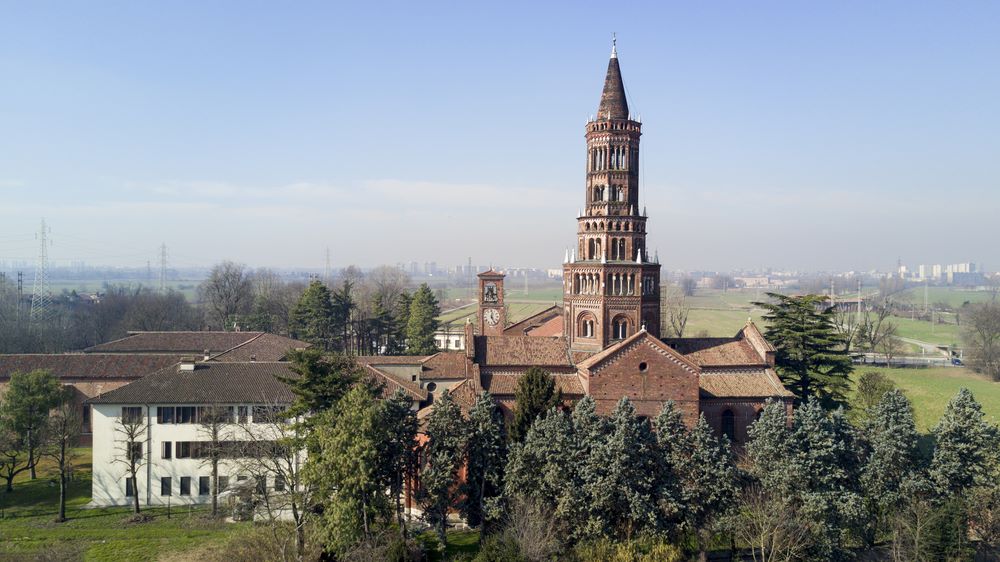
Just a few kilometres south of central Milan, Chiaravalle Abbey (Abbazia di Chiaravalle) preserves one of Lombardy’s most remarkable medieval monastic complexes. Founded in 1135 by Saint Bernard of Clairvaux, the Cistercian monastery combines Romanesque and early Gothic architecture, extraordinary fourteenth-century frescoes, a richly carved wooden choir and the slender brick bell tower known as the Ciribiciaccola. It also has a fascinating place in Italian food history: the monks of Chiaravalle are traditionally associated with the development of Grana Padano cheese.
Unlike Milan’s great urban churches, Chiaravalle still stands within an agricultural landscape. Fields, irrigation canals and farm buildings surround the abbey, even though the city has expanded almost to its doorstep. A community of Cistercian monks continues to live here, maintaining the religious traditions established nearly nine centuries ago.
The abbey is an excellent half-day excursion from Milan, particularly for visitors interested in medieval architecture, Renaissance painting and the agricultural history of the Po Valley.
From Saint Bernard to Medieval Milan
The foundation of Chiaravalle belongs to the great expansion of the Cistercian order during the twelfth century. Bernard of Clairvaux, one of the most influential religious figures of medieval Europe, promoted a monastic life based on prayer, manual work, discipline and relative architectural simplicity.
In 1135, Cistercian monks established a monastery south of Milan, in an area characterised by wetlands, woodland and agricultural land. The name Chiaravalle derives from Clairvaux, the Burgundian abbey with which Bernard was associated.
The monastery developed with support from Milanese benefactors and local authorities. Construction of the present church began around the middle of the twelfth century, and it was consecrated in 1221 by Enrico Settala, Bishop of Milan.
Chiaravalle soon became much more than a religious settlement. Its monks helped reorganise land ownership, improve cultivation and develop the hydraulic infrastructure of the surrounding countryside.
The Cistercians and the Transformation of the Countryside
The land south of Milan was historically difficult to cultivate because of its abundant water and extensive marshy areas. The Cistercians contributed to its agricultural development through drainage, irrigation channels, pasture management and the organisation of large farming estates.
The monastery developed around the Benedictine principle of ora et labora, prayer and work. Religious observance structured the day, while agriculture, animal husbandry and food production sustained the community.
This activity helped shape the landscape of the Bassa Milanese, where irrigation canals, meadows and dairy farming remained essential to the regional economy for centuries.
Chiaravalle is therefore important not only as a monument but also as part of the history of Lombardy’s agricultural wealth.
The Abbey Church
The church is built principally in red brick, combining architectural ideas from Burgundy with the Romanesque and emerging Gothic traditions of Lombardy.
The exterior is relatively restrained. The façade is organised around a central entrance, while the long brick walls and projecting transept emphasise the monastic origins of the building.
Inside, the atmosphere changes dramatically. The tall nave, ribbed vaults, pointed arches and substantial piers create a strong sense of vertical movement towards the crossing.
The essential medieval structure remains clearly visible, but the building is far more richly decorated than the austere interiors normally associated with the earliest Cistercian churches.
Later generations introduced frescoes, carved furnishings and elaborate devotional imagery, creating an extraordinary combination of medieval architecture and Renaissance and Baroque art.
The Medieval Frescoes of the Virgin Mary
Among Chiaravalle’s greatest treasures is the fourteenth-century cycle depicting the final episodes in the life of the Virgin Mary.
The paintings occupy the area beneath the great crossing tower and belong to the artistic culture that developed in Lombardy following the influence of Giotto.
They are associated with Stefano Fiorentino, a painter traditionally connected with Giotto’s workshop.
The scenes represent episodes surrounding the death, funeral and glorification of Mary, subjects particularly meaningful to a church dedicated to the Virgin.
Their artistic importance lies in the development of more natural figures, emotional interaction and a stronger sense of space compared with earlier medieval painting.
The cycle also preserves an unusual and extensive narrative devoted to the final events of the Virgin’s earthly life.
The Fiammenghini and the Cistercian Story
Other major frescoes were executed between the late sixteenth and seventeenth centuries.
The brothers Giovanni Battista and Giovanni Mauro della Rovere, known as the Fiammenghini, contributed an extensive decorative programme connected with the history and spirituality of the Cistercian order.
Their paintings belong to the vigorous religious art of Counter-Reformation Lombardy, with more animated figures, stronger contrasts and elaborate compositions.
Works by Luigi Miradori, known as il Genovesino, also belong to the later decorative history of the abbey.
These paintings transform Chiaravalle into an exceptionally interesting place for following the evolution of Lombard religious art from the fourteenth to the seventeenth century.
Bernardino Luini’s Madonna della Buonanotte
One of the most famous works associated with the monastery is the Madonna della Buonanotte, painted by Bernardino Luini in 1512.
Luini was among the most accomplished Lombard painters of the Renaissance and absorbed much from the artistic language of Leonardo da Vinci.
The fresco depicts the Virgin and Child and takes its name from the tradition that the monks contemplated the image before retiring to their sleeping quarters.
Its delicate modelling and gentle treatment of the figures provide a marked contrast with the more dramatic frescoes of later centuries.
The painting is located in an area not generally accessible during an ordinary walk through the church, making an appropriate guided visit particularly worthwhile.
The Wooden Choir
The monastic choir is one of the most impressive surviving furnishings at Chiaravalle.
Made in walnut by Carlo Garavaglia in 1645, it contains 78 finely decorated stalls with elaborate woodwork and scenes associated with the life of Saint Bernard.
The craftsmanship is exceptionally detailed. Architectural frames, figures and narrative panels transform the seating into a complex decorative ensemble.
But the choir is not simply a work of art. It remains connected with the monks’ daily prayer, continuing the religious function for which it was created.
Its preservation inside a living monastery gives it a significance that an isolated museum display could not reproduce.
The Ciribiciaccola: Chiaravalle’s Extraordinary Bell Tower
The most distinctive feature of the abbey is the tall brick tower rising above the crossing of the church.
Known in Milanese dialect as the Ciribiciaccola, the tower reaches approximately 56 metres and is one of the most elegant examples of Gothic brick architecture in Lombardy.
Its construction belongs to the fourteenth century and is traditionally attributed to Francesco Pecorari, an architect associated with important bell-tower designs in northern Italy.
The tower rises through increasingly slender octagonal stages decorated with small arches, columns, pinnacles and openings of different forms.
White marble details contrast with the terracotta brickwork, giving the structure a remarkably delicate appearance despite its height.
For centuries, it was a landmark visible across the flat countryside south of Milan.
A traditional Milanese nursery rhyme celebrates the Ciribiciaccola and the many small architectural ornaments surrounding it. The unusual name has become inseparable from the identity of the abbey.
The Cloister
The cloister formed the centre of everyday monastic life, connecting the church with spaces devoted to study, work, meals and communal activities.
The surviving cloister retains characteristic brick arches, slender columns and decorative capitals. Some columns have unusual intertwined forms that add an unexpected sculptural richness to the architecture.
From the cloister, the Ciribiciaccola appears above the roofline, providing one of the most beautiful views of the entire complex.
The surviving small cloister should not be confused with the much larger cloister constructed during the Renaissance, traditionally associated with Bramante. That structure was later demolished, with the nineteenth-century railway development contributing to the loss of the historic monastic layout.
Today, access to the cloister is regulated to protect the monastery’s religious life and heritage.
The Chapter House and Bramante’s Legacy
The chapter house was the room where monks gathered to discuss the organisation of monastic life and hear readings from the Rule of Saint Benedict.
At Chiaravalle, the space contains remarkable wall graffiti associated with the school of Donato Bramante.
These drawings include architectural representations connected with Renaissance Milan, making them particularly valuable for the history of the city and its artistic environment.
Bramante’s presence in Lombardy during the late fifteenth century profoundly influenced Milanese architecture.
The attribution of individual drawings should be treated cautiously, but their connection with the architectural culture of his workshop is an important part of Chiaravalle’s Renaissance history.
The chapter house is among the spaces best appreciated during an organised visit.
The Chapel of Saint Bernard
Near the entrance to the monastic complex stands the Chapel of Saint Bernard, constructed during the early fifteenth century.
The chapel preserves important paintings from different phases of that century.
Among the principal subjects are the Adoration of the Magi and representations of Saint Bernard with other saints.
Its vaults contain distinctive painted decoration, including colourful rainbow-like motifs.
Another notable painting depicts Christ before Pontius Pilate, showing the influence of northern European artistic traditions.
The chapel deserves particular attention because its paintings reveal the range of artistic exchanges taking place in Lombardy during the fifteenth century, before the full development of the Milanese High Renaissance.
Access is normally included in specific guided tours rather than ordinary church opening.
The Medieval Mill
The Mulino di Chiaravalle is one of the most valuable parts of the complex for understanding the economic life of a medieval monastery.
The watermill developed alongside the abbey, using water from the local canal system to power agricultural processing.
Its surviving buildings contain elements from different periods, organised around a medieval core.
After extensive restoration, the mill reopened in 2009 as a cultural and educational space.
Visitors can explore aspects of traditional milling, medicinal herbs, bread production and the relationship between the monastery and its agricultural estates.
The mill makes Chiaravalle particularly interesting for families and for anyone curious about the practical side of medieval life.
Chiaravalle and the Origins of Grana Padano
The abbey is closely associated with one of Italy’s most famous cheeses, Grana Padano PDO.
Local tradition credits the Cistercian monks of Chiaravalle with developing an early hard, long-aged cheese during the medieval period.
The economic explanation is convincing. The expansion of irrigation and permanent meadows encouraged cattle farming, which produced more milk than could be consumed immediately.
Turning surplus milk into a hard cheese that could mature and be stored for long periods was a practical solution.
The resulting cheese was historically known as caseus vetus, meaning aged cheese, while the later name grana refers to the granular texture of its paste.
The precise invention of modern Grana Padano cannot be assigned securely to one monastery or a single year. Medieval cheesemaking developed gradually across the Po Valley, and the modern protected designation is the product of a much later regulatory tradition.
Nevertheless, Chiaravalle represents an important part of the agricultural and monastic culture from which northern Italy’s great hard cheeses emerged.
Suppression and the Return of the Monks
The monastery’s history was interrupted dramatically at the end of the eighteenth century.
In 1798, during the period of the Cisalpine Republic, the Cistercian community was suppressed and monastic property was confiscated.
Buildings were altered, abandoned or demolished, although the church continued to serve religious purposes.
The railway and nineteenth-century urban changes further damaged the original monastic layout.
Restoration efforts began during the following decades, but the decisive revival came in the twentieth century.
On 1 March 1952, a community of Cistercian monks returned to Chiaravalle.
The abbey has remained an active religious house ever since, combining monastic life with conservation, cultural visits and educational activities.
The Monastic Shop and What to Buy
The abbey has a shop selling products associated with monastic traditions and the local territory.
The most appropriate purchases are Grana Padano, other regional cheeses, preserves, honey, herbal products and food specialities, depending on the current selection.
This is a better souvenir opportunity than buying generic religious objects: the food products connect directly with Chiaravalle’s agricultural history.
There is also a refreshment area where visitors can take a break before or after touring the monastery.
Visiting Chiaravalle Abbey
The abbey remains an active monastery, so general church access and cultural visits follow different arrangements.
The church is open for worship during much of the day, usually with a midday closure between 12:30 and 14:30. Ordinary cultural access to the church and cloister is more restricted.
For a weekday heritage visit, the usual visiting windows are Tuesday to Friday, 09:00–12:00 and 15:00–17:00, and Saturday, 09:00–12:00.
Weekend afternoons and holidays generally require a guided visit to access the church’s principal artistic areas and the cloister.
Available guided visits include:
- Church and cloister: approximately 1 hour, €10.
- Church, cloister and mill: approximately 1 hour 45 minutes, €17.
- Church, cloister, Chapel of Saint Bernard and mill: approximately 2 hours 15 minutes, €22.
- Chapel of Saint Bernard: approximately 30 minutes, €7.
- English or Italian audio guide: €7, available during designated weekday Info Point opening times.
For a first visit, the complete tour is the best option because it covers areas that cannot always be visited independently.
How to Get to Chiaravalle from Milan
Chiaravalle is located south of Milan, within the Parco Agricolo Sud Milano, approximately 7–9 kilometres from the city centre depending on the starting point.
Public transport is straightforward.
Take Metro Line M3 to Corvetto, then continue on bus 77 towards Chiaravalle.
Another option is bus 140 from Rogoredo, which connects the area with the southern edge of the city.
Allow approximately 35–50 minutes from central Milan, depending on connections.
By car, the abbey is easily accessible from southern Milan, although traffic and parking availability can vary.
The surrounding countryside is also suitable for cycling, particularly when combining Chiaravalle with the Vettabbia Park area.
How Much Time Do You Need?
Allow 90 minutes for a relatively quick visit to the church and accessible areas.
A guided visit including the cloister, chapel and mill requires around two hours and fifteen minutes.
With time for the shop, a short walk through the surrounding village and the agricultural landscape, Chiaravalle makes a comfortable half-day excursion.
The best time is generally spring or early autumn, when the surrounding countryside is green and outdoor walking is pleasant.
Is Chiaravalle Abbey Worth Visiting?
Chiaravalle is among the most rewarding historic sites outside central Milan, particularly because it combines several different aspects of Lombard history within one small area.
The church preserves major medieval and later frescoes, the choir is an exceptional example of seventeenth-century woodcarving, and the Ciribiciaccola remains one of the most distinctive Gothic towers in the region.
Yet the abbey’s importance extends beyond art and architecture.
Its monks helped shape the agricultural countryside south of Milan, developing an economic system based on irrigation, animal husbandry and food production. The connection with Grana Padano gives that history a tangible culinary dimension.
Most importantly, Chiaravalle remains a living Cistercian monastery rather than a former religious complex converted entirely into a museum. Almost nine centuries after its foundation, the relationship between prayer, work and the surrounding land remains part of its identity.
Useful Information
- Name: Abbazia di Chiaravalle / Chiaravalle Abbey
- Location: Via Sant’Arialdo 102, 20139 Milan, Italy
- Founded: 1135
- Founder: Saint Bernard of Clairvaux
- Church consecrated: 1221
- Religious order: Cistercian
- Architecture: Lombard Romanesque and early Gothic, with later additions
- Famous tower: Ciribiciaccola, approximately 56 metres high
- Main artworks: Stefano Fiorentino’s Marian fresco cycle, Bernardino Luini’s Madonna della Buonanotte and the Fiammenghini frescoes
- Wooden choir: Carlo Garavaglia, 1645
- Associated food tradition: Grana Padano
- Monastic community restored: 1952
- Church and cloister visiting times: Tuesday–Friday 09:00–12:00 and 15:00–17:00; Saturday 09:00–12:00
- Weekend visits: scheduled guided tours; reservations recommended
- Complete guided visit: €22, approximately 2 hours 15 minutes
- Audioguide: €7, Italian and English
- Info Point telephone: +39 02 849 304 32
- Info Point email: [email protected]
- Monastery telephone: +39 02 5740 3404
- Monastery email: [email protected]
- Public transport: Metro M3 to Corvetto and bus 77; alternatively bus 140 from Rogoredo
- Recommended time: 2–3 hours
- Accessibility: church and cloister accessible to visitors with reduced mobility; access to other historic spaces may be more limited
- Dress: appropriate clothing for an active religious site
- Best season: spring and early autumn

