
From Apocalypse Tapestries to Rosé d’Anjou: What Makes Angers the Most Surprising City in France?

Angers is not a simple stop along the Loire, nor a medieval postcard to look at and forget. It is a city that surprises with its historical density, its constant cultural life, its balance between its monumental past and its university present. What drives thousands of visitors to explore its streets, to return to the castle ramparts, to seek out a glass of Rosé d’Anjou in a brasserie in the Doutre? Angers does not limit itself to showing itself: it invites you to understand, to slow down, to observe closely. And it does not allow itself to be reduced to tourist formulas: every corner has a story and every detail deserves attention.
History
The first traces of settlement date back to the Gallo-Roman period, but it was in the Middle Ages that Angers took on a strategic role. The city became the political centre of the county of Anjou and then the heart of the power of the Plantagenets, protagonists of Franco-British history. The wars, alliances and ambitions of the house are reflected in the military architecture of the castle and in the civil buildings. The Renaissance enriched Angers with stately buildings and intellectual fervour, while the 19th century saw the city transform into an industrial centre and railway hub. Today Angers stands out for its attention to heritage, academic liveliness and urban management centred on sustainability and widespread culture.
What to See
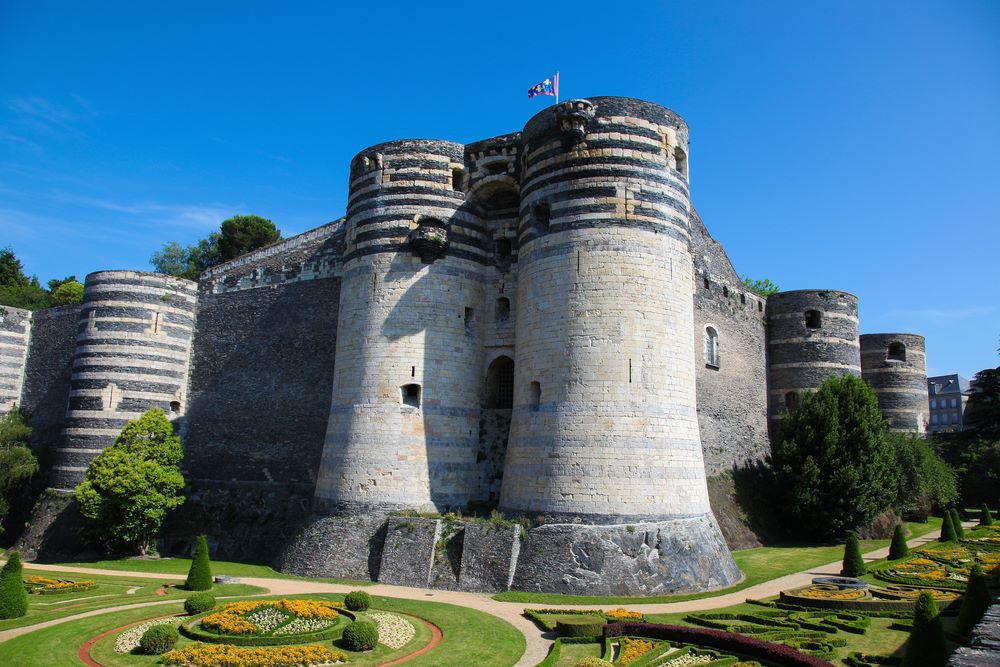
The Château d’Angers, built in the 13th century by Louis IX, stands out as a military architecture and cultural centre. Its 17 towers and massive walls conceal a rare treasure: the Tapestry of the Apocalypse, a cycle of over one hundred metres of scenes woven in the 14th century, commissioned by Duke Louis I of Anjou. Few works in Europe can boast such integrity.
The Cathedral of Saint-Maurice, with its Romanesque-Gothic façade and frescoed interior, is one of the most important religious buildings in the Loire Valley. The 13th-century stained glass windows are unique in their size and finesse.
The museums are no less fascinating: the Galerie David d’Angers houses monumental works in a restored glass-covered church; the Musée des Beaux-Arts offers a dialogue between ancient and modern art; the Musée Jean Lurçat devotes an entire wing to contemporary tapestry.
Neighborhoods and Surroundings
La Doutre is the neighborhood on the other bank: quiet, authentic, dotted with half-timbered houses and monasteries. A place where neighborhood life mixes with small cafes and still active shops. The city center, on the other hand, pulsates between the station, rue Lenepveu and place du Ralliement, a commercial and theatrical hub. Saint-Serge, to the north, is home to campuses, libraries and a new urban plan.

Near Angers, the Château de Brissac (tel. +33 2 41 91 22 21), known for its seven floors and its English-style park, can be visited all year round. The Abbey of Fontevraud (tel. +33 2 41 51 73 52), one of the largest in Europe, offers exhibitions and concerts. The towns of Savennières and Rochefort-sur-Loire offer tastings in the wine-growing domaines.
Trekking and Walking Itineraries
Angers is crisscrossed by cycle paths and hiking trails that connect the city centre with the Loire, the hills of Anjou and the large river parks. The La Loire à Vélo route runs through the city and is suitable for day trips to Saumur or Nantes. Lac de Maine, a natural area with a beach and wooded areas, is perfect for walking, kayaking or watching water birds. The Botanical Garden is an urban oasis with hundreds of plant species and tropical greenhouses.
Gastronomy and Restaurants
The cuisine of Angers is distinguished by a balance between sweetness and acidity, the fruit of a land rich in water and vineyards. The rillettes, the boudin noir, the cremet d’Anjou and the quernons d’ardoise tell of a simple but refined tradition.
The city is famous for the wine production of the Anjou-Saumur region, with appellations such as Rosé d’Anjou, Cabernet d’Anjou, Savennières (dry, elegant and mineral white), and the prestigious Coteaux du Layon, a sweet white from Chenin Blanc grapes grown on schistose soils.
Among the spirits, it is worth mentioning the famous Cointreau, an orange liqueur distilled in Saint-Barthélemy-d’Anjou, now distributed throughout the world.
La Table de la Bergerie (Champ-sur-Layon, tel. +33 2 41 78 30 17): refined, in the countryside, seasonal tasting menu.
Au P’tit Quai (12 Quai des Carmes, tel. +33 2 41 87 97 67): modern bistro, river view, contemporary French cuisine.
Les Trois Lieux (10 Port des Noues, Les Ponts-de-Cé, tel. +33 2 41 91 21 50): industrial design, creative cuisine.
La Rue Sauvage (38 Rue Baudrière, tel. +33 2 44 01 87 28): tapas bar, young atmosphere.
Le Favre d’Anne (21 Boulevard du Maréchal Foch, tel. +33 2 41 36 12 12): starred restaurant with signature cuisine.
Where to Sleep
The options range from independent B&Bs to designer boutique hotels. Each neighborhood offers a different setting: historic, residential or immersed in greenery.
Hôtel d’Anjou (1 Boulevard du Maréchal Foch, tel. +33 2 41 21 12 11): refined, excellent central location.
Maison Bossoreil (36 Rue Bourgonnier, tel. +33 2 41 88 45 72): charming residence with breakfast in the garden.
Les Chambres de Mathilde (27 Rue Hoche, tel. +33 6 25 12 02 75): family-friendly, well-furnished, quiet.
21 Foch (21 Boulevard du Maréchal Foch, tel. +33 2 41 20 21 21): elegant, contemporary boutique hotel.
Slow Village Loire Vallée (tel. +33 5 56 22 10 69): eco-friendly houses along the Loire, relaxing atmosphere.
Events and Curiosities
In January, the Premiers Plans Festival reveals the talent of new European directors and transforms the city into a diffused screening room. In September, Les Accroche-Cœurs invites artists and urban theatre companies from all over Europe for performances in the squares. The audience participates, the boundaries between actor and spectator are blurred.
Angers is also home to Cointreau, an orange liqueur distilled since 1875 in Saint-Barthélemy-d’Anjou, and Coteaux du Layon wine, known for its apricot and honey aromas. But it is also a city that invests in contemporary culture: artist residencies, music festivals, urban art workshops.
How to Get There and Get Around
Angers is connected by TGV to Paris (1h30 from Montparnasse), Tours and Nantes. The station Angers-Saint-Laud is in the city center (1 Esplanade de la Gare). The nearest airport is Nantes Atlantique (90 km).
The Irigo public transport system (tel. +33 2 41 18 80 00) operates trams and buses. Numerous cycle paths and pedestrian zones make the centre easy to explore on foot or by bicycle. Car parking is regulated: it is advisable to use the dissuasive car parks with shuttle.
Where to Shop
The historic Maison d’Adam (1 Place Sainte-Croix) is home to the Maison des Artisans: ceramics, glass, jewellery, hand-made fabrics. Rue Lenepveu is the bourgeois shopping street, with independent boutiques and French brands. The Place Imbach Market, every Saturday morning, is the heart of the local food trade, with bread, oysters, spices and cheeses from Anjou.
Useful Numbers and Practical Information
Tourist Office: 7 Place Kennedy, tel. +33 2 41 23 50 00, [email protected]
EU Emergencies: 112
University Hospital: CHU d’Angers, 4 Rue Larrey, tel. +33 2 41 35 36 37
Train station: Angers-Saint-Laud, 1 Esplanade de la Gare, tel. +33 2 41 87 62 00

