
Discover Modena’s Historic Heart: From Medieval Roots to Renaissance Splendor

Modena has an almost unreasonable number of claims to fame for a city of its size. Ferrari was born here. Luciano Pavarotti was born here. Traditional Balsamic Vinegar of Modena comes from this territory. The local table brings together tortellini, gnocco fritto, tigelle, Parmigiano Reggiano, cured meats and Lambrusco, while one of the most influential restaurants in contemporary Italian cuisine, Osteria Francescana, sits quietly in the historic centre.
Yet Modena is much more than an edible souvenir shop with sports cars parked outside.
At its heart stands one of Europe’s great Romanesque ensembles: the Cathedral, the Ghirlandina Tower and Piazza Grande, a UNESCO World Heritage Site since 1997. Around it spreads an elegant but manageable centre of arcades, warm brick façades, medieval streets, old food shops and palaces recalling the centuries when Modena was capital of the Este Duchy.
The city rewards slow curiosity. Look beyond the famous monuments and you encounter strange medieval sculptures, a stolen wooden bucket that became a symbol of civic rivalry, a mysterious female figure watching Piazza Grande from above and an entire Roman city buried beneath the modern streets.
Modena can be visited in a day, but two days are ideal, especially if Ferrari, Pavarotti or a balsamic vinegar producer are part of the plan.
What to See in Modena
- Piazza Grande
- Modena Cathedral
- Ghirlandina Tower
- Palazzo Comunale and the Historic Rooms
- Mercato Albinelli
- Palazzo Ducale
- Galleria Estense
- Museo Enzo Ferrari
- Casa Museo Luciano Pavarotti
- The streets of the historic centre
- A traditional acetaia
- The Roman remains of ancient Mutina
Piazza Grande
Start here. Piazza Grande is not simply Modena’s central square; it is the stage on which much of the city’s medieval political, commercial and religious life unfolded.
The square developed beside the Cathedral during the Middle Ages and for centuries served as marketplace, meeting place, courtroom and civic theatre. Public announcements were made here, sentences were proclaimed and crowds gathered beneath the municipal buildings.
Its irregular shape is part of its charm. The Cathedral dominates one side, the Palazzo Comunale stretches along another and the Ghirlandina rises above everything without making the square feel monumental or intimidating.
Look carefully near the Palazzo Comunale for the Preda Ringadora, a large rectangular block of reddish marble. Its name refers to public speaking: medieval officials and orators climbed onto it to address the population.
Its uses were not always dignified. Insolvent debtors could apparently be publicly humiliated here, while unidentified corpses were sometimes laid on the stone so citizens could recognise them.
Then look upward towards the corner of the Palazzo Comunale. A small female sculpture known as La Bonissima has watched the square for centuries. Nobody knows with certainty whom she represents. One tradition identifies her as a generous woman who helped the poor during a famine; another interpretation connects her with commerce and the regulation of the market.
That uncertainty makes her far more interesting than a neat explanation would.
Modena Cathedral

The Cathedral of Modena is one of the masterpieces of Romanesque Europe.
Construction began in 1099, when architect Lanfranco was entrusted with creating a new church over the burial place of Saint Geminianus, Modena’s patron saint. The sculptor Wiligelmo was responsible for much of its extraordinary decorative programme.
From a distance the Cathedral looks severe and balanced. Get closer and the stone begins to tell stories.
Wiligelmo’s reliefs on the façade narrate episodes from Genesis with figures that are muscular, expressive and surprisingly human. Adam and Eve, Cain and Abel and Noah are not distant theological abstractions; they behave almost like characters in a medieval graphic novel carved into stone.
The Cathedral also contains a remarkably playful bestiary. Lions, monsters, fantastic animals and hybrid creatures appear around portals and capitals. Medieval churches were not designed as silent museums. Sculpture taught, warned, entertained and occasionally frightened an audience in which many people could not read.
Inside, descend into the crypt, where the remains of Saint Geminianus are preserved.
Another highlight is the extraordinary Adoration of the Shepherds by Guido Mazzoni, created in painted terracotta in the late 15th century. The figures are intensely physical and emotional: wrinkles, gestures and expressions make the scene feel almost theatrical.
Do not rush through the Cathedral. The best details are not necessarily the largest ones.
Ghirlandina Tower
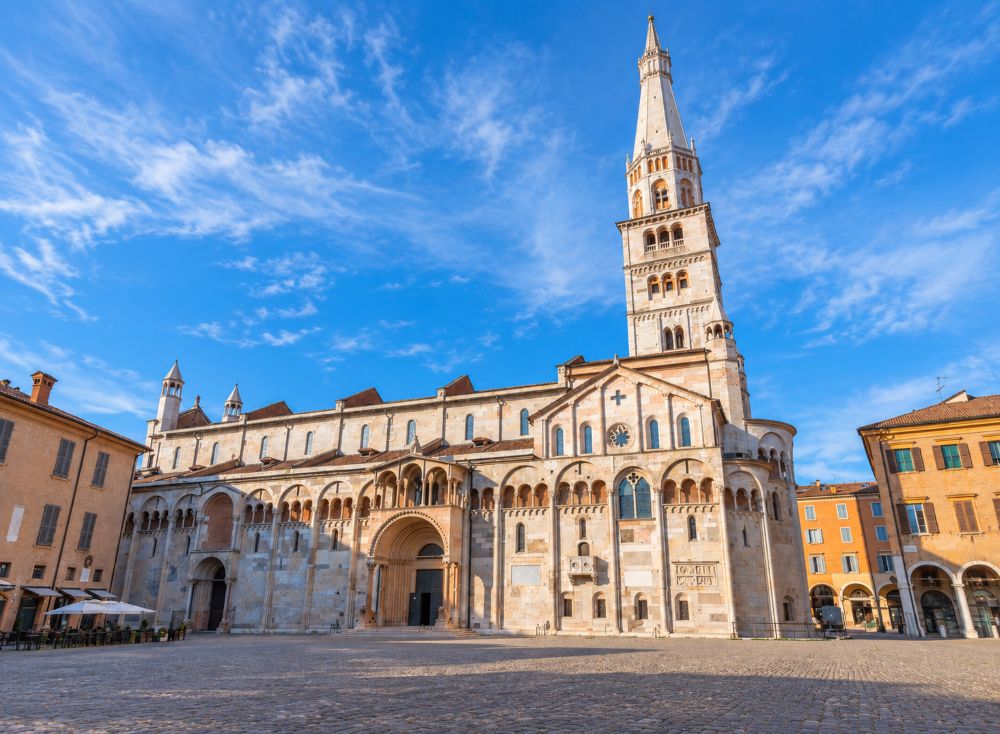
The Ghirlandina is Modena’s unmistakable vertical landmark.
Rising to approximately 89 metres, the bell tower was constructed in several phases beginning in the 12th century. Its lower sections harmonise with the Romanesque Cathedral, while the upper portion becomes lighter and more Gothic.
The affectionate name Ghirlandina probably refers to the decorative balustrades around its upper stages, which resemble elegant stone garlands.
But this was never merely a bell tower.
Medieval towers had political as well as religious meaning. The Ghirlandina watched over the city, announced emergencies, marked civic events and served as a powerful visual symbol of Modena itself.
Inside is the Sala della Secchia, traditionally associated with one of the strangest objects in Modenese history: the famous stolen bucket.
The climb involves roughly 200 steps and visitors do not reach the absolute summit, but the view from the accessible level provides an excellent understanding of Modena’s urban structure: the Cathedral roof immediately below, the compact historic centre and the plain stretching towards the Apennines.
Access is currently organised in timed groups and advance booking is required.
A curious detail: why a bucket matters in Modena
In 1325 Modena and Bologna fought the Battle of Zappolino, part of the wider conflicts between Ghibelline and Guelph factions in medieval Italy.
According to the famous later legend, Modenese soldiers stole a wooden bucket from a well in Bologna and carried it home as a trophy.
The story inspired Alessandro Tassoni’s 17th-century mock-heroic poem La Secchia Rapita, or The Stolen Bucket, which transforms the absurd object into the supposed cause of a war.
The real historical sequence is different—the bucket did not start the Battle of Zappolino—but Modena wisely decided never to let facts ruin an excellent story.
The old wooden bucket traditionally identified with the legend survives in the Palazzo Comunale.
Palazzo Comunale
The long arcaded building beside Piazza Grande may look like a single palace, but it is actually the result of several medieval civic buildings gradually joined and remodelled over the centuries.
Inside, the Historic Rooms of the Palazzo Comunale preserve the ceremonial side of Modena’s civic history.
Among the most interesting spaces is the Camerino dei Confirmati, where the famous wooden bucket associated with the Secchia Rapita is preserved.
The interiors also reveal another Modena, far removed from the muscular Romanesque architecture outside: frescoes, decorative ceilings and rooms shaped by centuries of civic administration.
The building remains the seat of municipal government, which gives the complex something museums often lose: continuity.
Another particularly Modenese surprise is found inside the palace: a small municipal acetaia, where barrels of Traditional Balsamic Vinegar mature above the administrative rooms. Visits are generally organised at specific times and should be booked in advance.
Few town halls smell this good.
Mercato Albinelli
For understanding how Modena eats, the Mercato Albinelli is as important as any museum.
The covered market opened in 1931, replacing the open-air food trading traditionally carried out around Piazza Grande. Its architecture still has an elegant early-20th-century character, centred on an ornamental fountain and surrounded by stalls selling meat, fish, vegetables, cheese, fresh pasta and local specialities.
Come in the morning when the market still behaves like a market rather than merely a gastronomic attraction.
This is a good place to understand the extraordinary density of Modenese food culture. Fresh tortellini sit beside Parmigiano Reggiano, prosciutto and mortadella; bottles of Lambrusco share shelves with balsamic vinegar; fresh pasta appears in an intimidating variety of shapes.
Look especially for tortellini, tortelloni, passatelli, Parmigiano Reggiano, Prosciutto di Modena, ciccioli, amaretti and bottles of Lambrusco.
Several counters and small eateries now allow visitors to eat inside the market, making Albinelli particularly useful for an informal lunch.
Palazzo Ducale

If Piazza Grande represents medieval Modena, Piazza Roma and Palazzo Ducale represent the city’s transformation into a European court.
The turning point came in 1598. The Este family lost Ferrara, which returned to direct papal control, and transferred the capital of its duchy to Modena.
The existing medieval castle was hardly suitable for a dynasty determined to maintain its political prestige.
From 1634, Duke Francesco I d’Este began transforming the site into the immense Baroque palace seen today. Bartolomeo Avanzini directed the project, while major artistic and architectural figures contributed ideas to the development of the residence.
The façade facing Piazza Roma is imposing without becoming heavy: long rows of windows, symmetrical wings and an elaborate central section turn the square into one of Modena’s grandest urban spaces.
The palace remained an Este residence until 1859.
Today it houses the Italian Military Academy, one of the country’s principal institutions for officer training. Consequently, this is not a palace where visitors can simply wander inside whenever they please.
Guided visits are available on selected dates and normally require advance reservation. When accessible, the itinerary can include the monumental staircase, state apartments and ceremonial rooms.
Even without entering, Piazza Roma deserves a detour, particularly in the late afternoon when the palace façade catches the softer light.
Galleria Estense
The Galleria Estense is essential for understanding what happened when Modena became the Este capital.
The dynasty had accumulated one of Italy’s most prestigious aristocratic art collections. Although political difficulties and sales dispersed part of it, what remains is still exceptional.
The gallery occupies the upper floor of the Palazzo dei Musei and brings together paintings, sculptures, decorative arts, musical instruments, bronzes, ceramics and objects from the Este collections.
Two works alone justify the visit.
The first is Diego Velázquez’s portrait of Francesco I d’Este, painted during the duke’s visit to Madrid in 1638. Francesco appears magnificently self-assured, almost glowing against the dark background.
The second is Gian Lorenzo Bernini’s marble bust of Francesco I, one of the great Baroque portraits. Remarkably, Bernini created it without having the duke pose directly before him, working largely from painted portraits.
The result is anything but static. Hair, fabric and lace seem caught in movement, while Francesco looks less like a man sitting for a portrait than a ruler entering the room.
Works by artists including Correggio, El Greco, Guido Reni and Cima da Conegliano expand the collection well beyond Este portraiture.
The gallery is usually closed on Monday, so plan accordingly.
Museo Enzo Ferrari
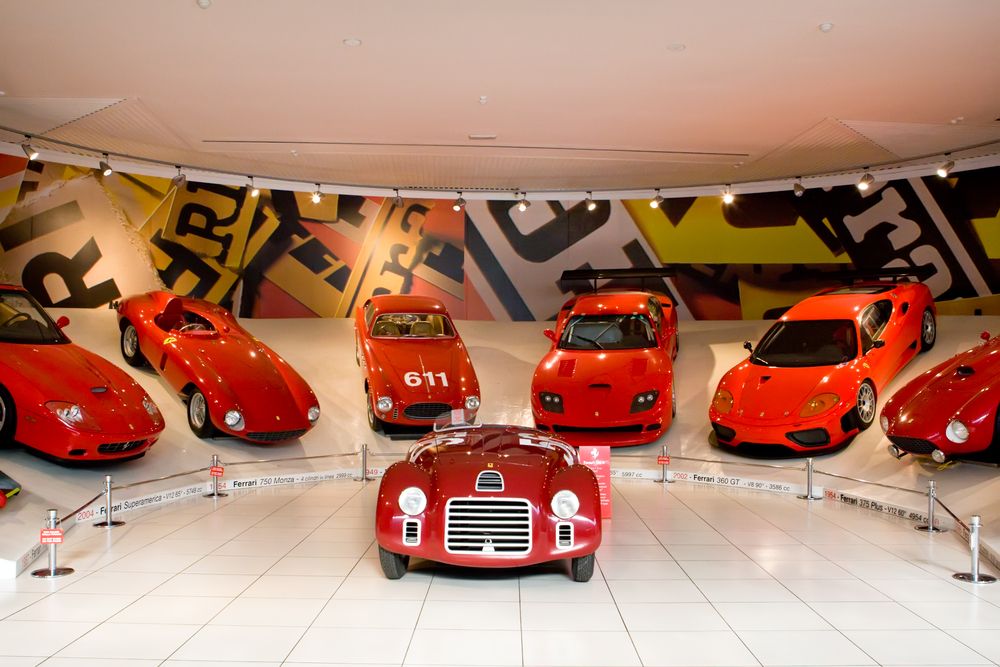
You do not need to be obsessed with cars to enjoy the Museo Enzo Ferrari.
The museum stands near the house where Enzo Ferrari was born in 1898, combining the restored family workshop with a dramatically modern exhibition building whose yellow aluminium roof resembles the bonnet of a sports car.
The contrast is exactly right.
The historic building concentrates more closely on Ferrari’s life, engines and engineering, while the main pavilion uses changing displays of cars, light, sound and large-scale projections to tell the broader Ferrari story.
Enzo Ferrari initially wanted to become a racing driver. He competed during the 1920s before increasingly turning towards race management and manufacturing. He founded Scuderia Ferrari in 1929, while the first road car carrying the Ferrari name appeared in 1947.
The museum in Modena should not be confused with the Ferrari Museum in Maranello, approximately 20 kilometres away.
The distinction is useful:
Modena is primarily about Enzo Ferrari, design, history and the man behind the company. Maranello concentrates more heavily on Ferrari cars, Formula One and the racing world.
Serious enthusiasts should visit both.
Casa Museo Luciano Pavarotti
Luciano Pavarotti remains one of the most recognisable opera singers in modern history, but his relationship with Modena was not merely biographical.
He was born here in 1935, the son of a baker who was also an amateur tenor, and maintained close ties with his home territory throughout his career.
The Casa Museo Luciano Pavarotti occupies the villa where the tenor spent the final years of his life.
It is located outside the historic centre, so a taxi or car is more convenient than walking.
The house avoids feeling like a conventional display of trophies. Stage costumes, photographs, awards and recordings certainly appear, but so do personal belongings, rooms and objects connected with Pavarotti’s everyday life.
The result offers a more intimate counterpart to the giant public image of the singer who filled opera houses and stadiums around the world.
One lesser-known aspect of the property is particularly revealing: Pavarotti loved horses. The surrounding land was connected with his equestrian passion, and for years Modena hosted the international Pavarotti International show-jumping competition.
Allow around an hour for the museum.
The Historic Centre: Via Emilia, Canalgrande and the Old Streets
Modena becomes much easier to understand once you stop treating its monuments as isolated attractions.
Walk.
The historic centre is compact, predominantly flat and ideal for exploring on foot.
The Via Emilia, laid out by the Romans in 187 BC, still cuts through the modern city. Few roads in Europe can claim such remarkable continuity: a route created to connect Roman settlements continues to structure daily life more than two millennia later.
Corso Canalgrande and Corso Canalchiaro preserve another clue to Modena’s past in their names. Several streets in the centre follow the routes of waterways and canals that once crossed the city.
These were progressively covered, but the urban vocabulary survived.
Walk through Via Farini between Piazza Roma and the centre, explore the narrow streets around the Cathedral, continue towards Largo San Francesco, then return through the market quarter.
Modena does not require an elaborate walking itinerary. Its centre is small enough to reward deliberate wandering.
Ancient Mutina: The Roman City Beneath Modena
Roman Modena is largely invisible, which makes its story unusually fascinating.
The Roman colony of Mutina was founded in 183 BC along the strategic Via Emilia and became one of northern Italy’s important Roman centres.
Cicero famously called it splendidissima, suggesting a prosperous and distinguished city.
Then geography intervened.
Repeated flooding and centuries of urban rebuilding gradually buried much of Roman Mutina beneath layers of sediment and later construction. In some places the ancient city lies several metres below the modern street level.
This explains why Modena lacks the immediately visible Roman monuments found in Verona or Arles despite having an important Roman past.
Archaeological finds can be seen in the city’s museum collections and at selected archaeological sites.
Knowing that another city lies beneath your feet changes the experience of walking through central Modena.
Traditional Balsamic Vinegar: Visit an Acetaia
Calling Traditional Balsamic Vinegar of Modena simply “vinegar” is rather like calling Parmigiano Reggiano dried milk.
The authentic product is made from cooked grape must, then aged through a sequence of wooden barrels known as a batteria. As liquid evaporates and concentrates, vinegar is progressively transferred between barrels of different sizes.
Woods can include oak, chestnut, cherry, mulberry and juniper, each contributing slightly different characteristics.
Ageing takes place for a minimum of 12 years for Traditional Balsamic Vinegar of Modena PDO; the Extravecchio category requires at least 25 years.
Traditionally, barrels were stored in attics rather than cool underground cellars. Modena’s hot summers and cold winters encourage evaporation and the annual cycle of concentration and maturation.
Historically, a new battery of barrels could even be started to mark the birth of a child and remain part of the family’s patrimony for generations.
That explains why a true acetaia feels less like a factory than a family archive made of wood and aroma.
If time allows, organise a visit to a producer in the countryside around Modena. Tastings reveal immediately why supermarket balsamic condiment and Traditional Balsamic Vinegar PDO are fundamentally different products.
What to Eat in Modena

Modena sits in one of Italy’s richest gastronomic territories, and eating here should be considered part of the sightseeing.
Begin with tortellini, tiny parcels of filled pasta traditionally served in capon or meat broth. Modena and Bologna have argued over their paternity for longer than anyone needs to solve over lunch.
Then try tortelloni, larger and generally filled with ricotta and greens, often dressed simply with butter and sage.
Gnocco fritto is another essential. Despite the name, it has nothing to do with potato gnocchi. These are light pieces of fried dough that puff into soft pillows and are eaten hot with cured meats.
Alongside them come tigelle, more correctly known locally as crescentine: small round breads traditionally cooked in special moulds and served with salumi, cheese or cunza, a mixture based on lard, garlic and rosemary.
Among meat dishes, look for bollito misto, cotechino and preparations using balsamic vinegar.
For cheese there is little need for introductions: Modena is part of the production territory of Parmigiano Reggiano.
And then there is Prosciutto di Modena PDO, generally sweeter and less aggressively salty than many industrial cured hams.
Desserts include torta Barozzi, originally from nearby Vignola, and Modenese amaretti.
What to Drink in Modena
Forget the idea that serious wine must be still.
Lambrusco is the natural wine of Modena, and the best examples are dry, lively, food-driven wines with far more character than the sweet commercial versions that damaged Lambrusco’s reputation abroad.
Three local styles are particularly worth knowing.
Lambrusco di Sorbara tends to be lighter in colour, high in acidity and energetic, with notes of red berries, flowers and citrus.
Lambrusco Grasparossa di Castelvetro is darker, fuller and more tannic, making it excellent with salumi, cotechino and richer dishes.
Lambrusco Salamino di Santa Croce generally sits between the two in body and structure.
Drink Lambrusco as Modenese food intends: with fat, salt, Parmigiano, fried dough and stuffed pasta. Its bubbles and acidity are not decorative; they clean the palate and keep an otherwise substantial meal moving.
Finish with Nocino, the dark walnut liqueur traditionally produced from unripe green walnuts harvested around the feast of Saint John in June.
Where to Eat in Modena
Trattoria Aldina
Hidden upstairs opposite Mercato Albinelli, Aldina is the sort of trattoria visitors hope still exists in Emilia.
The approach is straightforward: communal atmosphere, traditional pasta, generous portions and little ceremony.
Tortellini in broth and tortelloni with ricotta and spinach are classics. It is particularly good for travellers who want traditional Modenese cooking without turning lunch into an event.
Address: Via Albinelli 40, Modena
Telephone: +39 059 236106
Opening: Monday–Saturday, lunch only
Price: €
Best for: Traditional Modenese lunch and handmade pasta
Ristorante Da Danilo
A few minutes from the Cathedral, Da Danilo offers the kind of menu that makes choosing difficult for the right reasons.
Tortellini in broth, tortelloni, tagliatelle, lasagne and boiled meats keep the restaurant firmly anchored in Emilia. The kitchen is particularly appropriate for visitors who want a broad introduction to traditional local dishes in a proper sit-down restaurant.
Address: Via Coltellini 31, Modena
Telephone: +39 059 225498
Opening: Monday–Saturday, lunch and dinner; closed Sunday
Price: €€
Best for: Traditional cuisine, tortellini and classic Modenese dishes
Franceschetta58
Franceschetta58 offers a more contemporary interpretation of Emilia-Romagna.
The restaurant occupies a former tyre workshop and takes local ingredients and traditions in a more playful direction than a conventional trattoria. Seasonal dishes, modern techniques and a strong regional identity make it an excellent middle ground between rustic cooking and full-scale fine dining.
Address: Via Vignolese 58, Modena
Telephone: +39 059 3091008
Opening: Monday–Saturday, lunch and dinner
Price: €€–€€€
Best for: Contemporary Emilia-Romagna cuisine in an informal setting
Osteria Francescana
Massimo Bottura’s Osteria Francescana transformed the international perception of contemporary Italian cooking.
This is not the place to come simply because it is famous. It makes most sense for travellers interested in how traditional Italian flavours can be dismantled, remembered, questioned and rebuilt through modern haute cuisine.
Reservations require planning and prices sit firmly at destination-restaurant level.
Address: Via Stella 22, Modena
Price: €€€€
Best for: A gastronomic destination experience and contemporary Italian haute cuisine
Where to Stay in Modena
Rua Frati 48 in San Francesco
A five-star option inside a historic 16th-century building in the centre. Rooms combine the architecture of the old palace with contemporary furnishings, while the property also offers a wellness area, gym and restaurant.
Address: Rua dei Frati Minori 48, Modena
Telephone: +39 059 7474411
Best for: Luxury, couples and a central historic setting
Hotel Cervetta 5
Only a few steps from Piazza Grande, Cervetta 5 is particularly strong on location. The small scale and contemporary interiors suit travellers who prefer an intimate city hotel over a large international property.
Private parking is available in limited numbers, which is valuable in the restricted-traffic historic centre.
Address: Via Cervetta 5, Modena
Telephone: +39 059 238447
Check-in: from 14:00
Check-out: by 11:00
Best for: Central location and exploring Modena entirely on foot
Salotto delle Arti
Set inside historic Palazzo Montagnani, Salotto delle Arti is an intimate accommodation with high ceilings, period details, frescoes and individually styled rooms.
It is particularly suited to travellers who value atmosphere and historic character more than the facilities of a conventional hotel.
Address: Rua del Muro 86, Modena
Telephone: +39 389 9559087
Check-in: normally 14:30–18:30, with alternative arrangements possible
Best for: Romantic stays, historic interiors and independent travellers
How Much Time Do You Need in Modena?
One full day is enough for the historic centre and one major museum.
A good one-day itinerary begins at Piazza Grande before the city becomes busy. Visit the Cathedral, then climb the Ghirlandina. Continue through the Palazzo Comunale and Mercato Albinelli before lunch.
In the afternoon walk along Via Emilia and through Piazza Roma to see Palazzo Ducale, then choose either the Galleria Estense or Museo Enzo Ferrari.
Two days are much better.
Use the second day for the museum you skipped, Casa Museo Luciano Pavarotti and, most importantly, a visit to an acetaia outside the centre.
Ferrari enthusiasts can instead devote half a day to Maranello.
Getting to Modena
Modena lies on the main railway corridor through Emilia-Romagna and is easily reached from Bologna, Parma, Reggio Emilia and Milan.
The railway station is approximately 15 minutes on foot from the historic centre.
From Bologna, regional trains make Modena an easy day trip, although staying overnight produces a much better experience, particularly if you want to explore the city’s food culture at dinner.
By car, the city is close to the A1 motorway, but driving into the historic centre requires care because large sections are controlled by a ZTL, or Limited Traffic Zone.
Do not blindly follow a satellite navigator into the centre.
Parking in Modena
For travellers arriving by car, Parcheggio del Centro near Novi Sad Park is one of the most practical large parking facilities for reaching the historic centre on foot.
Several street parking areas also surround the centre, but pay attention to colour markings, restrictions and ZTL access points.
Hotels inside the restricted zone can often provide instructions for authorised access or register guests’ licence plates when permitted. Contact the accommodation before arrival rather than improvising once you reach the barriers.
Best Time to Visit Modena
April to June and September to October offer the best balance of comfortable temperatures, active city life and pleasant conditions for walking.
Summer can be hot and humid, particularly in July and August.
Autumn is especially attractive for food travellers. Vineyards are active, menus become richer and the surrounding countryside feels closely connected with the gastronomic identity of the city.
January also has a distinctive local moment: 31 January is the feast of Saint Geminianus, Modena’s patron saint, when the historic centre fills with stalls and celebrations.
A Few Modena Curiosities Worth Knowing
Modena is a city where small details often lead to surprisingly large stories.
The Romans knew it as Mutina, and much of that ancient city remains buried beneath today’s streets.
The Cathedral’s medieval sculptures include fantastic animals, demons and strange creatures that once formed part of a visual language understood by people who might never have opened a book.
A wooden bucket became so famous that it inspired one of Italy’s major mock-heroic poems.
Traditional balsamic vinegar was historically treated as a family possession rather than an everyday condiment, with barrels passed between generations.
Street names such as Canalgrande and Canalchiaro preserve the memory of waterways now hidden beneath the city.
And perhaps the most revealing Modenese contrast of all is geographical: within a relatively small territory, medieval stonecutters, Este court artists, opera singers, balsamic vinegar makers and racing-car engineers all built international reputations by doing essentially the same thing—taking craftsmanship extremely seriously.
Is Modena Worth Visiting?
Absolutely, and not merely as a day trip for Ferrari fans.
The city combines major medieval architecture, genuinely important art, extraordinary food and a distinctive modern identity without becoming difficult to navigate or overwhelmed by tourism.
Modena also has a quality increasingly rare in famous Italian destinations: everyday life still occupies the centre. People shop at Albinelli, cycle across Piazza Grande, meet beneath the arcades and drink Lambrusco without turning any of it into a performance.
Come for the Cathedral or Ferrari if you need an excuse.
Stay for the tortellini, the old streets, the smell of an acetaia and the moment when you realise that one of Italy’s most famous gastronomic cities is also one of its most interesting small cultural capitals.
Useful Information
- Region: Emilia-Romagna
- Province: Modena
- Population: approximately 185,000
- Ideal stay: 1–2 days
- Historic centre: compact and easily explored on foot
- Main railway station: Modena
- Nearest major airport: Bologna Guglielmo Marconi Airport
- UNESCO Site: Cathedral, Ghirlandina Tower and Piazza Grande
- Ghirlandina: advance reservation currently required for timed entry
- Museo Enzo Ferrari: near the railway station and historic centre
- Casa Museo Luciano Pavarotti: outside the centre; taxi or car recommended
- Best local foods: tortellini, tortelloni, gnocco fritto, tigelle, Parmigiano Reggiano and Prosciutto di Modena
- Essential local drink: Lambrusco
- Essential local product: Traditional Balsamic Vinegar of Modena PDO
- Driving: pay close attention to the ZTL in the historic centre

