
Celebrating Día de Muertos in Mexico City: A Guide to the Must-See Events
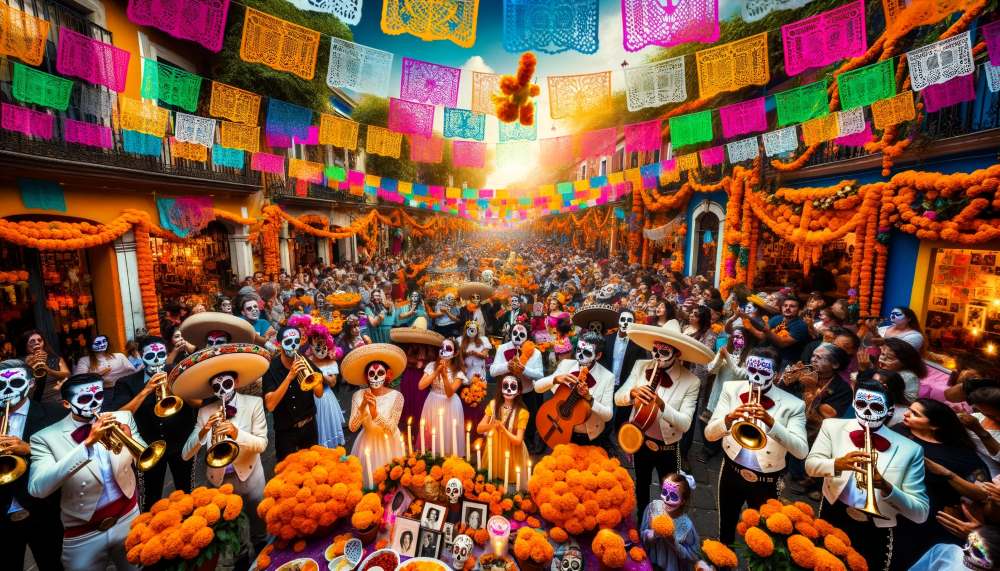
Death is often considered a taboo subject, traditionally linked to negative feelings like sorrow, tears, and even fear—stemming from the anguish of losing someone dear to us. However, in Mexico, there exists a day that turns this entire narrative on its head. A night that becomes a meeting ground between the living and the dead, where the boundaries between the two realms temporarily dissolve, reviving the spiritual connection that transcends the physical limitations of space and time: Día de Muertos.
Every year, on November 1st and 2nd, Mexico gears up to welcome back its departed by not just coloring death but even mocking it. The iconic representation of death in this event is La Catrina—an elegant skeleton adorned with a sombrero. Originally named “La Calavera Garbancera,” she was created in the late 19th century by Mexican lithographer José Guadalupe Posada as a critique of malinchismo, a term used to describe the tendency to reject one’s own roots.
Later, muralist Diego Rivera rechristened her as “La Catrina,” making her a symbol of this day: a tongue-in-cheek poke at mortality itself. Altars, or ‘ofrendas’ in Spanish, are an integral part of this celebration. These are usually composed of indispensable elements like salt, water, candles, marigold flowers, aromatic resins (incense, copal, and myrrh), the pan de muertos (an anise-flavored sweet bread), sugar skulls, the deceased’s photograph, and traditional Mexican food.
Other must-haves are decorative pieces like papel picado and colored sawdust. All these are typically arranged in cemeteries, where people gather to ‘accompany’ their departed. Each element serves a purpose: guiding the soul back to the earthly realm where they are awaited by their loved ones and specially prepared offerings. Once the ceremony concludes, the spirits return to the realm of the dead.
Día de Muertos is a magical night, illuminated by the glow of candles and the orange hue of marigold flowers, and scented with incense, copal, and myrrh, filling the air with an aroma that evokes the ancestral ties of the Mexican people to their pre-Hispanic roots. It’s also a night of revelry, enhanced by Mariachi music and other bands reflecting the warmth, candor, and joyful spirit of the Mexican people, which not even death can dim.
Events for Día de Muertos in Mexico City
The anticipation for Día de Muertos in Mexico City begins to build weeks ahead of November 2nd. Street vendors start displaying themed foods and decorations, and the city’s streets come alive with various events. Here’s a quick rundown of what to do in Mexico City for Día de Muertos.
Parades
The Día de Muertos Parade returns on Saturday, November 4, 2023. Kicking off at 2 p.m. at the Puerta de los Leones in Chapultepec, it will end at the Zócalo, featuring the musical groups “Sonido La Changa,” “Los Miranda,” and “La Maldita Vecindad.” The route stretches over 8.7 km, with an expected crowd length of about 1.2 km, and will include floats, marionettes, sugar skulls, catrinas, and 3,000 performers—500 of whom are volunteers—along with marching bands, dancers, acrobats, and many more. In past editions, over two million spectators lined the streets to witness the grand procession.
It should be noted, however, that this is not an ancient tradition but a modern tourism endeavor, which gained momentum after being featured in a James Bond movie. The same goes for other events like the Zombie March, the Nighttime Bicycle Ride for Día de Muertos, the Mega Procession of Catrinas, and the Alebrijes Parade.
The Marigold Flower Festival
The Cempasúchil, a vivid orange flower akin to chrysanthemums and marigolds, that holds the honor of guiding departed souls to their offerings. Between October 18 and 31, 2023, you’ll find it at its brightest on the Paseo de la Reforma, stretching from the Ahuehuete roundabout all the way to the Ángel de la Independencia roundabout. Here, local florists from Xochimilco showcase these captivating flowers daily from 10 a.m. to 8 p.m.
Exhibitions
For those who appreciate art, there’s the Mexicráneos 2023 exhibition. This must-see event is open throughout the Day of the Dead celebrations along the famed Paseo de la Reforma.
Historic Downtown
Get ready for a taste bud extravaganza! The Bread of the Dead and Chocolate Festival unfolds on November 3, 4, and 5, 2023, at the Palacio de Autonomía de la UNAM. Operating hours are from 10 a.m. to 8 p.m., and a minimal entry fee of 20 pesos will grant you admission.
Zócalo
The showstopper event, the Monumental Offering of Zócalo, traditionally set up in the Zócalo (Plaza de la Constitución) in Mexico City, returns on October 29, 2023. This year, it pays a heartfelt tribute to Pancho Villa and the División del Norte, marking a century since their departure.
UNAM
In the academic halls of the Universidad Nacional Autónoma de México (UNAM), the 26th Mega Offering takes center stage. Scheduled for November 1 and 2, this event will be held at the Olympic University Stadium (entry via gate B, between 11 a.m. and 9 p.m.). For additional details, their website megaofrenda.unam.mx is your go-to resource.
Xochimilco
Last but not least, 2023 marks the 30th anniversary of a Day of the Dead staple in the district of Xochimilco: the La Llorona en Cuemanco show along the district’s iconic canals. Dates? Circle October 6 to November 19, 2023, on your calendar, with extra performances available every day from October 27 to November 5.
Location: The show sets sail from Cuemanco’s dock, located at Blvd. Adolfo Ruiz Cortinez (Periférico Sur) s/n, in the Delegación Xochimilco, Mexico City.

