
Cambridge for Curious Travellers: Genius, Gothic Architecture and Centuries of Magnificent Academic Eccentricity

Cambridge has one of those names that arrives before the city itself. Newton, Darwin, Turing, Watson and Crick, Stephen Hawking, Keynes: centuries of discoveries, arguments and intellectual ambition have given this relatively small English city a global reputation wildly disproportionate to its size.
Then you arrive and discover that Cambridge is not simply a university wrapped in Gothic stone.
It is a remarkably enjoyable city to walk.
Narrow lanes slip behind medieval colleges. Bicycles appear from every direction. Students cross courtyards in gowns. Punts glide beneath bridges on the River Cam. Church towers rise above rooftops, gardens disappear behind high walls and pubs occupy buildings that have been serving scholars, travellers and locals for centuries.
The architecture alone would justify the trip. King’s College Chapel is one of the great achievements of English Perpendicular Gothic, while Trinity, St John’s, Queens’ and Pembroke form a sequence of courtyards, chapels, libraries and gardens spanning hundreds of years.
Yet Cambridge becomes much more interesting once you start looking beyond the postcards.
A seventeenth-century bridge survives despite being repeatedly described by a false mathematical legend. Students once chased each other around Trinity’s Great Court before the clock finished striking twelve. DNA history is associated with a table in a pub. A tiny apple tree recalls Newton. Lord Byron allegedly kept a bear because college rules prohibited dogs. And beneath all the formality of academic gowns, Cambridge possesses a long tradition of eccentricity.
One day is enough for the essentials. Two days are much better, allowing time for the colleges, museums, punting, the Backs and the quieter streets once the day-trippers have left.
What to See in Cambridge
- King’s College and King’s College Chapel
- King’s Parade
- Great St Mary’s Church and Tower
- Trinity College
- Wren Library
- St John’s College and the Bridge of Sighs
- Queens’ College and the Mathematical Bridge
- The Backs
- Punting on the River Cam
- Fitzwilliam Museum
- Senate House
- Corpus Christi and the Corpus Clock
- Market Square
- The Eagle
- Pembroke College
- Peterhouse
- Cambridge University Botanic Garden
- Kettle’s Yard
- Castle Hill
- Jesus Green and Midsummer Common
A Short History of Cambridge: From Roman Crossing to Intellectual Powerhouse
Cambridge did not begin with the university.
The area occupied an important crossing point of the River Cam long before scholars arrived. The Romans established a settlement around what is now Castle Hill, slightly north of the modern historic centre, while Anglo-Saxon and later Viking communities continued to use the river and regional trade routes.
The name Cambridge developed from the river crossing, although the linguistic history is amusingly complicated: the river itself eventually became known as the Cam largely through back-formation from the name of the town.
The university emerged much later.
In 1209, scholars fleeing disturbances in Oxford migrated to Cambridge. Teaching gradually became established, and in 1231 Henry III formally recognised the academic community.
The oldest surviving college is Peterhouse, founded in 1284.
From that point onward, colleges multiplied as wealthy bishops, kings, queens and benefactors created institutions intended to house scholars, train clergy and preserve learning.
The relationship between university and town was not always peaceful.
For centuries Cambridge was effectively divided between “Town and Gown”: ordinary residents on one side and university scholars on the other. Arguments over rents, privileges, justice, markets and behaviour periodically turned violent.
The university gradually accumulated enormous influence over the physical and intellectual character of Cambridge.
The result is the city you see today: not one enclosed campus, but dozens of colleges, departments, libraries and gardens woven through ordinary streets.
That distinction matters.
There is no single “University of Cambridge building” to visit. The university is a federation of autonomous colleges combined with central academic institutions.
King’s College: The Cambridge Image Everyone Knows

If Cambridge has one defining view, it is King’s College Chapel rising behind King’s Parade.
King’s College was founded in 1441 by Henry VI, who intended it as part of an ambitious educational project connected with Eton College.
The king was only nineteen.
His architectural ambitions were anything but modest.
The college chapel became one of the most extraordinary buildings of late medieval England, although political turmoil meant construction stretched across generations.
The Wars of the Roses repeatedly interrupted the project, and the building was completed only during the reign of Henry VIII.
That prolonged construction period explains why the Chapel belongs simultaneously to the medieval world and the threshold of Renaissance England.
Walk through the grounds before entering.
The vast lawn, Gothic chapel and River Cam beyond create the visual composition that has made King’s synonymous with Cambridge.
King’s College Chapel
The exterior is impressive.
The interior is better.
King’s College Chapel contains what is generally considered the largest fan-vaulted stone ceiling in the world.
Stand beneath it before looking anywhere else.
The vault seems almost weightless despite being made from stone. Fans expand from slender supports and intersect across the ceiling with mathematical precision, turning structural necessity into ornament.
The effect is remarkably modern.
Then look at the windows.
The great stained-glass cycle survives from the early sixteenth century and represents one of the most complete collections of its period in England.
The carved wooden screen separating the nave from the choir belongs to the reign of Henry VIII and carries the initials and heraldic symbolism of Henry and Anne Boleyn.
That detail places one of England’s most famous dynastic dramas directly inside the Chapel.
Music is equally important.
The Choir of King’s College has become internationally associated with the building, particularly through the Christmas Eve Festival of Nine Lessons and Carols.
Evensong during university term offers a completely different experience from an ordinary tourist visit.
There is no need to share the faith of the institution to appreciate what happens when choral music fills that enormous stone space.
Tourist access is ticketed and changes according to services, university events and the academic calendar, so check the day of your visit rather than assuming regular museum hours.
King’s Parade
King’s Parade is only a street, but you will probably walk along it repeatedly.
On one side stands King’s College.
Across the road are shops, cafés and historic buildings, while Great St Mary’s and Senate House sit immediately beyond.
It is Cambridge at maximum intensity: cyclists, students, visitors, academic gowns, tour guides and occasional musicians compressed into a remarkably small space.
Early morning is better.
Before the main visitor groups arrive, the monumental architecture becomes easier to appreciate and the street briefly feels like part of a working university city rather than a tourist corridor.
Great St Mary’s Church: The Best View in Central Cambridge

Directly opposite Senate House stands Great St Mary’s, the university church.
The institution has deep medieval roots, but much of the present building dates from the late fifteenth and early sixteenth centuries.
For centuries, this was effectively the ceremonial church of the university.
Before Senate House was built, academic ceremonies took place here.
The main reason many travellers enter today, however, lies above them.
Climb 123 steps to the tower.
The staircase is narrow, but the outdoor platform delivers the best central view of Cambridge.
King’s College Chapel suddenly appears almost close enough to touch. Below are Market Square, Senate House, college courtyards and a dense roofscape punctuated by towers and pinnacles.
If you climb only one tower in Cambridge, make it this one.
Senate House
The elegant classical building beside King’s was designed by James Gibbs and completed in the eighteenth century.
Senate House remains central to university ceremonial life, especially degree congregations.
That explains a scene visitors frequently encounter around Cambridge: graduates and academics moving through the streets in black gowns and colourful hoods.
Cambridge academic dress is not historical cosplay.
It remains part of university ritual.
The lawn and streets around Senate House become particularly animated on graduation days, when medieval institutional traditions collide with families carrying phones, flowers and champagne.
Trinity College
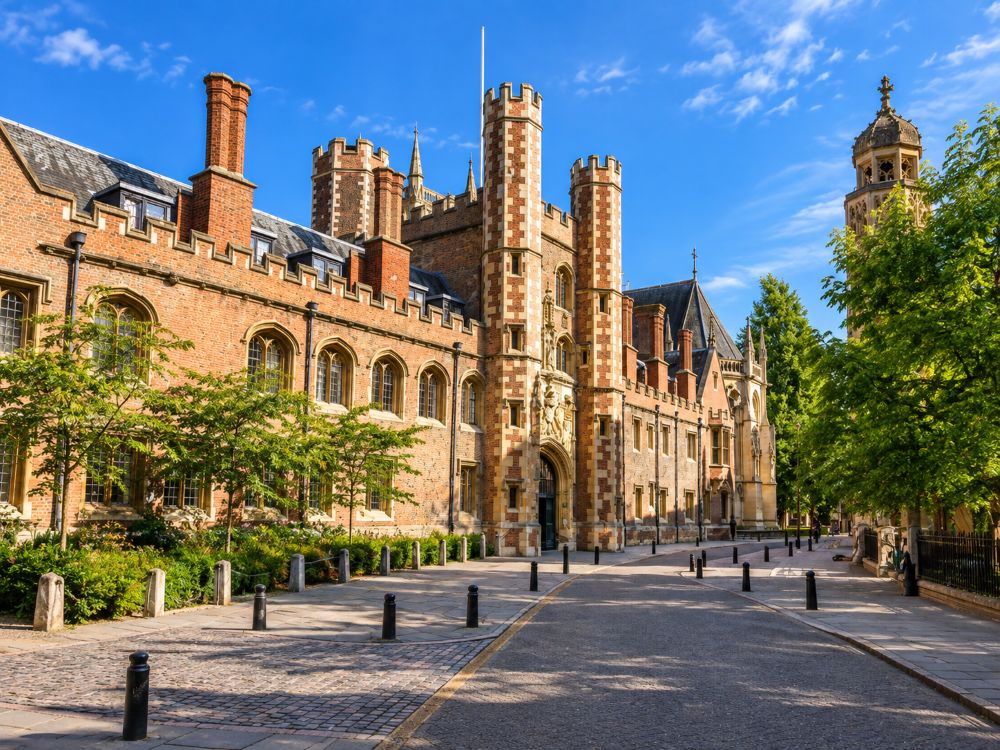
Trinity feels powerful before you know anything about it.
Its Great Gate opens onto one of Cambridge’s grandest academic ensembles, dominated by Great Court.
The college was created by Henry VIII in 1546, combining earlier institutions into what became the largest college in Cambridge.
Its list of former members is ridiculous.
Isaac Newton, Francis Bacon, Lord Byron, A. A. Milne, Bertrand Russell, Ludwig Wittgenstein, Jawaharlal Nehru and numerous Nobel laureates all form part of Trinity’s history.
The college remains an active academic community rather than an architectural attraction, so tourist access is controlled and can change.
Guided tours are currently offered at specific times, while some areas may remain closed because students and fellows actually live and work here.
That is worth remembering throughout Cambridge.
These courtyards are not museum sets.
Great Court and the Race Against the Clock
Great Court is Trinity’s architectural centrepiece and the location of one of Cambridge’s best traditions.
Students attempt to run around the perimeter of the court during the time it takes the clock to strike twelve at noon or midnight.
The route measures roughly 370 metres.
The challenge became internationally famous after a fictionalised version appeared in the film Chariots of Fire, although the movie sequence was filmed elsewhere.
Very few runners complete the circuit in time.
The changing speed of the clock chimes, route conditions and considerable physical demands make the challenge more complicated than simply sprinting around a square.
It is wonderfully pointless.
Cambridge traditions often are.
Newton at Trinity: The Apple Tree and the Door
Isaac Newton arrived at Trinity in 1661.
His work here helped transform mathematics, optics and physics, eventually producing Principia Mathematica and the laws of motion and universal gravitation.
Near the entrance you can see a descendant of the famous Newton apple tree.
No, Newton did not discover gravity because a fruit struck him violently on the head.
The better-supported story is subtler.
He later recalled watching an apple fall vertically while considering why objects always move towards the Earth.
The original tree stood at his family home at Woolsthorpe Manor in Lincolnshire.
Cambridge has one of its descendants.
Inside Trinity, Newton’s association is everywhere, but remember that many of his most important insights emerged during periods away from Cambridge when plague forced the university to close.
Sometimes intellectual history advances because everyone gets sent home.
The Wren Library
At the far end of Nevile’s Court stands one of Cambridge’s great hidden interiors.
The Wren Library was designed by Sir Christopher Wren and completed in the late seventeenth century.
Unlike the heavy Gothic architecture associated with much of Cambridge, Wren created a luminous classical library raised above an open colonnade.
Inside are extraordinary manuscripts and books.
The collection includes material associated with Isaac Newton, A. A. Milne and other important figures connected with Trinity.
One particularly charming object is a manuscript of Winnie-the-Pooh.
The contrast is very Cambridge: revolutionary mathematics and a bear who likes honey can occupy the same intellectual universe.
Public access to the Wren Library is normally available for limited periods and admission is free, but opening can change with college requirements.
Lord Byron and the Bear
Trinity rules once prohibited students from keeping dogs.
Lord Byron, never celebrated for obedient interpretation of regulations, apparently noticed that the rules said nothing about bears.
So he acquired one.
The animal was reportedly kept while Byron was a student at Trinity in the early nineteenth century.
Whether every colourful detail added to the story over two centuries is reliable is less important than the core anecdote: Byron really did possess a bear while at Cambridge.
The episode encapsulates one of the more entertaining sides of university history.
Rules produce loopholes.
Cambridge students have been finding them for centuries.
St John’s College
If Trinity feels imposing, St John’s is more theatrical.
Founded in 1511 by Lady Margaret Beaufort, mother of Henry VII, the college stretches across both sides of the River Cam through a sequence of courts.
Walk through the historic entrance and the architecture gradually becomes more dramatic as you move towards the water.
Its alumni include William Wilberforce, who became one of the leading British campaigners against the slave trade, and physicist Paul Dirac.
The most photographed structure comes later.
Bridge of Sighs
Cambridge’s Bridge of Sighs was completed in 1831 and connects parts of St John’s College across the River Cam.
The name inevitably recalls Venice.
The resemblance is fairly superficial.
Cambridge’s bridge is enclosed, richly ornamented and distinctly picturesque, but it was not designed as a replica of the Venetian structure.
One popular story claims the “sighs” belong to students walking towards examinations.
Excellent story.
Almost certainly retrospective mythology.
The best view is from the river during a punt journey, when the bridge appears framed by stone buildings and trees.
St John’s is one of the colleges worth paying to enter if access is available, because the sequence of courts and riverside architecture gives a much fuller experience than simply photographing the gate.
Queens’ College
Queens’ College was founded in 1448 and refounded shortly afterward by Elizabeth Woodville, queen of Edward IV.
Its architecture is particularly attractive because it preserves a more intimate medieval character than some of the grander later colleges.
Half-timbered buildings and brickwork create a warm contrast with the pale Gothic stone elsewhere in Cambridge.
The River Cam divides the college.
Cross it and you encounter another Cambridge icon.
The Mathematical Bridge
The wooden bridge at Queens’ is formally known as the Wooden Bridge, although practically everyone calls it the Mathematical Bridge.
Its elegant structure uses straight timbers arranged tangentially to create the impression of an arch.
The original bridge was designed by William Etheridge and built by James Essex in the eighteenth century.
Now for the story everyone wants to tell.
Newton did not build it.
It was not assembled without nails.
And students did not dismantle it before discovering they could not work out how to put it back together.
Newton had already died before the bridge was constructed.
The mythology survives because it is too satisfying to kill.
The real engineering is interesting enough without it.
The Backs
The western sides of several colleges face the River Cam across lawns and gardens known collectively as the Backs.
This is where Cambridge stops feeling urban.
Willows lean towards the river. Chapel towers rise behind lawns. Punts move quietly past college walls, and the concentration of Gothic architecture becomes almost absurdly picturesque.
The Backs are partly private college land, so there is no single continuous public path running directly beside every building.
Queen’s Road provides broad views from the western side, while bridges and public paths reveal different sections.
The best overall perspective, however, is from the river.
Punting on the River Cam
Yes, it is touristy.
Do it anyway.
Punting is one of the rare famous activities that genuinely provides a better understanding of Cambridge.
A punt is a flat-bottomed boat propelled using a long pole pushed against the riverbed.
They became popular as pleasure craft in Cambridge during the early twentieth century.
The classic route follows the College Backs.
From the river you pass some of Cambridge’s most famous architecture, including Queens’ College, King’s, Clare College, Trinity and St John’s.
You also see bridges impossible to appreciate properly from the street.
There are two choices.
Hire your own punt and discover how quickly a long pole can become an instrument of public humiliation.
Or book a chauffeured tour and allow somebody else to crash elegantly into the riverbank.
For first-time visitors, the chauffeured option is more useful because guides explain the colleges and traditions along the route.
Use licensed operators working from recognised moorings rather than buying from random street sellers around King’s Parade.
Why Punting Is Harder Than It Looks
The principle sounds simple.
Stand at the back.
Push pole against riverbed.
Move boat.
In practice, inexperienced punters rotate the boat, collide with banks, lose their pole or travel backwards while pretending everything is under control.
A proper Cambridge punt is steered from the flat platform at the rear.
Oxford traditionally does things differently, because Oxford and Cambridge are constitutionally incapable of agreeing on anything if an unnecessary distinction can be preserved.
That rivalry even extends to which end of a boat you should stand on.
Clare College and Clare Bridge
Clare College provides one of the most beautiful transitions between Cambridge architecture and the Backs.
Its elegant seventeenth-century buildings open towards the river, where Clare Bridge crosses into the gardens.
Completed in the seventeenth century, it is the oldest surviving bridge over the Cam in Cambridge.
Look at the stone spheres decorating it.
One appears to be missing a segment.
Naturally, Cambridge possesses several stories explaining why.
One tale blames an unpaid builder who supposedly removed part of the sphere in revenge.
Another claims later damage.
There is no need to force a conclusion.
The imperfect sphere is more entertaining with competing explanations.
Corpus Christi College
Corpus Christi is smaller than King’s or Trinity but historically important.
Founded in 1352, it is unusual because its foundation came from Cambridge townspeople and guilds rather than monarchs or bishops.
Its Old Court is one of Cambridge’s oldest surviving college courts.
The college also owns the remarkable Parker Library, containing medieval manuscripts collected by Archbishop Matthew Parker during the English Reformation.
Visitors are more likely to encounter its modern curiosity outside.
The Corpus Clock
At the corner of Corpus Christi stands one of Cambridge’s strangest modern landmarks.
The Corpus Clock, unveiled in 2008, has no conventional hands or numerals.
Instead, illuminated slits indicate the time beneath a rippling gold-plated disc.
Above it crawls a grotesque mechanical creature known as the Chronophage — the Time Eater.
It appears to consume each passing second.
The sculpture was created by inventor and Corpus alumnus John C. Taylor and deliberately makes time look threatening rather than reassuring.
Occasionally the clock appears accurate.
At other moments it accelerates or slows before correcting itself.
That behaviour is intentional.
Time, the design suggests, is not experienced with mechanical regularity.
For a city obsessed with clocks, examinations and centuries of history, it is an appropriately unsettling object.
The Eagle: Beer, RAF Graffiti and DNA
Some historic pubs have one good story.
The Eagle has several.
The site has served drinkers for centuries and remains one of Cambridge’s most famous pubs.
During the Second World War, British and American airmen gathered here.
Look at the ceiling of the RAF Bar.
Names, squadron numbers and messages were burned or written onto it by servicemen using candles, lighters and lipstick.
The marks survived.
Then there is DNA.
On 28 February 1953, Francis Crick and James Watson entered the pub and famously announced that they had discovered “the secret of life” after developing their model for the structure of DNA.
The popular story is irresistible, but it should not erase the contribution of Rosalind Franklin, whose X-ray diffraction work was crucial to understanding DNA’s structure, along with Maurice Wilkins and other researchers.
The Eagle is therefore not just somewhere to order a pint.
It is a compact lesson in war, science and how historical narratives get simplified.
Fitzwilliam Museum
Cambridge has excellent university museums, but if you choose only one, make it the Fitzwilliam Museum.
The institution began with the collection and bequest of Richard, Viscount Fitzwilliam, in the early nineteenth century.
The grand neoclassical building looks almost excessively monumental from Trumpington Street.
Inside, collections range from ancient Egypt, Greece and Rome to European painting, manuscripts, armour, ceramics and decorative arts.
Artists represented include Titian, Rubens, Rembrandt, Canaletto, Monet and the Impressionists.
The museum is free.
That makes rushing through it even less defensible.
Allow at least ninety minutes; art lovers can easily spend half a day.
It is currently open Tuesday through Saturday and on Sunday afternoons, with Monday normally closed.
Peterhouse: Cambridge’s Oldest College
A few minutes beyond the Fitzwilliam stands Peterhouse, founded in 1284.
It is Cambridge’s oldest surviving college.
The architecture is considerably less overwhelming than King’s, which is part of the attraction.
This is a place to appreciate scale and continuity rather than spectacle.
The college chapel dates from the seventeenth century, while parts of the dining hall preserve much earlier fabric.
Peterhouse also carries a more unsettling twentieth-century association.
During the 1930s, sections of its academic community became associated with controversial conservative and pro-German political currents.
Cambridge history is not an uninterrupted parade of enlightened genius.
Like every institution with eight centuries behind it, it contains contradictions.
Pembroke College
Founded in 1347, Pembroke is one of Cambridge’s older colleges and deserves attention even on a short visit.
Its chapel is particularly important because it was Christopher Wren’s first completed architectural work.
The building is small compared with King’s, but that makes Wren’s classical intervention easier to understand.
Pembroke also has strong literary connections, including former members such as poet Edmund Spenser and novelist Tom Sharpe.
The college is often calmer than the headline attractions along King’s Parade.
That alone can make it one of the most enjoyable courtyards to enter.
Market Square
Cambridge’s market tradition reaches back centuries.
Today the central Market Square operates seven days a week, normally from 10:00 to 16:00.
Stalls sell food, books, records, plants, jewellery, clothing and crafts.
This is also one of the easiest places for a quick lunch in the centre without committing to a restaurant.
The surrounding square works as a useful orientation point.
King’s, Great St Mary’s and the principal shopping streets are all within a few minutes.
Planning permission was approved in 2026 for a major future redesign of Market Square, so the precise arrangement of stalls and public space may change as the redevelopment progresses.
Cambridge University Botanic Garden
After several hours of Gothic stone, go somewhere green.
The Cambridge University Botanic Garden covers roughly forty acres south of the city centre and contains thousands of plant species.
The garden was developed in its present location during the nineteenth century under the influence of John Stevens Henslow, Darwin’s mentor at Cambridge.
That connection is important.
Henslow encouraged the young Charles Darwin’s interest in natural history and helped create the circumstances that eventually led to Darwin joining HMS Beagle.
The Botanic Garden therefore belongs to Cambridge’s scientific story as much as its recreational one.
Glasshouses, mature trees, systematic beds, seasonal borders and specialist collections make it worth at least an hour.
In summer, it is also one of the best places to escape the compressed crowds around King’s Parade.
Charles Darwin in Cambridge
Darwin arrived at Christ’s College in 1828 after abandoning medical studies in Edinburgh.
He was officially preparing for a clerical career.
Instead, Cambridge intensified his obsession with natural history.
He collected beetles enthusiastically, attended Henslow’s lectures and developed relationships with naturalists who shaped his scientific interests.
His later voyage aboard HMS Beagle began partly through these Cambridge connections.
Christ’s College commemorates Darwin, and a garden area associated with him can be visited when college access permits.
The story is a useful reminder that university careers rarely develop in straight lines.
One of history’s most important naturalists originally came to Cambridge to become a clergyman.
Kettle’s Yard
Kettle’s Yard provides a complete change of pace.
Rather than entering another monumental museum, you walk into what feels like an exceptionally cultivated private home.
That is essentially what it was.
Jim and Helen Ede created Kettle’s Yard by arranging paintings, sculpture, furniture, ceramics, stones, plants and ordinary objects throughout a group of cottages.
Modern works sit beside pebbles collected from beaches.
Nothing feels over-labelled or theatrically curated.
Artists represented include Ben Nicholson, Barbara Hepworth, Christopher Wood and Joan Miró.
The house demonstrates that collecting art can be about relationships between objects rather than accumulation of expensive masterpieces.
For travellers tired of traditional museum displays, it is one of Cambridge’s most rewarding stops.
Castle Hill: Where Cambridge Began
Walk north beyond the colleges and the city changes.
Castle Hill marks the area of the earlier Roman and medieval settlement.
William the Conqueror established a castle here after the Norman Conquest, although very little survives today.
The mound provides an elevated view across Cambridge.
It is not beautiful in the same way as King’s.
That is precisely why it matters.
From here you understand that Cambridge existed before its university and that the postcard centre represents only one chapter of a much longer settlement history.
Jesus Green and Midsummer Common
Cambridge is unusually generous with green space close to the centre.
Jesus Green runs beside the river and makes a pleasant continuation after the colleges.
Nearby Midsummer Common opens into broad grassland used for recreation, grazing and events.
Cows grazing within sight of central Cambridge buildings can surprise first-time visitors.
The arrangement is not a rural theme park.
Common grazing rights and open spaces are part of the historical landscape.
Jesus Green also contains an unusually long outdoor swimming pool.
At approximately 90 metres, the lido is one of the longest outdoor pools in Europe.
Cambridge and the Bicycle
You will notice bicycles before you understand Cambridge.
They appear everywhere.
Students cycle to lectures. Academics cycle between departments. Bikes accumulate against railings in numbers normally associated with Dutch cities.
Cambridge’s flat geography and compact centre make cycling efficient, but the bicycle has also become part of the visual identity of university life.
Pedestrians should pay attention.
Standing absent-mindedly in a cycle lane while admiring a medieval façade is one of the fastest ways to receive an authentic Cambridge introduction.
What to Eat in Cambridge
Cambridge does not possess the sharply defined regional cuisine of Bologna, Lyon or San Sebastián.
Its food identity comes instead from English baking, pub culture, East Anglian ingredients and the international population surrounding the university.
Start with a Chelsea bun.
The most famous Cambridge version comes from Fitzbillies, which has been baking them since 1920.
These are sticky, dense coils packed with currants and spice and glazed aggressively enough to make eating one with dignity almost impossible.
That is part of the experience.
Traditional pubs remain important for pies, sausages, fish and chips, roasts and beer.
Cambridgeshire and neighbouring East Anglia also contribute excellent asparagus, apples, strawberries, game and local cheeses.
Do not expect Cambridge dining to be frozen in Tudor England.
The university population has produced a genuinely international food scene, particularly around Mill Road, where Middle Eastern, Asian, Mediterranean and contemporary independent restaurants sit within a short walk.
Fitzbillies and the Cambridge Chelsea Bun
Fitzbillies deserves its own paragraph because the bun has become almost a Cambridge edible landmark.
Brothers Ernest and Arthur Mason opened the original bakery in 1920, using money received after demobilisation from the First World War.
The bakery survived wartime rationing, bankruptcy and a serious fire.
It closed again in 2011 before being rescued and relaunched.
The Chelsea bun remained constant through all that drama.
Fitzbillies now makes hundreds of thousands of them.
Do not expect a light breakfast pastry.
A proper Chelsea bun is sticky, buttery, fruity, spicy and unapologetically dense.
Coffee helps.
So does walking several kilometres afterwards.
Where to Eat in Cambridge
The Eagle
Go for the history and stay for a pint and straightforward British pub food.
The RAF ceiling and DNA connection give it an atmosphere impossible to manufacture.
Address: Bene’t Street, Cambridge
Best for: Historic pub atmosphere, beer and Cambridge stories
Price: ££
The Cambridge Chop House
Almost opposite King’s College, this is a strong choice for traditional British cooking in the historic centre.
Expect steaks, pies, slow-cooked meat and robust seasonal dishes rather than delicate tasting-menu minimalism.
Address: King’s Parade, Cambridge
Best for: British classics and a substantial lunch near King’s
Price: ££–£££
Fitzbillies
Come for breakfast, afternoon tea or simply a Chelsea bun and coffee.
The original Trumpington Street location is particularly convenient when visiting the Fitzwilliam Museum and Pembroke.
Address: Trumpington Street, Cambridge
Best for: Chelsea buns, cakes and a classic Cambridge stop
Price: ££
Where to Stay in Cambridge
University Arms
Cambridge’s classic luxury address overlooks Parker’s Piece and traces its hotel history to 1834.
The current interiors mix traditional British references with a more contemporary interpretation of university style: book-lined spaces, writing desks, patterned fabrics and views across the green.
Its location works particularly well because the colleges, Fitzwilliam Museum, railway station and restaurants are all within walking distance.
Address: Regent Street, Cambridge CB2 1AD
Telephone: +44 1223 606066
Best for: Luxury, design and a central city break
Price: ££££
Gonville Hotel
The Gonville occupies the eastern edge of the historic centre overlooking Parker’s Piece.
It combines boutique-hotel character with practical advantages including on-site parking, something that becomes genuinely useful in Cambridge.
Check-in is normally from 15:00 and check-out by 11:00.
Address: Gonville Place, Cambridge CB1 1LY
Telephone: +44 1223 366611
Best for: Couples, drivers and easy access to both station and centre
Price: £££
A Perfect One-Day Cambridge Itinerary
Arrive early and begin at King’s College before the centre becomes crowded.
Spend proper time inside the Chapel, then walk across King’s Parade to climb the tower of Great St Mary’s.
Continue north along Trinity Street to Trinity College and St John’s.
Around late morning, board a chauffeured punt and see the Backs from the river.
Have lunch in the historic centre, then walk south towards Corpus Christi, Pembroke and the Fitzwilliam Museum.
Give the Fitzwilliam at least ninety minutes.
Finish by crossing Parker’s Piece or returning to Market Square and the river.
If daylight remains, walk through Jesus Green.
One day works.
But it leaves little time to breathe.
Two Days in Cambridge
Use the first day for the historic university core: King’s, Trinity, St John’s, punting and Great St Mary’s.
On the second morning visit the Fitzwilliam Museum before continuing to the Botanic Garden.
Spend the afternoon at Kettle’s Yard and Castle Hill, then return through Jesus Green and the river.
Two days also allow you to enter smaller colleges rather than merely collecting façades.
That improves the trip considerably.
Cambridge becomes much more interesting when you stop asking which college is “the most beautiful” and begin noticing how radically different they are.
Which Cambridge Colleges Should You Actually Visit?
You do not need to pay to enter every college.
That quickly becomes expensive and repetitive.
For a first visit, prioritise King’s for the Chapel and iconic architecture.
Choose St John’s for its sequence of courts and Bridge of Sighs.
Visit Trinity if tours or relevant areas are accessible, particularly for Newton, Great Court and the Wren Library.
Then add one smaller college such as Pembroke, Queens’ or Peterhouse.
That combination gives far more variety than trying to see six monumental colleges in succession.
College opening is unusually fluid.
Examinations, ceremonies, private events and university business can close areas with little notice.
Always check access shortly before visiting.
How to Get to Cambridge from London
Cambridge is one of the easiest major day trips from London.
Direct trains run from London King’s Cross, with the fastest journeys taking around an hour.
Services from London Liverpool Street are generally slower but can be convenient depending on where you are staying.
Cambridge railway station sits southeast of the historic centre.
Walking from the station to King’s Parade takes roughly 20–25 minutes.
Buses and taxis are readily available, but unless you have luggage, walking gives a better introduction.
Getting Around Cambridge
Walk.
That is the simplest answer.
Most major attractions sit inside a compact centre where driving creates more problems than it solves.
Cycling is efficient but requires confidence in busy cycle traffic.
Buses are useful for the railway station, outer neighbourhoods and Park & Ride sites.
For central sightseeing, comfortable shoes beat transport.
Driving and Parking in Cambridge
Driving into central Cambridge is rarely the best strategy.
The street pattern is awkward, parking is expensive and extensive restrictions make navigation frustrating.
Use one of the Park & Ride sites when arriving by car for the day.
If staying overnight, choose a hotel with parking and leave the vehicle there.
Cambridge rewards travellers who abandon the car early.
Best Time to Visit Cambridge
April to June offers long daylight, spring gardens and the classic green appearance of the Backs.
The downside is academic examinations.
Some college areas become restricted during the university’s intense exam period known as Easter Term.
July and August bring easier weather and fewer students, but considerably more visitors.
September and October are excellent: the city regains academic energy while autumn light works beautifully along the river.
Winter can be cold and damp, but Cambridge becomes atmospheric rather than unpleasant.
December has the additional attraction of choral music and Christmas traditions, although access around King’s can become extremely busy.
Graduation, May Week and a Cambridge Calendar Oddity
Cambridge likes traditions enough to preserve their names even after the dates stop making sense.
May Week, for example, largely takes place in June.
The period follows exams and includes college balls, garden parties, concerts and celebrations.
One famous event is the May Bumps, a rowing competition in which boats chase one another along the narrow Cam and attempt physically to “bump” the boat ahead.
Because conventional side-by-side racing is difficult on the river, Cambridge developed something stranger.
Naturally.
Cambridge versus Oxford
You do not need to choose.
But the cities feel different.
Oxford is larger, denser and more urban, with monumental university buildings woven into a busier city.
Cambridge feels smaller, greener and more intimate.
Its river and Backs create a visual unity Oxford lacks, while the concentration of famous colleges around King’s Parade makes the historic core exceptionally compact.
Oxford arguably offers greater architectural variety.
Cambridge offers the prettier river landscape.
Anyone claiming one is objectively superior is probably revealing where they studied.
Cambridge Curiosities Worth Knowing
A Cambridge degree is traditionally conferred in Latin.
Lord Byron kept a bear at Trinity after discovering college rules prohibited dogs but apparently failed to mention bears.
Newton’s famous apple did not need to hit him on the head for gravity to become interesting.
The Mathematical Bridge was neither built by Newton nor originally assembled magically without metal fixings.
The Corpus Clock deliberately runs irregularly before correcting itself, making time feel less reliable than a clock normally should.
The Eagle preserves wartime graffiti created by RAF and USAAF airmen.
The River Cam acquired its modern name partly because people assumed the river running through Cambridge should naturally be called the Cam.
Cambridge’s famous May Week is largely held in June.
And students attempting the Trinity Great Court Run have spent generations discovering that prestigious universities are perfectly capable of preserving traditions with almost no practical purpose.
Is Cambridge Worth Visiting?
Absolutely.
Cambridge succeeds because intellectual history never entirely overwhelms the physical pleasure of the city.
You do not need to understand Newton’s mathematics to appreciate Trinity.
You do not need to care about university rankings to walk beside the Cam.
And you certainly do not need to know the principles of DNA replication to enjoy a pint beneath the RAF ceiling of The Eagle.
The best Cambridge experience moves constantly between the serious and the ridiculous: Gothic vaults and student pranks, Nobel Prizes and sticky buns, medieval libraries and punters crashing into bridges.
Spend a morning studying the fan vault of King’s.
Spend the afternoon drifting down the river.
Climb a church tower.
Look for Newton’s apple tree.
Eat a Chelsea bun that leaves syrup on your fingers.
Then stay until evening, when the coaches leave, bicycles reclaim the streets and Cambridge begins to feel less like one of England’s great tourist destinations and more like what it actually is: a small city that has spent eight centuries thinking on an improbably large scale.
Useful Information
Country: England, United Kingdom
County: Cambridgeshire
Ideal stay: 1–2 days
Best way to explore: walking, with punting for the Backs
From London: direct trains from King’s Cross and Liverpool Street
Main railway station: Cambridge
Walk from station to historic centre: approximately 20–25 minutes
Essential monument: King’s College Chapel
Best city view: Great St Mary’s tower
Best museum: Fitzwilliam Museum
Best river experience: chauffeured punting through the College Backs
Best historic pub: The Eagle
Essential local sweet: Chelsea bun
Best green escape: Cambridge University Botanic Garden
Best free major attraction: Fitzwilliam Museum
College visits: access can change at short notice because of exams, ceremonies and university events
Best seasons: late spring and early autumn
Driving: avoid the centre where possible; Park & Ride is usually easier

