
Brunico Travel Guide: What to See, Kronplatz, Mountain Museums and the Best Things to Do in South Tyrol

Brunico — Bruneck in German — is the small urban capital of the Val Pusteria, and that distinction matters. This is not simply another South Tyrolean village arranged around a church and a handful of hotels. Brunico has a genuine medieval centre, a castle built by the prince-bishops of Bressanone, museums with international ambitions, an active shopping street, railway connections through the Puster Valley and, immediately above town, one of the most important mountain resorts in the eastern Alps: Plan de Corones, or Kronplatz.
The city lies at roughly 835 metres above sea level where the Rienza valley broadens before continuing east towards Dobbiaco and the Austrian border. Mountains frame Brunico in every direction, but they do not overwhelm the town. Instead, the historic centre occupies the valley floor while Brunico Castle sits on a wooded hill directly above it and Kronplatz rises to 2,275 metres to the south.
That geography gives Brunico two personalities. Down below, there are arcaded streets, painted façades, bakeries, restaurants and enough everyday life to prevent the centre from feeling like an Alpine theme park. Go up to Kronplatz and the scale changes completely: ski slopes, hiking trails, Dolomite views, Reinhold Messner’s MMM Corones and one of Europe’s most unusual photography museums occupy the summit.
Brunico works particularly well for travellers who want mountains without abandoning civilisation every evening. You can hike at 2,000 metres in the morning, spend the afternoon inside a medieval castle and have dinner in a serious restaurant without moving accommodation.
Things to See in Brunico
- Brunico historic centre and Via Centrale
- The medieval city gates
- Brunico Castle
- MMM Ripa
- Ragen di Sopra
- Church of Santa Maria Assunta
- Ursuline Church
- Brunico War Cemetery
- South Tyrol Museum of Folk Traditions
- Plan de Corones / Kronplatz
- MMM Corones
- LUMEN Museum of Mountain Photography
- Riscone
- Puster Valley cycling route
- Christmas Market in winter
The Historic Centre
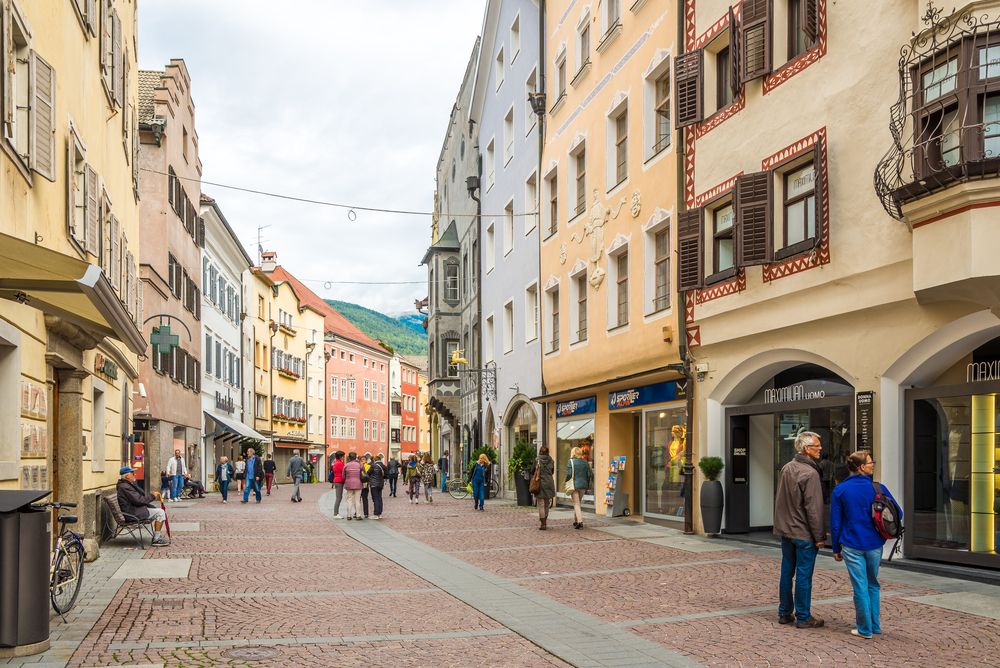
Brunico’s historic centre is compact but unusually urban for a town of this size.
Its principal axis is Via Centrale — Stadtgasse in German — a long pedestrian street lined with coloured façades, projecting bay windows, wrought-iron signs, boutiques, cafés and restaurants. Unlike the monumental centres of Bolzano or Bressanone, there is no single grand square that dominates everything.
The street itself is the centre.
That arrangement comes directly from Brunico’s medieval origins. The town developed in the thirteenth century beneath the new episcopal castle, enclosed within fortifications and organised around a commercial route running through the settlement.
Brunico was founded under Bruno von Kirchberg, Prince-Bishop of Bressanone, during the middle of the thirteenth century and is documented under the name Bruneke in 1256. The bishop established both the castle and the settlement beneath it as an administrative counterweight in the politically contested Puster Valley.
The modern name therefore preserves the name of its founder more clearly than many visitors realise.
Walk Via Centrale slowly rather than treating it as a corridor between attractions. Look above shop windows. Several buildings preserve painted details, oriel windows and architectural elements that reveal how wealthy trading families adapted the narrow medieval plots over successive centuries.
Brunico’s appeal lies partly in this mixture of Tyrolean architecture and ordinary commercial life.
The Medieval Gates
The old town once depended on a defensive system of walls and gateways, and four historic gates survive within the centre.
They make Brunico’s original structure unusually easy to read.
Instead of imagining where the medieval town began and ended, you can still physically walk through the passages that controlled movement into the settlement.
The gates are now absorbed into later buildings and everyday circulation rather than standing isolated like museum pieces.
That is preferable.
A medieval gate containing apartments or adjoining shops tells you more about the continuity of the town than a perfectly restored structure standing alone behind barriers.
Walk the entire length of Via Centrale and use the gates as markers for Brunico’s original scale. The medieval centre is substantially smaller than the modern town surrounding it.
Ragen di Sopra
East of the main commercial street lies Ragen di Sopra — Oberragen, one of the most attractive parts of Brunico.
The atmosphere changes immediately.
Via Centrale is commercial and animated; Ragen di Sopra is quieter, with historic houses, old religious buildings and the wooded slope of the castle rising above the street.
This is where Brunico begins to feel less like a regional shopping town and more like an old episcopal settlement.
The area also provides access towards the castle hill and the parish church.
Come through once during the day and again in the evening. The central shopping street tends to attract most casual visitors, leaving Ragen considerably calmer.
Brunico Castle
Brunico Castle stands on a wooded hill immediately above the centre.
Prince-Bishop Bruno von Kirchberg had the castle constructed around 1250, and the fortress appears in documents as castrum Bruneke by 1271.
Its purpose was not romantic.
The bishops of Bressanone needed a fortified administrative base from which to control their possessions in the Puster Valley. The emerging town beneath it developed in close relationship with that authority.
Successive bishops altered the complex over the centuries, so the castle is not a perfectly preserved thirteenth-century fortress. Residential spaces, defensive structures and later modifications overlap throughout the building.
From below, however, its strategic purpose remains obvious.
The castle occupies a commanding position above the Rienza valley while remaining close enough to the town to dominate its skyline.
Today the interior houses MMM Ripa, one of Reinhold Messner’s mountain museums.
The combination is unusually successful because the museum does not attempt to turn Brunico Castle into a generic collection of armour and furniture.
Instead, it asks what living in mountain environments actually means.
MMM Ripa
The Messner Mountain Museum Ripa examines the cultures of mountain peoples rather than mountaineering as a sport.
That distinction separates it from MMM Corones on the summit of Kronplatz.
Reinhold Messner uses the rooms of Brunico Castle to compare ways of life developed in high-altitude regions across Asia, Africa, South America and Europe. Clothing, tools, religious objects, domestic artefacts and photographs illustrate how communities have adapted to cold, altitude, isolation, limited agricultural land and extreme geography.
The subject could easily become an ethnographic curiosity cabinet.
At its best, the museum avoids that trap by repeatedly returning to the relationship between people and landscape.
Mountain life is not presented as picturesque poverty. It is treated as a series of practical solutions to difficult environments.
In 2026, MMM Ripa opens during the principal summer season from the second Sunday in May to the first Sunday in November, from 10:00 to 18:00, with last admission at 17:00. Tuesday is the weekly closing day. The adult admission price is currently €14.
Allow around 90 minutes for the museum and castle.
The walk from Brunico station takes roughly twenty minutes; from Via Centrale it is substantially shorter.
The Castle Hill
Even if you are not visiting the museum, climb the castle hill.
Paths cross the wooded area above the old town and connect the castle with other historical sites around Brunico.
This is one of the easiest places to escape the commercial centre without actually leaving the city.
Views appear intermittently through the trees rather than from one vast formal terrace, and the atmosphere can feel unexpectedly quiet considering how close Via Centrale lies below.
The hill is particularly good in autumn when the deciduous trees change colour.
In winter, snow turns the castle into exactly the Alpine image tourist brochures promise, but the paths can become icy. Proper shoes matter more than photographic ambition.
Brunico War Cemetery
The Cimitero di Guerra — Soldatenfriedhof lies in the wooded area close to the castle and is one of Brunico’s most affecting historical sites.
It developed in connection with the First World War, when the nearby Dolomite and Alpine fronts transformed this apparently peaceful region into the rear area of an enormous military conflict.
The cemetery contains soldiers of different nationalities and confessions who died in local military hospitals or in connection with the fighting.
It is deliberately understated.
Wooden crosses, trees and simple graves replace monumental martial architecture.
That restraint is precisely why the site is worth visiting.
South Tyrol’s twentieth-century history is complicated, and places such as this make more sense of the region than a purely romantic account built from castles, apple strudel and mountain huts.
Do not rush through it simply because it lies on the way to another attraction.
The Parish Church of Santa Maria Assunta

The Parish Church of Santa Maria Assunta stands in the Ragen area below the castle.
The present building incorporates the long religious history of the site but largely reflects later architectural rebuilding rather than medieval Brunico alone.
Its twin-towered profile forms an important part of the eastern skyline of the centre.
Inside, the scale is considerably larger than the town’s population might lead you to expect, reflecting Brunico’s role as the principal religious and administrative centre of the middle Puster Valley.
The church also makes a useful transition between old town and castle hill.
The Ursuline Church
At the western side of the historic centre, the Church of the Saviour at the Ursuline convent preserves a particularly interesting relationship with Brunico’s fortifications.
The church developed against the medieval defensive walls, and its tower incorporated elements of the earlier fortification system.
This is characteristic of Brunico.
The medieval infrastructure was rarely demolished cleanly and replaced. Instead, walls, gates and towers were progressively absorbed into religious and residential buildings.
The result is architecture that reveals itself gradually rather than through isolated monuments.
The South Tyrol Museum of Folk Traditions
A few kilometres east of central Brunico, in Teodone — Dietenheim, stands one of South Tyrol’s most useful museums for understanding rural Alpine life.
The South Tyrol Museum of Folk Traditions occupies the historic Mair am Hof residence and an extensive open-air area filled with original farmhouses, barns, workshops and agricultural buildings transferred from different parts of the region.
This is not simply a display of old ploughs.
The museum reconstructs the economic hierarchy of traditional South Tyrolean society, from landowners and prosperous farmers to agricultural labourers and craftspeople.
Historic interiors show kitchens, sleeping spaces, workshops and storage rooms, while the outdoor section demonstrates how profoundly building methods varied according to altitude, valley and available materials.
If you are spending more than one day in Brunico, the museum deserves several hours.
It provides context for almost every mountain village you will encounter afterwards.
Plan de Corones / Kronplatz
Brunico’s mountain is Plan de Corones — Kronplatz, rising to 2,275 metres immediately south of the city.
Its summit is broad and rounded rather than jagged, which explains much of its unusual development.
In winter, it supports one of South Tyrol’s most important ski areas.
In summer, cable cars deliver walkers, cyclists, museum visitors and families directly onto an open summit plateau surrounded by extraordinary views.
The Dolomites rise to the south and east, while the main Alpine ridge stretches towards Austria.
It would be easy to dismiss Kronplatz as an overly developed mountain.
Parts of it certainly are.
Lifts, restaurants, museum architecture and mountain-bike infrastructure make this very different from a remote Dolomite summit.
But judging it according to wilderness criteria misses the point.
Kronplatz is an accessible high-altitude cultural and recreational platform. Few places allow someone with no mountaineering experience to move from a Zaha Hadid museum to a panoramic ridge walk at more than 2,200 metres within minutes.
In summer 2026, the main season runs from 16 May to 8 November. The Kronplatz 2000 lift from Riscone operates approximately 09:00–17:00 during the season.
MMM Corones
Near the summit edge stands MMM Corones, perhaps the most architecturally dramatic of Reinhold Messner’s museums.
The building was designed by Zaha Hadid Architects and appears to emerge directly from the mountain.
Large concrete volumes penetrate the summit plateau before opening through windows towards surrounding peaks.
Where MMM Ripa studies mountain peoples, MMM Corones concentrates on traditional alpinism: the history of climbing, mountaineers’ relationships with rock and ice, and the evolution of an activity that changed from exploration into sport and, eventually, mass tourism.
The building is almost as important as the collection.
Hadid avoided creating an object perched visibly on top of the mountain. Much of the museum is buried, reducing its external profile while creating dramatic framed views from inside.
In summer 2026 it is open from 16 May through 8 November, generally from 10:00 to 16:00, with last admission at 15:30.
Combine it with LUMEN rather than making two separate summit journeys.
LUMEN Museum of Mountain Photography
A few minutes away stands the LUMEN Museum of Mountain Photography.
For anyone interested in photography, this is not secondary to the Messner museum.
LUMEN occupies four floors and roughly 1,800 square metres, tracing mountain photography from early technical experiments to contemporary art, documentary work and digital image culture. Historic cameras sit beside large-scale installations and temporary exhibitions.
The subject is particularly appropriate here.
Mountains have been photographed almost obsessively since photography became portable enough to leave the studio. Images helped turn Alpine landscapes from feared wilderness into destinations, sports grounds and commercial icons.
LUMEN examines that transformation rather than merely filling walls with beautiful peaks.
Some installations are deliberately theatrical, particularly the panoramic and mirrored spaces.
Normally that sort of museum design can become distracting.
At 2,275 metres, with real mountains visible immediately outside, it has considerably more justification.
In 2026, LUMEN follows the operating season of the lifts and is generally open daily from 10:00 to 16:00, with last admission at 15:30. Adult admission is currently €17, with combination options available for LUMEN and MMM Corones.
A Day on Kronplatz
Do not go up simply to photograph the panorama and immediately return.
Allow at least half a day.
Take the Kronplatz 2000 cable car from Riscone, visit MMM Corones first and then LUMEN. Have lunch or a drink at the summit, then walk part of the plateau rather than remaining between buildings.
The summit landscape is broad enough for easy panoramic walking without requiring a technical mountain route.
Strong hikers can use the lift only in one direction and incorporate longer descents, but the ordinary visitor does not need to prove anything.
Altitude also matters.
Even when Brunico is hot, the summit can be cold, windy or covered in cloud.
Bring another layer.
A 28°C afternoon beside the Rienza does not mean 28°C at 2,275 metres.
Kronplatz by Night 2026
Kronplatz occasionally keeps its lift and museums operating into the evening for Kronplatz by Night.
The 2026 summer programme includes evening openings on 30 May, 14 June, 17 July and 21 August. On these dates the Kronplatz 2000 lift operates into the night, while MMM Corones and LUMEN remain open for evening visits.
The attraction is obvious.
Sunset changes the mountain completely once the normal daytime visitors have descended.
If one of these dates matches your stay, it is much more interesting than simply taking the lift twice during daylight.
Riscone
Riscone — Reischach lies immediately south of Brunico and functions as the principal gateway to Kronplatz.
The settlement itself is residential and resort-oriented rather than historically important.
Its value is logistical.
The Kronplatz 2000 cable-car station is here, together with large parking areas, hotels, sports facilities and direct access to the mountain.
If your holiday is primarily about skiing, mountain biking or hiking, staying in Riscone can make more sense than sleeping in central Brunico.
If the objective is culture, restaurants and evening walks, the old town is the better base.
The distance between them is short enough that this is not a dramatic decision.
Walking and Cycling along the Rienza
The mountains naturally dominate discussions of outdoor activity around Brunico, but the valley floor is useful in its own right.
The Rienza — Rienz runs beside the town and forms part of a network of walking and cycling routes extending through the Puster Valley.
The Puster Valley cycle route is particularly valuable because it allows substantial distances to be covered without dealing with mountain gradients.
You can ride east towards Valdaora, Monguelfo and Dobbiaco or west towards San Lorenzo and eventually Bressanone.
Railway stations along the valley make one-way cycling practical.
This combination of bicycle and train is one of the best ways to travel through Val Pusteria.
There is no need to cycle back simply because you started in Brunico.
What to Eat in Brunico
Brunico’s food sits precisely where geography suggests: between Tyrolean Alpine cooking and Italian culinary influence.
The most recognisable dishes are robust.
Canederli — Knödel appear in numerous versions, made with bread and flavoured with speck, cheese, spinach or beetroot. They may arrive in broth or with melted butter and cheese.
Schlutzkrapfen, half-moon pasta parcels usually filled with spinach and ricotta, are one of the defining dishes of the Puster Valley.
Then come Tirtlan, gulasch, venison, pork, sausages, sauerkraut and dumplings, alongside polenta and mushrooms.
Sweet dishes deserve equal attention.
Kaiserschmarrn, strudel, Krapfen and buckwheat cakes are not decorative Alpine nostalgia here. They belong naturally to the regional repertoire.
Speck and mountain cheese are obvious, but do not build every meal around them. South Tyrolean cooking becomes considerably more interesting once you move beyond the standard tourist board of cured meat.
Beer in Brunico
Wine dominates much of South Tyrol’s international gastronomic image, but Brunico sits far enough north and east that beer feels equally natural.
A local reference is Rienzbräu, a brewery and restaurant near the Rienza.
This is the place to explore locally brewed beer alongside robust Tyrolean food rather than automatically ordering another glass of Alto Adige white wine.
The Puster Valley’s brewing culture makes geographic sense: historically and culturally, the route towards East Tyrol and Austria is as important here as the route towards Bolzano.
Where to Eat
Atelier Moessmer Norbert Niederkofler
For the most ambitious meal in Brunico, Atelier Moessmer Norbert Niederkofler is the obvious reference.
Chef Norbert Niederkofler has spent decades developing a cuisine based on Alpine ingredients and the philosophy he calls Cook the Mountain. The approach rejects imported luxury ingredients when local alternatives exist and places altitude, seasonality, preservation techniques and mountain agriculture at the centre of the meal.
This is not traditional South Tyrolean cooking reproduced more elegantly.
It is a contemporary interpretation of an Alpine food system.
Address: Via Walther von der Vogelweide 17, 39031 Brunico
Telephone: +39 0474 646629
Cuisine: contemporary Alpine fine dining
Price level: very high
Best for: a destination gastronomic experience
Weißes Lamm
Weißes Lamm is a stronger choice for travellers wanting regional food without turning dinner into a tasting-menu event.
The cooking remains grounded in South Tyrolean tradition, with meat, dumplings, pasta and seasonal dishes.
Address: Via Stuck 5, 39031 Brunico
Telephone: +39 0474 411350
Cuisine: South Tyrolean and regional
Price level: approximately €30–40
Best for: traditional dinner close to the historic centre
b.local
b.local takes a more contemporary approach and is particularly useful if you want to move away from the constant cycle of speck, dumplings and large meat plates.
Its central position and broader menu make it suited to a relaxed lunch or modern dinner.
Address: Via Europa 9, 39031 Brunico
Telephone: +39 0474 835222
Cuisine: contemporary regional and Italian
Price level: approximately €20–70
Best for: modern casual dining
Rienzbräu
Rienzbräu combines brewery and restaurant and is one of the easiest places to understand Brunico’s Austrian-Tyrolean cultural side through food.
Come for house beer, sausages, schnitzel, dumplings and substantial plates rather than delicately composed cuisine.
Address: Via Stegona 8, 39031 Brunico
Telephone: +39 0474 531307
Cuisine: Tyrolean, brewery food
Price level: approximately €20–30
Best for: local beer and an informal dinner
K.Bernardi Enotheque & Restaurant
K.BERNARDI – Enotheque | Restaurant is the more wine-oriented option.
The format sits between enoteca and restaurant, making it particularly useful for anyone who wants to examine South Tyrolean wine more seriously rather than accepting the generic house Pinot Grigio.
Address: Via Stuck 6, 39031 Brunico
Telephone: +39 0474 370186
Cuisine: wine bar and contemporary regional cooking
Price level: approximately €20–30
Best for: South Tyrolean wine and lighter dinner
What to Drink
South Tyrol’s great wine areas lie farther west, but Brunico’s restaurants provide access to the entire regional spectrum.
Start with Valle Isarco whites such as Sylvaner, Kerner or Grüner Veltliner if the meal centres on Schlutzkrapfen, freshwater fish or lighter dumplings.
Gewürztraminer works better when spice and aromatic intensity are genuinely useful rather than simply because it is the region’s famous grape.
With venison or beef, look towards Lagrein from the Bolzano area or a serious Pinot Nero from Alto Adige.
And drink beer.
Brunico is one of the places in South Tyrol where pretending that every meal requires wine makes less cultural sense.
Where to Stay
There are two logical strategies.
Stay in central Brunico if restaurants, shopping and evening walks matter most.
Stay in Riscone if Kronplatz is the principal reason for the trip.
Falkensteiner Hotel Kronplatz
Falkensteiner Hotel Kronplatz – The Leading Hotels of the World sits in Riscone close to the Kronplatz lifts.
The architecture and services target guests who want the mountain to be the centre of the stay rather than a day excursion from town.
Address: Via Funivia 1C, 39031 Brunico
Telephone: +39 0474 862400
Category: five-star luxury hotel
Best for: Kronplatz access, spa and an activity-focused stay
Hotel Rudolf
Hotel Rudolf is another strong Riscone option, positioned between resort comfort and immediate access to outdoor activities.
Address: Via Riscone 33, 39031 Brunico
Telephone: +39 0474 570570
Category: four-star hotel
Best for: skiing, hiking and spa facilities
Hotel Petrus
Hotel Petrus offers a more intimate luxury experience in Riscone while keeping Kronplatz close.
Address: Via Reinthal 11, 39031 Riscone
Telephone: +39 0474 548263
Category: four-star superior hotel
Best for: food, wellness and a quieter mountain base
Hotel Langgenhof
Hotel Restaurant Langgenhof is more useful if you want to remain close to Brunico itself rather than organising the entire holiday around the lift station.
Address: Via San Nicolò 11, 39031 Brunico
Telephone: +39 0474 553154
Category: hotel and restaurant
Best for: a comfortable base between the station, centre and surrounding valley
Niedermairhof
B&B Niedermairhof provides a smaller alternative in the Teodone area.
It suits travellers who prefer a historic, individual property over a conventional Alpine resort.
Address: Via Duca Teodone 1, 39031 Brunico
Telephone: +39 348 2476761
Category: boutique B&B
Best for: character and a quieter stay outside the commercial centre
How Many Days Do You Need?
A single day is enough to understand central Brunico.
Walk Via Centrale, visit the castle and MMM Ripa, explore Ragen and have dinner before leaving.
But Brunico makes considerably more sense as a two- or three-night base.
With two days, use one for the old town, castle and Folk Traditions Museum and the second for Kronplatz, MMM Corones and LUMEN.
With three days, add a cycling excursion, longer hike or day trip farther into Val Pusteria.
Skiers can obviously stay much longer.
Brunico itself does not require a week of sightseeing. Its value lies in how efficiently it connects urban life with the surrounding mountains.
A One-Day Brunico Itinerary
Begin on Via Centrale before the main shopping hours.
Walk the old town from gate to gate, detour through Ragen di Sopra and then climb towards Brunico Castle.
Visit MMM Ripa in the morning.
Afterwards, walk through the wooded castle hill and the war cemetery before returning to the centre for lunch.
Spend the afternoon either at the South Tyrol Museum of Folk Traditions in Teodone or simply walking along the Rienza and exploring the town more slowly.
If you have only one day, do not try to add Kronplatz.
The summit museums and cable-car journey deserve their own half-day at minimum.
A Two-Day Itinerary
Use day one for Brunico itself: Via Centrale, the city gates, Ragen, Brunico Castle, MMM Ripa and the war cemetery.
Add the Folk Traditions Museum in the afternoon if time allows.
On day two, travel to Riscone and take Kronplatz 2000 to the summit.
Visit MMM Corones and LUMEN, have lunch on the mountain and spend part of the afternoon walking on the summit before descending.
Return to Brunico for dinner.
That combination gives a far more accurate picture of the destination than trying to spend both days exclusively in the old centre.
Three Days in Brunico
The third day is for the valley.
Rent a bicycle and follow the Puster Valley cycle route, or take the train east and combine a one-way ride with the railway.
Alternatively, drive towards one of the side valleys or deeper into the Dolomites.
Brunico is particularly well positioned for exploring Val Badia, Val di Tures, Dobbiaco, San Candido and the northern Dolomites, although those destinations deserve their own guides rather than being reduced to hurried afternoon detours.
Getting to Brunico by Train
Brunico is unusually convenient by South Tyrolean standards because it sits directly on the Puster Valley railway line.
Regional trains connect the town with Fortezza — Franzensfeste, where passengers can transfer to the main Brenner railway running between Innsbruck, Bolzano and Verona.
Eastbound services continue through the Puster Valley towards San Candido.
The railway station lies close enough to the centre that a car is unnecessary for an ordinary city stay.
MMM Ripa estimates roughly twenty minutes on foot from Brunico station to the castle.
If you intend to combine Brunico with Kronplatz, local buses and hotel transport make Riscone accessible without a private vehicle.
Getting to Brunico by Car
From the Brenner motorway, leave the A22 at Bressanone/Val Pusteria and follow the SS49 east towards Brunico.
The route is straightforward but can become congested during peak holiday periods.
From Veneto, Brunico can also be approached through the eastern Dolomites and the Dobbiaco area.
Do not drive into the pedestrian old centre looking for your hotel unless the property has given specific access instructions.
Use designated car parks around the centre.
Once parked, central Brunico is better explored on foot.
Do You Need a Car?
Not necessarily.
For Brunico + Kronplatz, train, buses and cable cars are enough.
For a broader exploration of remote valleys, trailheads and mountain restaurants, a car becomes considerably more useful.
This is one of Brunico’s practical strengths compared with many Alpine destinations.
You can have a genuinely mountain-oriented holiday without hiring a vehicle and without feeling trapped in a single resort complex.
When to Visit
Late May and June are excellent for the valley, although some high-altitude trails may still retain snow early in the season.
By June, mountain infrastructure is reopening and temperatures around Brunico are comfortable.
July and August bring the widest range of mountain activities but also the largest crowds.
The town itself rarely feels overwhelmed in the same way as famous Dolomite villages, although Kronplatz becomes substantially busier.
September is outstanding.
Mountain lifts continue operating, hiking conditions are generally excellent and the first autumn colour begins appearing around the valley.
October can be beautiful in Brunico itself, although increasingly variable weather matters at altitude.
For 2026, Kronplatz’s summer lift season continues unusually late, until 8 November.
Winter changes the destination completely.
From late November through the ski season, Brunico becomes the urban base for Kronplatz, while the historic centre hosts its Christmas atmosphere and winter shopping.
Brunico in Winter
Kronplatz is the principal reason many visitors encounter Brunico at all.
The mountain is one of Dolomiti Superski’s major ski areas and has been developed around a network of modern lifts and long pistes descending towards several sides of the mountain.
Brunico provides the advantage of sleeping in a real town rather than directly inside a ski resort.
Restaurants remain varied, shops are useful beyond ski equipment and non-skiers have museums and a functioning centre.
The trade-off is obvious.
You need to transfer each morning to the lift base at Riscone rather than stepping directly onto the slopes.
For many travellers that is a small price to pay for having somewhere more interesting to spend the evening.
Brunico Christmas Market
Brunico’s Christmas market is smaller than the famous markets in Bolzano and Merano, which is not necessarily a disadvantage.
Stalls and seasonal decorations occupy the central area while the medieval streets remain part of the experience rather than disappearing behind an enormous event infrastructure.
The combination of snow, castle, narrow shopping streets and mountain backdrop is particularly effective after dark.
If the primary objective is Christmas atmosphere rather than collecting the greatest possible number of wooden stalls, Brunico is one of the more manageable South Tyrolean options.
For exact 2026 dates and programme, check the official tourism calendar before booking because seasonal schedules can be adjusted.
Brunico in 2026
The most useful current information concerns Kronplatz and its summit museums.
The 2026 summer lift season runs from 16 May to 8 November, with Kronplatz 2000 from Riscone scheduled around 09:00–17:00 during the main season.
MMM Corones operates through the same summer period, from 16 May to 8 November, generally from 10:00 to 16:00.
LUMEN likewise operates during the cable-car season and is currently open daily from 10:00 to 16:00, with final admission at 15:30.
MMM Ripa in Brunico Castle remains open through the principal summer season until the first Sunday of November, from 10:00 to 18:00, closing on Tuesdays.
The 2026 summer edition of Kronplatz by Night includes evening openings on 30 May, 14 June, 17 July and 21 August, combining late cable-car operation with access to MMM Corones and LUMEN.
Useful Information
Region: Trentino-Alto Adige / Südtirol
Province: Bolzano / Bozen
Valley: Val Pusteria / Pustertal
German name: Bruneck
Altitude: approximately 835 m
River: Rienza / Rienz
Historic foundation: 13th century
Founder: Prince-Bishop Bruno von Kirchberg
First documented mention: 1256
Principal monument: Brunico Castle
Main museum in town: MMM Ripa
Main mountain: Plan de Corones / Kronplatz
Kronplatz altitude: 2,275 m
Summit museums: MMM Corones and LUMEN
Main ski and lift base: Riscone / Reischach
Main railway: Puster Valley line
Car needed for the centre: no
Car useful for remote valleys: yes
Recommended stay: 2–4 days
Best summer months: June and September
Best for winter: skiing and Christmas atmosphere
Kronplatz summer season 2026: 16 May–8 November

