
Agra Travel Guide: From Akbar’s Red Sandstone Empire to Shah Jahan’s White Marble Masterpiece

Agra is often reduced to a single image: the white dome of the Taj Mahal floating above the Yamuna. That monument deserves every bit of its fame, but treating Agra as nothing more than its setting strips the city of the history that made the Taj possible in the first place.
For more than a century, Agra stood at the centre of the Mughal world. Babur planted gardens here, Akbar rebuilt the city as an imperial capital, Jahangir ruled from its palaces, Nur Jahan transformed Mughal taste, and Shah Jahan pushed architecture towards an almost obsessive refinement in white marble and precious-stone inlay. Within a relatively small area, the city preserves the evolution of Mughal architecture from Akbar’s muscular red sandstone to the luminous marble surfaces of the Taj Mahal.
The result is far richer than a rushed Delhi day trip. Agra has three UNESCO World Heritage Sites—the Taj Mahal, Agra Fort and Fatehpur Sikri—along with Itimad-ud-Daulah, Akbar’s Tomb at Sikandra, Mehtab Bagh, early Mughal gardens, Persian tilework, crowded bazaars, old mosques and a food culture that moves easily between imperial Mughlai cooking and gloriously uncomplicated bedai, jalebi and petha.
Give Agra two full days at minimum. Three are substantially better. One day should revolve around the Taj Mahal and Agra Fort, another around the smaller Mughal monuments and the old city, while Fatehpur Sikri deserves a separate half-day or more. That slower rhythm also lets you see the Taj more than once, which is important: sunrise, late afternoon and a distant view across the Yamuna produce three very different monuments.
What to See in Agra
- Taj Mahal
- Agra Fort
- Itimad-ud-Daulah
- Mehtab Bagh
- Akbar’s Tomb at Sikandra
- Mariam-uz-Zamani’s Tomb
- Jama Masjid
- Kinari Bazaar and the old city
- Chini ka Rauza
- Ram Bagh
- Taj Nature Walk
- Fatehpur Sikri
- Buland Darwaza
- Tomb of Sheikh Salim Chishti
- Agra’s marble-inlay workshops
- The Yamuna riverfront
Agra Before the Mughals
Agra’s history extends well beyond the dynasty that made it famous. Ancient literary and geographical traditions refer to settlements in the region, but the emergence of Agra as a major political centre belongs more securely to the late Delhi Sultanate. Sikandar Lodi established his capital here in the early sixteenth century, giving the city strategic importance before the arrival of the Mughals.
Its position on the Yamuna was fundamental. The river provided water, transport and a natural corridor connecting Agra with Delhi and the fertile Gangetic plain. When Babur defeated Ibrahim Lodi at the First Battle of Panipat in 1526, he inherited not simply territory but an established northern Indian urban network in which Agra already mattered.
The Mughals then transformed the city beyond recognition.
Babur disliked aspects of the Indian climate but became fascinated by creating ordered gardens against it. His descendants turned Agra into an imperial laboratory where Persian concepts, Central Asian traditions and Indian building techniques gradually fused into something recognisably Mughal.
Babur and the Beginning of Mughal Agra
Babur’s reign in India was short, from 1526 to 1530, yet his attitude towards landscape left a permanent mark on Mughal architecture. Gardens were not secondary decoration. They were structured environments in which water, shade, geometric order and cultivated vegetation represented control over both nature and space.
The early Ram Bagh, traditionally associated with Babur around 1528, is one of the best places in Agra to understand this principle. Long before the Taj Mahal, the Mughal relationship between garden, river and architecture was already taking shape.
Babur was temporarily buried in Agra before his remains were eventually transferred to Kabul, the city to which he remained emotionally attached. His successors, however, increasingly rooted the empire in India.
Akbar Turns Agra into an Imperial Capital
The decisive transformation came under Akbar, who ruled from 1556 to 1605. In 1565 he began rebuilding Agra Fort on a monumental scale, replacing earlier fortifications with massive red-sandstone walls and an imperial palace complex.
Agra became known in Mughal usage as Akbarabad, and the city expanded around the court. Administrators, soldiers, artisans, poets, merchants and diplomats converged here from across the empire and beyond.
Akbar’s architecture mirrors the character of his court. Red sandstone dominates, while columns, brackets, chhatris and carved surfaces draw from Persian, Islamic and Indian traditions without attempting to conceal the mixture. The great buildings at Agra Fort and Fatehpur Sikri feel experimental because they were experimental: Mughal architecture had not yet settled into the polished formula associated with Shah Jahan.
Jahangir and Nur Jahan
Akbar’s son Jahangir inherited a mature empire and a court increasingly fascinated with painting, gardens, natural history and luxurious decorative arts. His wife Nur Jahan became one of the most influential women in Mughal history, exercising unusual political power while also shaping artistic taste.
Her father’s tomb, Itimad-ud-Daulah, represents a turning point. Red sandstone gives way to white marble; heavy architectural mass becomes more delicate; carved surfaces yield to fine geometric screens and extensive hardstone inlay.
The visual path from Akbar’s fort to Itimad-ud-Daulah and then to the Taj Mahal can almost be read as an architectural sequence. Visit them in that order and the development becomes much easier to understand.
Shah Jahan and Agra’s Marble Age
Under Shah Jahan, Mughal architecture reached its most refined and controlled phase. He inherited Akbar’s red-sandstone city but increasingly favoured white marble, perfect axial planning, delicate inlay and architectural symmetry.
The change is visible even inside Agra Fort. Akbar’s robust Jahangiri Mahal stands only minutes from Shah Jahan’s elegant marble pavilions, creating an extraordinary side-by-side comparison between two generations of imperial taste.
The Taj Mahal represents the culmination of that process, but it was not an isolated miracle. It emerged from decades of architectural experimentation, highly specialised court workshops and an imperial economy capable of assembling artisans and materials across enormous distances.
The Taj Mahal
No photograph prepares you entirely for the first view through the Great Gate.
The Taj Mahal is famous for symmetry, but the first impression is less mathematical than theatrical. The dark red sandstone gateway frames a seemingly weightless white building at the far end of the garden, while the long reflecting pool exaggerates the distance. As you move closer, the proportions constantly shift until the mausoleum stops looking delicate and becomes enormous.
Shah Jahan commissioned the complex after the death of Mumtaz Mahal in 1631. Construction of the principal mausoleum began in the early 1630s and was essentially complete by 1648, while the larger ensemble—including subsidiary buildings and outer areas—was finished by about 1653. The UNESCO property covers nearly 17 hectares of the principal garden and mausoleum complex.
The Taj is usually described as a monument to love. That is true, but incomplete. It is simultaneously a dynastic mausoleum, an architectural image of paradise, a demonstration of Shah Jahan’s imperial resources and one of the most sophisticated exercises in visual hierarchy produced by the Mughal court.
Who Was Mumtaz Mahal?
Mumtaz Mahal was born Arjumand Banu Begum and married Prince Khurram, the future Shah Jahan, in 1612. She became his most favoured wife and travelled with the imperial court, including during military campaigns.
She died in Burhanpur in 1631 after complications surrounding childbirth. Her body was initially buried there before being transferred to Agra.
Popular retellings often reduce her to a passive romantic heroine. Her position was more substantial than that. As chief consort she possessed considerable prestige at court, while the extraordinary mausoleum built for her transformed her posthumous image into one of the most recognisable symbols of imperial India.
The Taj Mahal Is an Entire Complex
One of the most common mistakes is treating the Taj as a single white building. The mausoleum is only the culminating point of a carefully organised architectural landscape.
The sequence begins south of the garden, historically through a forecourt associated with bazaars and caravanserais. Visitors then pass through the monumental Darwaza-i Rauza, or Great Gate, before entering the charbagh garden. At the northern end, the white marble mausoleum rises above the river terrace, flanked by a red-sandstone mosque to the west and an almost symmetrical assembly or guest building to the east.
This relationship between white marble and red sandstone is fundamental. The mausoleum is visually privileged not simply because it is larger, but because it appears almost luminous against the darker buildings around it.
A Garden of Paradise
The Taj’s garden draws on the Persian charbagh, traditionally divided into four sections by watercourses and paths. The fourfold garden had strong associations with Qur’anic descriptions of paradise, where water, shade and cultivated abundance represented eternal reward.
Yet the Taj modifies the standard tomb-garden arrangement. Instead of placing the mausoleum in the exact centre, Shah Jahan’s architects positioned it at the northern riverfront edge. This followed a distinctive tradition of Mughal river gardens in Agra and made the Yamuna part of the composition.
The effect is crucial. The river is not simply behind the Taj; it completes the landscape and visually connects the mausoleum with the gardens on the opposite bank.
The Great Gate
The Darwaza-i Rauza is much more than an entrance. Its enormous central arch controls the first revelation of the mausoleum, creating one of architecture’s great exercises in framing.
Red sandstone is inset with white marble, geometric decoration and Qur’anic calligraphy. The inscription invites the faithful towards the imagery of Paradise, reinforcing the idea that crossing the gateway represents movement from ordinary space into an idealised garden.
Stand inside the dark arch for a moment rather than immediately racing towards the famous central photograph. The contrast between shadow and the white mausoleum beyond is deliberately dramatic.
The Optical Games of the Taj Mahal
The Taj is filled with visual corrections designed for the human eye.
The calligraphy around the high arches becomes progressively larger as it rises, reducing the apparent distortion that distance would otherwise create. Seen from ground level, the lettering appears remarkably consistent in scale.
The building also changes character depending on distance. From the Great Gate, the mausoleum looks compact and almost floating. At the marble platform, the dome and minarets become physically imposing.
This is not accidental prettiness. Mughal architects were controlling perception as carefully as stone.
The Main Mausoleum
The white marble mausoleum is essentially a highly sophisticated symmetrical structure organised around a central domed chamber. Each principal façade is dominated by a huge pishtaq, or recessed vaulted arch, surrounded by smaller stacked arches.
The corners are chamfered rather than square, giving the building an octagonal logic while preventing the enormous mass from appearing box-like. Small domed chhatris around the great central dome further break down the silhouette.
The outer dome rises more than forty metres above its drum, while a separate inner dome creates the proportions experienced from inside the tomb chamber. This double-shell construction allows the exterior to be monumental without making the interior impossibly tall.
The Four Minarets
Four minarets stand at the corners of the raised marble platform, framing the mausoleum without physically touching it. They are functional symbols of mosque architecture but also compositional devices, extending the monument outward while reinforcing the central dome.
Each is divided by balconies and crowned with a small pavilion. Their slight outward orientation is frequently explained as a safety measure designed so that they would fall away from the tomb during an earthquake; the structural reality is more complex, but their placement unquestionably enhances both stability and visual framing.
Walk around the terrace rather than remaining on the central axis. From the corners, the relationship between minarets, dome and Yamuna changes dramatically.
Pietra Dura and Parchin Kari
The Taj’s decoration becomes more extraordinary as you approach it. From a distance the mausoleum looks almost plain; close up, the marble dissolves into flowers, vines, calligraphy and geometric inlay.
The Mughal technique known as parchin kari, closely related to the European hardstone tradition often called pietra dura, uses precisely cut pieces of coloured stone fitted into carved marble. Jasper, jade, yellow marble and other stones create petals, leaves and scrolling plant forms without paint.
This was not crude mosaic. The pieces were cut to astonishingly thin and irregular shapes, polished flat with the surrounding marble and combined into designs that can resemble botanical illustration.
Agra’s marble workshops still practise descendants of this craft, although quality varies greatly. Genuine fine inlay requires painstaking handwork; a demonstration becomes considerably more interesting once you understand how many individual pieces can disappear into a single flower.
The Marble Flowers
On the lower walls of the mausoleum, flowers are also carved directly into white marble in shallow relief. Tulips, lilies, irises and other plants appear in ordered compositions, some naturalistic enough to reflect the Mughal court’s fascination with botanical observation.
These flowers are not random decoration. Paradise in Islamic art is repeatedly imagined through gardens, flowing water and ideal vegetation. The tomb’s architectural surfaces therefore continue the garden symbolically even after you leave the physical garden outside.
The closer you look, the less the Taj resembles a blank white monument.
Amanat Khan and the Calligraphy
The principal calligrapher was Amanat Khan Shirazi, a Persian master whose signature survives within the complex.
Black marble and jasper lettering is inlaid into white stone, using elegant thuluth script. Qur’anic passages focus heavily on judgement, mercy, Paradise and the afterlife, shifting the monument’s interpretation away from modern romantic cliché and back towards its funerary meaning.
Twenty-two passages appear across the complex, including complete Qur’anic chapters. At the Great Gate, the language prepares the visitor for entrance into Paradise; inside the mausoleum, inscriptions become more closely connected with mercy and the soul of the deceased.
Inside the Taj Mahal
The central chamber is octagonal and surrounded by radiating spaces. In the middle stand the elaborate marble cenotaphs of Mumtaz Mahal and Shah Jahan, enclosed by an extraordinary perforated marble screen.
These are not the actual graves.
The true burials lie in a lower chamber beneath the public floor, in keeping with Mughal funerary tradition. That lower chamber is not part of the normal visitor route.
Mumtaz Mahal’s cenotaph occupies the central axis. Shah Jahan’s larger cenotaph was added beside hers after his death in 1666, creating the most conspicuous break in the otherwise relentless symmetry of the monument.
That asymmetry makes the human story strangely visible: the Taj was designed for Mumtaz; Shah Jahan joined her later.
The Marble Screen
The delicate screen surrounding the cenotaphs is carved from marble into complex openwork. It replaced an earlier screen made from precious metal.
Hardstone flowers cover the screen and cenotaphs with remarkable density, concentrating the most luxurious decorative work at the symbolic centre of the building.
The interior is intentionally dim. Light filters through marble screens and openings rather than flooding the chamber, producing a completely different atmosphere from the dazzling exterior.
Photography inside the main mausoleum is prohibited.
The Actual Graves
The true tomb chamber lies below the cenotaphs. Mumtaz Mahal and Shah Jahan were buried according to Islamic custom, with their bodies oriented towards Mecca.
The lower chamber is much simpler than the public memorial space above. That contrast reflects a fundamental distinction between the actual burial and the ceremonial representation visible to visitors.
It also corrects one of the common misconceptions about the Taj. What millions photograph upstairs are memorial cenotaphs, not the graves themselves.
The Mosque and the Jawab
To the west of the mausoleum stands a red-sandstone mosque oriented towards Mecca. Its almost identical counterpart to the east is usually called the jawab, or answering building.
The eastern structure cannot function as a mosque because its orientation is wrong for prayer. Its role is partly architectural: without it, the river terrace would lose the perfect balance that defines the entire composition.
The two buildings reveal how deeply symmetry governed the project. Functional differences were subordinated to the larger visual order.
The Taj and the Changing Light
White Makrana marble is unusually responsive to atmospheric conditions. At sunrise the building can take on cold blue, grey or faint pink tones; strong midday sun makes it almost painfully bright; late afternoon warms the marble towards cream and gold.
Pollution, humidity, dust and seasonal haze also alter the experience. The monument does not literally change colour in a magical sense; rather, the pale stone reflects changing light exceptionally well.
Winter mornings can produce mist dramatic enough to make the mausoleum appear gradually rather than instantly. That can be beautiful, but it can also conceal the building entirely for a while, so sunrise photography in December and January is never guaranteed.
When to Visit the Taj Mahal
The Taj opens 30 minutes before sunrise and closes 30 minutes before sunset. It is closed to general sightseeing every Friday, when the mosque remains relevant for religious observance.
Sunrise is the best choice for temperature and generally for crowd management. Arrive before opening rather than at sunrise itself; security queues build quickly.
Late afternoon produces warmer light and allows you to stay as the sun falls, but crowds can be heavier. Midday has fewer romantic associations yet can be surprisingly effective during the cooler months, especially if you want strong light on the marble details.
Friday should be used for Agra Fort, Sikandra, Itimad-ud-Daulah and Fatehpur Sikri instead.
Taj Mahal Tickets in 2026
The standard foreign visitor ticket is currently ₹1,100, with an additional ₹200 ticket required to enter the main mausoleum. Indian admission is ₹50 plus the same ₹200 mausoleum supplement. Children under 15 enter the monument free.
The Eastern and Western gates are used for entry, while the Southern Gate currently functions as an exit rather than a standard entrance. Pollution-control rules restrict conventional vehicles close to the monument, so the final approach is made on foot or using battery-powered transport.
Carry as little as possible. Food, tobacco, tripods, chargers, large bags and numerous other objects are prohibited. A small bag, camera or phone, identification and water make security much simpler.
Night Viewing
On selected nights around the full moon, limited Taj Mahal night viewing is possible between approximately 20:00 and midnight in short timed sessions. Capacity is tightly controlled, with visitors entering in small groups.
Night viewing is unavailable on Fridays and during Ramadan. It also does not provide unrestricted wandering through the normal daytime complex; the experience is controlled and much shorter.
The attraction is atmospheric rather than detailed. Moonlight reduces the monument to silhouette, marble and reflection, which can be memorable under clear skies but underwhelming during haze.
The Black Taj Myth
One of Agra’s most persistent stories claims that Shah Jahan planned a second Taj Mahal in black marble across the Yamuna, connected to the white mausoleum by a bridge.
The idea became famous through later European accounts and the discovery of darkened architectural fragments around Mehtab Bagh. Archaeology has not produced convincing evidence for a planned black-marble twin.
What is far more interesting is the genuine urban design of the riverfront. Mughal Agra was lined with gardens and palaces on both banks, and Mehtab Bagh was carefully aligned with the Taj Mahal. The river landscape was already sufficiently sophisticated without requiring an imaginary second mausoleum.
Were the Taj Mahal Workers’ Hands Cut Off?
Another famous story claims that Shah Jahan mutilated the workers so that they could never create another Taj Mahal.
There is no reliable contemporary evidence supporting this tale.
The construction involved a highly organised network of architects, calligraphers, masons, inlayers and craftsmen, many of whom continued professional careers. The documented sophistication of Mughal court workshops is more interesting than the legend: thousands of specialists were mobilised from India, Persia, Central Asia and other parts of the Islamic world, with distinct craftsmen responsible for different elements of the project.
Agra Fort
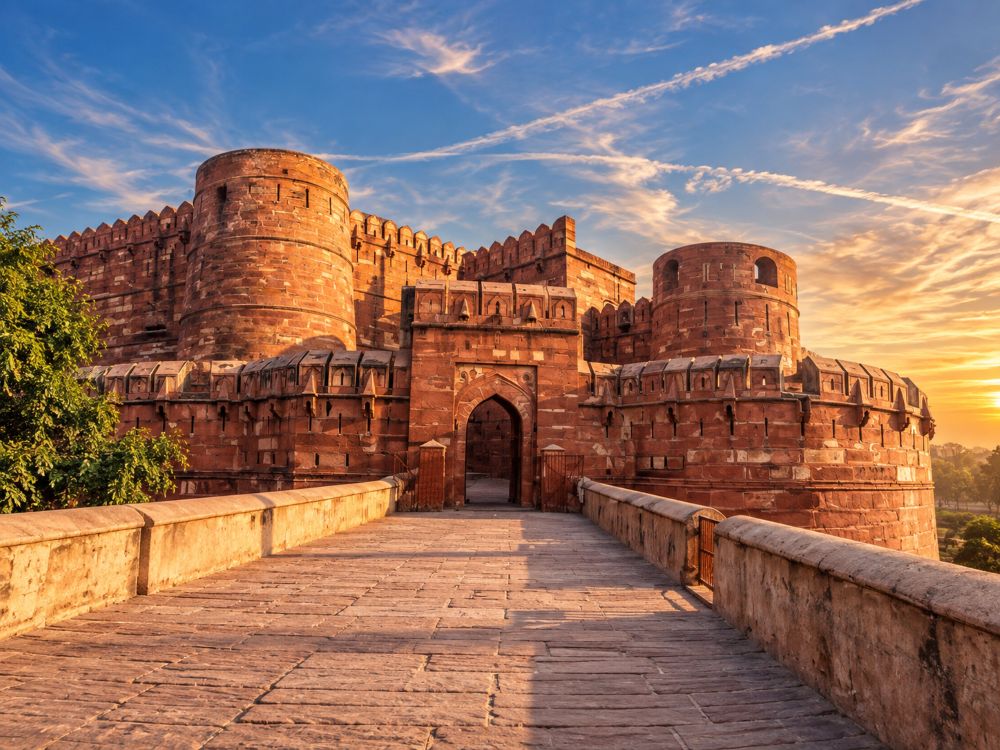
If the Taj Mahal shows the aesthetic perfection of Shah Jahan’s reign, Agra Fort shows how Mughal power actually functioned.
The enormous red-sandstone fortress curves along the Yamuna only a few kilometres upstream from the Taj. Its walls run for approximately 2.5 kilometres, enclosing what was once an imperial city of palaces, audience halls, mosques, gardens, courtyards, military spaces and private apartments.
Akbar began the great reconstruction in 1565, incorporating earlier fortifications into an immense new complex. Shah Jahan later replaced or remodelled several areas in white marble, creating the extraordinary stylistic contrast visible today.
UNESCO inscribed Agra Fort in 1983, the same year as the Taj Mahal.
Amar Singh Gate
Visitors enter through Amar Singh Gate, one of the fort’s monumental defensive approaches. The original principal ceremonial entrance, Delhi Gate, is not used for general tourist access.
The approach deliberately prevents a straight assault. Gates, turns and rising passages force movement through controlled angles before the palace areas become visible.
This is an important reminder that Agra Fort was not merely a royal residence dressed as a fortress. Its military architecture was real, even though later emperors filled the interior with gardens and marble apartments.
Jahangiri Mahal
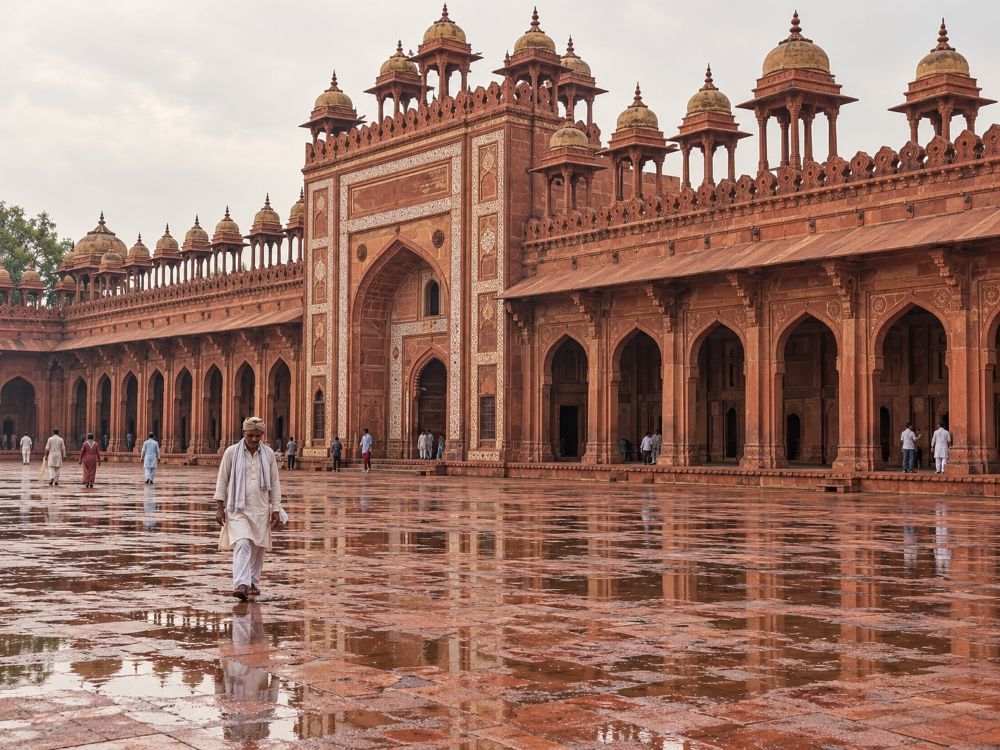
One of the fort’s most substantial surviving palaces is the Jahangiri Mahal, associated with Akbar’s construction period despite its modern name.
The building is dominated by red sandstone and richly carved brackets, balconies and columns. Indian architectural vocabulary is particularly strong here, creating a radically different effect from the later marble architecture of Shah Jahan.
Look at the detailing rather than searching for pure stylistic categories. Mughal builders borrowed forms because they worked and because the empire drew talent from across a culturally diverse territory.
The building feels experimental, muscular and almost sculptural.
Diwan-i-Aam
The Diwan-i-Aam, or Hall of Public Audience, was where imperial authority became visible to a wider courtly public. Officials, petitioners and representatives could be received within a highly controlled ceremonial environment.
Mughal government relied heavily on the physical performance of sovereignty. The emperor was not simply hidden behind palace walls; his appearance at audiences, balconies and ceremonies reinforced political order.
Architecture organised that performance by controlling who stood where and how close each group could approach.
Diwan-i-Khas
The Diwan-i-Khas, or Hall of Private Audience, served a more restricted political world. Ambassadors, senior nobles and important officials could meet the emperor in a setting deliberately more refined than the public audience hall.
Shah Jahan’s preference for marble and delicate ornament becomes especially visible in this part of the fort. The material shift is political as much as aesthetic: white marble became an architectural language of imperial refinement during his reign.
Khas Mahal
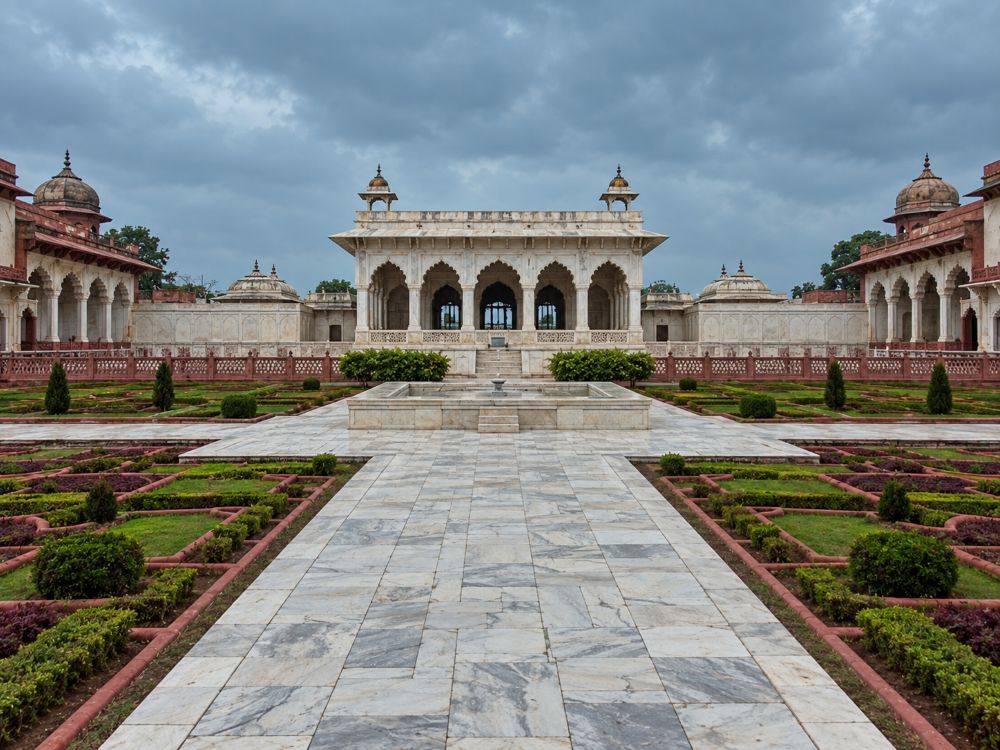
The Khas Mahal is one of Shah Jahan’s elegant private palace structures, combining white marble rooms with pavilions and views towards the Yamuna.
Its surfaces are far lighter than Akbar’s sandstone architecture. Carved marble, painted decoration and open arcades create a residence adapted as much to climate as ceremony.
Riverfront location mattered. Before modern roads took over urban movement, the Yamuna was a major axis of imperial Agra, and palaces were deliberately positioned to exploit water, gardens and cooling breezes.
Musamman Burj and Shah Jahan’s Final Years
The octagonal Musamman Burj overlooks the Yamuna and the Taj Mahal in the distance. It is inseparable from the story of Shah Jahan’s final years.
In 1658, his son Aurangzeb defeated his brothers in the Mughal succession struggle and removed Shah Jahan from power. The former emperor spent his remaining years confined within Agra Fort, though the popular image of a miserable prisoner staring eternally through one specific marble window oversimplifies the nature of his courtly confinement.
He died in 1666 and was buried beside Mumtaz Mahal, permanently disrupting the Taj’s central symmetry.
The view from this part of Agra Fort creates one of the city’s most powerful historical connections: the imperial palace, the river and Shah Jahan’s mausoleum exist in the same visual field.
Sheesh Mahal
The Sheesh Mahal, or Mirror Palace, belonged to the private imperial complex and used reflective decoration to multiply limited light into shimmering surfaces.
Mirror work later became widespread across Indian palace architecture, but within Mughal spaces it formed part of a broader fascination with controlled illumination, water, polished stone and luxury.
Access to individual areas of Agra Fort can vary with conservation and security requirements, so not every historically documented chamber is always part of the visitor route.
Moti Masjid
The Moti Masjid, or Pearl Mosque, is one of Shah Jahan’s most refined religious buildings within the fort. Its white marble gives it an almost weightless appearance compared with the enormous sandstone ramparts surrounding it.
The mosque illustrates an important Mughal pattern: external military severity could enclose spaces of extraordinary delicacy. Fort, palace, garden and sacred architecture were not separate urban categories; they could coexist within the same imperial enclosure.
Agra Fort Practical Information
Agra Fort is open from sunrise to sunset every day, making it particularly useful on Fridays when the Taj Mahal is closed. Foreign admission is currently around ₹650, while Indian admission is ₹50.
Allow two hours minimum. Architecture enthusiasts should give it closer to three.
The site is large and exposed. Morning is preferable from March to October, while winter afternoons can be excellent because the red sandstone warms dramatically in low light.
Itimad-ud-Daulah: The So-Called Baby Taj
The nickname Baby Taj is memorable and slightly unfair. Itimad-ud-Daulah deserves to be understood on its own terms.
Nur Jahan commissioned the mausoleum between 1622 and 1628 for her father, Mirza Ghiyas Beg, a Persian-born statesman who rose to enormous influence in the Mughal court and received the title Itimad-ud-Daulah, “Pillar of the State.”
The monument stands beside the Yamuna and represents a decisive architectural transition. It is one of the earliest major Mughal tombs constructed extensively in white marble and one of the most important early showcases of the coloured hardstone inlay later perfected at the Taj.
Why Itimad-ud-Daulah Matters
Its scale is intimate compared with the Taj, which allows the decoration to dominate. Geometric stone screens, delicate inlays, painted interiors and jewel-like surfaces make the tomb feel almost like an enormous precious object.
The architecture also reflects the increasing influence of Persian court culture and Nur Jahan’s own artistic patronage.
If you visit only to find “a smaller Taj,” you will miss the point. The more revealing interpretation is chronological: Itimad-ud-Daulah helps explain how the Taj became possible.
It is open from sunrise to sunset, with foreign admission currently around ₹310.
Mehtab Bagh
Across the Yamuna from the Taj Mahal lies Mehtab Bagh, the Moonlight Garden. Babur established an earlier garden in this area, while Shah Jahan’s riverfront planning later aligned the space directly with the Taj complex.
The reconstructed charbagh is now the classic opposite-bank viewpoint. The mausoleum appears beyond the Yamuna without the foreground crowds of its own garden, allowing the riverfront composition to become much clearer.
Sunset is popular, but the best experience depends on atmospheric conditions. During haze, the Taj can dissolve into the warm air; after rain, visibility can become exceptionally clear.
Mehtab Bagh is open from sunrise to sunset and foreign admission is currently around ₹300.
The Yamuna and the Lost Riverfront City
Modern Agra can make the Yamuna feel strangely peripheral, yet Mughal Agra was fundamentally a river city.
Imperial gardens and aristocratic residences lined both banks, creating a sequence of landscaped estates linked visually and physically by the water. The Taj Mahal belonged to this riverfront world rather than standing as an isolated monument at the edge of nowhere.
Much has vanished through urban change, neglect and shifting river conditions, but traces remain. Mehtab Bagh, Itimad-ud-Daulah, Ram Bagh and Chini ka Rauza all become more meaningful when understood as fragments of a larger river landscape.
Chini ka Rauza
North of Itimad-ud-Daulah stands one of Agra’s most unusual monuments. Chini ka Rauza, built around 1635, is the tomb of Afzal Khan Shirazi, a Persian scholar, poet and senior official under Shah Jahan.
Its name refers to chini, the glazed ceramic tiles that once covered substantial portions of the exterior. Surviving patches of blue, turquoise and coloured tilework provide a rare glimpse of Persian decorative traditions that are now far less visible in Agra than red sandstone or marble inlay.
The monument has suffered considerably, but that damage almost increases its value for anyone interested in architectural technique. It reveals a decorative Agra that might otherwise be forgotten.
Admission is free.
Ram Bagh
Ram Bagh is traditionally considered the oldest surviving Mughal garden in India, laid out under Babur around 1528. Its historical importance exceeds its current level of fame.
The design uses terraces, channels and pavilions to create an ordered garden adapted to the Yamuna landscape. The Mughal charbagh tradition would later reach extraordinary sophistication, but Ram Bagh shows the concept in an early Indian form.
Babur’s remains were temporarily kept in Agra before eventually being transferred to Kabul, further strengthening the garden’s association with the founder of the dynasty.
Visit in the morning, when shade and relative quiet make the site far more pleasant.
Akbar’s Tomb at Sikandra
Around ten kilometres northwest of central Agra stands Sikandra, where Akbar’s mausoleum occupies a vast garden of roughly 119 acres.
Akbar initiated the project himself, following the Mughal practice in which emperors could select and begin their own funerary complexes. His son Jahangir completed the tomb after Akbar’s death in 1605, with work finished around 1613.
The design immediately distinguishes itself from the Taj. Instead of a dominant central dome, the tomb rises as a broad five-level pyramidal structure, with red sandstone below and increasingly delicate marble elements above.
This suits Akbar surprisingly well. The monument combines architectural vocabularies rather than forcing them into one stylistic language, reflecting the cultural experimentation of his reign.
The Gateway at Sikandra
The monumental entrance gate may actually make a stronger first impression than the tomb itself. Four white marble minaret-like towers rise above an intricately decorated red-sandstone façade covered with geometric, floral and calligraphic patterns.
The contrast anticipates architectural ideas that would be pushed much further at the Taj Mahal.
Once through the gate, the vast charbagh creates a completely different atmosphere from central Agra. Blackbuck and other animals may be visible in the gardens, reinforcing the sense of an imperial estate rather than a conventional cemetery.
Foreign admission is approximately ₹310, and the site is open from sunrise to sunset.
Akbar’s Actual Grave
As at the Taj Mahal, the visible monument and actual burial should not be confused.
Akbar’s real grave lies in a comparatively austere interior chamber. The simplicity is striking after the architectural richness outside.
That contrast between elaborate commemorative architecture and restrained burial space occurs repeatedly in Mughal mausoleums and is easy to overlook when visiting only exterior courtyards and gardens.
Mariam-uz-Zamani’s Tomb
About a kilometre from Sikandra stands the tomb of Mariam-uz-Zamani, Akbar’s Rajput consort and mother of Jahangir. Popular culture frequently calls her “Jodha Bai,” although the historical use of that name is problematic and should not be treated as straightforward fact.
Her mausoleum adapted an earlier Lodi-period structure, later clad and modified with Mughal sandstone decoration.
The result is quieter than Akbar’s tomb but historically significant. The proximity of the two monuments also makes them easy to combine.
Foreign admission is currently around ₹300.
Jama Masjid
Across from the Agra Fort railway area stands the city’s Jama Masjid, commissioned by Jahanara Begum, Shah Jahan’s influential daughter, and completed in the seventeenth century.
The mosque is constructed primarily in red sandstone with white marble decoration and a large courtyard. Its position within the old commercial city connects Mughal religious architecture with the continuing rhythms of bazaars, traffic and everyday worship.
This is not a monument that should be experienced in the same way as the Taj. It remains an active mosque. Dress conservatively, remove shoes as required and avoid entering during prayer simply to obtain photographs.
Jahanara Begum
Jahanara is one of the women who deserves far more space in popular Mughal history.
Daughter of Shah Jahan and Mumtaz Mahal, she became Padshah Begum, effectively the first lady of the imperial court after her mother’s death. She controlled substantial wealth, sponsored architecture and gardens and was deeply connected with Sufi religious traditions.
Her patronage extended beyond Agra. In Shahjahanabad—modern Old Delhi—she helped shape the commercial world around Chandni Chowk.
The Jama Masjid of Agra adds another reminder that Mughal architecture was not produced exclusively by emperors.
Kinari Bazaar and the Old City
Agra’s monuments can feel strangely detached from the modern city if you travel only by air-conditioned car. Kinari Bazaar, Rawatpara and the streets around Jama Masjid correct that immediately.
The lanes are crowded with textiles, wedding ornaments, spices, sweets, jewellery, household goods and motorcycles attempting geometrically improbable manoeuvres. This is not a preserved Mughal bazaar, but it continues the commercial intensity that has characterised central Agra for centuries.
Walk with patience and keep expectations realistic. The old city is noisy, congested and physically demanding in hot weather, but it provides the urban context absent from manicured monument grounds.
Fatehpur Sikri
Around 36–40 kilometres west of Agra, Akbar built one of the most extraordinary imperial cities in India.
Fatehpur Sikri was developed from 1571 and served as the Mughal capital for roughly fourteen years. It was the dynasty’s first great planned imperial city, combining palaces, audience halls, mosques, courtyards, administrative buildings and residential areas within a fortified landscape.
The city is often described as “abandoned,” which creates the wrong impression. Akbar shifted his principal court away in 1585, but Fatehpur Sikri did not instantly become an empty ruin. Religious life continued around the shrine of Sheikh Salim Chishti, and the site remained important enough for later Mughal visits.
What survives today is exceptionally coherent, making it one of the best places to understand Akbar’s political imagination.
Why Akbar Built Fatehpur Sikri
The city developed around the settlement of Sheikh Salim Chishti, a revered Sufi saint. Akbar, who had struggled to produce a surviving male heir, sought the saint’s blessing. When a son was born in 1569, the future emperor Jahangir was named Salim in his honour.
The relationship between imperial authority and Sufi charisma became central to Fatehpur Sikri’s identity. Akbar did not simply build palaces near a holy man; he transformed the landscape around the shrine into an imperial capital.
This mixture of sacred and political power explains the city’s unusual organisation.
Diwan-i-Khas at Fatehpur Sikri
The Diwan-i-Khas appears relatively simple from outside, but its interior contains one of the strangest architectural features of Akbar’s reign: a monumental central column with an elaborately carved capital supporting a small platform, connected to the corners by narrow stone bridges.
Its exact ceremonial function remains debated. Popular guides often describe Akbar sitting in the centre while representatives of different religions occupied the corners, turning the room into a literal diagram of interfaith debate. That interpretation is appealing but more certain than the evidence allows.
What can be said is that the room embodies Akbar’s taste for architectural experimentation. The central capital combines patterns and forms drawn from multiple building traditions into something almost impossible to classify neatly.
Panch Mahal
The Panch Mahal rises in five increasingly smaller levels of open columns, creating a pyramidal pavilion designed to capture movement and air.
Its openness is perfectly adapted to hot conditions. Instead of thick enclosed rooms, hundreds of columns support shaded platforms with views across the palace complex.
The building is one of Fatehpur Sikri’s clearest demonstrations that Mughal architecture was also environmental engineering. Shade, airflow, pools and orientation were essential long before mechanical cooling.
Jodha Bai’s Palace
The large residential complex commonly called Jodha Bai’s Palace is one of Fatehpur Sikri’s most visited areas, though the traditional name should be treated carefully because historical documentation does not securely identify it with a queen known by that name.
The architecture itself matters more than the label. Red-sandstone façades combine Islamic arches with brackets, lintels, carved motifs and roof forms strongly associated with Indian building traditions.
This fusion is characteristic of Akbar’s architecture and provides one of the strongest contrasts with the stylistic discipline of Shah Jahan’s Taj Mahal.
Jama Masjid at Fatehpur Sikri
The immense Jama Masjid was one of the earliest monumental structures of the new capital and remains an active sacred space.
The courtyard is dominated by the white marble Tomb of Sheikh Salim Chishti, whose delicacy stands in stark contrast with the red sandstone around it.
Visitors often tie threads to the marble screens around the saint’s shrine while making wishes, continuing a devotional practice that keeps Fatehpur Sikri alive rather than reducing it to archaeology.
Approach with the same respect you would bring to any functioning religious site. Touts and unofficial intermediaries can be persistent around the mosque complex; religious devotion does not require purchasing expensive cloth or offerings.
Tomb of Sheikh Salim Chishti
The saint’s tomb is one of the architectural jewels of Fatehpur Sikri. White marble screens surround the chamber with exquisitely carved geometric patterns, while the small scale makes the building feel almost weightless beside the massive mosque courtyard.
The shrine also explains why Fatehpur Sikri exists where it does. Without Salim Chishti, Akbar’s imperial city would likely never have developed in this location.
Buland Darwaza
The Buland Darwaza, or Gate of Magnificence, rises approximately 54 metres and forms one of the grandest approaches to a mosque complex anywhere in India.
Its enormous central arch is flanked by smaller elements and crowned by chhatris, combining monumental Islamic geometry with architectural forms associated with India.
The staircase amplifies the height even further. From below, the gateway seems less like an entrance than a complete building.
The gate commemorates Akbar’s military success in Gujarat and turns imperial victory into architecture.
Did Fatehpur Sikri Run Out of Water?
The familiar explanation claims Akbar abandoned Fatehpur Sikri because its water supply failed.
Water management certainly posed challenges in this semi-arid setting, but the idea of a sudden environmental catastrophe is too simple. Strategic priorities were changing, particularly towards the empire’s north-western frontier, and Akbar transferred his court to Lahore in 1585.
Imperial capitals in the Mughal world could move with political necessity. Fatehpur Sikri’s short life as the primary capital should therefore be understood through military strategy, court mobility and resource management rather than one dramatic dried-up well.
Fatehpur Sikri Practical Information
The site is open from sunrise to sunset daily. Foreign entry to the principal protected monument complex is currently around ₹610, while children under fifteen enter free.
Private vehicles stop below the archaeological zone, with authorised battery transport connecting the parking area to the entrance.
Allow at least three hours at the site itself, excluding travel from Agra. Half-day excursions are possible; a rushed ninety-minute stop is not worth the drive.
Agra’s Marble Inlay Craft
The workshops around Agra continue to produce parchin kari, the marble-inlay tradition associated most famously with the Taj Mahal.
Craftsmen cut coloured stone into tiny petals, leaves and geometric shapes using hand tools before fitting them into precisely carved recesses in marble. Fine pieces can require astonishing patience.
The difficulty for visitors is commercial rather than artistic. Demonstrations are frequently attached to aggressive sales environments, often because drivers and guides receive commission.
Watch the process if it interests you, but feel no obligation to buy. Quality varies from genuinely skilled work to mass-produced tourist pieces.
What to Eat in Agra
Agra’s cuisine has two personalities. One descends from the Mughal court: kebabs, korma, slow-cooked meat, biryani, rich gravies and careful use of spices, nuts and dried fruit. The other is emphatically street-level: fried bread, potatoes, jalebi, chaat, dalmoth and sweets designed for appetite rather than ceremony.
Start breakfast with bedai, Agra’s version of a crisp lentil-filled fried bread served with heavily spiced potato curry. It is frequently followed—or accompanied—by hot jalebi, giving breakfast a combination of chilli, starch, oil and sugar that makes understated European breakfasts look like a moral failing.
Later in the day, try dalmoth, a savoury mixture of fried lentils, nuts, spices and crunchy elements that travels well and makes a good edible souvenir.
For dinner, turn towards Mughlai cooking: seekh kebab, mutton korma, tandoori meats, biryani and slow-cooked dishes are the logical continuation of a day spent inside Mughal palaces.
Petha: Agra’s Famous Sweet
Agra’s defining sweet is petha, made from ash gourd cooked and candied until it becomes translucent.
The plain version is firm, sugary and almost crystalline. Variations include saffron, paan, coconut and the softer angoori petha, small syrup-soaked pieces with a more delicate texture.
The sweet now carries a geographical association so strong that petha and Agra are almost inseparable. Stories linking its invention directly to Shah Jahan’s Taj Mahal workforce are popular but difficult to establish securely.
What does matter is freshness. Dry petha travels well; wet syrup versions are better eaten quickly.
Where to Eat in Agra
The Nawaabs
The Nawaabs
A strong choice for North Indian and Mughlai cooking on Fatehabad Road, especially when you want kebabs, rich meat dishes and biryani in a proper sit-down restaurant rather than a hotel dining room. The menu is broad enough for mixed groups without abandoning its northern Indian focus.
Address: 18A/5/4-D Fatehabad Road, Agra
Telephone: +91 70270 24829
Best for: Mughlai dinner and kebabs
Joney’s Place
Joney’s Place
Tiny, informal and close to the Taj Mahal, Joney’s Place is useful for simple Indian food, breakfast and inexpensive meals when you do not want another elaborate hotel restaurant. Its scale is almost the opposite of imperial Agra, which is part of the appeal.
Address: Bhanumati Road, Tajganj
Telephone: +91 98373 39686
Best for: inexpensive food near the Taj
Heart of Taj Café & Kitchen
Heart of Taj Café & Kitchen
Close to the eastern approach to the Taj, this is a practical stop for Indian dishes before or after sightseeing. It works especially well when early monument timings make normal hotel dining inconvenient.
Address: Taj Nagri Phase 1, near Shilpgram Road
Telephone: +91 99178 85278
Best for: convenient breakfast or casual meal near the East Gate
Where to Stay in Agra
The Oberoi Amarvilas
The Oberoi Amarvilas, Agra
For a once-in-a-lifetime Agra stay, the central attraction is brutally simple: views of the Taj Mahal from the property and many guest rooms. The architecture draws deliberately on Mughal references without attempting to impersonate an actual historical palace, while the location makes sunrise visits unusually easy.
Address: Taj East Gate Road, Agra
Telephone: +91 562 2231515
Best for: luxury, Taj views and a special-occasion stay
ITC Mughal
ITC Mughal, a Luxury Collection Resort & Spa, Agra
A large resort-style property on Fatehabad Road, ITC Mughal offers gardens, extensive facilities and a strong Mughal-inspired design vocabulary. It is particularly practical for travellers wanting resort amenities rather than a compact boutique hotel.
Address: Fatehabad Road, Tajganj
Telephone: +91 562 4021700
Best for: resort facilities, spa and longer stays
Tajview Agra
Tajview, Agra – IHCL SeleQtions
A solid upper-upscale option on Fatehabad Road, convenient for the Taj Mahal and major transport routes without the pricing of Agra’s top luxury properties.
Address: Fatehabad Road, Tajganj
Telephone: +91 562 6602000
Best for: comfort, location and mid-luxury value
A Perfect First Day in Agra
Start before dawn and be at the Taj Mahal gates before opening. Give the complex at least two and a half hours; three is better if architecture or photography matters. Walk the full garden, enter the mausoleum, inspect the mosque and jawab and resist the urge to spend the entire visit reproducing the same symmetrical photograph.
Return to your hotel for breakfast, then rest briefly before visiting Agra Fort in late morning or early afternoon. Spend two to three hours tracing the transition from Akbar’s sandstone architecture to Shah Jahan’s marble palaces.
Cross the Yamuna afterwards for Itimad-ud-Daulah, when the lower afternoon light begins warming its marble and sandstone details. Finish at Mehtab Bagh for the Taj Mahal across the river at sunset.
This gives you four versions of Mughal Agra in one day without reducing everything to the Taj.
A Second Day in Agra
Begin with Akbar’s Tomb at Sikandra, then continue to nearby Mariam-uz-Zamani’s Tomb. Returning towards the river, visit Ram Bagh and Chini ka Rauza before the midday heat becomes aggressive.
Spend the later afternoon exploring Jama Masjid, Kinari Bazaar and the old city. This is the point at which Agra stops feeling like a collection of archaeological parks and becomes an actual North Indian city.
Use the evening for a serious Mughlai dinner.
A Third Day: Fatehpur Sikri
Leave Agra early for Fatehpur Sikri and give the imperial city at least three hours. Move through the palace complex slowly before entering the sacred zone around Jama Masjid and Sheikh Salim Chishti’s tomb.
Return to Agra in the afternoon and keep the final hours flexible. Revisit the Taj from another viewpoint, watch artisans working in marble inlay or simply take a slower walk through Tajganj.
Three days create a much more coherent understanding of Mughal architecture than the standard same-day Delhi excursion.
If You Have Only One Day
One day requires discipline.
Visit the Taj Mahal at opening, continue directly to Agra Fort and then choose either Itimad-ud-Daulah plus Mehtab Bagh or Fatehpur Sikri. Do not try to include all of them unless the goal is collecting entrance gates rather than seeing architecture.
If the day is a Friday, reverse the logic completely: the Taj Mahal is closed, so concentrate on Agra Fort, Sikandra, Itimad-ud-Daulah and Fatehpur Sikri and schedule the Taj for another morning.
How Long Do You Need in Agra?
A Delhi day trip is enough to say you have seen the Taj Mahal.
It is not enough to understand Agra.
Two nights and two full days are the sensible minimum. Three days allow Fatehpur Sikri to breathe and remove the need to rush every monument.
Architecture enthusiasts could easily spend four days once the smaller tombs, gardens and riverfront sites are included.
Getting to Agra from Delhi
Agra lies roughly 230 kilometres south-east of Delhi and is exceptionally well connected.
Fast trains make rail the most efficient option for many travellers. Services from Delhi can reach Agra in around two hours or less depending on the train, with Agra Cantt serving as the principal station for most long-distance visitors.
The Yamuna Expressway also makes private car travel straightforward, usually taking around three to four hours depending on Delhi traffic and the exact starting point.
If you are travelling as part of India’s classic Golden Triangle, Agra sits naturally between Delhi and Jaipur.
Agra Metro
Agra’s developing metro system has added a useful transport layer along parts of the tourism corridor, including access around major central sites.
It does not eliminate the need for autos, taxis or walking, particularly for Sikandra and the trans-Yamuna monuments, but it can simplify journeys around the Taj–Agra Fort axis.
For most visitors, a combination of metro, auto-rickshaw and app-based car is more practical than hiring a driver for every movement.
Getting Around Agra
Distances between the main monuments are larger than they appear on schematic tourist maps. The Taj and Agra Fort are relatively close, but Sikandra lies far to the northwest while Itimad-ud-Daulah and Mehtab Bagh require crossing the Yamuna.
Auto-rickshaws are useful for short trips; private cars are more comfortable when combining several outlying sites. Agree fares clearly before using non-metered transport.
Driver commissions are common in shopping and restaurant stops. If you did not ask to visit a marble showroom, carpet workshop or restaurant, there is no obligation to accept the detour.
Best Time to Visit Agra
The most comfortable period is October to March.
November, February and early March provide particularly good conditions, combining cooler temperatures with relatively manageable mornings. December and January can be cold before sunrise and sometimes heavily affected by fog, which may obscure the Taj Mahal.
April to June can be brutally hot, with daytime temperatures exceeding 40°C. Sightseeing then requires very early starts, long midday breaks and serious attention to hydration.
The monsoon generally affects Agra from July into September. Rain can complicate movement, but washed air sometimes produces exceptionally clear post-storm views.
Sunrise or Sunset at the Taj?
For a first visit, choose sunrise.
The temperature is lower, the light is softer and the psychological impact of entering the complex as the day begins is difficult to reproduce later. Crowds are still substantial, but usually more manageable than at peak daytime periods.
For photography from Mehtab Bagh, late afternoon is preferable because the Taj stands across the river in changing western light.
The ideal Agra itinerary includes both rather than forcing a choice.
Air Pollution and Winter Fog
Agra’s location in northern India’s densely populated plains means atmospheric pollution can be significant, particularly during the cooler months. Agricultural burning, traffic, industry, dust and winter weather patterns can combine to trap particulate matter close to the ground.
This matters both for health and visibility. A perfectly planned Taj sunrise can become a white-grey wall in heavy fog.
Travellers sensitive to poor air quality should monitor conditions, limit prolonged outdoor exertion on severe days and consider appropriate respiratory protection.
Dress and Monument Etiquette
There is no elaborate dress code for most archaeological monuments, but modest clothing is appropriate at mosques and active shrines.
Shoes must be removed or covered in specific sacred and marble areas. At the Taj Mahal, shoe covers are commonly used around the mausoleum.
At Jama Masjid and Sheikh Salim Chishti’s shrine, remember that you are entering functioning religious spaces rather than museum interiors.
Photography
The Taj Mahal is exceptionally easy to photograph badly because everyone gravitates towards the same five compositions. Use the central axis, certainly, but then move.
Frame the mausoleum through the Great Gate, work with the mosque arcades, photograph from the marble terrace and use Mehtab Bagh for the river relationship. Early side light reveals marble relief carving far better than a front-on noon shot.
Photography is prohibited inside the principal mausoleum.
Drones are prohibited around the Taj Mahal.
Shopping in Agra
Agra is known for marble inlay, leather, carpets, jewellery and embroidery. Marble products are the most obvious extension of the Taj Mahal craft tradition.
Quality ranges enormously. Fine parchin kari is labour-intensive and cannot realistically cost the same as machine-produced souvenir stonework.
Ask to see the reverse of marble pieces, inspect the precision of inlay edges and compare several workshops before buying anything expensive. Avoid assuming that every shop presented by a driver is an artisan cooperative; commissions shape much of the tourism retail economy.
What to Buy
The most practical edible souvenirs are dry petha and dalmoth. Both travel substantially better than syrup-heavy sweets.
For craft, a small, well-made marble-inlay piece can be more meaningful than a large decorative object of mediocre quality.
Textiles and leather are widely available, but Agra is not the only or necessarily the best Indian city for either. Prioritise what is genuinely distinctive to the place.
Agra and the Golden Triangle
Agra forms the third point of the classic Delhi–Agra–Jaipur Golden Triangle, but the three cities represent very different strands of North Indian history.
Delhi layers Sultanate, Mughal, colonial and modern national capitals. Agra concentrates the mature Mughal court and its funerary architecture. Jaipur represents a Rajput royal capital planned in the eighteenth century.
The route becomes much more interesting when understood historically rather than simply logistically.
Four or five nights for the entire triangle is rushed. A more convincing journey gives at least two nights to Agra and considerably more to Delhi and Jaipur.
Small Details Worth Knowing
The Taj Mahal’s actual graves are below the richly decorated cenotaphs seen by visitors. Shah Jahan’s cenotaph is the principal break in the mausoleum’s otherwise obsessive symmetry because the building was designed around Mumtaz Mahal alone.
The calligraphy becomes larger higher on the building to compensate for perspective. The Taj garden does not place the tomb conventionally in the exact centre because the project belongs to Agra’s tradition of riverfront gardens.
Agra Fort contains architecture from several Mughal reigns, making its internal contrast more historically useful than architectural uniformity would have been. Itimad-ud-Daulah demonstrates extensive marble and hardstone work before the Taj Mahal, while Akbar’s Tomb deliberately avoids the enormous central dome that later became synonymous with Mughal mausoleums.
Fatehpur Sikri did not simply become an empty ghost city because one well dried up. The Mughal court moved for a combination of strategic and practical reasons, while the shrine of Salim Chishti remained active.
And Agra itself should not be mistaken for a city created to support a tourist monument. The Taj is the extraordinary survivor of an imperial metropolis that was already politically, commercially and architecturally important for generations before its marble dome appeared.
Useful Information
- State: Uttar Pradesh
- River: Yamuna
- Ideal stay: 2–3 full days
- UNESCO sites: Taj Mahal, Agra Fort and Fatehpur Sikri
- Best season: October–March
- Taj Mahal opening: 30 minutes before sunrise to 30 minutes before sunset
- Taj Mahal closure: every Friday for general sightseeing
- Taj Mahal foreign ticket: ₹1,100
- Main mausoleum supplement: ₹200
- Agra Fort foreign ticket: approximately ₹650
- Itimad-ud-Daulah foreign ticket: approximately ₹310
- Akbar’s Tomb foreign ticket: approximately ₹310
- Mehtab Bagh foreign ticket: approximately ₹300
- Fatehpur Sikri foreign ticket: approximately ₹610
- Children under 15: free at the principal ASI monuments
- Best Taj experience: sunrise
- Best opposite-bank Taj view: Mehtab Bagh
- Best architecture sequence: Agra Fort → Itimad-ud-Daulah → Taj Mahal
- Best half-day excursion: Fatehpur Sikri
- Essential breakfast: bedai with aloo sabzi and jalebi
- Essential sweet: Agra petha
- Essential dinner style: Mughlai
- Main railway station: Agra Cantt
- From Delhi: fast train or Yamuna Expressway
- Taj security: travel light; food, tripods, drones and numerous electronic accessories are prohibited
- Photography inside main Taj mausoleum: prohibited
- Tourist helpline: 1363
- Emergency: 112

