
A Weekend in Perugia: Art, History, Food, and Breathtaking Umbrian Panoramas
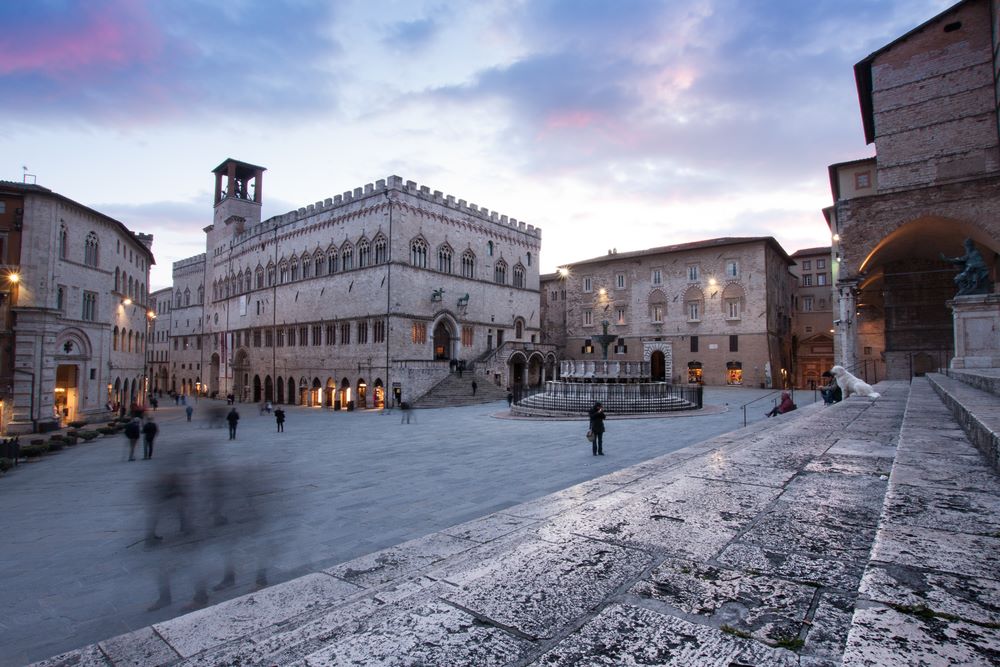
Perugia is a city built vertically and historically at the same time.
Its streets climb and fall across a cluster of hills above the Umbrian countryside, while beneath the medieval palaces survive Etruscan walls, Roman structures, underground streets and the remains of a papal fortress built directly over an earlier neighborhood. Piazza IV Novembre concentrates one of the finest civic ensembles in central Italy around the Fontana Maggiore, Palazzo dei Priori and the Cathedral of San Lorenzo; a few minutes away, an Etruscan gate more than two thousand years old still forms part of the ordinary street network.
The city is also far more cosmopolitan than its size suggests. The Università degli Studi di Perugia, founded in 1308, and the Università per Stranieri have brought generations of Italian and international students into the historic centre, giving Perugia an evening life rarely found in similarly sized Umbrian towns. Umbria Jazz transforms the city every July, while chocolate has become part of its modern identity through Perugina and Eurochocolate.
What makes Perugia particularly rewarding, however, is the way different periods remain physically superimposed. You can begin inside an Etruscan city, cross a medieval square, look at paintings by Perugino and Pinturicchio, descend through sixteenth-century papal fortifications and finish the afternoon on a terrace overlooking a landscape that extends towards Assisi and the Apennines.
Two full days are ideal. One day covers the monumental centre surprisingly well, but a second allows the Galleria Nazionale dell’Umbria, San Pietro, the archaeological sites and the quieter streets around Porta Sole and Borgo XX Giugno to receive the time they deserve.
Things to See in Perugia
- Piazza IV Novembre
- Fontana Maggiore
- Palazzo dei Priori
- Galleria Nazionale dell’Umbria
- Sala dei Notari
- Cattedrale di San Lorenzo
- Collegio del Cambio
- Corso Vannucci
- Rocca Paolina
- Porta Marzia
- Arco Etrusco
- Pozzo Etrusco
- Via dell’Acquedotto
- Porta Sole
- Basilica di San Pietro
- Basilica di San Domenico
- Museo Archeologico Nazionale dell’Umbria
- Oratorio di San Bernardino
- Borgo XX Giugno
- Casa del Cioccolato Perugina
- Giardini Carducci
- Umbria Jazz
- Eurochocolate
The Etruscan City Beneath Perugia
Perugia was already an important city centuries before Rome dominated central Italy.
Ancient Perusia became one of the principal centres of Etruria, protected by a monumental circuit of walls constructed from large blocks of local travertine. Much of that defensive system dates to the third century BC, although the urban settlement itself is considerably older.
Fragments of the walls still appear unexpectedly throughout the historic centre. Some support later buildings; others emerge beside medieval streets or survive within archaeological areas. This is one of Perugia’s defining characteristics: the ancient city was not abandoned and replaced somewhere else. Later generations simply continued building on top of it.
The result can be difficult to read at first.
Piazza IV Novembre occupies an area associated with the ancient civic centre. The Etruscan gate at the northern side of the acropolis became the Roman Arco di Augusto. Medieval streets followed earlier routes, and Renaissance buildings absorbed ancient masonry into their foundations.
Perugia is therefore best explored by looking down as often as up.
Arco Etrusco
The monumental Arco Etrusco, also called the Arco di Augusto, is the strongest surviving introduction to ancient Perugia.
Built in the third century BC from enormous travertine blocks, the gateway rises approximately eleven metres and was one of the principal entrances through the Etruscan walls. Two massive trapezoidal towers flank the central arch, producing a structure that still feels defensive rather than ceremonial.
Its Roman inscriptions reveal the next phase of Perugia’s history.
During the Bellum Perusinum of 41–40 BC, the city became involved in the civil war between Octavian and forces associated with Mark Antony. After a prolonged siege, Perugia surrendered to Octavian and much of the city was destroyed by fire.
The inscription AUGUSTA PERUSIA commemorates the subsequent reconstruction under the future emperor Augustus. A second inscription, COLONIA VIBIA, was added centuries later in connection with emperor Trebonianus Gallus, who originated from the Perugia area.
Few Italian city gates make the transition from Etruscan independence to Roman rule so clearly visible on the same structure.
The Etruscan Well
Only a short walk away, the Pozzo Etrusco demonstrates that the city’s ancient engineering extended far beyond fortifications.
Constructed during the second half of the third century BC, the well descends approximately 37 metres beneath Piazza Piccinino. Its upper chamber reaches about 5.6 metres in diameter before narrowing deeper underground.
The most impressive element is above your head.
Huge travertine beams were arranged without mortar to create a monumental structural system supporting the opening above. Some of the blocks weigh several tonnes, and their construction technique closely resembles that of the Etruscan city walls.
A modern walkway allows visitors to enter the upper chamber and look down into the shaft.
The experience is brief, but it changes the scale of ancient Perugia. The Etruscans were not simply enclosing the hill with walls; they were managing the water supply of a densely inhabited urban centre using sophisticated hydraulic engineering.
Piazza IV Novembre
Everything eventually returns to Piazza IV Novembre.
The square sits at the highest symbolic point of medieval Perugia, where the routes of the historic city converge around the Fontana Maggiore, Palazzo dei Priori and Cathedral of San Lorenzo.
Its irregular shape is part of the attraction.
Unlike Renaissance piazzas designed as unified architectural compositions, Piazza IV Novembre developed through centuries of civic construction. Cathedral steps become informal seating, Palazzo dei Priori presents different façades towards different streets, and the fountain occupies the centre almost as an independent sculpture.
The square remains intensely social.
Students sit on the cathedral steps into the evening, festivals take over the surrounding streets and Corso Vannucci begins immediately beside the palace.
It is both Perugia’s greatest monumental space and its living room.
Fontana Maggiore

The Fontana Maggiore was completed between 1278 and 1280 to celebrate the arrival of water in the city through a new aqueduct.
The fountain was designed within a larger engineering project directed by Fra Bevignate, while Nicola and Giovanni Pisano created the sculptural decoration. Boninsegna da Venezia worked on the hydraulic system.
Two polygonal marble basins rise one above the other beneath a bronze group.
The lower basin contains fifty reliefs covering an extraordinarily broad visual programme: the months, agricultural labour, zodiac signs, biblical scenes, Roman history, the liberal arts and aspects of medieval everyday life.
Above, twenty-four statues represent sacred, historical and allegorical figures.
The fountain therefore does much more than decorate the square. It turns the intellectual and social order of a medieval commune into stone.
Spend time walking around it rather than photographing it from one side.
The lower reliefs are effectively a thirteenth-century encyclopedia.
Palazzo dei Priori

The enormous Palazzo dei Priori developed primarily between the late thirteenth and fifteenth centuries and remains one of the most important medieval civic buildings in Italy.
Its irregular form reflects several construction phases rather than one unified project. The palace expanded as Perugia’s communal government required more space, eventually occupying a large section between Piazza IV Novembre and Corso Vannucci.
The façade facing the square is austere and fortified, with crenellations and Gothic windows. Above the entrance stand copies of the griffin and lion, symbols associated respectively with Perugia and the Guelph political tradition; the medieval originals are preserved inside.
The palace still houses municipal functions.
More importantly for visitors, it contains the Galleria Nazionale dell’Umbria, the Sala dei Notari and the historic merchant guild rooms.
A large part of Perugia’s artistic history is therefore concentrated inside one building.
Sala dei Notari
The Sala dei Notari was originally created as a civic assembly space before passing to the powerful guild of notaries.
Its vast hall is covered with medieval frescoes representing biblical narratives, heraldic motifs, allegories and moral themes. The paintings have suffered alterations and restorations over the centuries, but the room remains one of the strongest surviving interiors of communal Perugia.
The architecture is deliberately imposing.
Large arches divide the ceiling into sections, while painted surfaces transform what could otherwise have been a severe political hall into an environment saturated with imagery.
Entry is generally free when the room is not being used for institutional events.
Do not walk through it merely as the entrance to something else.
Galleria Nazionale dell’Umbria
The Galleria Nazionale dell’Umbria is the essential art museum in Perugia and one of the strongest collections of medieval and Renaissance painting in central Italy.
Its galleries occupy the upper levels of Palazzo dei Priori and trace Umbrian art from the Middle Ages through the nineteenth century, with particular strength between the thirteenth and sixteenth centuries.
The museum explains something that is easy to forget when Italian Renaissance travel concentrates on Florence and Rome: Umbria developed a major artistic culture of its own.
The collection includes works by Perugino, Pinturicchio, Piero della Francesca, Beato Angelico, Benozzo Gozzoli, Bartolomeo Caporali and numerous Umbrian masters. Medieval sculpture, gold-ground panels, altarpieces and textiles broaden the chronology considerably beyond one famous painter.
Allow at least two hours.
Three are easy to justify for anyone seriously interested in Renaissance painting.
Perugino
Pietro Vannucci became so closely associated with his native region that history remembers him simply as Perugino.
Born near Città della Pieve around 1450, he developed one of the most recognisable pictorial languages of the late fifteenth century: balanced compositions, luminous Umbrian landscapes, graceful figures and extraordinarily calm spatial construction.
His career was international by Renaissance standards. He worked in Florence and Rome and participated in the original decoration of the Sistine Chapel decades before Michelangelo painted its ceiling.
He was also the most important early master associated with Raphael.
Perugia provides an unusually concentrated opportunity to understand his work because paintings remain both inside museums and in spaces for which they were originally created.
The Galleria Nazionale is the obvious starting point.
The Collegio del Cambio completes the picture.
Collegio del Cambio
Inside Palazzo dei Priori but accessed from Corso Vannucci, the Nobile Collegio del Cambio preserves one of Perugia’s great Renaissance interiors.
The money changers’ guild commissioned Perugino to decorate the Sala delle Udienze at the end of the fifteenth century. The resulting fresco cycle combines Christian figures, classical heroes, virtues and planetary symbolism within a sophisticated humanist programme.
Perugino completed the work around 1500 with assistance from his workshop.
Tradition has long linked the young Raphael to parts of the decoration, although the extent of his direct participation remains debated.
Look for Perugino’s own self-portrait.
The painter presents himself not as a marginal craftsman but as an intellectual participant in the culture represented around him.
The room is compact.
Its artistic importance is not.
Corso Vannucci
Corso Vannucci forms the principal pedestrian spine of central Perugia.
Running from Piazza IV Novembre towards Piazza Italia, it passes Palazzo dei Priori, historic cafés, shops and palaces before reaching panoramic gardens at the southern end of the acropolis.
The street takes its name from Pietro Vannucci, Perugino.
Its current elegance can obscure the fact that this route has been central to civic life for centuries. Political demonstrations, evening walks, Umbria Jazz crowds and student life all continue to pass along the same axis.
Come once during the day.
Return after dinner.
Perugia changes noticeably when museum visitors disappear and students reclaim the centre.
Cattedrale di San Lorenzo

The Cathedral of San Lorenzo faces Palazzo dei Priori with its long flank rather than its principal façade, giving Piazza IV Novembre its unusual spatial arrangement.
Construction of the present church developed over several centuries beginning in the medieval period. The exterior was never completely covered with the intended marble decoration, leaving much of the masonry exposed.
Inside, the scale changes dramatically.
Tall Gothic proportions lead through chapels containing works from different periods, including an important Deposition by Federico Barocci.
The cathedral also preserves the relic traditionally identified as the Holy Ring of the Virgin, kept under elaborate security and shown only on particular occasions.
The exterior pulpit facing the square is associated with Saint Bernardino of Siena, whose preaching drew enormous crowds in fifteenth-century Perugia.
The cathedral steps remain one of the best places to sit and watch the city.
The Archaeology Beneath San Lorenzo
The area beneath the cathedral reveals another Perugia entirely.
Archaeological excavations descend through medieval structures to Roman and Etruscan levels, demonstrating how continuously the summit of the hill was occupied.
Walls, streets, foundations and earlier sacred spaces overlap vertically.
This is one of the best places to understand the city’s chronology because the layers are physically visible rather than described in an abstract timeline.
If the archaeological route is open during your visit, include it.
Perugia makes considerably more sense afterward.
Via dell’Acquedotto
One of the most distinctive walks in Perugia follows the former medieval aqueduct.
The original thirteenth-century aqueduct carried water towards the Fontana Maggiore without the mechanical pumping systems available to modern cities. After the hydraulic system lost its original function, sections of the route were transformed into a pedestrian passage.
Today Via dell’Acquedotto runs across arches between houses and gardens, producing one of Perugia’s most unusual urban perspectives.
It is especially attractive towards sunset, but the real interest is engineering.
The Fontana Maggiore becomes much more impressive once you appreciate that medieval Perugia had to move water uphill across difficult terrain before releasing it in the civic centre.
Porta Sole
Perugia’s steepest and most atmospheric streets climb towards Porta Sole, the eastern side of the historic centre.
Dante refers to Perugia and Porta Sole in the Paradiso, and the district still provides some of the best views over the Umbrian landscape.
The surviving Arco dei Gigli, sometimes also called Porta Sole, preserves Etruscan travertine in its lower structure while the pointed arch above belongs to the medieval period.
That mixture is typical Perugia.
Ancient gates rarely remained frozen in one historical phase. They were repaired, adapted, renamed and incorporated into later defensive systems as the city continued to use them.
Walk here without a rigid itinerary.
The narrow streets and sudden viewpoints are more important than checking off monuments.
Rocca Paolina
The Rocca Paolina is one of the strangest monuments in Umbria.
Pope Paul III ordered the fortress in the 1540s after crushing Perugia’s resistance during the Salt War of 1540. Its construction required the destruction or incorporation of a large section of the city associated particularly with the powerful Baglioni family.
Instead of removing everything beneath the fortress, builders swallowed streets, towers and houses inside its foundations.
The result survives underground.
Today escalators carrying residents between the lower city and Piazza Italia pass directly through vaulted spaces containing fragments of medieval buildings and roads.
You are effectively walking through a buried neighborhood inside the remains of a papal fortress.
Few transport systems in Europe have a better setting.
The Salt War
The political meaning of Rocca Paolina becomes clearer with the Salt War.
Perugia had long defended a significant degree of autonomy within the Papal States. When Paul III imposed a new salt tax in 1540, the city resisted.
The rebellion failed.
Papal forces reasserted control, and the construction of the fortress became a monumental statement of authority over the defeated commune.
For Perugians, Rocca Paolina therefore represented domination rather than protection.
During the political upheavals of the nineteenth century, much of the visible fortress was demolished. Sections were rebuilt and destroyed again during the final collapse of papal control.
What survives underground is enough to make the point.
The fortress was designed not simply against external enemies.
It was designed to control Perugia itself.
Porta Marzia
One of the most remarkable details of the Rocca Paolina survives at Porta Marzia.
The original gate belonged to the Etruscan walls. When Antonio da Sangallo the Younger designed the papal fortress, the ancient structure stood in the way.
Rather than simply destroying it, the monumental façade was dismantled and incorporated into the new fortification.
Today its sculptural elements appear embedded in a Renaissance wall.
This produces another classic Perugian collision: an Etruscan gateway preserved because a sixteenth-century military architect decided to reuse it inside a papal fortress.
Giardini Carducci
Above the Rocca Paolina, the Giardini Carducci offer one of the easiest panoramic views in the city.
From the terrace, the Umbrian landscape unfolds south and east towards hills, valleys and distant Apennine ridges.
The gardens are small.
The panorama is not.
This is an excellent place to end an afternoon in the historic centre, particularly when the low evening light begins defining the surrounding hills.
Basilica di San Domenico
Descending through Porta San Pietro brings you to San Domenico, whose immense Gothic volume dominates the lower part of the historic city.
The original medieval church suffered structural problems, and substantial rebuilding during the seventeenth century changed much of the interior. The enormous Gothic window in the apse, however, still demonstrates the ambition of the earlier building.
San Domenico also contains the monumental funerary monument of Pope Benedict XI, who died in Perugia in 1304.
The adjacent former convent houses the Museo Archeologico Nazionale dell’Umbria, making this one of the strongest areas for visitors interested in ancient Perugia.
Museo Archeologico Nazionale dell’Umbria
The archaeological museum provides the broader regional context missing from the isolated monuments of the historic centre.
Its collections include prehistoric objects, Etruscan material, Roman artefacts and important funerary assemblages from Perugia and surrounding territory.
Among the museum’s major strengths are finds connected with the Etruscan necropolises around the city, including material from the famous Hypogeum of the Volumni.
Visit the museum after seeing the Arco Etrusco and Pozzo Etrusco rather than before.
Once you have encountered ancient Perugia in situ, the objects in the cases acquire geography.
Basilica di San Pietro
Continue south through Borgo XX Giugno to reach the Basilica di San Pietro.
The Benedictine complex is one of Perugia’s richest churches, although its relatively restrained exterior gives little warning of the interior.
A dense sequence of paintings, carved choir stalls, decorated chapels and architectural details fills the basilica. Works associated with artists including Perugino, Vasari and other central Italian masters appear throughout the complex.
The long nave is particularly striking because the church preserves a visual richness very different from the broad austerity of San Domenico.
The abbey is connected with the University of Perugia’s agricultural institutions, and gardens extend around the complex.
San Pietro is slightly outside the principal tourist circuit.
That is one reason to go.
Borgo XX Giugno
The route between the historic centre and San Pietro follows Borgo XX Giugno, one of Perugia’s historic outer districts.
Its modern name commemorates 20 June 1859, when papal troops violently suppressed an uprising against papal government.
The episode became one of the key events in Perugia’s nineteenth-century political memory and was later interpreted within the broader history of Italian unification.
Today the district contains cafés, restaurants, churches and university buildings.
Walk rather than taking transport.
The descent from the acropolis shows how radically Perugia’s topography changes over relatively short distances.
Oratorio di San Bernardino
West of the main centre, the Oratorio di San Bernardino has one of Perugia’s most beautiful Renaissance façades.
Agostino di Duccio created the polychrome marble and terracotta decoration in the mid-fifteenth century. Angels, musicians and delicate relief figures cover the surface with an elegance completely different from the fortified architecture of Palazzo dei Priori.
The oratory was dedicated to Bernardino of Siena after his canonisation.
Its façade is worth seeking out even if the interior is closed.
Nearby San Francesco al Prato adds another major architectural presence to this quieter section of the city.
Perugia and Chocolate
The connection between Perugia and chocolate is modern rather than medieval, but it has become impossible to separate from the city’s international identity.
Perugina was founded in Perugia in 1907 and developed into one of Italy’s best-known confectionery companies.
Its most famous product arrived in 1922.
Luisa Spagnoli created a chocolate originally called Cazzotto, meaning “punch”, because its irregular shape resembled a fist. The name was eventually replaced with something substantially easier to sell romantically:
Bacio.
The silver wrapper, blue stars and tiny love messages eventually became as recognisable as the chocolate itself.
Luisa Spagnoli
Luisa Spagnoli’s biography extends far beyond confectionery.
She was one of the central figures in the early development of Perugina and later created the fashion business that still carries her name.
Her experimentation with angora wool led to a distinctive textile enterprise based on combing rather than killing the rabbits used to obtain the fibre.
This means two of Perugia’s internationally recognised commercial identities — chocolate and fashion — intersect through the same woman.
Her story also complicates the assumption that early twentieth-century Italian industrial entrepreneurship was an entirely male world.
Casa del Cioccolato Perugina
The Casa del Cioccolato Perugina is located at the factory in San Sisto, around fifteen minutes by car from the historic centre.
The visitor route combines a museum devoted to the company’s history with views into production areas when factory operations permit, tastings and a shop. Chocolate-making courses are also organised separately through the Scuola del Cioccolato.
In 2026, museum visits require advance reservation.
The standard full ticket is €12.
Opening is generally Monday to Saturday, with the site closed on Sundays and public holidays and reduced hours on Wednesdays. Because production schedules can affect what is visible from the factory walkway, this is one attraction where booking the precise visit rather than simply arriving makes sense.
Allow around two hours including transport from central Perugia.
What to Eat in Perugia
Umbrian cooking is inland, agricultural and generally direct.
There is no coastline to supply seafood traditions and historically little reason for elaborate aristocratic sauces. Pork, game, legumes, cereals, olive oil, truffles and fresh pasta form the core.
In Perugia, begin with torta al testo, a flatbread traditionally cooked on a stone or griddle and filled with ingredients such as sausage, cooked greens, prosciutto or cheese.
Umbricelli are thick hand-rolled pasta strands that work particularly well with tomato, truffle or rich meat sauces.
Look for strangozzi, wild boar ragù, roast meats and dishes using black truffle from the wider Umbrian Apennines.
Pork matters enormously.
The word norcineria, now used throughout Italy for specialist pork butchery, derives from nearby Norcia.
Torta al Testo
Torta al testo deserves better than being treated as Umbrian fast food.
The dough is simple, traditionally based on flour, water and leavening, and cooked on a hot circular surface known as the testo.
Its success depends almost entirely on texture and filling.
Fresh from the griddle, it should remain soft enough to fold around sausage and greens without becoming doughy.
Try one for lunch rather than ordering a full restaurant meal every time.
Perugia has centuries of art.
You are still allowed to eat a sandwich.
Truffles
Umbrian cuisine uses both black and white truffles, depending on territory and season.
Around Perugia, restaurants often offer pasta, eggs and meat finished with fresh truffle.
The key word is fresh.
Truffle sauces, oils and preserved products can be useful ingredients, but they are not equivalent to the aroma of a freshly shaved seasonal truffle.
If a restaurant offers a significant supplement for fresh truffle, ask which species it is and where it comes from.
In Umbria, that is a reasonable question rather than culinary pedantry.
Where to Eat
Osteria a Priori
Osteria a Priori is one of the most useful introductions to Umbrian ingredients in the historic centre. The kitchen works with regional products, while the adjoining enoteca and shop provide an unusually broad selection of Umbrian wine, olive oil, legumes, cheese, cured meat and preserves.
Come for traditional dishes rather than theatrical presentation: pasta, local meats, seasonal vegetables and truffle when available.
Address: Via dei Priori 39, 06123 Perugia
Telephone: +39 075 5727098
Email: [email protected]
Cuisine: traditional Umbrian
Price level: approximately €25–45
Best for: a first serious introduction to Umbrian food and regional wine.
Trattoria Oberdan Perugia
Trattoria Oberdan takes a slightly more contemporary approach while remaining firmly attached to regional cooking. Seasonal menus move through dishes such as handmade pasta, wild boar, lamb, truffles and forgotten local preparations reconstructed with a lighter modern touch.
Its location near Sant’Ercolano and Rocca Paolina makes it particularly convenient after a full day in the historic centre.
Address: Via Guglielmo Oberdan 35/37, 06121 Perugia
Telephone: +39 376 2387733
Email: [email protected]
Cuisine: contemporary Umbrian
Price level: approximately €25–45
Best for: traditional recipes interpreted with more modern precision.
Civico 25
Civico 25 sits in Via della Viola, one of the livelier evening streets on the eastern side of the centre. The restaurant combines Italian and Umbrian cooking with a strong interest in wine and a less formal atmosphere than many traditional trattorie.
It is particularly useful for dinner after exploring Porta Sole and the streets around the university quarter.
Address: Via della Viola 25, 06122 Perugia
Telephone: +39 075 5716376
Cuisine: Italian and Umbrian, wine-focused
Price level: approximately €30–50
Best for: an informal evening with a serious wine list.
Ristorante Al Tartufo
As the name suggests, this restaurant concentrates heavily on truffle, using it across pasta, eggs, meat and seasonal dishes.
The location immediately beside the Arco Etrusco makes it easy to combine with the northern part of the historic centre.
This is the address to consider if truffle is specifically part of the reason you are eating in Umbria rather than simply another ingredient on the menu.
Address: Via Ulisse Rocchi 4, 06123 Perugia
Telephone: +39 075 5734809
Cuisine: Italian and Umbrian, truffle-focused
Price level: approximately €30–80
Best for: seasonal fresh truffle.
Where to Stay
For a first visit, stay inside or immediately beside the historic centre.
Perugia’s station lies well below the acropolis, and accommodation close to Corso Vannucci removes the need to repeatedly climb between the modern lower city and the monuments.
Sina Brufani
The Brufani occupies one of Perugia’s great positions on Piazza Italia, directly beside the historic centre and the panoramic Giardini Carducci.
Opened in the nineteenth century, it remains the city’s classic grand hotel and has hosted generations of political figures, artists and musicians. Rooms facing the valley make the location particularly strong.
Address: Piazza Italia 12, 06121 Perugia
Telephone: +39 075 5732541
Category: 5-star historic hotel
Price level: €€€–€€€€
Best for: traditional luxury, views and immediate access to Corso Vannucci.
Locanda della Posta – Etruria Collection
Locanda della Posta sits directly on Corso Vannucci inside a historic palazzo and offers one of the most convenient addresses in Perugia.
The location is difficult to improve: Palazzo dei Priori, Piazza IV Novembre and Rocca Paolina are all only minutes away on foot.
Address: Corso Vannucci 97, 06121 Perugia
Telephone: +39 075 5728925
Email: [email protected]
Category: 4-star historic boutique hotel
Price level: €€€
Best for: staying directly on Perugia’s principal pedestrian street.
Priori Secret Garden
Priori Secret Garden occupies a quieter position near Via dei Priori while remaining inside the historic centre. The property combines contemporary interiors with one particularly valuable feature in a dense medieval city: outdoor garden space.
It is a good alternative to the larger hotels for travellers who prefer a smaller-scale stay.
Address: Via Vermiglioli 3, 06123 Perugia
Telephone: +39 075 5732524
Category: boutique hotel
Price level: €€–€€€
Best for: a quieter boutique stay close to Piazza IV Novembre.
The Bank Hotel – Etruria Collection
The Bank Hotel is a newer upscale option directly on Corso Vannucci, built around a central position rather than resort-style facilities.
Its greatest advantage is practical: you step outside into the pedestrian heart of Perugia and can reach almost every principal monument without transport.
Address: Corso Vannucci 78, 06121 Perugia
Telephone: +39 075 5728925
Category: 4-star boutique hotel
Price level: €€€
Best for: contemporary accommodation in the absolute centre.
How Many Days Do You Need?
One full day is enough to see the essential monumental core.
Begin with Piazza IV Novembre, Fontana Maggiore and Palazzo dei Priori, spend time in the Galleria Nazionale, continue through the Collegio del Cambio and Corso Vannucci, then descend through Rocca Paolina before returning through Porta Sole or the Arco Etrusco.
That is a strong day.
It is not complete Perugia.
With two days, add the Etruscan Well, archaeological museum, San Domenico, San Pietro and Borgo XX Giugno. The second day also gives you time to stop treating every steep street as an obstacle between monuments and start enjoying the city itself.
Three days make sense if you want Casa del Cioccolato, slower museum visits or nearby excursions.
A One-Day Perugia Itinerary
Start early in Piazza IV Novembre while the square is still relatively quiet.
Study the Fontana Maggiore before entering Palazzo dei Priori. Visit the Sala dei Notari and spend at least two hours in the Galleria Nazionale dell’Umbria.
Afterward, visit the Collegio del Cambio and have lunch around Via dei Priori or the streets behind Corso Vannucci.
During the afternoon, see the cathedral and continue towards the Pozzo Etrusco and Arco Etrusco.
Walk back through Porta Sole and Via della Viola before returning to Corso Vannucci.
Finish at Rocca Paolina, descending through the underground fortress before coming back up towards Giardini Carducci for sunset.
It is a full day, but almost everything is within the historic centre.
A Two-Day Perugia Itinerary
Use the first day for the acropolis, exactly as above, but give the Galleria Nazionale more time and do not rush the Etruscan sites.
On the second morning, descend towards San Domenico and visit the archaeological museum.
Continue along Borgo XX Giugno to San Pietro, then return slowly towards the centre for lunch.
Use the afternoon for the Oratorio di San Bernardino, Via dell’Acquedotto and the western districts of the old town.
If chocolate matters, move Casa del Cioccolato to the second afternoon and keep San Bernardino for the previous evening.
Three Days in Perugia
A third day allows Perugia to function as a base rather than a closed itinerary.
Assisi is the obvious excursion and is close enough to deserve a full day without changing hotels.
Other possibilities include Deruta for ceramics, Torgiano for wine and the wine museum, Corciano, Lake Trasimeno or the Montefalco and Bevagna area farther south.
Perugia works particularly well as a base because evenings remain lively after many smaller Umbrian towns have become quiet.
Getting to Perugia
Perugia lies on a hill away from Italy’s main high-speed railway axis.
By train, many journeys require a connection at Firenze, Terontola-Cortona or Foligno, depending on the point of departure.
The principal railway station, Perugia Fontivegge, sits below the historic centre.
Do not look at a map and decide to walk uphill with luggage simply because the straight-line distance appears short.
Take the MiniMetrò, a bus or taxi.
MiniMetrò
Perugia’s MiniMetrò is one of the city’s most useful pieces of modern infrastructure.
Small automated vehicles run between Pian di Massiano and the historic centre at Pincetto, with intermediate stops including Fontivegge railway station.
For visitors arriving by train, the route from Fontivegge to Pincetto removes most of the climb to the old town.
The final Pincetto station sits below the historic centre, from where escalators and pedestrian routes continue towards Piazza Matteotti and Corso Vannucci.
Drivers can also leave the car around Pian di Massiano and use the system to avoid entering the historic centre.
That is usually a much better idea than attempting to master Perugia’s restricted traffic zones on arrival.
Driving and Parking
Perugia is not a city where having a car improves sightseeing.
The historic centre contains ZTL restricted-traffic areas, steep streets and limited parking. Driving into the wrong access point can result in automatic fines.
If arriving by car, use one of the larger parking areas below the acropolis and continue by escalator or MiniMetrò.
The city’s extensive system of public escalators is part of everyday mobility. Several routes climb through or beneath historic structures, including the extraordinary passage through Rocca Paolina.
Walking remains essential once you are at the top.
Comfortable shoes matter more here than almost anywhere else in Umbria.
Perugia and Assisi
Perugia and Assisi work extremely well together, but they should not be treated as interchangeable.
Assisi is dominated by Franciscan history, pilgrimage and one extraordinary concentration of medieval religious art.
Perugia is more urban, more secular and historically more politically complicated. Etruscan walls, communal institutions, papal conflict, universities and modern cultural life give it a different rhythm.
If you have only two days in northern Umbria, give one full day to each.
If you have three, sleep in Perugia and use it as the base.
Umbria Jazz
For ten days every July, Perugia changes completely.
Umbria Jazz began in 1973 and developed into one of Europe’s major jazz festivals, bringing international artists into theatres, arenas, squares and smaller venues throughout the city.
The important part is not only the ticketed headline concerts.
Music spreads through the historic centre, and Perugia’s compact pedestrian core allows the festival atmosphere to take over streets that normally belong to students and evening walkers.
In 2026, Umbria Jazz ran from 3 to 12 July, with performances including Sting, Jon Batiste, Gilberto Gil, Zucchero, Elvis Costello, Snarky Puppy, Cécile McLorin Salvant and numerous major jazz musicians.
Accommodation during festival dates should be booked substantially earlier than for an ordinary summer visit.
Eurochocolate
Perugia’s second internationally recognised festival arrives in autumn.
Eurochocolate began in 1994 and turned the city’s association with Perugina into a much broader public celebration of chocolate.
After several editions held outside the historic centre, the event returned to central Perugia.
The 2026 edition runs from 13 to 22 November, filling the centre with producers, tastings, installations, demonstrations and events.
It is extremely popular.
That means the same rule applies as Umbria Jazz: if the festival is the reason for visiting, book early; if it is not, check the dates before accidentally discovering that your quiet Umbrian weekend coincides with tens of thousands of chocolate visitors.
When to Visit Perugia
April, May, September and October are the strongest months for a conventional cultural visit.
Temperatures are comfortable, the Umbrian landscape is green or beginning to turn autumnal and walking Perugia’s steep streets is considerably easier than during peak summer heat.
July is different.
Come specifically for Umbria Jazz and the crowds become part of the attraction. Come during the festival expecting a quiet Renaissance city and you have chosen the wrong week.
August can be hot, although the elevation gives Perugia more evening relief than lower Umbrian towns.
November is increasingly important because of Eurochocolate.
Winter is underrated. Museums are quieter, restaurant reservations are easier and fog can transform the surrounding valleys while the hilltop centre remains above the cloud.
Perugia in 2026
The Galleria Nazionale dell’Umbria introduced an expanded schedule from 16 March 2026 and is now open every day from 08:30 to 19:30, with the ticket office closing at 18:30.
The standard permanent-collection ticket is €10, rising to €12 during periods with temporary exhibitions. In summer 2026 the museum also scheduled several late Saturday openings until 23:30.
The Casa del Cioccolato Perugina requires advance booking and currently charges €12 for a standard adult museum visit. During part of summer 2026, temporary lift maintenance affects access to the elevated factory-viewing route for visitors unable to use stairs.
Perugia’s two major festivals are firmly confirmed for 2026: Umbria Jazz from 3 to 12 July and Eurochocolate from 13 to 22 November.
These dates matter.
Outside them, Perugia remains one of central Italy’s most manageable cultural cities.
During them, the city becomes an event.
Useful Information
Region: Umbria
Province: Perugia
Historic name: Perusia
Major ancient civilisation: Etruscan
Etruscan walls: principally 3rd century BC
Bellum Perusinum: 41–40 BC
Principal square: Piazza IV Novembre
Major medieval monument: Palazzo dei Priori
Fontana Maggiore: 1278–1280
Sculptors: Nicola and Giovanni Pisano
Main art museum: Galleria Nazionale dell’Umbria
Galleria Nazionale 2026 opening: daily, 08:30–19:30
Standard museum ticket: €10; €12 during temporary exhibitions
Major Renaissance artist: Pietro Vannucci, known as Perugino
Major Renaissance interior: Collegio del Cambio
Principal ancient gate: Arco Etrusco / Arco di Augusto
Pozzo Etrusco: approximately 37 m deep
Principal underground monument: Rocca Paolina
Rocca Paolina commissioned: 1540s under Pope Paul III
University founded: 1308
Traditional food: torta al testo, umbricelli, pork, truffles
Major local company: Perugina
Perugina founded: 1907
Bacio created: 1922
Casa del Cioccolato 2026 ticket: €12
Umbria Jazz 2026: 3–12 July
Eurochocolate 2026: 13–22 November
Main railway station: Perugia Fontivegge
Best connection to historic centre: MiniMetrò to Pincetto
Car needed: no
Recommended stay: 2 full days
Best months: April–May and September–October

