
A Weekend in Perugia: Art, History, Food, and Breathtaking Umbrian Panoramas
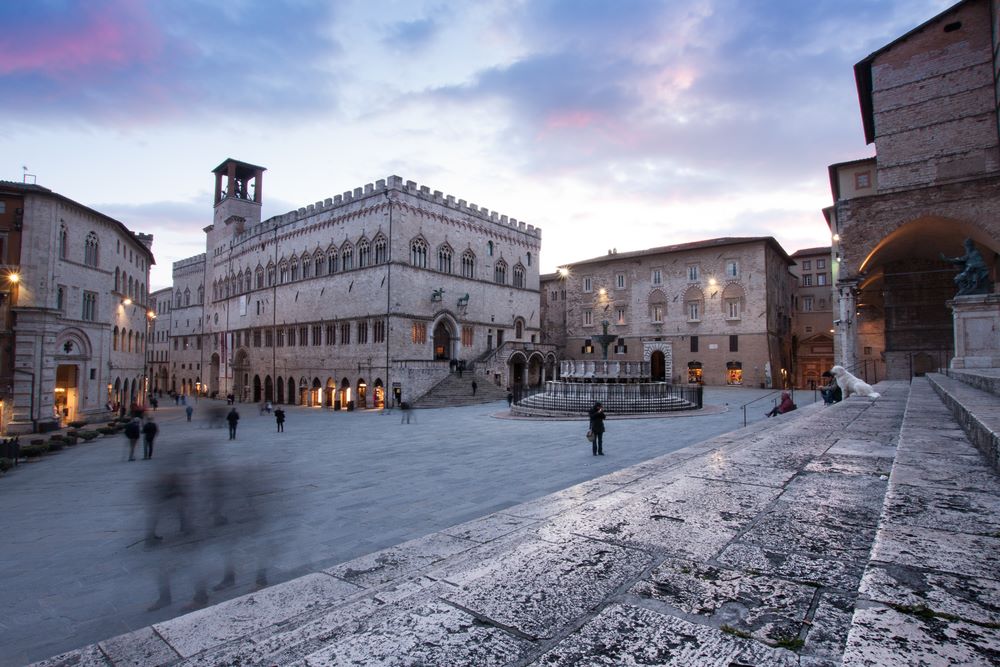
Perugia (Perusia) does not limit itself to surprising with its profile of medieval towers, winding alleys and spectacular squares: this Umbrian city is a true kaleidoscope of stories, art, views and flavours that overwhelms the visitor and invites them to lose themselves among the pink stone of its buildings, the stairways overlooking the valleys and the thousand vistas that seem made on purpose to be discovered slowly, on foot or with your nose in the air. Situated at about 450 metres above sea level, in the heart of the “green lung of Italy,” Perugia has managed to preserve its Etruscan and medieval spirit, reinventing itself today as a lively university city, cultural laboratory, and capital of international events such as Umbria Jazz and Eurochocolate.
What to See in Perugia: From the Middle Ages to the Etruscans
The ancient heart of the city is Piazza IV Novembre, an urban theater that pulsates with life among students, street artists and travelers from all over the world. Here stands the Fontana Maggiore (Major Fountain), an absolute masterpiece of medieval sculpture signed by Nicola and Giovanni Pisano (1278), whose sculpted stories still seem to tell Umbrian legends and mythology. Opposite, the severe travertine facade of the Cathedral of San Lorenzo (Duomo di Perugia), whose interior surprises with the chapel of San Bernardino and the evocative Museo Capitolare, which displays sacred furnishings and relics from centuries of religious history.
Right next door is the Palazzo dei Priori (Piazza IV Novembre, 1 – Tel. 075 5772491), the civic symbol of the city: an immense Gothic building that houses the Galleria Nazionale dell’Umbria, one of the most important Italian art galleries with works by Perugino, Pinturicchio, Piero della Francesca, but also wooden sculptures, tapestries and precious gold backgrounds. From here you can access the Sale dei Notari and the ancient corporations, which can still be visited today.
Going down Corso Vannucci, the city’s elegant living room, you come across the Collegio del Cambio (Corso Vannucci, 25 – Tel. 075 5728599), a Renaissance treasure chest frescoed by Perugino, and the nearby Collegio della Mercanzia, with fifteenth-century wooden decorations and an atmosphere suspended in time.
The city hides underground wonders: the Rocca Paolina (Piazza Italia), the fortress built by Pope Paul III Farnese in 1540 to tame the rebellious Perugia, today is a suggestive path between escalators and buried alleys, remains of medieval houses incorporated into the defensive walls. A journey under the city that fascinates adults and children.
You can’t talk about Perugia without mentioning its Etruscan soul. The Etruscan Arch (Porta Augusta), a grandiose monumental gate from the 3rd century BC, is still the most powerful emblem of pre-Roman Perugia, while the Etruscan Well (Via Caporali, 18 – Tel. 075 5733669) leaves you speechless with its 37 meters of depth: a feat of hydraulic engineering that still supplies water today.
Neighborhoods, Routes and Views
Perugia is a maze of historic districts: Borgo Bello, with medieval gardens and ancient shops, the colorful Porta Sant’Angelo district with its fortress, and the panoramic Porta Sole district, which offers one of the widest horizons in Umbria—on clear days the view reaches as far as Mount Subasio and Lake Trasimeno. Don’t miss the Tempio di Sant’Arcangelo, a rare paleo-Christian church with a circular plan (Via del Tempio, 18).
For those who love views, the Belvedere dei Giardini Carducci is the privileged terrace overlooking the Umbrian landscape, perfect at sunset or for a break between one visit and another.
Museums, Art and Culture
In addition to the National Gallery, the center offers museums for all tastes: the National Archaeological Museum of Umbria (Piazza Giordano Bruno, 10 – Tel. 075 5727141), housed in the former convent of San Domenico, houses funerary objects, statues and Etruscan and Roman artefacts. The Capitolare Museum (Piazza IV Novembre, 6 – Tel. 075 5723832) offers a collection of sacred art of rare beauty.
Lovers of sweets can’t miss the Casa del Cioccolato Perugina (Viale San Sisto, 207/C – Tel. 800 800907), a true paradise for discovering the history of Baci Perugina and trying their hand at tastings and workshops. For those traveling with children, try the Città della Domenica (Via Col di Tenda, 140 – Tel. 075 5054941), the first amusement park in Italy.
Events, Traditions and Markets
Perugia is a city of festivals: in July, Umbria Jazz brings international stars and free concerts to the squares, while in October Eurochocolate transforms the streets of the center into a triumph of pralines, sculptures and tastings. Every Sunday, the Antiques Market in Piazza Italia attracts the curious and collectors, while the Covered Market (Piazza Matteotti) is the kingdom of typical products, unsalted bread and Umbrian cheeses.
Cuisine and Where to Eat
The local gastronomy is an explosion of authentic flavours: black truffle, artisanal cured meats, torta al testo, strangozzi with goose sauce and cappelletti in broth. To savour the true cuisine of Perugia, we recommend Dal Mi’ Cocco (Via Giuseppe Garibaldi, 28 – Tel. 075 5724319), Trattoria del Borgo (Via dei Priori, 39 – Tel. 075 5729278), Civico 25 (Via della Viola, 25 – Tel. 075 5722945), or the refined Ristorante La Taverna (Via delle Streghe, 8 – Tel. 075 5724128).
Where to Sleep
Hotel Fortuna (Via Bonazzi, 19 – Tel. 075 5722845)
Historic hotel in the center, offers well-kept rooms and a panoramic terrace from which to admire the roofs of Perugia. Excellent solution for those who want to be a few steps from the main attractions without sacrificing comfort.
Sina Brufani (Piazza Italia, 12 – Tel. 075 5732541)
A luxury hotel with great charm, famous for its transparent-bottom swimming pool on the Etruscan ruins. A classic for those seeking elegance, a breathtaking view of the valley and impeccable service.
Hotel Priori Secret Garden (Via dei Priori, 39 – Tel. 075 5732895)
Modern and comfortable structure, with a beautiful secret garden where you can relax after a day of sightseeing. A stone’s throw from Corso Vannucci and perfect for those who love contemporary design.
Castello di Monterone (Strada Montevile, 3 – Tel. 075 5724214)
Historic residence at the gates of the city, surrounded by olive trees and gardens. It offers romantic rooms in an atmosphere of times gone by, ideal for a charming escape with spectacular views of Perugia and the Umbrian hills.
How to Get There and Get Around
By train: Perugia Fontivegge station (Piazza Vittorio Veneto) is connected to Rome, Florence and Ancona; from the square, urban buses leave (lines A, C, F, TS, G – stop Piazza Italia or Viale Indipendenza) and the minimetrò (“Fontivegge” station > “Pincetto” for the historic centre).
By car: It is recommended to park in the large paid parking lots “Piazza Partigiani” or “Pellini” and go up with escalators towards the center. The ZTLs are very strict.
By plane: Umbria International Airport “San Francesco d’Assisi” (Via dell’Aeroporto, 06134 Sant’Egidio, Perugia – Tel. 075 592141) is approximately 12 km from the centre; bus connection line E007 Umbria Mobilità.
On foot: The center is best explored on foot, thanks to escalators, public elevators and pedestrian paths. Getting lost in the alleys is highly recommended!
Out-of-Town Itineraries and Nature
A few kilometers from the city, Lake Trasimeno, the villages of Assisi and Gubbio, the paths of Mount Subasio and the Regional Park of Mount Tezio. Those who love walking can take the Green Path (along the Tiber) or the panoramic Sentiero della Bonifica for an excursion among nature, history and flavors.
Useful Information
Climate: temperate hilly, excellent in spring and autumn
Shop opening hours: 9:30–13:00 and 16:00–19:30 (closed on Sundays and public holidays, except for events)
Tourist Office: Piazza Matteotti, 18 – Tel. 075 5736458

