
A Step-by-Step Guide to Exploring the Enchanting Prague Castle

Prague Castle is considered the largest ancient castle in the world. It majestically overlooks Prague from above and can be reached on foot by climbing up from Charles Bridge. Inside, you’ll find St. Vitus Cathedral and Golden Lane, symbols of the enchanting city of Prague.
The History of Prague and Its Castle
Prague and its Castle coexist in perfect harmony—two different yet complementary worlds. Though separated by the Vltava River, they are romantically united by the line of Charles Bridge, which serves as a magnificent walkway connecting the two oldest parts of the city. The true historical core of Prague is located within Prague Castle, where the chronicles place the birth of the first settlement around 880 AD, although legend claims its origins were 150 years earlier, thanks to the legendary figure of Libuse.
An Enchanting View
What strikes the visitor today is the sheer grandeur of this complex, which, when admired from Charles Bridge, takes on a fairy-tale quality, especially during the early evening hours when it is warmly illuminated, reflecting in the placid waters of the Vltava.
Prague Castle (in Czech, Pražský Hrad) was originally built by the Premyslids using wood, and only a few traces of these early constructions remain. By the 10th century, stone began to dominate after the fortress passed to the Princes of Bohemia, reaching its Gothic and monumental form under Emperor Charles IV in the mid-1300s.
Charles IV’s Transformation
It was during the second half of the 14th century that Emperor Charles IV led the most significant development of Prague Castle. He employed Mathieu d’Arras, a French architect, and Peter Parler, a German builder, who infused the complex with monumental Gothic elegance. It was above all the construction of St. Vitus Cathedral that became the enduring symbol of Prague. Later, Rudolf II of Habsburg added Renaissance features, but Charles IV’s Gothic influence remains the most prominent today.
A curiosity: According to the Guinness Book of Records, Prague Castle—with its extension of over 74 hectares—is the largest ancient castle in the world. Today, it is also home to the President of the Czech Republic.
Exploring Prague Castle
A visit to Prague Castle usually follows a classic route: the main entrance is located in Hradčanské náměstí (Hradčany Square), from where visitors enter the various courtyards, gradually descending towards the Vltava, enjoying magnificent views along the way.
First Courtyard and the Baroque Gate
The entrance welcomes you with a grand baroque gate made of wrought iron, featuring the sculptures of the Titans by Placer, created in 1770. Here you can witness the spectacular changing of the guard that takes place every hour. Once you enter the first courtyard, you’ll notice the beautiful Matthias Gate, dating back to 1614, in the Baroque style, leading to the reception rooms of Prague Castle, such as the Throne Room and the Spanish Room. These rooms are accessible to the public only twice a year.
Second Courtyard: Art and History
Moving further, you enter the second courtyard, which features the Leopold Fountain in the Baroque style. The courtyard also includes the Chapel of the Holy Cross, with 18th-century murals depicting scenes from the Bible. The Prague Castle Gallery is on the opposite side, containing valuable works of art by Rubens, Titian, Veronese, and many others. On the north side are the imperial stables, which also serve as exhibition spaces in the Rudolfine galleries.
Third Courtyard and St. Vitus Cathedral

Entering the third courtyard, visitors are immediately struck by the imposing presence of St. Vitus Cathedral. Emperor Charles IV founded the cathedral in 1344 as a church for coronations. The project took centuries to complete, with part of it finished only in the 20th century. The cathedral houses the Mausoleum of the Czech Kings and the beautiful Chapel of St. Wenceslas, adorned with Gothic frescoes and semiprecious stones. A door in the chapel leads to the Crown Chamber, which holds the Czech crown jewels.
To appreciate the Gothic elements, go to the right of the cathedral, where the courtyard opens up for a broader view of the structure. Here you’ll also find the Palace of the Ancient Provostship, dating back to the 17th century, and the Gothic statue of St. George and the Dragon, created in the 14th century.
The Fourth Courtyard and Ancient Royal Palace
Behind St. Vitus Cathedral is the fourth courtyard of Prague Castle, home to the Church of St. George and the Ancient Royal Palace. The palace was the seat of the Czech kings for centuries, and its beautiful Gothic rooms are well worth visiting, especially the Vladislav Hall, with its elegant Renaissance stained glass windows. The Bohemian Chancellery here was the site of the second defenestration of Prague in 1618.
Basilica of St. George and Golden Lane

The Basilica of St. George is the second oldest church in Prague. Founded in 920, it is an important historical Romanesque building, although the Baroque style and the bold red color of its façade are quite surprising. It belongs to the Convent of St. George, the first monastery in Bohemia, established in 973. Today, the convent houses a permanent exhibition of the National Gallery.
From here, continue to Golden Lane by walking along Jiřská Street. This charming little street is lined with colorful, tiny houses dating back to the 16th century. Legends abound here, with stories of alchemists who supposedly worked in Golden Lane. Notably, Franz Kafka lived at No. 22 between 1916 and 1917. You can also visit the White Tower and the Daliborka Tower, both of which served as prisons during the 16th century.
Powder Tower and Final Views
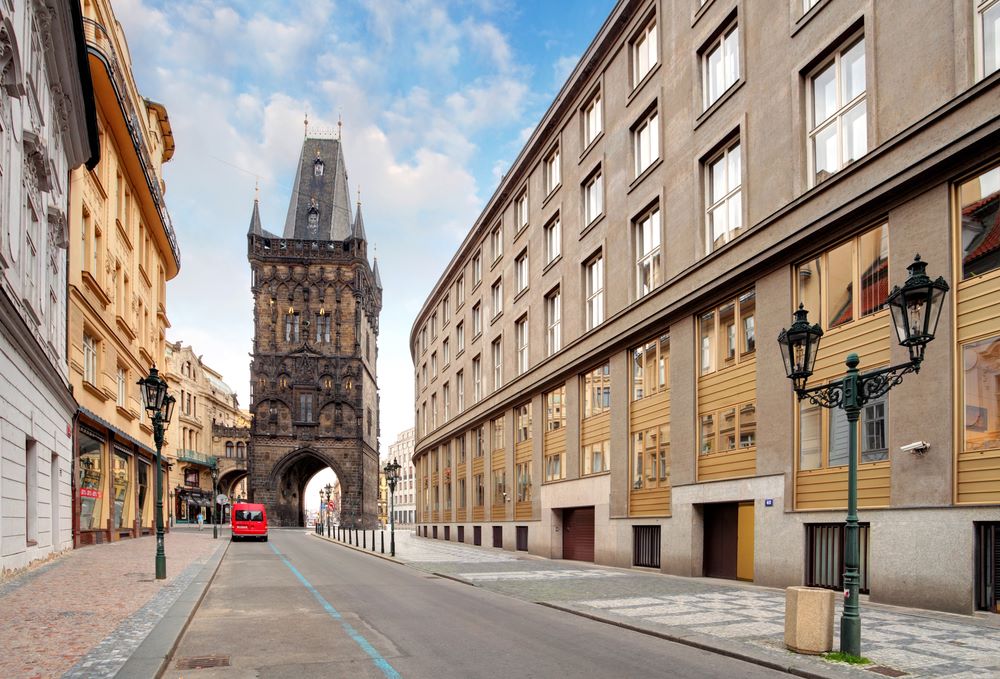
Another tower worth visiting is the Powder Tower (Mihulka), accessible through Vikářská Street. Built as part of the Prague Castle fortifications, it was used to store gunpowder and, according to legend, housed an alchemist’s laboratory. Nearby is the eastern entrance, marked by the Black Tower (Černá Věž), which dates back to the 12th century.
Once you exit the castle via the Black Tower, make sure to stop by the panoramic viewpoint at the Belvedere of the Royal Gardens. This spot offers one of the most spectacular views of Mala Strana, the Vltava, Charles Bridge, and Stare Mesto—a truly breathtaking panorama of Prague.
Useful Information
Entry to the Castle and Gardens is free, but accessing the innermost parts of St. Vitus Cathedral, the Royal Palace, St. George’s Basilica, and Dalibor Tower requires a ticket costing 350 crowns (approximately 12 euros). Individual tickets can be purchased for targeted visits. To reach the castle, you can start in Malá Strana by ascending Nerudova Street. The Malostranská metro stop or trams 12, 22, 23 also provide convenient access to the castle area.

