
A Day in Vigevano: Explore Leonardo’s Legacy and Local Delights

Always contested between the territories of Milan and Pavia, Vigevano is a true jewel of Italian tourism, a small treasure of architecture and history, just under an hour’s drive from the Lombard capital. Built on the right bank of the Ticino River, in the northeastern portion of Lomellina, its first historical records date back to the Lombard period, with the first documents mentioning it just decades before the year 1000.
But its transformation into a true city occurred a couple of centuries later, when Vigevano found itself under the influence of the Lordship of Milan, which determined its rapid growth and increase in wealth, thanks to the services rendered to the Visconti and Sforza families.
Leonardo’s Ideal City
Vigevano, now a municipality in the province of Milan, was designated in 1494 by Leonardo da Vinci as the “ideal city” for the Duke of Milan, Ludovico il Moro. This notion emerged while Leonardo was directing the canal works around the municipality, producing sketches that laid the foundation for the urban plan of Vigevano’s historic center. The Piazza Ducale and the Castle, along with the Sforzesca and the canal network, reflect Leonardo’s visions, incorporating architectural elements that create a distinctive, harmonious environment.
Discovering Vigevano: Piazza Ducale
The journey to discover Vigevano begins with Leonardo’s Manuscript H, which contains details of Piazza Ducale—a beautiful example of Renaissance art and architecture, surrounded by a portico with 84 columns, each adorned with uniquely styled capitals, symbolizing the magnificence of the Sforza dynasty.
The Piazza, the historic heart of the city, has been revered by many prominent Italian artists as a perfect representation of the Lombard Renaissance. Maestro Arturo Toscanini described it as “a musical symphony,” where every element resonates in harmony. The porticos, once occupied by wool and silk merchants, now host luxury boutiques and trendy eateries.
The Duomo and Bramante Tower

Overlooking the square is the Duomo, the Cathedral of Sant’Ambrogio, commissioned by Francesco II Sforza in 1532, featuring a mix of Renaissance and Baroque influences. However, it is the Bramante Tower (Torre del Bramante) that truly captures attention—a symbol of Vigevano and the gateway to the Castle. Initially present in Leonardo’s sketches of 1494, the tower was also an inspiration for the Filarete Tower of the Sforza Castle in Milan. Visitors can climb to the first battlement, from where the Alps can be seen on a clear day.
Inside the Castello Visconteo e Sforzesco

Upon entering the Castello Visconteo e Sforzesco, one is immediately drawn to the frescoes that adorn the rooms—works by prominent national and local artists, extending throughout the courtyard, the Piazza, and the nearby streets. Leonardo’s influence continues to be visible in the stables, especially in the “polita stable,” designed for Ludovico il Moro, with plans preserved in Manuscript B in Paris, contained within the Atlantic Codex. Another stable houses the Museo Archeologico Nazionale della Lomellina, featuring archaeological artifacts dating back to the early Middle Ages.
Other rooms in the castle have been repurposed to host various collections, including the International Footwear Museum “Pietro Bartolini” and the Civic Art Gallery. The Footwear Museum narrates the prestigious history of shoemaking in Vigevano, featuring 500 shoe models, including the pianella of Beatrice d’Este from 1494 and shoes once owned by Marilyn Monroe and Anita Ekberg. Previously, this collection was housed in Palazzo Crespi.
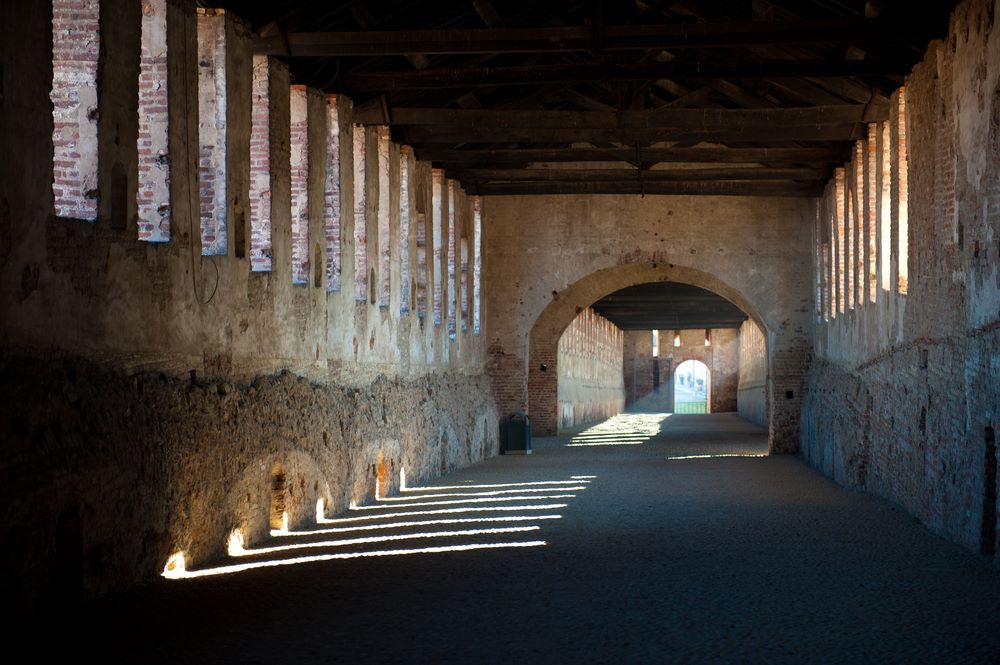
The Civic Art Gallery displays significant works by local artists like Bernardino Ferrari, alongside pieces by national artists such as Fontanesi and Mariani. From here, one can reach the aerial Loggia of the Falconeria, or descend to visit the Loggia delle Dame by Bramante, designed for Beatrice d’Este and her ladies. A masterpiece of engineering, Strada Coperta served as a passage connecting the castle to Rocca Vecchia, the residence of the Cavallerizza.
Exploring Vigevano’s Surroundings
The area around the Castle is filled with churches, from San Giorgio to the Gothic-Lombard churches of San Pietro Martire and San Francesco, as well as the Baroque Churches of Santa Maria del Popolo and del Cristo. The outskirts of Vigevano are also steeped in history, represented by the Ecomuseum of Mora Bassa, gifted by Ludovico il Moro to his wife and now home to many of Leonardo’s machines. A day in Vigevano is a journey full of art, history, and charm, best concluded at one of the local restaurants or trattorias, whether in the city center or the surrounding countryside. Each restaurant takes pride in traditional local dishes, many originating from the 16th century, like the Figadej (a liver sausage), cent Franc, and La Viginuna—all De.CO. (Municipal Designation of Origin) products. Also noteworthy are the Bramantini, named after the Bramante Tower.
Every dish in Vigevano has a perfect wine pairing: all produced in the nearby Oltrepò Pavese.
How to Reach Vigevano
There are several routes to reach Vigevano. The nearest motorway exits are Groppello Cairoli and Pavia Nord on the A7, Novara Est and Marcallo Mesero on the A4, or you can take the Vercelli Est or Casale Monferrato Nord exits on the A26. Vigevano is also accessible by train via the Milan-Mortara line, and the closest airport is Malpensa, approximately 50 km north.
Climate
Vigevano’s climate is typically continental—Po Valley—characterized by cold, foggy winters and hot, often muggy summers. From June to August, maximum temperatures reach around 30°C, with peaks often between 33-35°C. Rain is evenly distributed throughout the year, with relative lows in July and December (about 70 mm per month), and the wettest months in April and May, with frequent thunderstorms.
In winter, minimum temperatures hover around 0°C, with occasional lows of -5°C or less when cold air moves in from the east. Average maximum temperatures range between 6 and 8°C.

