
Unveiling Menorca’s Hidden Gems: Pristine Beaches, Ancient Sites, and Vibrant Cities

This island’s respect for nature and tranquillity make it a perfect destination to “unplug” and re-energize.
Menorca has beautiful beaches with clear water, lots of natural areas where you can walk, ride a horse, or ride a bike, a wide range of cultural activities like museums, concerts, archaeological sites, popular festivals, nightlife, a great sea for sailing, good food, and two cities that compete in their beauty, historical importance, and atmosphere.
Menorca is the most northern island in the Balearics. It is also the most eastern part of Spain and the first place where the sun sets. Menorca is a 700-km2 island that is known for its plain, from which gentle hills and the 358-m-high El Toro mountain rise.
Division of the Island
An artificial line cuts the island into two parts: the north, which has a rough environment, and the south, which is mostly made of limestone and has steep cliffs and lots of plants. The sand on the beaches in the north is thick and dark, while the sand on the beaches in the south is fine and white. Yes, the water is perfectly clear everywhere. The usual temperature for the whole year is 17°C, and there is a lot of sunshine and not much rain.
H2: History
Cultural Influences
The Phoenicians, Greeks, Carthaginians, Romans, Muslims, Catalan-Aragonese, British, French, and, of course, the Spanish all left their mark on the island and on the people who live there. Together, they have made the island a place with many different cultures and a strong sense of self. Eighty years of British rule (17th century) are still visible in the buildings, the details of daily life, and even the language, since some words in Menorcan Catalan come from English. The Statute of Autonomy of the Balearic Islands from 1983 says that Catalan is the local language and Castilian is the language of the state. It also brings back the specific institutions of self-government: the Consell insular, the Parliament, and the Government of the Balearic Islands.
UNESCO Biosphere Reserve
Menorca was named a Biosphere Reserve by UNESCO in 1993 because of how well it takes care of the earth and nature. Due to the slow start of tourism, almost half of its land has been left in its native state. The Albufera de Es Grau Natural Park, which is near Maó, is the center of the Biosphere Reserve. This is because it has a lot of natural resources and is a stopover for many bird species on their way to or from Africa. The natural heritage also includes the park, the Isle of en Colom, and the Cape of Faváritx.
Menorca: What to See
Most of the people who visit the island of Menorca do so because of its beaches. About 125 of the 216 km of shoreline examined were beaches. But Menorca has a lot more to offer than just its beaches, which we will talk about later.
Maó (Mahón)
The island’s center is called Maó (or Mahón in Spanish), and it is in the southeast. It has about 30,000 people and is built on the rocks at the end of a deep bay on the coast. Some people call it a fjord, which sounds strange at these latitudes. It is the Mediterranean’s biggest natural port.
Even though it’s not a very pretty city, it’s Menorca’s main transportation hub and a good place to shop and plan trips. Placa d’Espanya is the main square. The main tourist attractions, such as the Mercat Claustre del Carme, the Església de Santa Maria la Major, and the Museu Hernandez Sanz Hernandez Mora, are all near this square. The ferry port is also very close to this place.
Natural and Man-Made Beauty
But once you leave the city, you can see the natural and man-made beauty of Menorca. For example, Collingwood House is a beautiful Georgian home that is now a hotel. Not too far away is the village of Es Castell, which is also called Villacarlos. In front of the town are two small islands, Illa del Rei and Illa es Lazaret, which make this southern part of Menorca look like a picture.
Which, of course, is not the only one. In fact, people have been making truly unique places here for a very long time. This is the case with the island’s many ancient sites, such as Talat de Dalt, the nearby Rafal Rub, the town of Torralba d’en Salord, Son Catlar, and the Naveta des Tudons, to name only the most well-known ones.
H3: Exploring the Island The Me1 road, which goes from Maó to Ciutadella, cuts through the middle of the island, making it look like the island is in two parts. There are some very interesting places right on this road or close by, such as towns with their own style and historical sites.
For example, Es Mercadal is a farming town from the 15th century that is a great place to stop and try some of the local dishes. There is also a road from here to the top of Monte Toro for those who want to try their hand at hiking.
Ferreries, which is still on the Me1, is a small town that is known for making shoes (like the native Menorcan boots called “avarques“) and cheeses. It is 141 meters above sea level, which makes it the island’s largest village. The goods from the land are sold at a busy market on Saturday mornings.
Ciutadella de Menorca
Ciutadella de Menorca, or just Ciutadella, is the second most important city on the island. It is on the western side of the island. It was built by the Carthaginians, but the Turks destroyed it in the 1600s. When it was rebuilt a century later, it became the capital of the island until the British came and moved the city to rival Maó. The beautiful old town is a place that everyone should see.

The main square is Placa d’es Born, which is surrounded by houses from the 1800s. These alleys, which lead to the old city, give Ciutadella the typically Spanish and Mediterranean atmosphere that its visitors adore. We point out the Castell de Sant Nicolau, which is west of the city center and was built in the 1600s. It was a lookout that guarded the entrance to the port. In addition to its charm, it is now a great place to see the view of the southern coast and the island of Mallorca. In the second half of June, the famous caixers, who are dressed as heroes, perform at the fiestas de San Joan in Ciutadella.
The Menorca Beaches
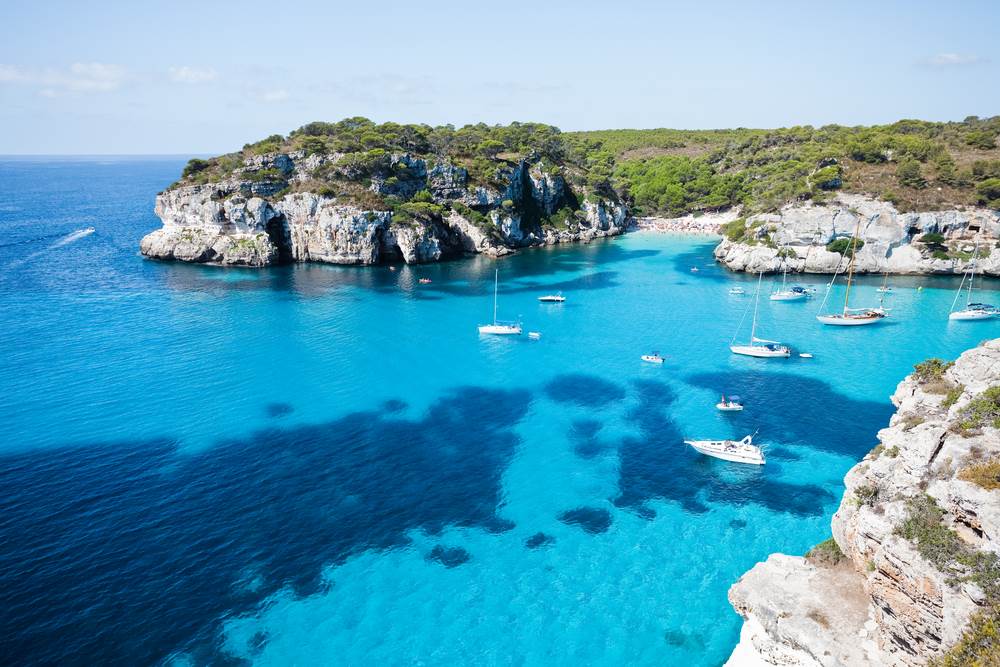
We were talking about the island’s more than 125 beaches and coves. So, there is only the shame of having to choose. To make it easier, you can divide the beaches into two groups: those in the north, which are usually more wild and windswept, and those in the south, which have white sand and are surrounded by pine woods. For reasons that are easy to understand, it is not possible to make a “full list”, as a result, we have focused on highlighting only the finest beaches.
Beaches in the South
On the west coast, we recommend Cala Blanca, Cala Santandra, Cala Blanes, and the rocky coves called Cales Piques. On the northern coast, however, the Codola di Torre Nova area is very popular with its many small beaches, as well as Cala Morell, Cala d’Algaierens, Cala des Pilar, Cala Barril (just in front of the Illas de Ses Bledes), Cala Pregonda.
Beaches in the North
On the east coast, the beaches are almost all concentrated north of Maó: that of Son Saura, the “smelly” Cala Pudent due to the dead seaweed on the shore, the Arenal d’en Castell, the very popular Port d’Addaia, the half-hidden Platja de Mongofre Nou, the black rocks of Cap de Favàritx, the peaceful Cala Presili, Cala Cavaller, Platja Es Grau, the rocks of Cala Binilauti, and the comfy Cala Mesquida

