
The Truth Behind Rome’s Bocca della Verità (The Mouth of Truth)
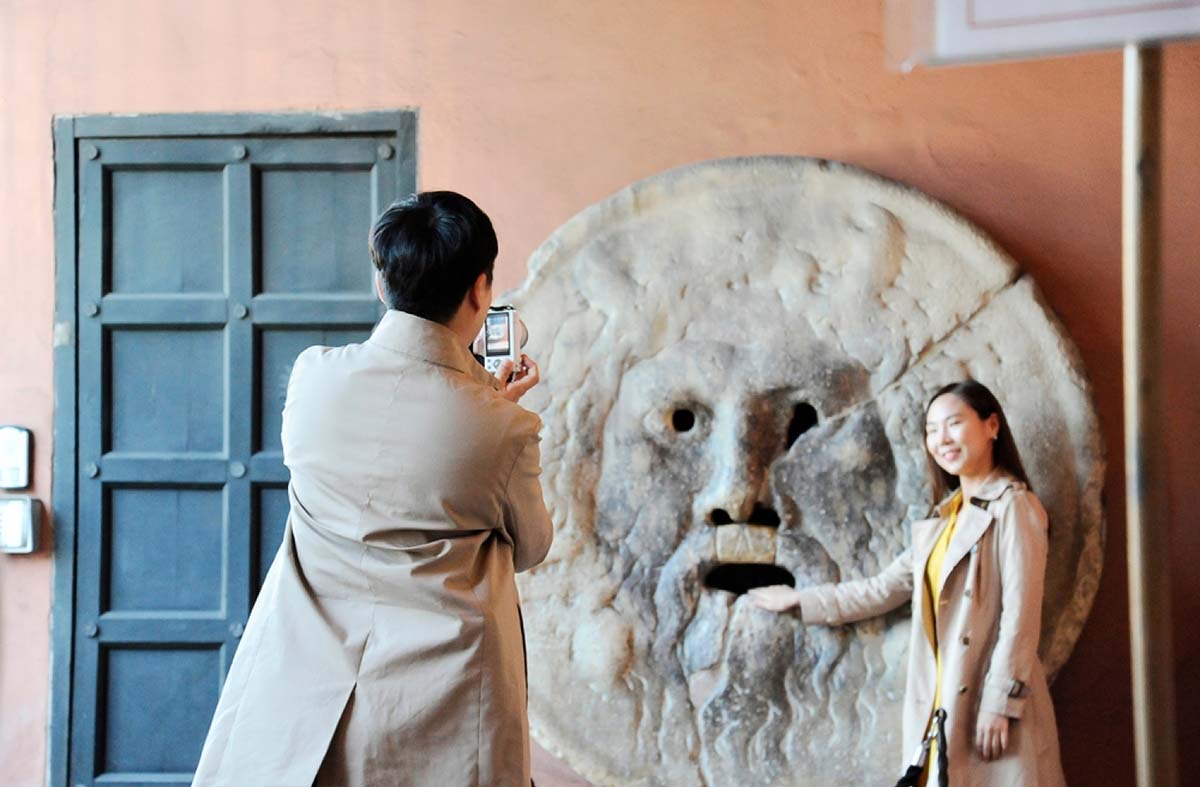
If you’re planning a trip to Rome, you simply must check out the Bocca della Verità! It’s a super popular spot thanks to its fascinating legend and the fact that visitors love to put their hands in the monster’s jaws. Just be prepared for some crowds!
If you’re planning a trip to Rome and want to see the city’s top attractions, be sure to snap a photo in front of the iconic Bocca della Verità!
This fascinating mask is located in the portico of the Basilica of Santa Maria in Cosmedin in the Foro Boario. But where does this mask come from?
It is certainly the most famous in the city and dates back to Roman times, but in reality, it is nothing more than a banal marble manhole cover with the appearance of a bearded male face with a wide open mouth, just to be able to swallow rainwater.
History
But when does his legend come back? Hey there! It’s interesting to note that according to historical records, in the fourth century, Emperor Julian II was deceived by someone disguised as the devil, which led to the restoration of paganism.
Did you know that there was a unique way of determining the guilt of convicts in the past?
They were taken before the famous Mouth, which was located on the external walls of the Basilica, and asked to insert their hand inside a crack. If they were innocent, their hand remained safe, but if guilty, the mask would cleanly sever their limb. Pretty interesting, right? Obviously, hidden behind the mask, there was an executor ready for action.
The notorious mouth was also used to verify the sins committed by faithless women; if found guilty, their hands were inexorably devoured.
According to legend, a Roman noble was able to use his cleverness to win over the “magic” of the mouth. It’s said that a woman who was accused of betrayal by her husband convinced her lover to come before the mask on the day of her execution.
The lover pretended to be mad and publicly kissed and embraced her. The cheating bride could thus quietly swear that she had kissed and embraced only two men in her life: her husband and that madman present there!
And it is thanks to these numerous legends that the myth of the Mouth of Truth has remained alive to this day, amusing and always intriguing both tourists and Romans alike.
Where is the The Mouth of Truth?

The building that houses it, the Basilica of Santa Maria in Cosmedin, is an ancient place of worship that was built exactly on the site of two previous Roman-era structures: the Statio Annonae, the service that managed the supply and distribution of food to the Roman people, and the Altar Maxima of Hercules, a sanctuary erected to protect traders, where Hellenic and local merchants could meet and transact their business freely under the guardianship and guarantee of Hercules, the Greek hero-god.
Inside the church are preserved, still in their place, ten marble columns with Corinthian capitals, which belonged to the Statio Annonae: seven of these columns (placed on the sides of the median portal, at the base of the bell tower, and in the sacristy) were located on the “façade”, while the other three (located in the wall of the left aisle) must have been on one of the smaller sides.
In the eighth century, the church was given to the Byzantine monks who had fled from the persecutions of the iconoclasts of the East during the religious controversy over the cult of images. They settled near the Tiber.
I didn’t know that the building was also called Cosmedin because of the decorations. Inside, in fact, it houses works and furnishings of extraordinary importance and beauty, such as, for example, the precious Cosmatesque floor mosaics, the raised choir, the episcopal seat, and the canopy above the high altar.
If you take a look outside, you’ll be able to spot the stunning bell tower. It’s got seven floors of mullioned windows and three mullioned windows, making it one of the most beautiful sights in the city. Plus, it’s built in a pure Romanesque style!
At the beginning of the 1700s, Giuseppe Sardi carried out one of the last transformations of the Basilica: it was thus equipped with a Baroque façade, which was then removed at the end of the 1800s by Giovenale, thus restoring the more ancient façade.
It’s great to know that the Basilica has maintained its connection with the East, just like it did in the past. Also, did you know that it serves as the Italian headquarters of the Greek-Melkite Catholic Church?

