
The Symbolism of Millais’s ‘Autumn Leaves’: A Study in Beauty and Melancholy
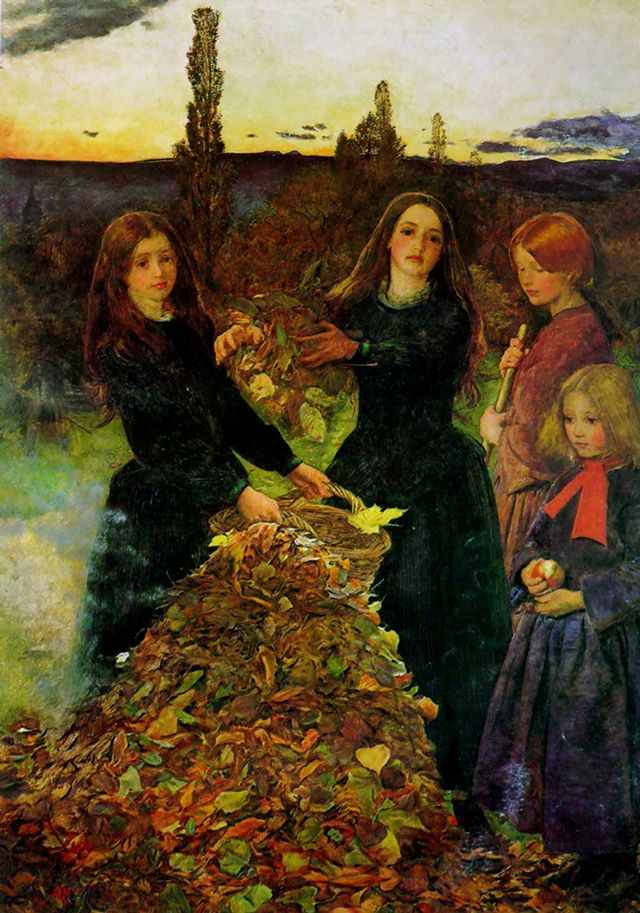
John Everett Millais, a prominent member of the Pre-Raphaelite Brotherhood, created the well-known work Autumn Leaves. This masterwork, completed in 1856, captures the melancholy and beauty of falling in a moment of stillness and reflection. Millais, known for his precise attention to detail and beautiful technique, urges the observer to examine the unavoidable passage of the seasons in this piece, which explores topics such as the ephemeral essence of time and fleeting beauty.
Autumn Leaves displays four young girls gathering fallen leaves to burn in front of an autumn setting. The leaves dominate the scene in warm tones of red, orange, and brown, evoking the sorrowful beauty of autumn. The girls appear to be completely immersed in their task, virtually oblivious to the observer, with peaceful yet slightly gloomy expressions.
The overall image has a transitory and tranquil sense, with a twilight sky painted in blue and pink. Millais’ use of color and light alludes to the gradual fading of the day, representing the transition from childhood to adulthood as well as the unavoidable passage of time.
“Autumn Leaves” has a symbolic meaning
This painting is rich in symbolism. The fallen leaves symbolize the transience of life and death. People sometimes interpret autumn’s fleeting splendor as a metaphor for the cycle of life and fading beauty. The young, naive girls contrast with the dry leaves, evoking the idea of fleeting beauty that fades over time.
Millais also utilizes twilight to indicate a journey: the junction of day and night, light and darkness, represents the line that separates youth from adulthood. The artist created one of his most stunning images, capturing the twilight mood full of meditation and soft melancholy.
Pre-Raphaelite Context
John Everett Millais was a founding member of the Pre-Raphaelite Brotherhood, an artistic movement that questioned traditional academic painting in England in the mid-nineteenth century. Inspired by Renaissance and medieval painting, the Pre-Raphaelites aimed to portray nature and human emotions in a realistic and honest way. In Autumn Leaves, Millais portrays a profound sense of introspection and symbolism while faithfully representing nature, achieving nearly scientific accuracy in his depiction of the leaves and their surroundings.
Millais’ Style and Methodology
Millais is known for his exceptional technical ability and meticulous attention to detail. To depict the usual magnificence of the autumn season in Autumn Leaves, the artist uses a warm color palette spanning from gold to brown. The artist methodically paints each leaf and blade of grass, resulting in a nearly tactile vision. The sunset sky creates feelings of nostalgia and calm, while the exact use of light and shadow lends depth and realism to the image.
Where Can I Find “Autumn Leaves”?
Autumn Leaves is on display at the Manchester Art Gallery, one of the United Kingdom’s most important museums. Seeing this masterpiece in person helps you to fully appreciate Millais’ craftsmanship and the delicacy of his brushstrokes, since this gallery houses an excellent collection of Pre-Raphaelite masterpieces. Examining the artwork closely exposes subtleties such as the girls’ meticulous expressions and the minute color variations in the leaves, which are difficult to see in print or on screen.
Interesting notes about the work
One intriguing aspect pertains to the models in the painting. Two of the girls depicted in Autumn Leaves were the daughters of James Leathart, Millais’ friend and patron. The young models contributed to the piece’s intimate and tranquil environment, which the artist intended to capture as a moment of simple purity and innocence. Autumn Leaves, one of Millais’s first works after his marriage, marked the beginning of his exploration of more meditative and intimate subjects.

