
The Royal Palace of Portici: A Majestic Gem of Neapolitan Architecture and Bourbon Legacy
Portici: A City of History and Beauty
The nature that surrounds it is so powerful that it leaves you speechless: on one side, the imposing silhouette of Vesuvius, with its beautiful but also dangerous charm; on the other, the beauty of the Tyrrhenian Sea, which can be calm and smooth as a mirror or angry and heavy when the wind is blowing.
A Brief History of Portici
We are in the city of Portici (Campania), which has about 56,000 people and is in the province of Naples, just south of the capital of the region. Portici only became a city in 2002, but it has been a well-known vacation spot since ancient times. It is in a fertile area and has a mild climate. The Romans already liked it, but the center became more important, especially in the Middle Ages. Over the years, different lords, like the Carafa and the Migliano, took control of it.
Development and Modernization
Portici was hurt when Vesuvius blew its top in 1631, but it got better during the time of Charles III of Bourbon. During this time, the look of the city changed a lot. The famous Villa Reale and Porto Granatello were built, but the opening of the first Italian railway section had the biggest effect. On October 3, 1839, two twin locomotives, the Bayard and the Vesuvio, ran over the 7411-meter Naples-Portici line for the first time. It took them 11 minutes.
Exploring Portici
Today, Portici is a very busy city with lots of culture and friendly people. It’s enough to say that it’s one of the cities in the world with the most people (15,000 people per km2), which means it can compete with Tokyo and other well-known cities with a lot of renters. This doesn’t mean that there’s no room for visitors; in fact, it’s quite the opposite.
Architectural Treasures
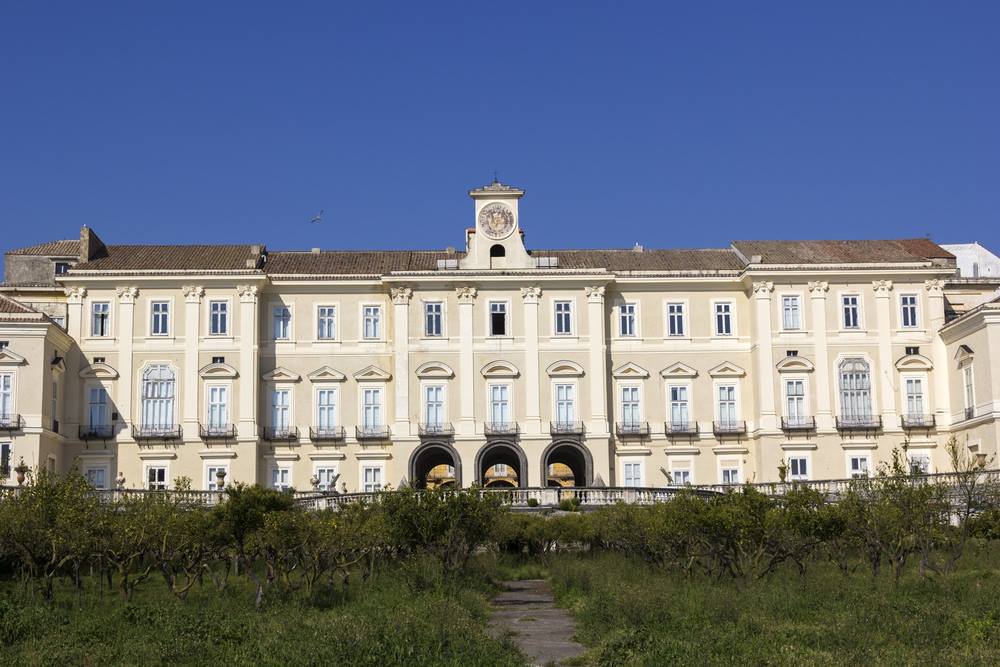
In Portici, on the beautiful coast of Campania, tourists will find a lot of interesting old buildings, as well as the beautiful villas of the so-called “Golden Mile” from the 18th century. The Royal Palace of Portici, an elegant home built by Charles III for the Bourbon dynasty of Naples before the Royal Palace of Caserta was built, is the undisputed queen of the city. The large, luxurious facade has a terrace and beautiful balustrades. The building itself is square, and the large, grand atrium is held up by nine vaults with pillars.
Cultural Delights
On the left side of the courtyard is the Barracks of the Royal Guards and the Palatine Chapel, both built in 1749. A staircase built a few years earlier leads to the vestibule on the first floor, where you can see Carolina Bonaparte’s apartment. The living room of Louis XIV and the boudoir of Queen Maria Amalia of Saxony are two of the most interesting rooms. The walls of the boudoir are covered with Capodimonte porcelain.
The Botanical Garden of the Palace is also worth seeing. It was set up in 1872 by Antonio Pedicino and Orazio Comes. Those who want to learn more about the area can go to the National Railway Museum of Pietrarsa, which has a realistic copy of our country’s first steam locomotive. The exhibition is set up in what used to be the royal mechanical factory. Ferdinand II of Bourbon ordered it to be built the year after the first train ran.
Festivals and Events
Lastly, the best way to get a feel for Portici is to take part in one of the many traditional events that are held there. “Night of Taste” is one of the most important events. It is a food and wine festival where local specialties are served in a unique setting between the sea and the stars.
So, for more than twenty years, the Festival of the Vesuvian Villas has been held in July. This event puts on great music and cultural shows in the center’s eighteenth-century homes. From a cultural point of view, the tributes to the famous musician Mozart that have been held every year since 2006 are also very important. In 1770, Mozart spent some time in Portici, and today, high-quality shows are still put on in his honor.
Getting to Portici
To reach Portici, you can evaluate different possibilities. By car, you have to get off the Naples-Salerno motorway at either Ercolano or Portici, depending on whether you are coming from Naples or Salerno. The Portici-Ercolano train station is also in the city. It is at the port of Granatello and is just a few minutes’ walk from the Piazza San Ciro. The closest airport is in Naples, which is only 9 km away. In the summer, the Metr del Mare, a ferry that connects the towns of the Gulf of Naples and stops in the Port of Granatello, is in operation.
H2: Enjoyable Climate
Once you get there, you realize how great the weather in Campania, especially along the coast, is for any kind of vacation.
The weather is always mild, so you can enjoy the sea or go for a walk without getting too hot, and it never gets too cold in the winter. In January, which is the coldest month, the average temperatures range from 4°C to 13°C. In July and August, they range from 18°C to 30°C.
In the summer, there isn’t much rain, but November is the worst month, with an average of 162 mm of rain.

