
Exploring Marseille: A Cultural Gem on the French Riviera

Marseille, which is called Massilia in Latin and Massalia in Greek, is one of the oldest ports in the Mediterranean. It is near the Calanques coast, which is one of the most beautiful parts of Provence. It is the capital of Provence and is opposite Nice at the end of the French Riviera.
Even though Marseilles isn’t as flashy as the popular resorts of the Cote d’Azur, doesn’t have any glitzy promenades or fancy hotels, and has a lot of traffic and pollution, it is one of the most exciting and entertaining cities in France. It has people from many different cultures and races and some of the best restaurants in the country.
Marseille was chosen as the European Capital of Culture in 2013, and as a result, more than 600 million euros were spent on remaking the city. As a result, Marseille looks as beautiful to tourists as it has ever been, if not more so. This is an unmissable chance to see one of the most interesting cultural cities in all of France.
You can get to Marseille quickly from Italy. After you pass the border crossing in Ventimiglia, take the A8 motorway. Before you get to Aix-en-Provence, take the A52 toward Aubagne and Marseille, which you can get to by taking the A50. About 25 kilometers northwest of the city is where the airport is.
Climate
You should go to Marseille in the spring, early summer, or September. In the middle of summer, however, the heat can be very oppressive. Temperatures can easily go above 30°C, and the humidity rate makes it even worse. During the holidays, a lot of the people who live there leave, so some restaurants and shops may be closed.
In the winter, the weather is usually mild, except when fog rolls in and makes the air smell bad. Autumn is the rainiest season, with the most rain between the end of September and the end of October, as well as in November and the beginning of December.
To see in Marseille:
The Old Port (Vieux Port) is still the center, and the forts of St. John and St. Nicholas are all around it.
The area has been reclaimed and turned into a pedestrian zone. Here you can find the famous fish market, which is best seen early in the morning, and a wide range of fish restaurants. Also on the seafront, work in Marseille and Provence in 2013 led to the opening of two important new museums, which helped improve the port area. The first is Il MuCem, which stands for Museum of European and Mediterranean Civilizations. It was designed by the French architect Rudy Ricciotti and covers an area of 40,000 square meters. It is near the Forte di San Giovanni on the J4 pier.
CeReM
The second new museum is not far away. It is called CeReM, which stands for Regional Center of the Mediterranean. Here, the project is Italian because it was made by a well-known architect from Milan named Stefano Boeri. Its large C shape, which is split by a dock, and the fact that you can see underwater from its underground floors are especially interesting.
Still talking about the new things that happened in 2013, the money set aside to celebrate Aix-en-Provence as the capital of Provencal culture has allowed the city center to become even better. Some examples include the Villa Mediterranee and the work of Boeri, the Museum of Photography, which was run by the famous Frank O. Gehry, and the Fonds Régional d’Art Contemporain, which will have to host many exhibitions of contemporary art.
On the highest point of the city is the neo-Byzantine church Notre Dame de la Garde, which has a statue of the Virgin Mary on top. It was built in the 19th century in the same style as the cathedral of Santa Maria Maggiore, which is on the other side of the port.
Some of the ex-votes from fishermen and sailors in “Notre Dame de la Garde” are very moving. But you should go there to see the beautiful view of the city and the Mediterranean. The beautiful Jardin de Pierre Puget is close by.
Basilique St-Victor

On the south side of the port is the Basilique St-Victor, a Romanesque basilica that was built by St. Cassien in the 5th century and destroyed by the Saracens in the 8th century. Inside the crypt, which has catacombs and sarcophagi, there is a tomb of two martyrs from the year 250 AD.
We point out the winding, narrow streets of the Quartier du Panier, which is the oldest part of the city and where the Greeks built temples in the 7th century BC and can be explored on foot.
Here you can see the beautiful Vieille Charité building, the church of Sainte Marie Majeure, and interesting streets like Rue Sainte and Rue Grignan.
Chateau d’If
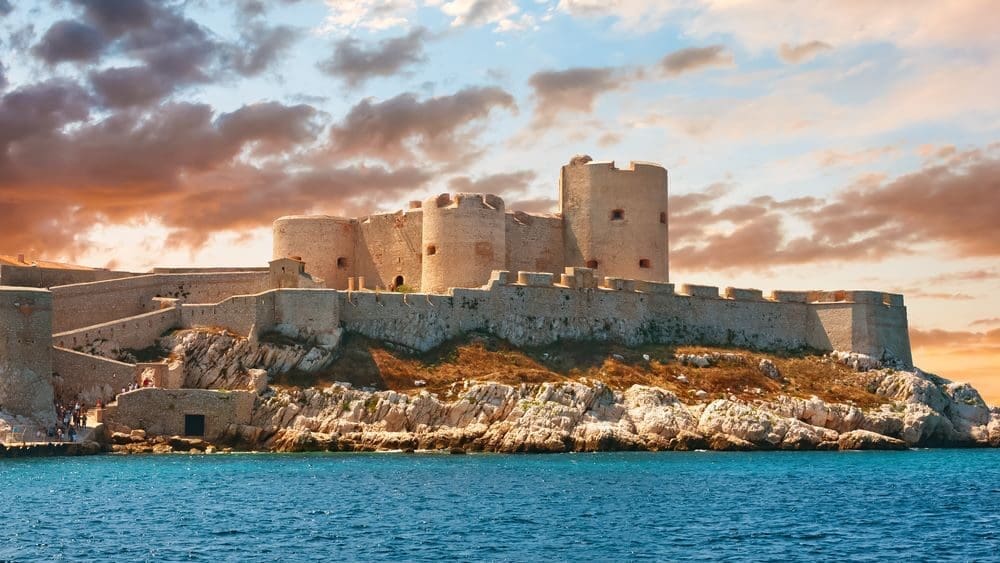
The trip to the Chateau d’If is an interesting one. From Vieux-Port, boats leave every half hour to go to the Chateau de If, which is on an island 3 km from the coast. It is a well-known prison that became famous when Alexandre Dumas set his famous book “The Count of Monte Cristo” there. From here, you can walk to the end of Malmousque, which is a beautiful place.
Arab quarter
To see the city from a different point of view, you can go to the Arab quarter. It’s like going back in time, with shops selling spices and fresh almonds in bulk on rue d’Aubagne, and then you can walk along rue des Dominicaines, where tiny shops sell everything.
Beaches
In Marseille, there are plenty of beaches where you can take it easy. In the south, the Plages du Prado are right after the beach in front of the Chateau d’If and on the way to Cap Croisette. This is a great place to relax on the beach. The place is also great for people who like to windsurf.
Les Calanques
The trip to Les Calanques is one of three trips that come highly recommended. The calanques are along the rocky coast between Marseille and the pretty fishing port of Cassis. The coast turns into a riot of white rocks that hang over turquoise waters in coves.
The best places are in Port-Pin and d’En-Vau, but you have to walk or take a boat to get there. If you plan to walk the route in the middle of summer, watch out for the risk of fire.
If, on the other hand, you go west of Marseille, don’t miss the villages of the Cote Bleue, where you can see other examples of gullies that are less spectacular and well-known than those on the east coast.
Don’t miss the Foire aux Santons and the other Christmas markets in Marseille if you happen to be there during Advent.

