
Barcelona Travel Guide: Gaudí, Gothic Streets, Mediterranean Neighbourhoods and the City Beyond the Famous Icons

Barcelona is not a city that can be reduced to Gaudí, the Gothic Quarter or the Mediterranean waterfront. Its urban fabric contains the Roman settlement of Barcino, medieval palaces built during the expansion of the Crown of Aragon, 19th-century industrial wealth, Modernisme, the rational geometry of the Eixample and the transformations created for the 1888 and 1929 international exhibitions and the 1992 Olympic Games.
The city is also unusually easy to read on foot. Within a few kilometres, the dense medieval streets of Ciutat Vella give way to Ildefons Cerdà’s immense Eixample grid, then to former independent towns such as Gràcia and industrial districts that have been reshaped repeatedly over the last century.
2026 is particularly significant. Barcelona is marking the centenary of Antoni Gaudí’s death and serving as World Capital of Architecture, while the Sagrada Família reached a historic milestone with the completion and inauguration of the exterior of its 176-metre Tower of Jesus Christ in June. The building is still not entirely finished: work continues inside the central tower and on the Glory façade.
Things to See in Barcelona
- Sagrada Família
- Gothic Quarter and Barcelona Cathedral
- Plaça del Rei and Roman Barcino
- La Rambla and La Boqueria
- El Born and Santa Maria del Mar
- Museu Picasso
- Palau de la Música Catalana
- Casa Batlló and the Block of Discord
- La Pedrera – Casa Milà
- Park Güell
- Recinte Modernista de Sant Pau
- Gràcia
- Parc de la Ciutadella and Arc de Triomf
- Barceloneta and the Mediterranean waterfront
- Montjuïc
- Museu Nacional d’Art de Catalunya
- Spotify Camp Nou
- Tibidabo and Collserola
Sagrada Família

The Sagrada Família is Barcelona’s essential architectural monument, but it is more useful to approach it as a building site that has evolved for almost a century and a half than as a conventional completed basilica.
Construction began in 1882 under architect Francisco de Paula del Villar. Antoni Gaudí took over the following year and progressively transformed the project into something radically different, combining Gothic structural principles, geometric experimentation, natural forms and an extraordinarily elaborate programme of Christian symbolism.
Gaudí spent the final years of his life increasingly concentrated on the church and was buried in its crypt after his death in 1926.
The contrast between the two principal completed façades is fundamental. The Nativity Façade, largely developed under Gaudí himself, is dense with plants, animals and scenes surrounding Christ’s birth. The Passion Façade, designed according to Gaudí’s overall programme but executed much later, uses the severe angular sculpture of Josep Maria Subirachs.
Inside, Gaudí abandoned the conventional image of Gothic stone columns. The supports branch as they rise, distributing loads like trees and turning the nave into an immense stone forest. Coloured light from the stained glass changes dramatically between morning and afternoon.
In February 2026, the upper arm of the cross was installed on the Tower of Jesus Christ, completing its exterior at 176 metres. Pope Leo XIV blessed and inaugurated the tower on 10 June 2026, the centenary of Gaudí’s death. Interior works will continue during 2027 and 2028, and construction remains active around the Glory façade.
For 2026, ordinary admission costs €26, while access including one of the towers costs €36. Tickets are sold online. From April through September, the basilica generally opens Monday–Friday 09:00–20:00, Saturday 09:00–18:00 and Sunday 10:30–20:00. Since February 2026, 09:00–10:00 is designated a quiet hour.
Allow around 90 minutes, or two hours if visiting a tower and museum.
Gothic Quarter and Barcelona Cathedral
The Barri Gòtic occupies much of the nucleus of Roman and medieval Barcelona.
Its narrow street plan can look almost accidental, but the district developed over many centuries around the Roman settlement of Barcino, founded during the reign of Augustus. Parts of its walls and towers survive within later buildings.
The medieval city became an important Mediterranean commercial and political centre under the Crown of Aragon, whose territories eventually extended across the western Mediterranean.
At its centre stands Barcelona Cathedral, formally the Cathedral of the Holy Cross and Saint Eulalia.
Most of the present structure was built between the 13th and 15th centuries, although its famous west façade is largely a neo-Gothic creation from the late 19th and early 20th centuries.
Inside, the crypt contains the tomb associated with Saint Eulalia, Barcelona’s co-patron saint. The cloister is known for its thirteen white geese, traditionally linked with the saint’s age at martyrdom.
Do not treat the quarter as a single photographic street. The strongest areas lie around Plaça del Rei, Plaça Sant Jaume, the former Jewish quarter known as the Call, the Roman wall near Plaça Nova and the quieter lanes around Sant Just.
Official city tourism material identifies the intersection of Roman cardo and decumanus around the present Carrer del Bisbe and Carrer de la Llibreteria as the core of ancient Barcino.
Plaça del Rei and Roman Barcino
Plaça del Rei contains one of Barcelona’s most coherent medieval architectural ensembles.
The Palau Reial Major was associated with the counts of Barcelona and later kings of the Crown of Aragon. The Saló del Tinell, built in the 14th century, is among its most imposing surviving spaces.
The square is also one of the best places to understand that medieval Barcelona was built directly over its Roman predecessor.
The MUHBA Barcelona History Museum allows visitors to descend beneath the square into substantial archaeological remains of Roman Barcino, including streets and spaces connected with wine production, fish processing, laundry and dyeing.
Above ground, fragments of the Roman Temple of Augustus survive within the medieval fabric of Carrer del Paradís.
Barcelona therefore offers something unusual: Roman, medieval and modern city levels can be encountered within a few hundred metres rather than in separate archaeological zones.
La Rambla and La Boqueria
La Rambla extends for approximately 1.2 kilometres from Plaça de Catalunya towards the sea.
The promenade took its present urban form during the 18th century, following the line of an older watercourse and the edge of the medieval city. By the late 18th and 19th centuries it had become one of Barcelona’s principal public spaces.
It remains extremely busy and is not the place to search for tranquillity, but several important institutions lie directly along or beside it.
The Gran Teatre del Liceu, opened in 1847 and reconstructed after a devastating 1994 fire, remains Barcelona’s principal opera house.
Nearby, Mercat de la Boqueria grew from food trading that had taken place in the area for centuries. Its current metal market structure belongs largely to the 19th and early 20th centuries.
The market is now heavily visited, particularly around the entrances from La Rambla. Walk deeper into the building before judging it. Butchers, fishmongers and specialised stalls still operate beyond the smoothie stands and prepared food counters facing the main tourist flow.
For better historic food markets with a less compressed atmosphere, also consider Mercat de Santa Caterina and Mercat de Sant Antoni.
El Born and Santa Maria del Mar

East of the Gothic Quarter, El Born preserves another important section of medieval Barcelona.
Its history was closely connected with merchants, craftsmen, maritime trade and the port.
The district’s defining monument is Santa Maria del Mar, one of the finest examples of Catalan Gothic architecture.
Construction took place principally between 1329 and 1383, remarkably quickly for a major medieval church.
Its interior feels radically different from the vertical complexity of northern European Gothic cathedrals. Columns are widely spaced and the three naves reach almost the same height, producing an unusually open and unified interior.
Much of the historical decoration disappeared during a fire in July 1936, exposing the architectural structure more clearly.
Nearby, the former market building now known as El Born Centre de Cultura i Memòria preserves archaeological remains of streets and houses demolished after the War of the Spanish Succession and construction of the Bourbon military citadel.
The district therefore links medieval maritime Barcelona with the political ruptures of the early 18th century.
Museu Picasso
Barcelona’s Picasso Museum matters because it does not attempt to tell the whole career through the artist’s most famous Cubist works.
Instead, it is particularly strong on his early development.
Picasso arrived in Barcelona as a teenager in 1895 and studied at the Escola de Belles Arts de la Llotja. The city became fundamental to his artistic formation, friendships and early exhibitions.
The museum occupies a sequence of medieval palaces on Carrer Montcada and contains thousands of works, including early academic paintings, Blue Period material and the extraordinary 1957 series in which Picasso repeatedly reinterpreted Velázquez’s Las Meninas.
From 31 March to 27 September 2026, the museum opens Tuesday, Wednesday and Sunday 09:00–20:00 and Thursday–Saturday 09:00–21:00. Monday is closed. General online admission for the collection and temporary exhibitions is €14.
Allow around 90 minutes.
Palau de la Música Catalana
The Palau de la Música Catalana is the great alternative to Gaudí for anyone trying to understand Catalan Modernisme.
Architect Lluís Domènech i Montaner designed the concert hall for the Orfeó Català between 1905 and 1908.
Unlike Gaudí’s often organic architecture, Domènech i Montaner combines exposed structure, brick, mosaic, sculpture, stained glass and floral decoration within a rigorously organised building.
The concert hall is the masterpiece.
A huge inverted stained-glass skylight descends from the ceiling like a luminous sun, while sculpture and mosaic seem to dissolve the boundary between architecture and decorative art.
It is also one of the rare major concert halls where natural light enters directly into the auditorium.
UNESCO inscribed the Palau together with the Hospital de Sant Pau in 1997.
A specialist architectural visit currently costs €30, and the Palau’s reception operates daily from 09:00 to 21:00, with visitor services available every day.
A concert is even better than a daytime visit because the building remains an active musical institution rather than a preserved museum.
Casa Batlló and the Block of Discord

Casa Batlló belongs to the Illa de la Discòrdia, the Block of Discord, where wealthy Barcelona families commissioned radically different Modernista façades within a few metres of one another.
Gaudí transformed an existing 1877 apartment building between 1904 and 1906 for textile entrepreneur Josep Batlló.
The famous façade combines bone-like stone supports, cast-iron balconies, coloured ceramic fragments and a roof popularly interpreted as the back of the dragon defeated by Saint George.
The interior is even more revealing.
Gaudí manipulated window sizes and graduated blue tiles inside the central light well to equalise natural illumination between floors. Ventilation openings were integrated into doors and windows, while an attic of repeated catenary arches creates one of his purest structural spaces.
Across the pavement and neighbouring façades, compare Gaudí’s work with Casa Amatller by Josep Puig i Cadafalch and Casa Lleó Morera by Domènech i Montaner.
In 2026 the General Visit operates daily from 09:00 to 19:15 and starts from €29, with prices varying according to date and booking conditions.
Allow 75–90 minutes.
La Pedrera – Casa Milà
Casa Milà, universally known as La Pedrera, was Gaudí’s last major private residential building.
Pere Milà and Roser Segimon commissioned it in 1906, and construction continued until 1912.
The undulating stone façade appears almost geological. Structural columns rather than conventional load-bearing interior walls gave apartments unusual flexibility, while underground parking anticipated a rapidly changing urban society.
The roof is the most famous space.
Chimneys, ventilation shafts and stair enclosures become huge sculptural forms rather than hidden technical elements. Their arrangement makes the rooftop feel almost like a constructed landscape.
Below, the attic uses hundreds of brick catenary arches and now contains one of the best exhibitions explaining Gaudí’s structural experiments.
La Pedrera’s standard Essential visit currently runs from 09:00 to 17:30 and starts at €29. A separate sunset period runs from 17:30 to 20:30, while night experiences continue later.
If visiting both Casa Batlló and La Pedrera, do not schedule them immediately one after another. They are sufficiently detailed that architectural fatigue is real.
Park Güell
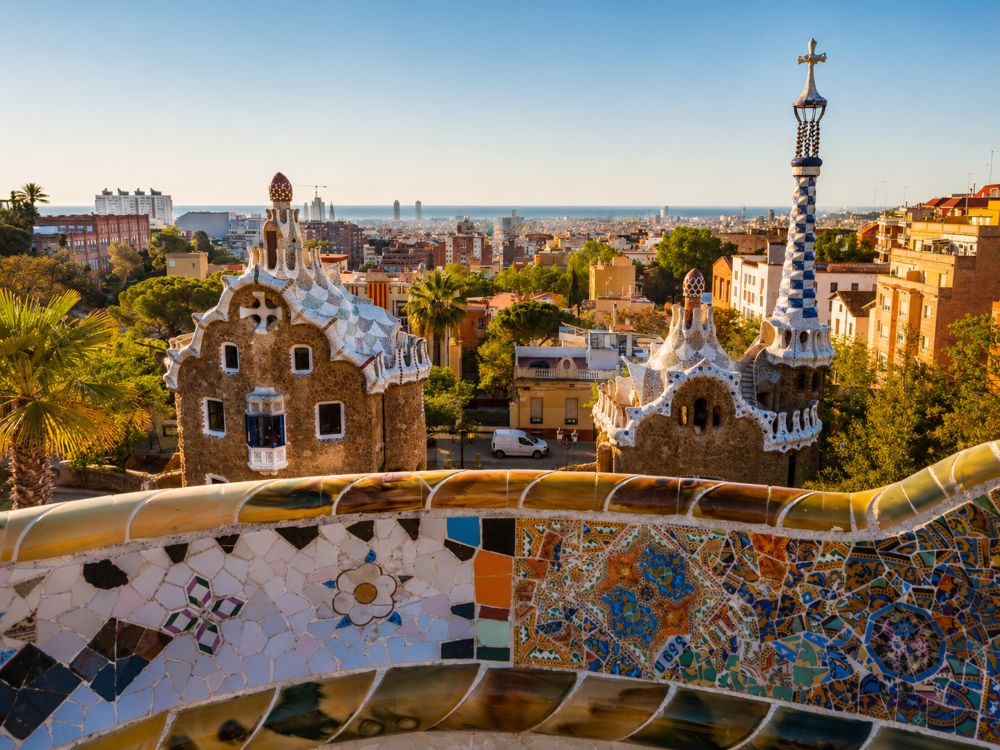
Park Güell began not as a public park but as an ambitious residential development.
Industrialist Eusebi Güell commissioned Gaudí to create a garden-city estate on the hills above Barcelona at the beginning of the 20th century.
The project failed commercially. Only a few houses were built, but the public areas became some of Gaudí’s most imaginative landscape architecture.
The monumental staircase, mosaic salamander, Hypostyle Hall and serpentine bench are the obvious attractions.
More interesting structurally are Gaudí’s viaducts and retaining walls. Rather than imposing straight engineered forms onto the hill, stone columns lean and curve in response to topography.
The Hypostyle Hall was intended as the development’s marketplace, while the broad terrace above was conceived as a community space.
The site became municipal property and opened as a public park in the 1920s.
In summer 2026, tourist admission to the monumental area is currently sold between 09:00 and 19:30, with a general ticket of €18. Ticket holders have a thirty-minute grace period after their booked time, and advance purchase is recommended.
Allow at least two hours, especially if continuing into the less monumental upper areas.
Recinte Modernista de Sant Pau
The former Hospital de la Santa Creu i Sant Pau is one of Barcelona’s greatest architectural complexes and still receives far fewer visitors than Gaudí’s principal works.
Lluís Domènech i Montaner designed the hospital as a network of individual medical pavilions surrounded by gardens.
Construction began in the early 20th century, financed substantially through the legacy of banker Pau Gil.
The architecture reflected advanced ideas about healthcare. Patients were distributed among specialised pavilions rather than concentrated in one enormous block, while sunlight, ventilation and gardens formed part of the therapeutic environment.
Underground tunnels connected the buildings for staff and service circulation.
Domènech i Montaner combined brick, ceramic, sculpture and mosaic throughout the complex without losing sight of its medical function.
The hospital moved to a new modern facility in 2009, allowing the historic buildings to undergo major restoration.
From April to October 2026, self-guided visits operate daily from 09:30 to 18:30. Admission costs €18 before 14:00 and €17 afterwards.
The walk between Sant Pau and the Sagrada Família along Avinguda de Gaudí takes roughly ten minutes, making the two monuments an excellent architectural pairing.
Gràcia
Gràcia was an independent municipality until its incorporation into Barcelona in 1897.
That separate history still shows.
The district is denser and less regular than the Eixample immediately below it, with smaller streets organised around squares rather than vast chamfered blocks.
Plaça del Sol, Plaça de la Vila de Gràcia, Plaça de la Virreina and Plaça del Diamant form the social geography of the neighbourhood.
The district also has deep connections with Catalan political and cultural life.
For visitors, Gràcia is most useful in the evening, when terraces fill with residents but the atmosphere remains different from the late-night concentration of the Gothic Quarter.
Its restaurants, independent shops and neighbourhood bars provide a better sense of everyday Barcelona than the busiest streets around La Rambla.
Park Güell lies above the northern edge of the district, so descending through Gràcia afterwards is more interesting than returning directly by metro.
Parc de la Ciutadella and Arc de Triomf
The Parc de la Ciutadella occupies land once dominated by the huge Bourbon military citadel constructed after the defeat of Barcelona in 1714.
The fortress was intended partly to control the city itself.
Most of it was demolished during the 19th century, and the grounds became central to the 1888 Barcelona Universal Exposition.
The Arc de Triomf, designed by Josep Vilaseca, served as the exhibition’s monumental entrance. Unlike triumphal arches celebrating military victory, it was conceived for a civic and international event.
Inside the park, the monumental cascade includes early work involving the young Gaudí, while several exhibition buildings survive.
The Parliament of Catalonia occupies part of the former military arsenal.
From the park, it is easy to continue into El Born, making the area more useful as part of a walking route than as an isolated attraction.
Barceloneta and the Mediterranean Waterfront
Barceloneta was created during the 18th century on land close to the expanding port.
Its regular blocks housed sailors, fishermen, dock workers and workers connected with maritime industries.
The neighbourhood remains unusually compact, with narrow streets running between the sea and Port Vell.
Barcelona’s modern beach landscape is much newer.
Major transformations connected with the 1992 Olympic Games removed industrial barriers, improved sewage infrastructure, created new beaches and reconnected the city more directly with the Mediterranean.
Barceloneta Beach is convenient rather than secluded.
For a calmer stretch, continue northeast towards Bogatell and Mar Bella.
The neighbourhood itself is worth walking before reaching the sand. Small bars, markets and residential streets reveal more of its history than the restaurant strip directly facing the waterfront.
For seafood, do not assume that a sea view automatically means better cooking.
Montjuïc
Montjuïc rises above the port and contains enough museums, gardens and historic sites to occupy an entire day.
The hill has served military, industrial, funerary, recreational and exhibition functions.
At the summit stands Montjuïc Castle, a fortress closely connected with Barcelona’s political history and periods of repression.
Lower down, the monumental axis around Plaça d’Espanya and the Palau Nacional was constructed for the 1929 International Exposition.
The hill was transformed again for the 1992 Olympics, when the Lluís Companys Olympic Stadium, Palau Sant Jordi and surrounding facilities became the centre of the Games.
Montjuïc is also home to the Fundació Joan Miró, Barcelona Botanical Garden, historic Olympic pools, Poble Espanyol and several less-visited gardens.
The cable car provides an easy ascent from the upper funicular area towards the castle. The current 2026 adult fare is €19 return at the ticket office or €17.10 when purchased online.
Do not attempt every Montjuïc attraction in one visit. Choose one major museum, the castle or Olympic area, and leave time for the gardens and viewpoints.
Museu Nacional d’Art de Catalunya
The MNAC occupies the Palau Nacional, built for the 1929 International Exposition.
Its greatest collection is not modern Catalan painting but Romanesque mural art.
During the early 20th century, murals from remote Pyrenean churches were removed and transferred to Barcelona to prevent their sale and export. They are now presented in architectural spaces that reproduce the apses from which they came.
The collection from Sant Climent de Taüll, including the famous Christ in Majesty, is among the masterpieces of European Romanesque art.
Later galleries cover Gothic, Renaissance, Baroque and Modern Art, including Catalan Modernisme and work by artists such as Ramon Casas.
From May to September 2026, the museum opens Tuesday–Saturday 10:00–20:00 and Sundays and holidays 10:00–15:00. General admission is €12 and includes the rooftop viewpoint.
Allow at least two hours; three are justified for anyone interested seriously in medieval or Catalan art.
Spotify Camp Nou
Camp Nou is again a functioning visitor attraction and football stadium in 2026, although the enormous Espai Barça redevelopment is still ongoing.
FC Barcelona returned progressively to the stadium, and the Camp Nou Experience reopened in January 2026 with access to the museum and a panoramic view of the ground.
The official 2026 schedule currently includes first-team home matches at Spotify Camp Nou beginning in August, including the 27 August league match against Athletic Club. Construction work continues to affect entrances and some stadium areas.
The Barça Museum provides a broader history of the club, its players and its relationship with Catalan identity.
Football fans should check whether a match or stadium tour is operating on the exact date rather than relying on generic opening information.
Metro access is easiest through Collblanc or Badal on L5, or Les Corts and Palau Reial on L3.
Tibidabo and Collserola
Tibidabo rises to more than 500 metres on the Collserola ridge behind Barcelona.
Its position gives one of the widest views over the city, extending across the Eixample towards the Mediterranean.
At the summit stands the Temple Expiatori del Sagrat Cor, an enormous church constructed in stages during the 20th century.
Beside it is the Tibidabo amusement park, whose origins reach back to 1901, making it one of Europe’s oldest operating amusement parks.
The contrast is peculiarly Barcelona: church towers, vintage rides, telecommunications structures and mountain forest coexist within a small area.
Beyond Tibidabo, the Parc Natural de la Serra de Collserola offers extensive walking and cycling trails.
It is the best place to understand Barcelona’s geographical setting between the Mediterranean and a wooded mountain ridge rather than thinking of it purely as a coastal city.
A Short History of Barcelona
Barcelona began as a Roman colony known as Barcino, established around the end of the 1st century BC.
Its Roman centre occupied the small hill now largely covered by the Gothic Quarter.
During the Middle Ages, Barcelona developed into one of the principal cities of the Crown of Aragon, whose maritime and commercial networks extended across the Mediterranean.
Shipbuilding, trade and craft production brought substantial wealth, reflected in churches such as Santa Maria del Mar and the royal complex around Plaça del Rei.
The city suffered major political ruptures during the early modern period, particularly the War of the Spanish Succession. Barcelona fell to Bourbon forces on 11 September 1714, an event that remains central to Catalan historical memory.
Industrialisation transformed Barcelona during the 19th century.
Textile manufacturing generated enormous wealth but also severe urban overcrowding within the old walls.
After the walls were demolished, engineer Ildefons Cerdà created the Eixample plan, with its vast rectilinear grid, broad avenues and distinctive chamfered corners.
The new district became the stage on which the wealthy industrial bourgeoisie commissioned Modernista architecture.
Barcelona expanded again through annexation of surrounding municipalities including Gràcia.
The Spanish Civil War brought bombing and political violence, followed by repression of Catalan institutions and language during the Franco dictatorship.
Democratic transition after Franco’s death eventually restored Catalan autonomous institutions.
The 1992 Olympic Games accelerated another transformation, opening the waterfront, improving infrastructure and reshaping large sections of the city.
Modern Barcelona still bears visible traces of every one of these phases.
Barcelona and Modernisme
Gaudí is the most famous figure, but Barcelona Modernisme was much broader.
The movement developed during a period when wealthy Catalan industrialists were commissioning houses, hospitals, concert halls, shops and factories.
Architecture became connected with the broader Renaixença, the revival of Catalan language and cultural identity.
Three architects dominate most itineraries.
Antoni Gaudí developed an increasingly personal system based on geometry, natural structures and religious symbolism.
Lluís Domènech i Montaner integrated architecture with sculpture, stained glass, mosaics and applied arts at the Palau de la Música and Hospital de Sant Pau.
Josep Puig i Cadafalch combined Catalan Gothic, northern European and contemporary influences in buildings such as Casa Amatller.
Seeing works by all three prevents Modernisme from becoming simply another name for Gaudí.
Barcelona in 2026
The city has an unusually strong architectural programme this year.
Barcelona is World Capital of Architecture 2026, with events running from February to December across the city.
At the same time, the centenary of Gaudí’s death has concentrated attention on his buildings.
The most important permanent change is at the Sagrada Família, where the completed exterior of the Tower of Jesus Christ has altered the skyline substantially. The central tower now reaches 176 metres, although internal finishing and the Glory façade remain under construction.
Spotify Camp Nou is again receiving visitors and scheduled matches, but the wider redevelopment remains active, so access routes may still change.
These details make older Barcelona guides particularly unreliable for the Sagrada Família and Camp Nou.
What to Eat in Barcelona
Barcelona cooking sits between Catalan rural traditions and Mediterranean seafood.
Pa amb tomàquet is fundamental: bread rubbed with tomato and seasoned with olive oil and salt. What appears almost absurdly simple is one of the foods most deeply embedded in everyday Catalan eating.
Escalivada combines roasted peppers, aubergine and onion.
Esqueixada uses salt cod with tomato, onion and olives.
Botifarra amb mongetes pairs Catalan sausage with white beans.
During winter, calçots are charred over open flames and eaten with a rich nut-and-pepper sauce during communal calçotades.
Suquet de peix is a fishermen’s stew built around fish, potatoes and a concentrated sauce.
Catalonia also has a strong tradition of combining meat with seafood, known as mar i muntanya.
For dessert, crema catalana predates many of the comparisons routinely made with crème brûlée.
Barcelona’s contemporary dining scene is exceptionally broad, extending from traditional restaurants and vermouth bars to some of the most technically ambitious kitchens in Europe.
Where to Eat in Barcelona
Disfrutar
Created by Oriol Castro, Eduard Xatruch and Mateu Casañas, Disfrutar represents the most experimental end of Barcelona dining.
The restaurant grew from techniques and ideas developed by chefs who had worked at elBulli, but its identity is independent rather than nostalgic.
Expect long tasting menus, complex technique and playful manipulation of temperature and texture.
Address: Carrer de Villarroel 163, 08036 Barcelona
Telephone: +34 933 486 896
Email: [email protected]
Cuisine: creative contemporary tasting menus
Price level: very high
Reservations: released up to twelve months in advance and often difficult to secure.
Gresca
Rafa Peña’s Gresca is a very different proposition: compact, direct and built around contemporary dishes that can often be shared.
The kitchen moves between Catalan ingredients, French influence, offal, charcuterie and deceptively simple plates.
Its natural-wine programme has been influential in Barcelona for years.
Address: Carrer de Provença 230, 08036 Barcelona
Telephone: +34 934 516 193
Cuisine: contemporary Catalan and European
Price level: mid-range to upper mid-range
Best for: a serious meal without tasting-menu ceremony.
Besta Barcelona
Besta combines Galician and Catalan influences, particularly seafood, fish and contemporary interpretations of Atlantic and Mediterranean ingredients.
The approach is modern without becoming overly technical.
Address: Carrer d’Aribau 106, 08036 Barcelona
Telephone: +34 930 198 294
Cuisine: contemporary Catalan-Galician
Price level: upper mid-range
Reservations: recommended.
Restaurant Can Culleretes
For a historical counterpoint, Can Culleretes has operated since 1786 and describes itself as Barcelona’s oldest restaurant.
The dining rooms preserve photographs and memorabilia from generations of the same institution, while the menu concentrates on traditional Catalan cooking rather than culinary reinvention.
Address: Carrer d’en Quintana 5, 08002 Barcelona
Telephone: +34 933 173 022 / +34 933 176 485
Email: [email protected]
Cuisine: traditional Catalan
Price level: moderate
Important 2026 note: the restaurant publishes a summer closure from 27 July through 24 August.
Bar Cañete
Bar Cañete is one of the most reliable places near La Rambla for tapas, grilled seafood and Catalan-Mediterranean dishes without resorting to a generic tourist menu.
The counter is particularly good for a shorter meal.
Address: Carrer de la Unió 17, 08001 Barcelona
Telephone: +34 932 703 458
Email: [email protected]
Cuisine: Catalan and Mediterranean tapas
Kitchen: generally 13:00–00:00, with Sunday normally closed
Price level: mid-range to high depending on seafood.
Where to Stay in Barcelona
For a first visit, Eixample is the most practical district: central, well connected and quieter at night than parts of Ciutat Vella.
The Gothic Quarter and El Born provide more atmosphere but also more noise and narrower streets.
Gràcia works for longer stays and repeat visitors.
The beach area makes sense only if direct access to the Mediterranean matters more than walking to the main historic sites.
Mandarin Oriental
Directly on Passeig de Gràcia, this is one of the strongest locations for a luxury first visit because Casa Batlló, La Pedrera and the Gothic Quarter are all easily accessible.
Address: Passeig de Gràcia 38–40, 08007 Barcelona
Telephone: +34 931 518 888
Reservations: +34 931 518 890
Email: [email protected]
Reservations email: [email protected]
Category: five-star luxury
Best for: architecture, shopping and central access.
El Palace Hotel Barcelona
El Palace preserves a grand early-20th-century hotel atmosphere near the eastern side of the Eixample.
The building opened as the former Ritz Barcelona and has retained a more traditional style than many newer luxury hotels.
Address: Gran Via de les Corts Catalanes 668, 08010 Barcelona
Telephone: +34 935 101 130
Reservations: +34 933 024 744
Email: [email protected]
Category: five-star luxury
Best for: historic atmosphere and central Eixample.
Casa Bonay
Casa Bonay occupies a 19th-century building at the eastern end of the central Eixample and takes a less formal approach than the grand luxury hotels.
Its public spaces, restaurant and rooftop make it particularly suited to travellers who prefer a contemporary neighbourhood-hotel atmosphere.
Address: Gran Via de les Corts Catalanes 700, 08010 Barcelona
Telephone: +34 935 458 070
WhatsApp: +34 680 963 120
Email: [email protected]
Category: boutique hotel
Best for: design, restaurants and a less formal stay.
Hotel Neri
Hotel Neri occupies historic buildings in the Gothic Quarter close to Barcelona Cathedral and Plaça Sant Felip Neri.
It makes sense for travellers who want to stay directly inside the medieval city rather than commuting into it each day.
Address: Carrer de Sant Sever 5, 08002 Barcelona
Telephone: +34 933 040 655
Category: luxury boutique hotel
Best for: Gothic Quarter atmosphere and walking access to Ciutat Vella.
Hotel 1898
Hotel 1898 sits directly on La Rambla, making it exceptionally convenient for the Boqueria, Gothic Quarter, Plaça de Catalunya and El Raval.
The trade-off is obvious: this is one of Barcelona’s busiest pedestrian corridors.
Address: La Rambla 109, 08001 Barcelona
Telephone: +34 935 529 552
Email: [email protected]
Category: four-star superior
Best for: first-time visitors prioritising location over neighbourhood tranquillity.
How Many Days Do You Need in Barcelona?
Three full days are enough for the essential city, but they require disciplined choices.
Four days are substantially better because they allow one major museum, time in Gràcia or Barceloneta and a less compressed visit to Montjuïc.
Five days are ideal for a first visit if architecture and museums both matter.
With six or seven days, Barcelona also becomes an excellent base for Montserrat, Girona, Sitges or the Penedès wine region.
Do not try to visit every Gaudí site. Sagrada Família, Casa Batlló or La Pedrera, and Park Güell provide enough variety for most first visits.
A Three-Day Barcelona Itinerary
Day One: Roman and Medieval Barcelona
Begin in the Gothic Quarter before the busiest pedestrian traffic arrives.
See the cathedral, Roman wall and Plaça del Rei, then continue through the medieval lanes towards El Born and Santa Maria del Mar.
Visit the Picasso Museum if it is a priority.
Have lunch in or around El Born rather than La Rambla.
Spend the afternoon at the Palau de la Música Catalana or Parc de la Ciutadella.
Finish with a walk through the lower Gothic Quarter and towards Port Vell.
Day Two: Gaudí and the Eixample
Book the first practical entry at the Sagrada Família.
Continue on foot along Avinguda de Gaudí to the Hospital de Sant Pau.
After lunch, move towards Passeig de Gràcia.
Choose either Casa Batlló or La Pedrera for the interior; examine both façades from outside.
Spend the evening in Gràcia.
This creates a coherent architectural day without attempting four expensive Modernista interiors consecutively.
Day Three: Park Güell and Montjuïc
Book Park Güell early.
Walk downhill through Gràcia afterwards rather than immediately boarding a bus back to the centre.
After lunch, move to Montjuïc.
Choose the MNAC or Fundació Joan Miró, then continue through the Olympic area, gardens or towards Montjuïc Castle.
Stay on the hill into late afternoon for city views.
If beaches matter more than museums, replace Montjuïc with Barceloneta and the waterfront.
A Four-Day Barcelona Itinerary
Use the first three days above, then keep the fourth less structured.
For art, spend several hours at the MNAC and add Fundació Joan Miró.
For food and neighbourhood life, explore Sant Antoni, Poble-sec and Gràcia.
Football supporters can devote part of the day to Spotify Camp Nou.
In warm weather, combine Poblenou with Bogatell Beach rather than returning automatically to crowded Barceloneta.
A fourth day makes the city feel substantially less like a sequence of timed-entry monuments.
How to Get from Barcelona Airport to the Centre
Barcelona–El Prat Airport has two terminals.
Metro L9 Sud serves both T1 and T2 and runs approximately every seven minutes. The journey into the wider Barcelona metro network takes roughly 32 minutes, although L9 does not go directly to Plaça Catalunya and requires a transfer.
The Aerobús is often simpler for visitors staying around Plaça d’Espanya, Gran Via or Plaça Catalunya.
The suburban rail service from Terminal 2 is useful for Passeig de Gràcia and other central stations. T1 passengers need the airport shuttle to reach the rail station.
Taxi is the easiest option with luggage or for several passengers travelling together.
Getting Around Barcelona
Barcelona’s metro is the most useful form of transport for longer distances.
For central sightseeing, however, walking is often faster because many attractions lie only one or two metro stops apart.
The Eixample is particularly easy to navigate because of its grid.
Buses become useful for Park Güell, the hill districts and routes not aligned with the metro.
The Montjuïc funicular is part of the normal metro system, while the separate cable car to the castle requires its own ticket.
Do not rent a car for an ordinary Barcelona stay. Parking is expensive, traffic adds little value and the historic centre is far easier on foot.
Barcelona without a Car
Barcelona is one of the easiest major European cities to visit without driving.
The airport, main railway stations, beach, principal Gaudí sites and Montjuïc are all connected by public transport.
A car only becomes useful when the trip expands into rural Catalonia or destinations poorly served by rail.
Even then, renting for one or two days outside the city is more practical than keeping a vehicle throughout the Barcelona stay.
Barcelona with Children
Sagrada Família is surprisingly effective with older children because the building’s natural forms and coloured light are visually immediate.
Park Güell is easier still, although steep paths and summer heat require planning.
CosmoCaixa is one of the best child-oriented science museums in Spain and provides a useful alternative when architecture fatigue sets in.
The beach, Tibidabo and the aquarium offer other straightforward options.
Avoid constructing a family itinerary around four long house museums in one day. Casa Batlló is generally the most visually accessible of Gaudí’s residential interiors for younger visitors.
Beaches in Barcelona
Barcelona’s beaches are urban beaches.
Expect excellent access, showers, lifeguard services in season and a large number of people rather than untouched Mediterranean scenery.
Barceloneta is the closest to the old centre and the most crowded.
Sant Sebastià extends southwest towards the W Barcelona end of the waterfront.
Nova Icària and Bogatell are usually better for travellers who want a conventional beach afternoon.
Mar Bella and the beaches farther northeast become increasingly removed from the tourist centre.
For genuinely attractive beach towns, take the train to places such as Sitges rather than assuming central Barcelona provides the best coastline in Catalonia.
Safety and Pickpocketing
Barcelona is generally straightforward to visit, but petty theft is a significant issue in the busiest tourist areas.
The greatest attention is warranted around La Rambla, the metro, Plaça Catalunya, Sagrada Família approaches and crowded transport connections.
Do not carry a phone loosely on café tables or in an open back pocket.
Keep bags closed and in front of you on crowded trains.
The problem should influence ordinary precautions, not determine the whole experience of the city.
Best Time to Visit Barcelona
March and April are excellent for architecture and walking, although weather can remain variable.
23 April, Sant Jordi, is one of Barcelona and Catalonia’s great cultural days, when streets fill with books and roses.
May and June provide long daylight and generally excellent conditions before the hottest part of summer.
July and August are hot, crowded and increasingly uncomfortable for tightly scheduled sightseeing. Book the first available monument slots and leave afternoons for museums, lunch or the sea.
September is one of the strongest overall months.
Around 24 September, the city celebrates La Mercè with concerts, traditional culture and large public events.
October remains excellent for urban travel.
Winter is underrated. Gaudí interiors, museums and restaurants remain fully accessible, hotel prices can be lower and crowd pressure drops substantially.
Essential Booking Strategy
For a busy spring or summer trip, reserve the Sagrada Família first.
Next book Park Güell and whichever of Casa Batlló or La Pedrera you want to enter.
Picasso Museum should also be reserved if visiting at a specific time.
Palau de la Música, Sant Pau and MNAC are generally easier to fit around the major timed sites.
Do not schedule Sagrada Família, Park Güell and Casa Batlló on three consecutive fixed appointments without allowing travel and meals between them.
Barcelona works best when every day retains some unbooked time.
Barcelona Essential Information
Country: Spain
Autonomous community: Catalonia
Province: Barcelona
Historic Roman name: Barcino
Main language: Catalan, alongside Spanish
Main airport: Josep Tarradellas Barcelona–El Prat Airport
Main railway station: Barcelona Sants
Main central districts for visitors: Eixample, Gothic Quarter, El Born, Gràcia
Best first-time base: Eixample
Recommended first visit: 4 days
Best overall months: April–June and September–October
Principal architectural movement: Catalan Modernisme
Major architects: Antoni Gaudí, Lluís Domènech i Montaner, Josep Puig i Cadafalch
Major 2026 event: Barcelona World Capital of Architecture
Major 2026 architectural milestone: completion and inauguration of the exterior of the Sagrada Família’s Tower of Jesus Christ
Sagrada Família ticket: €26 basic / €36 with tower
Park Güell ticket: €18
MNAC ticket: €12
Sant Pau ticket: €18 before 14:00 / €17 afterwards
Picasso Museum: €14 online for collection and temporary exhibitions
Airport metro: L9 Sud, approximately 32 minutes into the city transport network

