
Discover the Tranquil Beauty of Costa Rica: A Peaceful Paradise in Central America

Few countries can say that they are so peaceful and at peace with the rest of the world that they don’t need an army. One of these countries is Costa Rica, which decided to get rid of its military after the civil war in 1949 and hasn’t had any kind of political trouble since.
The country is now thought to be the safest in Central America, much more so than neighboring Nicaragua or Panama, let alone Guatemala, Honduras, or El Salvador. It’s no wonder that many tourists choose it as a vacation spot: it’s a nice tropical mix of beaches, nature, and pura vida, the local way of life, where all you need to do is enjoy life.
History
Costa Rica has been inhabited for at least 10,000 years, but it has never had a unified and important civilization like the Mayas and Incas, which lived in Central and South America, respectively. When Columbus got there, he met some tribes of women who were not related to these two empires but were just as aggressive.
In fact, the Spanish conquistadors had to work hard to settle permanently in this land of jungles and volcanoes that had never been touched by humans. In 1821, this country and others in Latin America declared independence from Spain. So began the United States’ bid for hegemony, which they lost in the famous Battle of Santa Rosa in the middle of the 19th century. Almost a hundred years ago, the country went through important periods of growth and political crises. After the end of the civil war, everything went back to normal.
From then on, Costa Rica went through a time of growth and stability that continues to this day. The beauty of its places and the high quality of its services have brought tourists from all over the world to the country.
What to see in Costa Rica
The country has one of the highest percentages of protected areas in the world. About 26% of the land is protected as a park or nature reserve. So, among the forests, volcanoes, and trekking in the mountains, excursions are the real stars of tourism in Costa Rica. There are plenty of beaches and ways to spend time with sea life, like snorkeling, surfing, and hanging out in hammocks in huts with palm leaf roofs.
The capital: San José
About 300,000 people live in San José. There are 1.5 million people in the urban area, which is almost a third of the country’s total population. The city isn’t particularly beautiful, but it’s a great place to settle in when you first move to the country. There are colonial houses and palaces, music, a few museums, and, most of all, a lively street life. It is an obvious good place to start the journey, since it is in the middle of the country on a plateau 1100 meters above sea level. The main bus station is called Meseta Central, and buses leave from there to go anywhere.
Volcán Arenal
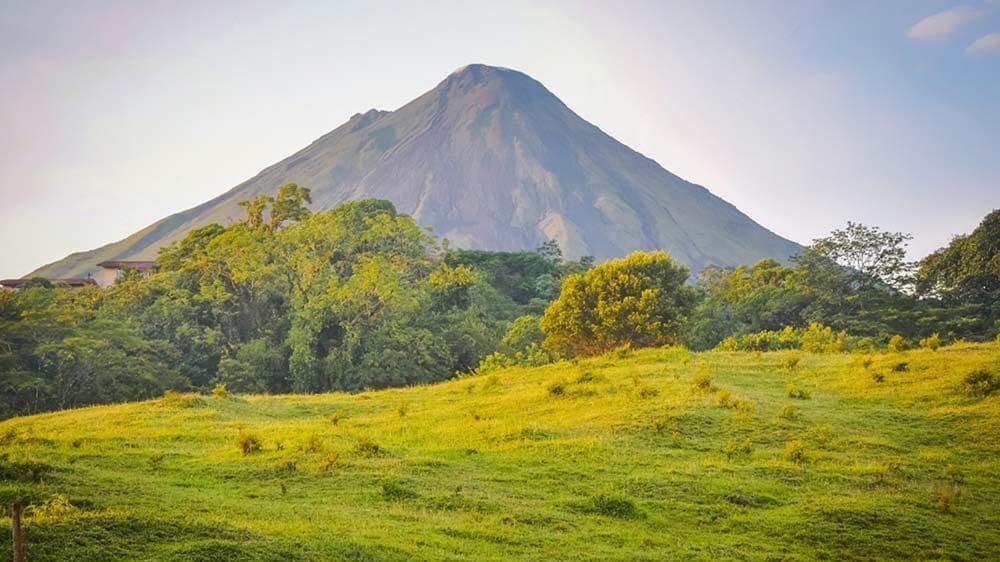
Once you’ve been to San José, you have a lot of places to choose from if you want to move. Volcán Arenal is the most active volcano in the country. It is in the north, but since 2010, it seems to have gone back to sleep. Inside the Natural Park, you can go on different walks along the paths, where you can also see a lot of animals. The Sendero Cerro Chato is the most beautiful and spectacular trail in the rea de Conservación Arenal. It leads to the lake on the top of Cerro Chato, Arenal’s “brother” volcano, but visitors can also choose different routes and options based on their own interests.
Cerro Chirripó
It is the highest mountain in Costa Rica. It is on the Cordillera de Talamanca and is 3,820 meters above sea level. It is in the Cerro Chirripó National Park, which has a landscape with strong environmental contrasts. For example, the forest can turn into a harsh environment, and the temperature can change by several degrees from one place to another.
Parque Nacional Corcovado and Parque Nacional Manuel Antonio
Those who want to go into the forest can go to Parque Nacional Corcovado, where the almost untouched jungle will test hikers with thick vegetation that ends only at the Pacific Ocean. There are no words to describe the beauty and magic of this natural wonder, which is a good home for many species of animals, including the fascinating harpy eagle, some of which are at risk of going extinct. But this isn’t the only forest. The most famous and visited forest in Costa Rica is the National Park of Manuel Antonio, which has some of the most beautiful beaches in the world.
Reserva Biológica Bosque Nuboso Monteverde
It is a cloud forest that is made possible by warm air masses from the Caribbean that reach here and, as they cool, give life to the clouds that stay “imprisoned” in the plants.
Parque Nacional Tortuguero

If you’d rather get close to water, you can go to Parque Nacional Tortuguero, where you can navigate the rivers that run through the jungle and look for turtles, caimans, and mammals that live along the banks.
Costa Rica’s most beautiful beaches
If you go to a tropical country, you’ll definitely want to check out the beaches. Don’t worry, you’re in the right spot. As the name suggests, Playa Grande is also the longest beach in the country. It goes from the mouth of the Rio Tamarindo at the same name to Playa Ventanas, which is more than 5 km away. This magical place is known for its big waves, blue water, and turtles that lay their eggs on the beach at night.
There are many beaches in Costa Rica, but the Pennsula de Nicoya in the north-west of the country could be enough to fill your whole vacation. It has one beach after another for every taste, where you can relax or play sports and find whatever kind of tourism you are looking for, from Playa del Coco with its sport fishing to Playa Hermosa, from Playa Ocotal to the many small beaches that follow one another right south of it. Or places like Playa Tamarindo, Playa Avellanas, and Playa Negra, where different levels of surfing are done. If you like this sport, the most famous waves in the country are in Salsa Brava, Pavones, and Dominical. Surfers from all over the world come here and stay for a long time. Pavones, in particular, has some of the best “left hand” waves in the world.
Isla San Lucas, Isla Gigante, Isla Tortuga, Isla Guayabo, Isla Negritos, and Isla Los Pàjaros are real pearls of beauty. The last three, in particular, are classified as biological reserves and can only be reached with a special permit.
Due to (or because of, depending on your point of view), the Caribbean coast is harder to get to than the Pacific coast. This is because it is more wild, which can make it hard to get to. We’ve already talked about the National Park of Tortuguero. The National Park of Braulio Carrillo is another place where you can find peace in nature. You can see monkeys and tepezcuintles there, and you can go hiking on the paths that lead to the top of Volcán Barva.
The main town on the east coast, Puerto Limón, can be used as a starting point for trips to places like the Refugio Nacional Vida Silvestre Gandoca-Manzanillo in the south of the country. Some examples of tourist attractions are mangrove forests, beaches with white sand, and coral reefs.
Climate in Costa Rica
There are so many good reasons to go to Costa Rica that it would be impossible to list them all. If you want to leave, you should know that the high season is from December to April. This is when it doesn’t rain as often, so there are more tourists.
Even though the weather in different parts of the country is different, the low season is from August to October, when tropical rains fall almost nonstop. Read our article about the weather in Costa Rica for more information.
Getting to Costa Rica
International flights land at the Juan Santamara International Airport in the capital, San José. Domestic flights land at the Tobas Bolao Airport in the Pavas district of the capital. San José is the country’s main transportation hub. If you’re patient, you can find buses from private companies going in any direction, both inside and outside the country.

