
Discover the Ancient Charms of Cadiz: Europe’s Oldest City in Western Andalusia

Cadiz – Oldest City in Europe
Exploring the Historic Center
Cadiz (Cádiz) is one of the best places to visit in western Andalusia. It is thought to be the oldest city in Europe that has always been inhabited. The Atlantic Ocean completely surrounds the city’s historic center, which is a fun maze of winding streets and sunny squares. Along the city’s edge are public beaches, which have been busy since the first warm days of spring. Walking through the oldest part of Cadiz, which is very different from the boring modern city, is a bright and happy experience. The chatter of the taverns where fish sizzles in the pan from morning to night mixes with the sounds of seagulls and waves to create a daily concert of sounds that are typical of Andalusia.
Rich History of Cadiz
Cadiz is a very old city. Its history goes back to the 11th century BC, when the Phoenicians built the first stone of what was then called Gadir. After that, the settlement was taken over by the Romans and the Visigoths. In 711, the Arabs tried to take over all of Andalusia, but they failed. In the second half of the 13th century, Alfonso X, who was known as “the Wise,” led the Christians back to the city and added it to the Kingdom of Castile.
Not even 300 years after the discovery of America, Cadiz became one of the most important ports for trade with the New World. It kept this position for several hundred years. In particular, the eighteenth century was a very prosperous time in the city’s thousand-year history. It was also the time when the ideas that led to the first liberal Spanish constitution, which was signed in Cadiz in 1812, were formed.
Exploring the Barrios
To try to understand Cadiz and find your way around the old city, you can’t ignore what are called “barrios,” which are the neighborhoods that make up the city. There are four neighborhoods in the historic center: the Barrio del Pópulo, where the Cathedral is; the Barrio de Santa Maria, which follows the shape of the old gypsy quarter, the birthplace of flamenco; the Barrio de la Via, which used to be a large vineyard and later became the fishermen’s district; and the Barrio del Menidero, where most of the bars, restaurants, and clubs are.
Exploring the Cathedral and Museums
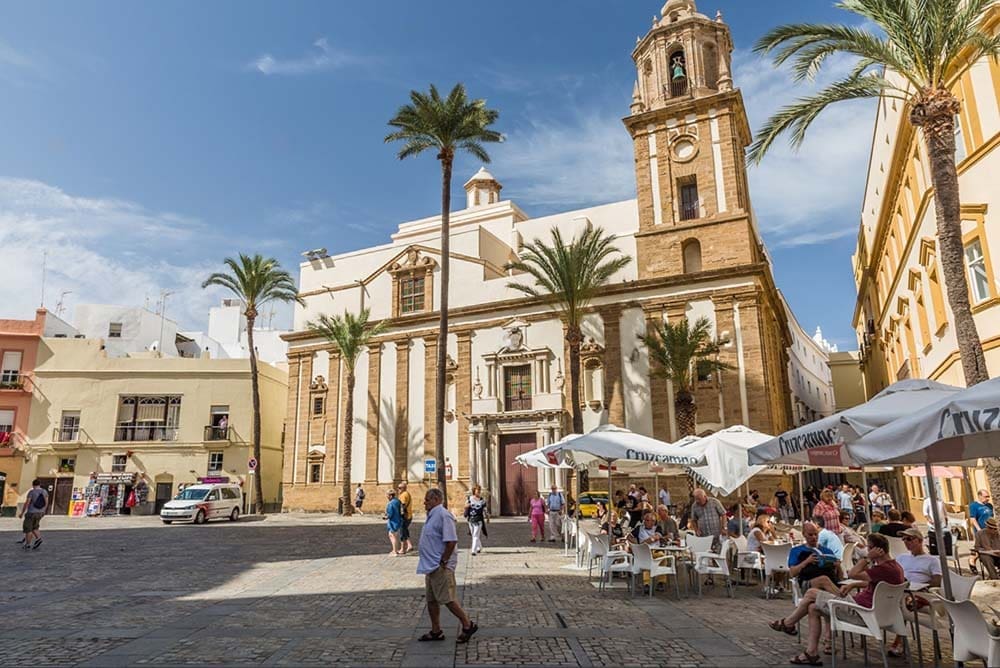
The Cathedral, which has a beautiful yellow dome on top, is a great place to start exploring the city. The building has a style that is hard to describe, something between baroque and neoclassical. This is because it was built over 122 years, from 1716 to 1838. Because the construction took so long, Vicente Acero’s original project, which was truly baroque, was changed and mixed with neoclassical features, such as the dome, the main facade, and the side towers.
The size of the basilica is impressive, but the decorations aren’t as nice as those of many other churches in the area. On the other hand, there is a beautiful pedestrian square at the base of the basilica where the stones are laid out to look like the plan of the Cathedral.
As you walk away from the church, the Museo Catedralicio is on the east side of the square. Here, you can see an old medieval road plan, some valuable pieces of the basilica’s equipment, and different kinds of art. Other interesting excavations include the Roman Theater, which was found by archaeologists along Campo del Sur, the part of the ring road that runs along the south side of the center.
Between Campo del Sur and the Cathedral is the Casa del Obispo, a large museum with an archaeological area of over 1,500 square meters. The tour schedule gives a broad and complete look at the history of the area from the eighth to the eighteenth centuries, with interesting looks at some very old ruins.
Museums and Beaches
When you leave the area around the Cathedral and head north, you’ll reach Plaza de Topete, a busy square with colorful flower stands. This is where the square got its old name, Plaza de las Flores, which is still used by some locals today. The Mercado Central is the oldest covered market in all of Spain. It opened in 1837, right next to the Plaza de Topete. The Museo de Cádiz is even further north, in the Plaza de Mina.
The exhibition is wide and heterogeneous, boasting a rich archaeological section, which includes a couple of beautiful marble Phoenician sarcophagi and numerous Roman statues, followed by a collection of fine arts in which there are about twenty canvases of a sacred nature painted by Francisco de Zurbarán.
The Museo de las Cortes de Cádiz is less known than the last one, but you can visit it for free and see a lot of things about the Cadiz parliament of 1812. The large and detailed mahogany and ivory model of the city in the 18th century stands out. It was made by Alfonso Ximénez between 1777 and 1779 and is the only one of its kind.
The last museum to see is the Museo de Vinos y Toros, which is an exhibition about two of Andalusia’s best things. Along with a thousand mostly old bottles of wine from all over the province, the display has a lot of photos and posters about bullfighting, which, despite the heated debates of the past few years, is still many “gaditanos”‘ favorite thing to do.
Enjoying the Beaches and Weather
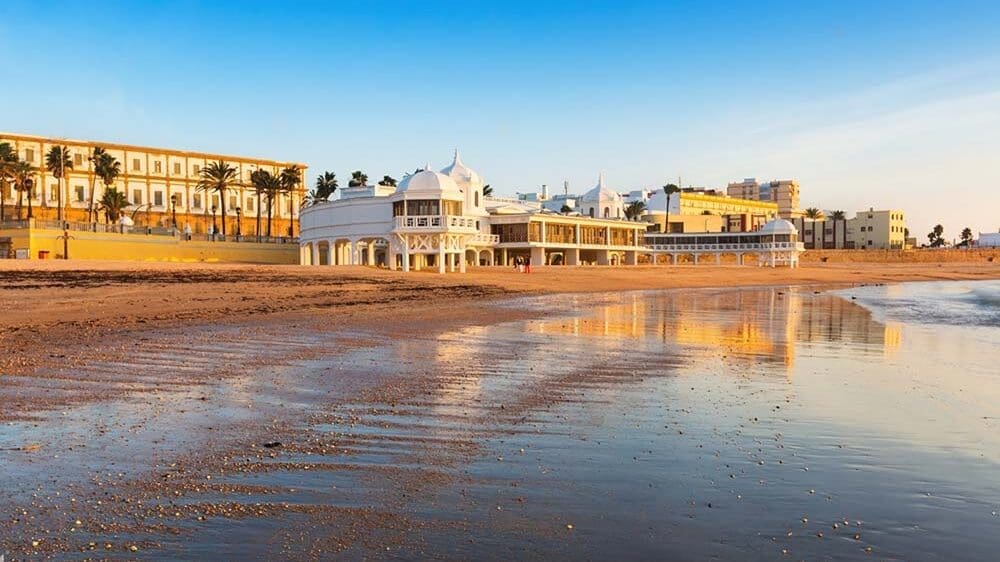
To end the trip to Cadiz in a good way, all that is left to do is look at its most important beaches. The main one is Playa de la Caleta, a narrow strip of sand south of the Castillo de Santa Catalina on the western edge of the Barrio de la Via in the historic center. The beach, which is easy to find because it has an ugly bathhouse in a fake Moorish style, is often crowded, but it is a good place to cool off on a hot summer afternoon. Playa de la Victoria, which runs along the coast of the modern part of the city, has the same number of people but is much bigger.
Experience the Carnival and Climate
From a historical point of view, the Carnival is without a doubt the most heartfelt, fun, and interesting event of the year. It is celebrated like no other Spanish city. The city comes alive for ten days every year between two weekends in February, when groups of masked people called “murgas” parade through the city on foot or on allegorical floats and perform funny skits. The Gran Teatro Falla decides which murgas are the best, but anyone can join in the celebrations as “ilegales,” which is a term for any group that decides to take to the streets and perform their repertoire.
Pleasant Weather and Access to Cadiz
Due to the view of the sea, the weather is mild and less hot than in other parts of Andalusia. The average annual temperature is about 17 degrees. The best thing is that there are 3,200 hours of sunshine a year, which is at least 300 days of good weather.
The hottest month is August, when the average temperature ranges from 28 to 22 degrees. The coolest month is January, when the average temperature ranges from 16 to 10 degrees. In the summer, cool sea breezes and low humidity make it feel less hot than it actually is, but if you’re really hot, you can always go for a swim to cool off.
How to Get to Cadiz
By Plane, Car, or Train
By plane, there are several European companies that run shuttles between Jerez de la Frontera, 38 km to the northeast, and important European cities like Düsseldorf, Frankfurt, Berlin, and Munich in Germany, London, Paris, and Geneva in Switzerland. Also, the San Pablo Airport in Seville is 130 km from Cadiz.
This airport also has many low-cost flights. By car, this province is connected to the rest of Andalusia by four main roads: the Seville-Cádiz highway and the national IV Madrid-Cádiz (E-5), the 340 Cádiz-Malaga, and the A-382, which goes into the heart of the region and goes all the way through the Serrania de Ronda. Lastly, there are direct train lines from Madrid, Barcelona, Seville, and Algeciras, and ferries leave for the Canary Islands from the port of Cadiz and other places.

