
Cape Verde: Discover the Archipelago’s Best Beaches Today
There are many reasons to visit Cape Verde: they can be sporting ambitions, given that the archipelago is a paradise for surfing, skim-boarding, and, above all, windsurfing and kite surfing, or because one wishes to make magnificent dives, or because the Cape Verde islands are a cultural “melting pot,” combining Caribbean aspects with African tribal traditions, creating an explosive mix, especially in the capital, Praia. Then there are those who simply want to spend their days at the beach, relaxing on soft, fine sands surrounded by a clear sea, and having the opportunity to spend a completely relaxing holiday in front of some of the world’s most beautiful beaches.
Various types of sand
If we are looking for the best beaches in Cape Verde for your needs, we must follow some general guidelines. The islands closest to the African coast, namely Ilha do Sal, Boa Vista, and Ilha do Maio, have the widest and most extensive beaches, with a higher chance of finding fine and light-colored sands. There are also beautiful beaches on the archipelago’s other seven islands, but in general, high and rocky coasts are more common, and the beaches have darker sands on average due to the abundance of volcanic rocks. There are, however, exceptions to this “rule.”
The Cape Verde wind
Another general rule to remember is that the Cape Verde Islands are characterized by constant trade winds, which were dubbed “Trade Winds” because they favored trade with the Indies during the period of sailing. The winds are constant because the Hadley Cell, which draws air masses from the tropics to the south, generates them. The generated winds are affected by the Earth’s rotation and tend to bend westward, resulting in an average wind direction of north-east to south-west. These winds, which blow continuously throughout the year, thus affect primarily the north-eastern coasts of the islands, and those who enjoy surfing will appreciate the beaches of these sectors, whereas the sea is calmer on average in the south-western sector, which remains more protected from the action of the wind. So here are the best beaches in Cape Verde—the ones not to be missed and easily included in a list of the world’s best beaches.
The Sal Island
The Island of Sal (Ilha do Sal) is the easternmost of the Ilhas do Barlavento and has some spectacular beaches. You must travel to the island’s southernmost tip to find them. Despite its original name, Ilha Plana, the island is mostly characterized by rocks and reefs due to its low morphology. On the other hand, magnificent beaches can be found in the town of Santa Maria. To the east, beyond the salt marshes, the large Shark Bay opens up, which is more exposed to the trade winds and thus preferred by kitesurfing and windsurfing enthusiasts. It stretches for about 4 kilometers. The main beach, Praia Santa Maria (here photo), opens up south-west of Santa Maria, and in practice, with the exception of the Molo di Santa Maria, extends from the city village to the rocks of Praia Ponta Petra. There are approximately 5 kilometers of golden beaches surrounded by turquoise waters. There are bathing establishments, but most importantly, there are long wild stretches flanked by dunes, and despite the large number of tourists, everyone manages to find their own corner of solitude if they so desire.
Island of Boa Vista
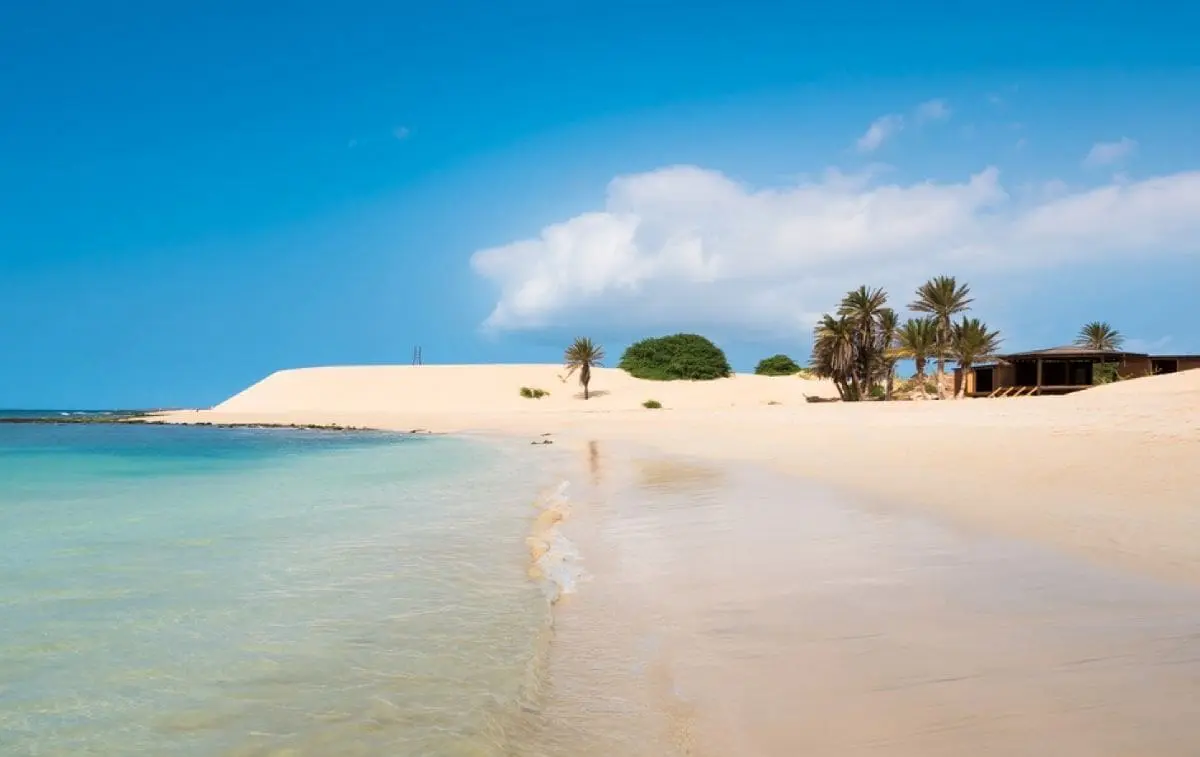
Moving south, we find more beautiful beaches on the island of Boa Vista, about forty kilometers away as the crow flies. If we want to see a desert dive into the ocean, we can go to Praia de Chave, which is just outside of Rabil, where the island’s airport is located. Dunes and turquoise waters collide for about five kilometers, and the sands extend more than a kilometer inland, giving the impression of being in a small Sahara. Other magnificent and white beaches can be found in the southern part of Boa Vista, while the very long Praia Santa Monica can be found in the southeast. This beach connects to the northernmost beach, Praia de Verandinha, but is “divided” from it by a large barcana-shaped cordon of dunes. It extends eastward for more than 9 km from here; plan on spending about half a day to complete the loop! Curral Velho, a third large beach in Boa Vista, is located along the southern coast and connects to Praia Lacacao to the west. The beaches to the north are windswept, but for those who want to take some nice photos, even with a ship wreck, we recommend a visit to Santa Maria Beach, which gets its name from the ship that sank in 1968.
The island of Mayo
Ilha de Maio is another ideal island for those seeking a less touristic beach vacation in Cape Verde: its south-western coast features three beaches of exceptional beauty. Two are located west of the center of Vila do Maio: the Praia Vila do Maio, a wide beach of light sand with a large salt pan on the back, which connects to the Praia di Morro further north. Instead, to the east of Vila do Maio, a much longer beach, the Praia da Ponta Preta, opens up, over 5 km long, even if not particularly deep, but bordered by crystal clear waters and where you can breathe absolute calm, only broken by the roar of the ocean waves.
The Island of Santiago

The largest and most populated island, Santiago, which is home to the capital Praia, does not have many beach attractions. Praia Tarafal, on the north-west coast, is the only bay with a certain charm, with golden sands in contrast to the island’s predominantly dark rocks. Sao Francisco, another east coast beach, is also worth a visit and is distinguished by golden sands.
The island of Fogo
Instead, Fogo is known for its active volcano (Pico de Fogo), but in addition to this remarkable natural attraction, you can swim at the island’s only beach, which is located in the village of Sao Felipe. Large beach, bounded by a small cliff, and with black sands that add to its allure.
Island of Sao Vicente

Moving westward, and ignoring Sao Nicolau, which has no beach attractions, the island of Sao Vicente deserves some attention (panorama photo), which can include a fair number of beaches. The only beach worth mentioning on the south coast is Sao Pedro (see photo), which is located near the airport. The beaches to the north, north, and east of Mindelo are stunning (see photo): they are the beach of Salamansa Bay, with the adjacent cove of Evora, and Praia Norte. However, keep in mind that both are affected by north-east winds, so the sea can be rough. Santa Luzia Island has a wild and beautiful beach on its south coast as well.
Santo Antao Island
The large island of Santo Antao has yet to be explored, and despite its imposing reliefs and long stretches of rocky coast, it has some interesting beaches. The beautiful beach of Ribeira Grande opens to the north of the island, but for strong landscape emotions, move to the dark sand beaches of the west: the bay of Tarrafal de Monte Trigo, but above all, the beaches that open along the so-called Caminho entre Ribeira da Cruz e Ponta do Sol, a spectacular mule track that grants breathtaking views of the ocean bordered by precipitous volcanic cliffs, such as the Praia de Baia Cruzinha.

