
Doppelbock: The Powerful Bavarian Lager Born in a Monastery and Built on Malt
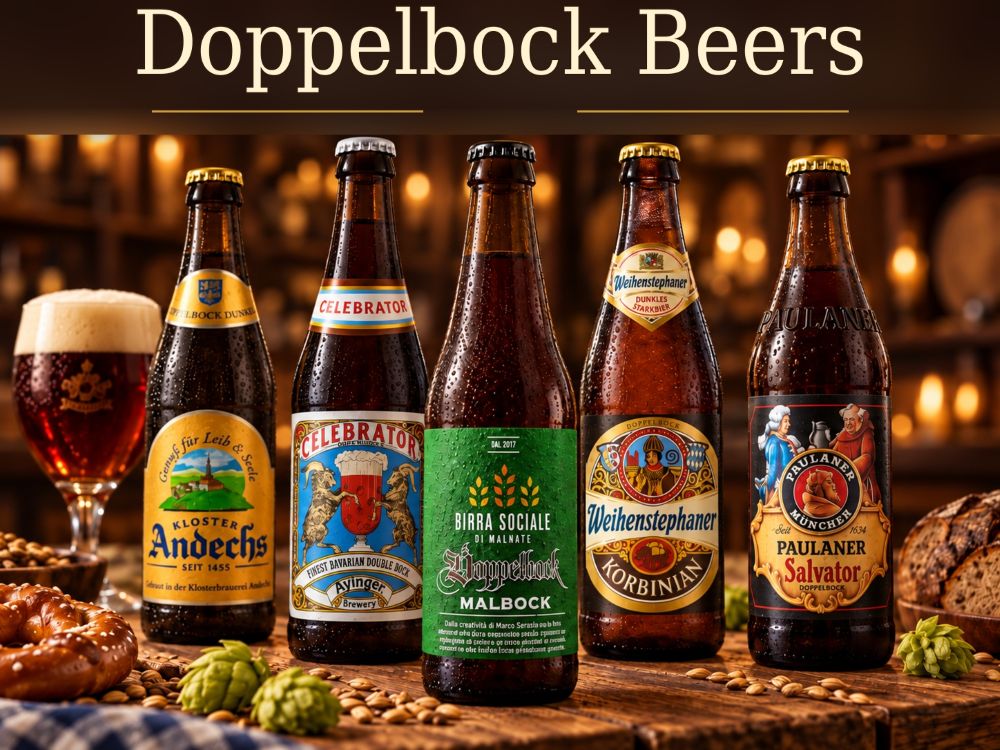
A good Doppelbock has a remarkable ability to disguise its strength. The glass is filled with dark copper or mahogany beer, crowned by a thick ivory head, and the first aromas suggest freshly baked rye bread, toasted nuts, cocoa and dried plums. The palate is rich, almost luxurious, yet the finish is cleaner than expected. Only after a few generous sips does the alcohol reveal itself.
This is one of Bavaria’s greatest contributions to brewing: a strong, bottom-fermented beer built around malt rather than hops, traditionally associated with the monks of Munich and the seasonal celebrations of Lent. Its most famous ancestor is Paulaner Salvator, the beer that gave rise to an entire family of powerful lagers whose names often end in -ator.
Despite its considerable strength, Doppelbock is not meant to be syrupy, aggressively sweet or dominated by roasted malt. The best examples achieve their complexity through the interaction of Munich malt, carefully controlled fermentation and prolonged cold maturation. The result can be remarkably elegant, with enough depth to accompany braised beef, roast pork, aged cheese and even dark chocolate.
Understanding Doppelbock means looking beyond the familiar story of monks surviving Lent on liquid bread. Its history is more complicated, its brewing techniques more demanding and its range of flavours broader than the dark bottles on supermarket shelves might suggest.
The Basics
- Origin: Munich, Bavaria, Germany
- Beer family: Bock
- Fermentation: Bottom-fermented lager
- Alcohol: Typically 7–10% ABV, although traditional examples can fall below this range
- Original gravity: 1.072–1.112 under BJCP guidelines
- Final gravity: 1.016–1.024
- Bitterness: 16–26 IBU
- Colour: 6–25 SRM, from deep gold to dark brown
- Principal malts: Munich, Vienna and Pilsner
- Hops: Usually traditional German varieties, used mainly for balance
- Yeast: Clean-fermenting lager strains
- Traditional techniques: Decoction mashing and extended cold conditioning
- Aroma: Bread crust, toasted grain, caramel, nuts, cocoa and dark fruit
- Body: Medium-full to full
- Carbonation: Moderate to moderately low
- Main variations: Pale Doppelbock and Dark Doppelbock
- Historic reference: Paulaner Salvator
- Other classic examples: Ayinger Celebrator, Weihenstephaner Korbinian, Andechser Doppelbock Dunkel and Spaten Optimator
- Ideal serving temperature: 8–12°C
What Is Doppelbock?
Doppelbock is a strong German lager distinguished by its substantial malt concentration, restrained hop character and exceptionally smooth texture.
Its name literally means double bock, but this does not mean the beer contains twice the alcohol or twice the malt of an ordinary Bock. The term expresses the idea of a stronger, richer version of the traditional German beer.
The modern style includes both pale and dark interpretations. Dark versions are more common and usually display bread crust, toasted malt, nuts, caramel and sometimes dried-fruit notes. Pale Doppelbocks emphasise fresh bread, honey-like malt richness and a somewhat drier finish, with slightly more noticeable hop bitterness.
That classification provides a useful technical framework rather than an absolute boundary for every historic German example. Ayinger Celebrator, one of the world’s most respected Doppelbocks, contains only 6.7% alcohol yet has an original gravity of 18.5° Plato and is unmistakably part of the tradition.
The defining characteristic is therefore not alcohol alone, but the combination of concentrated malt flavour, balanced sweetness, clean fermentation and smoothness.
The Origins: From Einbeck to Munich
The history of Doppelbock begins with the broader Bock tradition, whose origins lie in the northern German town of Einbeck.
During the late Middle Ages, Einbeck became famous for producing strong beers that travelled through the commercial networks of the Hanseatic League.
These beers eventually attracted attention in Bavaria, where brewers adapted the northern tradition to local ingredients and techniques.
The word Bock is commonly linked to a Bavarian pronunciation of Einbeck, although the German word also means male goat, explaining the frequent appearance of goats on beer labels.
Doppelbock itself followed a different historical path.
Its direct origins are associated with the monks of the Order of Minims, founded by Saint Francis of Paola, who established a community in Munich’s Au district.
Their strong beer eventually became known as Salvator, providing the foundation for the modern Doppelbock tradition.
The Paulaner Monks and the Birth of Salvator
The Paulaner brewing tradition dates back to 1634, the year of its earliest documented reference.
The monks of Neudeck ob der Au produced a particularly substantial beer associated with their religious calendar and community life.
During Lent, religious fasting placed restrictions on food consumption, and strong, nourishing beer acquired a special significance.
The famous description of Doppelbock as liquid bread comes from this tradition.
However, the romantic story of monks surviving for weeks exclusively on modern-strength beer needs qualification.
Historical strong beers were often considerably less attenuated than contemporary examples. They retained more unfermented carbohydrates and could contain less alcohol despite having a high original gravity.
A nineteenth-century Salvator, for example, could begin with a substantial concentration of malt extract yet finish at a strength below that of many modern Doppelbocks.
The older beer was therefore potentially more filling and less alcoholic than the powerful lagers sold today.
This distinction changes the familiar story considerably. The monks were not necessarily drinking the equivalent of an 8% modern lager throughout Lent.
Their beer belonged to an earlier brewing world, where fermentation efficiency, residual extract and alcoholic strength followed different relationships.
Brother Barnabas and the Development of Salvator
An important figure in Paulaner history is Valentin Stephan Still, better known as Brother Barnabas.
He joined the Munich monastery in 1773 and became associated with improvements to the strong beer that eventually developed into modern Salvator.
His work helped establish the beer’s reputation for richness and consistency.
In 1751, before his arrival, the monks had already received official permission to serve their strong beer during celebrations honouring the founder of their order.
The beer’s popularity gradually extended beyond the monastery.
By the nineteenth century, Salvator had become an important commercial product, attracting imitation from other Bavarian brewers.
That success led to one of the most distinctive naming traditions in German beer.
Why So Many Doppelbocks End in -ator
Take a look at the labels of famous Doppelbocks: Salvator, Celebrator, Optimator, Maximator, Korbinian and Troegenator.
The repeated -ator ending is not a coincidence, although it is not universal.
During the nineteenth century, several breweries used names connected with Salvator to identify their strong beers.
The commercial dispute eventually led to Paulaner securing exclusive rights to the Salvator name, forcing competitors to adopt alternatives.
Many chose names ending in -ator, retaining an obvious association with the original beer while creating distinct brands.
The practice became a recognisable convention, and modern breweries have continued it.
The ending does not indicate a special ingredient, a legal classification or a particular brewing method.
It is a historical reference that has become part of Doppelbock’s identity.
Pale vs Dark Doppelbock
Doppelbock is often imagined as a dark brown beer, but the style has two recognised variations.
Dark Doppelbock
Dark Doppelbock is the classic interpretation.
Its colour ranges from copper and mahogany to deep brown, sometimes with ruby reflections.
The aromatic profile can include toasted bread, dark crust, caramel, nuts, cocoa and dried fruit.
A restrained impression of chocolate is acceptable, but aggressive roasted, burnt or coffee-like bitterness should not dominate.
The palate is rich and malt-driven, with a smooth texture and enough attenuation to prevent excessive sweetness.
Paulaner Salvator, Ayinger Celebrator and Weihenstephaner Korbinian illustrate different interpretations of this style.
Pale Doppelbock
Pale Doppelbock is less common but equally legitimate.
It ranges from deep gold to light amber, with a white head and greater emphasis on fresh bread, honey-like malt and toasted grain.
The absence of darker malt character generally makes the finish feel slightly drier.
Herbal or floral hop notes may also be more noticeable.
Pale examples demonstrate that Doppelbock is not defined by colour or roasted flavours. Malt concentration, strength, fermentation and balance remain the essential features.
What Does Doppelbock Taste Like?
A classic dark Doppelbock opens with an intensely malt-driven bouquet.
Typical aromas include fresh bread crust, toasted hazelnuts, biscuit, caramel, cocoa and dried plums. Some examples suggest figs, raisins or fruit leather, particularly where deeper malt reactions contribute complex flavours.
The palate is generous, with substantial body and a smooth, sometimes velvety texture.
Malt sweetness is noticeable, but a properly brewed example should not finish like a dessert syrup.
Moderate hop bitterness, sufficient attenuation and the warming effect of alcohol provide balance.
The finish is generally long, with toasted malt, light caramel, subtle bitterness and gentle alcoholic warmth.
Pale Doppelbock shifts the emphasis toward fresh bread, honey-like impressions and a cleaner, slightly drier finish.
In both variations, harsh alcohol, solvent-like aromas and aggressive sweetness are signs of poor balance rather than desirable strength.
How Doppelbock Is Brewed
Doppelbock demands careful control because the brewer must produce a concentrated, high-strength beer without losing the clean character of a lager.
Munich Malt: The Foundation
Munich malt is central to many traditional recipes, particularly darker versions.
Compared with ordinary Pilsner malt, it undergoes more intensive kilning, promoting the formation of compounds associated with bread crust, toast and rich malt aromas.
These flavours develop through Maillard reactions involving sugars and amino compounds.
Munich malt provides substantial depth without necessarily introducing roasted bitterness.
Vienna malt can contribute additional biscuit and toasted-grain notes, while Pilsner malt may be included to improve fermentability and balance.
Small quantities of darker specialty malt can adjust colour or provide subtle complexity, but large amounts of roasted malt would move the beer away from its traditional character.
Decoction Mashing
One of Doppelbock’s most closely associated traditional techniques is decoction mashing.
The process involves removing a portion of the mash, heating it to boiling and returning it to the main vessel to raise the overall temperature.
Historically, decoction helped brewers manage mash temperatures before modern equipment made precise heating straightforward.
It can also contribute additional malt complexity through heat-driven reactions, producing deeper toasted and bread-like impressions.
Some traditional breweries still use single, double or more elaborate decoction schedules.
However, decoction is not a compulsory requirement for producing excellent Doppelbock.
Modern brewers can achieve convincing results through carefully selected malts and well-controlled infusion mashing.
The technique is valuable, but it should not be treated as a magical explanation for every toasted note in the finished beer.
Hops and Bitterness
Hops play a supporting role in Doppelbock.
Traditional German varieties provide enough bitterness to counterbalance the substantial malt concentration.
Hop flavour is usually low, while aroma may be almost absent in darker examples.
Paulaner Salvator, for instance, uses Herkules and Hallertauer Tradition, combining efficient bittering with a restrained traditional hop profile.
Excessive hopping would distract from the malt-driven character of the style.
The objective is not a beer without bitterness, but one in which bitterness supports the richness rather than becoming the principal flavour.
Fermentation and Lagering
Doppelbock is traditionally brewed with bottom-fermenting lager yeast.
The high concentration of fermentable sugars creates demanding fermentation conditions, making yeast health, oxygen availability before fermentation and temperature control particularly important.
Brewers commonly work with cool fermentation temperatures and sufficient quantities of healthy yeast to ensure complete, clean attenuation.
Poor management can produce excessive residual sweetness, diacetyl or harsh higher alcohols.
After fermentation, cold conditioning or lagering allows the beer to clarify and develop a smoother, more integrated character.
Extended maturation is particularly valuable in strong lagers because it helps bring malt, alcohol and bitterness into balance.
The result should be powerful without appearing rough.
What Makes Doppelbock Different from Ordinary Bock?
Traditional Dunkles Bock and Doppelbock share the same broad brewing heritage.
Both emphasise malt, clean lager fermentation and restrained hops.
The principal difference is concentration.
Doppelbock typically starts with substantially higher original gravity, producing greater alcoholic strength, body and flavour intensity.
A Dunkles Bock commonly falls around 6.3–7.2% ABV under BJCP guidelines, while Doppelbock generally occupies the 7–10% range.
However, the categories overlap in actual commercial products.
Doppelbock should therefore be understood as a richer and more concentrated expression of the Bock family, rather than a beer that must contain exactly twice the alcohol.
Doppelbock vs Eisbock
The difference between Doppelbock and Eisbock concerns production as much as strength.
Eisbock is traditionally made by partially freezing a strong beer and removing some of the ice, concentrating the remaining alcohol and dissolved flavour compounds.
This process can create beers with considerably higher strength and intensity.
Doppelbock, by contrast, achieves its strength through fermentation of a high-gravity wort without requiring freeze concentration.
Eisbock is generally more powerful, richer and lower in carbonation, often with pronounced dried-fruit and warming alcoholic character.
The two styles are related, but an Eisbock is not simply a Doppelbock that happens to contain more alcohol.
Doppelbock vs Weizenbock
Weizenbock is another strong German beer, but its fermentation character is fundamentally different.
Traditional Weizenbock contains a high proportion of wheat malt and uses top-fermenting wheat-beer yeast.
This yeast produces characteristic fruity esters and spicy phenols, frequently associated with banana and clove.
Doppelbock generally uses barley malt and clean lager yeast, placing the emphasis on toasted grain, bread, nuts and malt richness.
Some Weizenbocks reach Doppelbock strength, but their aromatic structure remains different.
Aventinus, the famous wheat Bock introduced by Schneider Weisse in 1907, is an important example of this separate tradition.
The Best Doppelbock Beers to Try
Paulaner Salvator — 7.9% ABV
The historic reference for the entire category.
Paulaner Salvator is brewed with Pilsner and Munich malts and has an original gravity of 18.3° Plato.
Its chestnut-brown colour and caramel-toned head introduce aromas of chocolate, toasted malt and bread crust.
The palate is substantial, with a rounded malt profile and restrained hop character.
For anyone approaching Doppelbock for the first time, Salvator provides the historical and sensory foundation.
Ayinger Celebrator — 6.7% ABV
One of the finest examples of how Doppelbock can achieve remarkable complexity without excessive alcohol.
Celebrator has an original gravity of 18.5° Plato and a deep mahogany colour with ruby highlights.
Its profile features toasted nuts, caramel and a distinctive woody, cedar-like nuance.
The texture is full and velvety, while the finish remains controlled and elegant.
The combination of substantial original extract and relatively moderate alcoholic strength makes Celebrator particularly interesting.
Weihenstephaner Korbinian — 7.4% ABV
Named in honour of Saint Korbinian, associated with the foundation of the Weihenstephan monastery, this beer is a classic dark Doppelbock.
It has an original gravity of 18.3° Plato and bitterness of 16 IBU.
The aroma and palate combine plums, figs, toffee, nuts and chocolate, supported by a full malt body.
Korbinian is especially effective with smoked meat and rich savoury dishes.
Andechser Doppelbock Dunkel — 7.1% ABV
Produced by the monastery brewery at Andechs, this is one of Bavaria’s most respected strong dark lagers.
Its original gravity is approximately 18.8° Plato, with bitterness of 21 IBU.
The beer pours dark copper with red highlights and a dense, creamy head.
Caramel, dried fruit, cocoa and gentle roasted notes shape the profile, while moderate bitterness prevents the finish from becoming excessively sweet.
It is particularly satisfying when served cool rather than ice-cold.
Spaten Optimator — 7.6% ABV
Spaten Optimator is another important Munich Doppelbock and a classic example of the traditional -ator naming convention.
Its dark malt character combines bread crust, caramel and gentle roasted impressions.
It provides a useful comparison with Salvator, especially for drinkers interested in the differences between established Munich breweries.
Tröegs Troegenator — 8.2% ABV
An American interpretation that remains closely connected with the Bavarian model.
Brewed in Pennsylvania, Troegenator combines Munich, Pilsner and chocolate malts with German Northern Brewer and Magnum hops.
Its flavour profile emphasises caramel, stone fruit and freshly toasted grain.
The beer demonstrates how the Doppelbock tradition has been adapted successfully by American craft breweries without abandoning its malt-driven identity.
How to Serve Doppelbock
Doppelbock benefits from a slightly warmer serving temperature than ordinary pale lager.
A range of approximately 8–12°C is useful for most examples, allowing the toasted malt and dried-fruit notes to emerge.
Some breweries recommend slightly cooler temperatures: Andechser Doppelbock Dunkel is traditionally served around 7–9°C, while Weihenstephaner recommends 8–10°C for Korbinian.
A tulip glass, stemmed beer glass or traditional Bock glass helps concentrate the aromas while preserving the head.
Avoid freezing the glass or serving the beer at extremely low temperatures.
Excessive chilling can suppress the very malt complexity that makes Doppelbock interesting.
A 330 ml bottle is often sufficient for a thoughtful tasting, particularly when the beer approaches 8% alcohol.
Food Pairings: What to Eat with Doppelbock
Doppelbock is especially suited to slow-cooked meat, browned vegetables, smoked dishes and mature cheeses.
Its toasted malt character echoes the Maillard reactions that occur when meat is roasted or seared, while carbonation and restrained bitterness help moderate richness.
Bavarian Schweinshaxe, roast pork knuckle with crisp crackling, is an excellent partner for a dark Doppelbock. The malt complements the browned skin, while the beer has enough body to stand beside the meat.
Another classic match is Sauerbraten with potato dumplings and braised red cabbage. The sweet-and-sour character of the braised beef creates an effective contrast with the beer’s malt richness.
For a particularly satisfying combination, try beef cheeks slowly braised with onions and dark beer, accompanied by buttery mashed potatoes.
Cheese pairings are equally rewarding. Allgäuer Bergkäse, aged Comté and mature Gouda provide nutty, savoury flavours that complement toasted malt and caramel without being overwhelmed by the alcohol.
For dessert, choose dark chocolate cake with toasted hazelnuts, preferably not excessively sweet. The beer’s cocoa-like notes and gentle bitterness can reinforce the chocolate while keeping the pairing balanced.
Is Doppelbock a Dessert Beer?
Some Doppelbocks can work beautifully with desserts, particularly those based on chocolate, nuts and caramel.
Ayinger itself describes Celebrator as a dessert beer, reflecting its richness and velvety character.
However, Doppelbock should not automatically be treated as a sweet after-dinner drink.
Many examples have enough dryness and malt complexity to perform better alongside savoury food.
Dark chocolate, hazelnuts and moderately sweet pastries can be excellent partners, but intensely sugary desserts may make the beer appear bitter or alcoholic.
The most successful combinations depend on matching flavour intensity while avoiding excessive sweetness.
Can Doppelbock Be Aged?
Doppelbock has greater ageing potential than many ordinary lagers because of its strength and malt concentration.
Some bottles can develop additional dried-fruit, nutty or sherry-like notes after a period of careful storage.
However, extended ageing is not always beneficial.
Fresh Doppelbock offers vivid bread crust, malt and toasted-grain aromas that gradually diminish over time.
Poor storage can produce stale, cardboard-like or unpleasant oxidative flavours.
The best approach is to follow the producer’s recommendations and store bottles in cool, dark, stable conditions.
For a particularly strong or bottle-conditioned version, tasting bottles at different ages can be interesting.
Ordinary commercial Doppelbock, however, should not automatically be kept for years in the expectation that it will improve.
How to Recognise a Great Doppelbock
The most important quality is balance between malt concentration, attenuation and alcoholic strength.
The aroma should offer substantial bread, toast, nuts or dark-fruit complexity without unpleasant burnt notes.
The palate should be rich and smooth, with enough residual malt character to provide fullness.
However, the finish must not become sticky or excessively sweet.
Alcohol should provide warmth and structure rather than a harsh burning sensation.
Hop bitterness remains secondary but plays an essential role in preventing the malt from becoming overwhelming.
A great Doppelbock can taste remarkably drinkable despite its strength, which is precisely why it deserves respect.
Doppelbock’s Place in German Beer Culture
Doppelbock remains closely associated with Starkbierzeit, the Bavarian strong-beer season traditionally celebrated around Lent.
In Munich, the annual tapping of Paulaner Salvator at the Nockherberg has become an important cultural event, accompanied by political satire and public festivities.
The tradition reflects the transformation of a monastic beer into a symbol of Bavarian brewing identity.
Today, Doppelbock is produced far beyond Munich, but its central character remains remarkably consistent: substantial malt, restrained hops, clean lager fermentation and patient maturation.
At its best, the style demonstrates how a beer can be powerful without being aggressive.
The monks of Au may not recognise every aspect of a modern 8% Doppelbock, but they would recognise the importance of the malt. Centuries later, that remains the ingredient around which everything else revolves.

